




Abstract
Ensuring that organizational innovation generates value increasingly requires effective marketing management. Prior studies, however, report conflicting effects of chief marketing officer (CMO) leadership on how well the firm exploits innovation. These inconsistencies may be associated with firm-level innovation effort, customer focus, and industry type. We analyze archival data from 587 interviews with global CEOs to explain the effect of CMO leadership on outcomes of organizational innovation. CMO leadership of the firm’s primary innovation mode is positively associated with product–market innovation effort but not marginal revenue from innovation. CMO leadership also moderates the relationship between customer focus and innovation revenue. Predictive validity testing shows that these effects are especially important for service firms. The benefits of CMO-led innovation have specific limitations that firms must consider for organization-wide innovation efforts.
Introduction
In global, highly competitive markets, the products that drive near-term revenue will not sustain long-term advantage. Continuous innovation is a core antecedent for ensuring the firm meets needs of current and future customers (Ren, Eisingerich, & Tsai, 2015). Coordinating firmwide efforts to address what customers want now and what potential customers will want in the future is the responsibility of the chief marketing officer (CMO). The CMO is charged with maximizing value from extant customer relationships (Kumar & Shah, 2009; Merlo, Eisingerich, & Auh, 2014) while pursuing revenue from new customers (Boyd, Chandy, & Cunha, 2010; Jones, Suoranta, & Rowley, 2013). Yet studies of CMO impact on revenue generation have generated ambivalent results (Mintz & Currim, 2013) and should be tested in cross-industry, international contexts (Engelen, Lackhoff, & Schmidt, 2013).
As a key member of the executive team, the CMO fulfills multiple roles. Fortune magazine states that CMOs should be “growth- and market-driven brand experts with an external lens” who “react quickly to changing market and customer expectations” (Lee, 2012). A capable CMO seeks novel solutions to market problems, conveys and filters information from firm boundaries to management, and integrates cross-functional projects. As the nexus of market knowledge and innovation output, the CMO is uniquely positioned to drive long-term value creation (Abernathy, Kubick, & Masli, 2013). The effect of CMOs on capturing value from innovation, however, remains unclear (Nath & Mahajan, 2008). Customer focus drives profitability, but the impact of innovation on this relationship has not been studied. CMOs improve firm performance when customer power is low as well as when the CMO has significant managerial discretion (Boyd et al., 2010; Nath & Mahajan, 2011). The importance of the CMO role has not been carefully tested in the context of innovation leadership.
This study explores the link between innovation leadership and performance at medium and large global firms. Our analysis of archival interviews with 587 global CEOs reveals unexpected relationships between CMO leadership, customer focus, and product–market innovation (PMI) efforts. CMO leadership of innovation is positively associated with PMI but not returns from innovation. In contrast with prior research on how executive managers balance short- and long-term goals (Rollins, Bellenger, & Johnston, 2012), we also find that customer focus is not consistently associated with innovation returns. The combination of CMO leadership and customer focus, however, is associated with slightly increased innovation revenues.
Executive management has important implications how firms organize and execute product and market development (Cormican & O’Sullivan, 2004). Customer focus and innovation may not be served well by CMO leadership, especially in the absence of a customer-focused culture. The contingent effects of CMO leadership and customer focus highlight the tension between present and the future responsibilities inherent to the CMO role. Reaping the rewards of organization-wide innovation requires a combination of ground-level customer familiarity and top-down leadership.
In the next section, we develop a conceptual framework and hypotheses linking CMO leadership and firm-level customer focus to outcomes of PMI. We then describe the archival data set and model specification for testing the hypotheses. We report the results of the analysis and identify the significance and limitations of the study. Finally, we discuss the implications of our findings for theory and practice and suggest directions for future research.
Prior Literature and Theory
Innovation has no intrinsic value to organizations. Firms are eager to improve innovation outcomes, but product and service innovations must address market gaps to meet customer needs and win their loyalty (Kumar & Shah, 2009). New products or services that deliver comparative value over existing options shield firms from competition and unlock new opportunities (Ren, Eisingerich, & Tsai, 2015; Tuli, Kohli, & Bharadwaj, 2007). Innovation drives organizational success only when markets value the resulting products and services (George & Bock, 2008). As innovation cycles accelerate and customers benefit from global information access, marketing becomes an increasingly important determinant of innovation outcomes.
Marketing-led innovation helps firms build trust-based relationships, cope with environmental uncertainty, and avoid commoditization (Lyons, Chatman, & Joyce, 2007). When marketing insight improves coordination and reduces exchange partner uncertainty, firms are more likely to turn innovative efforts into financial successes (Palmatier, Dant, & Grewal, 2007). At the same time, although focus on market requirements may improve innovation project outcomes, it may not lead to firm profitability.
The globally competitive environment requires continuous improvement of products and services, with commensurate and sometimes risky investments in time, resources, and planning. Innovation success itself requires a complex set of capabilities, including knowledge assets, technological competence, and connections to partners and markets (Ritter & Gemüenden, 2004). Marketing plays a vital role in facilitating innovation by supplying market intelligence into executive decision-making processes (Jaworski & Kohli, 1993; Kohli & Jaworski, 1990; Ren et al., 2015). Successful innovation has been attributed to the knowledgeable, authoritative role of marketing managers that allocate and deploy resources to link marketing insights with strategy and planning (Shah, Rust, Parasuraman, Staelin, & Day, 2006). Market orientation, rather than opportunity orientation, is generally linked to preferential firm outcomes such as profitability (Slater & Narver, 2000). Marketing activities that generate vital intelligence on customers, competitors, and trends increase firm value (Mizik & Jacobson, 2009; Srinivasan & Hanssens, 2009). But marketing processes, like innovation, are most valuable when firm efforts rest on a foundation of customer focus (Gupta, Lehmann, & Stuart, 2004; Srivastava, Shervani, & Fahey, 1998). Even apparently excellent marketing information may be ignored or applied improperly to innovation efforts, with potentially disastrous results.
In addition, successful innovation deployment requires integrating new offerings with the firm’s extant product and service portfolio (Eisingerich, Rubera, & Seifert, 2009; Rao, Agarwal, & Dahlhoff, 2004). This process incorporates many functions including intelligence gathering, strategic planning, scientific research, human resource management, and communication deployment in the field. Coordinating these activities across the organization is required to prevent conflicts between channels or business units (McGovern, Quelch, & Crawford, 2004). At medium and large firms, the effort to coordinate and interpret marketing activities and information is commonly embodied in the CMO.
CMOs and PMI
Organizational scholars have only recently begun to address the unique nature of the CMO role (Jaworski, 2011). The CMO is commonly viewed primarily as a function-specific role within a general executive management team (Menz & Scheef, 2014). Strategic planning requires critical, up-to-date knowledge of the marketing domain, including relational assets that link customers with the firm’s products and services (Srivastava et al., 1998; Vorhies & Morgan, 2005). Information from segmentation, needs analyses, network development, and product positioning may facilitate effective resource allocation across product initiatives (Mizik & Jacobson, 2009; Swaminathan & Moorman, 2009; Yadav, Prabhu, & Chandy, 2007).
The CMO may also serve as an information filter, shielding the executive team from fine-tuning minor discrepancies in product–customer interactions (Klaus, Edvardsson, Keiningham, & Gruber, 2014). A dedicated resource focused on customers and markets directs executive attention to matching organizational capabilities and long-term customer perception of value. Because the CMO generally reports to and works closely with the CEO, customer focus is strongly implicated in how the CEO understands marketing intelligence and deploys innovation and market-facing resources (McGovern et al., 2004).
At some firms, CMOs participate in market-oriented innovation efforts. The CMO may lead transformative activities at multiple levels by linking exogenous change to unique, firm-level knowledge and capabilities (Jaworski, 2011). CMOs gather critical market intelligence and then inform top management about new market opportunities, serving as the voice of consumers (Boyd et al., 2010). They may detect new business opportunities and offer CEOs critical intelligence regarding the potential success of various innovation efforts (Yadav et al., 2007). This information informs critical go-to-market decisions and facilitates building relationships with partners and collaborators.
By fulfilling these responsibilities, CMOs engage with firmwide efforts to investigate novel products and services or market opportunities. Case-based research suggests that CMOs are increasingly aware of the need for continually identifying new customer needs and entirely new customer segments (Jones et al., 2013). We refer to this process as PMI. This innovation effort extends the firm’s customer-facing capabilities to either reach new markets with existing offers or improve products and services to current markets. We distinguish this from two other types of firmwide innovation. Operational or process innovation seeks to improve the efficiency of the firm’s value creation activities. In contrast, business model innovation seeks to generate entirely new value propositions. Prior research suggests that the CMO role compares the firm’s product/service mix characteristics against data about customers and markets. The firm’s PMI activities should be linked to CMO leadership of innovation:
CMO Leadership and Innovation Outcomes
Executive leadership is a critical enabler of organizational learning, innovation process, and performance (Montes, Moreno, & Morales, 2005). Although most studies suggest that CMOs positively influence firm stock price and sales growth (Kumar & Shah, 2009), research has questioned the direct value of the CMO, especially with the organizational changes over time (Nath & Mahajan, 2008; Wang, Saboo, & Grewal, 2015). One explanation for conflicting results could be contingency effects associated with the CMO’s role in firmwide innovation efforts.
Successful innovation links internal capabilities and external requirements. Organizational structure and leadership roles are key factors in the discovery, incubation, and implementation of innovations (O’Connor & DeMartino, 2006). When CMOs lead innovation efforts, the firm may benefit from improved market orientation, signaling, and collaboration effects. The guidance and authority of the CMO may emphasize consumer and competitor action, which facilitates recognition and exploitation of new opportunities (Jaworski & Kohli, 1993). When CMOs are in charge of innovation processes, their actions and communications may signal to employees the importance of marketing research and marketing strategy, ensuring a more market-centric approach to innovation (Levy, Beechler, Taylor, & Boyacigiller, 2007). CMO leadership in firmwide innovation may link the firm’s capabilities with previously undeveloped products or market segments.
On the contrary, CMO leadership of innovation might overfocus on short-term customer needs and metrics. The CMO role has traditionally been associated with a focus on customer satisfaction, new product announcements, and advertisement (Nath & Mahajan, 2008; Srinivasan & Hanssens, 2009). Resources directed to initiating and sustaining marketing efforts may limit investments in research and development. A strong emphasis on current customers may inhibit firms from developing breakthrough innovations. Rather than facilitating innovation, excessive focus on current competitors and customers may lock firms into existing relationships and transaction patterns. In addition, many CMOs are directly responsible for implementing near-term marketing programs and remediating emergent customer satisfaction issues. In these cases, excessive focus on immediate problems with customers, suppliers, or competitors may inhibit the development of strategic innovations (Chandy & Tellis, 2000). CMO presence on top management teams generally increases managerial use of marketing metrics but does not lead to improved revenue outcomes (Mintz & Currim, 2013).
The balance of research suggests that CMO leadership improves the firm’s ability to identify and exploit valuable opportunities associated with new market segments or improved products and services. By facilitating critical intelligence gathering and sharing, CMO leadership should be associated with increased revenue from PMI:
Customer Focus and Innovation Outcomes
Successful commercialization of new products is an engine of sales growth (Pauwels, Silva-Risso, Srinivasan, & Hanssens, 2004). Businesses must manage innovation risks, however, because the failure rate of new products is high. The relative focus that managers place on the internal and external environment during innovation affects firm actions and performance (White, Varadarajan, & Dacin, 2003). Customer focus creates value for customers and subsequent value for the firm (Kumar, Venkatesan, & Reinartz, 2008). Firms with high levels of customer focus effectively gather customer and market data, apply that knowledge to product development, allocate marketing resources efficiently, and rapidly adapt to exogenous change.
Some firms, through accident or intent, effectively interact with customers to gain a deep understanding of market needs. At the most basic level, customer focus incorporates the Customer focus begins with the collection and interpretation of data from multiple sources relevant to customer interests (Shah et al., 2006). Applying market information to firm-level planning encourages opportunity scanning and creative thinking (Han, Kim, & Srivastava, 1998). Customer-focused firms obtain and interpret business intelligence, market research, and detailed customer information.
Interacting with customers taps real-time market intelligence for the development of new products and services of superior value. By drawing customers closer to the product development and delivery processes, customer focus can strengthen mutual understanding, deepen customer–firm relationships, and consequently further unlock opportunities for the development and successful commercialization of new product offerings (Merlo et al., 2014). Customer focus may improve a firm’s ability to integrate multiple types of information and coordinate knowledge acquisition and interpretation, leading to a more informed vision for product innovation (Han et al., 1998). New product development may thus be directly linked to the collection and interpretation of information about customers and competitors (Jaworski & Kohli, 1993).
Customer focus improves the firm’s application of resources toward marketing activities. Organizational skills centered on market knowledge can helps firms employ resources more effectively and facilitate customer cooperation (Rust, Lemon, & Zeithaml, 2004; Shah et al., 2006). Leveraging complementary assets, or creatively combining separate resources may defray production costs and minimize risks associated with the development and production of new goods (Swaminathan & Moorman, 2009). Active assessment of markets facilitates partnering efforts and helps avoid competency traps and lock-in (Kohli & Jaworski, 1990). Market data inform marketing processes to translate sophisticated interpretations of customer needs into the development of new products and services.
Finally, when customer sets present heterogeneous cultures and policies, a strong customer-centric capability facilitates adaptive behavior and problem solving (Han et al., 1998). Customer and market intelligence are likely most valuable when firms recognize and quickly adapt to changing consumer trends and other firms’ offerings in the marketplace. Observing and adjusting to external trends helps firms develop anticipate future changes in competitive pressures, technology, and customer wants (Kohli & Jaworski, 1990). Firm-level processes should be aligned with the needs of customers that are certain to change over time (Kumar et al., 2008; Shah et al., 2006).
Customer focus combines information processing with the effective development and deployment of marketing and delivery processes. The firm’s capability to collect and use critical customer- and market-related information and manage customer relationships accordingly may be key indicators of a firm’s innovation outcomes (Day, 2000). Engagement with diverse actors and data informs the development of new products (Jaworski & Kohli, 1993; Kirca, Jayachandran, & Bearden, 2005). Therefore, a strong customer focus should be linked to improved innovation outcomes (Shah et al., 2006):
CMO Leadership and Customer Focus
The relationship between customer focus and innovation outcomes likely depends on managerial factors. Interaction with customers and partners incurs costs and risks. Customer focus can absorb extensive organizational resources, leading to overly narrow innovation efforts and ossification (Fang, Palmatier, Scheer, & Li, 2008). Innovators must retain access to distant market information, encouraging management to generate new ideas, without incurring significant coordination costs and partner lock-in (Bock, Opsahl, George, & Gann, 2012). When more radical innovations are required to retain or regain competitive advantage, customers may not be accurate sources of information on required product specifications. A well-informed CMO serves as a critical link between rapidly changing customer needs and the top management team’s ability to adjust strategy and tactics (Klaus et al., 2014).
Leading organizational innovation is nontrivial. The identification of the innovation leader affects formal hierarchy and informal signaling. The CMO is generally responsible for the maintenance and improvement of the firm’s capacity to understand and interact with customers and suppliers. Assigning innovation leadership to the CMO signals that marketing is a high-priority investment (Srivastava et al., 1998). The formal role of the CMO in leading innovation efforts should therefore affect market-oriented activities across the firm. At the same time, CMO influence on top management depends on cultural factors as well as social capital effects (Engelen et al., 2013).
During PMI, the CMO appears well-placed to facilitate market-driven innovation. As the conduit and filter of critical market information, the CMO may leverage customer focus to ensure that product innovation is well-timed and well-targeted. Yet this structural contingency effect has received little scholarly attention. Prior research has been limited to examining how the CMO role adjusts to change in firm-level customer focus (Lamberti & Noci, 2009) and the link between customer power and the CMO’s effect on performance. Given the unique structural position of the CMO, we propose a positive moderating effect of CMO leadership:
The proposed model of CMO leadership, customer focus, and innovation is shown in Figure 1.
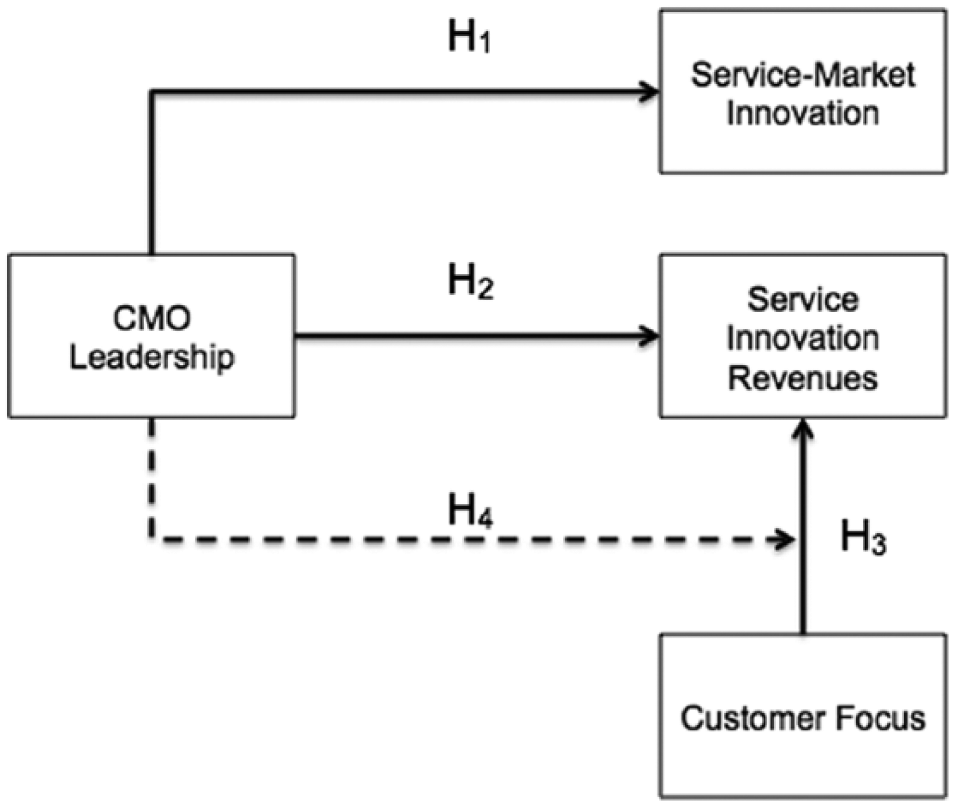
Model of CMO leadership and customer focus.
Method
Data
To test our hypotheses, we utilized data from IBM’s 2006 Global CEO Survey (Giesen, Berman, Bell, & Blitz, 2007). The main data source is semistructured interviews with 762 CEOs of primarily large, multinational firms. The survey instrument and interview guide were developed by trained researchers and incorporated multiple question types, including 5-point Likert-type scales, point assessments, binary responses, and open-ended questions. Items used non-value-laden wording; cards handed to the CEO explained and distinguished between concepts in the interview guide. Each interview utilized two interviewers that had been centrally and consistently trained. One interviewer led the informant through the structured survey while the other recorded responses, comments, and coded open-ended questions. The interview data set was supplemented with descriptive data for the firms, such as revenues, obtained independently by IBM.
Although the data set presents firms across a spectrum of sector, geography, and size, it is not a random population sample. The firms were current or potential IBM customers or firms of specific innovation interest to IBM. The data set contained 102 public sector organizations that were excluded to ensure consistency in reporting firm revenues from PMI. In addition, missing data on 73 firms reduced our final sample to 587 firms. These firms operate in diverse sectors (communications, 16%; financial services, 22%; distribution or other services, 32%; and manufacturers, 30%) and are geographically dispersed (Americas, 24%; Europe, 36%; Asia and Australia, 40%). Approximately, two thirds of firms had more than 5,000 employees and 9% had more than 25,000 employees. The analysis should be interpreted to reflect the effect of CMOs at large, diversified multinational firms.
Estimation
The interviews were divided into two sections. In the first part, the CEOs were asked questions related to the firms’ overall innovation activities. In particular, CEOs identified the relative importance of three innovation types: product/market, business model, and operational innovation. Based on the identification of the innovation type of greatest organizational effort, the CEOs were directed to the second section of the interview specific to that of innovation type. This construction allowed the CEOs to respond in greater detail about their firm’s main type of innovation, increasing the relevance of the CEO’s detailed responses.
This data structure lends itself to a two-stage Heckman regression specification (Heckman, 1979). The first stage identifies the common factors associated with the specific innovation type, in our case PMI. The second stage regresses the variables of interest on the outcome variable, in our case revenues attributed to the firm’s innovation effort. The two-stage estimation technique corrects for potential endogeneity by incorporating the information from the non-PMI firms. Although the second stage includes only the subset of firms that mostly engage in PMI (317 firms), this model specification controls for selection bias by including all 587 firms in the first stage.
To secure the full commitment of CEOs and ensure candid comments, the study promised full confidentiality. All unique identifiers were removed from the data set. This compromise was necessary to obtain unique access to more than 500 of the world’s most senior business leaders.
Dependent Variables
The first stage of the model is a selection model. This stage assesses the factors linked to the firm’s primary innovation effort. The dependent variable is a binary indicator of whether or not the respondent identified PMI as the firm’s primary type of innovation effort. In the second stage, we use a continuous variable bounded between 0 and 1, which captures the percentage share of revenue that CEOs attributed to PMI. The second stage investigates associations between the theoretical variables of interest and generated revenue for product–market (PM) innovators.
Independent Variables
CMO responsible for innovation
A binary variable identifies whether the CMO was identified as the executive team member responsible for the firm’s primary innovation effort.
Customer focus
The innovation efforts of firms may vary by efforts to incorporate customer knowledge, empathy, and interaction (Kumar & Shah, 2009; Rust et al., 2004). Consistent with prior research on customer orientation and customer-centric marketing (Sheth, Sisodia, & Sharma, 2000), we define customer focus as the firm’s effort to obtain customer information and align action with customer interests. Four binary variables associated with customer information gathering, market information, change and innovation, and product launch and delivery efforts, were integrated into a single factor using principal factor analysis. The factor loadings on the indicators are shown in Table 1. The dispersion of the constructed variable is shown in Figure 2.
Customer-Focus Factor Analysis (Eigenvalue = 1.82).


Dispersion of the customer-focus variable.
Control Variables
Innovative culture
As prior studies link creative environments to innovation outcomes (e.g., Bock et al., 2012), we use the climate of creativity inside a firm as a proxy of its innovative culture. Respondents were asked whether a climate for creativity existed within their firms on a 5-point Likert-type scale, ranging from (1) limited to (5) very strong.
CEO responsible for innovation
Research has demonstrated the links between senior leadership involvement and innovation adoption (Kimberly & Evanisko, 1981). To control for the direct oversight of the CEO, we use a binary indicator variable of whether or not the CEO was responsible for PMI efforts.
Chief technology officer (CTO) responsible for innovation
Because of IBM’s specific interest in technology, technology integration, and innovation linked to specific technology fields, the firms in the sample may place special responsibility or influence on the CTO position. To control for the specific effects of the CTO role in management of the firm’s primary innovation effort, we use a binary indicator variable of whether or not the CTO was responsible for PMI efforts.
Firm size
Firm size may affect innovation efforts. We define size by the number of employees. The data set aggregated size into six categories of 5,000-employee increments: Firms with fewer than 5,000 employees were assigned a value of 1, and those with greater than 25,000 employees were assigned a value of 6.
Industry/sector
The respondents were drawn from a variety of industrial sectors presenting potentially distinct exogenous drivers of change and varying industry life cycle issues associated with innovation efforts. In the first stage, we control for industry sector by including a set of 18 binary variables for the following sectors: aerospace and defense, automotive, banking, chemical and petroleum, consumer packaged goods, electronics, energy and utilities, financial markets, insurance, media and entertainment, miscellaneous, other consumer products, other industrial products, pharma, retail, telecom, travel and transportation, and wholesale distribution and services. In the second stage, we control for sector with four aggregated sector binary variables because of the smaller number of observations.
External forces
The survey contained nine binary variables related to external forces likely to affect respondents’ firms in the next 2 years. This enabled us to control for specific exogenous drivers including market forces, globalization, macroeconomic forces, technological forces, geopolitical issues, people skills, environmental issues, regulatory concerns, and socioeconomic issues.
Survey source
The survey was commissioned, designed, and implemented by IBM’s Institute for Business Value. It was administered by IBM and an independent research firm, the Economist Intelligence Unit (EIU). To account for any bias due to survey administrator entities, we included a binary variable for the administrator source.
Results
To examine PMI outcomes while including information from the non-PM innovators, we applied a two-stage sample-selection regression model (Heckman, 1979). The two stages have different numbers of observations. Table 2 shows summary statistics for the variables of interest in each stage. For ease of reporting, external force variables that were not significant in the regression are not shown. Similarly, summary statistics are not shown for the industry sector dummy variables as none were significant in the first-stage regression.
Summary Statistics.
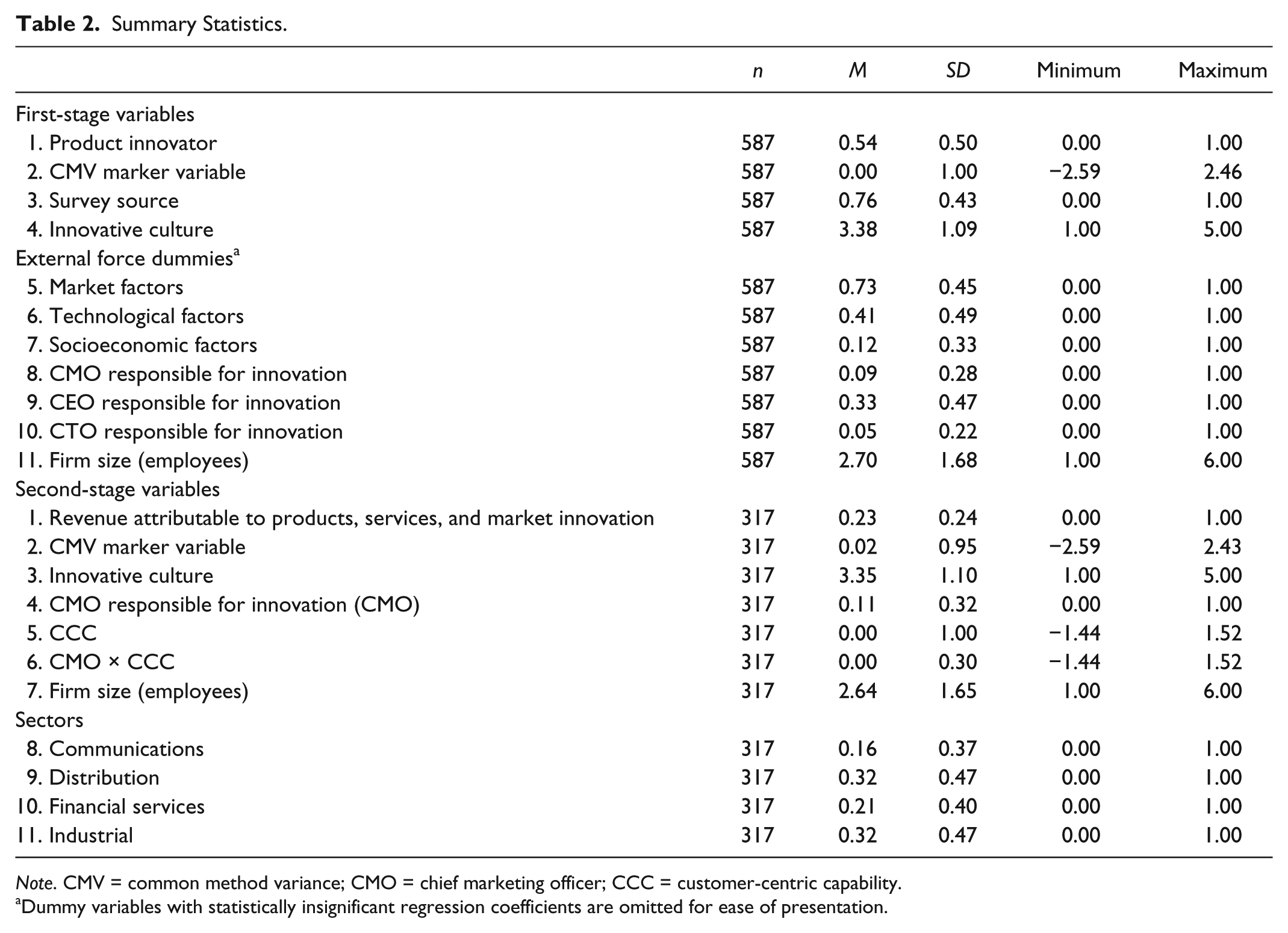
Note. CMV = common method variance; CMO = chief marketing officer; CCC = customer-centric capability.
Dummy variables with statistically insignificant regression coefficients are omitted for ease of presentation.
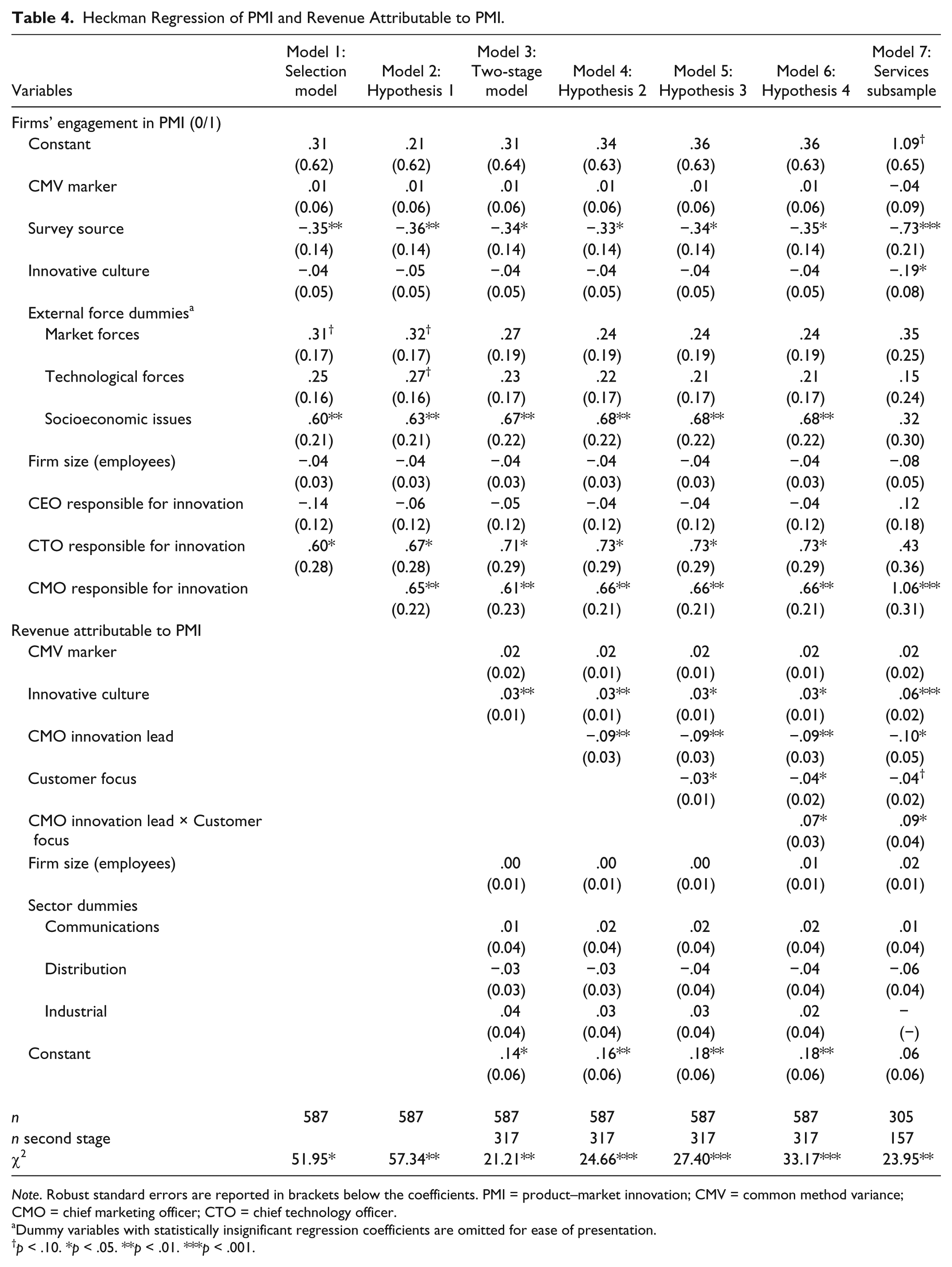
Table 3 shows pairwise correlation for the dependent and independent variables of interest for each model stage. The correlations report no particular strong associations. Table 4 reports the results of the regression analysis. The first two models show the output of the first-stage selection model using probit analysis. Although included in the regression, industry dummy coefficients were not significant and are not shown in Table 4 to improve ease of presentation. The results from the first-stage selection model identify factors associated with PMI being the firm’s primary innovation effort.
Pairwise Correlations.

Note. CMV = common method variance; CMO = chief marketing officer.
Dummy variables with statistically insignificant regression coefficients are omitted for ease of presentation.

Note. PMI = product–market innovation; CMV = common method variance; CMO = chief marketing officer; CTO = chief technology officer.
Heckman Regression of PMI and Revenue Attributable to PMI.
Note. Robust standard errors are reported in brackets below the coefficients. PMI = product–market innovation; CMV = common method variance; CMO = chief marketing officer; CTO = chief technology officer.
Dummy variables with statistically insignificant regression coefficients are omitted for ease of presentation.
p < .10. *p < .05. **p < .01. ***p < .001.
Model 2 includes the indicator variable of CMO leadership of innovation efforts (H1) in addition to the control variables (Model 1). We find that CMO responsibility for innovation is positively related to the likelihood that firms engage in PMI (b = .65, p < .01). If the CMO is formally responsible for innovation within a firm, the innovation efforts are 92% (e0.65) more likely to be directed toward PMI as opposed to process/operation and business model innovation. Hence, H1 is supported.
Models 3 through 6 are two-stage Heckman regressions. Model 3 presents the results for the two-stage analysis applying only the control variables in the second stage regression. Model 4 contains the indicator variable of whether or not the CMO is responsible for innovation efforts (H2). Model 5 adds the customer-centric variable (H3). Model 6 is the full model that includes all theory variables to test the hypotheses.
The two-stage analysis shows that CMO responsibility for innovation is significantly associated with revenue generation from PMI, but with the opposite sign than hypothesized (b = −.09, p < .01). Hence, H2 is not supported. Furthermore, customer focus is significantly associated with innovation-based revenue generation, but again with the opposite sign than hypothesized (b = −.03, p < .05). Therefore, H3 is not supported.
However, when the interaction effect of both the CMO responsible for innovation and customer focus are considered, the effect is positive and significant (b = .07, p < .05). Figure 5 shows that in highly customer-centric firms, greater innovation revenue is associated with CMO responsibility for innovation. Hence, H4 is supported.
Common Method Variance (CMV)
The use of single source data raises the possibility of CMV (Doty & Glick, 1998). We applied the Harman test (Podsakoff, MacKenzie, Lee, & Podsakoff, 2003) as a preliminary check to examine whether a single underlying factor explained variance in the model. We applied the test to each of the two stages separately. In the first stage, 27 factors emerged from the 33 variables; in the second stage, five factors emerged from the nine variables. Neither of these results suggests significant common method bias.
The Harman test, however, is not reliable when there may be multiple, complex factors driving model variance. We utilized a latent marker variable, uncorrelated with the variables of interest, to capture the underlying drivers of common method bias (Williams, Hartman, & Cavazotte, 2010). The latent marker variable was constructed from three aspects of innovation practice at the organization that showed low correlation with the variables of interest. The three variables were (a) whether the firm established incubation structures, (b) the use of metrics and incentives, (c) and the use of idea generation practices. These would be expected to carry common rater and common item method bias, including bias associated with social desirability, a likely driver of bias in single source performance-related data (Podsakoff et al., 2003). The latent marker variable was constructed via factor analysis. The marker variable was included in the regression to test for the presence of common method bias. The results of the regression model show no effect in either model stage. Comparing models in which the marker variable was included showed no significant difference in model fit (chi-square). Although common method bias cannot be entirely ruled out from any single source data sample, the results of the tests suggest that the likelihood is low for significant biasing of the coefficients due to CMV.
Predictive Validity
Another concern with cross-sectional data is the potential for apparently significant results to be driven by small subsamples of the data population. Following Woodside (2013), we tested for predictive validity. Specifically, we used a pseudorandom number generator to split the full sample of 587 firms into two subsamples of 294 and 293 firms. We then estimated our full model using only the data from the first subsample and used these estimates to generate a predicted share of revenue attributable to PMI innovation for firms in the second subsample. As a measure of our model’s predictive validity, we took the correlation between these predicted values and the observed shares of revenue attributable to PMI in the second subsample (Woodside, 2013). The process was then repeated by fitting the model using the second subsample, generating predicted values for the first subsample, and examining the correlation between these and the observed values. To ensure that results were robust across data subsamples, we repeated this process 1,000 times using different random number draws.
The distribution of correlations produced by this procedure is shown in Figure 3. The estimation procedure resulted in convergence in 1,727 of the 2,000 subsamples. The vast majority of these produced predictions that were positively and significantly correlated with the observed shares of revenue attributable to PMI innovation.

Kernel density of correlations from cross-validation of full sample (1,727 subsamples).
Further analysis addresses whether these results are consistent for product and services firms. To explore this, we generated populations of product and service firms based on industry. We then estimated the full model on the services subsample (n = 305). The results are presented in Model 7 of Table 4 and are consistent with our full sample results. We then replicated the predictive validity testing procedure described above using subsamples of service firms only. Figure 4 presents the distribution of the correlations produced by this procedure. The estimation procedure resulted in convergence in 1,637 of the 2,000 subsamples (n = 152 or 153). The majority of these produced significant and positive correlations. In fact, the correlation was slightly stronger for the services subsample than for the entire sample, suggesting that the findings are more consistent across services firms than product firms.

Kernel density of correlations from cross-validation of service subsample (1,637 subsamples).
Discussion
The study findings extend prior research on the role of the CMO and suggest important contingency effects linking CMO responsibility, customer focus, and firm performance during PMI. Our first finding supports prior research linking the CMO to product and market innovation efforts. These findings strengthen and quantify some of the assumptions made in prior research. CMO leadership increases the likelihood that a firm engages in PMI by 92%. Our results confirm the relevance of CMOs with regard to firm-level efforts to innovate products, services, or markets.
Testing of H2 and H3, however, presents a different picture of CMO leadership. Contrary to prior research, we found that both CMO leadership of PMI and customer focus were negatively associated with generation of innovation-related revenues. Although, on average, 23% of firm revenue was attributed to PMI, marginally less revenue (1%) was associated with PMI when CMOs were responsible for the innovation effort. Similar results are reported for the link between customer focus and innovation revenues. The effect size is relatively small (<1%) but statistically significant. These results contrast with prior studies that emphasize the value of the CMO (e.g., Kumar & Shah, 2009; Rust et al., 2004).
The results of the contingency testing clarify these effects. When customer focus is high and CMOs lead innovation efforts, the relationship to innovation revenue turns positive, as shown in Figure 5. Only the combination of customer focus and CMO leadership improves innovation-based revenue. CMO leadership for PMI at highly customer-centric firms leads to a slight advantage (2%) compared with leadership by other members of the executive team. Of particular interest, however, is the effect when the firm lacks customer focus. At the low end of the scale, the proportion of revenues attributed to PMI is 10 times greater when the CMO is not responsible (24% compared with 4%). In other words, CMO leadership at firms with low customer focus appears significantly less likely to profitably exploit innovation outcomes.
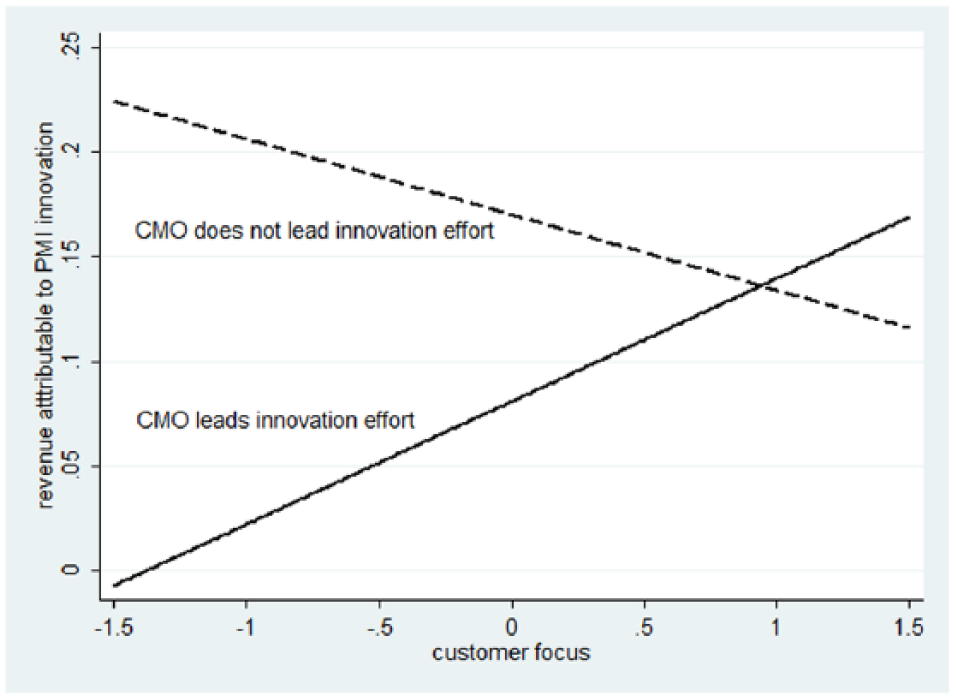
Effect sizes of customer focus and CMO innovation leadership.
The predictive validity testing (Woodside, 2013) shows that the results are especially robust for services firms. This presents new insight on CMO influence as well as entirely new questions about CMO leadership. Innovation at service firms may be driven by serendipitous learning rather than planned, systematic search. Successful service innovation requires complex configurations of novel service attributes and delivery capabilities (Ordanini, Parasuraman, & Rubera, 2013), increasing the value of deep managerial knowledge and organization-wide customer focus. In large, complex organizations, successful service innovation must address evolving customer needs within a broader framework of strategic resource management (Ostrom et al., 2010). Because services firms engage directly and continuously with customers, we would expect CMOs of service firms to be well-attuned to the balance between current and future customer needs. This is only the case, however, when the firm has already established a foundation of customer-focused capabilities.
These results address critical questions about the role of the CMO and the benefits of customer focus during firmwide innovation. On one hand, the presence of the CMO is clearly linked to firm efforts to innovate products and markets. In addition, the evidence suggests that CMO leadership of PMI carries marginal benefits when the firm demonstrates high levels of customer focus. This complements prior findings for contingency effects on CMO leadership outcomes (Nath & Mahajan, 2011). We find that the firm’s ability to capitalize on innovation is linked to customer-focus capabilities. When the CMO’s ability to coordinate and implement market-oriented activities is limited, whether by customer power or low levels of firm-based customer focus, firms are less likely to realize revenue benefits. Our findings caution against CMO leadership of product or service innovation at firms with limited customer-focus capabilities. A number of mechanisms are worth exploring to explain these results.
First, the dependent variable addresses revenue attributed specifically to the innovation effort rather than total firm performance. It is possible that these results reflect the special challenge of attributing newly recognized revenues. In addition, limited resources and attention may create internal trade-offs for CMOs in exploiting older product revenues against recent, innovation-driven revenues. In particular, the near-term financial reporting requirements of larger organizations may place a premium on the CMO’s role maximizing exploitation of the firm’s most established products and markets. In this scenario, our research augments prior studies by reinforcing the special challenge of the CMO in balancing the present against the future.
Another possibility is that CMOs are unable to ensure that outcomes are effectively attributed to innovation. It is not clear, however, why CMOs specifically would suffer these effects compared with other executives assigned responsibility for innovation. CMO focus on exogenous trends and events might inhibit attention to internal processes, especially those associated with revenue accounting and functional group reporting. Alternately firms might attribute innovation outcomes to the efforts of the executive team more closely linked to research and development activities. These suppositions, however, contrast with research linking CMO leadership to increased sales but not profitability in highly diversified firms (Nath & Mahajan, 2011). Future research might consider whether scale or scope effects of diversification affect the relationship between CMO leadership and innovation outcomes.
Our results highlight the unique challenge facing the CMO within the executive team. The CMO is expected to balance near-term marketing tactics with long-term innovation strategy. Short-term marketing activities improve consumer satisfaction, brand value, and new product launches, all of which contribute to increased firm value (Fornell, Mithas, Morgeson, & Krishnan, 2006; Mizik & Jacobson, 2009; Srinivasan & Hanssens, 2009). The CMO role may thus be tightly linked to generating and sharing critical market- and consumer-related information with other departments, focusing the attention of the firm and its members on maximizing value from customer relationships. These activities appear to be linked to successful development and deployment of PMI. But our results suggest that the dualistic nature of the CMO role tends to detract from the firm’s exploitation of innovation, except in cases where the firm already has strong customer-centric capabilities. This highlights a particular challenge facing the CMO. On one hand, the CMO may focus on exploiting the extant product–market portfolio to generate revenue benefits directly attributable to marketing activities. On the other hand, the CMO might take a more active role at the intersection of marketing and innovation to support the firm’s long-term competitiveness. Doing so appears to generate risks to the CMO’s leadership position vis-à-vis firm performance and, possibly, firm performance as well.
The data set of interviews with more than 500 CEOs of multinational firms presents rich information but certain limitations. The larger, global data set extends prior research on leadership and innovation based on CEO-supplied data (Montes et al., 2005). The participants do not represent a random sample but were targeted because of their size and potential relevance to IBM. Although firm size was not linked to outcomes, it is possible that size effects are not captured efficiently in this sample. To preserve confidentiality, certain data including firm size, industry, and national origin were converted to categorical formats. Other contingency effects could not be addressed with the data, including individual CMO characteristics or firm-centric customer power. Longitudinal research testing these results would be especially valuable because the nature of the CMO role in fostering long-term value creation may be linked to learning effects or even executive tenure.
Finally, scholars should continue to explore the nature of the CMO role within the top management team. With few exceptions (e.g., Nath & Mahajan, 2011), little attention has been addressed to how CMOs balance the significant tensions between long-term marketing strategy and near-term marketing tactics. For example, do firms investing in radical innovations to leapfrog competitors benefit from autocratic CMO leadership and high levels of customer focus? Even successful efforts by the CMO to anticipate future customer requirements may be unsuccessful if implementation is hampered by low customer focus or inability to direct attention away from the firm’s core products. The IBM data set does include a variable reflecting the perceived difficulty of change associated with innovation effort but was not significant in any of the model specifications. This challenge will only become more important as rates of innovation continue to increase, markets become more globalized, and industry entry barriers weaken.
Conclusion
Based on an archival database of interviews with more than 500 global CEOs, we report findings of the first large-scale, multi-industry empirical study linking CMO leadership and customer focus to firmwide innovation outcomes. We find that CMO leadership is linked to innovation revenues when the firm demonstrates customer-focus capabilities. The relationship is especially relevant for service, rather than product firms. Although our findings address key aspects of the CMO role, they also emphasize the importance of additional investigation into the inherently complex process of managing marketing and innovation at medium and large firms.
Innovation paradigms that explicitly incorporate customer and user information into the development process have yet to be carefully examined from a rigorous marketing perspective. When innovation requires cooperation and collaboration with customers, the CMO would appear to be the logical leader. On the contrary, although broadening the scope of marketing activities may carry general benefits, CMO leadership alone is not sufficient to exploit the growth potential of innovation, especially when firms lack customer-centric capabilities. Further research is needed to integrate the relatively disparate theoretical and practical fields of innovation and marketing.
Footnotes
Declaration of Conflicting Interests
The author(s) declared no potential conflicts of interest with respect to the research, authorship, and/or publication of this article.
Funding
The author(s) received no financial support for the research and/or authorship of this article.