




Abstract
This study used Bolman and Deal’s framework to examine the leadership frames of a vice-chancellor in a private university in Malaysia. Qualitative methods comprised interviews with the vice-chancellor and six of his staff reporting directly to him, document analysis, and observations. Atlas.ti was used to code the leadership frames. Content analysis revealed that the vice-chancellor exhibited three frames, showing a multi-frame leadership style. It reflects the vice-chancellor implements an effective leadership style and a high level of cognitive ability, which is important for the organizational effectiveness.
Introduction
Leadership is an important topic of research in organizational studies. Research on leadership has been multi-dimensional in nature where evaluation is made based on different perspectives (Bennis, 1995; Bolman & Deal, 1984; Covey, 1989; Kouzes & Posner, 2007; Sergiovanni, 1984). Hoy and Miskel (2001) defined leadership as the ability to support and enable a group of people to accomplish a common task.
The Importance of Studies in Leadership Styles
Past research conducted on frame preference in relationship to leadership effectiveness by Bolman and Deal (1991b) show that managers often use only one or two frames, but effective leaders use three or more frames (multi-frames). Bensimon, Neumann, and Birnbaum (1989) suggested that the ability to use several frames and switch from one to another may reflect a higher level of cognitive ability. This model has proven how leaders’ thinking relates to leadership effectiveness, and that a multi-frame orientation yields the most effective leaders. Goleman (2000) emphasized that leaders cannot rely on just one or two leadership styles, but must become proficient in as many as they can. The most effective leaders switch flexibly among the leadership styles.
Bolman and Deal’s (1984) framework shows similarity to Bensimon et al.’s (1989) and Goleman’s (2000) studies. Successful leaders may need to operate within most or all of these frameworks depending on circumstances. The effective leader will need multiple tools, the skill to use each of them, and the wisdom to match frames to situations. The ability to use multiple frames is required where leaders adapt their styles to the context in which they are operating.
Leadership styles are approaches used by various leaders to guide people, and these vary according to the situation, leader, or task to be accomplished. Although there are numerous organizational theories, Bolman and Deal’s four-frame model of leadership is suitable for this study because of its prevalent use in educational research, particularly research focused on higher education settings.
Bolman and Deal’s Four-Frame Model
In this study, multi-frame leadership is shown when a leader uses three or more frames, based on Bolman and Deal’s (1984) four frames of leadership. The four frames in Bolman and Deal’s (1984) four-frame leadership theory are structural, human resource, political, and symbolic. The structural frame emphasizes goals and efficiency. It assumes that leaders operate by defining clear, established goals. The organizations differentiate people into specific roles, and coordinate diverse activities through policies, rules, and chain of command. Structural leaders value analysis and data, keep their eye on the bottom line, set clear directions, hold people accountable for results, and try to solve organizational problems with either new policies and rules through restructuring (Bolman & Deal, 1991a).
The human resource frame focuses attention on human needs and assumes that organizations that meet basic needs will work better than those that do not. Human resource leaders value relationships and feelings and seek to lead through facilitation and empowerment. They tend to define problems in individual or interpersonal terms and look for ways to adjust the organization to fit people—or to adjust the people to fit the organization. When the “fit” between the individual and the organization is poor, one or both will suffer, whereas a good fit between individual and organization benefits both (Bolman & Deal, 1991a, 1997).
The political frame assumes that organizations are coalitions composed of individuals and interest groups competing for scarce resources. There are enduring differences in the values and beliefs of groups and individuals and these differences lead to conflict. Conflict is seen as a normal by-product of collective action. Political leaders spend much of their time networking, creating coalitions, building a power base, bargaining, and negotiating compromises (Bolman & Deal, 1991a, 1997).
The symbolic frame sees a chaotic world in which meaning and predictability are social creations and facts are interpretative rather than objective. Organizations develop symbols and culture that shape human behavior unobtrusively and provide a shared sense of mission and identity. Symbols are created to reduce confusion. Myths, rituals, ceremonies, and sagas help people to find meaning from their experience. Symbolic leaders instill a sense of enthusiasm and commitment through charisma and drama. They pay diligent attention to myth, ceremony, stories, and other symbolic forms (Bolman & Deal, 1991a).
This qualitative study on the leadership style of the vice-chancellor in a private university uses Bolman and Deal’s (2008) four-frame model. Vice-chancellors lead the effort to help their universities grow and respond to significant changes within the system of higher education. As the vision and mission of a new private university is being shaped, the vice-chancellor will need to respond to each situation with appropriate flexibility and responsiveness to change with a multi-frame perspective. As the student population grows and issues arising become more complex, there is a greater need to employ multi-faceted leadership styles. There is limited literature on qualitative research using this model being carried out in private universities in Malaysia. This research hopes to fill the gap found in the existing research and literature on the vice-chancellor’s leadership styles within private universities in Malaysia.
The research objectives in this study are to identify leadership style implemented by the vice-chancellor and to compare leadership style of the vice-chancellor as seen by the vice-chancellor and his direct reports.
Literature Review
Kezar and Carducci (2007) examined presidential leadership essential to advancing campus diversity efforts. They investigated leadership strategies for advancing campus-wide diversity efforts and how presidents can facilitate the advancement of diversity initiatives. The research questions in Kezar and Carducci’s study included
Kezar and Carducci used qualitative methodology with phone interviews and coding. Their sample was 27 presidents who had significant presidential experience and made significant progress advancing a diversity agenda, represented different institutional types or sectors in a variety of settings, and had a reputation for being reflective about their leadership strategies. Kezar and Carducci used Boyatzis’ (1998) thematic analysis, which involved both deductive and inductive coding. Using Bolman and Deal’s four-frame approach, Kezar and Carducci (2007) noted that the human resource frame was particularly important to presidents in moving a diversity agenda forward. While this article highlighted human resources strategies, the political and symbolic strategies need to be better integrated into presidential leadership as well. Future research is needed to better understand the perspectives of individuals throughout a campus. Doing more in-depth case studies of each campus to explore the themes would have added important depth and richness to this study.
Bensimon et al. (1989) examined the cognitive frames of 32 college presidents and the extent to which these college presidents incorporate single or multiple frames in their descriptions of the meaning of good leadership. Bensimon used qualitative research method to examine the interview data of 32 university presidents. This allowed the identification of their cognitive frames that reflected their espoused theories of leadership. Data were abstracted from the total interview transcript, based on their ability to respond to the following analytic question: How does President X define good presidential leadership? Content analysis was used to code references to elements of the four frames. Two distinct components were analyzed—the process of providing direction for the institution and the leadership tactics used. Presidents were considered to use a frame if their responses contained at least two references to that particular frame. Presidents could thus depict themselves as espousing from one to four frames. Of the 32 presidents, 13 (41%) espoused single frame, 11 (34%) espoused two frames, 7 (22%) espoused three frames, and 1 (3%) espoused four frames. In the first part, the three frame categories using excerpts from the interviews were described. Single-frame, paired-frame, and multi-frame theories were analyzed in-depth based on the interview responses. The findings showed that multi-frame orientations may be infrequent in presidents. Espousing a four-frame orientation is probably exceptional because few individuals display the cognitive complexity implied by this orientation. Bensimon concluded that new presidents cluster in the single-frame category while the more experienced presidents clustered in multi-frame categories. Eleven out of 16 experienced presidents espoused theories classified as paired or multi-frame. In contrast, half of the new presidents were clustered in the single-frame category. This could suggest that the more experienced presidents were able to shift among frames with greater ease. Espousing a multi-frame theory implies the ability to shift frames in response to circumstances.
In another study comparing principal leadership in the East with the West, Lin and Shouse (2006) interviewed 15 elementary and junior high school principals in Taiwan. The purpose of this study was to examine what leadership really means within the context of change from a rigid hierarchical setting to one more dependent on distributive collegial authority. Lin and Shouse also examined what these principals perceive as the most profound or fundamental challenges they’ve had to face in the wake of school reform, to what extent they find meaning in Western concepts of leadership, and adopted these in attempting to implement the mandated reforms. The 15 elementary and junior high school principals in Taiwan were interviewed over several months. Qualitative methods using semi-structure interviews and observation were used to collect the data. Criterion-based purposeful sampling was used to increase general representativeness of participants and settings. Interview protocols were designed to get the principals’ views of leadership and education reform, as well as their perceptions about teachers, parents, and students’ concern (Lin & Shouse, 2006). For data analysis, the whole text and material was read, and initial codes were formed (open coding). They then identified themes and grouped statements into units (axial coding) by hand and by computer. In addition, the responses of the principals were organized into two ways, one by participants and one by research questions. For data interpretation, they developed a description of leadership concepts and challenges principals faced for implementing school reform. The findings showed that the interviewed principals recognized the importance of principal leadership but they were increasingly influenced by Western theories of vision building, symbolic leadership, and a focus on task and relationship. Education reform had caused principals to rethink and even change their leadership practice (Lin & Shouse, 2006). In general, the principals are open to Western models of leadership and a more flexible model of shared vision and shared leadership. In my opinion, more than a Western model of organizations and leadership is needed, given the importance of private universities in developing countries.
Method
This qualitative study was conducted with semi-structured interviews with the vice-chancellor and six of the vice-chancellor’s team who reported directly to him. First-hand knowledge and personal experiences were obtained through the participants’ own words (Bogdan & Biklen, 1992) regarding the leadership of the vice-chancellor. It was necessary to use interviewing as a tool to obtain information that could not be observed such as feelings, thoughts, and impressions. Interviews were triangulated with supporting documents and observation. Documents included speeches written and given by the vice-chancellor during two occasions in the university and observations captured using photographs taken on the same two occasions. Observations included photographs taken at the two events including one of the vice-chancellor sitting among the stage party members during the university’s convocation ceremony in his full official robes. Other photographs showed the vice-chancellor giving an inspiring 1.5 hr speech complete with slides at the vice-chancellor’s distinguished guest lecture series.
Participants
The main participant was the vice-chancellor of a private university in Malaysia with a strong corporate background, a strong global presence, and an impressive academic resume. The other six interviewees reported directly to the vice-chancellor: one was a deputy vice-chancellor, two were vice presidents, and three were deans of faculties. All the seven interviews were held in the offices of the respective interviewees. Interviews allowed individuals to share their understanding regarding leadership and its value in higher education.
Data Collection
An interview protocol was prepared to match the research objectives and research questions in this study. The interview questions were semi-structured so as to allow other questions to emerge during the interviewing process and additional ideas could be explored. The use of the interview guide allowed more structure, which in turn eased the researcher’s task of organizing and analyzing interview data. The general atmosphere in all interviews was very casual, with the interviewees giving full attention at that time. In addition to their ability to concentrate, their communication skills and their ability for self-reflection contributed greatly to the quality of the interviews. Each interview conducted took approximately 30 minutes. A tape recorder was used with permission from those interviewed.
Interviews were supported with analysis of documents comprising a speech and a public lecture on topics of leadership. Documents were useful as a secondary data source. These were official speeches given by the vice-chancellor during convocation ceremonies and keynote addresses on the topic of leadership during the vice-chancellor distinguished guests’ lecture series. The speeches were also recorded with permission from the vice-chancellor and transcribed verbatim.
Used in conjunction with interviews and document analysis, observations were also conducted to triangulate emerging findings (Merriam, 1998). The observations were carried out during the two specified events as a complete participant where “the researcher is a member of the group being studied and conceals his or her observer role from the group so as not to disrupt the natural activity of the group” (Merriam, 1998, p. 100).
As a complete participant who was able to see things first-hand, the researcher was able to use her own knowledge and experience in interpreting what was observed. An observation protocol was prepared with the research questions in mind so that it would narrow down and focus on specific interactions and behaviors of the person or the activity. Field notes with descriptions, direct quotations, and observer comments were recorded soon after the observations (Merriam, 1998). For that purpose, the researcher carried around her journal and recorded her observations as soon as possible after an observation.
Data Analysis
Bolman and Deal’s (2008) four leadership frames were used as guiding questions during the semi-structured interviews. The purpose was to identify how many and which of the four leadership frames were perceived as the vice-chancellor’s preferred frames. Identities of the interview participants were kept confidential. Four main levels of data analysis were employed. At the first level of analysis, all the interviews were recorded with permission and were transcribed verbatim. Transcribing the interviews verbatim provided a complete database for analysis (Merriam, 2009). At the second level of analysis, the data obtained were uploaded into the computer-aided software Atlas.ti (Version 7). This software was used for the purpose of qualitative data analysis of the transcribed interviews, documents, and observations. Coding was done using the Atlas.ti software. Seven interviews, two speeches, and observations made as a complete participant were uploaded as primary documents into the hermeneutics unit (HU) of the software.
Deductive coding was used by identifying parts of the transcripts that resonated with the four leadership frames mentioned—structural, human resource, political, and symbolic. Indicators for coding the interview transcripts are summarized in Table 1. The coding system is simple and allowed the researcher to make reliable judgments about the presence or absence of frames as perceived by the interviewed participants and by the vice-chancellor.
Criteria for Coding Frame Responses.

Interview Questions and the Corresponding Leadership Frames.

Note. VC = vice-chancellor.
The data were analyzed using constant comparative method, where data from the interviews, documents collected, and observations were compared. Each code from the various sources was constantly compared with all other codes to identify similarities, differences, and general patterns. At the third level of analysis, data were reduced and a matrix was compiled with the four leadership frames as thematic codes. This allowed the researcher to determine whether there was a pattern among interview responses, speeches, and observations. At the final level of analysis, content analysis for the four leadership frames was carried out to allow for a quantitative output from the interviews. Occurrences of the quotes matching each of the codes were counted and tabulated.
Trustworthiness of the Study
The following strategies were employed to ensure trustworthiness in this study:
Triangulation
Multiple sources of data were used to determine the leadership frames of the vice-chancellor and its impact on organizational climate in the university. Interviews were conducted, documents were analyzed, and observations were made to provide more depth in support of the quantitative data obtained by the results of the survey.
Member checks
The raw data in the form of transcripts were returned to each participant with the request that they review it to ensure the accuracy of the information recorded during the interviews. On review, the participants signed on a form stating that they had reviewed the transcription and were satisfied that the information was indeed accurate.
Researcher’s bias
The researcher assumed the stance of a complete participant while collecting information as an observer. According to Merriam (1998), this may cause a “loss of perspective on the group, being labeled a spy or traitor when research activities are revealed, and the questionable ethics of deceiving the other participants” (Merriam, 1998, p. 100). A researcher should examine and carefully scrutinize his or her own familiarity with the topic and its source for a possible bias (Creswell, 2008). Higher education researchers share the problem of being insiders within their area of research. The interviewers and interviewees may be working in the same field and very often know each other. The aim was, as much as possible, to benefit from the researcher’s inside knowledge and, as much as possible, minimize the bias of studying one’s own university.
Fieldwork journal
The researcher kept a journal detailing the observations and thoughts of the researcher during the data gathering process.
Results
Structural Frame
Excerpts from the interview with Participant A clearly showed that one of the vice-chancellor’s preferred leadership frames is the structural frame. From the interview with Participant A, the vice-chancellor is seen to be very focused on the outcome in the processes that has to take place in the university: I see a man who is thoroughly focused in achieving what he needs to achieve without giving in to things based on his emotions. (P1: para 17) He can sit in a meeting, and people will be talking and talking, and in the end he will summarize everything for you because he’s paying close attention to what is said because he is focused on the outcome that needs to be achieved. (P1: para 66) The man who talks, who thinks about rules, policies, roles, and goals, come out very clearly when you pay close attention to his public lectures. (P1: para 21)
Triangulating this last quote with the documented speech 1 where the vice-chancellor gave a public lecture, the structural frame comes across clearly in outcome-focused, goal-focused processes. Here the vice-chancellor has the following to say: First of all, it is important all of us must have very clear and focused directions and strategy. (P8: para 139) It’s about clarity of thought; it’s about clarity of your strategy. It’s all about clarity. So, when you are clear about the strategy, you have the ability to overcome dilemma. Most of the time we have dilemma because we’re not clear and we’re not focused. (P8: para 41)
Similarly, excerpts from the interview with the rest of the Participants B to F supported what Participant A said about the vice-chancellor being clearly focused on the outcome.
Participant B: “He is definitely a person who is very clear about what goals he has to set.” (P2: para 57) Participant C: “Establishing clear strategic intent and documenting it and indoctrinating it.” (P3: para 26) Participant D: “VC has several strengths . . . a strong analytical mind, he is very clear about things, has clarity of thought, tremendous problem-solving skills. He can close cases very well.” (P4: para 26) Participant E: “He’s quite focused I would say. Being a focused person, he has good follow-up on targets, on deadlines, timing, time-lines and so on.” (P5: para 68) Participant F: “Like VC keeps saying the structure must fit the strategy to fit the vision. Once you have that in place and then you get the people to achieve that vision that you set out to do.” (P6: para 76)
Likewise, the vice-chancellor himself was able to evaluate clarity of outcome-based focus as one of his leadership strengths: I’m very good at conceptualizing a vision, then I articulate and share the vision continuously, repetitively, and tenaciously with the people whom I want them to buy-in the vision. Then, I will sit down with everyone to make sure everyone has got the ability to achieve the common vision in their respective roles. So, my strength is conceptualizing a goal, coaching and supporting a team to achieve the goal. And that is my leadership strength. (P7: para 18)
And again triangulating this with Observation 1 where the vice-chancellor gave a public lecture, someone in the audience commented, To successfully lead his team, a good leader must have a clear and focused vision. I think that’s very important because there are different politics and issues in every organization. (P12: para 31)
Human Resource Frame
Excerpts from the interview with Participant A also showed that another one of the vice-chancellor’s preferred leadership frame is the human resource frame. From the interview with Participant A, the vice-chancellor is seen placing emphasis on providing direction by being responsive to individual needs, showing high levels of support and concern for people. He sees leadership as attending to the needs of people and investing in people: His ability to mobilize, to motivate the staff and employees, to look at the vision and mission of the institution, and set a path or develop a strategy to achieve it, through the people. (P1: para 9) When you have a need, and you go to him, he responds very quickly, he makes time, so you can take that as an indication that he values human relationships as well. (P1: para 25) He is trying to make sure that he invests in other people. So, as a direct report, I think I really enjoyed working for him because I’ve learnt to rethink issues, I’ve learnt to place certain things, on a different level of importance, I’ve also learnt not to react emotionally . . . and focus on the outcome. (P1: para 45)
Similarly, excerpts from the interview with the rest of the participants supported what Participant A said about the vice-chancellor investing in people (Participant B), being responsive to individual needs (Participant C), and being a coach (Participant D).
Participant B: “VC believes in if the person has potential then the person must be given a chance.” (P2: para 73) Participant C: “I’ve known him to have various staff just walking to his office, you know, and asking for his time and I’ve seen him being very considerate and he listens out.” (P3: para 54) Participant D: “He emphasizes coaching others how to be a good leader. I recall an incident where I mentioned I had to conduct an enquiry, and he corrected me ‘not enquiry; coaching session’. He is both a coach and an educator.” (P4: para 26)
The vice-chancellor is also a leader who builds trust through open and collaborative relationships (Participant E) and is both friendly and approachable (Participant F).
Participant E: “He has a very consultative approach when he wants to build his strategy.” (P5: para 13) Participant F: “I think he is quite friendly to the staff. I think he respects the staff. He doesn’t mind criticism. He accepts criticism very well. That is actually one of his strong points.” (P6: para 36)
The vice-chancellor himself was passionate about investing in people and the importance of a healthy working relationship with his subordinates when he said, Human relationship is very important and leaders cannot get things done by themselves, I cannot get things done by myself. I can only get things done through my people. So my relationship with my colleagues, my peers must be there. (P7: para 38)
When asked about what he thought would be the characteristics of an effective leader, the vice-chancellor said, An effective leader is somebody who can cause, not just one [but] a group of people that can work together and achieve a common goal, effectively. Then the leader is an effective leader. But most of all, when this group of people, when they . . . after having achieved their common goal effectively, they think that they have achieved it all by themselves. (P7: para 11)
The vice-chancellor was clear about coaching by leading from behind, not from the front. Triangulating this quote with the documented speech 1 where the vice-chancellor gave a public lecture, he said, The great leaders in the world are those who have led you to move from point A to point B, and have you thinking that you have arrived there all by yourself. (P8: para 123)
In the interview with the vice-chancellor, he was also clear about this: I want them to arrive there by themselves with an invisible hand. (P7: para 26)
When asked what was most memorable during his office as the vice-chancellor, he said, It’s transformation of an individual and collectively more individuals—that is most memorable. Those are the most important memorable events to me as a vice-chancellor. It’s not about how good I have transformed the university. It’s how much I have transformed individuals. My job as a vice-chancellor is to transform individual by individual, and hopefully individuals that I have transformed, they then work together collectively and transform the rest. (P7: para 106)
And again triangulating this with Observation 1 where the vice-chancellor gave a public lecture, someone in the audience commented, The role of a leader is not so much about letting everyone know that you are one. It’s about helping your people grow. (P12: para 32)
From the few quotes above, it is clear that the vice-chancellor is a leader who truly values human relationships. He shows genuine concern for his people. From the interviews with the vice-chancellor’s direct reports who may know him a little more than the rest, the vice-chancellor is seen as a coach and mentor to them. This is reflected in the interviews with his direct reports on this aspect of his leadership.
Political Frame
Excerpts from the interviews with Participants A to F showed that the political frame is the vice-chancellor’s least preferred leadership frame. The vice-chancellor is not seen to build strong alliances or power bases. Participant A had the following to say: One of the staff members asked him, based on his experience in the corporate world, how he achieves what he needs to achieve, if there’s conflict. He said, ‘You need to see, wait for the tipping point to happen.’ Meaning some people may stay, some people may leave because of that, so those who stay are those who believe in your leadership and will go along with you to achieve the plans, those who do not believe what you can achieve, then they will make a choice to leave, and I think that in this institution, we saw instances of that. (P1: para 17)
Participant D agreed with Participant A that the vice-chancellor is good at handling conflict, and had the following to say: VC can resolve conflict very well. He is very clear. He is able to look at the situation. He doesn’t get caught up in emotions. Then he is able to provide solutions. I take my hats off to him—he resolves cases, closes cases very well. (P4: para 42)
The vice-chancellor himself explained why he preferred not to be embroiled in conflicts while he held the office as the vice-chancellor: The power and conflict is a very interesting thing. If you don’t try to gain power there’s no conflict. It’s a very simple thing. For me, you notice, I never go after power. So when I lead this university, it’s not because I have power, it’s because number one, I set an example by principle. Second, I walk the talk and coach my colleagues to do things. So, as long as I do not go after power, there will not be conflict. Conflict comes about because there is a struggle of power. (P7: para 46) What drives my leadership style is entirely based on principle. It’s a principle-driven leadership style. (P7: para 34)
The vice-chancellor’s view on not going after power was also supported by Participant A who reiterated that the vice-chancellor was not after power or position because he was already a highly self-actualized person: VC is a very highly self-actualized individual. Position as a VC is an insignificant thing for him. It’s not the position that brings value to him. It’s what’s within the office that he can do, he has always taught us. You know it’s not so much the person, it’s the office of the person. For example, the office of the vice-chancellor needs to be respected, not him. (P1: para 33)
From the above quotes, it is seen that the vice-chancellor is able to manage conflict and opposition but appears to prefer not to be embroiled in them. This arises from the perception that the vice-chancellor holds on to his principles and is not one who goes after power. Although the vice-chancellor was not perceived to use the political frame, it could also have been because there were sufficient resources in the university as politics usually emerges when resources are scarce.
Symbolic Frame
Excerpts from the interview with Participants A to F showed that the symbolic frame is not reflected as one of the vice-chancellor’s preferred leadership frames. This is possibly because the vice-chancellor did not have sufficient time in the campus, so whatever little time he had was spent in meetings and decision making, in the company of the people he was with (Participant A). It also suggests that whatever celebration the vice-chancellor initiated is not so much for symbolic purposes, but to arrive at an intended outcome (Participant C).
Participant A: “I think in context of celebration, he’s not a person who is big on celebrating, you know, like birthdays or anything like that, but it’s just the company, for him he celebrates the company of the people he’s with.” (P1: para 45) Participant C: “VC has always been a person that looks at celebrations as an excuse to do something . . . we tend to look at celebrations and sometime we may lose focus of our actual intent, so (what) VC does is he makes sure that whatever we celebrate, the culture is always to come back and to refocus on what is the actual intent of doing this.” (P3: para 46)
However, the vice-chancellor himself feels that he does communicate a strong and challenging vision and sense of mission when he said, I’m very good at conceptualizing a vision, then I articulate and share the vision continuously, repetitively, and tenaciously with the people whom I want them to buy-in the vision. (P7: para 18)
From the above quotes, it can be seen that the vice-chancellor looks at symbols and celebrations as a means to communicate a sense of vision and mission with his people. This reflects the symbolic frame, which includes the ability to excite and motivate, and to energize and inspire a sense of mission. This is further supported in the speeches documented, which showed that the symbolic frame is actually one of the vice-chancellor’s preferred leadership frames, besides the structural and human resource frames. This can be seen in the way the vice-chancellor engaged his audience with stories about “Psy,” Steve Jobs, and many others to bring across important lessons for his audience. To be able to inspire through storytelling is one of the indicators of the symbolic frame.
So, as you can see, this young man, Mr. Park, thirty-thirty four years of age, Korean, one song, one hit, he made it. More than one billion viewers on YouTube. He earns ten million year-to-date. So it is thirty five million ringgit, you know, in our Malaysian terms. (P8: para 39) Steve Jobs, at the very early days, he made a decision, what climate and culture he wanted for the organization. He said we should be pirates and not navy because navy is “command and control.” Pirates are very different thing. How many of you have worked with pirates before? (P8: para 63)
The vice-chancellor’s direct reports agreed that the vice-chancellor communicates a strong and challenging vision and sense of mission. He is highly charismatic and inspires others to do their best sometimes even through inspirational storytelling. The vice-chancellor also sees beyond current realities to create exciting new opportunities. He is an inspiration to others, and serves as an influential model of organizational aspirations and values.
In summary, the vice-chancellor is perceived to be strong in three out of the four frames—the structural, human resource, and symbolic frames. However, he did not seem to exhibit the political frame much compared with the other three frames.
Quantitative Output From Qualitative Data Analysis
At the final level of analysis, content analysis of the four leadership frames was carried out to allow for a quantitative output from the interviews. Content analysis is a valuable tool for qualitative researchers because it allows the researcher to simplify and reduce a large amount of data. It uses pre-designed categories in much the same way as quantitative researchers use operational definitions at the beginning of the research. It is based on counting and thus allows quantitative analysis of what was originally qualitative data. In this study, the researcher used the Atlas.ti software to generate the number of occurrences of the quotes matching each of the codes. These were quantified and presented in Tables 3 and 4, and in graphical form in Figures 1 and 2.
The Number of Occurrences of the Four Leadership Frames From Interviews Conducted With Participants A to F.

Note. P1 = primary document 1, Participant A; P2 = primary document 2, Participant B; P3 = primary document 3, Participant C; P4 = primary document 4, Participant D; P5 = primary document 5, Participant E; P6 = primary document 6, Participant F.
The Number of Occurrences of the Four Leadership Frames From Vice-Chancellor’s (VC) Interview, Documents, and Observations.

Note. P7 = primary document 7, VC’s interview; P8 = primary document 8, Speech 1; P12 = primary document 12, Observation 1; P16 = primary document 16, Speech 2; P17 = primary document 17, Observation 2.
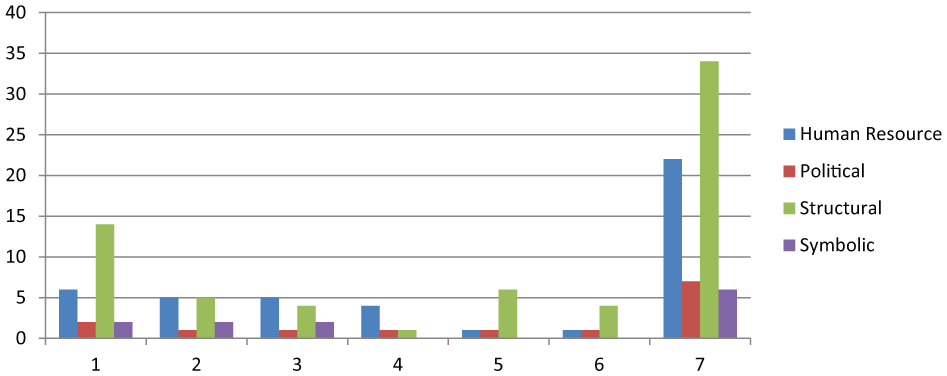
Graph of quantitative output showing the number of occurrences of the four leadership frames from interviews conducted with Participants A to F.

Graph of quantitative output showing the number of occurrences of the four leadership frames from VC’s interview, speeches, and observation.
Table 3 and Figure 1 showed the number of occurrences of the codes, structural, human resource, political, and symbolic, based on the interviews with Participants A to F, in table format and a graphical format generated using Excel. From the data analysis presented in Table 3 and Figure 1, the vice-chancellor was perceived to use the structural frame and the human resource frame a lot more than the other two frames.
Figure 1 showed that during the interviews with Participants A, B, and C, the structural frame and the human resource frame recorded more occurrences. Interviews with Participants D, E, and F showed either the structural frame or the human resource frame as the major frame exhibited by the vice-chancellor. Comparatively, both the political frame and the symbolic frames were not exhibited much, a pattern seen throughout all the interviews with the six participants. The total from Participants A to F also recorded two of the four frames with higher number of occurrences—the human resource frame and the structural frame.
Content analysis of the four leadership frames was also analyzed from the interview with the vice-chancellor, the documented speeches made by the vice-chancellor, and the observations conducted by this researcher, using the Atlas.ti software. Table 4 and Figure 2 showed the number of occurrences of the codes, structural, human resource, political, and symbolic, based on the interview with the vice-chancellor, the speeches, and the observations made, in table format and a graphical format generated using Excel.
From the data analysis presented in Table 4 and Figure 2, three of the four frames were clearly seen as the vice-chancellor’s preferred frames. These were the human resource, structural, and symbolic frames. This finding confirms the earlier conclusion that the vice-chancellor indeed exhibited the same three frames. This means that the vice-chancellor exhibited three out of the four frames (multiple frames). Bolman and Deal (1992) suggested that the ability to use multiple frames is an important indication of leadership effectiveness. This then indicates that the vice-chancellor is an effective leader as he exhibited multiple frames in his leading of the university.
Discussion and Conclusion
Studies using Bolman and Deal’s model uncovered a relationship between leadership effectiveness and choice of frames used, with multiple frames being associated with more effective leadership (Thompson, 2000). The finding from this study supports Mohanan and Shah’s (2011) contention that given the complex nature of the contemporary presidency, the use of at least three frames is critical to effectively lead the organization.
In this study, the vice-chancellor was perceived to use three out of the four frames. The multi-frame leadership style is an important indication of leadership effectiveness, which is consistent with Thompson’s (2000) study asserting the benefits of a multi-frame orientation. The vice-chancellor with his multi-frame leadership style is able to influence organizational effectiveness with his strategies that is outcome-focused (structural frame), encourage employee involvement and empowerment in decision making (human resource frame), and inspire them with his stories (symbolic frame). This allows for greater teamwork, commitment, communication, empowerment, and recognition, which may lead to organizational success.
The structural frame is recognized in the vice-chancellor’s outcome-focused, goal-focused strategies for the university. In institutions of higher learning, efficiency and effectiveness in approaching problems through careful thinking, planning, and logical analysis need to be emphasized. The structural frame is about how to organize and structure groups and teams to get results.
The human resource frame is recognized in the vice-chancellor as a leader who truly valued human relationships. The vice-chancellor showed genuine concern for his people, and was both a coach and a mentor to some of his direct reports during his tenure as vice-chancellor in the university. Leaders need to show sensitivity and concern for employee’s feelings and needs, and the personal recognition of the work well done. The human resource frame is about how to tailor organizations to satisfy human needs, improve human resource management, and build positive interpersonal and group dynamics.
The symbolic frame is seen in the way the vice-chancellor engages his audience with stories and analogies to bring important lessons across. Leaders need to communicate a strong and challenging vision and sense of mission to the people. The symbolic frame is about how to shape a culture that gives purpose and meaning to work, stage organizational drama for internal and external audiences, and build team spirit through ritual, ceremony, and story.
The leadership frame that was not exhibited as much by the vice-chancellor in this study was the political frame. This finding is consistent with Tull and Freeman’s (2011) study, where only 1.8% of the participants had the political frame as a preferred frame. Winton and Pollock’s (2013) study on principal leadership in Ontario, Canada, suggests that there is a need for principal preparation programs to develop aspiring leaders’ political skills. The political frame is about how to cope with power and conflict, build coalitions, hone political skills, and deal with internal and external politics. Bennis (1994) lends credibility and wisdom to the discussion by maintaining that leadership is largely a function of collaboration and coalition building.
Further work could include using the Bolman and Deal framework to identify and compare the leadership styles of vice-chancellors in public universities and private universities. This would make an interesting study to identify any differences in public and private sectors in leadership frames used by vice-chancellors of these institutions. In addition, leadership frames of vice-chancellors from academic and corporate backgrounds can be compared. This will provide greater understanding of the way these vice-chancellors run the universities based on their different backgrounds.
The study of how many frames a vice-chancellor uses may be useful criteria for future appointments of vice-chancellors into private universities. In Malaysia, private higher education is expanding very rapidly. The demand for places in private higher education institutions have increased significantly as the government pushes for a knowledge-based economy before the year 2020. This is a most crucial area for study, especially in the countries that are developing and upgrading their private colleges to the status of new private universities. Given the importance of private universities in developing countries, the findings of this study can therefore help to provide a broader direction to leadership in private higher education in this country.
Delimitations of the Study
In this study, Bolman and Deal’s framework is used as an analytical tool, not a predictive tool. Using this framework, the researcher is making some association to examine the leadership styles of one vice-chancellor of a private university in Malaysia. Bolman and Deal’s frame of leadership styles is used as a point of analysis to demonstrate leader self-awareness. Based on Bolman and Deal’s (1984) four-frame model, if three or more frames are expressed, leadership effectiveness is perceived. Use of multi-frame orientation is linked to perceived leadership effectiveness.
Footnotes
Declaration of Conflicting Interests
The author(s) declared no potential conflicts of interest with respect to the research, authorship, and/or publication of this article.
Funding
The author(s) received no financial support for the research and/or authorship of this article.