



Abstract
Effective leadership is essential for organizational development; however, it has been insufficiently examined in China. Thus, we explore what constitutes effective leadership in China by identifying the personality traits necessary for practicing effective leadership behaviors and developing an empirically-based personality trait framework. In-depth interviews were conducted with 132 executives identifying the initial item pool. Data were collected from 432 respondents and exploratory factor analysis was conducted to explore a possible model structure. Further data were collected from 513 respondents and confirmatory factor analysis was performed to assess the convergent and discriminant validities of the proposed model. A personality trait framework to practice effective leadership comprising 12 factors and 40 sub-items was developed. The findings expand our understanding of effective leadership in China by discovering individual characteristics; they offer an efficient benchmarking for assessing the discerning personality traits for effective leadership behaviors, and significant implications for Chinese leadership development practices.
Plain language summary
This study aims to identify the personality traits necessary for practicing effective leadership and develop a framework for effective leadership in China. We interviewed 132 respondents (executives of Chinese enterprises) and obtained the initial items for the personality traits pool. The Delphi method was applied to test the expert validity of 51 items. Thereafter, using a combination of interview data and expert feedback, we summarized 45 items. Subsequently, two questionnaires were distributed to a group of Chinese enterprise employees and their responses were analyzed. The dataset for the EFA was from the first questionnaire to extract two levels of indicators for each meta-category; the dataset collected by the second questionnaire was used to conduct several CFAs to examine the factor structure of each meta-category. The results indicated that the proposed models for each meta-category have good reliability, convergent and discriminant validities in the Chinese context. This study makes several contributions to the leadership theory and practice. First, it facilitates an in-depth exploration of effective leadership in China by identifying the personality traits necessary for effective leadership behaviors. Gaining insights and perspectives on effective leadership in China adds to our understanding of the Chinese characteristics in leadership research. Second, it contributes to leadership development by revealing the leadership personality traits framework necessary for assessing, selecting, and developing effective leadership practices. Finally, it has significant implications for the design of various human resources management practices in the Chinese context.
Introduction
China plays a significant role in global development and has emerged as the world’s second-largest economy (Broz et al., 2020; Bruton et al., 2021; Xue et al., 2021). Even under the impact of the novel coronavirus disease 2019 pandemic, overall 145 Chinese companies ranked in the 2022 Fortune Global 500 (Fortune, 2022); China maintains its position as the global leader in terms of the number of large companies. Owing to the rapid changes and development of China and its companies, several management scholars have explored the Chinese characteristics in different management topics using Chinese samples to examine the country’s advancement and success (Jiang & Kim, 2020; Kardon & Leutert, 2022; Zhao et al., 2021). Effective leadership, as one of the determinants of organizational performance and development, has been widely researched in the literature (Bottomley et al., 2015; Dinh et al., 2014; Harms et al., 2017; Shen et al., 2023; Weber et al., 2022). However, its knowledge regarding China is limited. Hence, this study addresses this gap and identifies the characteristics necessary for practicing effective leadership in China.
Leadership is essentially described as “the process of influencing others to understand and agree about what needs to be done and how to do it, and the process of facilitating individual and collective efforts to accomplish shared objectives” (Yukl, 2006, p. 8). Effective leadership contributes to organizational survival and development by improving organizational members’ motivation, responding to the changes in markets and environments, achieving organizational objectives, and maintaining high performance (Ahmad & Karadas, 2021; Alrowwad et al., 2020; Top et al., 2020). Yukl and colleagues (Yukl, 2012; Yukl et al., 2002) proposed the hierarchical taxonomy of effective leadership, including task-oriented, relations-oriented, change-oriented and external behaviors. With rapid changes in business, technological, political, and social factors, scholars have investigated effective leadership as essential to organizations and suggested that leadership must be developed at all levels (Bish & Becker, 2016; Lau et al., 2021; McCauley & Palus, 2021). From an important perspective of the existing leadership studies, researchers have examined various leadership behaviors to explain the influence of leadership on organizational performance, thus improving effective leadership (Behrendt et al., 2017; Heimann et al., 2020; Mitchell et al., 2019; Yukl, 2012). Meanwhile, both business and government organizations have focused on leadership development programs (Amagoh, 2009; Chami-Malaeb & Garavan, 2013) to enhance leadership effectiveness.
Although these studies have yielded promising findings, there are two noteworthy gaps. First, research on who can effectively perform such leadership behaviors and how they do so is rare (Yukl, 2012). Specifically, limited knowledge is available about the necessity of leaders’ personality traits to practice effective behaviors. Psychological researchers have acknowledged that personality traits influence individual behavior (Judge et al., 1999; Robert & DelVecchio, 2000); further, these factors can also be used to predict leadership effectiveness (e.g., Judge et al., 2002; Mumford et al., 2007). The development of effective leadership is not simply a choice of leadership style and training in relevant behaviors (Day et al., 2014); it is essential that leaders have the competencies to practice their behaviors in real work settings. Therefore, we primarily aimed to identify the personality traits necessary for the successful practice of effective leadership behaviors in a real work setting. Existing studies have explored personality traits using terms such as demographics (Fiedler, 1970), competence (B. Bass & Bass, 2009), skills (Dalakoura, 2010), and interpersonal attributes (Judge et al., 2002). To present an exploratory investigation, we intentionally adopted a broader and more holistic set of personality traits, including competencies, interpersonal attributes, and values.
Second, it could be argued that the individual characteristics necessary to practice leadership behaviors in different cultural backgrounds may vary according to the cultural traditions and business practices. Scholars have suggested that the cultural context is a significant factor that should be considered in leadership research (Gutierrez et al., 2012) as workplace environment and ethics, and relationships and communication styles between leaders and subordinates vary with culture. Leadership personality traits differ across countries (Kowske & Anthony, 2007), such as high- (e.g., China and Japan) and low-context countries (e.g., Germany and the United Kingdom). As Chinese companies have been developing rapidly, exploring what constitutes successful leadership in China has become vital (Andriesse & Van Helvoirt, 2010). Nevertheless, the components that constitute effective leadership in China remain under-researched. Hence, we also aimed to use Chinese samples to explore the Chinese elements that could help leaders perform effective leadership behaviors.
This study makes several contributions to the leadership theory and practice. First, it facilitates an in-depth exploration of effective leadership in China by identifying the personality traits necessary for effective leadership behaviors. Gaining insights and perspectives on effective leadership in China adds to our understanding of the Chinese characteristics in leadership research. Second, it contributes to leadership development by revealing the leadership personality traits framework necessary for assessing, selecting, and developing effective leadership practices. Finally, it has significant implications for the design of various human resources management practices in the Chinese context.
Literature Review
Leadership in China has received considerable attention in management studies (e.g., Qiu et al., 2019; Tourigny et al., 2019; Walker et al., 2012). Some scholars have invoked traditional Chinese philosophies such as Confucianism and Taoism to explain Chinese leadership practices (Jing & Van de Ven, 2014; Yang et al., 2020). For example, paternalistic leadership encompasses the elements of fatherly benevolence, authoritarian supervision, and moral integrity (Pellegrini & Scandura, 2008) and is prevalent in Chinese societies as a legacy of Confucian values (Cheng et al., 2004); it emphasizes that subordinates must obey their senior authority, while leaders must be benevolent and moral role models. Moreover, some researchers have provided empirical evidence indicating a relationship between leadership type and outcomes regarding satisfaction with leaders (Cheng et al., 2004), organizational citizenship behavior, commitment (Farh & Cheng, 2000), and job performance (Chan et al., 2013). For example, prior studies have emphasized the positive impact of leaders’ benevolence and morality on their subordinates’ performance (Chen et al., 2014; Lau et al., 2020; Zhang et al., 2015). Although significant evidence of leadership effectiveness has been examined in current studies, with rapid changes and development in China, it is crucial to know what constitutes effective leadership (Andriesse & Van Helvoirt, 2010); thus, further research is needed to investigate the characteristics required by leaders to be seen as successful (Brouer et al., 2016; Dalakoura, 2010).
Leadership is a complex concept, and an effective leader possesses the necessary traits and behaves appropriately to mobilize people and resources to achieve their vision (Grimm, 2010). Scholars have proposed several behavioral models for effective leadership (Burket et al., 2006; Horstmeier et al., 2016; House, 1971).
Traditionally, leadership research has emphasised leaders’ scope to direct followers’ attitudes and performance and has investigated generalized behaviour categories, such as task- and relations-oriented behaviours. These have, in turn, been sub-divided and studied, including concepts such as initiating structure and consideration (Fleishman, 1953), instrumental and supportive leadership (House, 1971), work and interaction facilitation (Taylor & Bowers, 1972), performance and maintenance behaviors (Misumi & Peterson, 1985), and transformational, transactional, and laissez-faire theory (Bass, 1985; Bednall et al., 2018; DeRue et al., 2011; Hakim et al., 2010; Horstmeier et al., 2016). Some have focused on the behaviors in change leadership, often in the context of varying environments and uncertainty (e.g., Burket et al., 2006; Marrone, 2010; Yukl et al., 2002).
Although studies have offered various perspectives, contemporary research on leadership behavior has been criticized for its weak theoretical foundation (van Knippenberg & Sitkin, 2013); therefore, there is demand for integration purporting to provide comprehensive taxonomies of effective leadership behaviors (DeRue et al., 2011). Yukl and colleagues (Yukl, 2012; Yukl et al., 2002) developed a clear and wide-ranging picture of the taxonomy of effective leadership behaviors that was established based on the traditional view of leadership composed of task- and relations-oriented behaviors; they added two emerging areas: change-oriented and external behaviors. This taxonomy has been widely used in subsequent studies, such as those by Behrendt et al. (2017), Bish and Becker (2016), Heimann et al. (2020), and Mitchell et al. (2019). This study has also been guided by the taxonomy of effective leadership behaviors.
Personality traits have been extensively studied in psychology (Kumar & Dudani, 2023; Luo et al., 2023) and management (Flavian et al., 2022; LePine et al., 2001), describing them as a stable pattern of values, psychological processes, competencies, and other characteristics that determine individual’s actions, thoughts, and emotions (Judge et al., 1999; Mayer, 2005; Pendleton & Furnham, 2016; Roberts & DelVecchio, 2000; Saucier & Goldberg, 2003). Regarding leadership research, personality traits shape leadership behaviors (DeRue et al., 2011) and are the drivers of organizational outcomes, especially among leaders operating at executive levels (Hambrick, 2007). For example, a leader who has a personality trait of openness is likely to show good communication skills and to perceive and understand multiple viewpoints, all of which can be deployed to enhance the work environment (Ozbag, 2016).
Previous studies commonly adopted a five-factor model (conscientiousness, emotional stability, openness to experience, extraversion, and agreeableness) to describe the scope of a normal personality in leadership (e.g., Colbert et al., 2014; DeRue et al., 2011; Shao & Webber, 2006; Silverthorne, 2001). However, in practice personality traits exceed the five-factor model, which simply refers to a predisposition to act, think and feel in certain ways (Pendleton & Furnham, 2016). Subsequently, the concept of personality traits has been expanded in the leadership research to include personal characteristics (Bastida et al., 2022; Brown & Trevino, 2006; Judge et al., 2002; Ozbag, 2016), social and emotional intelligence (Emmons, 2000; Goleman, 2006; Mackintosh, 1998; Riggio et al., 2002), and competencies (Ferris et al., 2007; Mumford et al., 2007). Prior studies have indicated that personality traits necessary for effective leadership include confidence, courage, ethical fitness, and the ability to prioritize (Grimm, 2010; Kidder, 1995; Moslehpour et al., 2022; Murray, 2010).
Being aware of the influence of personality traits on behavior, scholars have begun to integrate leadership traits and behavior (Colbert et al., 2014; DeRue et al., 2011). For example, DeRue et al. (2011) proposed that personality traits, such as intelligence, conscientiousness, openness to experience, and emotional stability, are commonly related to task-oriented behaviors, whereas extraversion and agreeableness are associated with relations-oriented ones. Overall, previous studies have highlighted that personality traits are critical for leadership behavior and effectiveness. Further empirical investigations are necessary to understand the construction of effective leadership practices in China.
Methodology and Results
This study used a mixed research method to identify the personality traits necessary for practicing effective leadership behaviors and proposed a framework for effective leadership in China. The data were collected through semi-structured interviews and questionnaires (the cohort of respondents for each comprised different individuals, specifically, there were several groups of respondents). Part 1 (interviews) was primarily identified the personality traits required to practice effective leadership behaviors. Part 2 employed an exploratory factor analysis (EFA) to explore the combination of personality traits and each meta-category of effective leadership behaviors in the Chinese context. Further, Part 3 investigated the fit of the conceived model to the actual one using a confirmatory factor analysis (CFA). Figure 1 shows the data collection and analysis procedures. Furthermore, all participants provided informed consent in response to a letter explicitly stating that participation was voluntary and that complete confidentiality would be guaranteed.

Data collection and analyses process.
Ethical Considerations
This study adhered to the ethical standards set by the institutional ethics committee (No.KY-IIT-2022-17). Participants were fully informed about the study’s objectives and potential outcomes, in accordance with ethical guidelines. Informed consent was obtained from all participants prior to their involvement. To ensure impartiality, all survey responses were kept confidential and anonymized. Furthermore, all ethical protocols were strictly followed throughout the data coding, analysis, and reporting processes.
Part 1: Generation and Selection of Items
This qualitative approach contributes to topics that have been insufficiently researched (Bish & Becker, 2016). In this study, an inductive method—in-depth interviews—was used to collect the initial items on personality traits to practice effective leadership behaviors. An inductive method—in-depth interview—was used to collect data in order to obtain initial personality traits necessary for practice effective leadership behaviours. We used a semi-structured interview format. Bell et al. (2019) stated that if an investigation is initiated with a clear focus, rather than a general notion of wanting to undertake research on a topic, a semi-structured interview is appropriate, allowing specific issues to be addressed. The interviews were conducted physically at respondents’ premises (usually an office or a conference room) and recorded (with participants’ consent requested prior to the interview).
Potential candidates were selected according to the following criteria: (a) an individual holds a leadership position in an organization, with over 10 years of leadership experience; (b) the geographical distribution of the candidates covers different provinces and industries; and (c) we could form a contract with them. We invited 170 potential interviewees, of which 77.65% (132 individuals) agreed to participate. The final sample comprised 132 executives from Chinese companies, including board chairpersons (32.58%), general managers (42.42%), and vice-general managers holding key managerial positions (25.00%). Of these, 50.76% and 49.24% worked for state-owned and private enterprises, respectively. Most participants had master’s degrees (58.33%) and were men (57.58%). The interviews were conducted between April 2020 and June 2021 and lasted for approximately 60 min each. Table 1 shows the demographic characteristics of the participants.
Demographic Characteristics of Interviewees.

At the beginning of each interview, we defined the four meta-categories of leadership behaviors proposed by Yukl (2012) to ensure participants’ understanding. Subsequently, the participants responded to four prompts that instructed them to describe the personality traits required by leaders to practice task-, relations-, change-oriented and external leadership behaviors. The original text of each interview was analysed using QSR Nvivo software with an inductive coding method, whereby we performed a systematic category analysis by ensuring that each item had a transparent connotation and referred to a leadership trait. We merged very similar items into one and deleted those that were mentioned two or less times.
All responses were manually assessed and guided by the research questions. We coded words, phrases, sentences, or paragraphs to capture the ideas conveyed. For example, the response “often treats others mercifully” was coded as “care for others.” The full analysis with the initial coding template yielded 51 items (personality traits) to match the four categories of effective leadership behaviors (task-, relations-, change-oriented, and external behaviors). To ensure reliability, we used the 3-rounds Delphi method and invited 21 experts, professors of human resources management, to review the 51 items. They appraised individual items and discarded those outside the major categories, together with those that lacked clarity or were deemed superfluous. For example, the item “personal achievement” was deleted because it was not deemed to be a personality trait. Following the iterative circuits of recognition, induction, and eradication, the initial item pool contained 45 items.
Part 2: Exploratory Factor Analysis
We administered a 45-item survey to participants in Chinese organizations. The questionnaire used a five-point-Likert scale (1 = Strongly disagree; 2 = Disagree; 3 = Undecided; 4 = Agree; and 5 = Strongly agree); the participants rated the extent to which they agreed or disagreed with the applicability of 45 items to each meta-category of effective leadership behavior (Yukl, 2012). We distributed 510 questionnaires and received 431 valid returns, with a response rate of 84.51%.
To achieve a broad understanding of the effective leadership behaviors in China, we selected participants from diverse Chinese industries, including banking, service, trading, and manufacturing. The respondents worked as managers (57.08%) or employees (42.92%). Most participants (65.20%) were men, while 34.80% were women; moreover, 50.11%and 49.89% had bachelor’s and master’s degrees, respectively. Approximately 25.52%, 54.29%, and 20.19% had more than 15, between 5 and 15, and less than 5 years of work experience, respectively.
We applied an EFA to construct the combinations of trait and behaviors, prior to which the Kaiser-Meyer-Olkin (KMO) test and Bartlett’s test of sphericity were performed to assess the factorability of the dataset. All four meta-categories namely, task-, relations-, change-oriented, and external behaviors, had KMO values of 0.891, 0.873, 0.917, and 0.901, respectively, which were greater than the minimum agreement level. Additionally, all statistical values for the Bartlett’s test of sphericity were significant at p < .001. The results confirmed the factorability of each meta-category in the EFA.
We applied a principal component analysis and Varimax orthogonal rotation for factor extraction and rotation, and used the scree plot and principal component analysis to determine the number of factors that should be retained. We extracted several factors for each meta-category. Each factor had an eigenvalue greater than 1 and above the recommended level of 60% of the total variance. Ultimately, 40 items were retained after removing those that failed to reach the acceptable level, where the factor loading was between 0.594 and 0.953.
Results of EFA for Task-oriented Behaviors
The EFA results proposed 3 factors that explained 63.13% of the total variance in task-oriented behaviors. One item was deleted as it theoretically did not belong to the extracted factor. The final outcome comprised three factors and ten items. Table 2 reports the patterns of rotated component matrix with the factor loadings exceeding the threshold level of 0.5. The first factor, called Task Execution (TE), refers to a leader’s competence to comply with the responsibilities of their job and organize and guide followers to achieve their task objectives. It includes four items; organizing ability, summarizing skill, crisis management, and planning ability. The percentage of variance explained by the eigenvalues of this factor was 26.65%. The second factor, Professional Quality (PQ), entails a leader’s awareness and prioritization of task achievement; it comprises clarity, justice and equity, and focus. The percentage of variance explained by the eigenvalues of this dimension was 19.43%. The third factor, Task Management (TM), describes a leader’s competence in managing the task objectives, and consists of three items: scope management, operating approach, and problem solving. The percentage of the variance explained by the eigenvalues of this factor was 17.05%.
Exploratory Factor Analysis for Task-Oriented Behaviors.

Results of EFA for Relations-oriented Behaviors
Both the scree test and eigenvalues suggested that 3 factors explained 65.73% of the total variance. One item was deleted because it did not reach the acceptable level; ultimately, 11 items were retained in this orientation. Table 3 presents the patterns of the rotated component matrices. The first factor, Team Concern (TC), describes individual traits of caring about others and establishing a harmonious relationship between a leader and followers; it comprises five items: respect for others, caring about others, knowing others, benevolence, honesty and trustworthiness. The percentage of variance explained by the eigenvalues of this factor was 25.01%. The second factor, Teamwork and Collaboration (TWC), refers to a leader’s competence in communicating and working with team members; it includes communication, listening ability, and coordination. The percentage of variance explained by the eigenvalues for this factor was 20.97%. The third factor, Team Development (TD), describes a leader’s awareness of and willingness to attend to the team members’ development; it consists of three items: democracy, power control, and developing others. The percentage of variance explained by the eigenvalues of this factor was 19.76%.
Exploratory Factor Analysis for Relations-Oriented Behaviors.

Results of EFA for Change-oriented Behaviors
The EFA result for change-oriented behaviors suggested that three factors, identified from the remaining 10, explained 63.37% of the total variance; one item was deleted as it did not attain the acceptable level, and another because it did not belong to the extracted factor. Table 4 presents the factor loadings. The first factor, Innovation Consciousness (IC), refers to a leader’s awareness and willingness to focus on innovation; it includes innovation, self-motivation, courageousness, and learning ability. The percentage of variance explained by the eigenvalues of this factor was 27.51%. The second factor, Transformation Competency (TC), entails a leader’s ability to identify opportunities for innovation; it encompasses analytical ability, judgment, and discernment. The percentage of variance explained by the eigenvalues of this factor was 18.30%. The last factor, Prediction (P), describes the leader’s capacity to anticipate and seize an opportunity and change; it comprises the ability to grasp an opportunity, flexibility and critical thinking. The percentage of variance explained by the eigenvalues of this factor was 17.56%.
Exploratory Factor Analysis for Change-Oriented Behaviors.

Results of EFA for External Behaviors
The scree test and eigenvalue for external leadership suggested that three factors explained 68.33% of the total variance and covered nine items. One item did not achieve the acceptable level and was deleted. Table 5 presents the results. The first factor, Moral Cognition (MC), refers to a leader’s awareness and willingness to pay attention to moral issues and behave ethically; it covers modesty, affinity, and generosity. The percentage of variance explained by the eigenvalues of this factor was 27.46%. Moreover, Personal Charisma (PC) refers to traits that make a leader charismatic, including self-confidence, self-discipline, and responsibility. The percentage of variance explained by the eigenvalues for this factor was 21.61%. The third factor, External Communication (EC), describes the ability to interact with outsiders and obtain information about the external environment; it encompasses strategic management, negotiation ability, and information management. The percentage of the variance explained by the eigenvalues of this factor was 19.26%.
Exploratory Factor Analysis for External Behaviors.

Part 3: Confirmatory Factor Analysis
To investigate the fit of the conceived model to the actual one, we applied a CFA. We obtained an independent sample of 513 leaders and employees from the Chinese organizations and used this dataset to assess the convergent and discriminant validities. In general, all the models fit with the data appropriately. Table 6 displays the fit statistics of the CFA for effective leadership behaviors, and Table 7 reports the correlations among each factor, *** indicates significance at a 1% level.
Summary of Fit Statistics of CFA Results.

Correlations Among Each Factor in Effective Leadership Behaviors.

Note. N = 513; TE = Task Execution; PQ = Professional Quality; TM = Task Management; TC = Team Concern; TWC = Teamwork and Collaboration; TD = Team Development; IC = Innovation Consciousness; TC = Transformation Competency; P = Prediction; MC = Moral Cognition; PC = Personal Charisma; EC = External Communication.
***indicates significance at a 1% level; AVE = Average Variance Extracted; CR = Composite Reliability.
Results of CFA for Ttask-oriented Behaviors
For task-oriented behaviors, an acceptable level of fit was achieved. As shown in Table 6, the baseline model of the proposed three factors (χ2/df = 1.435, CFI = 0.996, TLT = 0.994, RMSEA = 0.029, and SRMR = 0.020) met the conventional standards for an acceptable fit; further, this fit was significantly better than all alternative models that combined tow factors into one (i.,e., TE and PQ as one factor: χ2/df = 14.925, CFI = 0.852, TLT = 0.805, RMSEA = 0.165, and SRMR = 0.091; TE and TM as one factor: χ2/df = 12.439, CFI = 0.879, TLT = 0.840, RMSEA = 0.149, and SRMR = 0.070; PQ and TM as one factor: χ2/df = 16.073, CFI = 0.840, TLT = 0.789, RMSEA = 0.172, and SRMR = 0.092). Figure 2 shows the factor loading values for the task-oriented behavior construct. The factor loading values of three factors were statistically significant at the 1% level, ranging from 0.80 to 0.86; this was relatively high and suggested convergent validity. The correlation coefficients between each dimension were less than 0.85, indicating the discriminant validity.

Confirmatory factor analyses of task-oriented behaviors.
The proposed three-factor model demonstrated good internal consistency and convergent validity. Specifically, the alpha score for the model was 0.907, and that for the sub-dimensions (TE, PQ and TM) were 0.903, 0.864, and 0.873, respectively, which were greater than 0.7 criterion. The composite reliability (CR) ranged from 0.837 to 0.903, indicating an acceptable level. Additionally, convergent validity was measured by the average variance extracted (AVE), the AVE values for three factors were 0.699, 0.680, and 0.697, respectively, thus exceeding the suggesting criterion of 0.50.
Results of CFA for Relations-oriented Behaviors
For relations-oriented behaviors, the required level for the fit indices was achieved. All the fit indicates for the baseline model of proposed three factors indicated a good fit level (χ2/df = 1.139; CFI = 0.998; TLI = 0.998, RMSEA =0.016, and SRMR = 0.021); it was significantly better than all alternative models that combined tow factors into one (i.e., TC and TWC as one factor: χ2/df = 13.906; CFI = 0.839; TLI = 0.794, RMSEA = 0.159, and SRMR = 0.114; TC and TD as one factor: χ2/df = 12.196; CFI = 0.860; TLI = 0.821, RMSEA = 0.148, and SRMR = 0.096; TWC and TD as one factor: χ2/df = 8.096; CFI = 0.911; TLI = 0.887, RMSEA = 0.118, and SRMR = 0.059). Figure 3 shows the factor loading values for the relations-oriented behavior construct, where no observation variable was found across the two potential factors in the model; further, the results indicated the retention of the three factors. The factor loading for each item was significant at the 1% level (ranging from 0.79 to 0.87). These findings were considered relatively high, suggesting convergent validity. In addition, the correlation coefficients between each dimension were below 0.85, indicating the discriminant validity of this construct.

Confirmatory factor analyses of relations-oriented behaviors.
The proposed three-factor model demonstrated good internal consistency and convergent validity. Specifically, the alpha score for the model was 0.910, and that for the sub-dimensions (TC, TWC and TD) was 0.912, 0.851, and 0.860, respectively. The CR values of the three factors range from 0.862 to 0.913. Both indicators were used to investigate the internal consistency of the model. The AVE values for three factors were 0.676, 0.656, and 0.677, respectively, indicating good convergent validity.
Results of CFA for Change-oriented Behaviors
For change-oriented behaviors, the baseline model of proposed three factors (χ2/df = 1.647; CFI = 0.993; TLI = 0.990, RMSEA = 0.036, and SRMR = 0.023) obtained the conventional standards for an acceptable level; moreover, this fit was significantly better than all alternative models that combined two factors into one (i.e., IC and TC as one factor: χ2/df = 19.555; CFI = 0.793; TLI = 0.726, RMSEA = 0.190, and SRMR = 0.127; IC and P as one factor: χ2/df = 16.670; CFI = 0.825; TLI = 0.769, RMSEA = 0.175, and SRMR = 0.097; P and TC as one factor: χ2/df = 12.437; CFI = 0.873; TLI = 0.831, RMSEA = 0.149, and SRMR = 0.071). These results indicates the good construct validity of the model. Figure 4 presents the factors loading values for change-oriented behaviors and suggests that the three factors, IC, TC, and P, should be maintained. The factor loading of each item was significant at the 1% level (ranging from 0.80 to 0.88). These results were considered relatively high, indicating convergent validity. Regarding the construct’s discriminant validity, the correlation coefficients between each dimension was < 0.85, suggesting discriminant validity.

Confirmatory factor analyses of change-oriented behaviors.
The proposed three-factor model demonstrated good internal consistency and convergent validity. Specifically, the alpha score of the model was 0.898, and that of the sub-dimensions (IC, TC, and P) was 0.888, 0.863, and 0.876, respectively. The CR values ranged from 0.864 to 0.889, indicating good internal consistency. The AVE values for three factors were 0.666, 0.679, and 0.706, respectively, suggesting good convergent validity.
Results of CFA for External Behaviors
The results regarding external behaviour also showed acceptable level of the fit indices of the proposed three factors that indicated a good fit level: χ2/df = 1.147, CFI = 0.999, TLT = 0.998, RMSEA = 0.017, and SRMR = 0.022, demonstrating good construct validity. It was significantly better than all alternative models that combined two factors into one (i.e., MC and PC as one factor: χ2/df = 22.797, CFI = 0.762, TLT = 0.670, RMSEA = 0.206, and SRMR = 0.117; MC and EC as one factor: χ2/df = 16.441, CFI = 0.831, TLT = 0.766, RMSEA = 0.174, and SRMR = 0.084; PC and EC as one factor: χ2/df = 17.004, CFI = 0.825, TLT = 0.758, RMSEA = 0.177, and SRMR = 0.086). Figure 5 reports the factors loading values for external behaviors, suggesting the maintenance of the three factors MC, PC, and EC. The factor loading of each item was significant at the 1% level and ranged from 0.78 to 0.85. Those results were considered to be relatively high, indicating convergent validity. Additionally, the correlation coefficients between each dimension were below 0.85, suggesting the discriminant validity of the external behavior construct.
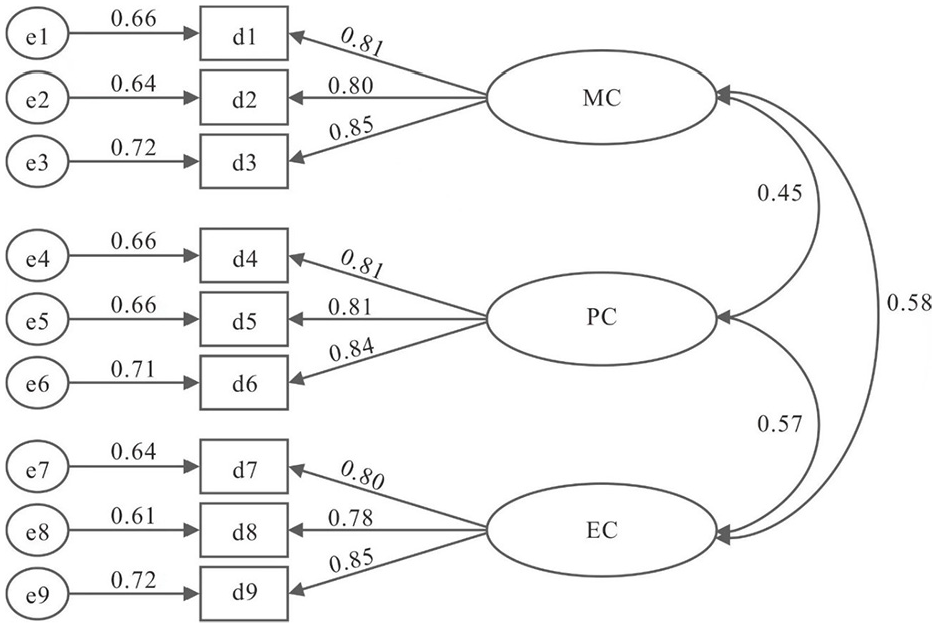
Confirmatory factor analyses of external behaviors.
The proposed three-factor model for external behaviors indicated good internal consistency and convergent validity. Specifically, the alpha value of the model was 0.873, and that of the sub-dimensions (MC, PC, and EC) were 0.859, 0.860, and 0.850, respectively. The CR values of the three factors ranged from 0.851 to 0.861. The AVE values for three factors were 0.671, 0.674, and 0.655, respectively, indicating good convergent validity.
Discussion
The study aimed to empirically identify the personality traits necessary for the four meta-categories (task-, relations-, change-oriented, and external) of effective leadership behaviors. We interviewed 132 respondents (executives of Chinese enterprises) and obtained the initial items for the personality traits pool. The Delphi method was applied to test the expert validity of 51 items. Thereafter, using a combination of interview data and expert feedback, we summarized 45 items. Subsequently, two questionnaires were distributed to a group of Chinese enterprise employees and their responses were analyzed. The dataset for the EFA was from the first questionnaire to extract two levels of indicators for each meta-category; the dataset collected by the second questionnaire was used to conduct several CFAs to examine the factor structure of each meta-category. The results indicated that the proposed models for each meta-category have good reliability, convergent and discriminant validities in the Chinese context.
The proposed framework identified personality traits similar to those in other studies. For example, Amagoh (2009) stated that an effective leader should possess significant abilities to implement and sustain strategic change initiatives. We proposed similar traits, such as innovation consciousness, describing a leader’s awareness and willingness to generate and identify new ideas, fresh perspectives, and innovative approaches when seeking to overcome challenges, as well as transformation competency, referring to a leader’s capacity to identify opportunities for innovation. Several fundamental personality traits, such as communication, planning ability, developing others, and courage, have also been identified in previous studies (Grimm, 2010; Reinertsen et al., 2005).
In addition, our findings indicated many personality traits that revealed the Chinese characteristics. Personality traits in moral aspects were emphasized, especially in our framework; for example, justice and equity, respect for others, caring about others, honesty and trustworthiness, judgment, modesty, and generosity. The importance of moral aspects in effective leadership can be explained by Chinese philosophy, as benevolence and ethics are the most fundamental values for individuals and leaders in the Chinese culture (Ma & Tsui, 2015; Zhu et al., 2019). We also found that the personality traits for practicing external leadership behaviors are based on morality, namely moral cognition, personal charisma, and external communication, as the traditional Chinese culture emphasizes effective leaders as ethical models for others (Chen, 2010).
Theoretical and Practical Implications
This paper makes several theoretical contributions to the leadership literature. First, we adopt mixed research methods to facilitate an in-depth exploration of the effective leadership in the Chinese context. Although previous studies have found that personality traits influence leadership behaviors (Judge et al., 1999; Roberts & DelVecchio, 2000), effective leadership behaviors from a Chinese perspective remain under researched. This study contributes to the field of effective leadership by identifying the personality traits necessary for effective leadership behaviors in China. This is among the first empirical studies to investigate who can perform leadership behaviors successfully; moreover, it can help scholars and practitioners better understand the specific individual characteristics required for effective leadership in China. Second, scholars have shown that cultural contexts should be considered in leadership studies (Gutierrez et al., 2012). This research highlights the competencies needed to practice effective leadership behaviors in China. We suggest a way forward for an additional empirical analysis of effective leadership in other high-context countries such as Japan and South Korea.
This study also has important practical implications for leadership development in organizations. The proposed framework provides clarity regarding the personality trait requirements in behavioral terms and could serve as a basis for establishing selection criteria, coaching tools, and development plans. In the current approaches to leadership development, it is common for a particular leadership theory to be chosen, and for individuals to be trained in leadership behaviors related to it (Day et al., 2014). Although leadership behaviors can be taught, they are founded on personality traits; therefore, development programs may be most effective when personality traits are considered. This study provides a blueprint for identifying the requirements of effective leadership and developing direct training initiatives. Additionally, the framework of personality traits serves as a guide for self-improvement and self-initiation in career planning and the development of effective leadership. For other countries and those interested in collaborating with Chinese organizations, the proposed framework could also be used as a reference to describe effective leadership in China.
Limitations and Future Directions
This study has several limitations, and offers opportunities for future research to improve and build upon our findings. First, it is limited to develop a scale that can be used to assess effective leadership in China. This study aimed to identify the personality traits necessary for practicing effective leadership behaviors and proposed a framework to describe effective leadership in China. We designed several studies to develop and conduct the items, examine the internal coherence, and test the convergent and discriminant validities of our proposed framework. This framework has the potential to be developed as a measurement scale for effective leadership. Future research can expand this study to assess the predictive validity of the measurement.
Second, the data obtained from multiple industries limits the accurate understanding of effective leadership in specific contexts. Leadership effectiveness may be influenced by external factors such as industry and organizational contexts; therefore, the combinations of personality traits affecting leadership behaviors may vary according to context. We collected data from multiple industries and organizations, rather than from any specific one. For wider practical applications, other scholars could explore the personality traits and leadership behaviors in specific organizational and industry contexts. Furthermore, this study is based on the participants’ perceptions of the Chinese companies. Future research could improve this design by including individual perceptions from other Chinese organizations and broadening the perspectives of the government sector, public organizations, and nonprofit organizations.
Third, this study focuses on the context of Chinese organizations, which may limit the generalizability of the findings to other cultural or organizational settings. Leadership effectiveness is influenced by cultural norms, values, and practices, which can vary significantly across regions and industries. Future research could expand on these findings by conducting comparative studies in diverse cultural contexts and organizational environments. Such studies would provide valuable insights into the influence of cultural dimensions on leadership traits and behaviors, contributing to a more comprehensive understanding of effective leadership across different cultural frameworks.
Thanks to an anonymous reviewer’s insightful comment, we acknowledge that one limitation of our proposed framework is based on effective leadership behaviors proposed by Yukl (2012). This study contributes to the discovery of the leadership traits necessary for practicing effective leadership behaviors in China and expands our understanding of effective leadership in the literature; however, we suggest that future research should further explore effective leadership behaviors based on outstanding Chinese leaders and investigate the requirements of leadership traits to better capture the construct of effective leadership in China.
Final, while this study identifies key personality traits necessary for effective leadership, it does not explicitly address “good personal character,” which has been emphasized as an essential trait by major religious leaders and philosophers such as Aristotle, Plato, and Confucius. The omission of this broader ethical dimension represents a limitation, as good personal character may play a critical role in fostering sustainable leadership and long-term organizational success. Future research should explore the integration of moral and ethical dimensions, including good personal character, into effective leadership frameworks proposed by Yukl (2012) to provide a more holistic understanding of leadership effectiveness, particularly examining how good personal character contributes to long-term organizational success and sustainability across diverse cultural and organizational settings.
Conclusion
China’s rapid development has encouraged scholars to explore the Chinese stories in different management topics. However, knowledge of effective leadership in China is limited. This study aimed to identify the personality traits necessary for effective leadership behavior practice and develop an empirically-based framework to discover certain traits, resulting in an efficient benchmarking for assessing the discerning personality traits for effective leadership behaviors in the Chinese context. It investigated the essence of effective leadership in China and provided new perspectives for leadership research. Further studies are required to explore other theories and perspectives on leadership in the Chinese context to provide a more comprehensive understanding of Chinese organizations and their development.
Footnotes
Declaration of Conflicting Interests
The author(s) declared no potential conflicts of interest with respect to the research, authorship, and/or publication of this article.
Funding
The author(s) disclosed receipt of the following financial support for the research, authorship, and/or publication of this article: This work was supported by Social Sciences Planning Project of Shandong Province [grant number 22DDJJ05).
Ethics approval statements
The Ethics Committee of Guangxi Academy of Medical Sciences approved our interviews (approval: No.KY-IIT-2022-17) on September 16, 2022. Respondents gave written consent for review and signature before starting interviews.

Data Availability Statement
Data sharing not applicable to this article as no datasets were generated or analyzed during the current study.