




Abstract
The purpose of this study is to reveal the relationship between effective school characteristics and effective leadership qualities from the perspective of a group of teachers in Antalya, Turkey, who were selected based on the demographic diversity of the population. The questionnaires “Qualifications of Effective Leaders Questionnaire” and “Effective School Characteristics Inventory” were used to collect data for the study. The data were collected from 560 school teachers working in the five central provinces in Antalya. Spearman correlation analysis and Linear regression were used in the study analyses. Consequently, the findings showed that there is a positive and significant correlation between effective leadership qualities and effective school characteristics. The results of the linear regression analysis further demonstrate statistically significant correlations. Specifically, there is a significant correlation between being democratic and tolerant, and limited learning obstacles. Additionally, a significant correlation exists between communication, excitement, and the dimensions of flexible resources, as well as focusing on basic skills. Lastly, there is a significant correlation between communication, excitement, vision, and monitoring students’ progress within effective schools.
Plain Language Summary
The purpose of this study was to explore the correlation between effective school features and effective leadership qualities of school principals in the case of teachers group constituted based on the demographic variety of the population in Antalya, Turkey. This research was conducted as a survey. The population of the study consisted of 560 school teachers working in the 5 central provinces in Antalya. In this research, the data were collected by “Qualifications of Effective Leaders Questionnaire” and “Effective School Characteristics Inventory.” In the analyses of the study, correlation analysis and linear regression were conducted. Consequently, the findings showed that there is a positive and significant correlation between effective leadership qualities and effective school characteristic. The result of Linear regression analysis further demonstrated that being democratic and tolerant had statistically significant positive effect on limited learning obstacles, communication and excitement had statistically significant effect on dimensions of flexible resources and focusing on basic skills, and finally communication, excitement and vision had statistically significant positive effect on monitoring students’ progress of effective schools.
Introduction
An effective school is an educational institution which achieves a high level of academic success and positive student outcomes (Leithwood et al., 2006). These schools accomplish their objectives and allow all learners to get meaningful learning experiences (Işman, 2004). The factors of an effective school include certain elements, such as (1) effective leadership, (2) shared vision and goals, (3) learning environment, (4) prioritizing teaching and learning, (5) purposeful teaching, (6) setting high expectations, (7) positive encouragement, (8) monitoring progress, (9) student rights and responsibilities, (10) fostering collaboration between home and school, and (11) establishing a culture of learning organization (Sammons et al., 1995).
Since effective schools emphasize pedagogical- curricular work, develop teachers’ professional capital, and create a positive learning and teaching environment, they contribute to the academic success of students (Bellei et al., 2020). By creating a student-centered learning environment, providing effective instructional guidance, and engaging families into students’ learning process, effective schools promote students’ academic achievement (Hill et al., 2023). In addition, effective schools tackle inequalities among students by aiming to improve all students’ performance (Arnaiz-Sánchez et al., 2019). Moreover, effective schools have a positive impact on the students’ unwanted behavior by providing a positive school climate and setting long-term achievement goals (Olsson et al., 2021).
Effective schools play a crucial role in shaping the educational field as they have an impact on students’ success, narrowing achievement gaps among students and creating more equal educational experiences, providing ongoing teacher development opportunities, and strong parent-school collaboration. Arnaiz-Sánchez et al. (2019) concluded in their study that effective schools have a great impact on students’ success due to comprehensive development, tackling inequalities, and improving academic performance as well as providing inclusive education for all students. Another study demonstrated that effective schools emphasize pedagogical-curricular work, teachers’ professional development, and positive school culture, which results in high educational achievements (Bellei et al., 2020). Similarly, Hill et al. (2023) concluded in their study that strong leadership, shared goals, positive parent-school relations, ongoing professional development of teachers, and collaborative relations in effective schools have a significant impact on students’ academic outcomes. Furthermore, Ramberg et al. (2019) explored in their study that effective schools have higher levels of teacher caring and support, which results in a positive impact on their motivation, learning outcomes, and social development.
Effective leadership is a crucial determinant of successful school setting and positive student outcomes. Fiedler (1967) briefly defined leadership as directing and coordinating subordinates, Burns (1978) defined it as the process of mobilizing subordinates with various motives, values and principles, with different economic and political characteristics, independently or through mutual interaction, by making use of competition and conflict to achieve goals. Strong leadership fosters creating a school culture which emphasizes high expectations from all stakeholders and continuous development (Hallinger, 2003). Thus effective educational leadership is essential for student success (Hallinger & Wang, 2015). Effective leaders also play a crucial role improving school achievement through creating appropriate learning environment, facilitating change in schools, and creating a collaborative school culture (Camarero-Figuerola et al., 2022; Karadağ et al., 2020).
Karadağ et al. (2020), who investigated the relationship between spiritual leadership, school culture and academic success, concluded that the elements such as hope, belief, self-sacrifice, vision, making a difference, efficacy and commitment that leaders show influence school culture, which affect school success in turn. Similarly, Kalkan et al. (2020) concluded in their study that leadership style influences the school culture so it is important to demonstrate strong leadership qualities in order to overcome administrative and instructional issues at schools. D. Chen et al. (2022) who investigated leadership styles that principals prefer in Germany and China and how they affect the achievement of students, concluded that principals’ leadership style has a direct impact on the student achievement even though the leadership styles preferred are different in these two countries. In addition, leadership affects teachers’ behavior and wellbeing. Shie and Chang (2022) found out in their study that authentic leadership has a direct effect on organizational citizenship behavior, which directly affects teachers’ well-being. Yazıcı et al. (2022) also concluded in their study that leaders’ adaptability and flexibility in case of changes have an impact on teachers’ commitment.
When the studies are examined, it is possible to see that a vast amount of research has been done on the effectiveness of schools. Furthermore, while there are many studies on topics such as leadership, effective leadership, and effective leadership in schools, no studies specifically address the relationship between effective leadership and school effectiveness and address this relationship in terms of any school stakeholder.
Therefore, the purpose of this study is to reveal the relationships between effective leadership, which will be discussed in detail in the literature review section, and the sub-dimensions of school effectiveness from the perspectives of teachers, one of the most important stakeholders of schools. In the following sections, a conceptual framework including studies on effective school leadership and school effectiveness and the methodology and findings of our study are mentioned.
Theoretical Background
Many researchers worked on the nature of leadership and effective leadership and many theories have been reached as a result of these studies. One of these theories is the path-goal theory based on Vroom’s motivation theory. According to this theory, the leader’s behavior is shaped according to the needs of his/her followers and the conditions in the work environment. In this context, four types of leadership behaviors emerge: (1) supportive leadership, which considers the welfare of employees and a positive organizational climate; (2) participative leadership, which provides participation in decision-making; (3) directive leadership, which reduces uncertainty in solving unstructured problems; and (4) achievement-oriented leadership, which seeks high-quality outputs by defining challenging tasks.
Effective leadership, which is a fundamental aspect of organizational success as it facilitates coordination, collaboration, and work for common goals, has a rich diversity in terms of representation in literature (Andenoro & Skendall, 2020). As there are many dimensions to explore, values to consider, principles to contemplate when defining leadership, it is complex and difficult to define (Raffo & Clark, 2018). The debate over the most appropriate leadership model for school principals has been dominated by four conceptual models: instructional, transformational, participative, and distributed leadership (Deligiannidou et al., 2020), and they all have focused that leaders have an impact on learning and teaching quality in schools. Leithwood et al. (2020) emphasized that effective educational leadership has an impact on school organization, which affects learning and teaching quality. Gurley et al. (2016) stressed that instructional leaders focus on learning in the school, and Bush (2018) noted the relationship between effective leadership and student learning outcomes. Thus as school leaders are an integral part of education, they act as the most effective resource in achieving school success (Doe et al., 2017).
Numerous studies have been made to identify the characteristics of effective school leaders and how these leaders transform their schools into effective learning areas, and to examine effective school principals and the effects of these principals on students’ learning and success (Barkman, 2015). Though it is conceptualized in different ways, certain features and principles are frequently referred to. One of these is effective communication skills, which encourage clear and effective interaction among stakeholders to support a democratic working environment and improve respect between leaders and other members (Moller, 2010; Salvaggio & Kent, 2016). When leaders have effective communication and are engaged to work, followers’ work engagement is also affected positively (Gutermann et al., 2017; Men, 2015). Today’s rapid developments require leaders to keep up with these demands for change. In order to accomplish this, it is important to gain the trust of other members (Agote et al., 2016). Another important principle is influencing members to show performance above and beyond their job descriptions (Alegbeleye & Kaufman, 2019). Empowering team members through guidance, mentorship, and development opportunities leads to motivation of the members and taking responsibility (Northouse, 2016). As schools have complex tasks including financial issues, curricular changes, and instructional challenges, it is necessary for leaders to create a culture to share and distribute leadership responsibilities (Bellibas & Liu, 2018; Hallinger, 2011; Hickey et al., 2022).
Within the scope of this study, the first dimension of effective leadership addressed is communication. School leaders who have good communication skills, can create a safe and effective culture at school, can express themselves well, and have good interpersonal skills, so themselves and other stakeholders feel responsible for students’ learning (Barkman, 2015). Communication skills of principals have a fundamental impact on the performance of teachers’ performance. When the principal is approachable, gives clear information in oral and written forms, discuss problems effectively, and gives proper feedback when needed a positive communication network exists in the organization (De Castro & Jimenez, 2022; Nguyen et al., 2017). Effective communication also involves teachers in decision making processes (Schneider & Burton, 2005).
The second dimension of effective leadership is vision. In order to develop sustainability, school leaders need to create and share a vision for the school (H.-H. Chen & Yuan, 2021). Visionary leadership facilitates a sense of purpose, work priority, and unity of organizational and personal principles and beliefs (M. Taylor et al., 2014). They set clear goals that ensure the success of all students, and communicate the goals precisely to all students and staff, so these goals help to develop a common vision between the leader and the staff (Klar & Brewer, 2013) and ensure that all stakeholders know their responsibilities and what is expected from them in achieving this vision. J. K. Chen and Chen (2013) stated that establishing a clear vision is correlated with the innovation in the organization, which is an important aspect of 21st century organizations.
The third dimension of effective leadership within the scope of this study is reliability and trust. Trust is defined as the state to intentionally accept the vulnerability regarding expectations of others’ positive behavior (Rousseau et al., 1998). As it can be accepted as a social capital, trust in the organization can support progress in organizational goals (Li et al., 2016).
The fourth sub-dimension is conceptualized as being democratic in this study. Being democratic encourages cooperation and collaboration of staff and leaders (D. Chen et al., 2022). Being democratic results in respect and understanding among the leader and employees (Salvaggio & Kent, 2016) and has an impact on the success of school and students (Leithwood et al., 2020).
The fifth dimension of effective leadership is consistency. When leaders’ actions and promises are inconsistent, followers’ approval of the leader decreases (Sorek et al., 2018). The inconsistency due to changes in plans and direction frequently leads to decrease in the credibility and the leadership, and causes confusion and uncertainty among employees (Falk & Zimmermann, 2017).
Another sub-dimension of effective leadership covered in this study is being excited about the work. When principals are excited about their job, they can inspire and motivate teachers, which results in better performance and higher job satisfaction (Cansoy, 2019).
Setting an example is the other sub-dimension of effective leadership in this study. School principals play a pivotal role in creating a culture in the school not only through their words but also with their actions, and serve as role models for all stakeholders showing principles, values, and expectations in the school (Hallinger & Heck, 1998). They set an example for teachers to encourage innovation, which results in unity in schools (Ayvalı & Koşar, 2021).
The last sub-dimension of effective leadership is positivity. Positive leaders contribute to the satisfaction, engagement, and the performance of the employees (Luthans et al., 2007) and they encourage a healthy and thriving organizational culture (Cameron & Spreitzer, 2012).
Effective school refers to the school that adds extra value to the outcome of the students compared to other schools (Sammons et al., 1995). According to Hoy and Miskel (2008), an effective school is the school that can achieve its goals in the best way. There are many factors influencing effective school and leadership such as teacher professional development, collaboration, quality in education and school outcomes, accountability, and sustainability (Andreoli et al., 2020).
The first study on the characteristics of effective schools was conducted by Edmonds (1979) and then Sammons et al. (1995) defined 11 key characteristics of effective schools. These are (1) professional leadership, (2) shared vision and goals, (3) a learning environment, (4) concentration on teaching and learning, (5) purposeful teaching, (6) high expectation, (7) positive reinforcement, (8) monitoring progress, (9) pupil rights and responsibilities, (10) home-school partnership, and (11) a learning organization. Doran (2004) on the other hand, listed the characteristics of effective school revealed in literature as leadership, high expectations, rules and discipline, mission focus, monitoring process, positive / supportive climate, time emphasis on duty, parent/community participation, staff development, basic skills, teacher participation in decisions, grouping procedures, teacher quality and other features.
The four sub-dimensions including limited learning obstacles, flexible resources, focusing on basic skills, and monitoring student progress of effective school are addressed within the scope of this study.
The limited learning obstacles dimension refers to eliminating all kinds of negativities preventing students from learning (Akcay Gungor, 2018). Thus both teachers and principals need to balance the increasing challenges of curriculum within limited teaching time (Kirk & Jones, 2004). On this basis, we developed our hypothesis as follows.
H1. Effective leadership sub-dimensions have a predictive effect on the school effectiveness sub-dimension “limited learning obstacles.”
The second sub-dimension of effective school covered in this study is flexible resources, which refers to using all material and human resources at school for the purpose of learning and teaching (Witmer, 2005). Within the context of Turkey, this dimension notes that school principals transfer school resources to the areas in need (Akcay Gungor, 2018). Based on this, our hypothesis is as follows.
H2. Effective leadership sub-dimensions have a predictive effect on the school effectiveness sub-dimension “flexible resources.”
Another sub-dimension of effective school is focusing on basic skills. Focusing on basic skills continue throughout the certain school duration, and contribute students’ background knowledge needed in the following learning period (Akcay Gungor, 2018). On this basis, we developed our hypothesis as follows.
H3. Effective leadership sub-dimensions have a predictive effect on the school effectiveness sub-dimension “focusing on basic skills.”
The last sub-dimension addressed in this study is monitoring student progress. School principals and teachers follow students’ learning performance throughout their school period and aim to increase students’ learning outcomes (Witmer, 2005). Monitoring progress regularly facilitates making any necessary changes to make corrections and improvement in plans (Jones & Harris, 2020). The related hypothesis is as follows.
H4. Effective leadership sub-dimensions have a predictive effect on the school effectiveness sub-dimension “monitoring students’ progress.”
Relationship Between Effective Leadership Qualities of School Administrators and Effective School Characteristics
Effective leadership qualities available in schools play a pivotal role in school effectiveness as it fosters students’ learning outcomes, encourages continuous teacher development, and creates a positive school environment. In a recent study, Ismail, Khatibi, and Azam (2021) concluded that there is a significant relationship between the instructional leadership of school deputy principals and school effectiveness in Maldivian schools. The study also highlighted that it is important for school principals to build collaborative school culture and to empower teachers to achieve school goals. Another study, which investigated the sustainability of effectiveness in Chilean schools over 10 years, concluded that leadership plays a pivotal role in making strategic decisions, maintaining stability, focusing on core dimensions in teaching and learning, creating a collective identity, and adapting changes (Bellei et al., 2020). Similarly, in their study Hill et al. (2023) concluded that effective leadership is essential for school effectiveness to set clear goals, motivate stakeholders for the goals of the schools, and create a collaborative relationship among stakeholders.
Method
In this study, it is aimed to examine the relationship between effective leadership qualities of school administrators and effective school characteristics. In this respect, the research is designed in accordance with the correlational survey methods to measure and describe the degree of relationship between two or more variables or score sets (Creswell, 2020, p.430).
Population and Sample
The population of the research consists of 16,534 teachers working in primary and secondary public schools in Aksu, Muratpasa, Dosemealtı, Konyaaltı, and Kepez districts in Antalya.
In this study, where the confidence level was 95% (z-score 1.96) and the margin of error (confidence interval) was taken as 5%, the sample size was calculated for the 16,534 population using the formula below where n: sample size, p: population proportion, E: margin of error.

Accordingly, since the population proportion was unknown, the formula was run with a value of 0.5 and a sample size of 376 people was reached for this study. The questionnaires were sent to 739 people in case of low return rates, 560 people returned the questionnaires and the research has been conducted with 560 randomly selected teachers working in aforementioned districts in the academic year of 2021 to 2022. Demographic background of the teachers constituting the research sample are presented in Table 1.
Distribution of the Participants Regarding Their Demographic Background.

As seen in Table 1, 366 of the participants were female and 194 were male. Of 560 participants, 267 were 31 to 40 years old, 175 were 41 to 50 years old, 68 were 21 to 30 years old, and 50 were 51 years old and over, and their seniority ranged between 1 year and more than 21 years. Of 560 participants, 202 taught primary education, 112 taught language and literature, 73 taught sciences while 45 taught social sciences, and 128 were the teachers of other branches.
Data Collection Tools
The data were collected through two different questionnaires in this study. The first questionnaire is the “Qualifications of Effective Leaders Questionnaire (ELNÖ-R)” developed by Turan and Ebiclioglu (2002) to determine the leadership skills of school principals. The questionnaire consists of 40 items in 7 dimensions including “Being excited,”“Communicating,”“Having a vision,”“Being reliable and trustworthy,”“Setting an example,”“Being democratic and tolerant,” and “Being positive” about the qualities of effective leaders. The second questionnaire is “Effective School Characteristics Inventory” which was developed by Matthew L. Witmer (2005) and translated into Turkish by Akcay Gungor (2018). The questionnaire consists of 14 items in four dimensions including “Limited learning obstacles,”“Flexible resources,”“Focusing on basic skills” and “Monitoring student progress” (Akcay Gungor, 2018).
In order to determine the reliability of these questionnaires, Cronbach’s Alpha coefficient was calculated. The Cronbach Alpha value of Qualifications of Effective Leaders was .98, and the Cronbach Alpha value of Effective School Characteristics was .94, which confirmed the reliability. In the analyses carried out by the developers of the original scales, the Cronbach alpha values were .98 and .96, respectively.
Although values above .95 Cronbach alpha are not accepted as good values due to the risk of item redundancy, no semantically repetitive item was found when the items included in the studies were examined. Thus, it is possible to say that the value of .98, which was found based on the fact that a high alpha value does not constitute scale unidimensionality (Cortina, 1993; Cronbach, 1951; Schmitt, 1996), does not pose a problem for the analyses used in this study.
Linear Regression Assumptions
There are various assumptions for the appropriateness of the model obtained by linear regression analysis (Albayrak, 2006), and these assumptions are listed below and checked separately for this study.
Homoscedasticity: According to this assumption, the variance of errors should be constant at the level of each independent variable, whether this variance is constant or not can be found by examining the scatter diagrams between errors and predicted values.
Multicollinearity: It is an assumption that there is no linear relationship between two or more independent variables and can be explained by looking at the Variance Inflation Factor (VIF) value. If the VIF value is above 10, it can be said that there is multicollinearity and the assumption is not met, but none of the VIF values in this study exceeded 10.
Independent errors: The residual values for any two data points should not be correlated with each other. This assumption can be tested with the Durbin-Watson test, which ranges from 0 to 4. A value of 2 indicates uncorrelatedness, while values greater or less than 2 indicate negative or positive correlation.
Linearity: It is observed with the scatter diagram and the relationship is assumed to be linear.
Examining outliers: It is assumed that there are no deviating units in the model and the presence of these units is examined with z-scores in this study.
Data Analysis
Firstly, missing data and extreme value analyses were made and outliers determined as −3 to +3 by calculating the z-score were removed in the data. Thus, 560 questionnaires were used for the analysis. Then Spearman correlation analysis was done to determine whether there is a significant relationship between the effective leadership characteristics of the administrators and the effective school characteristics as normality assumption was not provided as a result of the Kolmogorov-Smirnov and Shapiro-Wilk test results (p < .005). Since a positive and statistically significant relationship between the effective leadership characteristics of school administrators and the effective school characteristics perceived by teachers [r = .821, p = .000 < .01] was determined as a result of the Spearman correlation analysis, four different linear regression models were established in which the effective school characteristics sub-dimensions are the dependent variable and the effective leadership characteristics are the independent variables in order to evaluate the correlation between school administrators’ effective leadership characteristics and effective school characteristics. The results of the analyses related to these models are given in Tables 2 and 5.
Regression Matrices Between Limited Learning Obstacles and Sub-Dimensions of the Effective Leadership Qualities.

n = 560, R = .629, R2 = 0.396, F = 51.640, p < .01.
Regression Matrices Between Flexible Resources and Sub-Dimensions of the Effective Leadership Qualities.
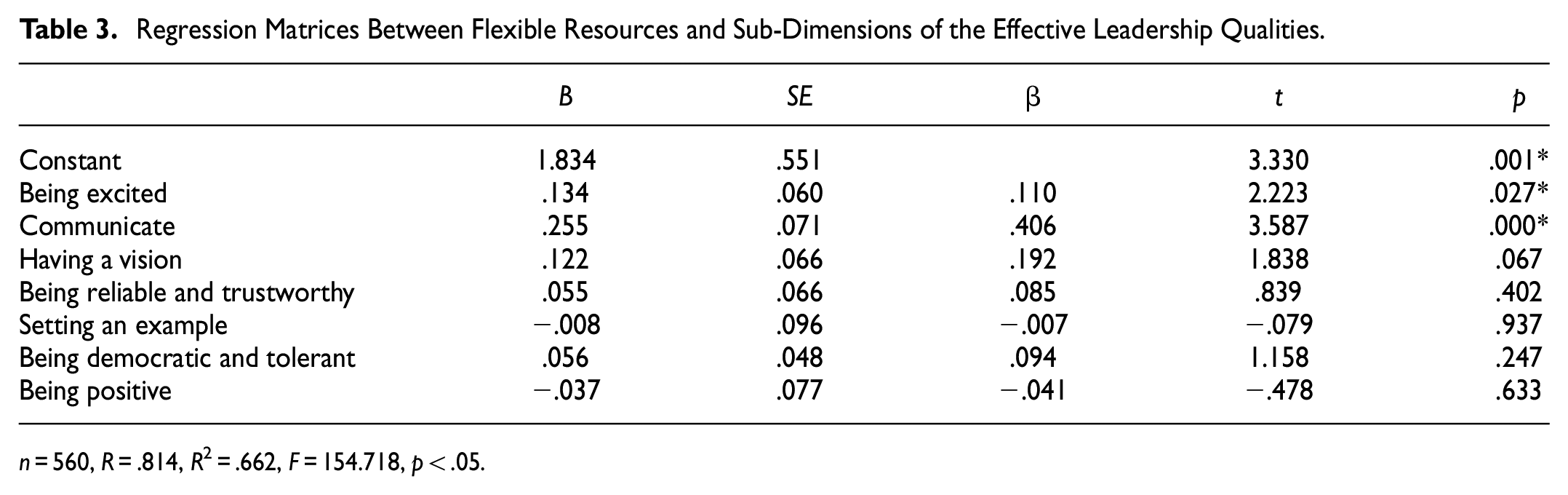
n = 560, R = .814, R2 = .662, F = 154.718, p < .05.
Regression Matrices Between Focusing on Basic Skills and Sub-Dimensions of the Effective Leadership Qualities.

n = 560, R = .704, R2 = .496, F = 77.546, p < .01.
Regression Matrices Between Monitoring Students’ Progress and Sub-Dimensions of the Effective Leadership Qualities.

n = 560, R = .711, R2 = .505, F = 80.594, p < .01.
Results
In order to evaluate the effect of school administrators’ effective leadership characteristics on the effective school characteristics, four different regression models in which sub-dimensions of the effective school characteristics are the dependent variable and the effective leadership characteristics are the independent variables were established. The results of these analyzes are presented between Tables 2 and 5.
As seen in Table 2, the results of the regression model, in which the sub-dimensions of the Effective Leadership Qualities were taken as the independent variable and the “Limited Learning Obstacles” sub-dimension of the Effective School as the dependent variable, was found significant (F = 51.640; p = .000). The Effective Leadership Qualities explains 39.60% (R2 = .396) of the dependent variable of “Limited Learning Obstacles.” When the significance levels of the parameters in the model are examined, it is seen that the sub-dimension “Being Democratic and Tolerant” has a positive and significant impact on the “Limited Learning Obstacles.” A 1 -unit increase in the “Being Democratic and Tolerant” sub-dimension causes an increase of 0.323 units in the sub-dimension of “Limited Learning Obstacles.” According to the results of the research, it can be said that “Being Democratic and Tolerant” is the most effective leadership skill on the sub-dimension of “Limited Learning Obstacles” of effective schools.
As seen in Table 3, the results of the regression model, in which the sub-dimensions of the Effective Leadership Qualities were taken as the independent variable and the “Flexible resources” sub-dimension of the Effective School as the dependent variable, was found significant (F = 154.718; p = 0000). The Effective Leadership Qualities explains 66.20% of the dependent variable of “Flexible resources” (R2=0.662). When the significance levels of the parameters in the model are examined, it is seen that the sub-dimension “Being excited” and “Communicate” have a positive and significant impact on the “Flexible resources.” A 1 -unit increase in the “Being excited” sub-dimension causes an increase of 0.110 units; 1 -unit increase in the “Communicate” sub-dimension causes an increase of 0.406 units in the sub-dimension of “Flexible resources.” Hence, it can be said that “Communicate” is the most effective leadership skill on the sub-dimension of “Flexible resources” of effective schools.
As seen in Table 4, the results of the regression model, in which the sub-dimensions of the Effective Leadership Qualities were taken as the independent variable and the “Focusing on Basic Skills” sub-dimension of the Effective School as the dependent variable, was found significant (F = 77.546; p = 0000). The Effective Leadership Qualities explains 49.60% of (R2 = .496) of the dependent variable of “Focusing on basic skills.” When the significance levels of the parameters in the model are examined, it is seen that the sub-dimension “Being excited” has a positive and significant impact on the “Focusing on basic skills.” A 1 -unit increase in the “Being excited” sub-dimension causes an increase of 0.264 units in the sub-dimension of “Focusing basic skills.” According to the results of the research, “Being excited” can be said to be the most effective leadership skill on the sub-dimension of “Focusing basic skills” of effective schools.
As seen in Table 5 the results of the regression model, in which the sub-dimensions of the Effective Leadership Qualities were taken as the independent variable and the “Monitoring students’ progress” sub-dimension of the Effective School as the dependent variable, was found significant (F = 80.594; p = 0000). The Effective Leadership Qualities explains 66.20% of the dependent variable of "Monitoring students’ progress” (R2 = .662). When the significance levels of the parameters in the model are examined, it is seen that the sub-dimension “Being excited”, “Communicate” and “Having a vision” have a negative and significant impact on the “Monitoring students’ progress.” The result of the analysis shows that the most effective leadership skill on the sub-dimension of “Monitoring students’ progress” of effective schools is “Communicate.”
Discussion and Conclusion
Studies in the literature reveal that effective leadership behaviors of school administrators are related to school effectiveness and students’ academic success (Bush, 2018; Gurley et al., 2016; Hallinger & Wang, 2015; Leithwood et al., 2020). Within the scope of this study it was found out that there is a significant correlation between effective leadership qualities perceived by teachers and the sub-dimensions of school effectiveness.
According to the research findings, it was concluded that there is a significant correlation between effective leadership and all sub-dimensions of effective school characteristics. As a result of the research, first of all, it was concluded that there is a correlation between the sub-dimension of limited learning obstacles of effective school and being democratic and tolerant sub-dimensions of effective leadership. This can be interpreted as school principals having a responsibility to create a democratic and comfortable environment for the effectiveness of the school. Jacobson et al. (2005) revealed the importance of creating a democratic environment to increase the effectiveness of schools and to strengthen solidarity and to reduce isolation among teachers. Ramberg et al. (2019) also emphasized the importance of creating equal and supporting opportunities for all students in an effective school. In a more recent study, Pashiardis and Johansson (2021) concluded that school leaders have an essential role to create a school culture which aims for accomplishment for all students regardless of their socio-economic status, gender, or ethnic background, and provide resource redistribution if needed. In their study, Helvaci and Aydogan (2011) also affirmed the impact of school administrators’ good relations and understanding with their staff on the effectiveness of schools. van der Vyver et al. (2014) also emphasized the importance of school principals’ care and understanding to encourage a positive working environment and high morale of teachers for the effectiveness of the school.
The study also revealed a significant correlation between the flexible resources sub-dimension of effective school and excitement and communication sub-dimensions of effective leadership. This result is in line with the study carried out by Abdurrezzak (2015), which stated that the school principal is responsible for making teachers feel comfortable and safe, and meeting their material needs for school effectiveness. Similarly, Klar and Brewer (2013) asserted that it is important for school administrators to support professional development and provide resources to reach goals taking individual needs into account in order to increase effectiveness of low-performing schools. In a recent study, Camarero-Figuerola et al. (2022) stressed that school leaders need to create an appropriate learning environment by encouraging cooperation and collaboration. Similarly, Yazıcı et al. (2022) concluded the impact of agile leadership to be open to new ideas, promote collaboration and dialog among teachers, and to encourage continuous learning for school. For the excitement sub-dimension of effective leadership, Lezotte and Ve Snyder (2011) also stated that an effective school administrator should be enthusiastic and confident and develop the appropriate strategies at work. Considering that school administrators have the pivotal role in leading others in Turkish schools, it may not be wrong to say according to this finding that the excitement they show can be motivating for other school stakeholders, and using an effective and school-friendly communication method to share this excitement may contribute to creating a positive climate throughout the school.
Thirdly, it was seen that there is a significant correlation between the focusing on basic skills sub-dimension of effective school and excitement sub-dimensions of effective leadership. Likewise, Olsson et al. (2021) emphasized in their study that effective leaders encourage all students’ success, focus on basic skills, and monitor students’ progress, which creates a favorable school ethos. Juharyanto et al. (2023) also concluded in their study that school principals, who can adapt quickly to cope with challenges and whose leadership skills contribute to the school culture positively, feel excited about their performance. This results in a positive school climate, motivated teachers, and innovative instruction approaches. Considering that the educational needs of students change rapidly in parallel with the advances in technology and the frequent policy changes in the national education system, it can be said that it is necessary for school principals to constantly monitor the basic skills of students and have the motivation and excitement required to acquire these skills.
Finally, it was pointed out according to the findings that monitoring the student development sub-dimension of effective school is significantly correlated with sub-dimensions of excitement, communication, and vision of effective leadership. School principals are primarily responsible for the management of school using resources effectively and creating a team spirit based on the regulations regarding the Turkish National Education System. Thus it may be right to say that their communication skills, excitement, and school vision are related to school effectiveness. Juharyanto et al. (2023) revealed in their study that the excitement of principals inspire teachers and encourage a continuous instructional development in school. They also added that open and clear communication of principals facilitates effective decision-making and problem solving processes in school, and enhances collaboration among teachers. Tahir et al. (2021) propounded in their study about novice principals that effective communication skills of principals are vital for positive relations with teachers, engaging parents, and coping with professional isolation in school. H.-H. Chen and Yuan (2021) concluded that creating a shared vision and collecting feedback from stakeholders contribute to a continuous development in schools.
Based on the study results, some suggestions for practitioners can be developed. Considering the relationship between the effective leadership features of school administrators and school effectiveness, it can be said that providing in-service training to school administrators could contribute to the effectiveness of their schools. In addition, it would be beneficial to include courses regarding flexible sources, communication, being excited and understanding in school leader training considering the correlation between these particular characteristics and school effectiveness. Furthermore, in the context of Turkey, it may be beneficial to suggest establishing professional schools to train school administrators. Moreover, for the policy makers, it could be facilitating to decide on the basic definitions and principles of effective schools. In this way, school principals and all other stakeholders could benefit from these while evaluating the school and the school leader.
Limitations and Direction for Future Research
It would be appropriate to conduct a new study with the dimensions of organizational culture from a broader perspective, in addition to the scope of these dimensions addressed only in this study. It would also be appropriate to enrich the results of this study with qualitative studies that seek answers to the questions “how” and “why” in addition to the quantitative methods applied between the dimensions that form the basis of this study and the questions “what?” and “at what level?,” and to include mixed method studies for this purpose; it will allow a clearer understanding of the relationship between effective schools and effective leadership skills.
Footnotes
Declaration of Conflicting Interests
The author(s) declared no potential conflicts of interest with respect to the research, authorship, and/or publication of this article.
Funding
The author(s) received no financial support for the research, authorship, and/or publication of this article.

Data Availability Statement
Data sharing not applicable to this article as no datasets were generated or analyzed during the current study.