




Abstract
The responsibility of specifying materials for building construction purposes within Nigeria rests on the architects. Understanding the appropriate parameters for specifying building materials that could lead to immense financial proportion is required from the architects. The level of understanding and knowledge of architects is germane to the optimum performance of buildings throughout their life cycle. The methodology applied for this research involved the administration of a structured questionnaire on professional architects within the study area to determine the basis of their decision on the materials they specify or chose for building finishes. The parameters used to measure the specification of materials for finishes are client’s choice, cost, climatic compliance, and maintenance demand of materials. Findings show that the maintenance demand of materials is the most important factor that determines the specification of materials irrespective of the choice of client and climate. However, cost occupies a prominent role in the decision process. It also shows that most architects are not fully aware about the role of climate in determining the life cycle of materials in tropical environments. The compliance of materials to ever-changing climate does not constitute a major factor in the specification of materials in the area.
Introduction
Materials for construction are required to meet environmental performance. This is determined through the compatibility of the material to the environment. Some of the parameters for determining the compatibility include the function, durability, and mechanical performance. The duties and responsibilities of architects in specifying appropriate materials for construction demand that the professional architects know the characteristic behavior of such materials and their compliance with the environment. Materials that require frequent replacement, in the submission of Chen and YongZhi (2012), are not resource saving and energy efficient. This will, consequently, negatively affect the environment from where raw materials are sourced for continuous production. This contributes to a large part of the world’s environmental degradation (Anink, Boostra, & Mark, 1996; Bribian, Capilla, & Uson, 2011; United Nations Environmental Programme, 1996).
Specification of building materials for the purpose of construction require greater attention than what currently exists. A broader understanding of these materials’ performance in relation to prevailing micro-climate is inevitable for architects. However, Emmitt (2011) submits that specifiers are usually very skeptical in specifying materials that are relatively new to them. This is due to the fear of failure even if the content is explained in the material’s catalog. Since specifications by architects determine the quality of the building at completion, it is essential and fundamental to clearly understand the process of material selection and the guiding principles.
The materials that are used as interior finishes are relatively protected from climatic elements while those used as exterior finishes are intentionally used to mitigate the impact of inclement weather on the building fabric. This agrees with Folorunso (2006) that materials used as exterior finishes are actually used as the last line of defense against the elements. It is required therefore that architects as specifiers are thoroughly familiar with the performance of whichever material is specified for external finishes.
The aim of this paper is to examine the parameters or sets of conditions that aid or influence the decisions and specification of exterior finishes for building projects in Lagos, Nigeria. It also emphasizes the need to pay adequate attention to reference information about different materials before specified for building projects.
Background Information
Specifications writing is a decision-making stage in the building procurement process. It determines the future cost of maintenance, quality, and duration of structure (Ali, 2009; Ali, Kamaruzzaman, Sulaiman, & Peng, 2010; Yiu, 2008). Decision making, however, varies according to Randell, Mitchell, Thompson, McCaughan, and Dowding (2009) in terms of ambiguity, complexity, and presentation. They submit that decision task has great influence on the actual decision that is finally taken. This stage, as posited by Majowiecki (2008), shows that contractual and specification documents are influenced by contrasting and circumstantial objectives. Some of these decisions are merely guided by past errors, experience, friend’s influence, availability, economy, and project budget as identified by Yechian and Ert (2011). The main issue of understanding the properties of the materials in order to determine their reliability and performance are rarely considered. Most times, specifications are based on sociocultural extraneous factors other than technical details.
The uncertainties that could result from decisions based on wrong parameters could be more than imagined (Hastie & Dawes, 2010). The place of reference information is in most cases replaced by experience despite the obvious changes in climatic factors that are been witnessed across the globe (Emmitt, 2011). The quality and performance of any building depend on the decision taken during specification. Emmitt and Yeomans (2001) draw a difference between the decision-making process before writing and the actual writing of specifications. This is done to eliminate the volume of error and wrong specifications that are being witnessed at the writing stage when specifiers are confronted with the realities of economic forces.
Past experiences play a major role in specifications writing among architects. This is adhered to in order to save time and minimize exposure to risk. This is in tandem with Franken, Pennings, and Garcia (2011) who submit that several decisions are taken in the building industry to minimize risk.
Researches in the area of specifications of building materials are relatively new. Mackinder (1980) as cited by Emmitt (2011) was the first noted researcher who conducted a study on how architects specify building materials. However, contemporary events have increased the quest for relevant and up-to-date information on products. The nature of the duties of the architect, which involve many responsibilities and mandates execution of projects, encroaches on the time required to study reference information that will aid adequate decision for specification. This explains why many decisions are made in favor of known products to save time, which may end up being at the detriment of the building.
Study Area
The study was conducted in Lagos, Nigeria, between March and July, 2012. Lagos, Nigeria, lies between latitude 6i40 north and 4i30 of the equator, and between longitude 2i50 east of the Greenwich Meridian. The study area covers approximately 3,577 km2 representing 0.4% of the country Nigeria in western part of Africa. Lagos has a population of about 13.4 million, which makes it the tenth largest city in the world. Although the area covers a very small percentage of the country’s landmass, it contains the largest concentration of human population in Africa.
Method
The research was carried out through a quantitative method that involved a field study. A well-structured questionnaire was developed to collect data for empirical analysis. The main respondents for the fieldwork were the registered architects practicing in Lagos. They were chosen because they are the people empowered by the constitution of the country to specify materials for building projects. A systematic sampling method of selecting 1 out of every 4 was adopted in randomly selecting 180 architects out of the existing 720 as listed in the ARCON Register of 2011. A total of 160 respondents returned the questionnaire. This constitutes 88.9% recovery, which is good enough for analysis.
The questions/constructs were put on a scale of 1 to 5 (1 = not at all, 2 = very little, 3 = somewhat, 4 = much, and 5 = to a great extent). It covers the reasons they have for specifying paint as an exterior finish in the area. These questions/constructs tagged V1 to V4 are as follows: V1 = reason for specification is due to client’s choice, V2 = reason for specification is due to cost consideration, V3 = reason for specification is due to climate compliance, and V4 = reason for specification is due to knowledge about maintenance demand of finishes. The frequency tables were run through the statistical package for social sciences (SPSS 15.0). V4 was used as the dependent variable against V1, V2, and V3 while calculating the multiple regressions.
Results and Discussion
The study was conducted using four variables as earlier discussed. Specifications state precisely and without ambiguities the materials to use, technology to be applied, and expected result. They are also described as an exact statement of particulars of something to be built by The American Heritage (2002). They are important in achieving a project goal and also ensure the safety of the structure. The sustainability of the building exterior wall is a precursor to obtaining optimal performance of the entire building (Horne & Hayles, 2008; Mwasha, Williams, & Iwaro, 2011).
Going through the analysis of the data as obtained through SPSS-15.0, the individual regression statistics obtained as shown in Table 1 below show that the variables V1, V2, and V3 at p < .05 are all significant on the maintenance demand of finishing materials, which constitute the greatest factor on which specifiers/architects base their decision
Test of Significance of Individual Regressions.

Source. Author’s Analysis (2012).
This is buttressed by the fact that 70% of the respondents as shown in Table 2 below agree much and to a great extent that the major factor they consider while deciding on specifying a material is the maintenance requirements. In all, 50% of their decisions are based on climatic consideration as shown in Table 2 below. This reflects that an important factor that determines the life cycle of building finishing materials, which are exposed to environmental conditions as stated by Hendry and Khalaf (2001) and as cited by Abu Bakar, Wan Ibrahim, and Megat Johari (2011), is not given a serious consideration. Although there is an interaction between the climate and the performance of exterior finishes that may consequently determine the rate of maintenance as identified by Smith et al. (2011), the low percentage of architects that paid attention to the issues of climate suggests that other parameters apart from climate influence their specifications. The elements of climate such as solar radiation, rainfall, and humidity are regarded as determining factors for the effective performance of finishes or otherwise (Onwuka, 1989). The current outcry about climate change requires that the reaction of materials to climatic behavior be made a priority for the specification of exterior finishing materials due to the performance required from such materials as a building’s last line of defense against climatic elements as posited by Folorunso (2006) and Singhaputtagkul, Low, and Teo (2011).
Frequency Distribution.

The percentage of the respondents who agree on cost of materials as a major factor in deciding which material to specify as shown in Table 2 is 56.2%. Folorunso and Fadamiro (2009) identify cost as the primary concern of every client. This shows that more consideration is given to cost than the changing climatic factors, though higher premium is placed on maintenance demand. An over consideration of cost at this stage of project procurement may end up being more expensive if cheaper materials of lesser quality are used. However, to base specification of materials for finishes on maintenance demand without proper consideration of climatic factors remains an irreconcilable issue because climatic factors are major determinants of the performance and maintenance of finishes.
As much as projects are expected to be kept within a cost limit, specification of high quality materials are not being jeopardized by architects practicing in the area. However, only 31.3% of respondents subscribe to the fact that clients’ choice play a significant role in the course of their job as shown in Table 2 below. The middle of the scale decision of 57.5% shows that despite the agreement of only a third part of respondents on the issue of clients’ choice, the specifications of architects in the area does not jettison the choice of the clients who are probably the end users.
This is supported by the fact that the client’s choice has significant impact on maintenance at p < .05 as shown in Table 1 above. In fact, clients’ choice as well as cost consideration and climate compliance of exterior finishes are all good predictors of maintenance demand of materials, which is the most critical issue that respondents in the study area do consider before specifying any material for finishes. This is further explained with a mode of 3.0, 3.0, 4.0, and 4.5, respectively, for the variables as shown in Table 3 below.
Mean and Mode of V1, V2, V3, and V4.
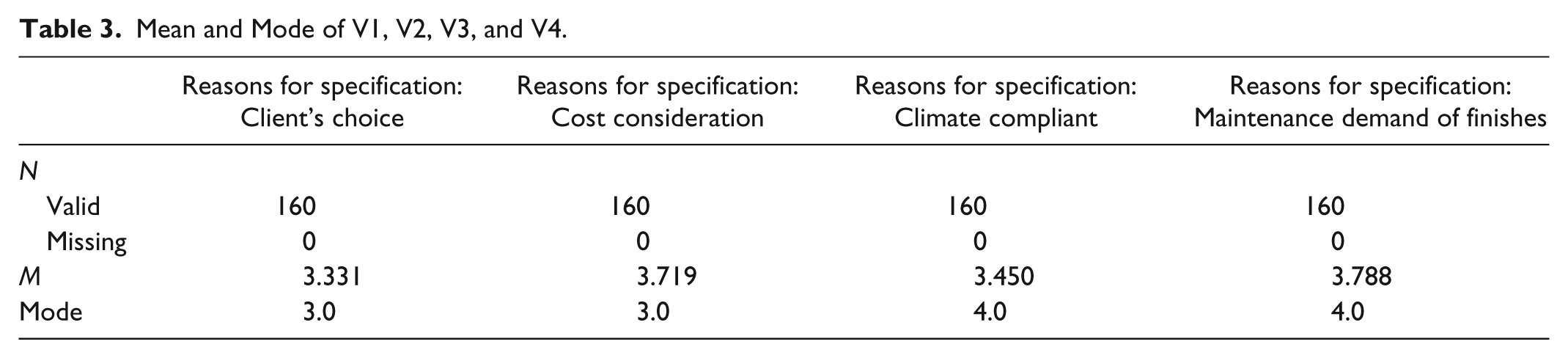
These variables equally, summarily, constitute 81.8% of the reasons for specifying building materials by architects as shown in the coefficient of multiple regressions (R2) in Table 4 below. It shows 81.8% of maintenance demand of finishes as the highest factor for specification of materials in the study area and is explained by V1, V2, and V3.
Coefficient of Multiple Regressions.

Coefficients—predictors: (constant); reasons for specification: climate compliant; reasons for specification: client’s choice; reasons for specification; cost consideration.
The F-calculated of 233.954 as shown in Table 5 below, which is higher than the F-tabulated of 2.663, further explains this phenomenon in the testing of the overall significance.
Overall Significance.
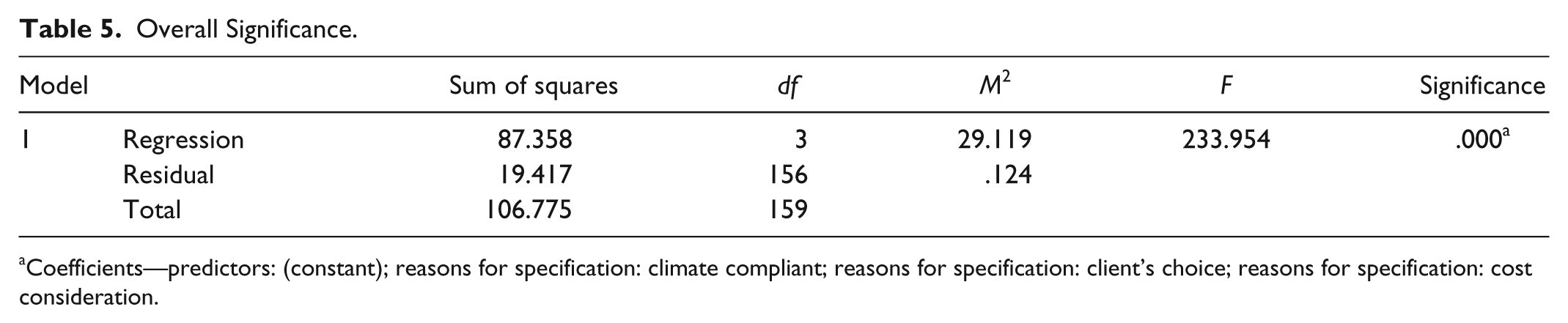
Coefficients—predictors: (constant); reasons for specification: climate compliant; reasons for specification: client’s choice; reasons for specification: cost consideration.
Conclusion
The research beams a search light on the bases for finishing material specification in the area. It identifies the underlining principles that are responsible for the decisions of the professional architects who are saddled with the responsibility of deciding for the client and other members of the building team.
This paper concludes that lack of proper information about the latest behavior of building materials due to climate change will lead to several wrong decisions that will aggravate and increase the need for maintenance. To achieve effective awareness maintenance, therefore, all building materials must carry information about their life cycle, performance, and rate of degradation under different parameters. This will enhance the specification, choice, and use of any material. It is also recommended, among other things, that the Standard Organisation of Nigeria step up its activity in ensuring that building materials are manufactured to comply with the minimum standard. Every product should be verified for compliance after production before it is allowed into the market
Limitations and Suggestion for Further Studies
Other parameters such as the quality of the materials, the level of knowledge about building materials, sociocultural preferences, aesthetics requirement and experiences gathered in practice, availability of a particular material, ability of local craftsmen to handle or fix a particular material, and the level of adherence to professional ethics were not considered in this study. This paper suggests that the above mentioned factors are necessary for investigation in order to authenticate this result. This will help to holistically unravel the factors that are responsible for the specification of building materials in the area.
Footnotes
Declaration of Conflicting Interests
The author(s) declared no potential conflicts of interest with respect to the research, authorship, and/or publication of this article.
Funding
The author(s) received no financial support for the research and/or authorship of this article.