




Abstract
This study seeks to examine programmatic efforts focused on developing a capacity building learning environment as a pathway to genomic science for underrepresented minority students. Students participated in a survey (n = 51); a subsample participated in focus groups (n = 11) as well as on a pre- and postskills assessment activity (n = 17). Overall, findings indicate that the programmatic intervention has assisted students in several areas such as (a) creating opportunities in science fieldwork and research, (b) preparing them for graduate school, and (c) serving as a pipeline for science research and careers. Furthermore, focus group participants expressed that the program has assisted them in gaining concrete experiences in (a) science research, (b) learning about their options in science, and (c) learning how to continue in a science academic path. The program has also assisted students in achieving and successfully planning their long-term goals in science-related fields.
In an era of globalization, the United States faces a crisis that will require the expertise and efforts of a diverse scientific community to address national and international challenges emerging from environmental, science, and the technological industries’ impending growth (Nelson, 2007). General statistics across the nation show that during the two decades between 1984 and 2004, minority undergraduate enrollment increased from 1.9 to 4.7 million, a growth rate of 146% (National Center for Education Statistics, 2007). This growth rate is higher than that of White undergraduate enrollment (15%) and raised the overall proportion of undergraduate students (e.g., Black, Hispanic, Asian, and American Indian) from 18% in 1984 to 32% in 2004 (National Center for Education Statistics, 2007). However, as underrepresented minority students seek higher education (e.g., medical school, dental school, and graduate school in the sciences), the trend seems to be disproportionately low for these students. Minority groups are severely underrepresented among the senior scientific workforce; this problem is particularly amplified among biomedical and behavioral researchers (National Academy of Sciences, 2007). For example, of the 4,396 doctorate degrees awarded in the biological sciences in 2005, just 158 (3.6%) went to African Americans, 227 (5.2%) to Hispanics and 12 (.27%) to Native Americans (National Academy of Sciences, 2007).
However, the racial/ethnic composition of our nation is projected to change drastically in the coming decades. For example, across the United States, English language learners (ELLs), mostly minority students, are the fastest growing segment of the student population. Just in one decade, 1991-1992 through 2001-2002, the number of ELL students in public schools grew 96%, while total student enrollment increased only 12% (Francis, Rivera, Lesaux, Kieffer, & Rivera, 2006). ELLs’ enrollment grew 200% in at least 15 states in the United States (Francis et al., 2006). These current trends, as well as the above demographics on minority students currently in science paths, call attention to the need for programmatic efforts in the development of learning environments that would provide pathways for minority students into science careers. Currently, there is still a gap in the academic opportunities for underrepresented minority students as they aspire to enter science fields such as genetic/genomics research (Mitchell & Lassiter, 2006). Therefore, the development of intervention programs seeking to ameliorate these disparities within science research become important and necessary. This exploratory study examines program characteristics that may serve to support the academic development of minority students in science.
Research Framework
This study examines programmatic interventions that encompass a learning environment research framework. Learning environment research focuses on indicators and points of leverage that promote students’ success by the development of supportive systems that serve as protective factors for students’ academic success (Benard, 2004; Condly, 2006). Theoretically, learning environment is an area of research that has important implications for the educational improvement of minority students. Empirically, it focuses on examining students who succeed in academic settings despite the presence of adverse conditions (e.g., low socioeconomic status [SES], single-parent home) that may place these students at risk of academic failure. This framework is focused on the predictors and protective factors for academic success rather than on characteristics of students’ academic failure, which may help us design more effective educational programs to foster minority students’ success in genomic science.
Literature Review
The impact of the learning environment, for students’ academic success, has been extensively researched in the past three decades (Borman & Overman, 2004; Downey, 2008; Fraser, 1990; Haertel, Walberg, & Haertel, 1981; Masten, Herbers, Cutuli, & Lafavor, 2008; Morrison, Brown, D’Incau, O’Farrell, & Furlong, 2006; Nettles, Mucherah, & Jones, 2000; Padron, Waxman, & Huang, 1999; Waxman & Huang, 1996). Several major reviews and research syntheses of these studies have concluded that the sociopsychological environment significantly affects students’ cognitive and affective outcomes as they make decisions on their academic pathways (Fraser, 1990; Haertel et al., 1981). For example, the work by Chang, Eagan, Lin, and Hurtado (2011) identified barriers for underrepresented minority students in science, technology, engineering, and mathematics (STEM) disciplines. Their work pinpoints to specific institutional parameters that affect the environment experienced by students in their academic path, including structural diversity, the psychological climate, and the behavioral climate. Hence, Chang et al. pointed to the importance for institutional members to become “deliberate agents of socialization” to affect in positive ways the psychological climate of their institutions.
Furthermore, from a theoretical perspective, learning environment research emphasizes the student-mediating or student-cognition paradigm, which maintains that how students perceive and react to their learning tasks in science and classroom instructional activities is more important in terms of influencing student outcomes as they chose a pathway to science (Knight & Waxman, 1991). This is because students’ perceptions of the learning environment are essential for understanding the opportunities for learning that are provided to each student in any given educational field (Fraser, 1990). In other words, this paradigm assumes that better understanding and the improvement of teaching and learning experiences within science programs can emerge by examining the ways that instructional activities and the learning environment are viewed or interpreted by the students themselves because students ultimately respond to what they perceive to be important (Chavez, 1984; Schultz, 1979). For example, in a study of factors affecting the persistence of undergraduate women of color in STEM disciplines, Whittaker and Montgomery (2012) reported that involvement in research programs and engagement in peer discussion related to course content are among the key factors contributing to persistence in STEM. Furthermore, their research also point to the importance of programs that provide sustained engagement of students and sustained mentoring (Whittaker & Montgomery, 2012).
Researchers have also examined the attitudes and perceptions of students toward their learning environment and these studies have yielded some important findings. In one such study, Waxman and Huang (1996) compared the motivation and learning environment of 75 resilient and 75 nonresilient minority students and found that resilient students had significantly higher perceptions of involvement, task orientation, rule clarity, satisfaction, pacing, and feedback than nonresilient students. These findings indicate that these are important factors that need to be present and foster in effective programs seeking to affect students’ academic success. Furthermore, the research by McGee and Keller (2007) also indicates that there are five key characteristics that predicted students who went on to PhD and MD/PhD training or to MD training intending to do research. They include (a) curiosity to discover the unknown, (b) enjoyment of the problem solving, (c) a higher level of independence, (d) desire to help others indirectly through research, and (e) a flexible minimally structured approach to the future. These seem to be key characteristics that need to be fostered and supported in learning environments seeking to engage minority students into science.
The benefits of developing a healthy learning environment have also been examined by researchers who have focused on the capacity building mechanisms that lead to students’ academic improvement (Borman & Overman, 2004; Downey, 2008; Haertel et al., 1981; Masten et al., 2008; Morrison et al., 2006; Nettles et al., 2000; Waxman & Huang, 1996). Some key characteristics for their academic success include (a) developing a more socioculturally congruent environment for students, (b) using feedback from students on environmental and perceived importance of program activities, and (c) tailoring opportunities for learning that are positively viewed by students (Waxman, Padrón, Shin, & Rivera, 2008). To this, programmatic responses have come in the form of several program component such as (a) development of social networks for students’ success (Buchwald & Dick, 2011), (b) undergraduate research science field experience (Wei & Woodin, 2011), and (c) development of core skills and knowledge in the chosen science discipline (Krilowicz, Johnston, Sharp, Warter-Perez, & Momand, 2007). In the next section, we provide a description of the program explored in this study that contains some of the elements cited in the literature.
Description of the Program
The Human Genome Sequencing Center (HGSC) at Baylor College of Medicine (BCM) provides a learning environment with training opportunities for underrepresented minorities (URM) to facilitate an interest in a career in the genomic sciences. At the time of this exploratory study, the HGSC was one of the three National Institutes of Health (NIH)–funded Genome Centers that contributed to the sequencing of the human genome and now is dedicated to investigating the genetic basis of inherited diseases and cancer as well as the involvement of minorities in personalized medicine. It has 200 staff including at least 20 PhDs, and the majority of the workforce has bachelor’s degrees. The HGSC provides an environment to train individuals for careers in Genomics, and it has also attempted to grow the representation of senior minority scientists since its inception.
To accomplish its objectives, the HGSC has engaged in three goals focused at enhancing the learning environment and supporting resilient behaviors of minority students in genomic science: (a) increasing the participant pool generally by stimulating students’ interest at multiple stages of their educational development; (b) retaining the participant pool via support services such as course experiences, mentorship, financial aid, bridging programs, and academic activities designed to motivate students into the genetic/genomic fields; and (c) strengthening the participant pool via acquisition of knowledge, academic enrichment, and development of skills deemed important for their success as future scientists. This exploratory study examines some of the areas in which the program is having success as expressed by students during surveys, pre- and postassessment of skills, and focus groups.
Method
Research Questions
Participants
This exploratory study involved 51 students who have participated or are currently participating in the Human Genomic Sequencing Center (HGSC) programmatic activities. They all participated in the survey portion of the study and a subsample of volunteers participated in focus groups (n = 11). The focus group participants involved a purposive sampling with representation from a wide spectrum including postbaccalaureate, laboratory technicians, and former summer program participants as well as research technicians who work at BCM but who are not in a HGSC-funded program. Furthermore, 17 participants completed an assessment of skill form. Although this assessment was applied to all 51 students, only 33% (n = 17) completed the preassessment task. Pre-and postassessment skill data are reported for those participants for whom postdata were available.
Some characteristics of participants were also examined such as ethnicity, gender, educational background, and academic achievement at point of entry into the HGSC program. In relation to their ethnic distribution, 78% were African American, 11.8% Hispanic (Mexican decent), 5.9% were “Other Hispanic” (e.g., Central and South American), and 3.9% defined themselves as “Other” and indicated a mixed ethnic background. The gender distribution of the group was 68.6% females and 31.4% males. Participants were also asked if they were the first ones in their family to attend college; 33% indicated that they were the first ones in their family to attend a 4-year university; 38% indicated that they were the first ones in their family to attend a master’s program; and 49% indicated that they were the first ones in their family to attend a PhD and/or MD program. Academically, undergraduate students had a mean grade point average (GPA) of 3.36 on entering the program (SD = 0.36) and among postbaccalaureate students entering the program, they had a mean GPA of 2.92 (SD = 0.41).
Instruments
In general, the design of this exploratory study involved the application and analysis of several instruments including (a) the BCM Summer Research Program Skills Assessment Form, (b) a student’s postprogram survey, and (c) focus groups. The BCM Summer Research Program Skills Assessment Form was designed to be applied as a pre- and postassessment for each participant. It is completed by the students as they enter the program (e.g., postbaccalaureate or summer undergraduate), as well as when they exit, to assess the level of skills prior to entering the program and those skills gained as a function of the HGSC intervention. The Skills Assessment Form indicates students’ skill levels in areas such as computer knowledge (programming, etc.), technical experience in chemistry (e.g., chromatography, etc.), or immunology (e.g., antibody production) to name a few. In addition, the survey instrument gathered socioeconomic information about participants and their families as well as information on the program’s impact as identified by each participant. Overall, the survey served to gather the following information: (a) SES background of participants such as their ethnicity and family educational history; (b) participants’ experience with research, laboratory experience, and work experience; and (c) participants’ academic activities such as their pathways to genomic sciences. Also, similar themes were examined during the focus groups. A focus group protocol was developed containing 13 questions that focused on examining, in depth, general categories addressed in the survey. Examples of the questions include (a) What are some of the areas in which you think that the program has had a positive impact in realizing your goals? (b) What are some of your academic experiences in the program that you found more beneficial? How were they beneficial? and (c) Has the program helped you gain confidence to go to graduate school? How? Can you give us some concrete examples on what you are accomplishing due to your involvement in this program? Questions such as these helped in our research efforts to acquire a thicker qualitative description of the factors that students felt were of importance in their scientific academic development. This line of inquiry also assisted in the continuous formative development of the HGSC programmatic activities.
Procedure
The HGSC at BCM established a Minority Action Plan funded by the National Human Genome Research Institute (NHGRI) to expose URM to genomic science careers. They have developed intervention programs at the undergraduate and postbaccalaureate levels to address the unmet needs of URM in the genomic sciences. This initiative includes several programmatic components such as a post baccalaureate, summer research, and engineering scholarships. A qualitative and quantitative description of each program and its activities is provided.
Students volunteered to participate in the research survey. Also, a purposive sampling of students was recruited for the focus groups. Two focus groups, of approximately 1 hr and 30 min each, were carried out with the same group of participants (n = 11). This allowed for each participant to respond to all questions as well as it also provided the opportunity to clear out any misunderstanding or lack of clarity from previous responses to the first focus group session. The sessions had a mediator (one of the principal investigators) who ensured that all students responded to the questions while the other researcher was in charge of managing the video camera. The videotaped focus groups were later transcribed and coded by one of the principal investigators. The coding followed a data reduction approach to examine general categories emerging from participants’ responses to each question. When possible, students’ names or identifying characteristics were deleted from the records to assure confidentiality. However, for the qualitative description of some of the participants, their authorization was obtained to include their stories in this study.
Results
In general, the findings from this exploratory study are presented in a mixed method research approach. First, a qualitative descriptive analysis of the HGSC intervention program and key activities is offered. This analysis not only includes examples of students but also examines processes leading to their academic achievement. The goal of this first section is to provide a thicker qualitative description that may serve others in similar programmatic efforts. Second, a section on the quantitative analysis of the surveys and Skill Assessment Forms are presented, using descriptive statistics. Also, categories that emerged from the focus groups are incorporated to provide a more descriptive interpretation of the results from the survey and Skill Assessment Form. The goal of this section is to show that the findings are not only for some individuals in the sample but also to show that students are systematically thriving within a learning environment that is providing pathways into genomic research.
Qualitative Findings Across Programmatic Activities
HGSC-Pregraduate Education Training (PGET)
This postbaccalaureate program focuses on providing assistance to students at different levels of the educational spectrum. Participants in this program include students and alumni pursuing a PhD, MS in Science, MPH, PharmD, and employees at the HGSC. The HGSC employees are either technicians who already work in HGSC on the Human Genome Project in some capacity and their program activities are designed around their work schedule, or they are research technicians who work outside the HGSC in research laboratories where they conduct their own independent research projects. The two types of postbaccalaureate technicians are exposed to a diverse range of genomic research and academic activities. The HGSC-PGET program provides research training and academic enhancement activities for 2 years.
These academic enhancement activities are purposeful and focused to guide students into a scientific career path. They seek to develop their capacity and self-efficacy in research. The development of a successful program focused on building self-efficacy in research is twofold. First, it requires an understanding of the ecology in which the students reside to provide the best viable path in their pursuit of a science career. Second, it is fundamental to design a program that is tailored to the needs of subgroups within the general minority population of students seeking advancement in the fields of science. Some of the activities in which participants are involved, such as courses and research, are vital to their development as scientists. For example, each week during the fall semester, a genomics scientist presents a lecture on his or her area of expertise. The scientist presents research from the laboratories in which students are usually involved in projects. Through this activity, students in the program learn how the work, in which they are engaged, is connected and related to the research being done around the country. This hands-on experience assists students to connect their learning with future career paths in science.
Another key component of the program is mentorship. Participants are introduced to faculty members or other science professionals, each month, to learn from these professionals and meet potential mentors. Part of their practicum experience also involves weekly meetings to discuss various scientific topics, and at the end of the program, all of the participants give an oral presentation. This requires them to investigate various research and opportunities in their focus areas. These two activities increased their sense of worth in their respective jobs and training, and they give participants additional confidence to pursue graduate degrees. For example, during focus groups one participant expressed the impact of the program as follows: My experience has helped me a lot. It has made me become more confident with the techniques I learned in the lab. A lot of other molecular theories; I am putting everything I learned in undergraduate to practice now and becoming more confident in reading the science papers; and actually doing research projects and all. (Focus group participant, Transcript File 13)
The program also seeks to create ecological spaces within the scientific community for students to participate in scientific activities. For example, through one of their grant-seeking efforts, HGSC received funding to support three recent college graduates in their postbaccalaureate program from the National Institute of General Medical Sciences (NIGMS) in 2004. These three participants conducted biomedical research in laboratories outside of the HGSC. These NIGMS postbaccalaureate fellows had research projects that varied from defining the molecular mechanism of Smurf 2—mediated Smad 2 degradation—to determining the role of TLR2 (toll-like receptor) in the induction of myocardial dysfunction by the pathogen Staphylococcus aureus, to determining the function of the germ line–specific nuclear protein PIE-1 in Caenorhabditis elegans germ cells.
For example, one of the fellows, Lori, presented a poster at the 2005 Pediatric Academic Societies’ meeting. Another fellow, Stacy was second author on a poster presented at the Fifteenth International C. elegans meeting. Since then, both have been admitted into graduate programs and are PhD candidates. Lori was admitted to BCM in the Molecular Virology and Microbiology Department and Stacy was admitted to the University of Pittsburgh’s School of Public Health in the Human Genetics Department. Their success led HGSC to look for similar opportunities for other students as a form of intervention for the development of successful academic paths. Due to their previous success, in 2006 NHGRI funded their proposal to include research postbaccalaureate fellows; they were recent college graduates who conducted independent research projects and were not working as research technicians in the HGSC pipeline. They supported three new postbaccalaureate research fellows in the HGSC-PGET program. These participants conducted their own independent research projects in HGSC research laboratories or Molecular and Human Genetics department with a slightly modified schedule. They experienced the research pipeline by interacting with graduate students, postdoctorate fellows, and research personnel. Components of the HGSC-PGET program were modified to meet the needs of these students. For example, these students were guided to take the HGSC Graduate Record Examinations (GRE) prep course, molecular/cellular biology courses, and then began the activities for graduate admission.
Genetics/Genomics Research Education and Training Program (HGSC-G/GREAT)
The second component of the overall minority action plan is the HGSC-G/GREAT program (formerly known as HGSC-SMART-Summer Medical and Research Training Program). Prebaccalaureate students enter the program to gain insight on how to conduct research in the future as well as on how to follow a science career path. Some of the first activities in which students are involved include HGSC orientation, dinner with the HGSC director, monthly meeting, and research discussions with HGSC faculty and other Texas Medical Center (TMC) professionals. During the summer, students are employed as HGSC staff. This opportunity provides students with further exposure to the Human Genome Project and related activities. Students also participate in activities such as visits to the Museum of Natural History to see the exhibit, The Living Genome: Reading the Book of Life. These students live in the same dormitory along with other summer students at BCM. The activities are provided to the program participants for 9.5 weeks of the summer.
The flexibility of the program toward meeting the needs of the students has added to its success and impact to students’ academic development. For example, when the students arrive, they are placed in HGSC-independent research laboratories, Robotics, or at the Human and Molecular Genetics department faculty research laboratories. HGSC-independent laboratories provide research projects on topics such as “Identifying Genes in the Retinal Differentiation Pathway in Drosophila,” “Developing a Novel DNA Sequencing Strategy,” “Modifying Robots for Specific Laboratory Protocols,” and “Identifying SNP’s in Ion Channel Genes.” The other laboratories where students are placed also provide research opportunities on topics such as Germline Development in C. elegans, Study Mutations Found in Patients With Dilated Cardiomyopathy, and Characterizing Genetic Variants in Various Pediatric Populations, to name a few.
Overall, this exposure to various topics and activities in genomics builds self-efficacy and encourages the students to consider a career in genetics/genomics sciences. HGSC schedules most of the program activities after work hours to accommodate the students’ needs. The program also provides group tutoring sessions conducted by BCM graduate students to enhance the summer students’ learning experience. During the last week of the program, the students present their research projects to their research mentors and HGSC faculty. At the end of their oral presentations, the students are required to complete an in-depth program evaluation. Mentors and faculty determine which students will be supported at the national student research conferences. Thus far, the program has supported nine of the most outstanding students, and one of the students, Erica, won first place in the oral presentation category at the 2004 Annual Biomedical Research Conference for Minority Students (ABRCMS) conference. Erica is currently a doctoral student at the University of Alabama–Birmingham.
HGSC Engineering Scholarship Program
This is the third component of the minority action plan. It is an intervention program that begun in 2002. The first student selected to participate in the program was Sidney. As a result of the HGSC support, he received an associate’s degree in science from the Houston Community College (HCC) and subsequently was accepted in the Mechanical Engineering Department at Prairie View A&M University. The HGSC Engineering Scholarship program provides academic activities until students graduate with either a bachelor’s or master’s degree.
A qualitative description of Sidney’s success is critical to understanding how and why the program has been successful in creating pathways for student’s academic success. For example, after the HGSC director selected Sidney as the recipient of the HGSC Engineering Scholarship, he enrolled in the local community college (HCC). Sidney was guided and recommended to become a member of an engineering society to meet other students in his field of interest. This mentoring process was important to increase his experience in engineering in an effort to engage him in activities with other aspiring engineers. Sidney was also encouraged to attend engineering society conferences and professional meetings related to his job at HGSC. In 2005, he resigned from his position at HGSC to pursue his bachelor’s degree without the pressures of his duties (e.g., supervisory role, robot maintenance, being on call, equipment maintenance, and maintaining stock of center repair equipment). As engineering courses are not available during the summer session, the program director encouraged Sidney to return for a summer internship. He worked in a laboratory, with a HGSC faculty, who has both engineering and biomedical research projects. This was a great opportunity for Sidney to work on a research project involving a novel sequencing technology. This academic activity also opened new doors for him, in the form of a part-time job, so he could continue to work on the project while attending school. The principal investigator of this project was supportive of his educational desire and allowed Sidney to work around his class schedule.
Overall, the above qualitative description examined the processes utilized by the HGSC for engaging minority students in genomic science. The success of the programs can be attributed to several factors including relationships with universities and programs that encourage minority students to obtain PhDs, cooperation from BCM faculty to allow students to work in their laboratories, and close working relationship with both BCM graduate and medical programs. The following section addresses some of the quantitative results of this exploratory study. It provides some preliminary data on the impact and satisfaction with the programs as expressed by the students.
Quantitative Findings of Overall Program Effectiveness
Descriptive analyses of the data were performed using the Statistical Program for the Social Sciences (SPSS). Group means were analyzed along the dimensions of program membership. Group perceptions of the academic learning environment, academic activities, and satisfaction with program were measured by surveys and pre- and postassessment skills of students. Patterns that emerged from the focus groups were also used to further describe and interpret the quantitative findings. Due to the small sample size, we are not able to report on statistical significant differences; however, positive trends emerging from the data are examined.
Figure 1, reflects the assessment of pre- and postskills gained by participants in the program. It shows students’ needs to gain more work experience in science as well as laboratory experience to be competitive applicants for any graduate program in the future. As expected, students in the PGET postbaccalaureate program entered with a higher degree of completed course work and some laboratory experience. This is usually related to their courses taken as undergraduates. However, as shown in Figure 1, they enter the program with minimal scientific work experience and minimal empirical research that would provide them with significant experience for successful entry into graduate school. At this point in their career, they were not able to connect their course work with the type of research experience that will direct them into a science research career path. Of the 17 students included in the analysis, 3 are currently in PhD programs; 1 student has graduated with an MPH and is now considering obtaining a PhD; and the rest continue with their work and professional development in their respective programs. Although the sample only includes 17 students, the trends observed, in Figure 1, help to focus efforts in areas in which the program may have a tangible impact. Furthermore, the knowledge of their preprogram skills also facilitates tailoring the program in significant ways to assist in their professional development.

Preskill assessment of scientific fieldwork by HGSC entering students.
Figures 2 and 3 examine individual participants’ pre- and postskills in science work as well as their college laboratory experience. These figures include those participants for whom pre- and postdata were available. The figures show an increase in students’ level of scientific work experience and laboratory work experience as they exit the program into higher education. These individuals’ pre- and postassessment exemplifies their growth through their participation in the program. The group’s mean in scientific work experience preprogram skill mean = 1.53 (SD = 1.84) and postprogram skills mean = 3.38 (SD = 1.41) revealed gains by participants at the end of the program. Similarly, preprogram skills mean = 3.18 (SD = 1.38) and postprogram skills mean = 3.44 (SD = 1.36) on college laboratory experience also indicate small gains from pre- to postprogram participation. Overall, participants showed a significant increase in their work experiences (ability to conduct hands-on experiments) and increase in scientific knowledge during the program. As shown in Figure 3, for some participants, there seem to be no gains, and in some cases, gains in their college laboratory experience seem to be minimal. This is due to the robustness of the coding system employed. After any participant achieved more than 13 months of college laboratory experience, they receive a score of 4, which was used as the maximum to represent a “very good level” of experience at pre- or postassessment. Furthermore, in the case of these students, who came in with a high level of college laboratory experience (more than 13 months), they are being guided to take higher level courses that would enhance their professional careers such as cell biology (12 months), Genetics (48 months), microbiology (12 months), and physical chemistry (12 months) to name a few. In this way, participants in these programs, regardless of their level of achievement as they enter into the program, were able to find aspects of the program that further prepare them to succeed in their scientific career path.

Pre- and postskill assessment of scientific work experience by HGSC participants.

Pre- and postskill assessment of college lab experience by HGSC participants.
Tables 1 and 2 show the general ratings given by students in the postprogram survey across several domains including preparing them for (a) scientific careers or grad school, (b) assistance and support for academic goals, (c) mentoring, (d) opportunities into science careers and research, and (e) HGSC program serving as a pipeline to higher education. Overall, participants rated the program as “very good” with a skewed distribution toward “excellent” (see Table 1). In Table 2, students provide feedback on their degree of satisfaction and importance of each element of their respective programs. The mean values indicate their ratings to be between “very satisfied” to “somewhat satisfied” with a skew distribution toward a higher level of satisfaction as well as rating program components as very important.
Percentage Ratings From HGSC Program Participants. Question From Postprogram Survey: If You Were Preparing a Report Card on How Well the HGSC Program Is Meeting Your Educational Needs as a Student, How Would You Grade the Following Areas?

Note. HGSC = Human Genome Sequencing Center.
HGSC-G/GREAT and PGET Programs: The Degree of Students’ Satisfied With Each Key Element of the Program and How Important Was Each Element to Them (Postprogram Survey, n = 51).
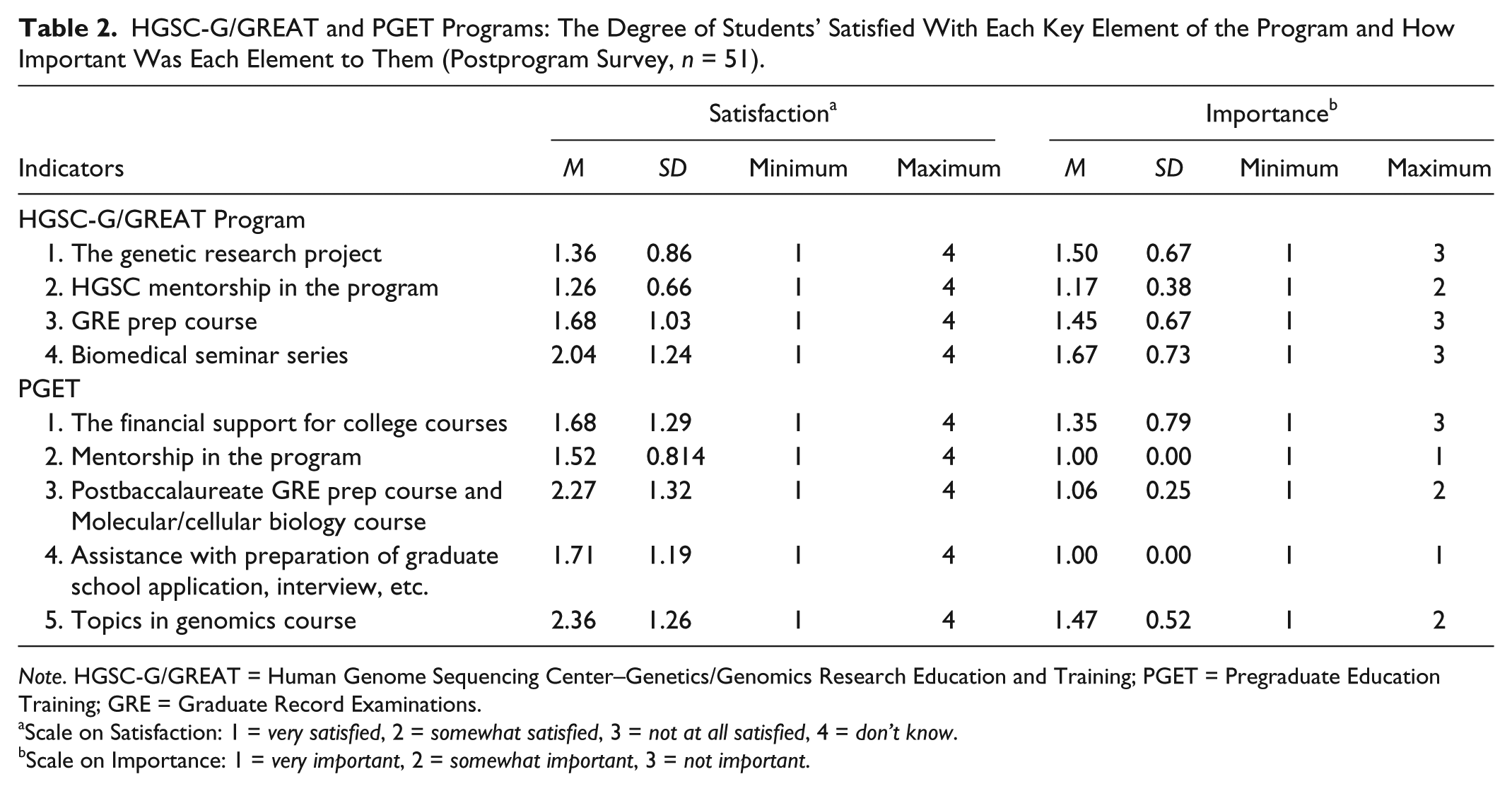
Note. HGSC-G/GREAT = Human Genome Sequencing Center–Genetics/Genomics Research Education and Training; PGET = Pregraduate Education Training; GRE = Graduate Record Examinations.
Scale on Satisfaction: 1 = very satisfied, 2 = somewhat satisfied, 3 = not at all satisfied, 4 = don’t know.
Scale on Importance: 1 = very important, 2 = somewhat important, 3 = not important.
During focus groups, participants corroborated the findings from the survey. Furthermore, they also described some concrete activities that have served them to develop self-efficacy and created a learning environment for their academic success. According to focus group participants, the top five activities that prepared them for research and/or career in science included (a) genetic research project, (b) laboratory work, (c) GRE prep course and other science core courses, (d) mentorship in specific science areas, and (e) assistance with graduate school application. Students underscored the importance of a supportive environment across all of these activities. For example, one of the focus groups participants described it as follows: It helped me realized my long-term goals by putting me in contact with different mentors that Dr. Murray brings to the program. This brings you to real life. You may have all of these things in the back of your head, saying, I am going to try to get to med school this way or get to graduate school this way; but having somebody seating down with you and telling their experiences, . . . really grounds you. . . . it puts a person behind med school or a person behind grad school by having those different mentors and peer groups. (Focus group, Transcript File 8)
These emerging patterns, in the focus groups, are also supported by survey data indicating that 96%% of the participants felt the program is preparing them for graduate school, 95% indicated that the HGSC has given them opportunities in fieldwork and research, and 93% reported the HGSC as their pipeline for science research and career path.
For these participants in the surveys and focus groups, it was not only a matter of having some academic activities in which to participate, but it was also critical to have the mentorship and support along the way to assist them in identifying a viable path in science research. They also felt that the key to their success was learning the value of networking, attending leadership and student research conferences, and having candid discussions with scientists in their respective fields. Figure 4 provides an example of the pipeline or path undertaken by some participants in the program. Undergraduate students who participated in the summer program, and those who have not graduated, are not included in Figure 4. Once they graduate, they are tracked to determine if they do indeed remain in a science career path. However, the longitudinal data being collected, on these students, is beyond the scope of this exploratory study.

HGSC postbaccalaureate program pipeline.
Limitations
There are several limitations that need to be addressed in future studies. First, this exploratory study is cross-sectional rather than longitudinal. A longitudinal study would provide us with better insight on academic achievement and processes over time. Second, the sole use of students participating in the program without a control or comparison group is also a limitation. One possible solution would be to collect data on students from the BCM who are in similar capacity as the students in the HGSC program to compare intervention versus nonintervention groups. A final limitation centers on the relatively small sample of students. A larger sample would improve the generalizability of the findings.
Conclusion
As previously stated, the objectives of the Human Genomic Sequencing Center (HGSC) have been to engage in three goals focused on enhancing the learning environment and supporting resilient behaviors among underrepresented minority students in genomic science. These objectives include (a) increasing the participant pool generally by stimulating students’ interest at multiple stages of their educational development; (b) retaining the participant pool via support services such as course experiences, mentorship, financial aid, bridging programs, and academic activities designed to motivate students into the genetic/genomic fields; and (c) strengthening the participant pool via acquisition of knowledge, research experience, academic enrichment, and development of skills deemed important for their success as future scientists. This preliminary study begins to point some of the areas in which these goals have been achieved as well as to some recommendations for future areas of emphasis for the development of successful programs. The findings are aligned with other research that similarly points to key characteristics that should be present for the development of effective minority science programs such as (a) the development of social networks within the learning environment so students can have positive experiences in their pathway to a science career, (b) research field experiences that enhance their academic portfolios, as well as (c) targeted and focused approaches at building students’ capacity through skills and knowledge training (Buchwald & Dick, 2011; Krilowicz et al., 2007; Wei & Woodin, 2011).
The study also points to salient characteristics in the learning environment that are proving to be successful. For example, the findings, from this exploratory study, indicate that the HGSC program has assisted students in several areas including (a) creating opportunities in science fieldwork and research, (b) preparing underrepresented minority students for graduate school, and (c) serving as a pipeline for science research and career. The HGSC program has also assisted students in achieving and successfully planning their long-term goals in science-related fields. It has served to develop their self-efficacy through mentoring activities, their exposure to minority scientists, and their engagement in science-related activities. It has also served to develop pathways for their academic success in science by creating a supportive learning environment. The evidence also begins to show that these programmatic efforts have, in fact, left behind a legacy of new and improved frameworks for minority students’ academic success that are also corroborated by others studies cited training (Buchwald & Dick, 2011; Krilowicz et al., 2007; Wei & Woodin, 2011). It has also aided in establishing a network for students and partnering arrangements across institutions (e.g., undergraduate and graduate university programs) to increase the number of access points for underrepresented minority students in genomic science and research.
This preliminary study adds to the body of knowledge on identifying the conditions, characteristics, and components for effectively guiding underrepresented minority students into the genomic sciences or any other academic discipline. It also serves to pilot test the effect of the program’s component on the academic achievement of individual participants. It is hoped that this exploratory study will serve in future research as we continue to identify some of the academic activities as well as the trajectory and shape of the educational process for the academic success of underrepresented minority students in science.
Footnotes
Declaration of Conflicting Interests
The author(s) declared no potential conflicts of interest with respect to the research, authorship, and/or publication of this article.
Funding
The author(s) received no financial support for the research and/or authorship of this article.