




Abstract
This study attempted to investigate the ability of English as a Foreign Language (EFL) classroom learning environment and student background characteristics to predict student persistence in EFL learning. The study also aimed to investigate whether the associations between learning environment characteristics and persistence varied by several student demographics. The sample for the study included 1,365 tertiary English preparatory program students in Turkey. Regression analyses showed that learning environment characteristics were significantly related to persistence with materials environment dimension found as the strongest predictor. When demographics were included in the analyses together with the learning environment predictors, they explained more variance in student persistence. Given the results on the variance of associations between student persistence and learning environment characteristics by student demographics, it was seen that the predictive abilities of learning environment factors varied on the basis of each subset of one particular student demographic characteristic.
Introduction
Persistence literally refers to continued efforts to further an activity even in the face of difficulties and challenges (Oxford Advanced Learner’s Dictionary, 2013). This term has been studied in several discipline areas and handled from different perspectives with regard to the meaning or indication of persistence. Most studies have considered persistence as one’s continued enrollment and retention at an educational institution. That is, such measures as withdrawal rates, assignment completion rates, course completion (Poellhuber et al., 2008), and decisions to continue or discontinue for the following level or grade (Erler & Macaro, 2011; Gardner et al., 1976; Hu et al., 2012; Matsumoto & Obana, 2001) have been taken as the indicators of persistence. However, it appears that these indicators of persistence emphasize a more analytical or concrete look at the issue, whereas persistence may be a more qualitative or abstract construct based upon students’ willingness or goal-oriented behaviors in doing something. In this sense, little is known about persistence as a more affective and motivation-related or goal-driven student outcome in the literature and it is not clear what factors may influence or be associated with such an outcome. This affective look into persistence should simply refer to students’ continued efforts to do something in spite of obstacles encountered in the learning of a discipline or a topic.
A similar construct to this affective outlook has been introduced to the literature with the study conducted by Duckworth et al. (2007) as grit which was further defined as “persistence and passion for long-term goals” (p. 1087), and this new construct has been treated as a trait-level measure requiring people to maintain interest and effort for a sustained period of time in spite of challenges and problems encountered. The most striking finding from Duckworth and her associates’ research (Duckworth et al., 2007) was that grit was significantly related to success outcomes beyond the effects of intelligence. Given the literature on general psychology, the presence of such a trait or individual difference has already been reported by several researchers long before Duckworth and her associates (2007). Upon his analyses on the biographies of successful individuals, Galton (1892), for example, concluded that in addition to their talents, these successful individuals possessed the ability accompanied by passion and perseverance to work hard. Similarly, Cox (1926), by working on geniuses, also found such characteristics of “persistence of motive and effort, confidence in their abilities, and great strength or force of character” (p. 218) as the determinants of their success when the effects of their intelligence quotient were controlled for. Hence, the literature provides evidence for the effects of the construct named as persistence or grit upon success beyond the effects of intelligence. Accordingly, it could be seen as an individual difference differentiating a particular individual from his or her similarities.
Persistence as a construct of retention or continued enrollment has been studied in relation to distant education (Joo et al., 2011; Poellhuber et al., 2008), foreign languages (Gardner et al., 1976; Ramage, 1990) and physical education (Gao et al., 2011). Given the investigations into persistence in foreign language learning, it is seen that most of these studies examined motivational and attitudinal factors, and their relevance to persistence as retention, and these factors were found to be related with continuation in foreign language study (Bartley, 1970; Gardner et al., 1976; Gardner & Smythe, 1975). However, other than the above factors, there may be some other factors or variables accounting for persistence in foreign language learning. That is, it appears that motivational and attitudinal factors have been most extensively investigated solely in relation to the retention perspective of persistence, but there is a scarcity of research linking environmental and teaching and learning process–related variables to persistence as an affective student outcome. In addition, available research in foreign languages has been performed with regard to such languages as German, French, and Spanish (Erler & Macaro, 2011; Gardner et al., 1976; Ramage, 1990). Therefore, it seems the literature lacks sufficient research on persistence with regard to the study of English as a Foreign Language (EFL) and on some environmental variables in classroom contexts that may be also strongly associated with persistence as an affective outcome.
Theoretical Framework: Learning Environment
The environment-related variables pertaining to educational contexts have been widely studied in the literature leading the research venue called learning environments research to emerge as a firmly established area of expertise. Following the work of Lewin (1936) and Murray (1938) concerning the fact that environment and the interaction of it with individuals’ personal characteristics affect and shape human behavior and also further guided by Getzels and Thelen (1960) who emphasized the possible effects of interactions among personality needs, expectations, and environment upon human behaviors, a considerable number of researchers have extensively worked on the conceptualization, evaluation, and examination of learning environments (Fraser, 1998, 2002; Goh & Khine, 2002). In this essence, investigations into individuals’ perceptions regarding their learning environments have started to gain attention in educational research. In line with such attempts, the development of data collection instruments such as Learning Environment Inventory (Walberg, 1968) and Classroom Environment Scale (Trickett & Moos, 1973) to elicit individuals’ perceptions in relation to learning environments has become a popular venue of research in the earlier periods of learning environments research. Moos’ (1979) conceptual framework for human environment guided and dominated the development of most of these instruments in that Moos’ (1979) three dimensions to characterize human environment, (a) relationship, (b) personal growth, and finally (c) system maintenance and change have been often used as a common framework in the design of such instruments.
According to Moos (1979), relationship dimension is related to relationships among individuals in a particular environment, personal growth to the opportunities individuals have to develop themselves within the environment while the system management and change refers to the degree to which the environment is neat, organized, and open to change. Moving from Moos’ (1979) categorization, different teacher behaviors from both instructional and noninstructional aspects, any type of interaction taking place in the classrooms, classroom assessment practices, classroom materials and physical conditions, and shortly all atmospheric characteristics available to the students concerning a school or a classroom were conceptually included in the term learning environment.
Given the lines of research concerning individuals’ learning environment perceptions, investigations into the relationships between learning environment characteristics and student outcomes have been reported as the most popular venue of research within this specific research field (Fraser, 2002) and now research into learning environments has sufficient evidence that learning environment perceptions are strongly related to students’ affective outcomes. This strong piece of evidence has been drawn from previous research conducted not only in more general discipline areas (Arısoy, 2007; Deemer & Smith, 2018; Dorman et al., 2006; Harbaugh & Cavanagh, 2012; Kim et al., 2000; Koul et al., 2006; Meriläinen, 2014; Ovbiagbonhia et al., 2019; Telli et al., 2006; Vermeulen & Schmidt, 2008; Wubbels & Brekelmans, 1998) but also in various foreign languages (Chua et al., 2009; Maulana et al., 2011; S. L. Wei & Elias, 2011). It is further seen that there has been a particular surge of interest in investigations into secondary-level science or science-related classrooms as is understood from both international (e.g., Afari et al., 2013; Chang et al., 2011; Dorman et al., 1997, 2006; She & Fisher, 2002; Taylor & Fraser, 2013; Velayutham & Aldridge, 2013) and national (e.g., Arısoy, 2007; Pamuk, 2014; Rakıcı, 2004; Yerdelen, 2013) research practices. Although there have been several attempts internationally (Alzubaidi et al., 2016; Bi, 2015; Khajavy et al., 2016; M. Wei et al., 2009; M. Wei et al., 2015; S. L. Wei & Elias, 2011; Wei & Onsawad, 2007) and nationally (e.g., Atbaş, 2004) to investigate classroom learning environments pertaining to EFL contexts, there is a lack of research to date which surveyed the associations between learning environment perceptions and student persistence in foreign language learning specifically operationalized as a student affective outcome.
Research on Affective Student Outcomes and Learning Environment: Foreign Language Learning Context
Given the research conducted in foreign languages, students’ perceptions of interpersonal teacher behavior and classroom general characteristics have been studied in relation to several attitudinal and affective variables. M. Wei and Onsawad (2007) investigated the associations between students’ perceptions concerning their teachers’ interpersonal behavior and their attitudes toward learning English and found that strictness behavior of the teacher was significantly and positively associated with students’ attitudes to learn English. Similarly, Maulana and others (2011) investigated the relationships between the development of teacher influence and proximity and the development of academic motivation with secondary school English classes in Netherlands. The results related the development of autonomous motivation to the development of teacher interpersonal behavior while the development of controlled motivation showed no relationships with the teacher behavior dimensions. Another investigation into the links between students’ intrinsic and extrinsic motivations in learning English and their perceptions of classroom environment was conducted by S. L. Wei and Elias (2011) in a secondary school context in Malaysia. Their results showed positive associations between students’ extrinsic motivation and task orientation dimension of the classroom environment. For their intrinsic motivation, on the other hand, perceptions of affiliation of the class demonstrated positive and their perceptions of involvement demonstrated negative associations.
In Singapore, Chua et al. (2009) examined the relationships between secondary school students’ perceptions about Chinese language classroom environment characteristics and their motivation toward learning Chinese. The results from their study showed that the dimensions of Involvement, Teacher Support, and Task Orientation were positively related to students’ motivation to learn Chinese. In his study in a Turkish context, Atbaş (2004) investigated the relationships between student experiences of several aspects of classroom environment (e.g., psychosocial, instructional, and physical) and two affective language learning outcomes, class participation, and study habits in a tertiary English preparatory class, and the results from his study showed that teacher supportiveness, satisfaction with the course materials, and involvement were the significant predictors of students’ class participation. The closest attempt to the aim of the current study was performed by Alzubaidi et al. (2016) who examined the associations between the university students’ learning environment perceptions and their levels of motivation and self-regulation in learning English in Jordan. Utilizing an instrument with a focus on general classroom characteristics, they reported strong correlations between students’ learning environment perceptions and their motivation and self-regulation-related gains.
It is seen above that out of the six learning environment studies performed in foreign languages, five were conducted in English language classrooms. Secondary school students from China, Malaysia, and Netherlands composed the participants of these six studies. Only two of these studies conducted by S. L. Wei and Elias (2011) and Alzubaidi et al. (2016) centered on general classroom characteristics by considering psychological, social, and physical dimensions of classroom environments, while the remaining four examined only the teacher behavior perspective. These studies employed the commonly used learning environment instruments, What Is Happening in This Class Questionnaire (WIHIC) and Questionnaire on Teacher Interaction (QTI) by ignoring the unique and particular characteristics possessed by foreign language classrooms. That is, there has been no study to date that utilized an instrument specifically developed to examine foreign language classrooms. Furthermore, given the variables investigated in relation to their links to learning environment perceptions, it has been seen that there is a need to include some different attitudinal or affective outcomes other than motivation and attitude toward the foreign language lessons. Hence, the absence of instruments specifically devoted to measure EFL learning environment characteristics and student persistence (not realized in numerical retention terms but as a goal-driven student outcome) should be specifically taken into consideration in further research.
Overall, as is already the case with learning environments research in relation to other discipline areas, it is also seen in foreign languages that there is a dominance of correlational research designs (Dorman & Fraser, 2009) with the use of common data collection instruments utilized previously in science or science-related disciplines to investigate same or similar group of affective student outcomes. Although investigations into foreign language classrooms can be seen as a recent innovative attempt against the dominance of science-related disciplines in learning environment research literature, there is still a need for further research which will expand learning environment research into foreign languages by particularly taking into account the contextual demands and characteristics of this particular subject area as such phenomena discussed in the literature as “context specificity” (Hopkins & Reynolds, 2001) and “differentiated effectiveness” across different subjects, different student background variables, different student personal characteristics, and different cultural and organizational contexts (Campbell et al., 2004) may be at work in individuals’ formulation of their learning environment perceptions.
Purpose and Research Questions of This Study
Given the above account, it is seen that there has been no research to date that looks at persistence in foreign language learning as either an indicator of continued enrollment (i.e., retention) or an affective outcome in the literature. Moreover, there is a need for research exploring the factors that may have an influence on students’ persistence in EFL learning, and in this sense, in addition to student personal characteristics, environmental or classroom factors are worthy of investigation. Thus, this study sought to investigate the relationship between learning environment characteristics of a tertiary EFL class and students’ persistence in learning English categorized as a student outcome in a Turkish setting. The following research questions guided this study:
How well do EFL classroom learning environment characteristics (course planning and organization, materials environment, communicative approach–oriented implementation practices, teacher-supportive behaviors, feedback and guidance on the assessment tasks, and authenticity and congruency with reality of the assessment tasks) and student demographic characteristics predict persistence in English language learning?
Does the relation between learning environment characteristics of EFL classes (course planning and organization, materials environment, communicative approach–oriented implementation practices, teacher-supportive behaviors, feedback and guidance on the assessment tasks and authenticity and congruency with reality of the assessment tasks) and persistence in English language study vary by several student demographic characteristics (gender, age, and family income level)?
Method
Participants
Employing cluster sampling in which the sampling unit was based upon a group (Fraenkel & Wallen, 2006), seven groups (clusters) were composed from seven geographical regions of Turkey. Only freshman students (no repeat students) enrolled in the must English preparatory programs of the seven different universities located in the seven different geographical regions of Turkey participated in the study (n = 1365). The participants had started the preparatory programs as A1 (elementary) level students and they had received approximately 3 months of instruction in the preparatory programs by the time the study was conducted. These students had to complete their must English preparatory programs to start their content departments to be offered in different faculties. There were 600 (44.7%) females and 742 (55.3%) males in the sample with an average age a little above 19 (M = 19.07, SD = 1.50) years. Given the family income levels of the participants, 126 (9.6%) students reported their family income levels as above 5,000 Turkish Liras (above US$1,600), 680 (51.8%) participants as more than 2,000 Turkish Liras (above US$600) almost, and the remaining 507 (38.6%) as less than 2,000 Turkish Liras (below US$600).
Instruments
Persistence scale in EFL
Persistence scale in EFL (PS) specifically developed for this study was used to measure the persistence scores of the students in learning English. That is, this new construct of persistence in EFL was developed as a domain-specific measure of grit aimed at measuring the individuals’ level of grit in learning English. This instrument was as an 18-item one-dimensional instrument with responses elicited on a 5-point scale ranging from not at all true of me (1), slightly true of me (2), moderately true of me (3), very true of me (4) to completely true of me (5).
The development of PS started with a detailed review of literature to achieve construct definition and content domain specification for the proposed construct of persistence. Based on the review of literature, an initial pool of 38 measurement items were generated. This item pool was first discussed with a group of EFL preparatory program students (n = 25) by means of focus group interviews to achieve face validity and later taken to experts to seek their opinions and judgments about the items already revised by the students to achieve content validity. As a result of a final feedback from the experts, the number of items was reduced to 30. Based on the expert opinions and review of literature, a one-factor structure centering on the idea of effort was proposed. Two different pilot studies and one validation study were conducted to refine the proposed unidimensional scale. In the first pilot study, the data were subjected to principal component analysis (PCA; n = 286) with a priori one-factor specification to detect the most preferred items by the participants for the unidimensional scale to be developed. PCA extraction here explained 31.51% of the variance, and using the cutoff value of .55 in the PCA, the most rated 18 items by the participants were chosen as a final reduced list of items. These 18 items were again subjected to exploratory factor analysis (EFA; n = 304) and the results from Maximum Likelihood extraction and a priori one-factor specification accounted for 49.41% of the variance. This one-factor structure was finally subjected to confirmatory factor analysis (CFA) in the main study reported here (n = 1,365), and the results revealed an adjusted goodness of fit index (AGFI) of .92, comparative fit index (CFI) of .99, and non-normed fit index (NNFI) of .98, which indicated a good model fit. Cronbach’s alpha value of .93 in the first pilot study and .94 for both the second pilot and validation study (the current study) verified the reliability of the instrument.
Questionnaire on EFL learning environment
The questionnaire on EFL learning environment (QEFL-LE) specifically developed for this study was used with its 28 items and six sub-dimensions such as (a) course planning and organization (CP), (b) materials environment (ME), (c) communicative approach–oriented implementation practices (CA), (d) teacher-supportive (TS) behaviors, (e) feedback and guidance on the assessment tasks (FG), and (f) authenticity and congruency with reality of the assessment tasks (AC; see also Mutlu & Yıldırım, 2017 for a short description of instrumentation for EFL learning environment). Table 1 shows the subdimensions and their definitions together with the categorization of each dimension according to Moos’ (1974) schema on human environments. Items were rated on a 5-point Likert-type scale with responses as never (1), rarely (2), sometimes (3), frequently (4), and always (5).
Description of QEFL-LE.

Note. QEFL-LE = Questionnaire on EFL learning environment; EFL = English as a Foreign Language; R = Relationship, p = Personal Development; S = System Maintenance and System Change.
Although the QEFL-LE was developed from scratch with the writing of original items for the initial pool first, these new and original items were nominated to their tentative scales prior to the administration of the scale to the sample, which in fact follows an intuitive-rational method to instrument development (Hase & Goldberg, 1967; Waldrip et al., 2008). That is, the QEFL-LE was developed by following a three-step intuitive-rationale instrument development process as (a) determination of salient dimensions, (b) writing appropriate items under these salient dimensions, and (c) field testing of the developed instrument. Two main salient dimensions such as (a) general classroom environment characteristics and (b) assessment procedures were first determined based on the review of literature on learning environments instruments and research on EFL teaching. As a second step, an initial pool of 41 items in line with the identified salient dimensions was generated. As a result of expert opinions, these 41 items were reduced to 28 items (21 items for general classroom characteristics and 7 for classroom assessment procedures). As a third step, QEFL-LE with a final form of a total of 28 items was field tested (n = 1,365) and separate principal components analyses (PCAs) were conducted on the two main dimensions of EFL learning environment. PCA extraction with varimax rotation for the general classroom characteristics revealed the presence of four components with eigenvalues over Kaiser’s criterion of 1.00 and accounted for 57.48% of the variance, while PCA extraction with oblimin rotation for assessment practices revealed a two-component solution explaining 62.85% of the variance. Alpha coefficients of .90, .73, .81, and .73 were noted, respectively, for CP, CA, TS, and ME dimensions of the general classroom characteristics, while FG and AC subfactors of assessment procedures respectively revealed alpha coefficients of .79 and .71, which verified the reliability of the QEFL-LE.
Student background form
A background information form was prepared by the researchers to elicit students’ responses in relation to their demographic characteristics (gender, age, and reported family income level), educational background (university subject domain, previous English courses attended, and high-school perceived level English proficiency), and finally exposure to English language (outside exposure to English via audio-visual tools and outside exposure to English via visual-printed tools). Information from this form was used to derive a total of eight variables categorized within the three main titles above.
Data Analysis
For the first research question (RQ1), the regression analyses were performed in a three-step manner. The first regression analyses were performed with EFL learning environment characteristics as predictors in relation to students’ persistence in EFL, second with student background variables only as predictors of student persistence, and the third with both learning environment characteristics and student background variables as predictors of students’ persistence in EFL learning. For the second research question (RQ2), multiple regression analyses were conducted again to assess the predictive abilities of the EFL learning environment characteristics upon students’ EFL persistence but this time in relation to the sub-categories of the three student demographics. Several of the subsets of age and family income level were merged to better interpret the results. For gender, there were two subsets, females and males. The variable of family income level was recomputed as having two main subsets, less than 2,000 Turkish Liras (less than US$600) and more than 2,000 Turkish Liras (more than US$600). The variable of age was reduced into two main subsets as below 20 years old and above 20 years old. Thus, six separate regression analyses were conducted on the basis of each two subsets belonging to the three-different student demographic characteristics.
Prior to each regression analysis, preliminary analyses were performed and they ensured no violation of the statistical assumptions. Leverage statistics and Cook’s Distance were checked to verify the absence of influential observations (outliers). Tolerance and variance inflation factor (VIF) values and bivariate correlations were examined to ensure the absence of multicollinearity. An acceptable value of Durbin-Watson score was also ensured to satisfy the assumption of the independence of the residuals. Examination of residual scatterplots also verified the assumptions of homoscedasticity, normality, and linearity. The alpha level was determined as .001 and .05 for the regression analyses for RQ1 and RQ2, respectively.
Results
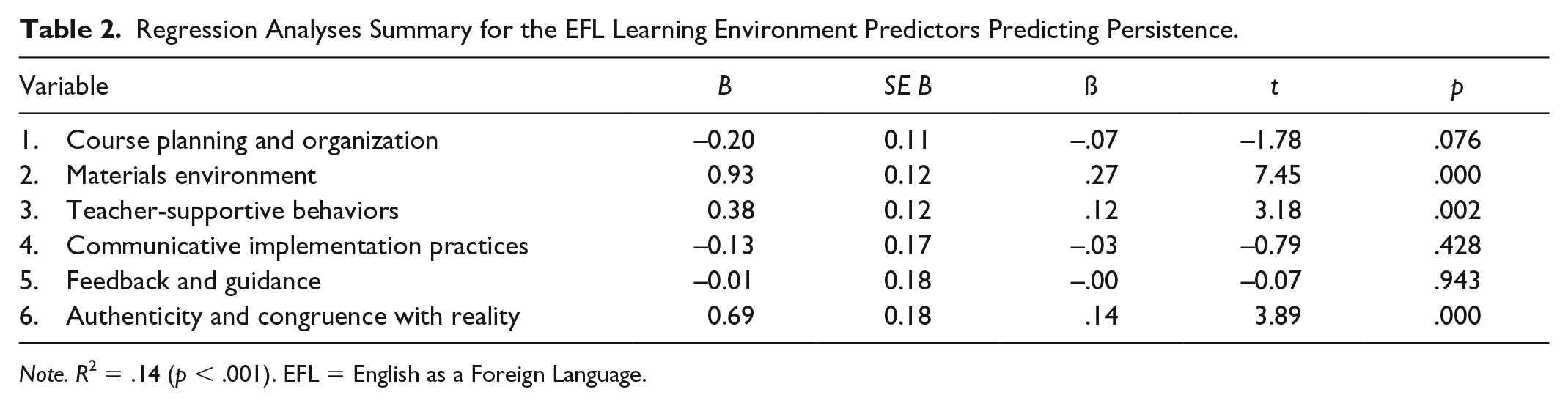
As a first step, a standard multiple regression analysis performed to assess the predictive ability of the six characteristics of the EFL learning environment upon students’ persistence in learning English showed that the regression model was significant and the total variance accounted for by the model as a whole was 14%, F (6, 1,210) = 34.75, p < .001. The R2 value of 14 indicates that 14% of the variability in students’ persistence scores is predicted by a set of predictor variables of CP, ME, CA, TS, FG, and AC. Table 2 shows the results of the regression analyses with all EFL learning environment dimensions as predictors.
Regression Analyses Summary for the EFL Learning Environment Predictors Predicting Persistence.
Note. R2 = .14 (p < .001). EFL = English as a Foreign Language.
The two predictors, materials environment and authenticity and congruence with reality of assessment tasks, were found to be uniquely significant, with the materials environment making a stronger contribution to the prediction of the dependent (criterion) variable of persistence than the variable of authenticity and congruence with reality, t (1,210) = 7.447, p < .001. The direction of the relationship between these two significant predictors and the criterion variable was positive. The predictor of course materials uniquely explained 4% of the variance in the persistence scores,
As a second step, standard multiple regression analyses were performed this time with eight student background variables as predictors and again student persistence as the criterion variable. The results indicated that the regression model was significant and the total variance (R2) explained by the model as a whole was 17%, F (8, 1,126) = 29.75, p < .001. Table 3 displays the results of the regression analysis conducted with eight student background variables as predictors.
Regression Analyses Summary for the Student Background Predictors Predicting Persistence.

Note. R2 = .17 (p < .001).
The three student background variables, family income level, perceived proficiency level in English at graduation from high school, and outside exposure to English via books and magazines were found to be significant (p < .001) and unique predictors of student persistence with the outside exposure to English via books and magazines being the strongest predictor, t(1,126) = 10.208, p < .001, respectively, followed by family income level and perceived English proficiency at graduation. The direction of the relationship between family income level and student persistence was negative, which means that those students with a lower family income are likely to become more persistent in EFL learning. The remaining two significant predictors, outside exposure to English via books and magazines and perceived high school English, positively related to the criterion variable of persistence. The variable of outside exposure to English via books and magazines uniquely explained 8% of the variance in persistence scores,
As a third step, a multiple regression analysis (enter method) was conducted to assess the predictive ability of both EFL learning environment and student background variables employed in combination upon students’ level of persistence in EFL learning. Standard multiple regression analyses revealed that the specified regression equation was significant and the model explained a total variance (R2) of 26%, F(14, 1009) = 26.50, p < .001. Table 4 shows the results of the regression analysis employed with the eight student background and six learning environment characteristics.
Regression Analyses Summary for the Student Background and EFL Learning Environment Predictors in Combination Predicting Persistence.

Note. R2 = .26 (p < .001). EFL = English as a Foreign Language.
Given the statistically significant predictors in the specified regression model, family income level, materials environment, and outside exposure to English via books and magazines were found to be significant (p < .001). The predictor of outside exposure to English via books and magazines made the strongest contribution to the prediction of student persistence, t(1,009) = 8.739, p < .001, respectively, followed by materials environment and family income level. The direction of the relationship between family income level and student persistence was negative, while the remaining two significant predictors positively related to the outcome variable of student persistence. The predictor of outside exposure to English via books and magazines uniquely accounted for 6% of the variance in student persistence,
Prediction of student persistence in EFL learning by learning environment characteristics on the basis of gender
A standard multiple regression analysis was conducted to assess the ability of six EFL learning environment characteristics to predict levels of persistence on the female subset, and the results indicated that the regression model was significant and explained a total variance of 11%, F(6, 526) = 12.44, p < .05. The two EFL class characteristics, course materials environment and teacher-supportive behaviors, were found to be significant, and course materials environment was a stronger predictor of student persistence compared to the variable of teacher-supportive behaviors, t(526) = 3.780, p < .05. There was a positive relationship between the predictors and the outcome variable. Table 5 shows the results from the regression analysis on the female subset.
Regression Analyses Summary for the EFL Learning Environment Predictors Predicting Persistence (Female Subset).

Note. R2 = .11 (p < .001). EFL = English as a Foreign Language.
On the male subset, the results from the standard multiple regression analysis showed that the regression model was significant and total variance accounted for by the model as a whole was 16%, F(6, 658) = 21.56, p < .05. The three EFL class characteristics, materials environment, authenticity and congruence with reality of assessment tasks, and teacher-supportive behaviors, were found to be significant unique contributors to the variance, with the course materials environment being the strongest predictor of student persistence, t(658) = 6.199, p < .001. The direction of the relationship between these three predictors and persistence was positive. The results from the regression analyses are depicted in Table 6.
Regression Analyses Summary for the EFL Learning Environment Predictors Predicting Persistence (Male Subset).

Note. R2 = .16 (p < .001). EFL = English as a Foreign Language.
Prediction of student persistence in EFL learning by learning environment characteristics on the basis of age
A standard multiple regression analysis was conducted on the cases aged below 20 years to investigate the predictive abilities of six EFL learning environment characteristics for student persistence. The results revealed that the regression model with six EFL learning environment predictors was significant, F(6, 893) = 25.70, p < .05. The model explained that 14% of the variance in students’ persistence and three of the six EFL learning environment predictors, course materials environment, authenticity and congruence with reality of assessment tasks, and teacher-supportive behaviors were found to be the unique significant predictors of student persistence. All three significant predictors were positively related to student persistence. The results from the regression analysis are shown in Table 7.
Regression Analyses Summary for the EFL Learning Environment Predictors Predicting Persistence (20 and Below 20 Years Old Subset).

Note. R2 = .14 (p < .001). EFL = English as a Foreign Language.
A standard multiple regression analysis was performed this time on the cases aged 20 years or above 20 years to examine the predictive abilities of all six EFL learning environment characteristics upon students’ levels of persistence. The results showed that the regression model with six EFL learning environment predictors was statistically significant, F(6, 293) = 9.83, p < .05, and indicated an R2 value of .15, which meant that 15% of the variance in students’ persistence scores is predicted by student perceptions on the six EFL classroom dimensions. Course materials environment was found to be the only statistically significant predictor in the regression model, and the direction of the relationship between this predictor and students’ persistence was positive. The results from the regression analysis on this subset are shown in Table 8.
Regression Analyses Summary for the EFL Learning Environment Predictors Predicting Persistence (Above 20 Years Old Subset).

Note. R2 = .14 (p < .001). EFL = English as a Foreign Language.
Prediction of student persistence in EFL learning by learning environment characteristics on the basis of family income level
A standard multiple regression analysis was performed on the cases coming from families with an income of 2,000 Turkish Liras or less to investigate the predictive abilities of six EFL learning environment characteristics upon levels of persistence. The results indicated that the regression model was statistically significant, F(6, 447) = 10.66, p < .05, indicating an R2 value of .11 in students’ persistence predicted by student perceptions in relation to six EFL classroom environment characteristics. Two out of six learning environment predictors, materials environment and communicative approach–oriented implementation practices, significantly and uniquely predicted student persistence in EFL (Table 9). Communicative approach–oriented practices were negatively and materials environment were positively associated with the persistence levels of students coming from lower income families.
Regression Analyses Summary for the EFL Learning Environment Predictors Predicting Persistence (Less Than 2000 Turkish Liras Subset).

Note. R2 = .11 (p < .001). EFL = English as a Foreign Language.
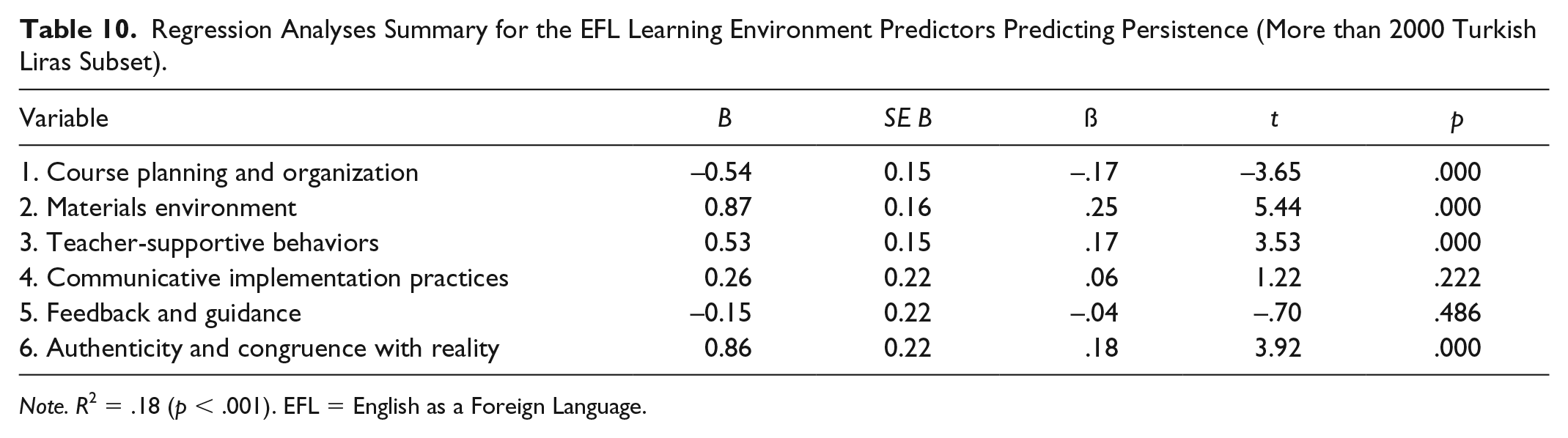
Another standard multiple regression analysis was performed this time on the cases coming from families with an income of more than 2,000 Turkish Liras to assess the ability of six EFL learning environment characteristics to predict student persistence. The results showed that regression model was statistically significant, F(6, 713) = 27.29, p < .05. The model with all six learning environment predictors indicated an R2 value of .18. Four of the six EFL learning environment characteristics, materials environment, authenticity and congruence with reality of assessment tasks, teacher-supportive behaviors and course planning and organization statistically and uniquely explained the variance in the persistence levels of the higher income EFL students. As shown in Table 10, with the exclusion of course planning and organization dimension, all other three significant predictors positively related to students’ persistence in EFL learning.
Regression Analyses Summary for the EFL Learning Environment Predictors Predicting Persistence (More than 2000 Turkish Liras Subset).
Note. R2 = .18 (p < .001). EFL = English as a Foreign Language.
Overall, the results indicated that the dimensions that have predictive abilities upon student persistence differed by the different subsets of the demographic variables. Table 11 summarizes the statistically significant EFL learning environment dimensions by the subsets of student demographic characteristics.
Significant EFL Learning Environment Predictors as a Function of Students’ Persistence in EFL for the Subsets of Student Demographic Characteristics.

Note. EFL = English as a Foreign Language; (−) = indicates the direction of relationship as negative; (+) = indicates the direction of relationship as positive.
Discussion and Conclusion
The key findings revealed that EFL learning environment characteristics and student background variables were significantly related to student persistence in EFL learning. Moreover, when both sets of predictors were included in the analyses, they contributed more to the explanation of the variance in students’ persistence scores as the total variance explained by these two sets of predictors increased when they were included in the analyses together. It was also seen that when the separate predictive abilities of each set of variables were compared with one another, student background variables explained a marginally higher variance in students’ persistence scores.
Associations Between EFL Learning Environment Characteristics and Persistence in EFL Learning
When the significant contributions of the six EFL learning environment dimensions (CP, ME, CA, TS, FG, and AC) to students’ persistence in EFL learning were considered, it was seen that EFL learning environment variables significantly contributed to student persistence either uniquely or as a shared variance. These results are consistent with the general tenor of learning environments research regarding the relationships between students’ learning environment perceptions and their affective outcomes in both foreign languages (Chua et al., 2009; Maulana et al., 2011; S. L. Wei & Elias, 2011) and other discipline areas (Arısoy, 2007; Dorman et al., 2006; Harbaugh & Cavanagh, 2012; Kim et al., 2000; Koul et al., 2006; Meriläinen, 2014; Telli et al., 2006; Vermeulen & Schmidt, 2008; Wubbels & Brekelmans, 1998).
The dimensions of materials environment, authenticity and congruence with reality, and teacher-supportive behaviors consistently appeared as the unique significant predictors of students’ persistence in EFL learning according to the results from each three regression analyses conducted for the purposes of RQ1. The materials environment dimension of the EFL class was found to be the strongest factor in predicting student persistence followed by authenticity and congruence with reality and teacher-supportive behaviors dimensions. All dimensions positively related to students’ levels of persistence. Given the remaining three EFL learning environment characteristics, it was seen that they had no unique and direct abilities to predict levels of persistence in EFL learning but somehow indirect effects when they were assessed in combination with the other dimensions, which leads the researchers to conclude that the relationship between student persistence and their EFL learning environment perceptions is not always direct but somehow indirect and conditional.
The results from this study concerning the unique predictive ability of the materials environment dimension of the EFL class are consistent with the findings from previous studies in that these studies had also provided evidence for the presence of associations between student perceptions regarding the classroom physical conditions and other similar affective outcomes such as class participation as an aspect of engagement (Atbaş, 2004), student attitudes to laboratory work (Henderson et al., 2000), and attitude toward computing and computing courses (Newby, 1998; Newby & Fisher, 2000). Furthermore, previous research on the physical conditions of the school contexts and their effects on students’ cognitive and noncognitive outcomes produced results in line with this study supporting the associations between materials environment characteristics and various affective student outcomes (Filardo, 2008; Higgins et al., 2005; Pulay & Williamson, 2019).
The results regarding the unique contributions of the authenticity and congruence with reality of the assessment tasks dimension corroborate the results from the previous studies (Dorman et al., 2006; Koul et al., 2006). In addition, the results from the research on the associations between assessment methods and student approaches to learning are in line with the results of this study concerning the authenticity and congruence with reality as an aspect of assessment procedures. Slater (1996) mentioned students’ putting into more effort and persistence in case they deal with alternative assessment practices or with making sense of the materials as a part of such practices. When persistence was assumed to be a by-product or an indicator of a deep learning approach, supporting evidence could easily be drawn from previous research concerning the links between deep-level learning approaches and alternative assessment methods that are not measuring rote but meaningful learning (Segers & Dochy, 2001; Trigwell & Prosser, 1991). Hence, one basic implication would be that students might show more persistence in learning English when they are exposed to more authentic and alternative assessment procedures measuring meaningful learning. The results from this study also align with those from the line of research which consistently has showed the significant effects of physical environment characteristics of the school contexts upon several affective characteristics of the individuals (Filardo, 2008; Higgins et al., 2005).
Given the positive associations between student perceptions pertaining to the dimension of teacher-supportive behaviors and students’ persistence in learning English, the results from this study mirror those reported previously in the literature. The two main constructs (affiliated with the two main instruments in the learning environments literature, WIHIC and QTI) which are “teacher support” and “teacher interpersonal behavior” have been frequently studied within learning environments research in the literature, and teacher-supportive behaviors subscale of the QEFL-LE instrument used in this study was designed mainly to encompass these two popular constructs. In this regard, two previous studies conducted in foreign languages and studying the above similar constructs related to teacher assistance and behaviors again were found to have reported similar results. Chua et al. (2009) found the teacher support scale of the WIHIC instrument as positively associated with students’ motivation in learning Chinese. Similarly, the results from another study conducted by den Brok (2001) in English as a Second Language (ESL) were also consistent with the results from this study in that by utilizing an effort dimension similar to the persistence construct of this study as an aspect of subject-specific motivation for English, the researcher found a positive strong effect of teacher proximity (realized in cooperation and dominance characteristics) upon motivation.
A final comment should be made here about the explained degree of variance in student persistence by EFL learning environment variables. The explained degree of variance was low in the current study; however, this study provided strong and firm evidence for the presence of associations between EFL learning environment characteristics and student persistence as an affective outcome. All six EFL learning environment dimensions were found to have effects upon student persistence directly (with unique contributions) or indirectly (with having a share in the total shared variance). In this regard, it is assumed that improvements concerning classroom conditions and the characteristics investigated and analyzed in this study would automatically result in increased levels of persistence on the part of the students to learn English.
Associations Between Student Background Variables and Persistence in EFL Learning
The finding that the variable of outside exposure (through the reading of books or magazines) was a significant unique predictor of student persistence in EFL learning is consistent with previous research conducted to investigate the relationships between exposure and motivation (Barbee, 2013; Hui-hua, 2005). Upon the assumption that motivation is a “general cover term” including also persistence among a variety of characteristics (McDonough, 1981, p. 143), the results from this study indicated parallel results with Barbee’s (2013) key finding that exposure via books and magazines was positively related to students’ motivation. Likewise, Hui-hua’s (2005) finding concerning the existence of a positive link between the amount of exposure to English outside school and student motivation provided another evidence for the ability of out-of-class exposure to predict levels of persistence in learning English.
Students coming from lower income families were found to be showing more persistence in English, which was also reported by Orozco (2014) who found a similar finding that students with lower socioeconomic status showed more grit compared to those with higher socioeconomic status. An explanatory comment should be made here concerning the lower income students who were represented by the less than 2000 Turkish Liras (less than US$600) subset in the statistical analyses. It is very likely that these students are having serious financial difficulties during their studies at university as a family with a total income of less than 2000 Turkish liras (less than US$600) appears to receive around minimum wage rate (almost US$450 at the time the data for this study were collected), and this wage is never a real living wage but seen as a starvation one in Turkey. The superiority on the part of the lower income students might be explained by these students’ being accustomed to dealing with the difficult and harsh conditions they perhaps frequently faced in their life experiences. With the presence of supply of tactics and strategies to persist at hand, these lower income students could have persisted more to cope up with the difficulties in the process of learning English. Another prediction regarding their higher levels of persistence could be made based on the support they received from their families, and this prediction is supported by Gottfried et al. (1998) who mentioned the positive effects of parental motivational practices upon students’ intrinsic motivation’ and “task endogeny” which has aspects closely related to the construct of persistence. In addition, being persistent is a very common good behavior strongly encouraged in the Turkish culture and family life. Thus, being supported by their families and the broader cultural contexts to show perseverance in learning English and also perhaps to look for sources like English books or magazines (signaling here the variable of exposure) to better learn English, lower income students could have been more motivated in the EFL learning process.
Given the finding that high school proficiency in English as a significant predictor of persistence, the results from this current study align with those from previous research on grit. Previous researchers working on grit found differences in grit by educational attainment (completed degree) and cumulative GPA scores in which more educated adults or those with higher GPA scores showed more grit (Duckworth et al., 2007). Although these two constructs appear to be different from the persistence investigated in this current study in that these two are based on an exact and documented attainment of proficiency but not on perceptions, the results pertaining to these two constructs might still give insights to speculate on the existence of associations between students’ previous gains in terms of achievement and the degree of persistence they would perform in doing an activity or a task.
In summary, a general and holistic implication from the results regarding the student background-related variables could be that students who come from lower income families, who are more exposed to English via reading books or magazines in English, and who possess higher perceptions regarding their previous proficiencies in English at high school are likely to show more persistence in learning English, which points out the presence of and interplay between these background variables, and this was also confirmed by the existence of shared variance by all of the student background variables (i.e., a total of eight variables) included in the analyses in predicting students’ persistence in EFL.
Variations in the Associations Between EFL Learning Environment Perceptions and Student Persistence in EFL by Student Demographic Characteristics
On the analyses conducted on the basis of gender, it was seen that authenticity and congruence with reality of assessment tasks dimension of the EFL learning environment was predictive of students’ persistence in EFL for males but not for females. However, the other two significant predictors of student persistence in the regressed model, materials environment and teacher-supportive behaviors, were common to both females and males as significant predictors of both female and male participants’ levels of persistence. The results on the materials environment and teacher-supportive behaviors dimensions as a significant predictor of an affective outcome like persistence are consistent with the previous research conducted on the data sets including both females and males (Henderson et al., 2000; Newby, 1998; Newby & Fisher, 2000). For the unique significant contribution of authenticity and congruence with reality of the assessment tasks dimension to explain student persistence for males but not for females, a basic implication could be that males having more realistic and investigative interests or preferences for things over people (Prediger, 1982, as cited in Su et al., 2009) could have played an important role in their preferences for this EFL learning environment dimension (Holland, 1959, 1997, as cited in Su et al., 2009). Based upon their natural interests in the realistic and technical matters, men perhaps paid more attention to such more technical and detailed issues of the language classes as the assessment procedures and the congruence between the curriculum and assessment practices.
On the analyses conducted on the basis of age, materials environment dimension was found to be common to both age subsets as a significant predictor of persistence. The results also showed that the two dimensions, teacher-supportive behaviors and authenticity and congruence with reality of assessment tasks, uniquely predicted student persistence for younger students; however, these two dimensions made no contributions to the explanation of variance in student persistence for older students. Based on these results, a basic implication could be that younger students being less experienced and less mature in classroom procedures and in life in general may be paying more attention to the more technical problems in their classrooms such as physical conditions or the course materials. In contrast, older students may be taking for the granted of the effects of teacher communication or support behaviors or any testing procedures. Upon the effects of teacher-supportive behaviors, another alternative implication would be based on the results in line with previous research on student perceptions of the interpersonal teacher behavior. Previous research has indicated that older students tended to perceive their teachers stricter compared to their younger classmates (Levy et al., 1997, 2003). For this reason, for younger students, perceptions of a more helpful and friendly teacher rather than a strict one and the support felt from such teachers may have resulted in more motivation and persistence for learning English. For students of older ages, teacher figure or especially a dominant teacher figure may bear no influence upon students’ personal attitudes or actions toward learning English.
Given the analysis conducted on the higher family income subset of the variable of family income level, it was revealed that materials environment, teacher-supportive behaviors, and authenticity and congruence with reality of assessment tasks dimensions were all found to be positively and course planning and organization negatively predictive of student persistence in EFL learning. Given the analysis conducted on the lower family income subset, the results indicated that materials environment dimension positively and communicative approach–oriented implementation practices dimension negatively relate to students’ persistence. One main finding here was that teachers’ supportive behaviors were associated with more persistence in learning English for higher family income but not for lower family income students. This finding is consistent with a previous study conducted by Waldrip and Fisher (1999) who found that students from rural areas had more tendencies to report the negative dimensions of their teachers’ interpersonal behavior compared to those students from metropolitan areas. In this essence, the rural area students in their study might stand for those coming from lower income families and metropolitan area students for those coming from higher income families.
In contrast to the positive predictive abilities of teachers’ supportive behaviors discussed above, there was a negative direction of relationship between the higher income students’ perceptions about course planning and organization characteristics and their persistence for learning English. As the items in course planning and organization subscale of the QEFL-LE relate to teachers’ control and organizational behaviors of instruction, these students might have perceived this dimension as more referring to the teacher admonishing and strict behaviors which in fact possess a contradictory stand to the helpful and supportive teacher profiles in their minds. This tendency to polarize the perceptions regarding the two dimensions here might have resulted in different effects upon their levels of persistence. Moreover, with their probable better and richer schooling experiences and educational opportunities and facilities encountered and thus perhaps with more frames of references to evaluate their learning environments, higher income family students might have more sensitivity to care about the assessment practices of the language classrooms to be more persistent for learning. Those from lower income families, however, might have had bad or insufficient experiences due to their low socioeconomic reasons such as large class size, lack of effective teachers, and insufficient school facilities to benefit from communicative language teaching-based implementation practices (Ansarey, 2012; Koosha & Yakhabi, 2013; Rahman & Karim, 2015; Roy, 2016). Thus, these students might have developed negative opinions about communicative classrooms because of the above-mentioned unfavorable conditions.
Implications for Educational Practice
Based on the empirical evidence from this current study, policy makers, educational administrative bodies, and teachers should work to provide good and satisfying learning environments in terms of both physical and environment-related characteristics and other more interpersonal and instructional issues. On the way to achieve these, regular investigations perhaps in the form of systematic and detailed needs assessment or action research studies are recommended so that the students’ perceptions regarding the course books, technological equipment or physical conditions in the classrooms, and teachers’ communicational and instructional behaviors or assessment-related issues could be elicited, which in turn could be used for improvement purposes to achieve educational effectiveness.
Limitations
Self-report instruments were utilized to measure students’ persistence and their learning environment perceptions, which may naturally mean that these two instruments are vulnerable to social desirability bias. Content-related evidence of validity was considered more compared to other types of validity in the development of QEFL-LE by the use of relevant theoretical background and expert opinions. However, not only the content-related but also the criterion-related evidence of validity should be considered to satisfy construct-related evidence, which, in fact, is a broader and more encompassing definition of validity evidence for instruments (Fraenkel & Wallen, 2006). Therefore, with more studies using these two instruments and also attempting to construct-validate QEFL-LE, it would be possible to gain more warranted inferences about the findings elicited through these instruments.
Recommendations for Future Research
For the analyses of the study data, multiple regression analyses were performed at the student level. However, the use of multilevel analysis (Bryk & Raudenbush, 1992; Goldstein, 1987) techniques are recommended for future research in that researchers would be able to test the predictive abilities of several independent variables upon students’ persistence not only at the student but also at the class and school levels thus controlling for the problems of “aggregation bias” (Fraser, 1998). A comment should be made here about the low, yet significant degree of variance explained by the EFL learning environment characteristics, which may have been resulted from the absence of critical variables associated with persistence in the analyses. Thus, future research should include such variables as self-efficacy and academic efficacy (see Dorman et al., 2006; Duckworth et al., 2007) into their research designs as some researchers previously working on similar or related constructs to persistence have already offered mediating or confounding effects of those in their studies.
Footnotes
Authors’ Note
The study reported here was a part of Dr Gülçin Mutlu’s dissertation conducted under the supervision of Prof. Dr Ali Yıldırım and the researchers presented this study at the 27th International Congress on Educational Sciences (ICES/UEBK-2018) which was held on April 18–22, 2018. Researchers made another oral presentation concerning the instrument development process for the learning environment questionnaire used in this study at the second INES International Academic Research Congress (INES-2017) held on October 18–21, 2017.
Declaration of Conflicting Interests
The author(s) declared no potential conflicts of interest with respect to the research, authorship, and/or publication of this article.
Funding
The author(s) disclosed receipt of the following financial support for the research, authorship, and/or publication of this article: Researcher Gülçin Mutlu was supported by a grant from Scientific and Technological Research Council of Turkey (TÜBİTAK) through the National Scholarship program for Turkish PhD students (BİDEP 2211). Also, author received a monthly salary from TUBITAK as a doctoral student.
