



Abstract
Universities face many challenges such as budget costs, licensing, and software and hardware management in their activities related to information and communications technology (ICT). Through overcoming these challenges, universities may deliver smart, secure, and fluent services for their instructors, students, researchers, information technologies (IT) staff, and administrators. Cloud computing can be a solution to these challenges. The transition to cloud computing in universities is an important step in terms of online education, economic crisis, globalization, and high and constantly changing requirements, especially in the COVID-19 period. Cloud computing can play a very important role in quickly solving the problems faced by universities during this coronavirus period. The purpose of this research was to determine the position of universities in Turkey within the context of cloud computing and to present an abstract hybrid cloud framework for these universities. Descriptive method and survey technique were used in the research. SPSS program was used to analyze the data. Percentage, frequency, and chi-square statistics were used in the analysis process. As a result of the research, the existing conditions and problems in the use of the cloud service model in universities were tried to be identified and a road map for solving these problems was drawn up. In this context, a hybrid framework for adopting cloud computing in universities for them to overcome their identified challenges was proposed. The results are primarily intended to provide a guideline to universities in cloud computing adoption.
Introduction
In the information age, universities use new information technologies (IT) in line with the requirements of age and expectations of their users. Universities must be in an effort to shape themselves according to the requirements of the new IT and to renew themselves technologically. Today, cloud computing is one of the new technologies whose name is heard very often. This technology has a wide usage area in finance, health, insurance, automotive, and military fields and also in universities.
Thanks to cloud computing, many universities are now experiencing a revolution in their IT. The rapid increase in the number of universities in Turkey in recent years has raised various questions regarding the quality of university information services. Cloud computing will enable universities with limited budgets to benefit from information services without making any new financial investments for information and communications technology (ICT) resources. With cloud applications in higher education, knowledge can be managed effectively to increase academic performance, effectiveness, and efficiency in universities.
Universities have been also affected by the COVID-19 crisis recently. In this period, they have been temporarily closed, had to interrupt their face-to-face education, had switched classes to online learning, and had canceled trips including activities such as conferences. It can be said that dependence on cloud computing applications has increased significantly, especially during the COVID-19 outbreak (Alashhab et al., 2020). To prevent the spread of the disease in the COVID-19 epidemic, many education sectors and universities switched to online learning environments (Chaka, 2020; Chen et al., 2020). The education sector buys software to continue distance education. Cloud computing technologies offer various types of service in this context. Cloud computing service model can help universities to present information services in accordance with the expectations of their users. The use of the cloud computing service model by universities will continue to be an important issue in the post-COVID-19 period due to some important advantages of cloud computing especially in distance education.
The purpose of this research is to determine the position of universities in Turkey within the context of cloud computing and to present an abstract hybrid cloud framework for adopting cloud computing into universities to overcome the identified challenges of the universities. In the study, section “Literature Review” presents a literature review regarding the theoretical and conceptual background, and section “Purpose, Scope and Method of the Study” introduces the research model in detail. In section “Findings and Evaluation,” the findings of the study are evaluated. Section “An Abstract Hybrid Cloud Framework for Universities” describes the presented framework, while in the last section, conclusion and recommendations are listed.
Literature Review
Cloud Computing
What electricity is in industrial society is cloud computing in the information age (Carr, 2009). Cloud computing means providing faster innovative, flexible resources and economic scaling by providing computing services (including server, storage, database, network, software, analysis, and machine intelligence) over the cloud (Seyrek, 2011). Cloud computing is a distribution model that allows applications and services to be accessed independently from time, space, and platform in a huge data center infrastructure (Sevli, 2011). The need for greater computing power has driven advances in scalable computing to distributed computing (Chetty & Buyya, 2002). To build a grid, the development and deployment of a number of services are required (Buyya et al., 2005). It can be said that cloud computing is a model built on existing technologies such as virtualization and grid computing. Computational grids aimed to offer computing power by combining geographically distributed resources (Abramson et al., 2002). Cloud computing enables information services to be presented as advanced and scalable applications by taking advantage of a reliable and scalable infrastructure (Mirzaoğlu, 2011). It can be said that those who have used web applications such as Gmail, Wikipedia, Hotmail, or Twitter have experience in cloud computing (Mirashe & Kalyankar, 2010). Cloud computing offers access to information from anywhere and at any time through the internet (Henkoğlu & Külcü, 2013). It is the solution where the data produced by the applications are placed in the cloud and the mobile devices serve as a simple interface. National Institute of Standards and Technology (NIST) defines cloud computing as a model in which services and sources are accessed with minimal management effort or service provider interaction (Liu et al., 2012). In cloud computing, the capabilities of business applications arise as sophisticated services that can be accessed over a network (Buyya et al., 2009).
Characteristics of cloud computing are listed below:
On-demand Self-service: The ability to use information resources automatically in accordance with the usage rates and performances of computing resources.
Broad Network Access: The ability of users to access cloud resources not only through computers but also through all types of devices and computer networks.
Resource Pooling: The ability to share information resources, such as computer network, server, operating system, database, and computer software, between multiple cloud users.
Rapid Elasticity: Resources can be offered to users by cloud computing when they are needed the most. With this feature of cloud computing, users can use resources when they need and release them for other users when they are finished.
Measured Service: The ability of users to optimize resource utilization based on their use of cloud resources and their performance. With this feature, cloud services can be charged at the same time. In this way, users only pay for the cloud resources they use.
The cloud conceptual reference model created by NIST contains elements that must be included in a cloud structure; these are “Cloud User,” “Cloud Controller,” “Cloud Service Provider,” “Cloud Agent,” and “Cloud Carrier” (Sevli, 2011). Software as a Service (SaaS), Platform as a Service (PaaS), and Infrastructure as a Service (IaaS) are the service models. Public, private, community, and hybrid clouds are four deployment models of cloud computing (Goyal, 2014).
Cloud Computing and Universities
All actors in the information society are shaped according to knowledge, which is the most important and basic resource of the information society. And production of knowledge takes place among the basic dynamics of this society (Bell, 1976; Masuda, 1990). In the age of knowledge in which information has gained a strategic value in its own right, societies that cannot access, use, manage, and benefit from the power of knowledge will have to live up to the standards of the industrial society and perhaps the agricultural society. As in agriculture and industrial societies, human beings have to mobilize the power of knowledge and benefit from this resource in the most efficient way in the information society (Tonta, 1999). Developed countries, which can be characterized as information societies, make the most of the power of IT. Countries that make the most of IT are becoming stronger and increasing their domination, whereas those that do not make the necessary planning and investment in this area are becoming poor (Çakın, 2004). Today, developments emerging at a dizzying pace in IT have changed the production and delivery of IT services. Nowadays, the diversity of information produced, stored, and shared in electronic environments has increased and access to information has been made independent of time and place.
It is seen that as long as development and change in IT continue, the production and presentation of information services are an inevitable fact. Factors such as the spread of computer and internet use in all segments of the society, the diversification of the information sources, the ability of the user to access information from anywhere, and the shifting of the communication environment from the traditional to the electronic environment have changed the profile of today’s information user and increased their expectations (Özenç Uçak, 2004). In the information society, universities are the most important determinants of social development. The most important things a university should do are education and research (Çelik, 2000). It is possible to gather the goals of universities in four groups (Çakın, 1983):
To improve the level of technical and scientific knowledge,
To train qualified personnel required by society,
To increase the intellectual power and culture of the students, and
To raise the common culture and standard of the society in which it serves.
While delivering information services, universities face many challenges such as budget costs, licensing problems, and integration and management of software and hardware. In overcoming these challenges and providing an alternative way to operate information systems in a cost-effective manner, the role of cloud computing is great, especially for universities with budget shortages. Although personalized learning, being economic, elasticity, measurability, accessibility, low carbon emission, and standardization are shown as some benefits of cloud computing in the education field, security, compliance issue, lock-in, reliability, lack of skills, insufficient support of cloud service providers, policies on the cloud, privacy, and the complexity of cloud technologies are shown as some of its challenges (Njenga et al., 2019; Sabi et al., 2016).
Google Apps, Dropbox, Google Apps for Education, Microsoft Office365, and so on are some of the cloud applications that are already extensively employed in education. Some online applications such as Blackboard, CenturyTech, ClassDojo, and Google Classroom, which can be used in the field of education, are recommended by UNESCO (2020). Behind the desire to benefit from cloud computing in universities lies mainly the willingness of universities to use their financial resources cost-effectively and efficiently. Many universities are now experiencing a revolution in their information services with cloud computing. Higher education institutions need effective IT governance, which is necessary for them (Bianchi & Sousa, 2016). If universities take full advantage of cloud computing, this will eliminate the classic University understanding.
Steps for a Successful Transition to Cloud
After reviewing the theoretical and conceptual background of cloud computing, steps for a successful transition to the cloud were investigated. Transition from existing legacy systems to cloud platforms is difficult and costly (Gholami et al., 2017). There are different strategies for transition to the cloud in the literature. While some studies indicate that the transition to the cloud consists of the evaluation, design, establishment, implementation and operation, and monitoring steps (Şanlı, 2011), some others emphasize that this transition consists of the steps of learning, organizational evaluation, pilot cloud implementation, cloud preparation assessment, cloud dissemination strategy, and continuous cloud improvement strategy (Wyld, 2009). According to Takai (2012), the transition to the cloud consists of the following steps: the promotion of cloud computing, data center consolidation, establishment of the enterprise cloud infrastructure, and submission of cloud services (Takai, 2012). For a smooth transition from traditional system to cloud-based system, Pradesh (Pardeshi, 2014) suggested a five-step framework: confirmation, implementation, decision, knowledge and, persuasion.
Attaran et al. (2017) identified the three phases of the cloud service adoption strategy for successful implementation of cloud in two universities, Bryant (BU) and Roger Williams (RWU). For example, RWU students use an online learning system called Bridges where all of their course materials are stored in an external cloud hosted by Amazon Web Services (AWS). Bridges allows faculty and students to upload, view, and download lectures, assignments, grades, and much more over the internet using a variety of personal devices from anywhere with an internet connection.
ICT Structuring at Universities in Turkey
Higher education services in Turkey are carried out by state universities and private universities. Private universities, which entered Turkish Higher Education in 1984 for the first time, have taken their places as a public institution, with their increasing numbers and growing student capacities. State and private universities have some structural similarities and differences in terms of management, finance, education and training structure, quality and qualified graduates, and performance status. In the current system in Turkey, IT departments of universities are responsible for meeting the ICT needs of the universities. Results of a research which has been conducted on the websites of the IT departments of the universities show that university IT departments generally contain the following groups of units (Damar & Coşkun, 2017):
Network/System: It covers the units where technical works such as network installation, computer maintenance, smart card, and camera-related services are provided. The subunits of it are Technical Services Branch Office, Network and System Management, Hardware Branch Office, System and Network Group, Hardware Services, System/Network Services, System Management Unit, Smart Card Unit, Technical Units, Technical Support and Operating Services, Security Camera Systems Unit, IP Power Plant Unit, Administrative and Technical Support Unit, Maintenance and Repair of Computer, and Other Information Materials.
Software/Web Projects: It includes units responsible for software and web projects. The subunits are Web Technologies, Software Services, Web Management Unit, Web Design, Software Unit, Software and Visual Media Services, Web Unit, and Software Branch Manager.
Administrative Financial Affairs: It includes administrative units related to finance, accounting, and so on. The subunits are Administrative Financial Affairs, Administrative Units, Accrual Works, Works, Administrative Affairs, Administrative Office, Purchasing, and Secretariat.
Help Desk: It covers the units to which users communicate with for their hardware and software problems. The subunits are Communication Unit, Project Support Group, Informatics Branch Office, Mobile and User Accounts, User Support Unit, Workshop, Informatics Group, Hardware Support, and Software Support Unit.
Project and Personnel Management: It covers the units related to project and personnel management. The subunits are E-Document and Personnel Coordination Unit, Informatics Branch Office, Human Resources Unit, Process and Governance Group, and Analysis and Training Branch.
Purpose, Scope, and Method of the Study
The purpose of the research is to identify the existing conditions and problems in the use of the cloud service model in universities, to put a road map for solving these problems, and finally to propose a cloud computing model in this context. In the study, significant differences between state and private universities within the framework of this research are also stated.
The main contributions of this study are as follows:
Determination and evaluation of the current situation of universities and their opinions through the research questions determined within the scope of this study;
Presentation of an abstract hybrid cloud framework for the delivery of university information services such as SaaS, IaaS, and PaaS;
The literature review explaining cloud computing in universities and based on research questions;
Determination of significant differences between state and private universities by using chi-square tests; and
Some suggestions offered considering the literature review and results of the study.
In this context, highlighting the role of cloud computing adoption in overcoming ICT challenges faced by universities, and as a guide offering remedies to universities to avoid these problems to a certain extent.
IT departments are critical for universities in the context of the implementation of cloud computing. The universe of the study consists of the IT departments of the universities as shown in Table 1. According to the data given in this table, 59.5% of the university IT departments (105 departments) participated in the research. In all, 72.1% of the state university IT departments (75 departments) participated in the survey, whereas 41.6% of the private university IT departments (30 departments) participated.
The Universe of the Research.

Note. M = existing, N = participants.
The research questions used in the survey applied to the universities are determined as stated in Figure 1.

Research questions.
The framework presented in this study was adapted from the literature review performed considering these research questions. With the first (R1) question of the study, it was aimed to determine the awareness of the cloud computing service model. Universities need to be familiar with what the cloud is and what it can offer. From this point of view, it is necessary to be aware of cloud computing technology to be able to choose the right cloud model that is most appropriate in terms of information services that the university needs. In the second (R2) question of the study, it was aimed to determine whether there was a necessity for transferring information services to the cloud environment in universities. The expenses of universities mainly consist of computer hardware, software development and software license costs, heating and cooling costs of systems, and costs required for the employment of qualified ICT personnel. Cloud computing can be a solution to these expenses of universities. In this context, it is important to determine how universities evaluate their hardware, software, energy, and ICT personnel costs. It is seen that one of the most important reasons for the transition of institutions and organizations to cloud computing is the reduction in the expenditures related to information systems. The cost-effectiveness of cloud computing is one of its most prominent advantages that causes all organizations to adopt and use cloud computing. Today, relatively large amounts of investment are being made in computer hardware, software, computer network technologies, and many other information system technologies. In addition, the expenses of IT personnel employed to operate these systems constitute a separate expenditure item. Energy costs such as heating and cooling of these information systems are also among the important expenditure items. In the third (R3) and fourth (R4) questions of the study, it was aimed to determine the current ICT situation and whether the universities are ready for transition to the cloud in terms of their possibilities. Determining whether universities are ready to move to the cloud with their current possibilities may help the decision of moving to the cloud. As universities move from the current state to the cloud, they need to take into account the possible effects of cloud adoption on the organization and make a comparison between the two situations. In addition, they want to switch from a cloud platform to a non-cloud platform by putting alternative plans if it does not meet the requirements of the adoption process. The questions of which information services are primarily desired to be transferred to the cloud environment and the possible problems that may be encountered in transferring information services to the cloud environment will help to determine the positions of universities in the context of cloud computing. Thanks to cloud computing, institutions and organizations can use the computer resources they need without installing information systems, software, and hardware infrastructures within their own organization by sharing them as much as they need through cloud computing platforms. A cloud service user can receive and use the information service offered by another cloud service provider via cloud computing platforms. In such a case, there will be an increase in service diversity naturally. By the fifth (R5) question of the research, it is aimed to determine the possible benefits and problems that may be encountered in transferring the library services to the cloud environment. The sixth (R6), seventh (R7), and eighth (R8) research questions of the study are related to the creation of a framework for the adoption of cloud computing in the light of the data obtained from the survey.
Findings and Evaluation
In this part of the study, the data obtained from the survey applied to the IT departments of universities are evaluated. The study findings were statistically analyzed under the headings “Awareness,” “Requirement,” “Cloud Services/Applications,” “Technology Readiness,” and “Benefits and Possible Obstacles.”
Awareness
Regarding the survey question evaluating participants’ knowledge levels about cloud computing, the respondents reported their knowledge levels as “Good” with a rate of 28.6% (Figure 2). This shows that the knowledge related to cloud computing among universities is at a low and basic level. The existence of universities with no knowledge of cloud computing is noteworthy. If “Very good” and “Good” knowledge levels are considered as sufficient levels, it is seen that approximately half of the universities (50.5%) do not have enough knowledge about cloud computing.

Knowledge levels of cloud computing.
In the chi-square test performed, no significant difference (χ2 = 0.180) was found between the state and private universities in terms of knowledge level of cloud computing.
Requirement
The majority of universities (79.1%) stated that they saw software expenditures as the highest item among the high-cost items of their budgets (Figure 3). This is followed by hardware with 78.0%, operation with 65.9%, electricity with 49.6%, and personnel expenditures with 49.5%. These results show that universities think ICT expenditures are among the high-cost items of their budgets. This can be considered as an indicator of the need for cloud computing in universities. It is seen that the software has the highest expenditure item. This also refers to the need for SaaS cloud services.

ICT spending.
The chi-square analysis showed that there is no significant difference between the perceptions about operating (χ2 = 0.349), electricity (χ2 = 0.117), software (χ2 = 0.590), hardware (χ2 = 0.285), and personnel (χ2 = 0.108) expenditures.
Cloud Services/Applications
Implementation status
The survey reveals that only 8.8% of respondents are currently using a cloud model in their universities (Figure 4). Most of the IT departments stated that they did not think to apply (71.4%) cloud computing in their universities. It is noteworthy that the rate of those who think about the application of cloud computing at the trial stage is quite low (6.6%).
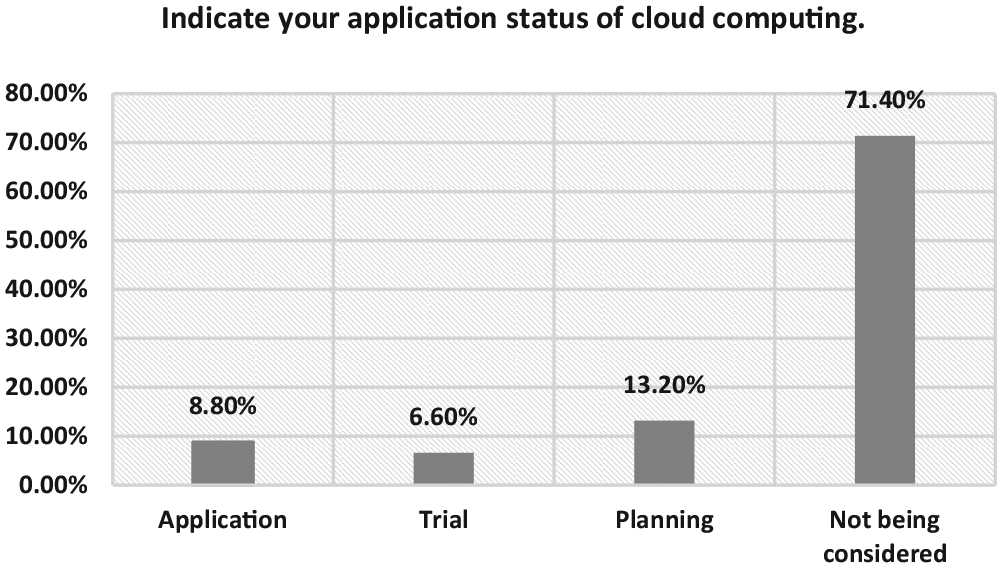
Application status.
Cloud architecture status
Nearly half of the universities (43.5%) stated that they did not have a cloud architecture (Figure 5). Results showed that 21.2% of the participants had a private cloud architecture, 12.9% had a hybrid cloud architecture, 11.8% had a community cloud architecture, and 10.6% had a public cloud architecture. In addition, the data obtained from the survey revealed that most of the respondents had no cloud architecture.

Architecture status.
Cloud services
While 11.0% of the IT departments stated that they used SaaS, 9.9% and 4.4% of them said that they used PaaS and IaaS services, respectively (Figure 6). The majority of respondents (74.7%) were unresponsive to this question, which indicates that they do not have sufficient knowledge of cloud services. The data reveal that cloud applications are not widely used.

Cloud services.
A significant relationship (χ2 = 0.01) was found in the chi-square test conducted to determine whether there was a relationship between cloud computing awareness and use of cloud applications. The chi-square test also showed that there is a significant relationship (χ2 = 0.035) between the use of virtualization technologies and the use of cloud applications.
Technology Readiness
It is seen that the majority of the universities (80.8%) are using virtualization technology (Figure 7). Virtualization is the fundamental technology that powers cloud computing. From this point of view, it can be said that universities are ready for the transition to the cloud.

Usage of virtualization.
The chi-square test showed that there was a significant relationship (χ2 = 0.034) between cloud computing awareness and the use of virtualization technology.
Approximately half (47.3%) of the universities have International Organization for Standardization (ISO)/International Electrotechnical Commission (IEC) 27001 certification, approximately one third (35.2%) have ISO/IEC 25599 certification, and a low portion (17.6%) have both certificates (Table 2). This can be evaluated as that in terms of cybersecurity perspective, universities are not ready for the transition to the cloud.
ICT Certificate Status.
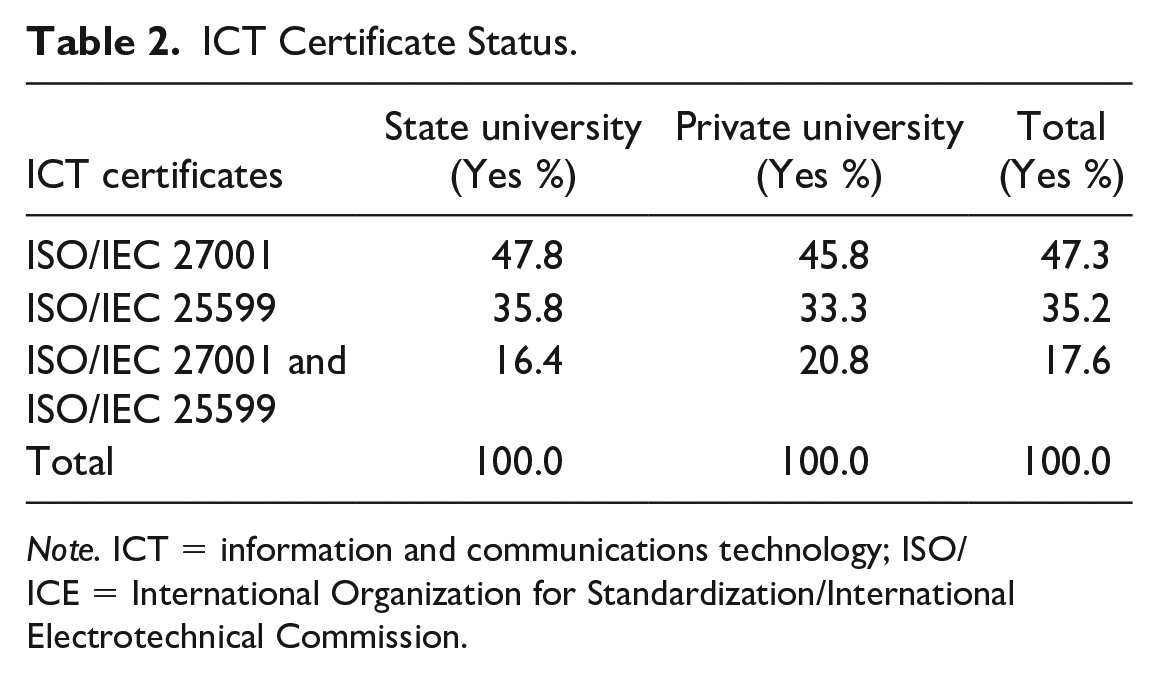
Note. ICT = information and communications technology; ISO/ICE = International Organization for Standardization/International Electrotechnical Commission.
In the survey, participants were asked whether they think that cloud technologies would play a great role in the future (Figure 8A). The majority of the universities (70.6%) stated that they thought cloud technologies would play a great role in the future. This can be interpreted as that universities tend to adopt cloud computing.

Future of cloud computing in universities.
In the survey, participants were asked whether university top management support was sufficient for cloud computing or not (Figure 8B). Approximately one third of the universities (36.5%) thought that top management support was sufficient. This can be seen as a negative situation in terms of the transition to cloud computing. In the survey, participants were asked whether cloud compliance is taken into account or not (Figure 8C). Approximately one fifth (20.0%) of universities stated that cloud compliance is taken into consideration. This can also be evaluated as a negative situation.
Benefits and Obstacles
Benefits
Participants were asked to identify the benefits of cloud computing for universities (Figure 9). As the first benefit of cloud computing, 76.5% of the participants stated that “service continuity will be ensured in natural disasters and unexpected developments.” This is followed by “service flexibility” (70.6%), “service variety” (69.4%), “paying as much as you use in information services” (65.9%), “decrease in ICT operation and maintenance expenditures” (65.1%), “execution of information services with simpler ICT tools” (62.4%), “less damage to the environment” (58.8%), and “being less dependent on ICT activities” (57.1%). These results reveal that, in general, IT departments agree with the benefits of cloud computing for universities.

Benefits of cloud computing.
Obstacles
Participants were asked to identify obstacles of cloud computing for their universities (Figure 10). In all, 77.6% of the participants stated that “data security and confidentiality” and “dependency on the cloud service provider” were the most important obstacles of cloud computing. This was followed by obstacle perceptions related to “software security” (7.9%), “interoperability” (71.8%), “ICT resources” (70.6%), “legislation and cost” (63.5%), “management support” (61.2%), “human resources” (60.0%), and “awareness” (57.6%).

Obstacles of cloud computing.
An Abstract Hybrid Cloud Framework for Universities
Within the scope of the study, a literature review was made on how to create the conceptualization process of the model. There are currently four types of cloud models in the market: “Public Cloud Model,” “Private Cloud Model,” “Hybrid Cloud Model,” and “Community Cloud Model” (Goyal, 2014). Academicians and researchers have proposed different models for different cloud computing categories for the adoption of cloud computing. Several studies have highlighted the adoption of cloud computing and cloud applications in education (M. B. Ali, 2019; K. E. Ali et al., 2018; Alonso-Monsalve et al., 2018; Juma & Tjahyanto, 2019; Pardeshi, 2014; Rao et al., 2013; Sabi et al., 2016). The NIST proposes four different cloud organization models and cloud management models in cloud computing design (Liu et al., 2012). Different methodologies and results have been used in the adoption of cloud computing. Some of the critical success factors (CSFs) for the effective implementation of cloud-based e-learning at universities and institutes of higher education are Cloud Data Security, Availability and Reliability, Customizable Service Level Agreement, Network Bandwidth, Compatibility, Technical Support, Management Support, Human and Resource Readiness, Complexity, Cost Flexibility, Ease of Use, and Relative Advantage (Naveed & Ahmad, 2019).
Hybrid clouds contain a combination of two or more private, community, or public cloud structures and therefore have a more complex structure (Goyal, 2014). In the study of K. E. Ali et al. (2018), an abstract hybrid model for adopting cloud computing in e-government to overcome the e-government’s challenges was proposed. In the study of Monsalve et al. (Alonso-Monsalve et al., 2018), the orchestration between the volunteer platform and the public, private, or hybrid clouds was described in the proposed hybrid cloud model. Juma and Tjahyanto (2019) proposed the ITOETAM model, which was the combination of the Technological, Organizational, Environmental (TOE), Technological Acceptance Model (TAM), and Internal, External (I-E) methods, to find challenges and suggest the solution to overcome those challenges (Juma & Tjahyanto, 2019). ITOETAM (the proposed model for cloud computing adoption challenges in Zanzibar’s Universities), TOE (the model used previously in cloud challenges), TAM (the model used to solve the challenges of cloud computing), and I-E (the model used to solve challenges in cloud computing) are examples for some different models used in the literature (Juma & Tjahyanto, 2019; Tashkandi & Al-Jabri, 2015). These studies show that cloud-based learning models are becoming widespread and their use is gradually increasing. Elhoseny et al. (2018) proposed a new hybrid cloud-IoT (Internet of Things) model which consists of four main components: stakeholders’ devices, stakeholders’ requests (tasks), cloud broker, and network administrator. A proposed architecture based on the hybrid cloud model which uses both the public and private clouds is simulated using CloudSim. It consists of two main parts, that is, the Cloud Management System and the Hybrid Cloud (Sqalli et al., 2012). In the cloud computing adoption model proposed by Okai et al. (2014), a roadmap for cloud computing adoption is proposed by universities to overcome the challenges faced. Among the examples of educational cloud-based applications, Microsoft Education Cloud (website creation, file sharing, Word processing, desktop sharing, resource scheduling), Google Education Cloud (Google Mail, Google Sites, Google Docs, Google Video, Google Calendar, Google Talk), Earth Browser (provide real-time data for weather, geological, and other data), Socratica (classrooms in science to access create and study modules), VMWare (provide virtual computers), and IBM Cloud Academy (Smart analytics system) can be listed (Alharthi et al., 2015). Arpaci (2019), investigated educational use of the mobile cloud computing services in the higher education based on data collected from 308 undergraduate students.
In this study, an abstract hybrid cloud framework was presented (Figure 11). The framework consists of Private University Cloud (“PUC”) and Community University Cloud (“CUC”). The structure is a hybrid cloud because it includes both PUC and CUC. The purpose of the framework is to meet the expectations of universities in a cloud environment in a cost-effective manner. The stakeholders of the framework are educational institutions, instructors, students, IT personnel, researchers, IT staff and administrators, learners, educational practitioners, and so on. In the creation of the framework, existing studies in the literature on the subject were examined. In the conceptualization process, both the information obtained from the literature and the results obtained as a result of the survey conducted within the scope of the research were used.

An abstract hybrid cloud computing framework for universities.
In this structure, universities can use their own private or community cloud technologies in places where security and privacy are more important and precaution must be kept high, and public cloud technologies in areas where security measures can be kept at a lower level.
PUC Implementation
PUC is a private cloud that can be established by each university through their own IT resources. Thanks to PUC, data and processes will be managed within each university. This structure will belong to each university itself because it will deliver private cloud services. By PUC, each university will be able to deliver SaaS, PaaS, and IaaS cloud services to their cloud users. The users of this structure are instructors, students, researchers, IT staff and administrators, and so on who are located only in their university. In the context of current technologies such as Web 2.0, universities may develop cloud services within the service-oriented architecture (SOA) structure in accordance with the needs of their users. In this cloud structure, universities will produce the content of information services themselves and will use their own methods in their own IT structures (databases, web servers, etc.) technically. In PUC, the prioritization of the services/applications will be done by each university considering the facts of the university such as network capabilities, transactions, and capacity.
CUC Implementation
CUC is a community cloud that covers the information services of member universities. Universities, which are members of this model, will provide services/applications to this cloud. And CUC users will be able to use services/applications via portal structure offered in the framework. By using their own IT resources, they will deliver selected categorized SaaS, PaaS, and IaaS cloud services. If CUC members want to share any cloud service or application with other CUC members, they will deliver it in CUC. When and how a cloud service/application is shared depends on CUC members. The cloud users of CUC are instructors, students, researchers, IT staff and administrators, and so on who are members of this community cloud structure. This model will provide cloud services that belong to any member university. This structure will allow universities to share their resources among members of this cloud. Technical issues such as disaster recovery and back-up process will be implemented by community members jointly. This structure will include both selected PUC services/applications and other cloud services/applications.
Cloud Supreme Board (CSB)
This board will be formed in cooperation with universities that want to provide information services in the cloud, and it will be responsible for the administration and coordination of university information services in the cloud environment both in administrative and in technical terms. In the proposed model, if such a board structure can be designed, it can be ensured that the coordination processes of cloud information services are carried out technically and administratively. By this structure, it is possible to control which cloud service will be delivered, taking into account copyright/licensing laws and publishers’ attitudes. It is aimed that this board will carry out tasks that will ensure cloud data security and confidentiality, develop policies on cloud computing, conduct R&D studies on cloud applications, and carry out activities such as raising awareness of cloud computing. The duties and authorities of this proposed structure within the framework of the model should be supported by laws or regulations, and technical, organizational, financial, and functional arrangements necessary for cloud operation should be made. Therefore, the stakeholders to be included in the committee should be independent and have the authority to perform the functions expected from the model by assigning the subworking groups seen necessary. To create a holistic understanding of the cloud software, cloud hardware, and cloud infrastructure requirements required for the technical structuring proposed in the model, universities should work together on this structuring and make the necessary arrangements.
Portal Structure
There is a portal structure under the proposed model. Services/applications in PUC or CUC will be delivered via this portal structure. Information services in the model will be put into service through a single hybrid cloud platform. Information services to be provided through this model using a cloud model will be found in this portal. University users will receive information services by using this portal. It is possible to implement the information services in the cloud environment through the provision of services to be included in the portal structuring and the updating of these services by the relevant universities.
Services/Applications of the Proposed Hybrid Cloud Model
The architecture of the proposed hybrid cloud includes SaaS, IaaS, and PaaS platform as shown in Figure 12. By combining PUC and CUC environments, the model, which is a computing environment, allows data to move and to be shared seamlessly between these environments. In this architecture, both PUC and CUC cloud structures include SaaS, IaaS, and PaaS cloud services needed. These services can be categorized as secret services, dynamic services, and so on. When computing and processing demand fluctuates, hybrid cloud computing gives universities the ability to seamlessly scale their on-premises infrastructure.
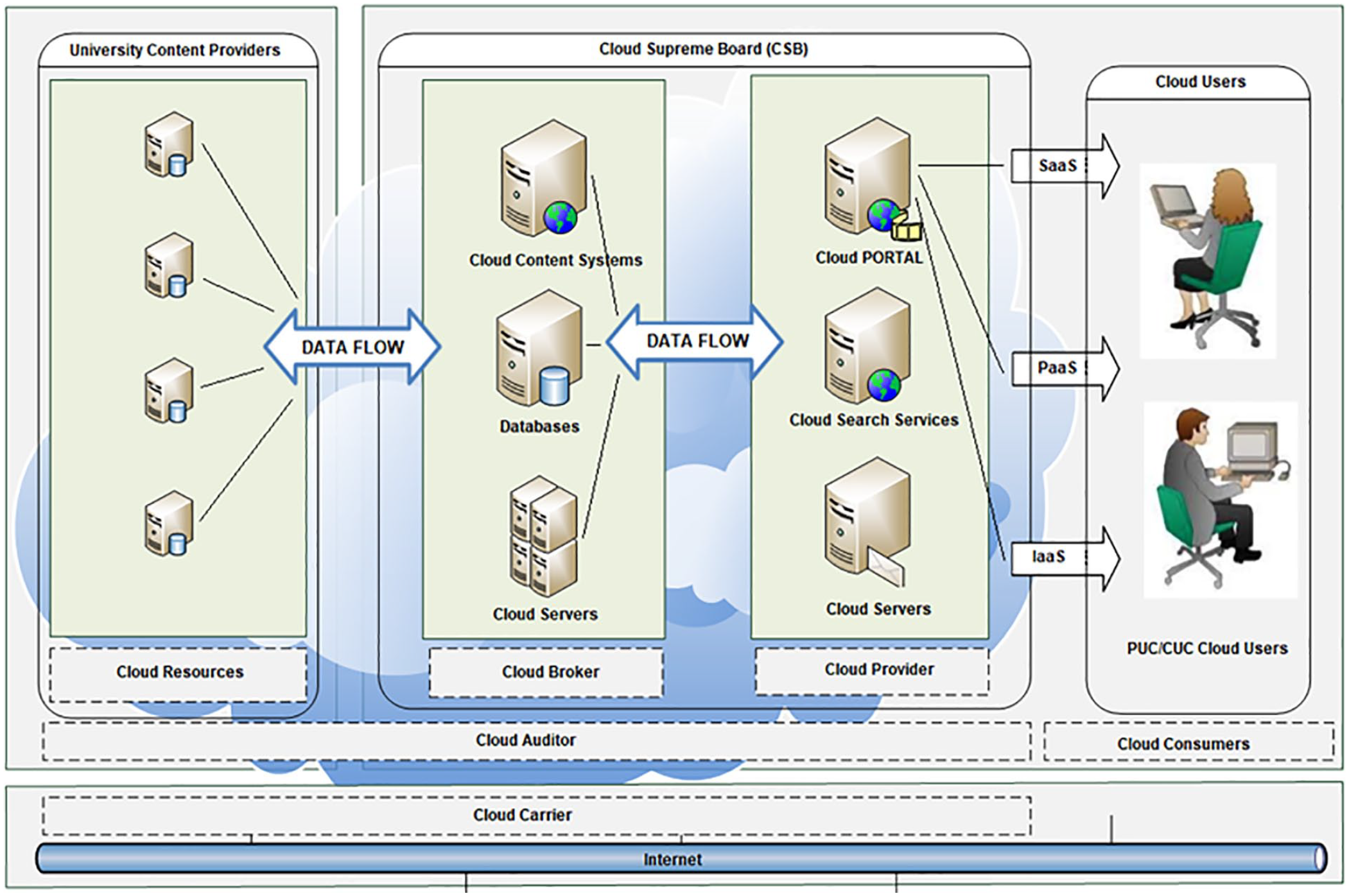
Technical architecture of the framework.
In the survey, 71.4% of IT departments stated that they did not think to apply cloud computing in their universities. Results of the survey study also showed that approximately half of the universities (50.5%) did not have enough knowledge about cloud computing. The fact that universities do not want to implement cloud computing may be due to their lack of sufficient knowledge about the cloud. Therefore, the on-premises infrastructure which is included in the framework could give the ability to build the model with external assistance from other universities.
Examining the survey results, it is seen that the majority of universities (79.1%) are considering software expenditures as the highest item among the high-cost items of their budgets. The fact that the majority of universities see software expenditures as the highest item among the high-cost items of their budgets shows the need for SaaS cloud services in the first stage. Especially during the coronavirus period, it is a fact that universities need to purchase software to continue distance learning. Universities can use SaaS as a solution thanks to cloud computing, which offers cost-effective solutions to users. The survey also shows that the universities are already familiar with SaaS, IaaS, and PaaS series. This situation can be interpreted as that cloud users tend to use software-heavy applications more. In this context, SaaS services were included in the presented framework, and based on the information obtained from the survey, IaaS and PaaS services were also given importance.
In this architecture, data will be synchronized across PUC and CUC infrastructure. Universities can gain the flexibility and computing power of the CUC cloud for their basic and non-sensitive computing tasks, while they can keep their critical applications and data safely behind a university firewall via CUC. Each of the PUC and CUC environments that make up this hybrid cloud architecture has its own benefits and uses. By combining PUC and CUC into a single hybrid cloud, universities can gain greater control over data safety, accessibility, privacy, authenticity, and security for both their IT infrastructure and their users’ data, applications, and systems.
The cloud users of the framework will be able to use both PUC and CUC services anytime from anywhere. As PUC is a private cloud and offers the most control over security parameters, the services/applications delivered in this structure will be chosen by each university administration. By adopting PUC and CUC, universities will establish a pool of shared services and applications which can be used via the portal structure.
Conclusion
The cloud computing service model, which is one of the most up-to-date technologies in recent years, is increasingly used in universities. Today, universities are engaged in various works to adopt cloud computing service model. Moving to the cloud in universities is an important step in terms of online education, economic crisis, globalization, and high and constantly changing requirements. Cloud computing can also play a very important role in quickly solving the problems faced by universities during this coronavirus period. With the adoption of the cloud, management of knowledge can be done in an effective way to achieve high academic performance and efficiency in universities. The issue of cloud computing use by universities is clearly very important and would continue to be important, especially in the post-COVID-19 world.
In this study, literature studies focusing on cloud computing in universities were reviewed based on the research questions, and the position of universities in Turkey was determined. In the study, an abstract hybrid cloud framework that contains guidelines to overcome the major challenges identified was presented. Within this context, the existing conditions and problems in the use of the cloud service model in universities were tried to be identified and some recommendations for solving these problems were drawn up. Considering the results of the study, we provided some recommendations. The results are primarily intended to provide a guideline to universities in cloud computing adoption.
The study findings were statistically analyzed under the headings “Awareness,” “Requirement,” “Cloud Services/Applications,” “Technology Readiness,” and “Benefits and Obstacles”:
Findings of this study show that approximately half of the universities (50.5%) do not have sufficient knowledge about cloud computing technology.
The majority of IT departments see IT expenditures (enterprise electricity, software, hardware, and personnel) among the high-cost items of their budget. This can be interpreted as an indicator of the need for cloud computing in universities. Therefore, based on this result, an abstract hybrid cloud framework was presented. The fact that the vast majority of IT departments are seeing software costs as the highest expenditure item of their budget suggests that SaaS cloud services should be used first.
The majority of universities use virtualization technology. A very small portion of the IT departments have required ICT security certificates. Only a very small portion of universities are currently using a cloud model in their universities. These results support the fact that nearly half of the IT departments have a cloud architecture. Universities think that top management support is not sufficient for cloud computing, and cloud compliance is not taken into account. These results show that IT departments are not ready for transition to the cloud. However, evaluations related to the future of cloud computing in universities reveal that they tend to adopt cloud computing.
Although they mentioned some disadvantages, most of the IT departments stated that they agreed with the advantages of cloud computing. Behind the desire of universities to benefit from cloud computing lies mainly their willingness to use their financial resources cost-effectively and efficiently.
In the chi-square test done in the study, no significant difference was found between the state and private universities in terms of knowledge level related to cloud computing (χ2 = 0.180). Also, no significant difference was found between the perceptions about operating (χ2 = 0.349), electricity (χ2 = 0.117), software (χ2 = 0.590), hardware (χ2 = 0.285), and personnel (χ2 = 0.108) expenditures. On the contrary, a significant relationship was determined between cloud computing awareness and the use of cloud applications (χ2 = 0.01). A significant relationship was found between the use of virtualization technologies and the use of cloud applications (χ2 = 0.035). In addition, a significant relationship was determined between cloud computing awareness and the use of virtualization technology (χ2 = 0.034).
To adopt cloud technologies in universities, the study presented a framework that could identify and classify information services of universities. The proposed model consists of two different cloud computing patterns, PUC and CUC. PUC is a private cloud to be structured and managed by each university. CUC is a community cloud that covers the information services of PUC cloud services of volunteer universities. In the presented framework, there is a portal structure by which the cloud services and applications will be delivered.
The results of this study show the following:
Although there is generally a need for a cloud environment in universities, there are some problems at various levels arising from both internal dynamics and external dynamics of universities in front of the realization of such a formation.
Cloud computing awareness level, compliance of existing capabilities with such a structure, the level of usage of cloud applications, and the extent of support provided by the university administration come to the fore.
If these problems are overcome, it may be possible to restructure ICT in the cloud environment.
Recommendations regarding the results of this study are as follows:
In recent years, the number of universities has increased in Turkey. Cloud computing will enable these universities, growing in number, to provide information services more cost-effectively. Therefore, the usage of the cloud computing service model in universities should be encouraged. Policies should be developed to make better use of cloud computing in universities. A system focused on the use of the cloud service model in information services should be established. This should be supported by plans, programs, budgets, and practices.
The awareness of universities and their IT units about cloud computing should be increased. In this context, the participation of universities in national and international fairs, congresses, and seminars on cloud computing should be facilitated and supported. National and international studies regarding the provision of information services should be followed by using the cloud computing service model. IT departments of universities can organize and participate in activities, such as seminars, workshops, and conferences, which allow sharing information and experience on cloud computing.
Support should be provided to cloud entrepreneurs to benefit from cloud computing in universities. Cloud compliance and usage in ICT investments should be encouraged. Supportive arrangements, such as various tax exemptions, should be encouraged to provide information services to investors, individuals, and institutions using the cloud service model. The implementation of cloud projects in public and private universities should be encouraged.
Existing technology development centers (technopark, etc.) should also be taken into account in the adoption of cloud in universities and also moving university information services to the cloud.
Due to the rapid increase in the number of universities in recent years, especially newly established universities may not have equal opportunities. Increasing costs of universities mainly include purchasing new computer equipment; paying license fees to automation systems, maintenance, and repair of information systems; and the employment of energy and qualified ICT personnel. In particular, these universities should be provided with the opportunity to utilize the cloud computing service model that provides ICT services such as transaction and storage infrastructure and to be able to dynamically scale without being dependent on location, time, and environment as a solution to their costs.
Universities should be encouraged to carry out R&D studies on cloud computing. This will contribute to the inclusion of university information services in the cloud.
As a future study, we plan to determine and evaluate the cybersecurity issues mentioned in this study in detail in terms of the adoption of cloud computing in universities.
