




Abstract
This article discusses the status of prenominal and postnominal adjectives in Arabic. It is argued that Kremers’s treatment of adjectives is non-economic as it generates two different syntactic representations for prenominal and postnominal adjectives. It also undermines endocentric properties of phrasal projections and fails to correctly predict the definiteness status of adjectival construct state heads. The article proposes an alternative analysis with a single underlying syntactic structure for both types of adjectives. The need to have nominal features of the specifier (Spec) of the agreement phrase head (Agr) checked and licensed within the determiner phrase (DP) triggers leftward noun phrase (NP) movement, thus forming postnominal adjectives. In prenominal adjectives, however, the strong Definiteness Feature (DEF) on the determiner (D) causes the adjective phrase to raise to the specifier of the DP.
Introduction
Most of the traditional grammar written on classical Arabic depended on what native speakers of the language judged to be grammatical. However, this form of classical Arabic has seen dwindling interest and the once widely spread and prestigious style of communication is presently confined to religious and some literary texts. Instead, the modern standard Arabic is now prevalent and dominates the media, although its use too is limited to official register and is often learned rather than acquired. Nevertheless, the treatment of prenominal and postnominal adjectives in both classical and modern standard Arabic remains indistinguishable for the most part.
Adjectives in Arabic normally follow the nouns they modify. Thus, the following order is commonly found in Arabic:
(1) Determiner Phrase (DP) + Noun Phrase (NP) + Adjective Phrase (AP).
In (1), both the DP and the NP precede the AP. However, it is the intrinsic property of some adjectives to precede the NP they modify (Fassi Fehri, 1999), yielding the following order:
(2) DP + AP + NP.
This short article expounds on the status of adjectives in Arabic. It argues that Kremers’s (2003) analysis of prenominal and postnominal adjectives, which rests on the notion of definiteness inheritance, presents a challenge for the X-bar theory, is structurally superfluous and non-economic, and can generate ungrammatical structures. The article sets forth an alternative minimalist account that posits a single underlying structure for both prenominal and postnominal APs. In particular, it is argued that the definiteness feature weakness or strength determines the AP prenominal versus postnominal status in the DP.
Adjectives in Arabic
Positive Adjectives
Positive adjectives usually follow the nouns they modify and agree with them in number, gender, case, and definiteness. Consider the following examples:
(3) bint-u-n jameel-at-u-n
girl-nom-indef pretty-fem-nom-indef
“a pretty girl”
(4) al-bint-u al-jameel-at-u
def-girl-nom def-pretty-fem-nom
“the pretty girl”
The adjective jameel-at-u-n “pretty” in (3) and al-jameel-at-u “the pretty” in (4) both agree with the preceding nouns bint-u-n “a girl” and al-bint-u “the girl” respectively in number (singular), gender (feminine), case (nominative), and definiteness. 1
Positive adjectives can, however, occur prenominally in which case they do not bear any case, gender, number, or definiteness agreement with the noun they modify:
(5) (al)-jameel-u al-wajh-i
def-pretty-nom def-face-gen
“(the one with) the pretty face”
The definite marker on the adjective (al)-jameel-u “the pretty” is optional and is not the result of definiteness agreement with the noun al-wajh-i “the face.” The adjective here with the noun forms a construct state (CS; see “Definiteness and the CS” section) as apparent from the genitive case ending -i on the nominal complement. It should be noted that the construction in (5) is not very common and is more likely to be found in classical Arabic.
Comparative Adjectives
Comparative adjectives can only occur postnominally, but unlike positive adjectives, they do not agree with the noun preceding them in gender or number. 2 Rather, comparative adjectives have to adhere to the form of Af’al Attafdheel 3 and be followed by the min “than” prepositional phrase:
(6) al-bint-u (al)-akbar-u min ukht-i-ha
def-girl-nom (the)-older-nom than sister-gen-her
“the girl (who) is older than her sister”
(7) al-awlaad-u (al)-akbar-u min akhawaat-i-him
def-boys-nom (the)-older-nom than sisters-gen-their
“the boys (who) are older than their sisters”
The comparative adjective (al)-akbar-u “(the) older” modifies a singular feminine noun al-bint “the girl” in (6) and a plural masculine noun al-awlaad-u “the boys” in (7). Although the adjective has to agree with the noun in case, agreement in number, gender, or definiteness is non-obligatory.
Superlative Adjectives
The superlative adjective is constructed in Arabic using the singular genderless Af’al form. However, unlike comparative adjectives, superlatives are unique in Arabic in that they can occur prenominally or postnominally:
(8) al-walad-u al-akbar-u
def-boy-nom def-oldest-nom
“the oldest boy (of a known group of boys)”
(9) akbar-u walad-i-n
oldest-nom boy-gen-indef
“the oldest boy”
(10) akbar-u al-awlaad-i
oldest-nom def-boys-gen
“the oldest of the boys”
In (8), the superlative adjective al-akbar-u “the oldest” follows the noun al-walad-u “the boy” and shows agreement in definiteness and case. However, in (9) and (10), the superlative precedes the nouns walad-i-n “boy” and al-awlaad-i “the boys” but shows neither definiteness nor case agreement. In both (9) and (10), the adjective constitutes the head of a CS with the following NP as the genitive complement. Lipinski (1997) discussed the various types of adjectives in Semitic languages (see also Abd Al-Ghani, 2000; Qanbaar, 1988, among others). He states that the pattern Af’al is used for the superlative and may then take the definite article as in (8) or be defined by a genitive as in (9) and (10). In its prenominal use, the superlative adjective conveys a greater degree of the attribute compared with postnominal superlatives (Kremers, 2003).
Construct State
There is little discussion in the literature of the adjectival CS. Most of the work centers on the nominal CS, mainly in Hebrew and Arabic (Fassi Fehri, 1999; Siloni, 1997 among others). A CS is the structure where the noun or the adjective is annexed to a genitive DP. Moscati (1964) defined the CS as
the special form taken by a noun when it is defined by a following genitive (or prenominal suffix). The two nouns cannot be separated, though there are certain exceptions to this rule. (pp. 100-102)
The CS can be either nominal composed of the head noun followed by the genitive DP as in (11), or it can be adjectival in which case the head adjective is annexed to the genitive DP as shown in (12):
(11) Nominal CS.
qalam-u al-walad-i
pen-nom def-boy-gen
“the boy’s pen”
(12) Adjectival CS.
akbar-u walad-i-n
oldest-nom boy-gen-indef
“the oldest boy”
The NP construction in (11) expresses possessiveness. The CS head qalam-u “pen” (the possessed) assigns its complement the DP al-walad-i “the boy” (the possessor) the genitive case -i. The adjectival CS in (12) is very similar to the nominal one structurally but rather expresses the superlative meaning of the adjective; the adjective akbar-u “oldest” is the head of the CS, and the noun walad-i-n “boy” is the genitive DP complement.
The genitive case on the CS DP complement is believed to be structural because the genitive DP can assume different thematic roles in Arabic. It can be the subject, possessive, object, or agent in a sentence. Lindauer (1995) argued that the German genitive can have numerous thematic roles and thus concluded that the DP genitive case is structural. Similarly, Longobardi (1995) and De Wit (1997) argued that if the genitive noun can assume a number of theta roles, then the genitive case is structural.
Definiteness and the CS
Traditionally, grammarians stipulate that the superlative form of the adjective be definite (and singular). Moscati (1964) noted how the CS in Semitic languages is closely connected with the function of definiteness and indefiniteness (see also Borer, 1984; O’leary, 1969). When postnominal, the superlative bears the overt definiteness marker al “the” as in (8). However, in its (CS) prenominal use, it acquires definiteness via annexation to the complement regardless of the DP definiteness status as in (9) and (10). In other words, the superlative adjective in Arabic has to be always definite either via prefixation of the definiteness article or by constituting the CS head.
Evidence for the inherent definiteness of CS heads can be found for example in the ungrammaticality of the following:
(13) *al-akbar-u walad-i-n
def-oldest-nom boy-gen-indef
“the oldest boy”
(14) *al-akbar-u al-awlaad-i
def-oldest-nom def-boys-gen
“the oldest of the boys”
The ungrammaticality of (13) and (14) is due to double definiteness of the superlative by the definite article al- “the” and by being the head of the CS. As stated above, because prenominal superlatives constitute the first element of a CS, they are inherently definite, and as such, cannot realize the overt definiteness marker. 4
Further evidence for definiteness of the CS can be found in the use of adjectives modifying nominal heads in DP-possessive structures:
(15) qalam-u al-walad-i al-jadeed-u
pen-nom def-boy-gen def-new-nom
“the boy’s new pen”
The positive adjective al-jadeed-u “the new” in (15) describes qalam-u “pen” and agrees with it in number (singular), gender (masculine), definiteness (definite), and case (nominative). Such definiteness agreement on the adjective argues that the CS head qalam-u “pen” is in fact definite.
Kremers’s Analysis of Postnominal and Prenominal Adjectives
Kremers (2003) proposed an analysis of postnominal and prenominal adjectives in Arabic according to which two syntactically different structures are posited. Consider the following representation of the positive and superlative adjectives stated earlier in (4) and (10), respectively:
(16) Postnominal adjectives.
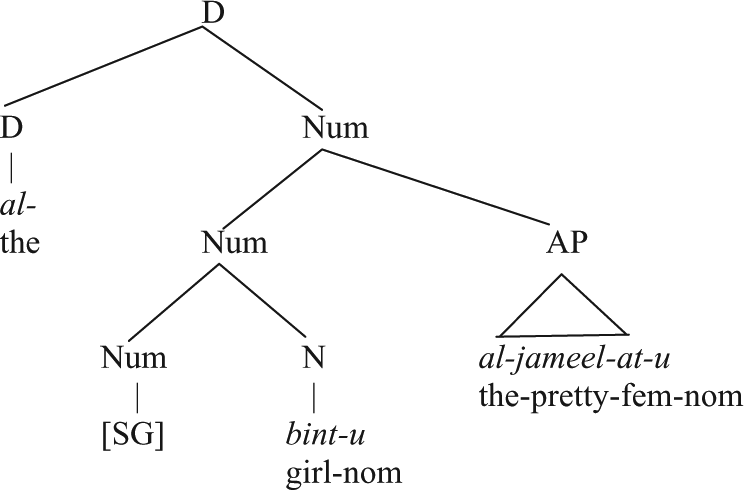
In (16), the positive adjective al-jameel-at-u “the pretty” constitutes the AP that occurs after the noun al-bint-u “the girl” and is syntactically adjoined to the right of the number (Num) phrase. Whereas (16) is proposed for postnominal adjectives, the representation in (17) below is proposed for prenominal adjectives:
(17) Prenominal adjectives.

In (17), the superlative adjective akbar-u “oldest” precedes the DP al-awlaad-i “the boys.” On par with the nominative and accusative case assignment of the subject and the object by T and by little v, respectively, (Chomsky, 1995) and given the fact that genitive case assignment is structural, the genitive case is therefore assigned by a functional head, namely, possessive (POSS) (Delsing, 1993; Longobardi, 1995; Szabolcsi, 1994; Valois, 1991). Kremers (2003) assumed that the POSS head is a projection of the feature POSS that has the value [±POSS] and determines whether the head adjective in the construction has a DP dependent. If the value of POSS is set as [+POSS], then it carries an additional set of unvalued γ features that need to be valued via an Agree relation with the DP complement that is assigned the genitive case:
The head Poss has the value [+POSS] in addition to a set of unvalued γ-features. Because the γ-features are unvalued, Poss is active and tries to value these features. It probes its c-command domain for an active match; it finds a match in the complement DP which is active because it has an unvalued CASE feature. A match is established and the unvalued features of both sides are valued. (p. 37)
The assumption is that in a CS structure, the feature POSS must always be valued as [+] that requires a set of unvalued γ features to be valued through Agree. The unvalued γ features are matched with the unvalued CASE feature (genitive) of the DP complement.
Kremers (2003), after Fassi Fehri (1999), assumed that the head of a CS is unmarked for definiteness. That is, it has neither the definite article al- “the” nor the indefinite marker -n. Instead, the CS head receives its definiteness value via definiteness inheritance from its complement DP. If the genitive DP is definite as in (18), then the head noun, namely, darraaj-at-u “bike” would be definite and if the DP complement is indefinite as in (19), then the head noun will be indefinite as can be discerned from the definiteness status of the modifying adjective in the following examples:
(18) darraaj-at-u al-awlaad-i al-sareeʕ-at-u
bike-fem-nom def-boys-gen def-fast-fem-nom
“the boys’ fast bike”
(19) darraaj-at-u awlaad-i-n sareeʕ-at-u
bike-fem-nom boys-gen-indef fast-fem-nom
“boys’ fast bike”
Given the agreement in case, definiteness, gender, and number between postnominal adjectives and the nouns they modify, the definiteness of the adjective sareeʕ “fast” in (18) and its indefiniteness in (19) result from its agreement with the CS head darraaj-at-u “bike.” One may be led to believe that agreement with the DP complement awlaad-i-n “boys” is what determines the adjectival definiteness. This is not the case, however, as the adjective (al)-sareeʕ-at-u “(the) fast” shows case, number as well as gender agreement with the CS head and not with the genitive DP. The adjective has the same nominative -u, not genitive -i, case as the first element of the CS darraaj-at-u “bike”; is not plural as the DP complement; and carries the same feminine marker as the CS head, namely, -at.
Furthermore, Kremers assumes that definiteness inheritance is a result of Agree. The DEF feature gets valued in the course of the derivation through Agree. D enters the derivation with a valued or unvalued DEF depending on the value of the POSS feature. In other words, if POSS has the value [−POSS] (i.e., when the head noun has no genitive complement), DEF enters the derivation already valued as either the definiteness marker al- “the” or the indefiniteness marker -n. However, if POSS is valued as [+POSS], DEF is unvalued with neither the definite article al- nor the indefinite marker -n.
Discussion
Kremers’s (2003) analysis outlined in (16) and (17) is structurally non-economical as it postulates two markedly different syntactic representations for prenominal and postnominal APs. Second, the analysis assumption of a hybrid category with two heads, namely, D/POSS, in the NP is unattractive. It compromises the endocentric property of X-bar phrases that requires “all phrases be headed by one head” (Haegeman, 1994, p. 105), and “every head project a phrase and that all phrases have heads” (Hornstein, Nunes, & Grohmann, 2005, p. 168). Third, the two features of the hybrid category D/POSS inexplicably stand in a converse relationship: When POSS has the value [+POSS], DEF is forced to remain unvalued and vice versa. It is not clear what causes this trade-off between the two features.
Moreover, the stipulation that [+POSS] renders DEF unvalued and must therefore appear without the definite al- or indefinite -n marker seems to be contradicted by the kind of data mentioned in “Positive Adjectives” section (repeated here in (20) for convenience):
(20) (al)-jameel-u al-wajh-i
def-pretty-nom def-face-gen
“(the one with) the pretty face”
Although the definite article on the CS head adjective (al)-jameel-u “(the) pretty” is optional, (20) still presents a problem for Kremers’s (2003) analysis that mandates that POSS be always valued as [±POSS] whenever in CSs. Such condition requires DEF also to be unvalued (i.e., without the definite article al- “the” or the indefinite marker -n). However, this is not the case in (20) as the DEF feature is indeed valued for definiteness with the definite article al- being realized, albeit optionally, on the adjective (al)-jameel-u “(the) pretty.” In other words, positive prenominal adjectives pose serious problems for an analysis that assumes a value mismatch between POSS and DEF.
Finally, the notion of CS heads acquiring definiteness from DP complements (definiteness inheritance) seems to be undermined by examples involving conjoined adjectives such as the following:
(21) ajmal-u bint-i-n wa* (al)-atwal-u
pretties-nom girl-gen-indef and def-tallest-nom
“the prettiest and tallest girl”
Recall that under definiteness inheritance, the definiteness of the CS head is dependent on and acquired by the genitive DP complement. CS heads inherit their definiteness value from the complement to which they are annexed (i.e., if the CS complement is definite, the head would be definite and vice versa). Thus, in (21), the CS head ajmal-u “prettiest” is predicted to be indefinite after its DP complement bint-i-n “girl.” However, note that the conjoined adjective al-atwal-u “the tallest” in (21) is in fact definite and carries the same nominative case ending -u as the CS head adjective ajmal-u “prettiest.” Clearly al-atwal-u “the tallest” cannot be in agreement with the CS complement bint-i-n “girl” because the latter has different case (genitive -i) and gender (feminine) endings, and is specified for indefiniteness (-n). Therefore, it follows that the definiteness on the adjective al-atwal-u “the tallest” in (21) results from agreement with the superlative CS head ajmal-u “prettiest.” This indicates that the CS head adjective in (21) is indeed definite although overt definiteness morphology is lacking. To sum up, a definiteness inheritance analysis fails to account for the inherent definiteness of CS heads as it would incorrectly predict the CS head adjective ajmal-u “prettiest” in (21) to be indefinite based on the indefiniteness of the DP complement bint-i-n “girl.”
Proposed Analysis
Rather than positing two different structures in the analysis of prenominal and postnominal adjectives, an alternative analysis that makes reference to one unified syntactic structure is proposed. The following tree schema is suggested for both prenominal and postnominal adjectives in Arabic:
(22) Syntactic representation of prenominal and postnominal adjectives in Arabic.
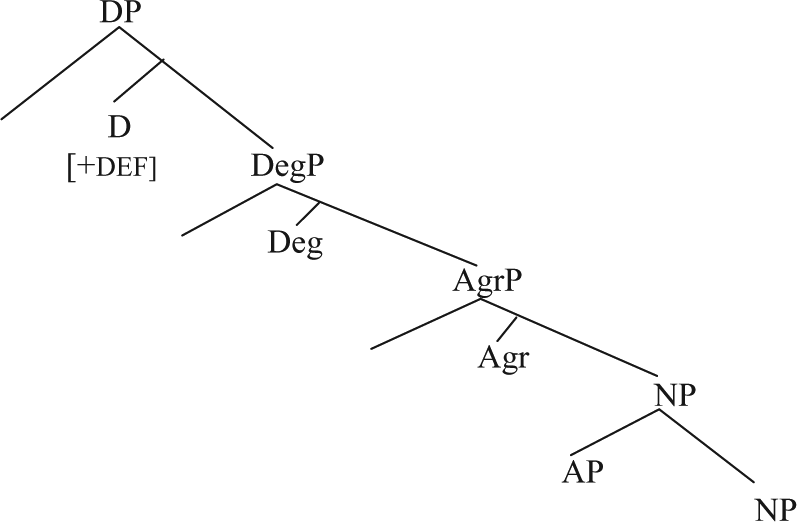
To explain how postnominal and prenominal adjectives can be derived from the tree diagram in (22), consider the following representation for postnominal adjectives:
(23) Syntactic representation of postnominal adjectives in Arabic.

The NP in (23) raises to the specifier of the agreement phrase (AgrP). I assume after Cinque (2005) that what is triggering the NP movement is the need for extended projections of the NP to be licensed. I also assume, after Koizumi (1995) and the argument made therein for the existence of agreement phrases in Minimalist Syntax, that the head category Agr has a maximal projection, namely, AgrP. In (23), the AgrP specifier’s need for a nominal feature to be licensed within the DP triggers the movement of the NP to [Spec-Agr]. 5 I assume further that D has a weak DEF (definiteness) feature that does not cause the movement of the AP to the specifier of the DP. However, to account for the elative form of postnominal superlatives, I assume that the adjective acquires the elative morphology by entering an Agree relation with [Spec-DegP] (Chomsky, 2000).
Now consider the following tree structure for prenominal adjectives:
(24) Syntactic representation of prenominal adjectives in Arabic.

The tree structure of prenominal adjectives in (24) is identical to that of postnominal adjectives in (23); however, contrary to (23), D is said to have a strong DEF feature in (24) that triggers the movement of the AP to the specifier of the DP. The AP undergoes movement first to [Spec-AgrP] then to [Spec-DegP] to acquire the elative (or superlative) morphology 6 and ultimately to [Spec-DP] to check the strong definiteness feature on the determiner. Being in a spec-head relation with the determiner, the adjective acquires definiteness and functions as a determiner in the sense that it singles out the most salient member of a set. Because the AP movement blocks the movement of the NP to the specifier of the agreement phrase, [Spec-AgrP] has to acquire the nominal feature that licenses its presence in the DP some other way. Following Cinque (2005), I assume that licensing is done through Merge. That is, the specifier of the agreement phrase acquires the nominal feature through an Agree relation with the NP. In this manner, the extended projection of the NP is licensed without resorting to movement of the NP to [Spec-AgrP], which would otherwise be impossible due to [Spec-AgrP] being already occupied with the AP.
Note that the analysis proposed in (22), unlike that of Kremers (2003), does not resort to hybrid maximal projections. The maximal phrase is headed by one single head, namely, D, which is a projection of the DP; thus, endocentricity of phrasal projections in the X-bar theory is respected. In addition, problematic data for the definiteness inheritance approach are easily accounted for under this analysis. Consider the NP in (21) above where, contra to definiteness inheritance, the adjective ajmal-u “prettiest” was argued to be definite although its genitive DP complement is not. According to (22), the adjective ajmal-u “prettiest” moves first to [Spec-AgrP], then to [Spec-DegP] to acquire the elative form, and eventually to [Spec-DP] for checking the strong definiteness feature in D.
Finally, it is more adequate for economy considerations to postulate a unified syntactic representation for both to different but related APs. The thrust of the argument is that the syntactic representations in (23) and (24) are isomorphic and the distinction between prenominal and postnominal adjectives is syntactically reduced to the featural strength of the definiteness feature on the determiner. In other words, the choice of whether an adjective occurs prenominally or postnominally is constrained by the definiteness feature in D. If D has a weak definiteness feature, then the AP is postnominal, and if D has a strong definiteness feature, then the AP is prenominal.
Evidence for Noun Phrasal Movement in Postnominal Adjectives
Taking into account postnominal adjectives, the analysis proposed in the previous section assumes the movement of the whole NP to the specifier of the agreement phrase. Evidence for such movement of the NP can be found in constituency tests designed to reveal the syntagmaticity and wholeness of a syntactic unit. For space limitations, I consider here two tests of constituency: modification and coordination.
Noun Complement Modification
Recall that the underlying representation or the deep structure (DS) for postnominal adjectives places the modified NP to the right of the AP before moving it to the left of the adjective at the surface structure (SS) level:
(25)
def-pretty-fem-nom car-fem-nom def-boy-gen
car-fem-nom def-boy-gen def-pretty-fem-nom
“the boy’s beautiful car”
In (25), the CS head sayyar-at-u “car,” along with its genitive complement al-walad-i “the boy,” moves to a preadjectival position. The derivation that takes place in (25) is depicted in the following tree diagram:
(26) Syntactic representation of postnominal adjectives in Arabic.

Now consider the following example where the NP undergoes partial movement:
(27) *sayyar-at-u al-jameel-at-u al-walad-i
car-fem-nom def-pretty-fem-nom def-boy-gen
“the boy’s beautiful car”
The ill-formedness of (27) stems from the head of the CS sayyar-at-u “car” moving to the spec of AgrP without its genitive complement al-walad-i “the boy.” The example in (27) can only be grammatical if the whole NP (the noun along with its complement) moves to [Spec-AgrP]. The constituency of the NP as exemplified here can be taken as evidence for whole noun phrasal movement rather than head movement to the specifier of the agreement phrase in postnominal adjectives.
Coordination
As mentioned earlier, movement to the spec of the agreement phrase targets whole NPs rather than single nominal heads. Therefore, in NPs made up of two or more conjoined nouns, the single head along with its coordinated noun is expected to undergo movement as in (28):
(28)
def-pretty-fem-nom def-dogs-nom and def-lions-nom
def-dogs-nom and def-lions-nom
def-pretty-fem-nom
“the pretty dogs and lions”
Note the full agreement between the two coordinated nouns al-kilaab-u “the dogs” and al-?usood-u “the lions” in case, number, and definiteness. According to the analysis of postnominal adjectives so far proposed, the NP constituent left-joins the specifier of AgrP as shown in the following diagram:
(29) Syntactic representation of postnominal adjectives in Arabic.
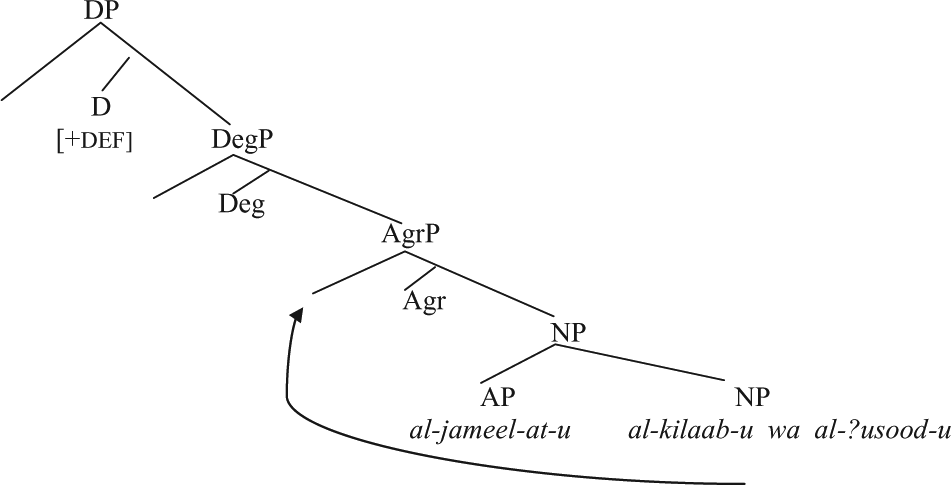
In (29), the entire NP moves to [Spec-AgrP] where it is modified by the adjective al-jameel-at-u “the pretty.” Partial NP movement, however, would render the structure ill-formed:
(30) *al-kilaab-u al-jameel-at-u wa al-?usood-u
def-dogs-nom def-pretty-fem-nom and def-lions-nom
“the pretty dogs and lions”
The illicitness of (30) is due to raising the noun al-kilaab-u “the dogs” to [Spec-AgrP] without the coordinated noun al-?usood-u “lions.” This presents further evidence that the movement involved in (23) cannot be single head movement of the noun.
Finally, the fact that when NP-to-[Spec-AgrP] movement occurs, it always affects the determiner al- “the” lends more credence to the claim that phrasal rather than single head movement takes place in postnominal adjectives as shown in the ungrammaticality of the following example:
(31) *bint al-jameel-at-u al-
girl def-pretty-fem-nom def-
“the pretty girl”
The NP in (31) moves without its determiner al- “the” to the specifier of the agreement phrase as illustrated in (32):
(32) Syntactic representation of postnominal adjectives in Arabic.

The diagnostics above indicate that the noun movement in postnominal adjective constructions is indeed a movement of the maximal projection NP rather than a movement of the head N.
Conclusion
This article has dealt with postnominal and prenominal adjectives in Arabic. It was argued that although Kremers’s (2003) analysis captures some generalizations of the CS in Arabic, it is not without its shortcomings. It presents a serious challenge to one important endocentric tenant of the X-bar theory: single head projection of phrases. Furthermore, in addition to assuming two distinct syntactic representations for postnominal and prenominal adjectives, the analysis fails to account for some new emergent data. In particular, definite adjective conjunctions with CS heads pose some problems for a definiteness inheritance account. An alternative minimalist approach with one unified syntactic representation accounts for prenominal and postnominal adjectives. Strong definiteness of D in prenominal adjectives triggers AP movement to [Spec-DP], whereas lack of it and the need for nominal features within the DP to be licensed in postnominal adjectives trigger NP movement to [Spec-AgrP]. Tests of constituency, namely, NP modification and coordination, provide clear evidence for NP-phrasal vis-à-vis single head movement to the specifier of the agreement phrase.
Footnotes
Declaration of Conflicting Interests
The author(s) declared no potential conflicts of interest with respect to the research, authorship, and/or publication of this article.
Funding
The author(s) received no financial support for the research and/or authorship of this article.