




Abstract
Corruption and bribery are often seen as the same in public messages, but people might understand them in different ways. These varying perceptions can significantly influence how anti-corruption efforts are received and understood. Therefore, we explored the perceived definitions of “corruption” and “bribery” among young adults (N = 253, M_age = 21.32; 59.3% female) using the structural approach of Social Representation Theory as the underlying framework, and collected data through an online survey. A prototypical analysis was conducted using IRAMUTEQ software to elicit the core elements (high important level and agreed by most people) of corruption and bribery. Results showed that respondents used the term “money” to describe corruption and bribery but distinguished them based on moral evaluations and perpetrators. Corruption was associated with negative terms like “bad” and “dishonest” and linked to the “government,” while bribery lacked such moral connotations and was associated with the “police.” The absence of consequences in social representations may provide insight into the persistent challenge of combating corruption and bribery.
Plain Language Summary
Corruption and bribery are often talked about in the same way, but people might think about them differently. These different views can really affect how efforts to stop them are understood. So, we looked at how young adults (253 people, average age 21.32, 59.3% female) define ‘corruption’ and ‘bribery.’ We used Social Representation Theory (how people understand and share ideas about the world) as our basis and asked them through an online survey. We then analyzed the data using software called IRAMUTEQ to find out the most common and important ideas people had about corruption and bribery. The results showed that most people thought of ‘money’ when talking about both corruption and bribery. But they saw them differently based on how they felt about them and who was involved. Bribery was mostly connected to specific people, especially the police. On the other hand, corruption was seen as something related to the whole government, which made it feel like a bigger and more general problem. Corruption was also linked to negative words like ‘bad’ and ‘dishonest’. Bribery, on the other hand, didn’t have such strong negative feelings. This difference in how people think about these issues might help explain why fighting corruption and bribery is still such a challenge.
Keywords
Introduction
The United Nations underscores the importance of both combating corruption and bribery in Sustainable Development Goal 16.5 (Castelo Branco, 2021). The general effects of corruption on national development and the world at large include the hindrance of economic growth, the destabilization of institutions, and the deepening of social inequality, which ultimately undermine the prospects for sustainable development globally. Corruption significantly, for example, hampers national development, distorts markets, erodes public trust, exacerbates poverty, and undermines political legitimacy and good governance (Aulia et al., 2024; Coetzee, 2014; Dele, 2021). However, addressing corruption and bribery is particularly challenging due to the varying interpretations of these terms. Different individuals may hold conflicting views on what constitutes corruption or bribery, which complicates efforts to enforce laws and communicate anti-corruption messages effectively (Hooker, 2009; Segon & Booth, 2010). As a result, preventing corruption requires not only legal or institutional definitions but also a deeper understanding of how these terms are perceived by the public in everyday life.
There are many forms of corruption and bribery, such as petty bribery, political bribery, and financial bribery. However, in the context of this research, we are interested in the general conceptualization of corruption and bribery as related to the fundamental concept of dishonesty, rather than those connected with specific types. This study seeks to explore how young adults perceive and differentiate between the social representations of “corruption” and “bribery.” Specifically, it aims to understand how these perceptions influence individuals’ judgments and decision-making. While expert definitions of corruption and bribery are well established, public understanding often diverges, leading to a gap between legal definitions and laypeople’s beliefs (Orosz, 2010).
By employing the Theory of Social Representation (Moscovici, 2001), this study investigates how young adults communicate these everyday understandings of corruption and bribery, known as social representations. We argue that clarifying these social representations is essential for improving the effectiveness of anti-corruption strategies. We propose that corruption may be communicated as a concept distant from the individual—something associated with those in positions of power—while bribery is more likely to be communicated as a micro-level issue, potentially involving oneself or people in one’s immediate environment.
This research contributes by offering new insights into how social representations can inform the design of culturally sensitive and contextually appropriate anti-corruption interventions. Aligning anti-corruption strategies with the public’s micro understanding can lead to more effective outcomes, ensuring that efforts to combat corruption resonate with the people they aim to protect (Budiman et al., 2013; Othman et al., 2014; Zaloznaya, 2014).
Understanding Social Representation of Corruption and Bribery
Corruption and bribery are often used interchangeably in everyday language, but their meanings can vary depending on context. While specific types of bribery, such as petty bribery, political bribery, and financial bribery, are frequently discussed, this research focuses on the broader conceptualization of both corruption and bribery as related to dishonesty. This distinction is crucial for understanding how these terms are perceived by the general public and how such perceptions might influence policy-making. The terms “corruption” and “bribery” are often considered synonymous in public discourse (Dikmen & Çiçek, 2023; Rothstein & Torsello, 2014). However, it is important to examine whether the general public sees them as equivalent or if there are key distinctions between the two concepts that influence their understanding and response to anti-corruption messages.
Understanding how individuals conceptualize terms like corruption and bribery is crucial, as these concepts may not be universally understood in the same way. For instance, politicians often use the phrase “fight corruption,” assuming it inherently includes bribery. However, this assumption may not align with the public’s understanding of these terms (Kato, 2019; Kumar, 2022; Ngui, 2020). If the public perceives bribery and corruption as distinct phenomena, messages targeting corruption may fail to resonate or have the intended impact. Therefore, clarifying how these terms are understood by the public could significantly improve the effectiveness of anti-corruption campaigns. This research is novel in its potential to inform policy design by aligning anti-corruption strategies with public perceptions. Moreover, it underscores the importance of cultural sensitivity in crafting such strategies, suggesting that anti-corruption initiatives should be tailored to local norms and values for maximum impact.
So, do the general public perceive corruption and bribery as synonymous, or are there distinctions between these two concepts? Previous literature highlights three key aspects: (i) individuals may have varying understandings compared to general definitions (Doan et al., 2022; Ten Have & Neves, 2021); (ii) perceptions can influence cost-benefit evaluations (Becker, 1968; Mazar & Aggarwal, 2011); and (iii) cultural factors play a role in shaping the acceptability of these behaviors (Fein & Weibler, 2014; Rothstein & Torsello, 2014).
Individuals’ Understanding of Corruption and Bribery
Corruption and bribery are complex phenomena with unclear definitions, and individuals’ social representations of these concepts vary significantly across cultural, social, and institutional contexts, influencing their behaviors and attitudes (Doan et al., 2022; Ten Have & Neves, 2021). While corruption includes a broad spectrum of behaviors—such as extortive corruption (coercion under threat), investive corruption (offering benefits in expectation of future returns), defensive corruption (acts done to avoid harm), nepotistic corruption (favoring relatives or friends), autogenic corruption (self-serving acts like embezzlement), and supportive corruption (reinforcing or protecting corrupt networks). Alatas (1990)—bribery is most closely aligned with transactive corruption, which involves a reciprocal agreement between a giver and receiver of illicit benefits. This form is particularly salient in public discourse because it clearly involves two parties and a mutual exchange, making it more visible, morally loaded, and widely recognized. In many societies, including Malaysia, corruption is most frequently associated with bribery, political donations, and money politics (Abas Azmi & Zainudin, 2021). Given its prominence, studying how people socially represent corruption and bribery—especially in their most recognized transactive forms—is essential for understanding how these acts are justified, normalized, or condemned within specific cultural settings. Focusing on these social representations may offer insights into public tolerance, ethical boundaries, and the effectiveness of anti-corruption measures.
Secondly, empirical research highlights that individuals’ perceptions of corruption and bribery are influenced by cultural, economic, and institutional factors. Virtual interviews with 25 young people and focus groups in Russia and Argentina reveal divergent perceptions in these countries (Morayta & Pruel, 2023). In Argentina, young people often associate corrupt behavior with improving material living conditions, especially through interactions with institutions like the police. In contrast, Russian respondents commonly link corruption to expediting processes or bypassing bureaucratic barriers in universities and hospitals. In developing countries, the boundary between public and private roles is often blurred, with practices like gift-giving and patronage extending into the public sphere (Rose-Ackerman, 1999). Additionally, in India, networking across public-private boundaries is a coping strategy driven by reciprocal obligations and social norms (Ruud, 2000). Similarly, recent research in Malaysia shows that the type of primary school attended can influence young adults’ intentions to engage in bribe-giving, with those from Chinese vernacular schools exhibiting higher intentions compared to national school students (Mengzhen, van Oosten, & Wan Jaafar, 2025). This finding underscores how early socialization and educational context can shape perceptions and behavioral intentions related to bribery.
Thirdly, people often use the terms “corruption” and “bribery” interchangeably, treating them as if they are the same. (Batrancea et al., 2018; Mengzhen et al., 2021; Nichols & Robertson, 2017). Corruption is commonly defined as the abuse of power or trust for self-interested purposes (Nichols & Robertson, 2017; Pozsgai-Alvarez, 2020); while bribery is viewed as a quid pro quo exchange of benefits (Nichols & Robertson, 2017). Given these conceptual similarities, it is unsurprising that the public often equates the two terms. This conflation complicates efforts to address corruption and bribery effectively, as people’s perceptions shape their attitudes and behaviors (Galli & Fasanelli, 2020; Orosz, 2010).
While corruption broadly includes various forms, such as nepotism, abuse of authority, and conflicts of interest in legal and public policy literature, this paper primarily focuses on bribery as a central form of corruption. This focus is intentional to explore the direct, transactional nature of bribery, which involves an explicit exchange of benefits. In doing so, the paper narrows the scope to better understand how bribery manifests in practice, particularly in contexts where the transactional element is clear. Although other forms of corruption are significant, the focus on bribery allows for a more concentrated examination of its impact and perception in real-world scenarios, particularly on a personal level.
Cost-Benefit Analysis
One of the theories that explain the deterrence of corruption and bribery is the cost-benefit analysis (Becker, 1968; Mazar & Aggarwal, 2011). This perspective assumes that people are rational and generally selfish so tend to act based on an assessment of the advantages that may be gained in any situation and how potential costs may be best avoided. It has been shown that when potential costs are perceived to outweigh the potential benefits then individuals’ intentions to bribe change (Liu et al., 2017; Olken & Pande, 2012), suggesting that at least some corrupt behavior is the result of rational consideration. Based on this analysis, efforts to curb corruption and bribery were carried out, such as giving rewards to people who report corruption and bribery (Abbink & Wu, 2017) or crackdown on those who are involved in such act (Banuri & Eckel, 2015).
To assess the costs and benefits before engaging in corrupt or bribing activities, individuals must first comprehend their own perceptions of corruption and bribery. For example, the distribution of cash to voters during election campaigns is a controversial issue in Malaysia, with different politicians holding varying opinions on the matter. Some view it as an act of charity and not corruption or bribery, while others consider it a corrupt act (Ragu, 2023). From a cost-benefit viewpoint, distributing cash as a form of charity would not be considered a cost if it is perceived as a benevolent act. Hence, these perceptions would hinder efforts to curb corruption and bribery. These differing perspectives highlight the need for a clear understanding of how individuals perceive corruption and bribery.
Cultural Influence on Perceptions of Corruption and Bribery
The perception of corruption and bribery is heavily shaped by cultural factors, with what is considered acceptable behavior varying significantly across societies (Fein & Weibler, 2014; Rothstein & Torsello, 2014). This cultural variation complicates individuals’ ability to accurately evaluate the costs and benefits of corrupt acts. Firstly, what one society views as corrupt may overlap with behaviors considered acceptable or even positive in another context (Magnus et al., 2002). For instance, in Asian cultures, gift-giving to authority figures such as teachers, clients, or government officials is regarded as a token of respect, rather than a form of bribery (Chan et al., 2003; Li et al., 2022; Steidlmeier, 1999). Similarly, donations to charitable organizations may be seen as socially beneficial, with little concern for transparency or the potential for corruption (Noor et al., 2017; Zainon et al., 2012). In Indonesia, bribes exchanged between private sector entities are not considered corrupt (Madjid et al., 2022).
Secondly, research comparing corporate gift-giving practices in Malaysia and the UK reveals significant cultural and legal differences in how corruption is perceived. In Malaysia, regulations regarding gifts and hospitality are less detailed than in the UK, highlighting the role of local legal frameworks in shaping perceptions of corruption (Ahamad Kuris et al., 2023). These examples demonstrate that cultural contexts are critical to understanding how corruption and bribery are perceived, and that behaviors considered corrupt in one society may be entirely acceptable in another.
Thirdly, Cultural dimensions, as outlined by Hofstede, shape perceptions of corruption across countries. Power distance, or the perception of hierarchical inequality, influences corruption perceptions in varying ways (Jun & Kim, 2022; P. V. S. D. Souza & Silva, 2023). Individualism is generally linked to higher perceptions of corruption, though some studies suggest the opposite (Dipierro & Rella, 2024; P. V. S. D. Souza & Silva, 2023). Additionally, long-term orientation, indulgence, masculinity, and uncertainty avoidance contribute to heightened corruption perceptions (Dipierro & Rella, 2024; P. V. S. D. Souza & Silva, 2023). These cultural dimensions help explain differences in how corruption is understood across countries, highlighting the need for research on how these varying cultural influences shape social representations of corruption and bribery.
In light of these complexities, as culture may influence how individuals perceive corruption and bribery, and because we lack sufficient understanding of this, it is necessary to investigate the social representations of corruption and bribery, as they may differ from culture to culture
Theoretical Framework: Theory of Social Representations (TSR)
Social representation theory, originally formulated by Moscovici (Moscovici, 2001), is a widely employed framework for examining social representations (Wanders et al., 2021). It refers to systems of values, ideas, and practices that help individuals understand new information, navigate the social world, and develop a shared language for communication by naming and classifying various aspects of their environment (Galli & Fasanelli, 2020). The COVID-19 pandemic has demonstrated these processes in action as new information related to pandemic changed the way in which the virus was labeled, for example as the “Wuhan virus” (Su et al., 2020), and shifts in preventive measures, from mask-wearing by symptomatic individuals to widespread use of gloves, double masks, and face shields (Khubchandani et al., 2020). Different countries and even groups within the same country developed distinct lay theories about COVID-19, influencing behaviors such as vaccination patterns and COVID-related practices, as seen in the contrasting behaviors between red and blue states in the US (Thorp, 2021).
The development of how individuals perceive corruption and bribery in their everyday lives and how these perceptions shape their social reality are generally referred to as social representations or common-sense theories that may not be fully accurate or scientific, but which are actively used in everyday life to guide and manage behaviors and interactions with others (Molho et al., 2020; Prislin & Crano, 2012). Social representations are the set of conceptions and explanations deriving from everyday life which are generated by communication of individuals (Moscovici, 1984). Social representation is also a product and process of a mental activity of an individual or a group whereby he reconstructs the reality which has a specific meaning for him and with which he confronts (Orosz, 2010). It is important to understand that social representations lead to the formation of attitudes (Bidjari, 2011) and that these attitudes are instrumental and significantly predictive of intentions to bribe (Mengzhen et al., 2021). Social representation mediates the level between individual and collective representations (Orosz, 2010). This is because such social representations or common-sense theories are not individual artifacts, rather they are products of groups because their development is based on the exchange of knowledge between group members, active interactions about the meaning of new information, and shared agreement about how such information can be categorized and placed in the existing picture of the world. As a result, social representations are strongly linked to the broad social and cultural context in any given historical period, but there is a paucity of research about social representations of corruption in the contemporary digital era.
Moreover, understanding the distinction between corruption and bribery is vital because, according to social representation theory, people form shared beliefs about complex issues like these to make the unfamiliar more comprehensible (Moscovici, 2001). Communication is key in constructing and spreading these shared meanings within a cultural context. When widely held, such beliefs shape collective attitudes, opinions, and behaviors, significantly impacting policy development. Therefore, understanding these distinctions is essential for addressing societal issues and influencing public perceptions and actions.
Although corruption and bribery have existed for a long time, they are relatively new topics in the theory of social representation, with limited studies available on this subject (Mengzhen et al., 2021; Steklova & Steklov, 2018). In today’s digital age, however, social media plays a significant role in shaping public perceptions and discourse surrounding issues of corruption and bribery. For instance, memes have emerged as a tool for highlighting corruption and proposing methods to combat it (Ofori & Sena Dogbatse, 2023). The impact of social media on the public’s understanding of corruption is not always straightforward, for example, exposure to content about corruption, even when framed negatively, can paradoxically increase individuals’ propensity to engage in bribery (Incio & Seifert, 2024). This suggests that the manner in which corruption is discussed online can produce unintended behavioral consequences. Furthermore, individuals who primarily obtain information about corruption from social media platforms tend to perceive higher levels of corruption in their surroundings and often hold more polarized opinions compared to those who rely on traditional news sources (Charron & Annoni, 2021). These findings highlight the role of social media in shaping public attitudes toward corruption, suggesting that this influence may lead to a shift in both the understanding and reality of corruption. As such, it is crucial to conduct further research to explore and understand how these perceptions are being formed and transformed in the digital age.
To better understand how individuals conceptualize and understand corruption the present research applies social representation theory (TSR). As “corruption” and “bribery” are the most commonly used terms to describe the many forms of corruption, in the present research, we aim to explore young peoples’ social representations of corruption and bribery using TSR as an organizing framework.
The structural approach adopted within TSR establishes how the various concepts in social representations of any given phenomenon are organized (Moliner & Abric, 2015). According to this approach, social representations consist of two segments: the core and the peripheral system. The core of the representation is a stable and anchored part with a small number of elements that are shared by the majority of individuals in the particular culture and which appear as the first associations with a particular topic. The core serves as the basis for organizing the other elements of social representations about a given topic and it is maintained through collective memory which captures the value system of the group.
The peripheral system contains more elements than the core and consists of concepts related to the core, but which are not mentioned at first prompting or by the majority of respondents when they are asked to think about a particular phenomenon. The peripheral system serves as a “bridge” between the core and the environment, therefore, it is more flexible and can be affected by situational factors. As the concepts in the peripheral system are changeable and adaptive they may change quickly depending on the context, but to some degree the peripheral system also insulates the core from rapid modifications so that the basis for representations of a given topic may change only slowly over time.
Revealing the structure of a social representation makes it possible to conduct a qualitative examination of the language elements of that representation, and also to conduct a quantitative analysis of the elements found in the theory about a given topic. Thus, TSR offers a potentially fruitful methodology for analyzing the everyday and naive explanations used by laypeople for the topics of “corruption” and “bribery.”
Methodology
Study Design
The present research was a cross-sectional survey study in which participants were asked to freely generate and rank statements in line with the approach adopted in previous TSR studies (Chundu et al., 2021; Etoundi et al., 2020; Maura et al., 2022; Mengzhen, Lim, Berezina, & Benjamin, 2024; Moliner & Abric, 2015; Ogoro et al., 2022; Rateau et al., 2023; Wachelke, 2021). The focus of the study was to reveal the core and peripheral elements of social representations about the key terms “corruption”and“bribery.”
Consent
This research was reviewed and approved by the university ethics committee, Approval Ref No: SUREC 2020/083. on August 13, 2020. All respondents provided implied consent by clicking the “I agree” button to proceed with the research.
Participants
Data was collected from (N = 253) of Malaysian respondents aged between 18 and 35 years old (M = 21.32; SD = 3.92). 103 (40.7%) were male, and 150 (59.3%) were female. The majority of participants (n = 154; 60.9%) were educated up until tertiary level, and (n = 115, 45.5%) reported English to be their primary language. We deemed this sample to be sufficient based on three considerations; (i) G-Power was calculated and it suggests at least 91 participants are required to achieve 95% power (Faul et al., 2009). (ii) the sample size exceed the minimum of 250 as suggested by (Schönbrodt & Perugini, 2013) and (iii) a larger sample size increases the likelihood of survey respondents forming a subgroup on the representational elements, thereby reducing the likelihood of a consensus conclusion (Dany et al., 2015).
We used convenience sampling to efficiently collect data from readily available participants who share common perspectives on “corruption” and “bribery.” This approach aligns with the exploratory nature of TSR, which emphasizes understanding shared meanings within specific social groups rather than achieving statistical generalizability (Moscovici, 2001). Convenience sampling is widely accepted in such research for its practicality and relevance in capturing everyday representations within a broad, non-region-specific sample (Mengzhen, Berezina, & Benjamin, 2024).
Procedure
Once the research was approved by the University Research Ethics Committee, we advertised the study across various social media platforms such as Facebook and twitter and universities’ notice boards. Participants who are interested in the study could visit the study site hosted by Qualtrics by scanning the QR code on the advertisement. Participation is on a voluntary basis and respondents are not compensated for their input.
At the study site, participants were given a short briefing about the purpose of the study and, after giving their informed consent to participate, they were presented with the question prompt”
“Think about corruption. What words or phrases come to your mind? Please, write five words or phrases.”
When participants had responded to the first prompt, they were then presented with a second question prompt:
“Think about bribery. What words or phrases come to your mind? Please, write five words or phrases.”
When participants had responded to the two question prompts they were asked to provide demographic information. This was the last part of the study, so participants were thanked for their participation.
Data Analysis
Four types of data analysis were used in this study: (i) content coding, (ii) ranking and frequency, (iii) similarities analysis, and (iv) prototypical analysis. The analyses were conducted using the “Interface de R pour les Analyses Multidimensionnelles de Textes et de Questionnaires” (IRaMuTeQ) software (M. A. R. de Souza et al., 2018). IRaMuTeQ was selected for its alignment with the social representation theory framework underpinning this study, as it is specifically designed to analyze social representations, offering unique tools for uncovering cognitive and communicative structures within textual data (M. A. R. de Souza et al., 2018).
Content Coding
Content coding is based on the meaning of words and phrases and aims to combine semantically related terms into the same category. In the present research, for example: “money” and “cash” were combined under the category “money.” The initial recoding of words and phrases was done by the researchers, but the coding was then verified by 13 independent coders who were shown the original words and phrases and combined categories and asked to indicate if they agreed that a particular term had been correctly recoded. The average pairwise percentage agreement between the original coding and independent coders was 96% for “corruption” and 97% for “bribery,” which is considered good and indicates high agreements. This method was used to explain inter-coder reliability, as it is a suitable and informative measure in contexts involving high consistency and straightforward coding tasks (McHugh, 2012).
Ranking and Frequency
The coded responses to the two question prompts were used to obtain the frequencies and ranks for each word or phrase. The association written on the first row for each prompt was ranked as 1, followed by the association written in the second, third, fourth, and fifth row ranked as 2 to 5. The ranks allocated for each association were combined and mean rank for each association was calculated. The frequency of each association was a simple count of the number of times that an association occurred in the dataset.
Similarities Analysis
Similarities analysis is used to graphically represent the semantic categories and the most important elements of social representations (Chundu et al., 2021), how the internal structure is of a representation is organized (Ferrara & Friant, 2016; Polli et al., 2021); and to reveal the relationships between the elements of the representation (Idoiaga Mondragon et al., 2021).
The similarities analysis was performed using the IRaMuTeQ software to calculate the frequency of co-occurrences across words and phrases. This analysis yielded a graph illustrating the common elements of each representation connected through nodes, where a bigger node represents a higher frequency for the concepts that serve as the fundamental core of the representation. The core elements are connected between each other and peripheral elements using lines, where the stronger relationships between concepts are linked with thicker lines.
Prototypical Analysis
Prototypical analysis is based on two parameters of free associations, also known as the rank-frequency method: (1) association frequency and (2) appearance rank, which make it possible to determine the structure of social representations (Chundu et al., 2021; Dany et al., 2015; Dvoryanchikov et al., 2014; Etoundi et al., 2020; Verges, 1992; Wachelke, 2021). The associations that have the lowest mean ranks are those mentioned first and therefore represent the centrality of those elements to the social representations. The rank-frequency method is considered a valid approach because it ensures that the categories accurately reflect how participants organize and prioritize social representations (Dany et al., 2015). The IRAMUTEQ software allows categorizing all the significant elements into four categories; (i) the central core zone, (ii) the first peripheral zone, (iii) the contrasting elements zone, and (iv) the second peripheral zone.
The central core zone consists of elements with a high rank because they came first to participants’ minds and a high frequency because a lot of participants named this concept. The central core includes elements that are stable and agreed among the majority of the group and have deep roots in the collective memory of the social group (Orosz, 2010). This core is stable over time and consists of just a few unconditional beliefs which make it possible to define the group’s history, values and norms.
The first peripheral zone includes words or phrases that have low ranks, which indicate a lower importance level, but which have a high frequency, that is, many participants mentioned it. The elements in this zone are not immediately recalled and could change based on the environment and everyday experience of participants. As already noted, the main function of the peripheral zone is to protect the central core (Moliner & Abric, 2015) as notions in this zone are more anchored in the current reality, not very stable and prone to change depending on the circumstances. The potential lability of these characteristics allows individuals to integrate potential contradictions and to integrate new information into their social representations without any significant changes to the elements in the central core. Those elements which are most commonly found across a range of group members constitute the proximal peripheral system, whereas those words which are evinced rarely and idiosyncratically form the outer peripheral systems.
The contrasting elements include words which have comparatively low frequencies but that have high rank. These associations are evoked among some individuals but are relatively infrequent across the group as a whole, so they designate a subgroup of individuals who prioritize specific categories which differ from the majority (Chundu et al., 2021). In common with the first peripheral zone the contrasting elements are also liable to potential change, which over longer time frames may alter the central system (Granhag et al., 2016).
The second peripheral zone is made up of words which have both low frequency and low rank, so they are not particularly useful in defining social representations (Chundu et al., 2021).
Results
In total there were 1,265 elements illustrated by the participants for each term and these were classified into 291 unique elements for “corruption” and 280 elements for “bribery.” Using established thresholds and criteria, those elements that were mentioned by less than 5% of the participants were excluded from further analysis (Dvoryanchikov et al., 2014) which meant that any elements with frequencies less than 13 were dropped.
Coding
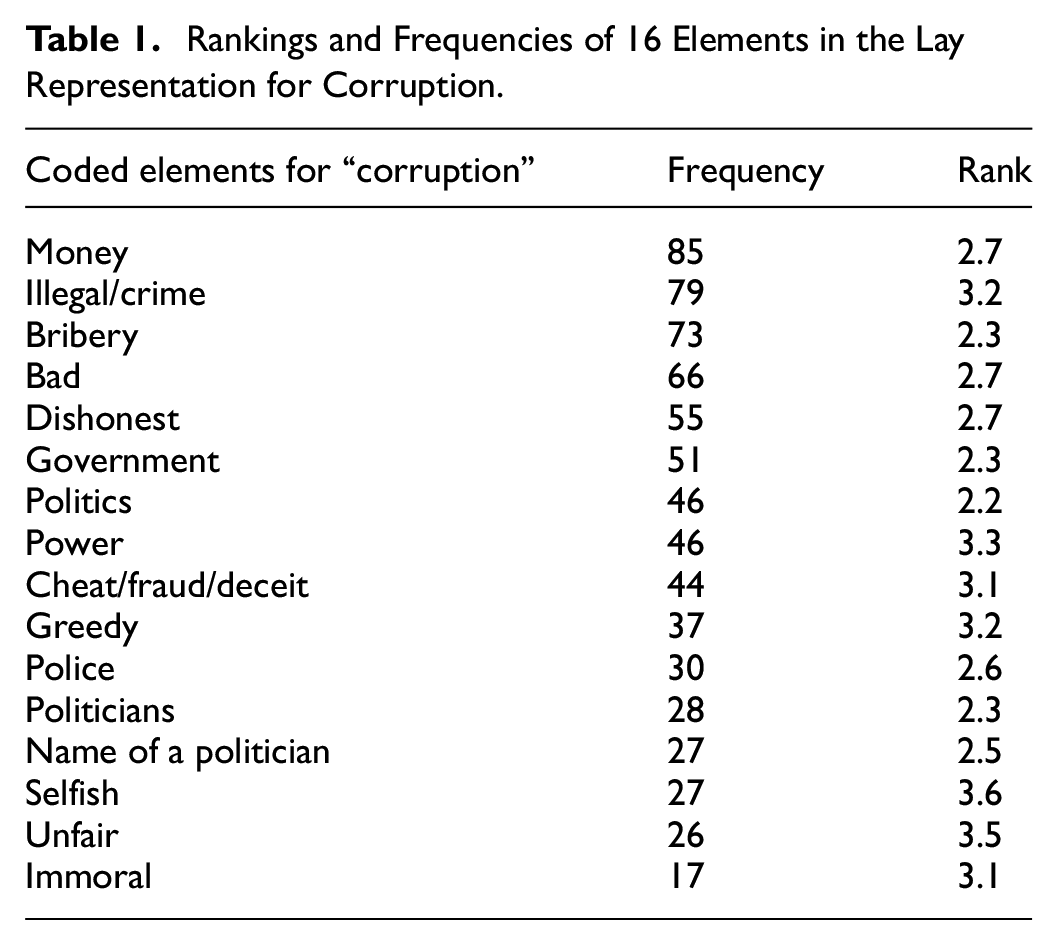
After coding there were 16 elements in the social representations of corruption and 20 elements in the social representations of bribery. The elements, with their mean ranking and frequencies are shown in Tables 1 and 2.
Rankings and Frequencies of 16 Elements in the Lay Representation for Corruption.
Ranking and Frequencies of 20 Elements of the Lay Representation for Bribery.

Similarities Analysis—Corruption
A tree-shaped graph for “corruption” was generated using IRaMuTeQ and is shown in Figure 1.

Similarities analysis—corruption.
There is one nucleus with the element “money” in the central position and three representation clusters highlighted in different shapes.
This suggests that “money” is one of the most frequently used elements in the social representations of “corruption” and the thickness of the lines to other nodes such as “bribery” and “government” suggests that “money” has a high co-occurrence with the other most significant elements related to “corruption.” This implies that “money” is a key normative element which represents corruption and that it is at the center of the respondents’ thought processes when considering the interconnections between the other elements related to “corruption.”
The main cluster represents the most significant elements of the social representations and it can be seen that “money” co-occurs with the words “politicians,” “bad,” “politics,” and “unfair.” This suggests participants considered that using “money” in corruption is “bad” and “unfair,” and is associated with “politics” and “politicians.”
The second cluster appears to show that respondents mostly associated “corruption” with “bribery,” which co-occurs with “illegal/crime,” “dishonesty,” “cheat” and “immoral.” This suggests that respondents have a strong sense that corruption, specifically related to bribery, is not acceptable behavior. However, the very thin line to “immoral” means that, only some of the respondents thought that corruption breached the moral code.
Related to “dishonesty” was a sub-cluster with the words “power,” “greedy,” and “selfish,” perhaps implying that bribery is associated with these personal characteristics.
In the third cluster, “money” was linked with “government” and followed by “name of a politician” and “police.” This suggests that participants viewed “corruption” as primarily an activity carried on with representatives of the state, specifically the police.
The tree-shaped graph for “bribery” generated using IRaMuTeQ is presented in Figure 2 and showed only one nucleus with the element “money” again in the central position, with a further two representation clusters highlighted in different shapes.
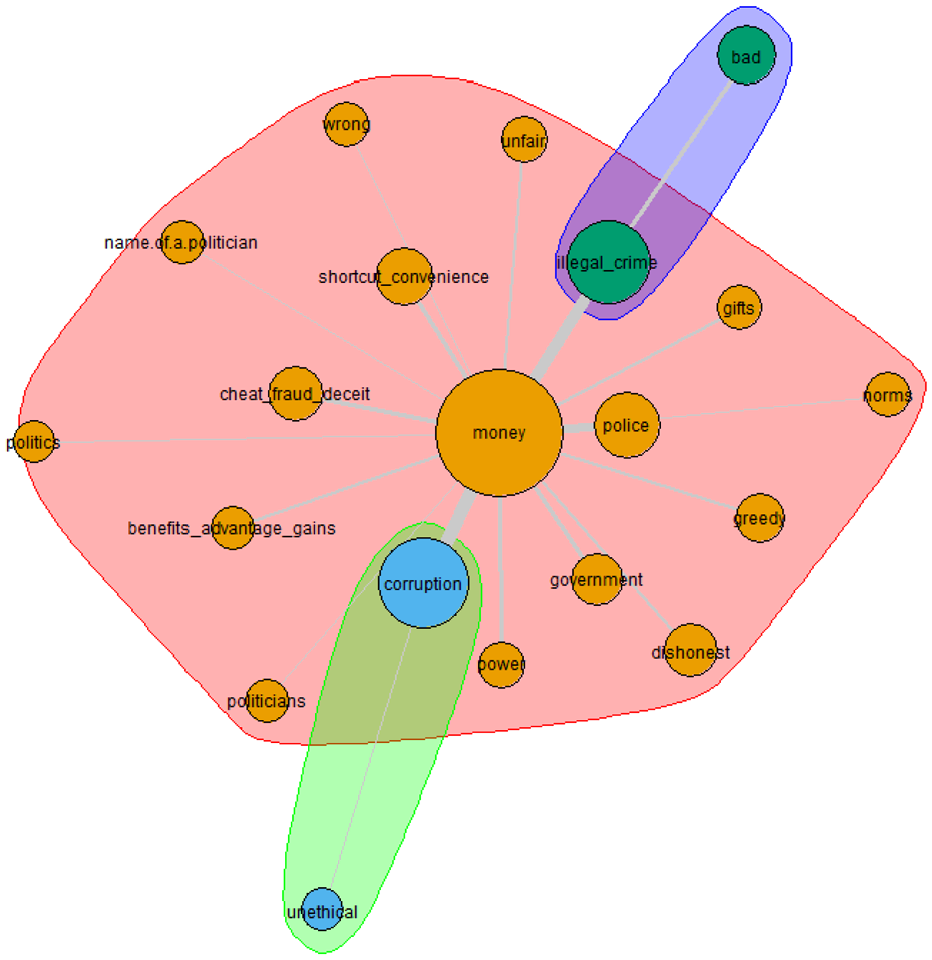
Similarities analysis—bribery.
The appearance of “money” again implied that it is the most frequently used, and therefore normative element of “bribery,” and that it has a high co-occurrence with other words used to describe “bribery.” The most significant of these elements, as shown by the thickness of the lines between nodes, included the words “illegal/crime,” “police,” and “corruption.”
In the main cluster, “bribery” is represented by “money” that co-occurs with “government,” “politics,” “police,” and “name of a politician.” Besides that, “money” is also used to define bribery as a form of “cheat” and “dishonest” act. However, it is also striking that participants indicated that “bribery” using “money” is associated with “shortcut” and “convenience,” which is presumably deployed to win influence from those “greedy” people who hold “power,” perhaps taking the form of a “gift.” Despite this, utilizing “money” for “bribery” is seen as “unfair” and as “wrong.”
The second cluster shows that respondents associated “bribery” with “money” and the terms “illegal/crime” and “bad.” This is a strong association and the importance of the cluster is shown by the large circle for “illegal” and the thick line linking it to “money.” This suggests a high degree of consensus that “bribery” is a “bad” act involving the “illegal” use of “money.”
The third cluster showed that most people linked “bribery” with “money” and “corruption.” As “corruption” has the biggest circle after “money,” this indicates most of the people thought of “corruption’’ when they thought about “bribery.” Respondents also considered that using “money” for “corruption” is “unethical.”
Prototypical Analysis
Prototypical analysis was carried out to explore the social representations for “corruption” and “bribery,” and the outcomes are shown in Table 3.
Prototypical Analysis for the Lay Representation of “Corruption” and “Bribery.”

Note. First number indicates frequency, second number indicates mean rank between 1 and 5, lower ranks indicate the higher level of importance of the element.
The central core element for “corruption” is represented by the five words: “money,” “bribery,” “bad,” “dishonest,” and “government.”
The first peripheral element for “corruption” is represented by just one association “illegal/crime.”
The contrasting element for “corruption” is represented by four words: “politics,” “police,” “politicians,” and “name of a politician.”
The second peripheral element for “corruption” is represented by six words, “power,” “cheat/fraud/deceit,” “greedy,” “selfish,” “unfair,” and “immoral.”
The central core for “bribery,” it is represented by the three words: “money,” “corruption,” and “police.”
The first peripheral element for “bribery” is represented by four concepts: “illegal/crime,” “bad,” “shortcut/convenience,” and “cheat/fraud/deceit.”
The contrasting element for “bribery” is represented by four words, “government,” “name of a politician,” “politicians,” and “politics.”
The second peripheral element for “bribery” is represented by nine concepts: “dishonest,” “greedy,” “power,” “unfair,” “norms,” “gifts,” “wrong,” “benefits/advantages/gains,” and “unethical.”
Discussion
This study explores how young adults perceive and differentiate between the concepts of “corruption” and “bribery.” While both terms are closely associated with money, the findings suggest that they are represented differently in the minds of participants—especially in terms of moral judgment, perceived legitimacy, and institutional associations. These differences highlight the importance of social context in shaping how unethical behavior is rationalized or rejected, particularly in environments marked by weak governance, such as in Malaysia. It is important to note that the notions and definitions of “corruption” and “bribery” presented here are based on public perception and should not be misunderstood as universally accepted or formal definitions of these terms.
Common Ground: Money as a Core Element in Corruption and Bribery
The study revealed that corruption and bribery share overlapping features in the minds of young adults. Both are frequently linked to financial transactions, with “money” emerging as a central element in both concepts. This aligns with prior research suggesting that public discourse often treats bribery as a specific expression of corruption (Nichols & Robertson, 2017; Steklova & Steklov, 2018).
We attribute this result to the prominence of money in Malaysian politics, where close relationships between political figures and business leaders often facilitate mutual benefits. This dynamic is particularly evident during election campaigns, where the distribution of money becomes a key tool for political influence. The prevalence of such practices underscores the normative connection between money, corruption, and bribery in the Malaysian context (Jones, 2022). Given this cultural backdrop, it is not surprising that money emerges as a core element in both representations of corruption and bribery, reflecting a deeply rooted concept of political and social manipulation.
Distinction: Bribery as a Familiar, Situational Construct
The data indicates that bribery is a more familiar and concretely understood concept than corruption. Participants generated 20 distinct elements for bribery, compared to only 16 for corruption. This suggests that bribery is perceived in more accessible, everyday terms—possibly because it is more frequently encountered or witnessed in daily life. For instance, “money” appeared in 57.9% of associations related to bribery, but only 29.2% of those related to corruption. This disparity implies that bribery is more narrowly and directly associated with financial exchange, whereas corruption encompasses broader, less tangible dynamics.
Moral Judgments and Psychological Distance
The study also found differences in moral framing. “Corruption” was strongly associated with evaluative terms such as “bad” and “dishonest,” indicating a clearer ethical condemnation. In contrast, “bribery” lacked such strong moral markers, suggesting a more ambiguous or situationally dependent judgment. Drawing from the theory of self-concept maintenance (Mazar et al., 2008), this may indicate that participants rationalize bribery in ways that preserve their self-image. While bribery was described as “bad” in peripheral associations, this evaluative stance may not be strongly held. This is supported by survey data showing a growing willingness among university students to accept bribes (The Star Online, 2017), as well as findings that young entrepreneurs are frequently targeted for bribe payments (Yusof & Arshad, 2020). In such cases, participants may downplay the immorality of bribery, especially when it is seen as necessary for success.
Perpetrators: Specific Versus Systemic Blame
Another significant distinction lies in how participants identified perpetrators. Bribery was directly linked to specific actors—particularly the police. In contrast, corruption was associated more generally with entire government institutions, suggesting a broader and more abstract conceptualization. This differentiation is critical. The specificity of blame toward the police in bribery cases may stem from participants’ lived experiences, reflecting their familiarity with everyday bribery in law enforcement contexts (Mengzhen, Sin, Wan Jaafar, et al., 2024). The fact that the police—who should serve as anti-corruption enforcers—are linked to bribery highlights systemic issues in governance, underscoring that good governance is key to curbing corruption. (Rubasundram & Rasiah, 2019).
Cultural and Social Values in Corruption and Bribery Representations
Cultural and social values significantly shape perceptions of corruption and bribery. Corruption is linked to “government” and “police,” suggesting judicial leniency in cases involving these institutions, likely influenced by the cultural normalization of corruption (Houqe et al., 2020). Both corruption and bribery are associated with “power,” “greedy,” and “unfair,” reflecting views of unethical power dynamics, which could be explained by (Ahamad Kuris et al., 2023; Hofstede, 2023; Jun & Kim, 2022; P. V. S. D. Souza & Silva, 2023), who attributes this to Malaysia’s high power distance and collectivist culture, fostering more lenient perceptions of corruption compared to individualistic societies like the UK. While public condemnation of these practices is strong, with “money,” “illegal/crime,” and “dishonesty” being prominent, corruption is also linked to specific social roles such as politicians and the government, underlining the importance of cultural context in shaping public attitudes and legal frameworks regarding corruption (Zainon et al., 2012).
Tree-Graph Analysis: Bribery as a Pragmatic Tool
Visual data from the tree-graph analyses supported these findings. In the corruption graph, “money” was directly associated with terms like “politicians,” “bad,” and “unfair,” forming a cluster centered on political power and injustice. A separate cluster linked “money” to “government” and “police,” suggesting a broader institutional critique. This aligns with the view that corruption is often seen as an activity carried out by state representatives, particularly politicians, in an acquisitive manner.
In the bribery graph, “money” was strongly linked to “police” and, to a lesser extent, to peripheral terms like “shortcut/convenience” and “cheat/fraud/deceit.” This suggests that bribery is perceived as a pragmatic, if unethical, tool—especially in minor legal infractions. The focus on “shortcut” implies that bribery is viewed as a functional workaround to avoid prosecution, either for real or imagined legal infractions, often involving “cheat/fraud/deceit” by both the police and offenders. This further underscores the perception of bribery as an activity that enables individuals to bypass legal processes, not necessarily a moral failing.
Lack of Awareness on the Effects of Corruption and Bribery
The lack of understanding about the costs of corruption and bribery among young adults is evident in this study. While previous research suggests that severe punishments and a high conviction rate are necessary to reduce corruption (Chong & Narayanan, 2017), this is not reflected in the core representations of “corruption” and “bribery” in the current study. The key finding is that “bribery” is often viewed through a cost-benefit lens, as suggested by terms like “shortcut/convenience” and “cheat/fraud/deceit.” However, these terms are located in the first peripheral elements, indicating that such views may not be universally shared and are likely situational. This lack of understanding may explain why corruption persists and is linked to weak governance. In societies with weak governance structures, bribery often becomes the most effective and least costly way to secure benefits or avoid punishment, particularly in interactions with the police (Shleifer & Vishny, 1993).
Limitations and Future Directions
This study has several limitations that should be acknowledged. First, it employed a cross-sectional design and convenience sampling through social media and university platforms, which may introduce sample bias and limit generalizability. Future research should aim for a more representative and diverse participant pool across regions and demographics, potentially using a longitudinal design to capture how perceptions evolve over time.
Second, while the free association method effectively revealed key concepts, it did not clarify how participants interpreted terms like “money.” These terms could carry different meanings (e.g., as a means or an outcome), which introduces ambiguity. Future studies could incorporate follow-up interviews or surveys to better understand the context and depth of these associations.
Third, the study focused primarily on bribery and did not explore the full spectrum of corrupt behaviors, such as nepotism, embezzlement, or favoritism. Future research could examine a wider range of corruption types to provide a more comprehensive understanding of how these are socially represented.
Fourth, the current study is descriptive and exploratory in nature. It did not use advanced statistical methods or test causal relationships between variables. Future work should consider mixed-method or quantitative approaches to test hypotheses and validate observed patterns with more robust data.
Finally, the findings are context-specific to Malaysia, a country with distinct cultural and governance structures. While this offers valuable localized insight, it may not be generalizable to other settings. Comparative studies across different cultural, political, and economic environments could help distinguish universal from culturally specific representations of corruption and bribery.
Implications
The findings of this study have several important implications for future anti-corruption efforts and public policy. The differentiation between corruption and bribery in the minds of young adults suggests that educational campaigns and policy interventions need to address these concepts separately. Given the situational rationalizations for bribery, anti-corruption efforts should focus on discouraging justifications for bribery while also emphasizing the broader systemic impact of corruption. By targeting youth education, anti-corruption programs can more effectively change public attitudes toward bribery, highlighting its moral failings even when it is seen as a “shortcut” for success.
Additionally, public policy should focus on institutional reform, particularly in the police and political sectors, to reduce systemic corruption. As the study found, the police were specifically blamed for bribery, a reflection of institutional failures. Policymakers should therefore design targeted strategies for reforming law enforcement practices, strengthening institutional accountability, and promoting transparency.
Finally, the findings underscore the need for culturally tailored interventions. In Malaysia’s high power distance and collectivist culture, anti-corruption programs should be designed to address the role of power dynamics in enabling corrupt practices. Understanding how cultural factors influence perceptions can help create more effective and contextually relevant interventions.
Conclusions
This study highlights how young adults perceive corruption and bribery differently, aligning with macro and micro-level distinctions. Corruption is seen as a systemic, distant issue linked to those in power, such as politicians and government institutions. In contrast, bribery is viewed as a personal, situational issue, often involving direct interactions like paying off the police. The absence of consequences in social representations may provide insight into the persistent challenge of combating corruption and bribery. These findings suggest that anti-corruption efforts should address these concepts separately. Campaigns should emphasize corruption as a broad, systemic problem, while focusing on the personal responsibility tied to bribery, even when justified as a “shortcut.” Understanding these perceptions can guide more effective public policies and educational programs targeting both the moral and institutional aspects of these issues.
Footnotes
Acknowledgements
The team would like to extend our appreciation to all research assistants who helped in various ways to complete this research project.

Ethical Considerations
This research was reviewed and approved by the university ethics committee, Approval Ref No: SUREC 2020/083.
Funding
The author(s) disclosed receipt of the following financial support for the research, authorship, and/or publication of this article: Open access funding provided by Meiji University. All other associated costs for this study were self-funded by the first author.
Declaration of Conflicting Interests
The author(s) declared no potential conflicts of interest with respect to the research, authorship, and/or publication of this article.
Data Availability Statement
Data sharing not applicable to this article as no datasets were generated or analyzed during the current study.