




Abstract
The purpose of this article is to develop a new method for corporate diagnosis (CD). To this end, a method is developed for the diagnosis process of project-based companies. The article presents a case study in a large company where data have been collected through focus groups. Project delay, high project cost, and low profitability are examples of project deficiency in project-based companies. Such issues have made managers pay special attention to find effective solutions to improve them. Prominent factors are inappropriate strategy, structure, system, human resource management, and PMBOK(Project Management Body of Knowledge) processes. Thus, CD and analysis is an important task in improvement of corporate performance. The CD model that is developed in this article could be used for project-based companies. The proposed method can be used for CD in any project-based company. This article provides an emphatic application of CD as a prerequisite for restructuring in project-based companies.
Introduction
Changing corporate environment may lead to severe organizational inefficiencies. Several studies have developed typologies of environments. Shane (2005) focused on the environmental change from a new approach. Shane classified the change into three categories, namely, technological, political and regulatory, and social and demographic changes. Hubert and Sofie (2008) introduced four sets of factors related to environmental changes that can cause corporate inefficiency. They categorized these factors into environmental changes, immediate environment, management, corporate policy, and corporate characteristics. Literature has demonstrated that the type of corporate environment influences the shocks that the corporate may receive. Environmental change and performance inefficiency affect different aspects of a corporate including corporate strategy and structure, and human resource management.
Dam construction companies in Iran are the complex ones with frequent radical shocks. This kind of environment may, anytime, receive corporate environmental shocks that reduce the efficiency level. The Iranian Water and Power Resources Development Company (IWPRDC) is the most important dam construction corporation in Iran that has recently received a number of serious environmental shocks especially in terms of a reduction in governmental budget and performance inefficiency. The following are the main questions that IWPRDC managers have faced: (a) Which factors reduce the performance of organization? (b) Which organizational factors must be considered in the corporate diagnosis (CD) process in project-based companies?
According to the Weisbord’s (1976) model, the main factors that must be considered in CD are strategy, structure, system, and human resource management. But these items are not comprehensive for CD in project-based companies because this model omitted the projects’ inefficiency. So, the previous researches have weakness in providing a model that covers the different factors that lead to inefficiency in project-based companies. To fill the gap in the literature, this article proposes a method for organizational diagnosis in project-based companies. The main questions of this article are as follows:
The remainder of the article is organized as follows. Section 2 provides a literature review on CD. Section 3 describes the research methodology and data sources. Research findings are presented in Section 4 followed by concluding remarks.
Literature Review
After representing the theory of systems in management, drawing attention has been assigned to environmental changes within the companies. Rapid changes on one hand and great financial problems on the other hand, which companies face, obliged the managers to assign the topics of change management and organizational change in their prioritization (Karimi, Khodaie, & Chaghouee, 2014). So, research attributed the changes to corporate governance and environments (Park & Kim, 2008).
Corporate in transition economies, have also pursued corporate diagnosis and restructuring eagerly (Makhija, 2004) and the importance assigned to the change process within the companies has been formed the early a point of question: what is the main cause of inefficiency within the companies? To give a clear response to such question and because the companies are seeking to improve operating efficiency, increase cash flow, and, ultimately, enhance firm profitability (Espen, 2008); the CD has been transformed as a managerial necessity within the companies. Indeed, CD models help the managers to recognize the weaknesses and efficiency existing in the company, and then concentrate on the most important cause and finally go through resolving it using an in-depth planning (Karimi et al., 2014).
Corporate diagnosis is a process that involves the three steps of publicly entering a human system, collecting valid data about experiences, and feeding back to the system toward promoting corporate performance (Wu, Dai, & Magnier, 2010). Furthermore, Karimi et al (2014) has defined corporate diagnosis such that “it is defined as a method to analyze the organization aiming at defining organizational deficiencies and planning to resolve them through organizational changes and development”. Corporate diagnosis deals with answering three questions: the causes of change (why), the process of change (how), and the content of change (what; Janićijević, 2010). As noted by Janićijević (2010), when it comes to CD, studies in the area of corporate development and changes are preoccupied with three main issues: (a) development of corporate diagnostic model, (b) the choice of procedures and methods for data collection of diagnosis (the methodology of CD), and (c) methods and techniques of data processing and making conclusions.
A corporate diagnosis model is a representation of a corporate that helps us identify its main components and relations between those components for the purpose of understanding the corporate (as an object of change). The models are represented in the chronological order in which they first appeared in the literature as follows (Zali, Hosseini, & Madhoshi, 2006):
Force Field Analysis (1951)
Leavitt’s model (1965)
Likert system analysis (1967)
Open system theory (1966)
Weisbord’s six-box model (1976)
Congruence model for organization analysis (1977)
Mckinsey 7s framework (1981-1982)
Tichy’s technical political cultural (TPC) framework (1983)
High-performance programming (1984)
Diagnosing individual and group behavior (1987)
Burke–Litwin model of organizational performance and change (1992)
Falletta’s organizational intelligence model (2008)
According to Weisbord’s (1976) model and Mckinsey’s 7s framework (Hanafizadeh and Ravasan, 2011): strategy, structure, system, and human resource management are the main factors that must be considered in CD. Despite the emphasis of these past researches on these factors as the prominent ones that must be assessed in diagnosis process, a suitable method for corporate diagnosis in project-based companies has not been prepared by previous researchers. Herewith, we aim at filling the above-mentioned gap.
Research Methodology
Founded in 1989, the IWPRDC is considered as one of the most prominent corporations in the field of dam construction in Iran. The company has 900 qualified staffs. Due to environmental changes (especially changes in governmental budgets), IWPRDC has faced inefficiencies.
Herewith, the Delphi Method is selected as a research method that accesses view of an expert group (Karimi, Chaghouee, & Hamidpour, 2014; Karimi et al., 2014) for the purpose of identifying causes of corporate inefficiency. As described by Okoli and Pawlowski (2004), the Delphi method involves three general steps: (a) brainstorming to explore a list of important factors, (b) narrowing down the original list to the most important ones, and (c) ranking the list of factors.
The objective of the first phase is to extract the factors. In this phase, a focus group was formed to determine the deficiency factors. For the next two phases, we had experts in six distinct panels. In brief, panels modified and narrowed down the previous identified factors that reflected the causes of the poor performance. While short-listing the factors in the second phase, the expert panels rated the factors. The goal of the final phase (Phase 3) was to reach a consensus within each panel on the factor ranking. Data were collected through focus groups. In the next section, the data collection process is explained.
In this research, focus group was used to collect data. Focus groups are analytical challenges because they combine three levels of data, including individual, group, and group interaction (Duggleby, 2005). To analyze group dynamics, we considered some of the questions designed by Ingrid and Christine (2010), such as, “How closely did the group adhere to the issues presented for discussion?” “What were the contradictions in the discussions?” “What common experiences were expressed?” and “Was a particular view dominant?”
Focus groups offer an immediate reaction among the participants as they negotiate and confront each other’s views (Kidd & Parshall, 2000). In this research, we sought agreements among the panel members during the focus group sessions and paid attention to disagreements.
The optimal size of a focus group to ensure a proper discussion is generally six to eight participants (Ingrid & Christine, 2010). Here, we had a group of eight participants who were randomly selected from the 20 top managers of IWPRDC. We held 21 sessions in the corporate diagnosing stage. The focus group sessions took 2 to 3 hr each, and they were moderated by a moderator and an observer (co-researcher). The primary role of the moderator was to initiate, observe, facilitate, and conduct discussions among the participants, while the observer took field notes and observed non-verbal communication patterns among the participants. The sessions were digitally recorded. Data from each focus group session were analyzed by taking the following steps (Ingrid & Christine, 2010):
Overview: reading the transcript several times to get a grasp of the material.
De-contextualization: categorizing data according to the main themes in the research guide.
Coding: organizing the text according to emerging categories within each theme.
Conceptualization: identifying the main concepts in the emerging codes and sub-codes.
Re-contextualization: re-arranging the text according to the emerging logic.
Documentation: focus groups’ participants were selected to illustrate and validate the process of analysis in the next session.
Findings
In today’s world, it is imperative to use cutting-edge technologies and tools (Ghapanchi, 2013; Ghapanchi & Aurum, 2012a; Ghapanchi, Jafarzadeh, & Khakbaz, 2008a, 2008b; Ghapanchi, Tavana, Khakbaz, & Low, 2012; Najaftorkaman, Ghapanchi, Talaei-Khoei, & Ray, 2013) to assist companies achieve their goals and objectives. This can also assist companies’ executives in their decision making (Ghapanchi & Aurum, 2012a, 2012b; Khakbaz, Ghapanchi, & Tavana, 2010). In this research, we undertook an in-depth study of the inefficiency in IWPRDC, and found five sets of corporate inefficiency. To make this classification, we utilized the Weisbord (1978) and Mckinsey (1981-1982) models, PMBOK standard, and interviews with key figures of the corporation. Table 1 shows different categories of corporate inefficiency.
Different Categories of the Corporate Inefficiency.

The semantic network shown in Figure 1 illustrates the relationship between inefficiency categories. Figure 1 demonstrates “corporate inefficiency,” “Is-From” (I-F), and factors A, B, C, D and E. This figure shows which inefficiency factor “Is-From” or “Can-Affect” the other group. For example, factors in category A can affect B, C, and D categories.
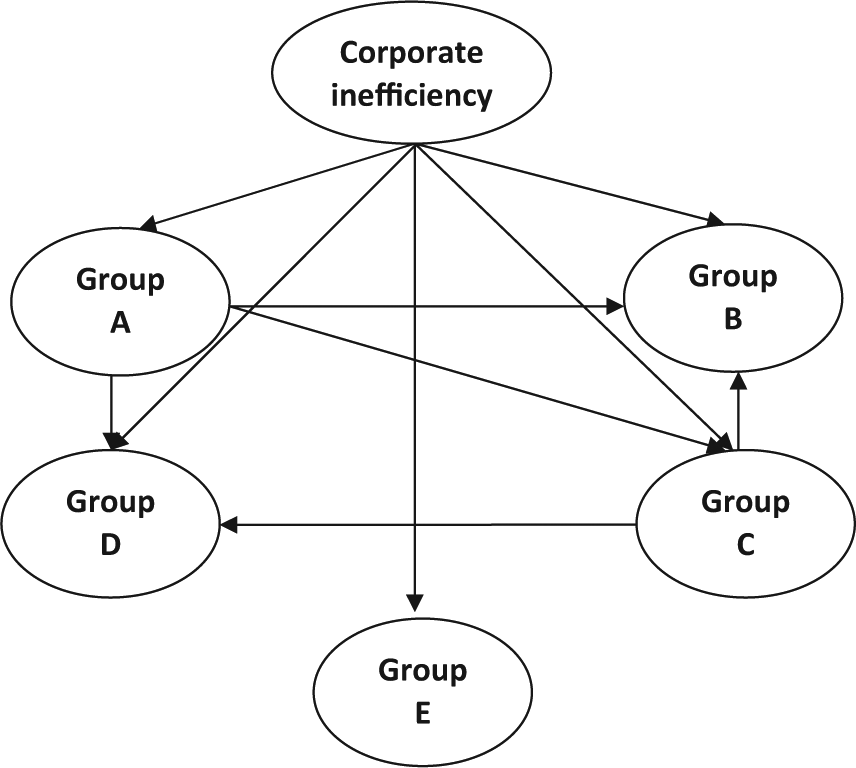
Semantic network of deficiency groups of IWPRDC.
In addition to external relationships between categories, it is valuable to determine the relationship between elements of each category. In Figure 1, these relations are shown with “Result-In” (R-I) and “Can-Affect” (C-A) connections, which demonstrate how the emergence of a problem in one category leads to inefficiency in other places. Therefore, it is required to identify the sub-categories in each category (as depicted in Table 2).
Inefficiency Causes in IWPRDC.

Note. IWPRDC = The Iranian Water and Power Resources Development Company.
Figure 2 illustrates relationships among five major categories of the corporate inefficiency sources. “Result-In” (R-I) is a concept that we have used here to demonstrate the relationship between factors contributing to deficiency in each group. Uncovering such relationships, which are often hidden, is of great value to the management of the company. To make it clear, we make an example. Group D includes seven sub-categories. “Absence or low clarity of personnel duties” (Factor 2) can “result in” some problems like “deficiencies of human resource management” (Factor 3). “Weakness in recognition of personnel training needs” (Factor 7) may cause “deficiencies of personnel training programs” (Factor 4). Also, this network shows that a problem like “deficiencies of human resource management” (Factor 3) results from “inefficiency of human resource rules” (Factor 5). Moreover, “inefficiency of personnel motivation and encouragement methods” (Factor 6) can “result in” some problems like “deficiencies of human resource management” (Factor 3).

Semantic Network of inefficiency causes in IWPRDC and their relationships.
An important aspect of collected data is the frequency of factors and their ranking (see Table 3). According to Table 3, the prominent causes of inefficiency in IWPRDC are structure problems (M = 4, N = total number of experts in six panels = 48). Furthermore, the main sub-factors are E-3 (frequency = 43), C-1 (frequency = 42), and E-5 (frequency = 41). It also indicates that the deficiency of corporate structure and the weakness of PMBOK project processes (especially the poor controlling and closing processes) are the main corporate deficiency factor.
Frequency of Each Factor.

Concluding Remarks
This article is an endeavor to highlight the causes of corporate inefficiency in project-based companies and illustrates how such agents might threat them, such as our case study (i.e., IWPRDC). Discovering the deficiency causes and their internal/external relationships can yield several benefits to the corporate management. This article attempted to illustrate the main deficiency sources through conducting a study on structure effects and presenting the results of an in-depth study of the IWPRDC.
According to first question of this study, sources of corporate inefficiency are categorized into five groups: strategy, system, structure, HRM, and PMBOK processes. The part also presented acquired data through a semantic network and depicted internal and external relationships between the causes of deficiency. It means that during the corporate diagnosis in companies that are implementing some projects, the managers and researchers must consider these factors and evaluate them for their effect on reduction of corporate performance.
In addition to the second question, the following items are demonstrated as sub-factors, which must be checked during corporate diagnosis in project-based companies:
Strategy: human resource management strategy, financial management strategy, supervision and control strategy
System: project supply system, financial preparation and control system, projects preparation and control system, quality management system, contractors and advisors’ assessment and selection system, system integration and knowledge management system
Structure: relationship between structure and corporate missions and visions, structure hierarchy, operational decision making, corporate communication network, relationship between structure and corporate process, role of project managers in the corporate structure
Human resource management: human resource employment, clarity of personnel duties, personnel training programs, human resource rules, personnel motivation and encouragement method, the recognition process of personnel training needs
PMBOK process: initiating processes in corporate projects, planning processes in corporate projects, controlling processes in corporate projects, executing processes in corporate projects, closing processes in corporate projects
Finally, this article demonstrates a method for identification of factor and sub-factors that cause the inefficiency in project-based companies and introduced a Semantic Network of inefficiency causes for cause-and-effect analysis of considered sub-factors. Based on the result of this, in IWPRDC, the main item that must be considered for reduction of inefficiency is structure. So, the implementation of a restructuring project is advised to the managers.
This research is not free of limitations. Due to time constraints, in this study, we examined the proposed CD model only in one Iranian project-based company. Further research would be necessary to evaluate and modify this model by utilization in different kinds of project-based companies in other countries.
Footnotes
Declaration of Conflicting Interests
The author(s) declared no potential conflicts of interest with respect to the research, authorship, and/or publication of this article.
Funding
The author(s) received no financial support for the research and/or authorship of this article.