




Abstract
Within the culture of an all-male private school, sport often holds a special status as compared with music. As an area of learning and participation, sport is typically associated with masculinity and receives broad social acceptance, whereas music is often seen at the margins of the curriculum and considered as an activity for a select few who are innately talented. Because of these perceptions, participation rates for males are often higher for sport than they are for music. With this as our context, this study examined differences between the two elective subjects of music and sport, by seeking to investigate boys’ motivation to choose whether or not to elect music and sport in the final years of high school. The study utilized an online survey that was completed by 293 subjects (13 to 16 years old, school years 8 to 10). Results indicate that the boys were more motivated to select elective sport rather than music (42.7% vs. 4.8%, respectively), with 49.8% choosing neither music nor sport. A comparison of facilitators of elective music and sport revealed similarities across the two domains, with interest in the subject (music or sport) receiving the highest mean rating for elective facilitation. Seven of the nine impediment scales were significantly higher for music (only importance of the subject and parental influence were statistically identical across sport and music). The study is the first of which we are aware that directly compares music and sport as school subjects, and as such, offers insight into the different motivational forces that act to either facilitate or impede students’ choice of these subjects within an all-male private school.
Keywords
Introduction
The environment of an all-boys school involves a complex mix of cultures. Some of the most interesting surround masculine attitudes to subjects such as sport, and these can be contrasted with a subject such as music, where perceptions of the importance and usefulness of the subject can be distinctly different. The pressure to conform to gender-role stereotypes intensifies during adolescence, often influencing the individual’s choice of involvement in activities perceived as appropriate to their own gender (Wigfield & Eccles, 1994). In fact, Hallam, Rogers, and Creech (2008) suggested that stereotyping “may be an inhibitory factor for boys, who may come under great pressure from peers if they engage in any activity that is seen as ‘feminine’” (p. 15). Females are often reported as enjoying their musical participation, whereas boys cite bad experiences with a teacher as being a significant reason for why they do not enjoy the subject (Turton & Durrant, 2002).
Collins (2012) described the adolescent male ecosystem as a complex and delicate balance of messages and experiences that can profoundly affect boys’ attitude of being involved in musical activities. Within this explanation, three essential needs must be satisfied to maintain boys’ interest and motivation for music: interest and positive attitude, success and accomplishment, and acceptance and praise. If any one of these areas is influenced by negative messages or experiences, then motivation for involvement in musical activities may be impeded. In contrast to music, research indicates that sport competence is highly valued by boys, where the status and popularity of a sport can affect the way a boy feels he is perceived within his particular peer group (Ridgers, Fazey, & Faircloth, 2007).
In Western societies, adolescents report spending an average of 75 min each day listening to music, with most possessing a portable listening system to regulate their personal and social lives (Rideout & Roberts, 2010). Despite the huge rates of consumption of music, studies across different countries and regions of the world show a consistent trend, indicating that the general population of school students value music less as compared with sport and other so-called academic subjects such as math, mother tongue, and science (McPherson & O’Neill, 2010). Given the personal and social significance of music and sport in adolescent males’ daily lives, it is noteworthy that music is regarded as being less useful and important for one’s future career and as a subject that is seen to add value to one’s education when compared with academic subjects (McPherson & O’Neill, 2010; Renwick & Reeve, 2012; Sulz, Humbert, Gyurcsik, Chad, & Gibbons, 2010).
While choice of elective subjects can signify motivation, there is limited research into the factors that influence choice of elective subjects at high school (Ferrer-Caja & Weiss, 2000; Sulz et al., 2010), and in particular males (Sulz et al., 2010). This is surprising because subject selection has a profound effect on the lives of adolescents beyond their school years, and is a major determinant of future career aspirations.
Drawing on motivational theories considered to be helpful for understanding subject choice, the purpose of this article, therefore, was to examine high school student attributions for the selection or non-selection of music and sport. The study adopted a survey that explicitly examined reasons for subject selection, compared sport with music, and sought to clarify reasons that facilitate selection versus reasons that impede selection of each subject by adolescent males.
Subject Choice
Three main conceptual frameworks have been devised that examine influences on adolescent elective decisions. From an Ecological conception, emphasis is given to the importance of individual factors such as the individual’s level of confidence and social factors such as significant family members, peers, and friends (Sulz et al., 2010). Similarly, Self-Determination theory highlights the individual’s need for autonomy and competence, and social relatedness and support (Ryan & Deci, 2000), whereas Expectancy-Value model emphasizes the individual’s expectations and goals, as well as the social factors which shape the individual’s values and beliefs (Wigfield & Eccles, 2000).
Ecological Theory
Using the ecological perspective, research has examined sport participation (Allison et al., 2005) and factors that influence elective enrollment (Gyurcsik, Spink, Bray, Chad, & Kwan, 2006; Luke & Sinclair, 1991; Sulz et al., 2010) by focusing on individual and social environmental causes of behavior. Typically, researchers study influences on adolescent elective sport enrollment by examining individual (past experiences, self-efficacy, class schedule, knowledge of the course) and social environmental (attitude of significant others such as parents and teachers, course curriculum, community activities) influences for electing the subject in schools (Sulz et al., 2010). Overall, facilitators for both male and female enrollment are influenced by both individual and social factors. The important difference is that impediments to male elective enrollment are influenced by social environmental factors whereas impediments for females are influenced by individual and social environmental factors (Allison et al., 2005; Gyurcsik et al., 2006).
Luke and Sinclair’s (1991) investigation into facilitators and barriers for elective sport found predominantly social environmental (including curriculum content and teacher behavior) influences to be the most important, and these accounted for 58.8% of the facilitator statements and 71.46% of the barrier statements (Luke & Sinclair, 1991). Unlike Sulz et al. (2010), Luke and Sinclair (1991) found facilitators and barriers to be similar. They ranked from greatest to least influence, curriculum content, teacher behavior, class atmosphere and students’ self-perception, and facilities (Luke & Sinclair, 1991). Despite investigating male and female participants, this study does not report gender distinctions, and limits the investigation to students in senior high school (Grade 11 only). However, students are faced with elective decisions prior to Year 11; hence, the current study furthers the Luke and Sinclair paper by focusing on the years in which elective decisions are most pertinent (i.e., Years 8, 9, and 10), and by comparing factors across more than one domain (music and sport).
Although research into factors that facilitate or impede elective enrollment in sport is limited (Ferrer-Caja & Weiss, 2000; Sulz et al., 2010), what is known is that both individual and social environmental factors play an important role in adolescent elective decisions. To date, these types of ecological sport studies have not been conducted in the music domain, nor are there any studies which compare possible differences between the two subjects.
Self-Determination Theory
Self-determination theory is a meta-theory that includes issues that are related to Planned Behavior and Basic Needs. Planned Behavior perspectives posit that behavioral intention is influenced by the individuals’ attitudes toward the subject, social support, and perceived autonomy support, each of which is useful for examining influences for adolescents’ selection of elective subjects such as music and sport (Shen, 2010). Similarly, Basic Needs research within this paradigm suggests that the psychological needs of competence, relatedness, and autonomy are the fuel for internalization and optimal motivation (Deci & Ryan, 2002). Evans, McPherson, and Davidson (2013) found the Basic Needs to be a robust framework for investigating adolescent music engagement and claims the fulfillment of basic psychological needs (competence, relatedness, and autonomy) is vital for ongoing involvement in musical activities. This line of research shows that students are more likely to cease involvement in music making when these needs are not met. Like the ecological framework, both Planned Behavior and Basic Needs perspectives not only emphasize the individual and social components influencing choice but also highlight the autonomous learning environment (facilitating choice, control, and responsibility to the learner) for promoting motivation and future enrollment. The literature of Planned Behavior and Basic Needs remains primarily focused on individual and social issues related to elective subject selection.
Research using this theoretical framework indicates that most senior high school students make subject choices without adequate advice or planning, which in turn fails to maximize their future opportunities for elective subject choices (Warton, 1997a; 1997b; Warton & Cooney, 1997). Other research (Eccles, 2005) shows that adolescents limit their range of subject choice with inaccurate information and fail to consider long-term goals (Eccles, 2005; Siann, Lightbody, Nicholson, Louise, & Dave, 1988). For example, Siann et al.’s (1988) investigation of subject choices for Chinese secondary students identified two main influences on these decisions: whether they liked the subject or not and because they were required to make a choice between subjects (imposed either by school framework or by eliminating less desirable options). While these studies provide valuable insight into factors influencing subject selection, they focus on the overall process of subject selection rather than influences within specific domains.
Expectancy-Value Theory
The Wigfield and Eccles (2000) Expectancy-Value theory combines the motivational components of competency beliefs, importance of subject, and utilitarian beliefs, and focuses on both the role of students’ beliefs about their own competence and the value they place on the activity. Applying this framework, McCormick and McPherson (2007) have shown how the achievement in an upcoming examination of instrumental music learners can be predicted by the value they place on their musical participation, and the perceptions they have of their own abilities. Furthermore, this line of research suggests that the students’ subjective task values (including importance, interest, and usefulness) are most influential in subject choice decisions (Austin, Renwick, & McPherson, 2006; McPherson, Davidson, & Faulkner, 2012; O’Neill, 2012; Renwick & Reeve, 2012; Schunk, Pintrich, & Meece, 2010; Wigfield & Eccles, 2000).
Importance and Value
When students perceive a particular subject area to be important and valuable, they are more motivated to pursue further study in that domain (McPherson & O’Neill, 2010; O’Neill, 2012; Schunk et al., 2010; Sichivitsa, 2007; Simpkins, Vest, & Becnel, 2010). O’Neill (2012) claimed that “the positive valuing of music participation is one of the most important reasons why young people choose to continue with music learning” (p. 175). Wheeler’s (2011) study on sport found that parents who valued sport influenced their children’s value of sport and that the transmission of the sporting culture influenced children’s long-term motivation and participation. However, during adolescence, there is an overall decline in value beliefs (Hidi & Ainley, 2002; McPherson & O’Neill, 2010; Schunk et al., 2010), such that when academic activities are not valued or seen as important, students are de-motivated for learning.
Literature on music suggests that the marked decline in motivation during adolescence is due to a belief that ability is essentially innate (Austin et al., 2006; Hargreaves, MacDonald, & Miell, 2012; McPherson & O’Neill, 2010; McPherson et al., 2012); and therefore that no amount of effort will change one’s innate capabilities. This misconception has been refuted by many academics including McPherson and Williamon (2006), Sloboda and Davidson (1996), and McPherson et al. (2012), who place a much greater emphasis on environmental aspects of skill development, and especially the development of a healthy motivational profile in the pursuit of personal goals associated with skill development. It is self-evident that struggling learners who consider music ability to be an inherited or fixed trait that is beyond their control will be less likely to value music activities and invest sufficient effort and time into developing skills. Consequently, it is children’s beliefs about their musical competence that determine their commitment level to musical learning such that music learners who sustain an “incremental and multifaceted view of music ability” are most likely to both value and maintain motivation for learning music (Austin et al., 2006, p. 231).
Interest
A learner’s interest in a subject also predicts activity choices across a variety of domains including maths, music, and sport (Fredericks & Eccles, 2002; Simpkins et al., 2010). Research by Hidi and Ainley (2002), and Hidi and Renninger (2006) indicates that there are differences in interest across domains. In particular, Wigfield (1994) found that during elementary school interest in school music declines, in contrast to school sport which does not. However, as students progress into high school, overall adolescents are much more interested in non-academic activities than school-based academic activities.
Utility Value
Adolescent elective choice is also influenced by the utility value individuals place on each subject. Utilitarian value is determined by future goals, career aspirations, capacity to earn a good income, and acceptance into tertiary education (Renwick & Reeve, 2012). As students begin to focus on long-term goals, parental pressure relating to vocational opportunities and potential earning capacity can unduly influence adolescent subject choice (McPherson et al., 2012). The “arts” subjects (music, dance, drama, and art) are often considered less important for daily life and employment than the more “academic” subjects (English, maths, science; McPherson & O’Neill, 2010) with the result that the more “academic” subjects are elected in preference to subjects such as music and art.
Self-Efficacy
Self-efficacy studies seek to understand how individual’s beliefs about their ability to plan and perform particular tasks affect how they complete those tasks as they strive to reach their own personal goals (Renwick & Reeve, 2012). Positive self-efficacy leads to higher levels of concentration, control, involvement, satisfaction, and motivation for learning (Bassi, Steca, & Caprara, 2007), while also promoting task choice, motivation, achievement, sustained effort, and persistence (Bandura, 1986; Schunk et al., 2010). Across a range of school subjects, including music and sport, studies have found that elective enrollment decisions are strongly influenced by self-efficacy (Cetinkapl & Turksoy, 2011; McCormick & McPherson, 2003; McPherson & McCormick, 2006; Sulz et al., 2010). McPherson and O’Neill’s (2010) study found that adolescent subject choices are influenced by their expectations of success and the personal value of each subject. Overall, research indicates that self-efficacy significantly influences adolescent subject selection, with students more likely to engage in activities they feel competent in and value (McPherson et al., 2012; O’Neill & McPherson, 2002; Sullivan & Strode, 2010).
Aim of the Study
The review of the literature supports the assertions presented by McPherson and Hallam (2009) that there are complex relationships between motivational influences and subject selection However, most of the factors that influence adolescent choice of elective subjects can be categorized according to an individual component (autonomy, utility, competency beliefs, intrinsic interest and enjoyment, importance, and self-efficacy) or a social environmental component (peers, teacher, family, and access and utilization of career information). Studies that compare both reasons that facilitate and reasons that impede elective choice across more than one subject directly such as sport and music are lacking. Such an approach would have the benefit of identifying whether any of the motivational factors for one subject are dominant relative to another. For example, if sport is chosen as an elective subject because it is rated as having high competence value, is that value higher than for music? Furthermore, are the reasons for choosing a subject symmetrical with the reasons for not choosing? For example, are students who have friends doing music as likely to choose music as an elective as students lacking friends in music would choose not to?
The central interest of this study was to compare items drawn from the research that act either to facilitate or to impede the selection of music and sport during the final years of high school. For this reason, we chose to restrict our analysis to specific motivational constructs within the three theoretical perspectives mentioned previously that we considered would best enable us to focus on this issue. The survey instrument therefore did not seek to confirm or explore underlying dimensions of any single theory.
The items we selected, and the nominal theories and dimensions to which they belong are listed in Table 1. As a result of our literature review, the study was confined to those items reflected in the research surveyed earlier. Furthermore, the study used a small selection of items (to avoid subject fatigue), while representing the broad range of motivational frameworks described in the literature review. This present study therefore investigated
Reasons for choice (RFC) of music or sport electives (facilitators).
Reasons for non-choice of music or sport electives (impediments).
Details of RFC Items.
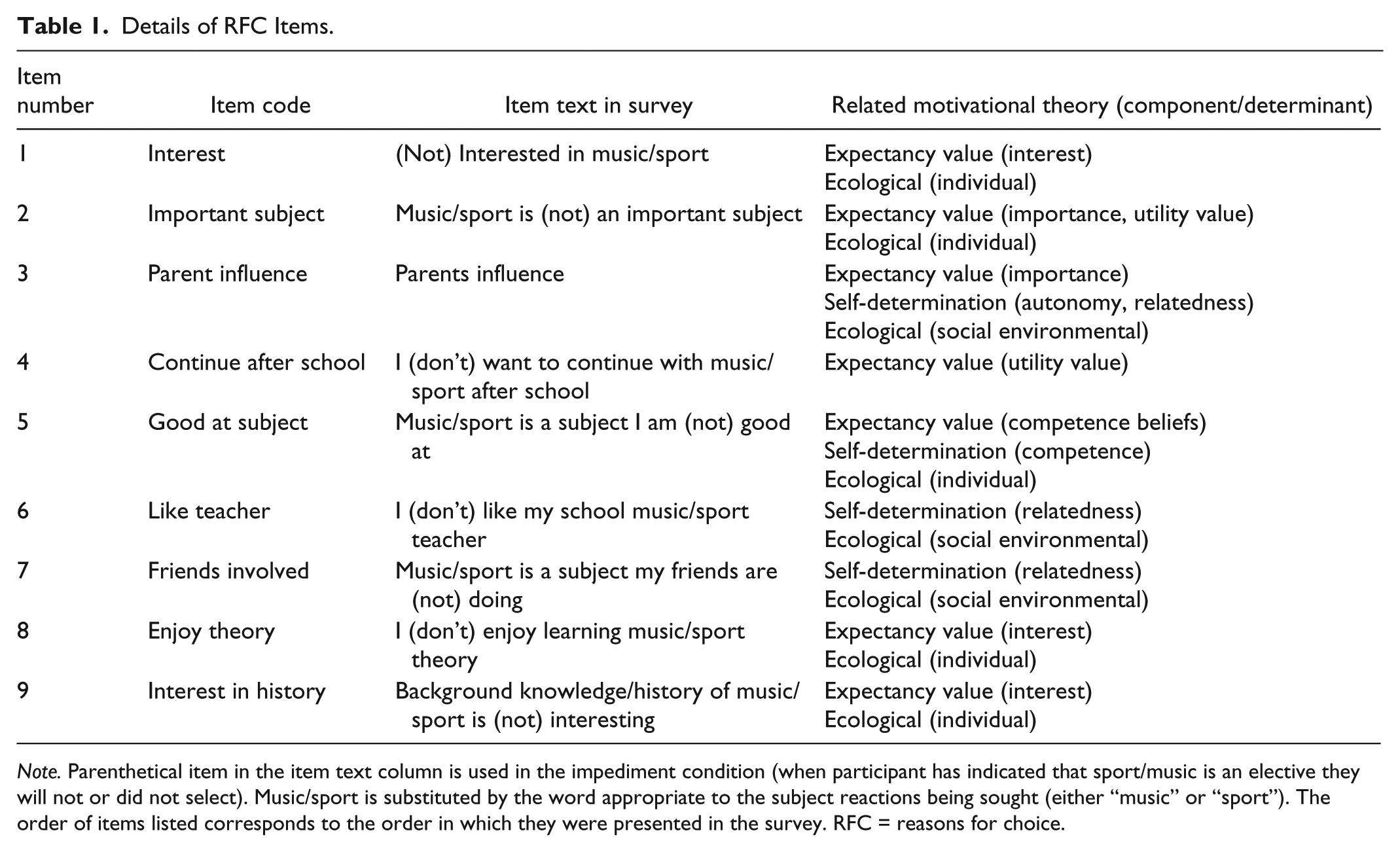
Note. Parenthetical item in the item text column is used in the impediment condition (when participant has indicated that sport/music is an elective they will not or did not select). Music/sport is substituted by the word appropriate to the subject reactions being sought (either “music” or “sport”). The order of items listed corresponds to the order in which they were presented in the survey. RFC = reasons for choice.
It was anticipated that an examination of these reasons for subject selection would help clarify understandings of adolescent motivation from a perspective not commonly currently found in the literature. We chose to examine a boys school because issues surrounding subject selection for music and sport are particularly intense in this type of setting. Unlike music, sport is firmly established in the ethos and traditions of this particular school and has been regarded as a valued activity for students in every grade leading up to the last year of high school. In fact, it is compulsory for all boys to participate in at least one sport until their final 2 years of high school. Therefore, exploring this particular setting in which perceptions are firmly enculturated can offer valuable insight into motivation for sport and music. Hence, the present study focused on reasons for elective choice by male high school students. We were particularly keen to determine whether facilitators and impediments were the same for music and sport. Furthermore, we tested whether reasons for doing an activity (when the question is posed as a facilitator of the chosen activity) corresponds to the reasons for not doing that activity (when the question is posed as a barrier for the activity not chosen).
Method
Participants
Participants from a private boys school in Sydney, Australia, were invited to participate in a survey. Students (N = 293) ranged in age from 13 to 16 years (Years 8, 9, 10). The issue of subject selection is most pertinent for students in Years 8, 9, and 10 when students form judgments about whether they will elect these subjects in subsequent years; hence, this analysis has been limited to students in those years.
The school provides a large range of academic subjects to cater for a breadth of student abilities and interests. Students entering Stage 5 (Years 9 and 10, age 14-15) at the school must select two elective subjects in total: one from each of the following two strands for 200 hr of study:
Each of these courses offers a curriculum that integrates practical and theoretical components of each subject. In the case of music, the learning experiences included performing, composing, and listening to music in a range of styles, periods, and genres (including a mandatory topic on Australian music).
Currently, all students in Stage 5 (Years 9 and 10) are required to participate in sport training on 2 weekday afternoons, as well as a match each Saturday. Summer sport activities that students in Stage 5 can choose include cricket, rowing, rugby, tennis, basketball, surf life saving, rock-climbing, swimming, and athletics. Winter sport activities include rugby, soccer, cross-country, tennis, and athletics.
Underpinning the schools philosophy is the notion that students can learn a great deal about life from mandated involvement in sport. In contrast, both music and drama activities are encouraged, in and outside the classroom with the school having a long tradition of vocal and instrumental groups and annual productions of various kinds. Both sport and music can be chosen as an elective subject in the final years of schooling (i.e., Years 11 and 12).
Students entering Stage 6 (Years 11 and 12, age 16-17) at the school must select five elective subjects in total. English and Christian studies are mandatory subjects. Students may choose electives from the following subjects: ancient history, biology, business studies, chemistry, drama, economics, English extension, extension maths, geography, German, information technology, modern history, physical development health physical education (PDHPE). In addition, it is compulsory for students in Stage 6 to participate in sport. This includes training twice mid-week and a match against other Great Public Schools (GPS) on Saturday.
All students enrolled in elective music must participate in at least one extra-curricular ensemble. There is a wide range of ensembles for students to be involved, which include Junior Band, Intermediate Concert Band, Senior Concert Band, Jazz Band, Intermediate String Ensemble, Senior String Ensemble, Symphony Orchestra, Chapel choir, a capella choir, percussion ensemble, and guitar ensemble. In addition to these ensembles, students can be involved in the annual school musical and end of semester concerts.
The study was conducted near the end of the academic year when participants had already chosen their subjects for the following year. The total number of online survey participants for the purpose of this study is N = 293. A multivariate test found no significant difference between the year groups surveyed; hence, results are collapsed across the year of study.
Procedure and Materials
Participants started by indicating whether they had elected to study music and sport for the following year. Following on from this response, they were asked to provide reasons for (facilitators) and against (impediments) choosing music and sport as elective subjects by rating nine items from 1 (strongly disagree) to 11 (strongly agree; see Table 1 for details of the nine items): interest, important subject, parent influence, continue after school, good at subject, like the teacher, friends involvement, enjoy theory, and interest in history.
Following institutional ethical approval and parent consent, the survey was initially piloted with a small number of other participants, and this resulted in some minor adjustments to the wording of questions that made the survey easier to read and understand. The online Activities I Like to Do at School (ALDAS) survey data, which took approximately 15 min to complete, were collected at school with surveys being self-administered online in computer laboratories that were supervised by several staff members.
The survey was presented in two orders to achieve counterbalancing, with half of the participants answering the music questions first and the other half answering the sport questions first. Participants identified reasons for involvement in music and sport activities, and reasons for and against choice of elective study of music and sport. The survey contained a conditional branch that depended on whether the subject (music or sport) was chosen (or was going to be chosen) as an elective. Those who answered “yes” branched to the facilitator questions and those who answered “no” branched to the impediment questions. Impediment questions were worded identically to the facilitator questions, with the inclusion of the “not/do not” at the grammatically appropriate location (see Table 2). For example, the facilitator item “My friends are doing it” had a matching impediment item “My friends are not doing it.” A sample of the items used in the survey is shown in Figure 1.
Cross-Tabulation of the Two Variables (Music/Sport and Elective Chosen/Elective Not Chosen).


Sample music facilitator question from the survey.
Results
Of the 293 participants, 14 participants (4.8%) chose only music as an elective subject, 125 (42.7%) chose sport as an elective, 8 (2.7%) chose music and sport elective, and 146 (49.8%) chose neither music nor sport. Table 2 presents a cross-tabulation of the participants who fell into each cell of the two variables (music/sport and elective chosen/elective not chosen).
A MANOVA was conducted with the nine music- and nine sport-related items as the dependent variables with an independent variable order of presentation (music questions first or sport questions first). This was found to be not significant, F(18, 244) = 1.202, p = .259,
Because a priori control of a mixed-design ANOVA with regard to the subject (music or sport) and choice (facilitator or impediment) was not possible (both variables subject to between- and/or within-subject variation), and due to the complexities of such a design upon parametric within-subject design (Keselman, Algina, & Kowalchuk, 2001), our analyses used a between-subjects design to allow a more conservative analysis (Kantowitz, Roediger, & Elmes, 2008). Figures 2 and 3 provide bar charts with 1 SE error bars and an indication of the items that were significantly different between sport and music subjects.

Facilitators to choosing elective music versus sport bar chart.
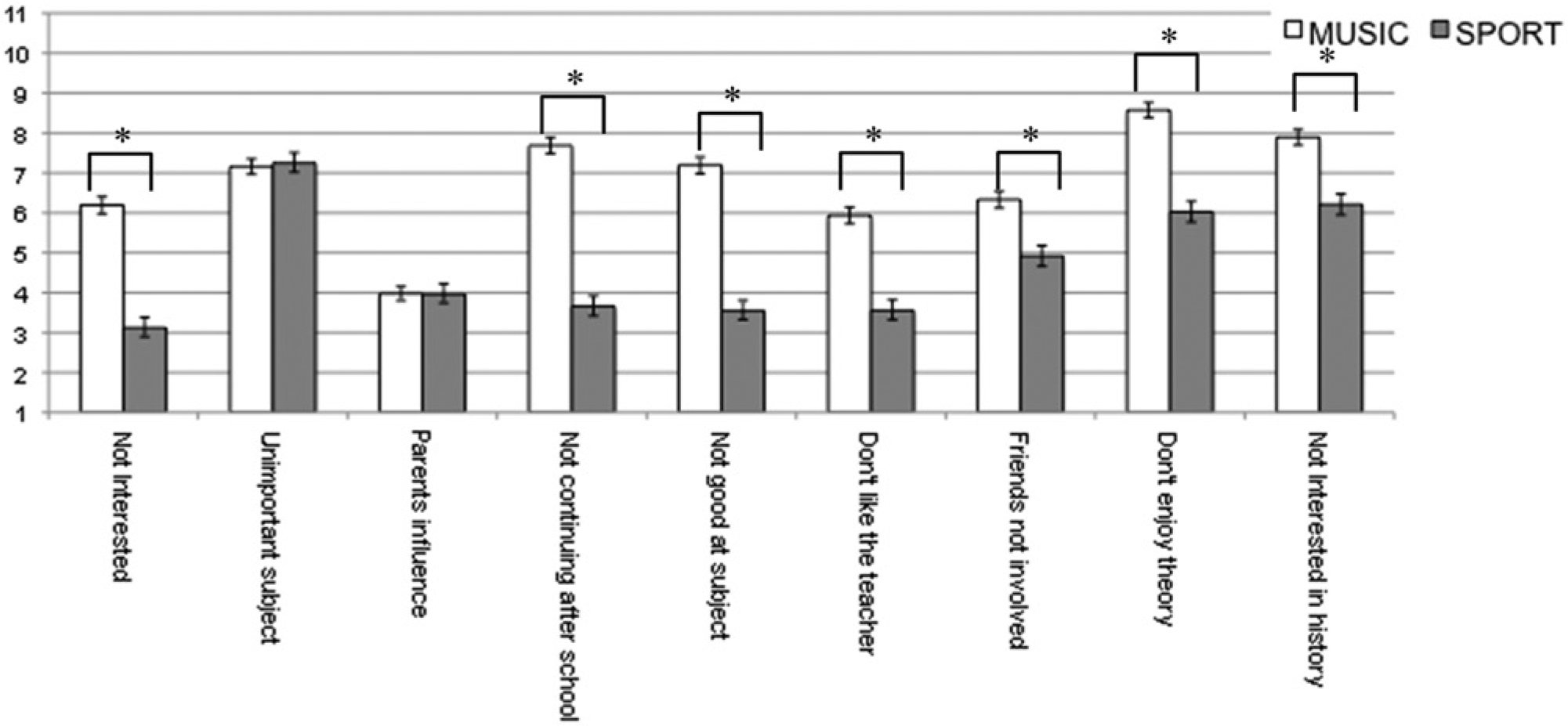
Impediments to choosing elective music versus sport bar chart.
Elective Facilitators
Using the facilitator data (a “yes” response to item “I will choose/have chosen as an elective”), a MANOVA using Pillai’s Trace with RFC items as dependent variables, music versus sport as the independent variable demonstrated significant difference between music and sport elective facilitators, F(9, 149) = 2.712, p = .006,
Factors for facilitating elective music and sport were fairly similar across the two domains. Interest was the most important reason for facilitating elective music (M = 9.58, SD = 2.302) and sport (M = 10.06, SD = 1.86); mean (SD) of 9.58 (2.302) and 10.06 (1.86), respectively, on a scale of 1 to 11 (see Table 3), followed by important subject, continue after school, good at subject, and like teacher. The least influential item for both music and sport was parent influence, which fell below the midpoint of the scale (6) for both subjects (5.17 [3.253] and 4.85 [2.986], respectively). While the item scale was labeled from 0 to 10 for the participant, this was converted to a 1 to 11 scale for analysis.
Music and Sport Elective Facilitator Statistics.
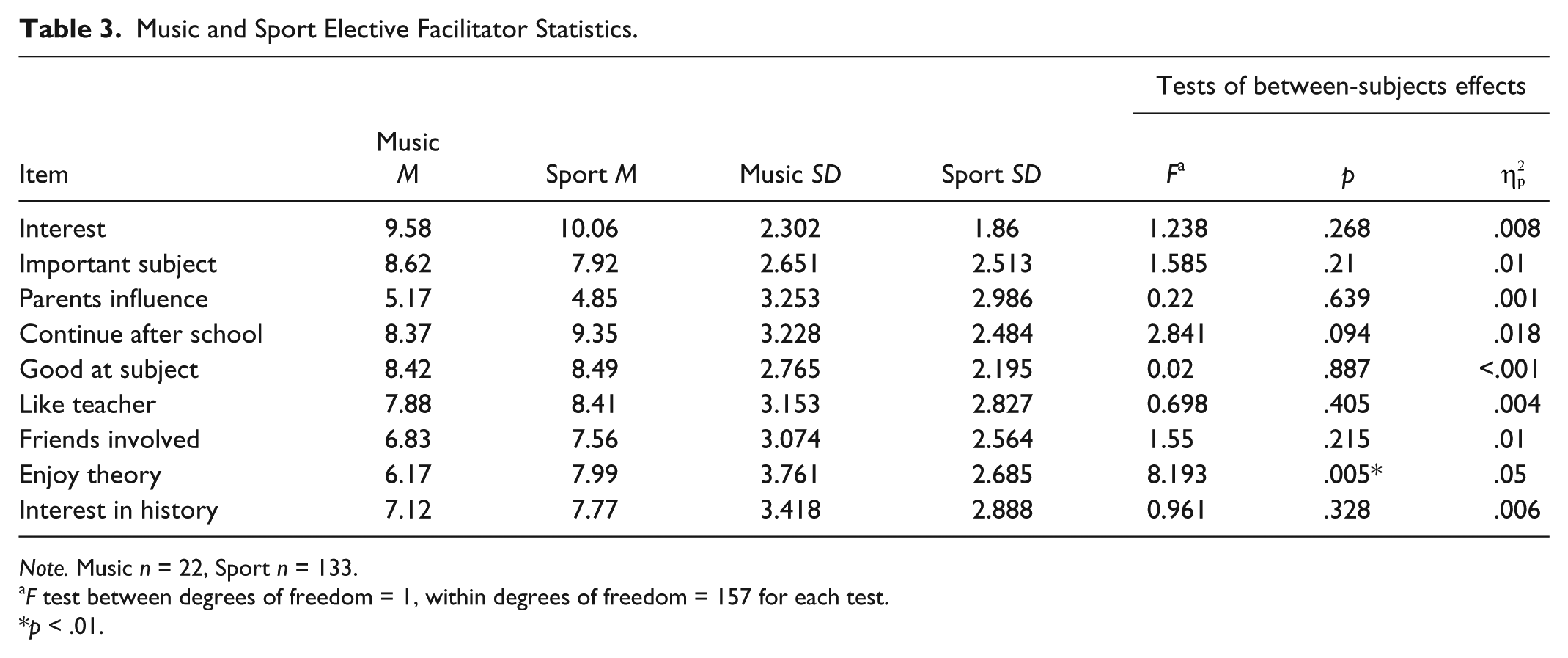
Note. Music n = 22, Sport n = 133.
F test between degrees of freedom = 1, within degrees of freedom = 157 for each test.
p < .01.
Elective Impediments
Using the barriers data, a MANOVA using Pillai’s Trace with RFC items as dependent variables, music versus sport as the independent variable demonstrated significant difference between music and sport barriers with Pillai’s Trace, F(9, 427) = 29.768, p < .001,
Music and Sport Elective Impediment Statistics.

Note. Music n = 271, Sport n = 160.
F test between degrees of freedom = 1, within degrees of freedom = 157 for each test.
p < .01.
The main (highest mean) impediment to sport was the item “unimportant subject” (7.25 [2.939]). All other items were rated at or below the scale midpoint (6). Music impediments, however, were above the scale midpoint for every item apart from parent influence (3.95 [2.905]) and friends not involved (5.93 [3.445]).
Further examination of the sport–music comparisons revealed generally small effect sizes. The only items that had moderate effect sizes (according to the
Summary of Extreme Scoring Facilitators and Impediments for Music and Sport by Item.

Note. NS = not significant.
p < .05. for one sample t-tests to test the probability that the mean value was significantly different to the scale midpoint
Discussion
Facilitators and Impediments
As shown in Table 4, all items with the exception of parents, and for music only the enjoyment of theory, were reported as significant facilitators for students’ choice to elect music and sport. In contrast, differences between music and sport were much more stark for the reported impediments. For music, all impediments were significantly higher than for sport, except for the parents item. For sport, the only reported impediment that was higher than for music was the item perceived importance of the subject, although the differences were not statistically significant.
The moderate effect size of the two impediments, Not Continuing After School and Don’t Like Teacher, supports earlier research by Sulz et al. (2010) that employed an ecological framework and identified both the usefulness of the subject to students’ future (an individual component) and the influence of teachers (a social environment) as influential barriers to elective enrollment. Furthermore, supporting the Expectancy-Value model, which emphasizes the individual’s utilitarian beliefs and value they place on a particular activity, and the Basic Needs Theory’s emphasis on the psychological need for relatedness, these impediment results reflect aspects of each of the three main theoretical perspectives presented in the literature review (Ecological, Self-Determination, and Expectancy-Value theories). The fact that these impediments were stronger for music than for sport may be indicative of an overall lack of motivation for music as compared with sport.
Interestingly, the least important facilitator and impediment reported for both music and sport was parental influence. Despite the large amount of evidence indicating the important role parents play in motivation and learning (McPherson, 2009; McPherson et al., 2012; Schunk et al., 2010; Sichivitsa, 2007; Ullrich-French & Smith, 2009; Wheeler, 2011), research also indicates that adolescents use music and sport as tools for establishing independence and their own identity (Blomfield & Barber, 2011; Hargreaves et al., 2012; Lamont, Hargreaves, Marshall, & Tarrant, 2003; MacDonald, Miell, & Wilson, 2005; McPherson et al., 2012; North & Hargreaves, 1999; North, Hargreaves, & O’Neill, 2000; Schubert & McPherson, 2006; Tarrant, North, & Hargreaves, 2002; Wigfield & Tonks, 2002; Woody & McPherson, 2010). Thus, when choosing elective subjects at school, students at the age surveyed may perceive that they are influenced more by their own interests, competency beliefs, peers, and teachers, than by their parents. Overall, our findings suggest that the highest facilitators and impediments for elective choice are more individual-oriented than social-environment-oriented. This finding supports the Self-Determination theory view that adolescent motivation is most powerful when it is self-determined and intrinsic rather than teacher or parent-directed.
It is interesting to note that responses for facilitators are not symmetric for like items across conditions (facilitator vs. impediment), suggesting that the significance of an item depends on whether the subject is or is not selected. For example, high interest is an important facilitator for elective choice, yet high lack of interest is not as much of an impediment.
Music and Sport Elective Choice
Results indicate that the male adolescent participants sampled are more interested in enrolling in elective sport than in music, with 42.7% choosing elective sport and only 4.8% choosing music. Yet, almost half of the participants (49.8%) did not choose music or sport as one of their school subjects. Of the RFC items tested, reasons for choosing sport items were rated significantly higher overall than for music. This finding is in accord with McPherson and O’Neill’s study, which reported that students perceive they were less capable in music and valued music less than other subjects (McPherson & O’Neill, 2010). Results from the current study are also consistent with the Simpkins et al.’s (2010) study, which reported that males were more motivated to participate in sport than in music. In agreement with Schunk et al.’s (2010) finding, students report valuing tasks they expect to succeed in, and think that the most important tasks are those they expect to do well in. The significance of the results for importance of subject, interest in subject, and wanting to continue after leaving school is indicative of deeply rooted beliefs surrounding the value of music education at school. Values shape the way we approach learning and influence decisions about continuing to study subjects when given the choice. Through an enhanced understanding of the value and importance of an activity, students are more likely to be more motivated and engaged in learning beyond the school realm. We therefore propose that if music educators are seeking to address low student enrollment in elective music, there is a need to encourage students (and parents) to become more reflective about the usefulness and importance of studying music: “Skills can only continue to beget skills when they are valued for their deeply personal significance by their owner” (McPherson et al., 2012, p. 226).
The current study furthers the Simpkins et al. (2010) study by demonstrating that elective sport at school is preferred to elective music in school by adolescent males. This mirrors the Simpkins et al. finding that out-of-school sport is preferred to out-of-school music for adolescent males. However, the present study does not just elucidate why males choose sport and do not choose music but also suggests that there are specific differences that influence elective enrollment between sport and music subject selection.
Nearly all RFC items for facilitating elective music and sport were statistically identical across the two domains. The most important (as measured by mean score) elective facilitator for both music and sport was interest in the subject (see Table 4). Other important facilitator items for music and sport included important subject, continue after school, good at subject, and like teacher. These significant facilitator items represent a cross-section of each of Expectancy-Value, Ecological, and Self-Determination theories. The items interest and important subject are related to the Ecological and Expectancy-Value theories, while the item such as teacher is related to the Ecological and Self-Determination theories. In addition, the item good at subject is represented in all three theories, and finally, the item continue after school is related to only the Expectancy-Value theory.
Our results suggest that elective facilitators for music and sport are predominantly individual-oriented, with interest in the subject being the most influential. Follow-up ANOVA was used to investigate which RFC items rated sport higher than music. However, one notable exception from these similarities across the domains was that students reported enjoying the theory of sport significantly more than enjoying the theory of music. Although it was not a high scoring item, it was significantly higher than for the music case, and therefore it distinguishes sport choice from music. We have not yet cited a previous study that reports one reason that compels students to select one subject over the other. The enjoyment of theory of sport appears to be driven by cultural factors, rather than because there is anything especially more interesting about sport theory than music theory.
In contrast, factors impeding enrollment (barriers) were significantly higher in music than in sport. The greatest (highest mean) impediment reported to elective sport was that it was considered an unimportant subject (7.25 [2.939]). All other RFC items were rated at or below the scale midpoint (6). Music impediments, however, were above the scale midpoint (6) for every item (including not interested, unimportant subject, not continuing after school, not good at subject, don’t enjoy theory, not interested in history, friends not involved), apart from parent influence and not liking the teacher.
The only impediment items that do not distinguish music from sport were the high scoring lacking importance of the subject and the low scoring parent influence. Perhaps anything that is considered an unimportant subject is an impediment regardless of subject, whereas the other items that are significantly stronger for music such as not interested, not continuing after school, not good at subject, don’t like teacher, friends not doing, don’t enjoy theory, and not interested in history do appear to be subject-specific barriers. Some reasons are obviously subject specific, such as disliking the teacher (Turton & Durrant, 2002), because the teacher will be different for different subjects of study. A version to music is most likely to have cultural origins—where boys at the particular school, the parental socioeconomic status, and broader exposure to sport rather than music, produce a halo effect (Nisbett & Wilson, 1977), making many justifications for non-subject selection accentuated. However, participants reported that parent influence was not significant as a facilitator nor impediment across both music and sport domains. Although the present study focused on RFC, the more unusual finding of the study (e.g., that parental influence may not be as important for this age group as previously suggested) is notable in terms of the design of the study and the ecological model proposed by Sulz et al. (2010).
Conclusion
This study explored reasons influencing adolescent choice of elective subjects and extends previous research. Our approach was to identify a selection of motivational “reasons for choice” that sampled a range of theoretical factors in motivation research. Furthermore, our comparison of two subject domains, as well as the analysis of facilitators in tandem with impediments, paves the way for more comprehensive follow-up research. In the present study, we were able to not only report that male students are more motivated to participate in sport than in music in the socioeconomic and cultural climate represented by the area in which the study was conducted but also pinpoint the reasons for differences in facilitators and impediments that promote elective choice and reasons against choice of music or sport. Our results indicate that individual-oriented items rather than social environmental items may be more important in determining a boy’s choice of these elective subjects. Elective facilitators were similar across music and sport domains, whereas impediments were different across domains. Furthermore, reasons for impediments to elective music were rated significantly higher than reasons for impediments to elective sport. While social environmental influences are important, researchers and educators need to be particularly cognizant of the dominant role individual-oriented factors play in adolescent motivation and choice. In addition, impediments to elective choices vary across music and sport domains for adolescent males with significantly more impediments for music.
These findings not only have implications for motivation theory but also raise practical issues for teachers. It is vital that educators become more cognizant of the different views students have toward studying the theory of sport, which overall students enjoyed, versus the theory of music, which, on the whole, they did not. This reflects deeply embedded values held toward music study, especially when compared with sport study, and affirms McPherson and O’Neill’s (2010) finding that music study is least valued by students. If music educators are to more fully engage and motivate students, then the deeply embedded beliefs about the utility and value of learning music must be addressed. Both students and parents need to recognize that the highly valued outcomes of self-discipline, co-operation, problem solving, and creativity can all be developed through music study. However, while McPherson et al. (2012) may correctly believe that students who succeed are those who can imagine themselves as musicians in the future, the onus rests on educators to engage the majority of students for whom music will not result in a music career. Therefore, music educators need to encourage students and parents to become more reflective about the usefulness and importance of studying music if they are to more fully engage their students. In addition, students must be presented with a future perspective beyond school life to give purpose and meaning to their music education. In other words, it is quite likely that at the core of impediments and facilitators of music or sport choice are cultural reasons. A more comprehensive understanding of these motivational forces would enable researchers and educators to implement effective strategies for promoting elective enrollments and ultimately address some of the impediments to more active participation in music as a school subject.
Footnotes
Authors’ Note
S. W., G.E.M., and E.S. conceived of the study design. S.W. collected data and performance analysis and interpretation in collaboration with G.E.M. and E.S. All authors read and approved the final manuscript. Access to sample survey questions, and sample answers can be requested from the author by email:
Declaration of Conflicting Interests
The author(s) declared no potential conflicts of interest with respect to the research, authorship, and/or publication of this article.
Funding
The author(s) disclosed receipt of the following financial support for the research and/or authorship of this article: This research was supported by an Australian Research Council Grant DP1094998.