




Abstract
The present study compares student teachers’ career choice motives and their relationship with stress-inducing thoughts across five European countries. A previously established factorial structure for career choice motives embedded within self-determination theory was supported. The factors consist of intrinsic motives, such as interest in educational work with children, and extrinsic motives, such as financial security. Furthermore, differences in the importance of these factors in choosing the teaching profession across countries were found. Results further revealed evidence for a link between extrinsic motives and stress-inducing cognitions. Conclusions and implications for teaching practice are discussed.
Keywords
Becoming a teacher represents a professional goal many students in various European and non-European countries pursue. In numerous countries in Europe, around 10% of all students complete programs in teacher training and education science (Organisation for Economic Co-operation and Development [OECD], 2016). Due to the popularity of the profession, researchers have investigated the motives that lead students to study teaching. Over the decades, this field of research has revealed insights into motivational and other personal factors influencing these decisions (Johnson & Kardos, 2008; Richardson & Watt, 2006, 2016; Zumwalt & Craig, 2008). As researchers from a growing number of countries have been involved in this field of research over the years, international comparisons are on the rise (Bastick, 2000; Heinz, 2015; Scharfenberg et al., 2018; Suryani et al., 2016).
However, despite the popularity, teachers across countries report high job demands and the resulting stress they experience at work (Dicke et al., 2014; Richards, 2012). Research investigating this perceived stress among teachers is based on the assumption that different people perceive specific occupational requirements inducing stress in differing ways (Lazarus, 1993, 2006). Consequently, studies on factors related to teacher stress focus on personal characteristics, such as self-efficacy, and stress-inducing thoughts (Cascio et al., 2014; Montgomery & Rupp, 2005; Schwarzer & Hallum, 2008). Stress-inducing thoughts, also called dysfunctional cognitions in the scientific literature, are particular dysfunctional automatic patterns of thought that effect a person’s behavior and emotional state in a negative way. Numerous such thoughts have been investigated, including avoidance of risk or perfectionism (Beck et al., 1979). Thus, it would be relevant to know more about links between stress-inducing thoughts and the personal traits of future teachers.
So far, only a few studies have brought career choice motives and concepts like stress-inducing thoughts together (Scharfenberg, in press). Investigating relationships between career choice motives and stress-inducing thoughts, the goal of the present study, enables more precise insight into career-decision-making processes and, in consequence, might help creating (preventive) measures for people with a specific set of career choice motives. Using cross-country comparisons for this research topic can reveal additional reasons and explanations for both career choice motives and stress-inducing thoughts as country-specific structural conditions and culturally shaped differences can be taken into account as a rationale. By studying one country only, there is no way to decide whether observed effects are induced by certain conditions within this country or whether they are an issue across countries. Considering more countries, especially those differing in structural conditions and cultural contexts, allows conclusions on the interplay of motivation and stress-inducing thoughts in a certain framework.
Following this goal, we first compare the career choice motives of future teachers from five European countries (Germany, Switzerland, Sweden, Romania, and Ukraine). These countries were selected because they differ significantly with regard to teachers’ working conditions and cultural backgrounds. This applies, for example, for the salaries teachers earn, working conditions, teacher–student ratio, and workload (Eurydice, 2013, 2016; OECD, 2005). In a second step, we analyze how these motives are related to stress-inducing thoughts to gain insight into the interplay of motives and such thoughts. In the following, we discuss the importance of structural conditions and cultural backgrounds.
Existing Research on Career Choice Motives and Stress-Inducing Thoughts
Theoretical Considerations and Research on Career Choice Motives
Career choice motives can be defined as career-related thought processes that cause a person to act in a specific way (Richardson & Watt, 2006, 2016; Wigfield & Eccles, 2000). Drawing on general theories of motivation (e.g., Atkinson, 1964; McClelland, 1961), the field of work and organizational psychology has developed a broad range of theoretical models that describe career development and career choice either as a dynamic process (e.g., theory of circumscription and compromise, Gottfredson, 2005) or as a singular decision based on personal traits (e.g., theory of vocational personalities and work environments, Holland, 1997): In many ways, the career development process and the literature devoted to its understanding resemble a giant jigsaw puzzle. [. . .] The greatest challenge, as with all jigsaw puzzles, lies in fitting the many different pieces together to form a coherent picture. (Lent, 2005, p. 101)
When it comes to the career choice motives of teachers, this coherent picture consists of a range of career choice motives that tend to recur in studies done within different countries, with differing methodologies, and with different instruments (Scharfenberg, in press). Although the research landscape is very heterogeneous and only a few instruments have been used more than once (Richardson & Watt, 2016; Scharfenberg, 2018), Heinz (2015) and Rothland (2014) describe that many studies find comparable motives that include, among others, child-centered motives, like the joy of “working with children”; subject-centered motives, like the “interest in their subject”; altruistic reasons, like “to contribute to society”; and extrinsic reasons, like “job security, hours, pay, status,” the idea of teaching as a “fallback career,” and a significant “influence of family members” (all Heinz, 2015, p. 265 f.).
There are various ideas about how to group the revealed motivational factors based on a number of theoretical models. Expectancy-value theory, one such theoretical model, assumes that choices are dependent on values and expectancies. Within this framework, career choice is seen as the result of an assessment that takes both the value of expected outcomes and the probability to achieve these outcomes into consideration (Wigfield & Eccles, 2000). Factors Influencing Teaching Choice (FIT-Choice), the most renowned expectancy-value-based model for measuring career choice motives of teachers, considers task demands and task returns of the occupation; self-perceptions of (future) teachers; intrinsic values; personal utility values, like job security; and social utility values, like the social contribution a teacher can make (Richardson & Watt, 2006, 2016; Watt & Richardson, 2007). Furthermore, it includes socialization influences and the option to choose teaching as a fallback career.
A second well-accepted theory of motivation is self-determination theory, created by Deci and Ryan (2000, 2012). Within their theory, Deci and Ryan focus on three psychological needs, autonomy, competence, and relatedness. In particular, Ryan and Deci (2000) define two types of motivation: “intrinsic motivation, which refers to doing something because it is inherently interesting or enjoyable, and extrinsic motivation, which refers to doing something because it leads to a separable outcome” (p. 55). Based on the degree to which those needs are fulfilled, Ryan and Deci (2000) further differentiate extrinsic motives, based on the degree of personal autonomy involved.
Career choice motives of future teachers can be differentiated based on the degree of self-determination and autonomy involved, too. Many researchers differentiate between intrinsic and extrinsic motives (for an overview, see Heinz, 2015). Whereas intrinsic motives relate directly to work tasks or work outcomes of teachers (e.g., imparting knowledge), extrinsic motives see an occupation as instrumental to achieve external goals like a decent salary or a high job security. Intrinsic career choice motives that involve high levels of self-determination and autonomy, and are often named by student teachers, include imparting knowledge, supporting children in their development, interest in particular subject matter, and contributing to society (Heinz, 2015; Liu, 2010; OECD, 2005; Sinclair, 2008). Sometimes, these (or some of these) motives are named altruistic as well. However, there is no consensus regarding the differentiation between intrinsic and altruistic motives in the field (Bastick, 2000; Kyriacou et al., 2003; Rinke, 2008). Various findings focus on the differences in intrinsic career choice motives and professional expectations among student teachers for various school types. The results have revealed that elementary school student teachers report child-centered motives to be more important, whereas prospective teachers on secondary schools perceive subject-related factors to have more significant effects on their career choice (Weiß & Kiel, 2013; Brookhart & Freeman, 1992). Similar patterns can be found when focusing on gender differences (Bruinsma & Jansen, 2010). However, as the gender of prospective teachers is highly correlated with the type of school those teachers are going to work at later on, those two factors can be hard to differentiate: whereas male teachers tend to work in secondary schools (and, subsequently, have a higher focus on subject-centered motives), in many countries the workforce of primary school teachers is mainly female (Jungert et al., 2014).
Motivational factors, like financial and occupational security, the compatibility of profession and family, and recommendations made by others are often called extrinsic motivational factors (Richardson & Watt, 2006; Wilhelm et al., 2000). With regard to self-determination theory, it is important to consider the different levels of self-determination within the field of extrinsic motives. In line with the second research question of the present article, a classification of motives and levels of self-determination will be described in more detail later in the article (see Results section and Figure 1). Most results reveal that intrinsic motives, which involve highly self-determined behavior, are more important for student teachers than extrinsic motives. Only a small number of studies show greater significance on the part of extrinsic motives, such as status and money (Bastick, 2000; Heinz, 2015; Zumwalt & Craig, 2008).
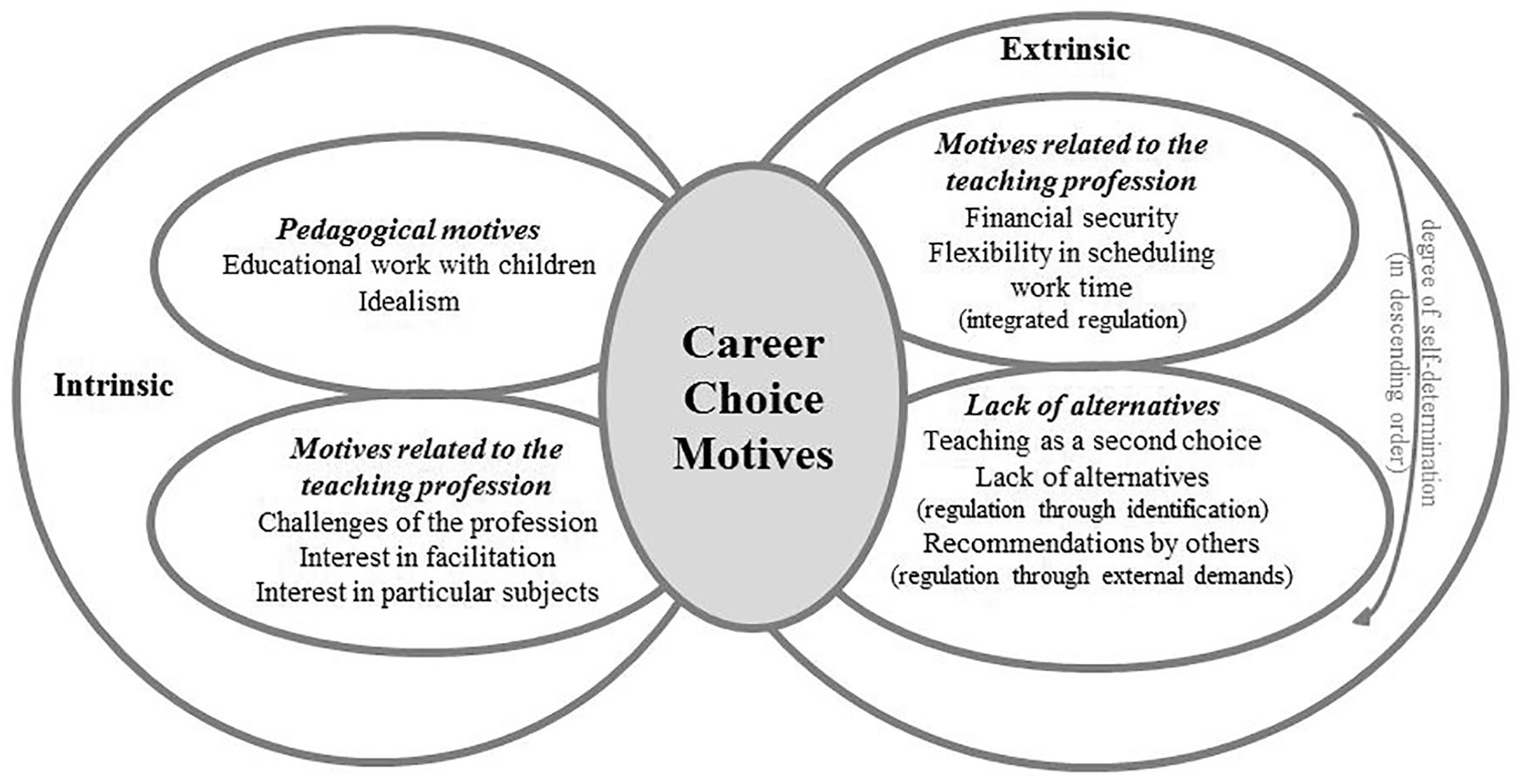
Career choice motives mapped onto the concept of self-determination by Deci and Ryan (2000).
Several studies point to country-specific differences in the motive patterns of (prospective) teachers (Bastick, 2000; Heinz, 2015; Kyriacou et al., 2003). Diverging political systems and administrative frameworks can be particularly important in this regard, for example differences regarding teacher salaries, working conditions, teacher-student ratio, and workload (Eurydice, 2013, 2016; OECD, 2005). Whereas the salary of teachers in Eastern European countries, like Ukraine or Romania, is quite low (i.e., a Romanian teacher earns between US$4,000 and US$11,500 per year; Eurydice, 2017b), it is rather high in Western countries, including Switzerland and Germany (a German teacher earns between US$51,000 and US$88,000 per year; Eurydice, 2017a). In addition, in some countries, such as Germany or Romania, teachers are governmental employees and cannot be laid off except for criminal misdemeanor. In comparison, in other European countries, including Sweden and Switzerland, teachers can be hired and fired like regular employees.
A third discriminating factor is the regulation of the workday. Whereas teachers work 45.50 hr a week during a school year in Sweden, German and Romanian teachers for the most part have only to be in school to teach and can arrange some parts of their remaining work time rather flexible (i.e., 16–24 lessons per week in Romania, accounting for a nominal workload of 40 hr a week; Eurydice, 2017a, 2017b, 2017c, 2017d). However, qualitative parameters of the teaching profession, such as social status and reputation, are harder to compare. Although research findings are ambiguous, the job reputation of teachers seems to be a major issue in many countries (see Bertilsson, 2014, for Sweden; see Institut für Demoskopie Allensbach, 2013, for Germany). Finding a sample of countries that would represent this heterogeneity of characteristics within the teaching profession was one of the goals of this study.
Although the teaching profession seems to be an attractive course of study, teachers from different countries repeatedly state difficult job demands and the resulting stress they experience at work (Admiraal et al., 2000; Dicke et al., 2014; Johnson & Birkeland, 2003; Kittel & Leynen, 2003; Richards, 2012). In addition to differences in the workplace, other factors, particularly related to teachers’ personality, are responsible for the problem of teacher ill-health and early retirement. One frequently investigated factor, particularly in line with the onset of depression, are stress-inducing thoughts (Brown & Beck, 2002). Although first research findings suggest a relationship between motivation and stress-inducing thoughts, studies on the relationship between career choice motives and stress-inducing thoughts are still scarce (Baker, 2004; Moneta & Spada, 2009). In the following paragraph, existing research on stress-inducing thoughts and teacher health is introduced, which will subsequently lead to the present study’s research goals and analyses.
Existing Research on Teacher Stress and Stress-Inducing Thoughts
Within the last decades, a field of research concerning factors related to perceived stress has developed, and various findings have been published with regard to teachers. In addition to certain personality characteristics that are generally positively related to stress and psychological ill-health, such as neuroticism and social introversion (Mohiyeddini et al., 2015; Schneider, 2004; Uliaszek et al., 2010), coping strategies (Admiraal et al., 2000; Chan, 1998; Hillert et al., 2014) and self-efficacy (Cascio et al., 2014; Schwarzer & Hallum, 2008) are important resources. This list of personal characteristics has been broadened by and empirically supported with conceptualizations of stress-inducing thoughts (for a meta-analysis investigating a number of variables, see also Montgomery & Rupp, 2005). Those are defined as “pervasive and systematic negative bias in information processing” (Brown & Beck, 2002, p. 232) and include a wide range of thought patterns, ranging from dependency and risk avoidance to perfectionism (Beck et al., 1979).
Significant relationships between stress-inducing thoughts and mental health problems, such as depression, anxiety disorders, traumas, and higher levels of perceived stress have been found (Hinds et al., 2015; Karekla & Panayiotou, 2011; Norberg et al., 2007). In one study, for example, people with high levels of dependency were more prone to the development of physical illnesses (Bornstein, 1995). Furthermore, automatic thoughts about avoiding social support have been interpreted as harmful to a person’s health because social support has been proven to encourage appropriate reactions to stress (Burke et al., 1996). With regard to stress-inducing thoughts, various researchers in the German-speaking area have validated different scales measuring a number of stress-inducing thoughts. Among others, Trageser has validated a set of more generally worded items that are fit for the use with teachers (Kiel et al., 2016; Trageser, 2010).
The analysis of a possible connection between automatic thought processes and career choice motives is assumed as an approach that could reveal important additional insights. There are two reasons that support the importance of this approach: first, it is assumed that those thoughts hinder peoples’ ability to react to stressful situations in a favorable way. At the same time, these thoughts make it difficult for people to access and make use of their resources (Beck et al., 1979). Thus, considering such thoughts is an essential part of research on teacher health.
Second, there is first evidence relating stress-inducing thoughts to career choice motives. Specifically, intrinsic motives are related to a lower level of perceived stress (Baker, 2004), whereas extrinsic motives are related to avoidance coping behaviors (Moneta & Spada, 2009) and depression in the workplace (Lu, 1999). This has been investigated using various samples, showing the association between extrinsic motives and inappropriate work-related coping behaviors (Baker, 2004; Reichl et al., 2014). Furthermore, this is in line with the established relationship between self-determination and psychological well-being, as suggested by Deci and Ryan (2000, 2012), who claim that high levels of self-determination, which are related to intrinsic motivational factors, can predict subjective well-being (Olesen et al., 2015).
Research Questions
As described above, the motivational factors responsible for choosing a particular course of study or profession are complex. The final decision can be seen as an alignment of personal goals or interests and occupational demands. A misfit between the environment, including related external expectations and demands, and a person’s abilities will lead to stress (Edwards et al., 1998). Answers to questions regarding the link between career choice motives and personal characteristics, which are assumed to play an important role in the development of stress and stress-inducing thoughts in future work life, are essential. But research investigating this relationship is still rare, and only found with regard to specific educational areas (Kiel et al., 2016). The present study, therefore, aims to analyze this particular connection.
The motives investigated in the present study are based on the self-determination theory by Deci and Ryan (2000). This has already been realized in a previous study based on a sample of future early childhood educators (Weiß et al., 2018), which has been extended to include a broader sample from four additional European countries (Switzerland, Sweden, Romania, and Ukraine). Those countries represent a heterogeneity of work-related environmental conditions that is as broad and diverse as possible within the European context (see Table 1 in the Method section).
Cultural and Structural Contexts of the Countries and Higher Education Institutions Involved (Eurydice, 2017a, 2017b, 2017c, 2017d; Hofstede Insights, 2019).

After motivational factors are extracted based on the total sample, the study examines whether those factors can be grouped into clusters. Furthermore, it investigates how these motivational clusters differ regarding the presence of stress-inducing thoughts to reveal evidence for personal risk factors that are independent of particular conditions but might be related to career choice motives. In addition, the distribution of different motivational clusters across those countries is another focus and aim of the present study. This part is particularly important in line with the exploratory assumption made in the present study, assuming country-specific work-related conditions to be (at least partially) responsible for the differences in motivation. Due to the scant research in this area, the study has an exploratory goal and seeks to address the following research questions:
Method
Project Context
The present study is included in the STeaM research project, conducted by the chair of school and teacher Research at the University of Munich in Germany in collaboration with other higher education institutions in Switzerland, Sweden, Romania, and Ukraine. The project aims to compare the career choice motives and personal characteristics in the field of teacher education and teacher well-being. The findings will be used as an empirical basis for recommendations and counseling instruments for student teachers.
Participants and Procedure
A total of 2,541 student teachers participated in the study. In line with the research questions and goals of the study, future teachers from various countries were involved. The data collection process took place between 2012 and 2015. The coordination of the data collection and analyses was conducted at the University of Munich in Germany. Altogether, four additional European higher education institutions were involved in data collection. Those were located in Switzerland, Sweden, Romania, and Ukraine as described below. Before data collection, all higher education institutions participating held several common meetings to coordinate and adjust the collections processes to create equal collection conditions. Framework conditions (e.g., what kind of information about the project and the questionnaire used would be given to the student teachers involved) were agreed and set.
In all countries participating in the study, data collection was embedded in mandatory lectures future teachers needed to attend. Table 1 introduces the European higher education institutions that were involved in data collection. Each institution is briefly characterized by the cultural context of each university and country.
For the data collection, the future teachers were asked to complete a questionnaire during a mandatory lecture in their respective higher education institutions. In a first step, subsequent to the data collection process, the original data set was subject to preliminary analyses based on the number of missing values in the data set. The researchers decided to exclude cases that showed more than 5% missing values for either of the two sets of variables included. Due to this decision, a total of 211 participants (8.30%) were excluded from further analyses, leading to a final sample size of 2,330 student teachers. The distribution of the total sample across the five country-based subsamples was uneven; whereas the German sample included the largest number of student teachers (n = 1,488), the Ukrainian future teachers were the smallest group (n = 96). The Swiss and Swedish samples consisted of 289 and 353 student teachers, respectively. In Romania, 104 student teachers participated in the present study. The uneven distribution is discussed in the Discussion section. In the final sample, 527 persons were male, and 1,798 were female. The average number of university semesters was found to be 2.79 (SD = 2.46), as was the number of semesters in a teaching program (M = 2.29, SD = 1.89), which did not include the Swiss sample due to missing data. Student teachers’ ages ranged from 17 to 53 years (M = 22.11, SD = 4.67).
Instruments and Preliminary Analyses
Career choice motives
This study used an instrument to measure career choice motives which had already been designed, tested, validated, and applied in a previous study (Weiß & Kiel, 2013). The development of this instrument was based on existing studies and theories while factors that were missing were subsequently identified and added by experts in a second step. The resulting 73 items are rated on a 4-point Likert-type scale ranging from 0 (strongly disagree) to 3 (strongly agree). Various scales and factors have been identified through factor analyses through studies conducted previously using international samples (Weiß et al., 2018). A table containing more detailed information on measures of internal consistencies of the particular factors that have been extracted in this study can be found in line with the first and second research questions in the Results section.
Stress-inducing thoughts
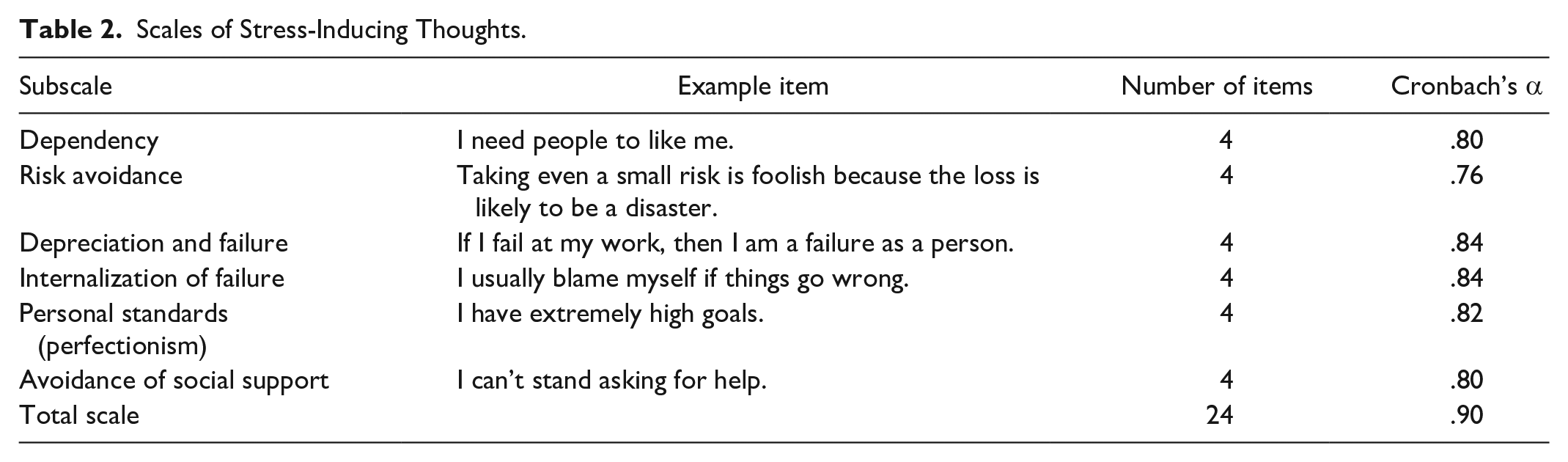
The questionnaire used in the present study refers to stress-inducing thoughts, or dysfunctional cognitions, as defined by Beck and colleagues (1979; Brown & Beck, 2002). It is based on the Scale of Dysfunctional Attitudes (Hautzinger et al., 1985), the Irrational Attitudes Inventory (Plutchik, 1976), the Frost Multidimensional Perfectionism Scale (Frost et al., 1990), and a newly developed scale concerning the Avoidance of Social Support (Trageser, 2010). The questionnaire consists of six dimensions, each with four items, and had been, as described above, already successfully validated among samples with teachers (Trageser, 2010). The student teachers in the present study were asked to rate all 24 items on a 5-point Likert-type scale ranging from 0 (strongly disagree) to 4 (strongly agree). Overall, the reliability measures of the entire scale and all six subscales, which are displayed in Table 2, represent scores that, overall, are perceived as good in research in the social sciences (Kline, 1999). Conducting separate reliability analyses for all country-based subscales revealed similar results. Table 2 depicts the six scales, with an example item, the number of items, and the internal consistency measure for all five countries as an aggregate.
Scales of Stress-Inducing Thoughts.
Results
The results are structured in accordance with the research questions stated above.
Factorial Structure of Career Choice Motives
To determine the number of factors that fit the data, an exploratory principal component analysis with a varimax rotation was conducted on all 73 items of the instrument. The initial results were inspected and adapted by excluding items with small (<.40) or inconclusive factor loadings. The reliability measures of the scales vary between .64 and .88, representing acceptable to good results (Table 3). When inspecting each factor in more detail, significant differences can be observed which can further be attributed to differences in self-regulation and self-determination that will be described in more detail further below.
Scales and Subcategories of Career Choice Motives.

In line with the second research question, the motivational factors have been mapped onto the different levels of self-regulation and self-determination, applying a theoretical basis based on the self-determination theory by Deci and Ryan (2000, 2012). Figure 1 depicts the result of this process for the motive factors. In particular, factors can be divided into two broader categories: intrinsic motivation and extrinsic motivation. These two overarching categories can further be split into subcategories, represented by factors, which are shown in Figure 1. For intrinsic motivation, those range from educational work with children to interest in particular subjects, whereas those assigned to extrinsic motivation range from flexibility in scheduling work time to recommendations by others.
Due to similarities regarding the content of those individual factors, they can be summarized into four broader subcategories: intrinsic pedagogical motives (Factors 1 and 2), intrinsic motives related to the teaching profession (Factors 3–5), extrinsic motives related to the teaching profession (Factors 6 and 7), and extrinsic motives related to a lack of alternatives (Factors 8–10). Those categories are particularly important to mention at this point as they represent the different levels of self-determination, autonomy, and locus of control, as suggested by Deci and Ryan (2000, 2012).
Determination of Clusters of Career Choice Motives
Before determining the number of clusters, outliers in the data set were identified using cluster analysis with the single linkage approach, which represents a standard and recommended procedure when conducting cluster analyses. The resulting two outliers (one student teacher from Germany and one from Ukraine) were taken out before conducting the final cluster analysis, which resulted in a total sample of 2,328 student teachers. This procedure is important, as cluster analyses represent a data-driven approach, and particularly with hierarchical cluster analysis, clusters are created based on the similarity of data. Based on this fact, results (i.e., number of clusters and the assignment of participants to individual clusters) can be significantly influenced by individual outliers. The single linkage approach enables the identification of those scores that are significantly further away from the majority of data points and, consequently, cannot be easily assigned. Therefore, removing outliers can increase the results’ accuracy (Almeida et al., 2007). Furthermore, given the small percentage of outliers compared with the total sample, the results are not assumed to have changed significantly.
In a second step, five clusters were extracted using an agglomerative hierarchical cluster analysis using Ward’s Method and Squared Euclidean Distance. To validate the number of clusters, we conducted an additional discriminant analysis with a prior specified number of five clusters and compared the assignment of participants with particular clusters of both methods. The resulting adjusted Pearson’s coefficient revealed a significant (p < .001) score of .91 between both procedures, which is interpretable as large. This would, therefore, justify the assumption of a strong agreement across the two described methods. This was further supported by comparing variances within and among clusters.
Related analyses investigating homogeneity of clusters revealed that roughly 80% of coefficients showed values lower than 1.00 (Backhaus et al., 2016). The distribution across the five-cluster solution revealed a highly distinguishable pattern with regard to mean scores on the different factors of career choice motives as well as the numbers of participants (Ncluster 1 = 449; Ncluster 2 = 744; Ncluster 3 = 269; Ncluster 4 = 749; Ncluster 5 = 116). Table 4 contains all results of the analyses of variance, while Figure 2 displays the mean values of all clusters across the 10 dimensions graphically.
Variance Analytical Comparison of the Motives.


Cluster based on the career choice motive factors.
Significant (ps < .01) differences between clusters were supported by subsequently conducted Scheffé post hoc tests across all dimensions. The Scheffé post hoc procedures are the basis for comparisons between single clusters. Furthermore, as it is a relatively conservative test, the probability of overestimating effects is small (Kim, 2015). The tests revealed that most clusters significantly differ from one another across the extracted factors, which was further supported by the medium-to-large effect sizes. However, some insignificant results were found as well. For example, Clusters 2 and 3 did not significantly differ from one another (ps > .05) regarding the factors interest in facilitation, interest in particular subjects, and flexibility in scheduling work time. Similarly, Clusters 1 and 5 did not differ significantly regarding the factors interest in facilitation, financial security, and recommendations by others. In addition, Clusters 2 and 5 did not differ significantly on teaching as a second choice and recommendation by others. A comprehensive description of the clusters, taking into account the stress-inducing thoughts, is provided in the section “Description of clusters, taking all variables into account”.
The Distribution of Countries Across All Five Motive Clusters
As a third step in the analyses, it was examined how student teachers from the five countries were distributed across the clusters and whether specific clusters represent particular countries. A chi-square test revealed evidence for a significant association between countries and clusters, χ2(16) = 550.13, p < .01. To further explore this association and draw a conclusion about the relative distribution of the five subsamples, despite uneven sample sizes, two preliminary steps had to be performed: first, the number of participants from a particular country within each cluster had to be calculated in relation to the total number of future teachers in the specific country-based subsample. Second, the relative number of participants in each cluster, as a percentage of the entire sample, had to be analyzed. To accomplish this step, the percentages calculated in Step 1 were used as the underlying data set (in the form of whole numbers).
As shown in Figure 3, the distribution of countries across all five clusters varies significantly. This is further supported by the fact that no cluster covers all student teachers from a particular country, and all clusters are distributed unequally across countries. Table 5 displays the standard residuals of all countries across the five clusters, offering further support for the significant differences described above (Agresti, 2007).

Distribution of the different countries across clusters (while controlling for the unequal sample size of the subsamples).
Standard Residuals for Countries Across Clusters.

Differences in Career Choice Motive Clusters With Regard to Stress-Inducing Thoughts
An analysis of variance (ANOVA) showed that clusters differed significantly concerning stress-inducing thoughts (all ps < .01), with low-to-medium effect sizes on all factors, namely, dependency, F(4, 2322) = 13.94,
Participants’ Means and Standard Deviations for the Clusters on Stress-Inducing Thoughts.
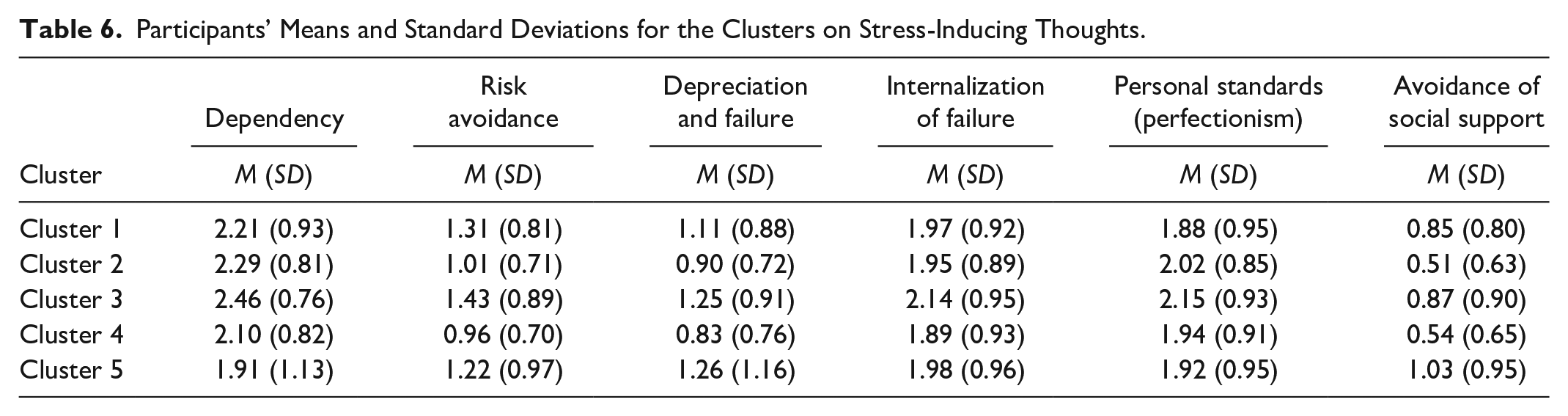
A post hoc Scheffé test was conducted as well and revealed further evidence of significant differences (at p < .05) regarding particular factors of stress-inducing thoughts in the clusters. When inspecting the above numbers, it can be seen that all five clusters followed a similar pattern across stress-inducing thoughts. The most significant differences were found regarding the factors dependency, risk avoidance, depreciation and failure, and avoidance of social support. A detailed description is given in the following section. Effect sizes between clusters (i.e., partial eta squared) reached values up to .10, which represent medium values (i.e. on the factor risk avoidance:

Distribution of the clusters across the stress-inducing thoughts.
Description of Clusters, Taking All Variables Into Account
In summary, the characteristics of the five clusters can be described as follows:
Cluster 1 included low intrinsically motivated student teachers. The first cluster (n = 449, 19%) is represented by lower values for intrinsic motives, especially for the occupational idealism motive, as compared with Clusters 2 to 4. This applies equally to addressee-related and content-related motivations. All extrinsic motives have medium values as compared with the other groups, with the exception of teaching as a second choice, which has the second-highest value. The cluster is further associated with medium levels for all factors measuring stress-inducing thoughts. The cluster consists of a high number of student teachers from Romania, as well as from Ukraine and Sweden. The number of Swiss student teachers is very low.
The student teachers in Cluster 2, a larger group with n = 744 (32%), show the highest values for all intrinsic motives. This is also the reason for them being called highly intrinsically motivated, perfectionistic student teachers in the present study. Educational work with children/youth has the highest value in comparison with all the other clusters. Moreover, flexibility in scheduling work time, an extrinsic motive related to the teaching profession, is especially pronounced. Extrinsic motives regarding a lack of alternatives are evaluated as less important. Compared with the other clusters, this group has lower values for the factors risk avoidance, depreciation and failure, and avoidance of social support, but higher levels for the remaining three dimensions, particularly with regard to personal standards (perfectionism). Student teachers from Germany and Switzerland are overrepresented in this cluster, whereas the number of future teachers from the Ukraine is very small.
Future teachers assigned to Cluster 3 are called highly extrinsically motivated, dependent student teachers. This cluster, which is small at 269 (12%) future teachers, shows values for intrinsic motives that are higher than those of most other clusters, with the exception of Group 2. All extrinsic motives are rated at a higher level: recommendation by others is evaluated as very important; the same applies for financial security and lack of alternatives. For five of the six factors measuring stress-inducing thoughts, student teachers in this cluster present the highest values. In particular, they had high mean values for the factors internalization of failure and dependency, which indicate major problems handling failure. Moreover, student teachers in this cluster seem to have a stronger fear of being blamed and therefore do not want to take any risks at all. Cluster 3 comprises student teachers from all countries, including a large number of Ukrainian prospective teachers.
The fourth cluster, a larger group of 749 (32%) student teachers, shows similar characteristics to those of the third cluster, in particular with regard to intrinsic motives with only slightly lower values. In addition, and contrary to the third cluster, it is characterized by relatively low values for extrinsic motives related to the teaching profession. Furthermore, future teachers in this cluster show the lowest values for the second dimension of extrinsic motivation, measuring the lack of alternatives. This cluster is almost the exact opposite of Cluster 3 concerning stress-inducing thoughts: this cluster shows consistently more favorable attribute levels for stress-inducing thoughts as compared with the other groups. This is why participants in this cluster are called highly intrinsically motivated, highly functional student teachers. The cluster includes many future teachers from Switzerland.
Finally, participants in Cluster 5 are described as moderately motivated, insecure, and support avoidant student teachers. Comprising 116 prospective teachers, the fifth cluster represents the smallest group. This corresponds to a percentage of only 5%. The resulting profile is different from those of all other groups with regard to motivation. It is characterized by the lowest values for the two intrinsic motive dimensions, as well as the dimension measuring extrinsic motives related to the teaching profession. Within the group of extrinsic motives related to a lack of alternatives, the score is relatively high with regard to the motive teaching as a second choice and drops to an average level for the factors lack of alternatives and recommendation by others. This cluster is characterized by the highest levels of depreciation and failure, as well as avoidance of social support. Student teachers in this cluster immediately feel responsible if something goes wrong, and they refuse to make use of social support in strenuous occupational situations. Ukrainian student teachers are overrepresented in this cluster.
Discussion
Career Choice Motives of Student Teachers
The factor analysis revealed factors that are similar to extant findings regarding those measuring intrinsic and extrinsic career choice motives (Liu, 2010; Sinclair, 2008; Watt et al., 2012; Watt & Richardson, 2007), which can be mapped onto the self-determination theory created by Deci and Ryan (2000, 2012). Findings from the cluster analysis resulted in five groups of student teachers who differ with regard to combinations of particular career choice motives. These differences are equally reflected in the relative levels of importance of intrinsic and extrinsic motives. Student teachers from different European countries are not distributed equally across all five clusters. Rather, in some clusters, a significant amount of student teachers from one particular country can be found.
Furthermore, significant differences regarding various stress-inducing thoughts are found when comparing the five clusters in this regard. In particular, dependency, depreciation and failure, and avoidance of social support differentiate the groups with effect sizes reaching up to medium levels in the post hoc tests. Taking these findings together, it can be said that each cluster is characterized by different attribute levels of motives and stress-inducing thoughts: for example, one group is characterized by the lowest levels among all career choice motives but is, at the same time, associated with a higher level of stress-inducing thoughts, such as depreciation and social withdrawal.
Through self-determination theory, created by Deci and Ryan, various motive structures were revealed in the present study. Intrinsic motivational factors included items representing experiences of competency and autonomy. Similarly, the extrinsic motives found in this study represent varying degrees of self-determination. These different motive profiles go hand in hand with diverging levels of stress-inducing thoughts (Beck et al., 1979; Brown & Beck, 2002). The differences showed a relationship between extrinsic motivational aspects and stress-inducing thoughts, further supporting existing research on the relationship between career choice motives and perceptions of stress, as well as behavior in response to stress (Baker, 2004; Lu, 1999; Reichl et al., 2014).
Occupational demands, challenges, and stress-inducing situations are subject to individual evaluation processes (Lazarus, 1993, 2006). Prospective teachers experience stress in different ways, with stress-inducing thoughts playing an important role in these processes. Specifically, they determine whether a certain stressful situation is experienced as more negative or positive and can increase stress in strenuous situations (Norberg et al., 2007). Contrary to other factors influencing stress, which are directly related to the school context, these cognitions are independent of particular environmental conditions and therefore reveal more general insight into prevention opportunities. However, it is important to keep in mind that these aspects that are specific to the particular job and work environment, such as perceived support by colleagues, perceived climate, or teachers’ professional competences, are found to further enhance the prevention of psychological ill-health (Grayson & Alvarez, 2008; Skaalvik & Skaalvik, 2009). Therefore, on a more general and basic level of attention, student teachers with higher levels of stress-inducing thoughts tend to be more vulnerable to stress and potentially negative impacts on health and work ability. Consequently, professional development should include appropriate measures for those who may have difficulties handling stressful situations. This could be applied in the context of cognitive behavioral modification (Meichenbaum, 1993, 2003), self-instruction, problem-solving skills, and appropriate coping strategies.
However, the results show the importance of taking the characteristics of particular countries into account as well when considering the abovementioned findings. When looking at the distribution of countries in the second cluster, for example, the values on the factor financial security are relatively high. Student teachers from Germany and Switzerland are represented more than participants from countries like Ukraine within this cluster. It is worth noting that the unbalanced sample limits the conclusiveness of the observed country-specific differences. Nevertheless, the findings of this study seem to be consistent with differences in the structural conditions between the observed countries. Salaries are higher in Germany and Switzerland and lower in Ukraine (Eurydice, 2017a, 2017b), but the cost of living, especially in Switzerland and also in Germany and Sweden, is substantially higher than it is in countries such as Romania and Ukraine as well. Therefore, high salary could be an incentive and a necessity to cover living expenses. Taken as a whole, it appears that structural conditions within countries seem to be connected with both career choice motives and stress-inducing thoughts. However, due to the limitations mentioned above, the precise nature of this relationship cannot be clearly derived from the results revealed in the present study and would have to be investigated in more detail in further studies.
Conclusion: Consequences for Teacher Education and Conditions of Teaching
When drawing conclusions based on the findings, two factors must be taken into consideration: first, the relevance of the country-specific working conditions of teachers (salary and occupational security) should be considered to interpret the results appropriately (Eurydice, 2016; OECD, 2005). This is in line with the discussion on teacher selection in general (Gore et al., 2016) and the negative selection controversy that is discussed in many countries (Barber & Mourshed, 2007; Denzler & Wolter, 2009; McKenzie & Santiago, 2005; Roloff Henoch et al., 2015).
The following two paragraphs discuss two exemplary issues in more detail. First, we discuss whether the salary of teachers could be one reason for negative selection, the notion that the teaching profession attracts those with less favorable characteristics. Second, we discuss groups of future teachers with certain constellations of career choice motives and particular stress-inducing thoughts, which exist across countries, which indicate the need to develop measures dealing with these difficulties.
Political issues and conditions related to certain career choice motives
First, some of the revealed differences seem to reflect country-specific working conditions and differences in professional images. The professional images of occupations can vary over time and do not have to be homogeneous (for Germany, see Enzelberger, 2007). These variations prevent the formulation of simple, monocausal links between career choice motives and national specifics, especially in terms of culture. Whereas some researchers use the term culture quite freely (Hofstede, 2001), many question the simplifications, unifications, and isms that the culturalization of national differences implicates (Dale & Robertson, 2009).
At the same time, it is well known that the working conditions and professional images of teachers can be shaped quite differently in different countries (OECD, 2006) – and the results of this study suggest that there might be a connection between them and the career choice motives of future teachers.
German and Swiss student teachers reported higher intrinsic motivation, which is associated with higher degrees of self-determination. In comparison, participants from Romania and Ukraine are more often found in clusters related to constellations of career choice motives with a low degree of self-determination. This corresponds to the comparatively high level of uncertainty avoidance in those two countries: a high level of uncertainty avoidance could, especially when combined with a comparatively high power distance, lead to people choosing options that are considered safe, predictable, or socially acceptable instead of pursuing their own interests (Hofstede Insights, 2019). Fittingly, in these two countries, recommendations by others and a lack of alternatives are of higher importance than in the other countries (Richardson & Watt, 2006, 2016; Wilhelm et al., 2000). Furthermore, this underlines the observation that their career choice processes are strongly controlled by external factors (Deci & Ryan, 2000, 2012). Moreover, it seems that due to worse occupational conditions in these countries, the teaching profession attracts a greater number of student teachers who cannot deal with difficult and stress-inducing job-related situations in an appropriate way. This result underlines a contradiction regarding a severe problem already addressed above: the assumption of a negative selection bias. In general, it seems that not those countries with good working conditions, but rather those with less favourable ones tend to suffer more from nevative selection. Salaries in the teacher profession in Romania, for example, are very low (Eurydice, 2016, 2017b).
The opposite pattern can be found in the fourth cluster, which includes a high number of prospective Swiss teachers. Compared with the situation of the Romanian and Ukrainian student teachers described above, extrinsic conditions play a less important role. This may be the case as professional conditions in Switzerland can be interpreted as very good, with a high level of income and occupational security, even when taking into account the high costs of living in this country (Eurydice, 2013, 2016; OECD, 2005). The motivational structure also reflects the fact that future teachers show a high level of perceived self-determination (Deci & Ryan, 2000, 2012). This can certainly be interpreted as a good reason for entering the profession. Self-determination allows a positive experience of competency and autonomy, which is negatively related to job dissatisfaction and attrition (Gagné & Deci, 2005). Due to good basic conditions, these future teachers are attracted by the teaching profession and seem to be prepared for difficult professional circumstances and situations. Importantly, they seem to be able to handle difficult occupational demands and failure effectively, perceive themselves to be more autonomous, and are willing to make use of others’ help, to name just a few examples.
Taking the country-specific roles of intrinsic and extrinsic motives together, further contexts need to be discussed. Intrinsic motives seem to gain (more) importance when good workplace conditions are ensured. Valuing intrinsic motives in career-decision-making might be easier when the chosen profession entails a (higher) salary: without the need to think about how to cover the living expenses, it is easier to follow intrinsic motivations. Therefore, such structural differences could help shaping the perception of professional images as well. Moreover, professional images also have a historic dimension that differs between the involved countries.
Further differences of career choice motives across countries
Second, demands and developmental tasks do not only arise from country-specific conditions. The results suggest that groups of future teachers with unfavorable constellations of career choice motives and particular stress-inducing thoughts exist across countries independently of specific country-related characteristics and conditions. This leads to the need to implement arrangements to support affected student teachers, and strengthen teacher professionalization (van den Berg, 2002). To do this, it would be helpful to target those clusters that are characterized by more unfavorable constellations, which would be Clusters 3 and 5 in the present study. This can be realized in two ways.
On one hand, particular constellations of career choice motives must be questioned. Factors that imply lower levels of intrinsic motivation could affect student teacher selection processes, potential restriction criteria for applications, and related assessments, as well as opportunities for counseling with regard to suitability or potential changes in one’s course of study. Furthermore, it would be helpful to implement measures that support student teachers’ self-reflection. In view of the scarce resources in teacher education programs and school systems, this may be a suitable way of providing advice for future teachers regarding their personal (in)congruence with their chosen future profession.
On the other hand, the results also suggest designing and implementing interventions to support student teachers with higher levels of stress-inducing thoughts, who will need help in that regard. This could, for example, be realized by implementing trainings for “at-risk students,” who display disadvantageous career-choice-motive profiles and stress-inducing thoughts. Although it is important to keep in mind that the results of the present study do not offer a definite prognosis of a given student teacher’s future success or failure as a teacher and does not consider other factors that play an important role, such as specific environmental conditions and teachers’ competences, it has been found that balanced and stable teacher personalities are related to teachers’ and students’ skills and competencies (Pulkkinen et al., 1999). Therefore, professional teacher educators must carefully weigh decisions about whether these student teachers should be closely monitored and supported through additional training elements, such as supervision or reattribution training (Beck et al., 1979).
Moreover, early practical experiences should be closely accompanied by appreciative feedback (Hattie & Timperley, 2007). However, when considering all these practical implications, the particular conditions of the individual countries must be kept in mind. This is of particular importance with regard to the possibilities for, and constraints on, change in these countries. As described above, in Ukraine, for example, such possibilities for change are very limited due to the financial situation of the profession.
Limitations and Further Research
All measurements used in the present study are exclusively of quantitative nature and, consequently, involve certain limitations. Specifically, the predefined set of items limits the range of potential aspects of the resulting constructs. Furthermore, there are some limitations regarding the sample. The participating student teachers were selected from one higher education institution per country. Thus, the study is unable to determine whether the results are influenced by factors that occur on the level of single universities. This, for example might be the case when the teacher training programs of a university attract a range of students that is not representative of the whole group of students within this country.
In addition, the difference in sample sizes across countries has to be mentioned. This applies especially, but is not limited, to the Ukraine from which only less than 100 student teachers were participating. Next to other biases, sample size affects the power of a test. Thus, small- or medium-sized effects might be harder to detect when comparing two countries with smaller sample sizes. Furthermore, a small number of participants limit the influence of a country on the construction of clusters within the cluster analysis as well: in case of country-specific differences, the clusters are therefore going to overrepresent specifics of countries with many participants.
These limiting aspects are to be considered particularly with regard to the generalizability of the presented findings. In addition, numerous additional participants from all countries, particularly from Switzerland, had to be excluded from the analyses due to missing data. Careful interpretation is therefore essential, especially when it comes to the results on Ukrainian student teachers.
This is also supported by the effect sizes revealed based on the present data set, which in some cases did not reach scores that can be interpreted as medium in size. Keeping the aspects mentioned above in mind, future research could address these limitations and fill existing gaps. Both sample and findings would be more representative if it were possible to expand the study on more universities/higher education institutions in the countries involved. As a further long-term enhancement, projects could include more countries into their analyses. In particular, comparisons with countries outside of Europe would lead to a more heterogeneous sample and more detailed insights into career choice motives and stress-inducing thoughts across countries. This might also enable researchers to gather more information about the importance of cultural backgrounds for career choice decisions.
Despite the aforementioned criticism, the present study reveals first evidence for the fact that career choice motives and stress-inducing thoughts are somehow related. Thus, these findings might be helpful for applications in programs of intervention and prevention. However, the specific nature of this relationship should be investigated in more detail in further analyses.
Footnotes
Acknowledgements
We would like to thank our colleagues Simona Sava (West University of Timișoara, Romania) and Ioana Velica (Babes-Bolyai University, Cluj-Napoca, Romania) who are in charge of the Romanian subproject and provided the Romanian data for this article.
Declaration of Conflicting Interests
The author(s) declared no potential conflicts of interest with respect to the research, authorship, and/or publication of this article.
Funding
The author(s) received no financial support for the research, authorship, and/or publication of this article.
