




Abstract
Early family relationships have been suggested to influence the development of children’s affect regulation, involving both emotion regulation and defense mechanisms. However, we lack research on the specific family predictors for these two forms of affect regulation, which have been conceptualized to differ in their functions and accessibility to consciousness. Accordingly, we examine how the (a) quality and (b) timing of family relationships during infancy predict child’s later emotion regulation and defense mechanisms. Parents (N = 703) reported autonomy and intimacy in marital and parenting relationships at the child’s ages of 2 and 12 months, and the child’s use of emotion regulation and immature and neurotic defenses at 7 to 8 years. As hypothesized, the results showed that functional early family relationships predicted children’s efficient emotion regulation, whereas dysfunctional relationships predicted reliance on defense mechanisms in middle childhood. Further, results showed a timing effect for neurotic defenses, partially confirming our hypothesis of early infancy being an especially important period for the development of defense mechanisms. The findings are discussed from the viewpoints of attachment and family dynamics, emotional self-awareness, and sense of security.
Learning to regulate emotional experiences and impulses is one of the most important developmental tasks during child’s early years. There is robust evidence that both emotion regulation (Aldao, Nolen-Hoeksema, & Schweizer, 2010) and defense mechanisms (Bond, 2004) are important for one’s mental health and socioemotional functioning. However, few empirical studies have considered emotion regulation and defense mechanisms together, probably because of their different origins in cognitive versus psychodynamic and clinical research traditions (Sala, Testa, Pons, & Molina, 2015). Furthermore, whereas substantial empirical research is available on the development of emotion regulation (e.g., Calkins & Hill, 2007; Eisenberg, Spinrad, & Eggum, 2010; Kopp & Neufeld, 2003), research on children’s defense mechanisms and their early predictors is more scarce (see Cramer, 2006). Thus, the present study aims to increase knowledge concerning the differences and similarities between early predictors of emotion regulation and defense mechanisms. We analyze how the quality of family relationships during infancy predicts children’s emotion regulation and defense mechanisms in middle childhood. We expand earlier research by considering emotion regulation and defense mechanisms together, and by testing the importance of timing of the family relationships during early and late infancy.
Emotion Regulation and Defense Mechanisms
Regulation of affective states, such as emotions, mood, stress, and motivational impulses, involves multiple processes which help to maintain, for example, goal-directed behaviors, positive mood, and sense of security (Gross & Thompson, 2007; Hart, 2014; Koole, 2009). According to Gross and Thompson, such affect regulation processes involve both emotion regulation and defense mechanisms (Gross, 1998; Gross & Thompson, 2007). Although the differences and similarities between these two are inadequately understood, emotion regulation is conceptualized to focus on managing discrete emotional states (Gross, 1998; Gross & Thompson, 2007), and defense mechanisms on managing motivational impulses and needs (Hart, 2014; Vaillant, 1995). Furthermore, whereas emotion regulation has been suggested to operate both consciously and unconsciously (Gross & Thompson, 2007; Mauss, Bunge, & Gross, 2007), defense mechanisms are thought to operate unconsciously (Cramer, 2008; Gross & Thompson, 2007; Vaillant, 1995).
Emotion regulation refers to the processes individuals use to influence which emotions they experience and when and how they experience and express them (Gross, 1998; Gross & Thompson, 2007). Voluntary emotion regulation typically occurs when an individual becomes aware of own emotional states and shapes them according to situational demands and personal goals (Gross, Richards, & John, 2006). Emotions can be regulated, for example, by attending toward less emotion-provoking aspects of the situation or by cognitively reappraising the meaning of the situation. Self-awareness of one’s own emotions fosters efficient emotion regulation, likely because this allows internal states to be better understood and modified (Herwig, Kaffenberger, Jäncke, & Brühl, 2010; Subic-Wrana et al., 2014). Interestingly, however, research suggests that emotion regulation can also occur automatically outside of awareness (Bargh, Schwader, Hailey, Dyer, & Boothby, 2012; Mauss, Bunge, & Gross, 2007). For example, Mauss, Cook, and Gross (2007) demonstrated that subliminally priming emotion regulation (by presenting words related to emotional control) helped participants to downregulate their emotional responses to anger provocation. Such automatic emotion regulation probably reflects the activation of previously learned and routinized emotion regulation strategies (Mauss, Bunge, & Gross, 2007).
Defense mechanisms modulate emotional experiences unconsciously, without being consciously accessible (Cramer & Brilliant, 2001; Gross & Thompson, 2007). They aim to maintain psychological sense of security by producing cognitive distortions and by limiting the conscious experience of negative emotions (Hart, 2014; Steiner, Araujo, & Koopman, 2001). Research suggests that defensive self-deception, involving biased attention and memory, is inherently unconscious because awareness of it would impede its effectiveness (von Hippel & Trivers, 2011). For example, conscious and deliberate attempts to suppress unwanted thoughts often result in their reappearance into consciousness (Abramowitz, Tolin, & Street, 2001), whereas unconscious and automatic repression of unwanted thoughts is more efficient (Geraerts, Dritschel, Kreplin, Miyagawa, & Waddington, 2012; Lambie & Kevin, 2003). Thus, it seems essential for defense mechanisms to fulfill their function by operating unconsciously. From developmental perspective, Cramer and Brilliant (2001) found that children’s understanding of defense mechanisms increased from 7 to 11 years. Importantly, those children who understood the defensive function of denial and projection in vignettes were less likely to use these defenses themselves. Such findings support the view that children typically rely on primitive and cognitively simple defense mechanisms (e.g., denial) during infancy and early childhood (Fraiberg, 1982), but progress toward more complex defenses (e.g., projection and identification) as their cognitive abilities and self-awareness develop in middle childhood and beyond (Cramer, 2006).
Vaillant (1971, 1995) categorized defenses according to their developmental maturity and mental complexity. Empirical studies have confirmed the existence of two to three defense dimensions among adults (e.g., Andrews, Pollock, & Stewart, 1989; Bond, 1995, 2004) and children and adolescents (Araujo, Medic, Yasnovsky, & Steiner, 2006; Steiner et al., 2001). Immature defenses produce severe cognitive distortions about self and others. For example, in projection, unacceptable emotions are attributed to emancipate from others, and in omnipotence, self is perceived superior in comparison with others. Neurotic defenses typically alter subjective experiences by dissociating emotional and cognitive mental contents. For example, in repression, a threatening thought is shut out of consciousness, and in reaction formation, it is transformed into its opposite. In contrast, mature defenses typically cause only minor cognitive distortions (Vaillant, 2000) and they have been suggested to be more conscious and deliberate (Conte & Plutchik, 1993; Cramer, 2006; Vaillant, 2000). Indeed, reliance on mature defenses has been found to associate with high emotional self-awareness and efficient emotion regulation (Besharat & Khajavi, 2013; Sala et al., 2015). As mature defenses cannot be clearly differentiated from emotion regulation, the present study focuses on immature and neurotic defenses.
According to Hart’s (2014) integrative defense theory, reliance on self-deceptive defense mechanisms is primarily motivated by sense of insecurity, characterized by experiences of vulnerability and lack of confidence about one’s ability to cope with threats. Insecurity can stem from various sources, involving attachment relationships, self-esteem, and conflicts in beliefs. In line with the theory, studies have shown reliance on defense mechanisms to increase after being rejected by an important peer among 9- to 11-year-old girls (Sandstrom & Cramer, 2003) and to associate with low emotional upset after traumatic event among 10- to 13-year-old boys (Dollinger & Cramer, 1990). Furthermore, retrospective and cross-sectional adult studies have shown reliance on immature and neurotic defenses to associate with childhood experiences of harsh parenting (Finzi-Dottan & Karu, 2006), attachment insecurity (Besharat & Khajavi, 2013), and beliefs of abandonment (Walburg & Chiaramello, 2015) and one’s own emotions being unacceptable (Sala et al., 2015). While such associations have not been studied among children, they suggest that reliance on defense mechanisms can be shaped by early social and emotional experiences.
Early Family Relationships and Development of Affect Regulation
During infancy, children rely heavily on their mothers and fathers for aid to regulate their arousal and distress (Ekas, Braungart-Rieker, Lickenbrock, Zentall, & Maxwell, 2011; Kopp & Neufeld, 2003). Sensitive and supportive caregiving facilitates children’s cognitive development, such as attention and executive skills (Bernier, Carlson, Deschênes, & Matte-Gagné, 2012; Evans & Porter, 2009), which in turn promotes efficient emotion regulation (Eisenberg et al., 2010). Furthermore, as depicted by attachment theory, sensitive caregivers foster children’s sense of security by providing emotional acceptance, expertise, and continuous support on which the child can rely on (Cassidy, 1994; Thompson & Meyer, 2007). This helps children to develop emotional awareness and effective emotion regulation with potentially long-term positive impact on later development (Dykas & Cassidy, 2011; Moutsiana et al., 2015).
In contrast, insensitive caregiving impairs children’s cognitive development and sense of security (Bernier et al., 2012; Cassidy, 1994). Children with insecure attachment style tend to either exaggerate or suppress their emotional expressions to ensure parental proximity and protection (Ainsworth, Blehar, Waters, & Wall, 1978). Attachment research suggests that insecurely attached children and adults process attachment-related information defensively, to avoid psychological pain (for a review, see Dykas & Cassidy, 2011). For example, Kirsh and Cassidy (1997) found that insecurely attached 3-year-old children showed attentional avoidance of attachment cues (e.g., mother-child drawings) and deficits in remembering threatening information (e.g., story about maternal rejection). However, to the best of our knowledge, previous studies have not examined whether insensitive caregiving predicts children’s reliance on defense mechanisms during later development.
To gain a comprehensive understanding about children’s developmental environment, it is important to broaden the focus from dyadic relationships to the wider family system (Morris, Silk, Steinberg, Myers, & Robinson, 2007; Thompson & Meyer, 2007). According to emotional security theory, children adapt their regulatory strategies to fit the quality of family relationships, involving interparental conflicts and interactions (Davies & Martin, 2013). Children may, for example, suppress or exaggerate their expression of emotional distress to defuse or avoid interparental conflicts. In line with this, infant studies have demonstrated that interparental conflicts increase children’s emotion dysregulation and attentional avoidance of stress-provoking stimuli (Crockenberg, Leerkes, & Lekka, 2007; Du Rocher Schudlich, White, Fleischhauer, & Fitzgerald, 2011). In our previous study, we found that dysfunctional family systems during infancy, involving both parental and marital subsystems, predicted both children’s attentional avoidance and attentional bias toward threats (i.e., angry facial expressions) in middle childhood (Lindblom, et al., 2015). Altogether, these studies suggest that children’s development of emotion regulation and defense mechanism is malleable by the early interpersonal experiences within the family.
Results of attachment and family studies concur with Hart’s (2014) integrative defense theory, by demonstrating that insecurity-provoking family relationships heighten children’s defensiveness, as indicated by their self-protective behaviors and information processing biases. Surprisingly, however, previous prospective studies have not examined how the quality of family relationships during infancy predicts children’s affect regulation during middle childhood or beyond. Furthermore, most research about affect regulation has focused on the quality of maternal caregiving, excluding fathers and interparental relationships. Thus, in the current prospective study, we assess the quality of children’s interactional environment at the family level, including both the parenting and the marital subsystems. Autonomy and intimacy, two of the very most basic relational dimensions (Byng-Hall, 1999), are applied to define the relationship quality in marital and parenting subsystems. In relationship with the spouse or child, autonomy refers to individuality and a sense of agency, reflecting functional family boundaries, and intimacy refers to feelings of love and sharing of emotions (Mattejat & Scholz, 1994). Low autonomy and intimacy in the marital subsystem indicate poor relationship quality and associate with interparental conflicts and verbal aggression (Gavazzi, McKenry, Jacobson, Julian, & Lohman, 2000; Rankin-Esquer, Burnett, Baucom, & Epstein, 1997), whereas low autonomy and intimacy in parenting indicate insensitive parenting and associate with overly hesitant, intrusive, and emotionally disengaged caregiving (Leung, Miller, Lumeng, Kaciroti, & Rosenblum, 2015; Sokolowski, Hans, Bernstein, & Cox, 2007).
Age-Specific Development During Infancy
Neurodevelopmental and behavioral studies suggest that sensitive periods exist in child development with potential long-term consequences on later functioning (Pechtel & Pizzagalli, 2011; Tottenham & Sheridan, 2010). As an example of sensitive period, animal studies have demonstrated that very early disruptions in maternal care can permanently alter attachment-related neural functioning and emotional learning (Rincón-Cortés & Sullivan, 2014). Furthermore, the studies of institutionalized and then adopted children suggest that the first 2 years of life are especially important for social skills (Almas et al., 2012), and the second year of life is especially important for executive functions (Merz, McCall, Wright, & Luna, 2013). However, research is lacking about the more normative social experiences within the infancy period. For example, one study found that high amount of maternal stroking at the infant’s age of 2 months was beneficial on children’s emotional well-being at the age of 2.5 years (Sharp, Hill, Hellier, & Pickles, 2015). Yet, the study did not test whether the timing of maternal stroking (e.g., early vs. late infancy) would moderate the effect. To our knowledge, only one study has explicitly tested for the existence of age-specific timing effects during infancy. The person-oriented study analyzed the course of maternal psychological distress across the pre- and postpartum period, and found that children of mothers who were symptomatic at the child’s age of 2 months (but not during the pregnancy or the child’s age of 12 months) showed increased internalizing symptoms at 7 to 8 years, compared with children of mothers who were symptomatic only at pregnancy or at the child’s age of 12 months (Vänskä et al., 2011). The results are indicative of potential age-specific effects during infancy on the development of affect regulation.
Neurodevelopmental research suggests that simple and involuntary functions, such as implicit emotional learning, develop earlier than complex and voluntarily controlled functions, such as executive skills (Pechtel & Pizzagalli, 2011). Considering the functional differences between emotion regulation and defense mechanisms, it can be hypothesized that the automatized processes related to defense mechanisms develop earlier than those of the more cognitively complex emotion regulation. Regarding defense mechanisms, it has been suggested that repression, that is, defensive exclusion of threatening thoughts from consciousness, is related to impaired memory formation and recall, involving altered amygdala and hippocampus function (Axmacher, Do Lam, Kessler, & Fell, 2010). Interestingly, developmental research suggests that the development of these brain structures is malleable to stress-induced alterations already during early infancy (Tottenham & Sheridan, 2010). Regarding emotion regulation, there is some evidence that the underlying brain structures, related to conscious monitoring of and controlling own emotions (e.g., orbitofrontal cortex and anterior cingulate gyrus), are malleable to experiences during the late infancy and later on (Moutsiana et al, 2014; Zelazo, Qu, & Kesek, 2010).
Research Tasks and Hypotheses
We examined how the quality and timing of early family relationships predict children’s later emotion regulation and defense mechanisms. Autonomy and intimacy in marital and parental family subsystems were assessed at the child’s age of 2 months and 12 months. Emotion regulation, immature defenses, and neurotic defenses were assessed when the children were 7 to 8 years old.
As our first research task, we tested a different family preconditions hypothesis that the quality of family relationships during infancy predicts children’s later emotion regulation and defense mechanisms. We hypothesized that well-functioning family relationships, involving high levels of autonomy and intimacy, would predict children’s efficient emotion regulation, and dysfunctional family relationships, involving low level of autonomy and intimacy, would predict children’s reliance on immature and neurotic defenses.
As our second research task, we tested an age-specific hypothesis that the timing of family relationship quality at the ages of 2 months and 12 months would differently predict emotion regulation and defense mechanisms. We hypothesized that relationship quality at 12 months would predict effectiveness of emotion regulation more strongly than at 2 months. Further, we hypothesized that family-relationship quality at 2 months would predict reliance on immature and neurotic defenses more strongly than at 12 months.
Child’s early characteristics, involving temperamental traits and developmental achievements, can influence the quality of early parenting (e.g., Biringen, Emde, Campos, & Appelbaum, 1995) and child’s self-regulation development (e.g., Ursache, Blair, Stifter, Voegtline, & Family Life Project Investigators, 2013). Furthermore, half of the couples participating in our sample had achieved parenthood through assisted reproductive treatment (ART). Thus, we controlled for the potentially confounding effects of the first year developmental achievements and ART status in addition to other background variables. Finally, when modeling age-specific effects, we controlled for the effects of concurrent family relationships at the age of 7 to 8 years.
Method
Participants and Procedure
The study sample consisted of 703 Finnish married or cohabitant couples. Of the participating couples, 56% had received successful ART (n = 392) and were recruited from five infertility clinics in Finland, whereas 44% were naturally conceiving couples (NC; n = 311) and were recruited at Helsinki University Central Hospital while participating in routine ultrasonographic examination. Couples with multiple pregnancies were excluded from the study sample and only women above the age of 25 years were included in the NC group. The participants provided informed consent at the beginning of the study and at T3. The ethics committees of the responsible clinics approved the study at each stage of the data collection.
The ART couples were more often primiparous (65.70%) than the NC couples (34.30%), χ2(1, N = 703) = 49.91, p < .001. In the whole sample, the education level was relatively high: 29% of the mothers and 31% of the fathers had a university-level education, 40% of the mothers and 27% of the fathers had a college-level education, 14% of the mothers and 23% of the fathers had vocational training, and 17% of the mothers and 19% of the fathers had basic education or were students. The mean age of the mothers was 33.19 years (SD = 3.73) and fathers 34.60 (SD = 4.95).
This study is based on questionnaires completed separately by mothers and fathers when their child was 2 months (T1), 12 months (T2), and 7 to 8 years (T3) of age. Response rates (at least one parent participating) were 94% at T1 (n = 656), 78% at T2 (n = 547), and 60% at T3 (n = 420). Attrition at T2 and T3 was independent of the mothers’ or fathers’ level of education, the length of their relationship, the parents’ ages, and the child’s gender. Attrition at T2 and T3 was also independent of the ART status of the mothers, but it was greater among NC (8.9%) than ART (5.4%) fathers at T2, χ2(1, N = 656) = 3.18, p = .052.
Measures
Family relationships
Family relationships were measured by the Subjective Family Picture Test (SFPT; Mattejat & Scholz, 1994) at the child’s ages of 2 months (T1), 12 months (T2), and 7 to 8 years (T3). Both parents rated the quality of four family relationships: wife-to-husband, husband-to-wife, mother-to-child, and father-to-child. These relationships were rated in terms of autonomy (four pairs of items, e.g., determined–indecisive, shy–self-assured) and emotional intimacy (four pairs of items, e.g., rejecting–loving, warm–cool) using a 7-point scale. Higher scores on autonomy indicate relational self-assurance, agency, and independence, whereas high scores on intimacy indicate emotional attachment, interest, and acceptance. To measure autonomy or intimacy in the marital subsystem and in the family subsystem, the corresponding two items were averaged across parenting relationships (mother-to-child and father-to-child) and across marital relationships (wife-to-husband and husband-to-wife) separately for both parents’ reports. This averaging was justified as there were medium-sized correlations between the items (average r = .44, ranging from .27 to .79, all p < .001). However, the correlation was small for the item determined–indecisive between mothers’ reports of wife-to-husband and husband-to-wife relationships at T3, r = .15, p < .001. The resulting variables were used as indicator variables for latent constructs of marital autonomy, marital intimacy, parental autonomy, and parental intimacy, separately for fathers’ and mothers’ reports, at T1, T2, and T3. The validity and reliability of SFPT scales have been demonstrated, for example, by large correlations (average r = .60) with other family diagnostic questionnaires, and acceptable retest reliability over 2 weeks interval (r = .77; Mattejat & Scholz, 1994).
Child’s emotion regulation
The child’s emotional self-regulation at the age of 7 to 8 years (T3) was assessed by the self-regulation subscale of the Emotion Questionnaire (EQ; Rydell, Berlin, & Bohlin, 2003). EQ consists of vignettes describing emotion-evoking situations for different emotions. For each vignette, parents estimated on a 5-point Likert scale how easily the child was able to calm down by him- or herself (1 = doesn’t apply at all, 5 = applies very well to my child). We used nine vignettes for negative emotions of anger (e.g., My child gets into a conflict with a peer), sadness (e.g., A toy is lost or broken), and fear (e.g., My child gets frightened and worried). To include more complex emotions as well, we added six vignettes for shame/guilt (e.g., My child gets caught doing something forbidden). First, items were averaged separately for each emotion of anger (three items), sadness (three items), fear (three items), and shame/guilt (six items). Second, these four variables were averaged to represent efficiency of emotion regulation separately for mothers (α = .84) and fathers (α = .93). These two variables were used as indicator variables in structural equation models. The validity and reliability of EQ has been demonstrated by showing high scores on EQ at the age of 6 years to predict low behavioral and emotional problems and prosocial behaviors at the age of 8 years, and acceptable retest reliability over 5 weeks interval (ranging from r = .74 to .97; Rydell et al., 2003).
Child’s defense mechanisms
The child’s defense mechanisms were measured at the age of 7 to 8 years (T3) with the parent version of the Response Evaluation Measure for Parents (REM-P: Steiner et al., 2001; Yasnovsky et al., 2003). REM-P is based on Vaillant’s (1971, 1995) model of defense mechanisms and is similar to the widely studied Defense Style Questionnaire (Andrews et al., 1989; Bond, 1995). However, REM-P is modified to be suitable for adolescents and children and to avoid overly pathological wording. It comprises 71 items that describe 21 defenses ranging from immature to neurotic and mature defense mechanisms, such as repression (three items; e.g., My child doesn’t show his/her true feelings), projection (three items; e.g., My child feels that s/he is always treated unfairly), and intellectualization (four items; e.g., My Child uses reason and logic, not feelings, to understand people). Both parents independently estimated the child’s typical defensive behaviors on a 5-point Likert scale (1 = totally disagree, 9 = totally agree). Although defense mechanisms are considered to operate unconsciously, their operation can be assessed through their residuals in behavior and emotional responding (Bond, 1995).
First, to obtain defense scores, 21 sum variables were computed by averaging the items representing each defense mechanism (three to four items per defense mechanism). Second, to examine the factor structure of parental reports of defense mechanisms in this age group of children, we performed exploratory factor analyses (using averaged values between the parents’ reports and the principal extraction method with oblimin rotation). The analysis yielded a three-factor solution: (a) immature defenses (22.19% variance explained; e.g., acting out, projection, displacement, omnipotence, passive aggression), (b) mature defenses (16.12%; e.g., humor, intellectualization, sublimation, reaction formation, altruism), and (c) neurotic defenses (8.17%; e.g., repression, denial, dissociation, withdrawal, suppression). Two sum variables of individual defense mechanisms had to be excluded from the analyses because of low variability (conversion) or low initial eigenvalues in factor analysis (<0.20 for somatization). Third, based on this three-factor solution, defense-style scores were computed by averaging the corresponding sum variables to represent the child’s reliance on immature defenses (five variables; mother, α = .74; father, α = .72) and neurotic defenses (six variables; mother, α = .64; father, α = .67) separately for both parents’ reports. The resulting four variables were used as indicator variables in structural equation models. Mature defenses were excluded from the main analyses because our hypotheses did not concern them. The validity of the self-report version of the questionnaire has been demonstrated, for example, by showing correlations with anxiety and psychosocial functioning among 8- to 15-year-old children (Araujo et al., 2006). However, the parent version has been previously used only in one study of 34 mothers and their 7- to 10-year-old children (Yasnovsky et al., 2003). The study showed acceptable retest reliability over 2 weeks interval (r = .81), but only modest convergence with children’s self-reports of defense mechanisms (r = .36; immature and neurotic defenses were considered as a joint factor).
Early developmental achievements
Early developmental achievements (or delays) were measured with parental reports. At child’s age of 2 months (T2), parents reported the emergence of the child’s contact smile (0 = no, 1 = yes), eye contact (0 = no, 1 = yes), and regularity of eating and sleeping rhythms (0 = no, 1 = yes). At the age of 12 months (T3), parents reported the child’s ability to walk without support (0 = no, 1 = yes), ability to stand (0 = no, 1 = yes), and regularity of sleeping rhythms (0 = no, 1 = yes). The six items were standardized and averaged to form a developmental achievement index. The reliability of this index was poor (α = .53), indicating that the developmental domains were independent of each other. Yet, to obtain a balanced assessment of developmental achievements during the first year, we decided to use this variable as a rough cumulative index (for a similar approach, see Appleyard, Egeland, van Dulmen, & Sroufe, 2005). Providing some validity for the index, we found in our previous study a highly similar index to associate negatively with birth complications and poor neonatal health (e.g., low agpar scores) (Punamäki et al., 2006).
Background variables
Background variables were child’s gender, mothers’ age, ART status, parents’ average education level (academic level, college level, vocational training, basic education/student), and number of previous children (primi- or multiparity).
Statistical Analyses
Statistical analyses were carried out using structural equation modeling with the Mplus 5 program (Muthén & Muthén, 1998-2007) using maximum likelihood estimation with robust standard errors. This estimation method handles missing data using full information maximum likelihood. The overall fit of the models was evaluated with the comparative fit index (CFI), the Tucker–Lewis index (TLI), the root mean square errors of approximation (RMSEA), and the chi-square (χ2). As a criterion of acceptable fit, we used values of >0.95 for CFI and TLI (Hu & Bentler, 1999), and <0.08 for RMSEA (Browne & Cudeck, 1993). R-squared values were reported to indicate absolute (R2) and incremental (ΔR2) variance accounted by the independent variables over and above the control variables. Benjamini-Hochberg procedure was used to protect significance levels against false positive discoveries (Benjamini & Hochberg, 1995). In all models, child’s developmental achievements and background variables were used as covariates.
The different family preconditions hypothesis was tested by regressing the latent variables of early family-relationship quality on emotion regulation and defense mechanisms. To examine whether the quality of family relationships decreased or increased the child’s efficacy of emotion regulation and reliance on the neurotic and immature defenses, regression coefficients were estimated separately for both assessments at 2 months (T1) and at 12 months (T2).
To test the age-specific hypothesis, age-specific models were built separately for each family-relationship dimension predicting children’s affect regulation, that is, emotion regulation, neurotic defenses, and immature defenses (for a conceptual depiction, see Figure 1). Two criteria, adapted from Budescu (1993), were used to compare the relative importance of family relationships at 2 months and at 12 months. The age-specific predictor is more important than another predictor if it both (a) explains a larger proportion of the dependent variable when examined without the another predictor and (b) explains a unique proportion of the dependent variable when shared variance with another predictor is taken into account. As shown in Figure 1, the concurrent effects of family relationships at the child’s age of 7 to 8 years (T3) were controlled in all age-specific models.

Conceptualization of the models used to test age-specific effects of family relationships on affect regulation.
First, we used Akaike’s information criterion (AIC; Akaike, 1973) to test which of the two age-specific models (Model T1 or Model T2 in Figure 1) explained a larger proportion of emotion regulation and neurotic and immature defenses. A difference of ≥ |2.00| in AIC was used as a rule of thumb to indicate meaningful significance in the explanatory power between the non-nested age-specific models (Burnham & Anderson, 2002). Negative values indicate greater predictive power of family relationships at 2 months (Model T1) over 12 months (Model T2). Conversely, positive values indicate greater predictive power of family relationships at 12 months (Model T2) over 2 months (Model T1).
Second, we used the Satorra-Bentler adjusted chi-square test (Δχ2; Satorra & Bentler, 2001) to test whether each of the age-specific model had unique predictive power over and above the other age-specific model. This was achieved by nested comparisons between the age-specific models (Model T1 and Model T2 in Figure 1) and the baseline model (Models T1 and T2). To test the unique contribution of 2 months over 12 months, the fit of Model T2 was tested against that of Models T1 and T2. Conversely, to test the unique contribution of family relationships quality at 12 months over 2 months, the fit of Model T1 was tested against that of Models T1 and T2. Poorer fit of the age-specific (e.g., Model T1) model compared with that of the baseline model (Models T1 and T2) indicates unique predictive power of the excluded age-specific predictor (e.g., 12 months).
Both non-nested and nested comparisons of age-specific models were based on the total fit of the models because this is not influenced by the possible problem of multicollinearity biasing individual path coefficients (e.g., Marsh, Dowson, Pietsch, & Walker, 2004). In other words, the comparisons reflect the combined total effects of both parents’ reports of family relationships.
Results
Measurement and Structural Model
Family relationships
Figures 2 to 5 present the measurement models for marital autonomy, parental autonomy, marital intimacy, and parental intimacy. All models showed good fit, and tests of longitudinal factorial invariance confirmed stability over time, indicating that the latent constructs captured identical content across T1, T2, and T3. However, we had to exclude one indicator variable (independent–dependent) due to low factor loading from models of autonomy. Tests of factorial invariance between mothers’ and fathers’ reports showed similarity in reports of parental autonomy, marital autonomy, and marital intimacy, but not in reports of parental intimacy. The lack of interparental factorial invariance for parental intimacy indicates that mothers and fathers perceived the latent concept of parental intimacy differently. In all models, error terms were correlated across time (T1-T2, T2-T3, and T1-T3) within each respondent (mother or father) to control for item-related biases. These error correlations were constrained to be the same when this did not impair the model fit.

Measurement model for mother’s and father’s reports of marital autonomy.

Measurement model for mother’s and father’s reports of parental autonomy.
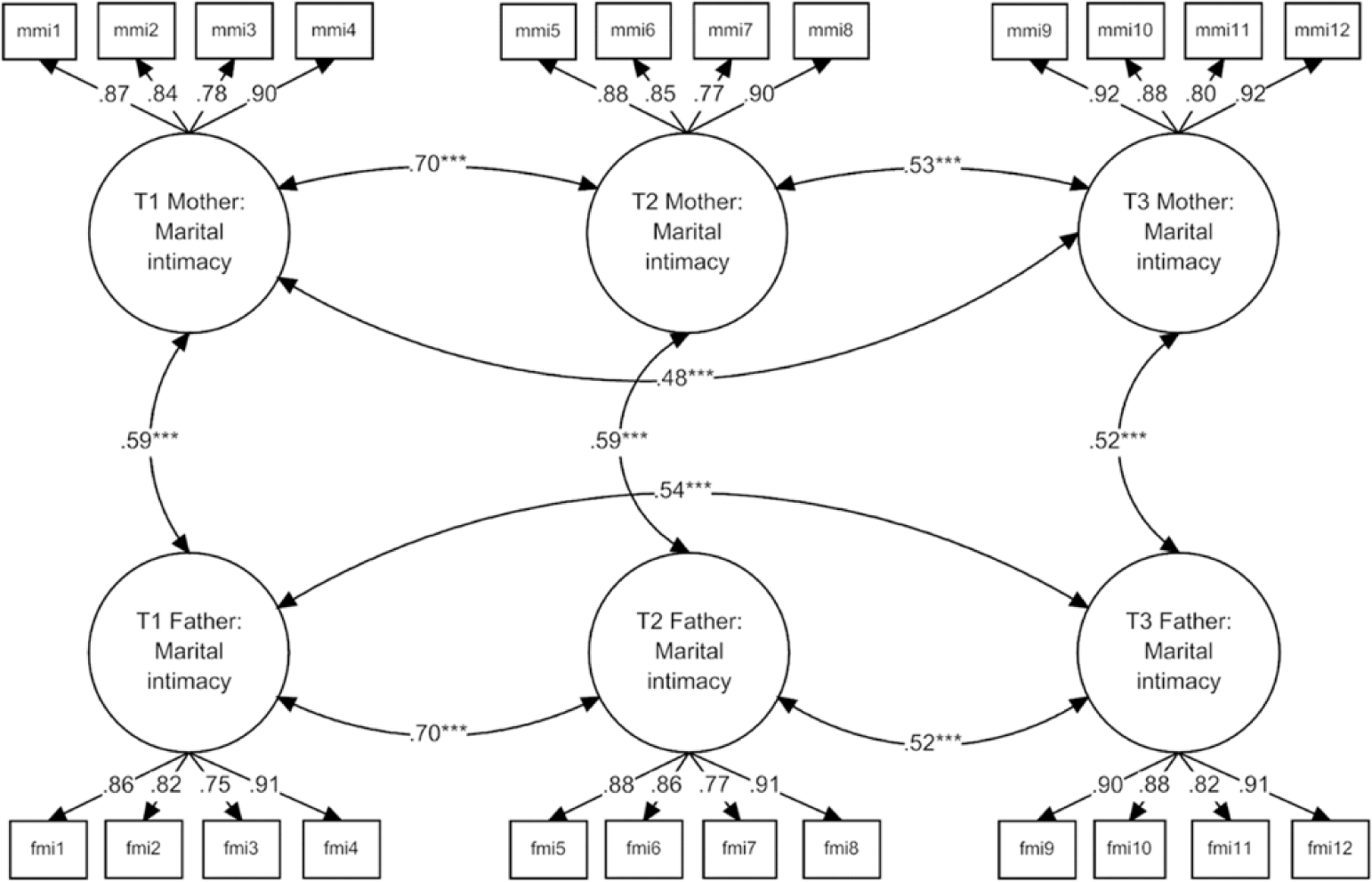
Measurement model for mother’s and father’s reports of marital intimacy.

Measurement model for mother’s and father’s reports of parental intimacy.
Affect regulation
The measurement model for the child’s emotion regulation and defense mechanisms, presented in Figure 6, showed good fit, CFI = .99; TLI = .99; RMSEA = .00, 90% CI = [.00, .08]; χ2(3) = 2.83, p = .860. Efficient emotion regulation correlated negatively with use of both neurotic, r = −.40, p < .001, and immature, r = −.71, p < .001, defenses. Only a marginally significant positive correlation was found between immature and neurotic defenses, r = .21, p = .070. There was some fluctuation of factor loadings between mothers (.54-.81) and fathers (.66-.78). Thus, to ensure in subsequent analyses that both the fathers’ and the mothers’ reports contributed equally to affect regulation variables, the factor loadings for indicator variables were fixed at one. Despite this technical restriction, the resulting model showed good fit, CFI = .99; TLI = .99; RMSEA = .02, 90% CI = [.00, .09]; χ2(3) = 3.29, p = .907, and practically replicated the correlations between emotion regulation and defense mechanisms.

Measurement model for affect regulation.
Equality of structural models between subgroups
Before testing the research hypotheses, we examined whether modeling should be done separately for the mothers’ and fathers’ reports of family relationships, separately for families with a boy or a girl as the target child, or separately for families with or without fertility treatment history (ART or NC). The similarity of the latent correlations, that is, structural equality assumption, was tested in models combining the family relationships (Figures 2-5) and affect regulation (Figure 6). In these combined models, family relationships at T1, T2, and T3 were allowed to correlate with the child’s emotion regulation, neurotic defenses, and immature defenses at T3.
Chi-square difference tests showed similar correlations between the mothers’ and fathers’ reports of family relationships and emotion regulation, neurotic defenses, and immature defenses regarding parental autonomy, χ2(9) = 12.76, p = .174; marital intimacy, χ2(9) = 10.02, p = .349; and marital autonomy, χ2(9) = 9.76, p = .371. However, the correlations differed between mothers’ and fathers’ reports of parental intimacy and emotion regulation, neurotic defenses, and immature defenses, χ2(9) = 17.06, p = .047. Thus, subsequent analyses were done separately for mothers’ and fathers’ reports of parental intimacy.
The multi-group comparison between boys and girls showed similar correlations for all family relationships and emotion regulation, neurotic defenses, and immature defenses: parental autonomy, χ2(18) = 16.64, p = .549; parental intimacy, χ2(18) = 21.99, p = .233; marital autonomy, χ2(18) = 26.06, p = .100; marital intimacy, χ2(18) = 20.74, p = .293. Furthermore, the multi-group comparison between ART and NC families showed similar correlations for all family relationships and emotion regulation, neurotic defenses, and immature defenses: parental autonomy, χ2(18) = 8.82, p = .946; parental intimacy, χ2(18) = 24.29, p = .150; marital autonomy, χ2(18) = 9.26, p = .987; marital intimacy, χ2(18) = 18.36, p = .433. Therefore, these subgroups were analyzed together in subsequent analyses.
Effects of Background Variables and Developmental Achievements
Before testing our research hypotheses, we examined the influence of background variables and early developmental achievements on affect regulation. The model showed that children from multiparous families had more efficient emotion regulation, B = −0.20, SE = 0.07, p = .006, and used fewer neurotic defenses, B = −0.20, SE = 0.07, p = .005, and fewer immature defenses, B = −0.19, SE = 0.09, p = .024, than children in primiparous families. Boys used more immature defenses than girls, B = 0.27, SE = 0.08, p = .001, and there was also a non-significant trend for boys to have poorer emotion regulation, B = 0.10, SE = 0.07, p = .054, than girls. Higher early developmental achievements predicted more efficient emotion regulation, B = −0.13, SE = 0.08, p = .001, and less use of immature defenses, B = −0.21, SE = 0.10, p = .025. These variables accounted for 7.0% of the variance for emotion regulation, 10.6% for immature defenses, and 9.1% for neurotic defenses. ART status, mothers’ age, and parents’ level of education did not predict affect regulation. The model had acceptable fit, CFI = .973; TLI = .934; RMSEA = .03, 90% CI = [.02, .05]; χ2(21) = 36.45, p = .019.
Family Relationships Predicting Emotion Regulation and Defense Mechanisms
Table 1 presents the regression coefficients for each family relationship dimension separately predicting emotion regulation and defense mechanisms. The results, for the most part, confirmed our different family preconditions hypothesis. As hypothesized, high levels of marital autonomy and parental autonomy at the child’s ages of 2 and 12 months predicted children’s efficient emotion regulation (column “Emotion regulation” in Table 1). Further, as hypothesized, low levels of marital autonomy and parental autonomy at the child’s ages of 2 and 12 months predicted children’s high reliance on neurotic defenses and immature defenses (columns “Neurotic defenses” and “Immature defenses” in Table 1). Finally, low marital intimacy at the child’s age of 12 months predicted children’s reliance on immature defenses and on neurotic defenses. Marital autonomy accounted for an average of 4% of affect regulation, parental autonomy accounted for an average of 6% of affect regulation, and marital intimacy accounted for an average of 2% of affect regulation over and above children’s developmental achievements and background variables.
Family Relationships at 2 Months (T1) and 12 Months (T2) Predicting Children’s Affect Regulation at the Age of 7 to 8 Years (T3).

Note. Δr2 = incremental change in r2 over and above the early developmental achievements and background variables. Coefficients are constrained to be the same between mothers’ and fathers’ reports, except for parental intimacy. Asterisks in parentheses refer to non-significance after the Benjamini-Hochberg correction (p > .0266). The models showed acceptable fit, CFI = 0.942-0.967; TLI = 0.932-0.959; RMSEA = 0.03-0.03, 90% CI = [0.02, 0.04]; χ2(341-530) = 482.92-849.92, all ps < .001. T = time; CFI = comparative fit index; TLI = Tucker–Lewis index; RMSEA = root mean square errors of approximation; CI = confidence interval.
p < .05. **p < .01. ***p < .001.
Table 1 (rows with “Parental intimacy”) presents the regression coefficients for parental intimacy, analyzed separately for mothers’ and fathers’ reports because initial analyses indicated structural inequality between the parents’ reports. In line with our hypotheses, father’s reports of low parental intimacy at the child’s age of 12 months predicted reliance on immature defenses (accounting for 4% of the variance over and above the control variables). However, against our hypothesis, mothers’ or fathers’ reports of parental intimacy at the child’s age of 2 months did not predict emotion regulation, neurotic defenses, or immature defenses.
Age Specificity in Family Relationships Predicting Emotion Regulation and Defense Mechanisms
Table 2 shows the results of non-nested and nested comparisons to determine the relative importance of family relationships at the child’s ages of 2 months and 12 months in predicting emotion regulation and defense mechanisms (for a conceptual depiction, see Figure 1). In all age-specific models, we controlled for the effects of concurrent family relationships at the age of 7 to 8 years (T3), children’s developmental achievements, and background variables.
Comparisons Between Age-Specific Models of Family Relationships at 2 Months (T1) and 12 Months (T2) Predicting Children’s Affect Regulation at the Age of 7 to 8 Years (T3).

Note. All models involve early developmental achievements, background variables, and the corresponding family relationships at the child’s age of 7 to 8 years (T3) as covariates. ΔAIC = difference in (truncated) AIC between non-nested models (T1 vs. T2). Bolded positive values (≥2.00) indicate greater predictive power of T2 over T1, whereas bolded negative values (≤−2.00) indicate greater predictive power of T1 over T2. Δχ2 = difference of chi-square (df = 1) between nested models (T1 vs. T1 and T2; T2 vs. T1 and T2). Significant results indicate unique contribution of the time point (T1 or T2) over the other time point. Asterisks in parentheses refer to non-significance after the Benjamini-Hochberg correction (p > .0083). T = time; AIC = Akaike’s information criterion
p < .05. **p < .01. ***p < .001.
The results confirmed the age-specific hypothesis only regarding neurotic defenses (column “Neurotic defenses” in Table 2). Non-nested comparisons showed that parental autonomy at 2 months (T1) explained a larger proportion of neurotic defenses, ΔAIC = –6.42, than parental autonomy at 12 months (T2). Further, nested comparisons showed that parental autonomy at 2 months (T1) explained a unique proportion of neurotic defenses, Δχ2 = 15.52, p < .001, over parental autonomy at 12 months (T2) and 7 to 8 years (T3). Thus, we concluded that parental autonomy at the age of 2 months was more important predictor of children’s reliance on neurotic defenses than parental autonomy at the age of 12 months.
Against our hypotheses, non-nested comparisons suggested that both marital autonomy, ΔAIC = 6.38, and marital intimacy, ΔAIC = 8.73, at 12 months (T2) would explain a larger proportion of neurotic defenses than at 2 months (T1). However, after considering the Benjamini-Hochberg correction (with the critical p value of .0083), marital autonomy, Δχ2 = 8.72, p = .013, and marital intimacy, Δχ2 = 9.39, p = .009, at 12 months (T2) did not explain statistically significant unique proportion of neurotic defenses over corresponding marital relationships at 2 months (T1) and 7 to 8 years (T3). Thus, we concluded no age-specific effects for marital autonomy and marital intimacy.
Against our hypotheses, the results did not provide support for the age-specific hypothesis regarding emotion regulation (column “Emotion regulation” in Table 2). Although non-nested comparisons showed that marital autonomy at 12 months (T2) explained a larger proportion of emotion regulation, ΔAIC = 3.11, than marital autonomy at 2 months (T1); the nested comparisons showed that marital autonomy at 12 months (T2) explained only a non-significant unique proportion of emotion regulation, Δχ2 = 4.93, p = .085, over marital autonomy at 2 months (T1) and 7 to 8 years (T3).
Against our hypotheses, the results did not support the age-specific hypothesis regarding immature defenses (column “Immature defenses” in Table 2). All results of non-nested (ΔAIC ranging from 0.53 to 1.60) and nested (Δχ2 ranging from 0.20 to 3.62, all p > .164) comparisons were non-significant, indicating that there was no age-specificity in how family relationships predicted immature defenses.
Age-specific tests were run separately for mothers’ and fathers’ reports of parental intimacy because initial analyses indicated structural inequality between the parent’s reports. Against our hypotheses, all results of non-nested (ΔAIC ranging from −0.97 to 1.98) and nested (Δχ2 ranging from 0.02 to 2.01, all p > .157) comparisons were non-significant. Thus, we concluded no age-specific effects of parental intimacy in predicting emotion regulation, neurotic defenses, or immature defenses.
Discussion
Research considering both emotion regulation and defense mechanisms is scarce, and there are no previous studies on the early predictors of children’s defense mechanisms. Thus, the current study is novel in analyzing the early family preconditions of children’s emotion regulation and neurotic and immature defenses in middle childhood, as well as in testing for age-specific timing effects during infancy. The results provided support for the different family preconditions hypothesis, by showing that well-functioning family relationships predicted children’s efficient emotion regulation and dysfunctional family relationships predicted children’s reliance on defense mechanisms. However, the results showed only limited support for the age-specific hypothesis. Parental autonomy at the child’s age of 2 months was a more important predictor of children’s reliance on neurotic defenses than parental autonomy at the age of 12 months. Against to our hypothesis, no age-specific effects during infancy were found for emotion regulation or immature defenses.
The different family preconditions hypothesis was valid for parenting and marital subsystems. High autonomy in the parenting subsystem predicted children’s efficient emotion regulation, whereas low autonomy predicted children’s reliance on neurotic and immature defenses. These results are in line with attachment research, which has demonstrated the importance of early caregiving quality for children’s emotion regulation and attachment-related regulatory strategies (e.g., Calkins & Hill, 2007). It is noteworthy, however, that our study is the first to prospectively show that parental autonomy during the first year predicts children’s emotion regulation and defense mechanisms in middle childhood. When interacting with their infants, autonomous parents are likely to show emotional acceptance and be skillful in supporting their infant’s emotion regulation development. Parents with low sense of autonomy, in turn, can be fearful or intrusive in their interactions, forcing the infant to defensively regulate their own experiences and expressions (Beebe, Lachmann, Markese, & Bahrick, 2012; Lyons-Ruth, 1999). It is possible that the infant’s early interpersonal strategies form the basis for later reliance on immature and neurotic defenses, involving distorted mental representations of self and others, and limited conscious awareness of one’s own interpersonal needs.
Our findings further confirmed that problems in the marital subsystem, indicated by low marital autonomy, and to some extent also by low marital intimacy, predicted children’s inefficient emotion regulation and reliance on neurotic and immature defenses. These results are in line with the emotional security theory (Davies & Martin, 2013), which proposes that children develop unique strategies to maintain sense of security in the context of interparental relationship. Low marital autonomy likely indicates conflictual interparental interactions, involving heightened verbal aggression and expressions of negative emotions (Gavazzi et al., 2000). In line with this, previous studies have found that exposure to marital disagreements increase infant’s avoidance behaviors and emotional expressiveness (Crockenberg et al., 2007; Du Rocher Schudlich et al., 2011), presumably to either avoid or defuse interparental conflicts (Davies & Martin, 2013). It is possible that infant’s exposure to conflictual interparental interactions hinders children’s sense of security, which hinders children’s emotion regulation development and heightens reliance on defense mechanisms.
It is important, however, also to consider the potential family dynamic mechanisms which could explain the significance of the marital subsystem on children’s later affect regulation. According to family systems perspective, problems in the marital subsystem can spillover into the parenting subsystem and thereby influence children (Stroud, Durbin, Wilson, & Mendelsohn, 2011), although the marital subsystem has at least some unique contribution over the parenting subsystem (Crockenberg et al., 2007; Finger, Hans, Bernstein, & Cox, 2009). Thus, it is possible that in our study, to some extent, the effects of marital problems on children’s emotion regulation and defense mechanisms were mediated through the quality of parenting. Family dynamic mechanism could also help explain why only fathers’, but not mothers’, reports of parental intimacy predicted children’s reliance on neurotic defenses. Marital satisfaction is known to decrease during the transition to parenthood (Doss, Rhoades, Stanley, & Markman, 2009) and fathers are more prone than mothers to withdraw from parenting when experiencing marital dissatisfaction (Elliston, McHale, Talbot, Parmley, & Kuersten-Hogan, 2008). Thus, it is possible that fathers’ perceptions of parenting were especially susceptible for the negative spillover from the marital subsystem.
In our previous study, we found that children from disengaged families, characterized by low emotional intimacy during infancy, showed attentional avoidance of threat (i.e., angry facial expression), whereas children from enmeshed families, characterized by low autonomy, showed attentional bias toward threat at the age of 10 years (Lindblom et al., 2015). Such attentional processes, developing already during infancy (Hoehl, 2014), could be one mediating link between early family experiences and later emotion regulation and reliance on defense mechanisms. Further longitudinal studies are needed, however, to test such mediating processes. As an alternative hypothesis, it should also be considered whether children’s sense of insecurity, rather than early regulatory processes, account for the effects of early family relationships on children’s later affect regulation.
The results largely disconfirmed our age-specific hypothesis in that we found age-specific effect within the first year only for neurotic defenses, but not for emotion regulation or immature defenses. We find the lack of age-specific effects intriguing, because developmental research suggests existence of sensitive periods (Pechtel & Pizzagalli, 2011) and infancy is considered to be especially important period for emotional development (Bernier et al., 2012; Sharp, Hill, Hellier, & Pickles, 2015). However, our study is one of the first to stringently test for the existence of age-specific effects within infancy (i.e., 2 months vs. 12 months) on later development. The lack of age-specific results likely indicates high plasticity in the development of emotion regulation and immature defenses after infancy. Indeed, studies focusing on older children suggest a sensitive period for executive functions during preschool-age (Zelazo et al., 2010), and a potentially sensitive period for immature defenses, such as projection, during middle childhood (Cramer, 2006). Even as the quality of the early family relationships is undeniably important for infant’s well-being, its age-specific effects on children’s later emotion regulation and immature defenses seem to be negligible in our normative sample.
Interestingly, however, in line with the age-specific hypothesis, low autonomy in the parenting subsystem at the age of 2 months was an especially important predictor of children’s reliance on neurotic defenses in middle childhood. It is tempting to speculate about the underlying psychological and neural mechanisms. Neurotic defenses, such as repression and reaction formation, are characterized by limited awareness of threat provoking thoughts and unacceptable emotions. Research suggests that early development of emotional self-awareness takes place within sensitive and well-attuned dyadic interactions, which provide the infant feedback about his/her own emotional states (Beebe et al., 2012; Gergely & Watson, 1996). In line with this, psychodynamic theory suggests that infants’ symbolic representations of their own emotional needs are left “underdeveloped” with insensitive and rejecting caregivers, making them difficult to be consciously reflected later on (Lyons-Ruth, 1999). Such a dyadic process could explain the importance of early parental autonomy on children’s later reliance on neurotic defenses.
Furthermore, in an integrative model of the neural basis of defensiveness, Axmacher et al. (2010) suggested that repression is related to disruptions in declarative memory function. Excessive amygdala activation disrupts declarative memory function in the hippocampus that can prevent the integration of threatening experiences in the autobiographical memory. Consequently, reminiscent of the operation of neurotic defenses, the memories about threatening events may be consciously accessible but lack the component of self-referral. Interestingly, studies suggest that early experiences of excessive stress, such as harsh parenting, can produce alterations in infant’s hormonal stress regulation, with consequences on amygdala volume (Moutsiana et al., 2015; Pechtel & Pizzagalli, 2011) and memory function in the hippocampus (Tottenham & Sheridan, 2010). It is possible that such neural and endocrinal alterations during early infancy could underlie children’s later reliance on neurotic defenses. Naturally, further studies are needed to test the hypothesized roles of dyadic and neural processes underlying children’s reliance on neurotic defenses.
In general, we found that highly functional family relationships during infancy predicted children’s efficient emotion regulation and less reliance on neurotic and immature defenses. In line with Gross and Thompson (2007), we conceptualized emotion regulation and defense mechanisms as separate affect regulation processes, but they have also been suggested to present the opposite ends of the same dimension (e.g., adaptive–maladaptive regulation; Sala et al., 2015). In line with this view, we found that the early family predictors of emotion regulation and immature and neurotic defenses were highly similar, despite the effects being in the opposite direction. One expectation for this was, however, the finding about the importance of very early parental parenting autonomy on neurotic defenses, but not on emotion regulation. Although this age-specific finding warrants replication, it is noteworthy that the effect was found even after controlling for multiple comparisons and the concurrent parental autonomy in middle childhood. To better understand the differences and similarities between emotion regulation and defense mechanisms, further studies may need to more directly compare their cognitive and psychodynamic processes (e.g., attention, memory, self-awareness, and motivational factors).
Limitations of the Study
Our study has several limitations. First, the modeling of family relationships was based only on three measurement assessments. This warrants the definite conclusions made about the absolute timing of age-specific effects, in that, for example, the assessment at child’s age of 12 months may reflect the later ongoing family relationships in early childhood. Further studies should involve more assessment points within the infancy.
Second, our relatively large sample was based on questionnaires and might have been susceptible to reporter bias. The Response Evaluation Measure has been found to be valid in assessing defense mechanisms based on children’s self-reports (Araujo et al., 2006), but only one previous study has used the parent version of the questionnaire (Yasnovsky et al., 2003). It is not completely clear to what extent parents can reliably report their children’s defense mechanisms. However, supporting the validity of the parent version questionnaire, our measurement model showed that mothers’ and father’s reports adequately captured the same latent constructs. Yet, more studies are needed to further validate the parent version of the questionnaire.
Furthermore, mothers’ and fathers’ reports regarding some family relationships did not correlate significantly. Such inconsistencies are relatively common in family research, suggesting that parents may have equally valid but unique perspectives on family relationships (e.g., Driscoll & Pianta, 2011). Indeed, we confirmed the validity of parents’ reports by demonstrating (a) similar associations between parents’ reports of family relationships and children’s affect regulation and (b) similar structure of the latent family relationship constructs between the parents, with the exception of parental intimacy. However, observational methods might have yielded more reliable information about family relationships, as well as children defense mechanisms.
Third, it is possible that some child characteristics (e.g., infant’s temperament traits) influenced both family relationships during infancy and children’s affect regulation in middle childhood. To control for such bias, we controlled for the effects of children’s developmental achievements, such as social contact and regularity of sleep patterns. Ideally, however, the models should take into account the more complex and continuous bidirectional influences between family relationships and infant characteristics.
Finally, although the results were theoretically meaningful, it is important to note that their effect sizes were small. This may be because of the families in our sample were relatively low-risk families, and also because of the relatively long follow-up period. Further studies with more heterogeneous samples are needed to replicate our results.
Conclusions
To the best of our knowledge, our study is the first long-term study to examine age-specific effects of family relationships within infancy on children’s affect regulation, involving both emotion regulation and defense mechanisms. In line with the attachment (Thompson & Meyer, 2007) and emotional security (Davies & Martin, 2013) theories, our findings support the notion that both parental and marital relationships contribute to children’s ways of modulating their emotional experiences and interpersonal needs. Furthermore, in line with Hart’s (2014) integrative defense theory, our results suggest that children may develop reliance on self-deceptive defense mechanisms to cope with the insecurity stemming from early dysfunctional family relationships. This may help to understand the role of defense mechanisms mediating between early adversity and later mental health, as previously suggested by retrospective adult studies (e.g., Finzi-Dottan & Karu, 2006). Finally, our finding about the importance of very early parental autonomy on children’s later neurotic defenses was novel. To better understand this tentative finding, further studies are needed to look for potential sensitive periods during early infancy and to test the hypothesized neurocognitive and psychodynamic pathways.
Footnotes
Declaration of Conflicting Interests
The author(s) declared no potential conflicts of interest with respect to the research, authorship, and/or publication of this article.
Funding
The author(s) disclosed receipt of the following financial support for the research and/or authorship of this article: This study was supported in part by grants from the Academy of Finland (11232276), Alfred Kordelin Foundation, Emil Aaltonen Foundation, Finnish Child Psychiatry Research Foundation, Finnish Cultural Foundation, Oskar Öflunds Stiftelse, and University of Tampere.