




Abstract
This article discusses the first development of communicative interaction between mother and child, by analyzing the connection between expression and smile. A total of 13 mother–child dyads, recruited at the moment of admission to hospital, participated in the study. Observations have been made when the children were 3, 6, and 9 months old. Mother and child were put in front of each other, and the mother was asked to play freely with her child using a set of toys. The sequential codification of the mother’s and the child’s behaviors (occurrence and duration) was encoded by two independent observers. Occurrences and durations were analyzed to verify the increase of the interactive dyadic exchange along the three follow-ups. The results highlight an increase in synchronic behaviors in the dyad as the child’s age increases, showing the circularity of the dyadic interaction: Mothers increase the occurrences of contingent responses and children increase their competences regarding emotional regulations.
Introduction
The processes of emotional regulation that characterize the interaction between mother and child in the first year of life are fundamental elements in determining the competences of emotional regulation of the child (Beebe & Lachmann, 2002; Lowe et al., 2012), and in the guidance of the socioemotional and relationship development (Sroufe, 1995; Sroufe, Egeland, Carlson, & Collins, 2005; Webb, Schweiger Gallo, Miles, Gollwitzer, & Sheeran, 2012). From birth, the child uses sensorial and motor behaviors (sucking, crying, smiling) to get in contact with the people who take care of him (Evans & Porter, 2009; Gustafsson et al., 2015; Marcone, 2007; Marcone et al., 2004; Tenuta, Costabile, Marcone, Corchia, & Lombardi, 2008). A newly born child’s attentive abilities can become increasingly specific, responding selectively to stimulations.
Various studies have shown that in the first few days of life, the child recognizes her or his mother’s voice and its rhythmic characteristics (Sansavini, Bertoncini, & Giovanelli, 1997; Van Puyvelde et al., 2010); turns toward the human face, preferably her or his mother’s (Johnson, Dziurawiec, Ellis, & Morton, 1991; Simion, Valenza, Umiltà, & Dalla Barba, 1998); and imitates facial and vocal expressions (Meltzoff & Moore, 1977). Social interactions between the child and the caretaker facilitate children’s social competence. Stern (1985) defines such emotional interactions as a “reflection” or “empathic correspondence” of the caregiver toward the children’s expressions of affection. In general, mothers are able to pick up on the needs of the child, to adapt to them by stimulating them and considering the age and the degree of involvement in the interaction (Bornstein, Haynes, O’Reilly, & Painter, 1996; Leclère et al., 2014; Licata et al., 2014; Venuti, Gnisci, Marcone, & Senese, 2001). In this early phase, one can speak of “synchrony” when the mother is able to negotiate the relationship with behaviors focused on respecting and adjusting the other’s time (Gratier, 2003; Im-Bolter, Anam, & Cohen, 2015; Jaffe, Beebe, Feldstein, Crown, Jasnow, Rochat, & Stern, 2001; Malloch, 2000; Miall & Dissanayake, 2003). Particularly, by following the child’s activities, the mother tries to get involved not only by following and keeping up with said activities but also by intervening at moments of quiet to stimulate him, without causing breaks in the rhythmic alternation of turn-taking. The mother analyzes the attention of the child, she elaborates on it and makes it the center of a new sequence of interactions (Leclère et al., 2014; Schaffer & Crook, 1978; Stern, 1985; Venuti, 2001). In the first few months of life, besides having a huge communicative function, the emotional expressions have a socioemotional meaning (DiCarlo, Onwujuba, & Baumgartner, 2014; Izard et al., 2001). This is proven by attachment relationships (Evans & Porter, 2009; Steele, Steele, & Croft, 2008), in nonverbal communication (Hall & Bernieri, 2001; Miller & Lossia, 2013) and, later, in the empathic characteristics of anticipating the other’s behavior (Eggum et al., 2011).
The second month of life represents a fundamental transition in the child’s development, where first occurrences of face-to-face communications between the mother and the child are observed, and between those, a system of regulation is created, distinguished by tuning processes with coordinated and noncoordinated emotional conditions (Sravish, Tronick, Hollenstein, & Beeghly, 2013; Tronick & Weinberg, 1997). The “tuning” reflects the role of emotions in communications and can be used to share emotions with another person, show empathy, imitate, or respond in a contingent way. Trevarthen (1979) and Bruner (1999) define this mutual awareness as “primary intersubjectivity,” and they argue that intersubjectivity is a necessary precursor for further more complex bonds, when the children start to share and turn their attention to objects and external situations, in the communicative dyad.
After the second month of life, emotional expressions become increasingly complex and better coordinated (Sroufe, 1995). The child’s coordination, in turning his view toward the mother’s face and then to an object, is fundamental in the intentional communicative development (Adamson & Bakeman, 1985; Jones & Hong, 2001; Messinger & Fogel, 1998). During the dyadic interaction, mother and child have mutual adjustments of their points of view, their respectives postures, their way of playing, creating what Fogel and his colleagues (1997) define as co-regulation: both partners are active subjects in a mutual influence. After 3 to 4 months, communication between the child and the mother changes in a considerable way. Between the first 4 to 9 months of life, social and emotional competences necessary for triadic relationships quickly develop (Striano & Bertin, 2005; Yato et al., 2008). The quality of the mother–child relationship and the type of maternal interaction are extremely important during this period (Haley & Stansbury, 2003; Little & Carter, 2005). The child starts to gain interest in objects and starts to develop an interest in interpersonal play, sharing with the mother the attention toward objects (Gustafsson et al., 2015; Legerstee & Barillas, 2003; Salley et al., 2016). Between the ages of 8 and 12 months, children become more intentionally communicative (Mundy & Willoughby, 1996). Messinger and Fogel (1998) found that gazes at mother and smiles tended to co-occur when infants offered objects to mother. If previously, in the context of playing with objects, it was the mother that tuned into the emotional experience of the child, between 9 and 12 months, frequent episodes of tuning can be observed that are triggered by that child itself. Some authors (DiCarlo et al., 2014; Messinger et al., 2013; Venezia, Messinger, Thorp, & Mundy, 2004) have analyzed the communication of positive affection compared with the experience with objects, and have noticed that the child, from 8 to 10 and 12 months, tends to significantly increase the behavioral sequence “smiles-looks at object, then looks toward the face of the adult, maintaining the smile.”
The aim is to look into the communicative changes in the face-to-face mother–child dyadic interaction analyzing the relationship between the direction of the eyes and the smile. Observations have been made when the children were 3, 6, and 9 months old. The dyadic mother–child interaction during a free play session was video-recorded and coded through a sequential coding system (Bakeman & Quera, 2011). Occurrences and durations of target mother’s and child’s behaviors were acquired.
The main goal is to control and demonstrate how a child’s behaviors can be supported by maternal behavior during the change from primary to secondary intersubjectivity, verifying the development of certain communicative competences as the child’s age increases. The second aim is to identify specific behavioral sequences elicited by child during the dyadic interaction to determine whether these sequences increase with age. To this end, two macrocategories of behavioral sequences were individuated: (a) “The child looks at the object, looks at the mother, and smiles” and (b) “the child looks at the object, looks at the mother, and does not smile.”
Method
Participants
Thirteen mothers (out of which eight were primigravida) are on average 30.85 years old (SD = 3.05; Min = 26; Max = 35). The average socioeconomic level of the 13 families (socioeconomic status [SES]; Hollingshead, 1975) is at a higher level than the Italian sample (M = 56.15; SD = 11.07) (Venuti & Senese, 2007).
The 13 children (male = 8; 61.5%) have all been born on time (average gestational age = 39.61 weeks; SD = 1.12; Min = 38; Max = 41), with an average weight at birth of 3.211 kg (SD = .412; Min = 2.55; Max = 4) and without perinatal and postnatal consequences.
The 13 dyads were recruited at the moment of first admission to the hospital. All mothers have signed an informed consent for participation in the study and for the use of their data; later, the same mothers have been contacted by phone with additional explanations and to date for their appointment. Participants’ recruitment and testing were in conformity with the local Ethics Committee requirements and with the Declaration of Helsinki, 2008.
Procedure and Materials
Concealed observations (a one-way mirror) have been made and video-recorded in a laboratory, each lasting 5 min. The dyads have been observed at the Socio-Psycho-Pedagogic Laboratory of the Department of Languages and Educational Studies at the University of Calabria (Italy). The laboratory was designedly obscured with curtains to avoid any potential visual distractions. The structure of the environment included the presence of a set of toys suited to the age of the child: (a) a soft, colorful ball; (b) a small bucket; (c) a small music keyboard; and (d) two colorful cuddly toys. The mother was asked to put the child in a highchair, preprepared with a large playing surface, and then to sit on a stool in front of the child. Then, the mother was asked to play freely with her child, using the provided set of toys.
The recorded video material was transcribed and encoded by two previously trained independent observers. The observers were trained in the coding system through video recordings, previously encoded by an expert. The reliability of the two independent encoders was measured through Cohen’s (1960) kappa; particularly, after having performed a time sampling codification, a sequential Cohen’s kappa was calculated, (Gnisci & Bakeman, 2000) adjusted to ±1 s, to obtain a temporal measurement of the level of agreement. The kappa index resulted in an average of over .60, guaranteeing the accuracy of the observers both on the exact interpretation of the code regarding the observed behaviors, and on the precision of coding at the right time, the beginning and the end of the single interactive sessions, with a maximum difference of 1 s (Bakeman & Gottman, 1997).
The coding scheme (Table 1) used focuses on the concept of co-occurrence and dyadic synchrony during a playing session. In two different moments, the mother’s and the child’s behaviors were recorded through an event and time sampling sequential codification that evaluates occurrences and duration indexes. The play sequences obtained were represented with two streams of parallel events. The sequential data file was processed through the computer program of sequential analysis Generalized Sequential Querier (GSEQ) (Bakeman & Quera, 1992, 1995, 2011).
Encoding Scheme Behaviors of Mother and Child.

Note. For all behaviors, occurrences were measured, for some, the duration (t).
The encoding scheme includes categories such as (a) look (at child / at mother); (b) smiling (at child / at mother); (c) handling/looks at target toy; (d) maternal/child initiative; shared attention; (e) touch the child (only mother) (see again Table 1).
Moreover, an additional coding of the sequential behavior of the child was performed, creating two behavioral macrocategories given by the action sequences:
Looks at object → looks at mother → does not smile
Looks at object → looks at mother → smiles
The sequential actions of these two macrocategories have been recorded at 3, 6, and 9 months.
Data Analysis
Descriptive statistical analyses have been performed on the mother’s and the child’s target behaviors at 3, 6, and 9 months of age.
Subsequently, to verify the factor “Growth,” separate ANOVAs for repeated measurements have been performed, with “Growth” (3, 6, and 9 months) as Independent Variable, and Child’s and Mother’s behaviors were the Dependent Variable (look; smiling; handling/looks at target toy; maternal/child initiative; shared attention; touch the child), both for the occurrences and for the durations (see again Table 1).
To highlight the trend of the dyads’ interactive exchange, a Pearson’s r correlation coefficient was calculated between the maternal and the child’s behaviors, for both the occurrences and the durations at all three age stages.
In the end, to evaluate the evolution of the behavior of the smile from the child toward the maternal face, various chi-square tests were performed on the two sequential macrocategories, “looks at object, looks at mother, does not smile” and “looks at object, looks at mother, smiles,” on the three observed age stages (3, 6, and 9 months).
Results
Results relative to descriptive statistics (average, standard deviation, and standard error) of target behavioral occurrences of the mother and the child (Table 2) in the three different observations (3, 6, and 9 months) are depicted in the table. For the categories: looking, smiling, and handling of the target object, the descriptive statistics of the duration of the behaviors in seconds have been added.
Mean, Standard Deviation, and Standard Error of Occurrences and Duration (t) of Maternal and Child’s Behaviors at 3, 6, and 9 Months.

Note. (t) = time in seconds.
As mentioned above, separate ANOVAs for repeated measurements have been performed, one for each target behavior, both for the maternal and children’s behaviors. To facilitate the evaluation, the results have been presented and discussed separately: (a) Coding of maternal behaviors and (b) Coding of the child’s behaviors.
Coding of the Mother’s Behaviors
The results of the ANOVA for repeated measurements (I.V.: “Growth”: 3, 6, and 9 months) conducted on maternal behavior of “turning one’s eyes toward the child’s face” show a significant increase in occurrences, F(2, 24) = 21.628; p < .001, and of the average duration for each occurrence, F(2, 24) = 4.29; p < .05, with the aging of the child, emphasizing both a quantitative increase in that behavior and also in the maintaining of the look with the eyes. At the same time, the amount of smiles that the mother gives to the child as she looks at it increases along with the increasing age of the child, F(2, 24) = 11.213; p < .001, even though the average duration of each occurrence remains stable, F(2, 24) = 1.769, ns. An additional, significant difference shows in the occurrence of the behavior shared attention, F(2, 24) = 5.443; p < .05; as the child ages, episodes of alternating looks between the mother and the child and the object increase significantly. On the contrary, a significant decrease in the behavior touching the child, F(2, 24) = 8.100; p < .01, can be measured. No significant differences are measured between the behaviors handling of the toy—occurrences, F(2, 24) = .666, ns; time, F(2, 24) = 1.318, ns—and maternal initiative—F(2, 24) = 3.224, ns—emphasizing that these behaviors remain stable from 3 to 9 months of age.
The analysis of the post hoc performed through the Scheffé test shows additional and even more interesting aspects (Figure 1):
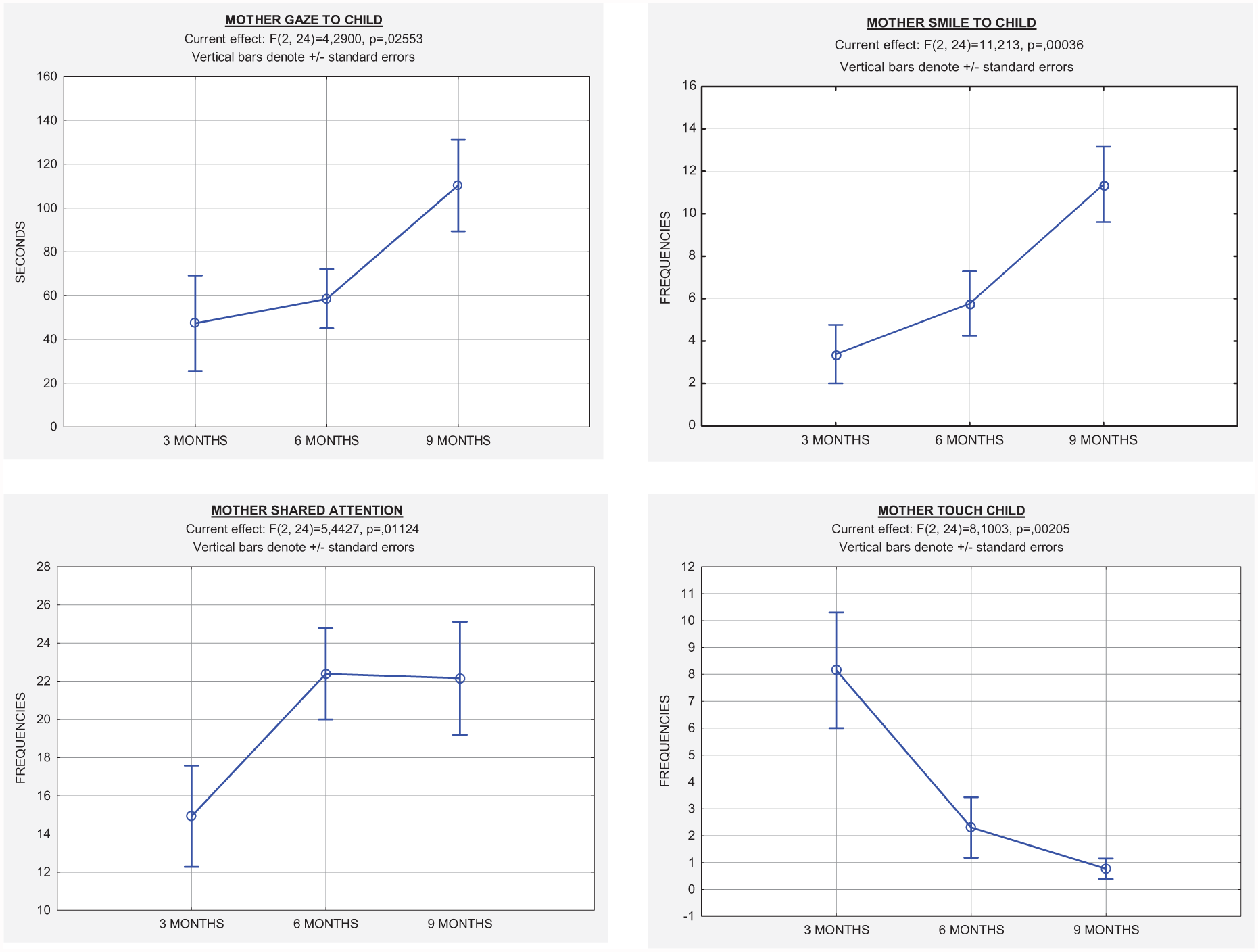
Main effects of the mean time of the maternal behavior mother’s gaze to baby’s face and of the mean occurrences of maternal behaviors smiling during reciprocal gaze, shared attention and touch the child at 3, 6, and 9 months.
The mother significantly increases the average duration of the looks toward the face of her child only in the comparison of 3 and 9 months (p < .05), but neither between 3 and 6 months (p = .889), nor between 6 and 9 months (p = .099).
The significant increase in smile that the mother gives to the child, is observable at 9 months of age: between 3 and 6 months, the occurrences of smiles from the mother to the child are similar (p = .403), whereas the comparison between 3 and 9 months (p < .001) and 6 and 9 months (p < .05) show the qualitative change of this behavior that happens at 9 months of age of the child.
Maternal behaviors of alternating looks between the child and the object (shared attention) become important only from the sixth month onwards; there is no difference in the occurrences between 6 and 9 months (p = .996), while the average of occurrences at 3 months is significantly lower both compared with 6 months and with 9 months (both p < .05).
The more the child grows, the fewer there will be moments where the mother touches the child; such a decrease can be seen inside 6 months of age, stabilizing afterwards. The results of the post hoc test show similar occurrences between 6 and 9 months (p = .732), whereas from 3 to 6 months a significant difference (p < .05) can be observed, even stronger in the comparison of 3 and 9 months (p < .01).
Coding of the Child’s Behaviors
Regarding the child’s behaviors, similar to the mother’s, the results of the ANOVA for repeated measurements (I.V.: “Growth”: 3, 6, and 9 months) show a significant increase in behavioral occurrences of direction of the eyes toward the mother’s face, F(2, 24) = 15.65; p < .001, but, unlike the maternal behavior, not of the average duration of each occurrence, F(2, 24) = 2.46, ns. Occurrences of the behavior smile toward the maternal face increase with an increase in age as well, F(2, 22) = 6.358; p < .01, but not the average duration of each occurrence, F(2, 22) = 3.021, ns, as was the case with maternal behavior. The child also significantly increases its shared attention behavior with increasing age, F(2, 22) = 3.832; p < .05, therefore following the same path as shown by the results obtained with the mothers in the same category. In addition, the child increases its initiative, F(2, 22) = 28.952; p < .001, in a significant manner. We found no significant differences in the occurrences of the behavior attention toward the object, F(2, 24) = 1.354, ns, neither in their average duration, F(2, 24) = 1.828, ns.
In particular, the post hoc analysis performed with the Scheffé test, has shown that (Figure 2):

Main effects of the mean occurrences of child behaviors: child’s gaze at mother’s face, smiling to mother, shared attention, and initiative at 3, 6, and 9 months of age.
The increase in direct looks toward the mother is only obvious after 6 months of age, with a significant difference between 6 and 9 months (p < .05) and between 3 and 9 months (p < .001), but not between 3 and 6 months (p = .076).
The increase of smiles that the child addresses toward the mother is only significant between 3 and 9 months when taken as a whole (p < .01), not between 3 and 6 months, nor 6 and 9 months (for both p = .227).
In a similar manner to what happens with maternal behavior, the occurrences of the child’s behavior, alternating looking at the mother and the object (shared attention), become more significant from the sixth month onward (p < .05), whereas there is no difference in occurrences between 6 and 9 months (p = .894).
The initiative of the child experiences a strong push between 3 and 6 months (p <. 001), remaining at the same level between 6 and 9 months (p = .72).
Table 3 is a summary of the most relevant results that emerged from the ANOVAs for repeated measurements performed on the codifications of the mother and the child.
ANOVA for Repeated Measurements for all Behavioral Categories of Mother and Child.

Note. (t) = time in seconds.
p < .05. **p < .01. ***p < .001.
Correlation Analysis
The results of the correlation analyses show certain relevant aspects regarding the trend of the behaviors between mother and child.
The first relevant result is the elevated correlation in shared attention between mother and child (r = .77; p < .001), in the same way that the correlation is strong when the mother plays with an object and the child looks at the object (r = .52; p <. 01), which becomes even stronger when the time of the mother’s play with the object is correlated with the length of attention that the child has for the same object (r = .72; p < .001).
Chi-Square Analysis
A first descriptive analysis of the two sequential macrocategories “child looks at object, looks at mother and (1) smiles / (2) does not smile” shows how on the third month, the behavioral sequence ends with a smile in 90% of the cases, whereas already at the sixth month, exactly as at the ninth, the same sequence ends with a smile in only two thirds of cases (65.50% and 62.00%, respectively). These data are confirmed by the chi-square analysis performed, which emphasizes the dependence between the macrocategories and age, χ2(2) = 20.986; p < .001. The following analysis of the standardized residuals shows that at 3 months, the children perform very few “look at object, look at mother, and do not smile” (z = −3.43) and many sequences that end with a smile (z = 2.4); such a discrepancy ends already at 6 months of age (Table 4).
Occurrences, Percentages of Occurrence and Chi-Square Analysis for the Sequential Macrocategories at 3, 6, and 9 months: (a) Looks at Object, Looks at Mother, and Does Not Smile; (b) Looks at Object, Looks at Mother, and Smiles.

Note. The percentage of occurrence is indicated in parentheses; the adjusted residuals are in square brackets. χ2 = 20.986.
p < .001.
Discussion
Children, from the first months of life onward, have communicative abilities which are an active part of interaction with their mothers, increasing their positive expressions toward the maternal face when they support and coordinate the expressive behaviors (Leclère et al., 2014). At 3 months of age, relationship components begin to show that Trevarthen (1979) calls primary intersubjectivity, and, still during this period, communication is seen as a process of mutual regulation of attention and affection (Beebe & Lachmann, 2002; Lavelli & Fogel, 2013), or “bidirectional” regulation (Beebe, Knoblauch, Rustin, & Sorter, 2005), or, in other words, tuning of affection (Stern, 1985).
The importance of maternal sensibility and symmetry in carrying out a regulative function for the emotional organization of the child is emphasized by the bond that is established in the dyad during the exchange (Harder, Lange, Hansen, Væver, & Køppe, 2015; Reyna & Pickler, 2009). Our study emphasizes how mothers engaged in a dyadic exchange with their child increase the frequency and the average duration of the communicative behaviors of the intersubjectivity (direction of the eyes and the smile) during the growth of the child. The smile frequently comes up during the sharing of pleasure during social play, and in this context, it is often the child’s smile that joins the adult one (Lavelli, 2007). At this age, children start to prefer interpersonal games characterized by rapid variations of rhythm, intense emotions such as smiling at the mother, and start to get interested in the external world, trying to touch and grab objects. Our results emphasize how a smile, in the first few months of life, is used as an answer to a stimulation and, at an older age, is an integral part of the child’s experience of the interaction with the mother. The results of the current study show that infants manifested more attention and positive affect when someone broke dyadic contact to engage in a triadic interaction, already at 3 months of age. When the adult coordinated attention with the infant, therefore completing what might be called the “referential” or “relatedness triangle,” infants gazed and smiled as they did in the normal face-to-face interaction (Parker-Rees & Leeson, 2015; Tomasello, 1999). The study showed that both alternating visual attention and positive affect are aspects of joint attention to which 3- to 9-month-old infants are sensitive. In general, the study confirms young infants’ sensitivity to head and gaze direction by 3 months of age which is a necessary precursor to more systematic triadic interaction in later ontogeny.
At 6 months, social interaction is characterized by triadic exchanges, mother-child-object; children in this phase not only engage in dyadic actions but also begin using a series of actions to capture the attention of adults (e.g., attempting to grad objects, repetition of actions) (Reddy, 2003). Our results go in that direction: Children are able to carry out a series of initiatives geared toward a communicative exchange and, while playing, alternate their looks between the object and the face of the mother.
In the period between 8 and 12 months of age, kids increase their communicative intentionality by using nonverbal behavior (Martins, Mateus, Osório, Martins, & Soares, 2014; Mundy & Willoughby, 1996). Sometime during the first year of life, infant communication changes from dyadic to triadic interactions. Whereas the proto-conversations infants engage in during the dyadic period involve monitoring people’s gazes to share emotional experiences, triadic communication involves coordinating with people’s gazes to share experiences about the world (Trevarthen, 1979). As such, coordinated attention (CA) is considered an important sociocognitive achievement, and is hypothesized to play a central role in the development of mental state awareness and prelinguistic and linguistic communication (Baron-Cohen, 1991; Bertenthal & Boyer, 2015; Bruner, 1991; Legerstee, 2005).
Theories and empirical data have suggested that the emergence of triadic interactions between 9 and 12 months of age constitutes infants’ first attempts to simultaneously integrate object interest and person engagement within their focus of attention (Carpenter & Call, 2013). In particular, it is argued that only triadic communication is meaningful, because sharing experiences over objects is dependent on cognitive abilities which allow for mental state awareness, such as an understanding of goal-directed actions (Carpenter, Nagell, & Tomasello, 1998). Consequently, they claim that CA has its roots in gaze monitoring during the dyadic period. In particular, it is argued that from early on, infants communicate reciprocally with conspecifics, showing a strong desire to connect with the social world (Stern, 1985; Trevarthen, 1977, 1979). These dyadic interactions are evidence of intersubjectivity (Stern, 1985; Trevarthen, 1979; Tronick, Als, Adamson, Wise, & Brazelton, 1978) and, like triadic interactions, enable infants to engage in meaningful communication with others where subjective experiences, such as affect and attention, are shared (Stern, 1985; Trevarthen, 1977, 1979).
At 9 months, the development of the intersubjective experience relative to the child’s abilities to coordinate their focus of attention on objects/events represents a radical change, supported by the appearance of a series of social behaviors indicating the inclusion of the other’s perspective in their way of relating to the surrounding world. In this phase of development, children start to include external events and objects in their interactions with others, emphasizing, therefore, the important period of transition that includes control of the psychomotor, cognitive, and socioaffective relation development (Lavelli, 2007). The positive effect of the interactive dyadic exchanges and the qualitative change that happens in these 3 to 9 months of the child’s life is further emphasized by the results of the sequential analysis performed on the two sequential macrocategories: “The child looks at the object, looks at the mother and (1) smile / (2) does not smile”; these data, therefore, confirm the hypothesis that behaviors of synchronic visual and tactile interaction positively influence mother–child interaction, making the bond stronger and more intimate.
Conclusion
In conclusion, the study highlights the importance of the first mother–child communicative interaction: the circular dyadic interaction observed during the study proves to be an important factor for the growth of the child and for the consciousness of the maternal role. In particular, what most promotes a functional mutual exchange seems to be the smile. It is used first as an answer to a stimulation: I look, You smile; but, after few months, it becomes the essence of the dyadic interaction. In general, the positive engagement will enable the successful transition to joint attention.
Although the present work is a longitudinal study, one of our limits represents a low numerosity of the sample. Furthermore, we do not have mother’s temperamental data.
The present study underlines one of the most important aspects about the first empathetic and emotional communication between mother and child. Both longitudinal methodology and sequential analysis allow us to understand the whole sample of mother–child’s interactional turn-taking, even at this early age, even in hospital. These aspects could be notable both in a methodological and applicative point of views. With regard of sequential analysis, it allows to observe interactional turn-taking in a circular way, since first months of life. The applicative aspect concerns the opportunity to systematically observe dyads in hospital: This represents a natural environment in which a more efficient and immediate monitoring of both functional and dysfunctional aspects is possible; furthermore, the systematic observation allows to verify eventual difficulties in early coconstruction of turn-taking, that represents a basic step for both child’s emotional-relational development, and mother’s consciousness about her nurturant care.
Footnotes
Declaration of Conflicting Interests
The author(s) declared no potential conflicts of interest with respect to the research, authorship, and/or publication of this article.
Funding
The author(s) received no financial support for the research, authorship, and/or publication of this article.