




Abstract
Based on the theory of asset building, this study provides an in-depth analysis of the China Family Panel Studies (CFPS) conducted in 2016. The main objective is to examine the measurement structure of China’s family development ability and explore the relationship between the family saving rate, government subsidies, and family development ability using the structural equation modeling approach. Additionally, this research identifies the causal treatment effects of family savings rate and government subsidies on family development ability through propensity score matching and generalized propensity score matching methods. Consequently, it offers a comprehensive analysis of the impact of family savings rate and government subsidies on family development ability. The findings indicate that the influence of government subsidies on improving family development ability is negligible, while the effect of family saving rate on various factors of family development ability is significant. Specifically, the relationship follows an inverted U-shaped curve, with a family saving rate of approximately 35% demonstrating optimal performance. One possible explanation for this trend is that increased family savings instill a sense of future confidence among family members, thereby promoting family development ability. The robustness of these conclusions is confirmed through various causal inference models. These empirical findings provide valuable evidence and serve as a reference for exploring the transformation and development of social policy models in China.
Plain language summary
This study focuses on the theory of asset building and conducts an extensive analysis of the China Family Panel Studies (CFPS) carried out in 2016. The primary aim is to investigate the measurement structure of China’s family development ability and examine the relationship between the family saving rate, government subsidies, and family development ability using structural equation modeling. In addition, the research employs propensity score matching and generalized propensity score matching methods to identify the causal treatment effects of family savings rate and government subsidies on family development ability. Consequently, it presents a comprehensive analysis of the impact of family saving rate and government subsidies on family development ability. The findings suggest that government subsidies have a negligible influence on improving family development ability. On the other hand, the effect of the family saving rate on various factors of family development ability is significant. Interestingly, the relationship between family saving rate and family development ability follows an inverted U-shaped curve, with an optimal performance observed at a family saving rate of around 35%. This indicates that increased family savings foster a sense of future confidence among family members, thereby promoting family development ability. To ensure the robustness of these conclusions, various causal inference models are employed, and the findings consistently support the initial observations. These empirical results provide valuable evidence and serve as a reference for exploring the transformation and development of social policy models in China.
Keywords
Introduction
Supportive policy reform for family development capacity building has become a guiding ideology for achieving sustainable family development and promoting long-term balanced population development. This has happened under the background of low fertility rates and an aging population. China has long employed income-based policy to mitigate economic distress and life pressure for disadvantaged groups. Overall, the social effects have been positive. However, we must be soberly aware that any policy is subject to its own characteristics and environmental constraints, as such, due consideration should be given to its limitations and future development. Over the long run, a public policy should target inclusive wealth creation, not just redistribution (M. Sherraden & Gilbert, 2016). Therefore, to promote family development and create future orientation, an asset-building welfare policy with individual and/or family savings accounts at its core may be more effective than income-based social policy.
What effect does saving have on family development? What role does it play? Previous literature on family saving has focused on the savings levels themselves and their influencing factors, ignoring the analysis of saving’s function and effect on family development; research on government subsidies has focused on the poverty reduction effect while neglecting family development. This study will explore the effects of family savings and government subsidies on family development, and integrate “asset-based” and “income-based” social policy theories into the same framework for comparative analysis. It also will explore the causal effects of both empowering families and promoting family development. In addition, this study also entails the use of quantitative tools to simulate expected policy effects.
Review
In this research, a total of 64 relevant studies were retrieved through a literature search on keywords such as family savings, government subsidies, and family development ability. Among them, 19 were in Chinese and 45 were in English.
Income-Based and Asset-Based Social Policy Theories
The income-based policy theory provides a framework for addressing poverty and inequality by offering financial support to individuals and families, acting as a safety net for those who are unable to support themselves. This approach is rooted in the principle that everyone should have access to a basic standard of living, and it is the government’s responsibility to ensure this right is upheld. The policy aims to redistribute wealth from the affluent to the disadvantaged through government programs and policies, ensuring that everyone has the necessary resources for a decent life. The income-based policy acknowledges that poverty is primarily caused by a lack of income, and providing adequate fiscal resources is vital in tackling poverty and its associated social issues (DiNitto & Johnson, 2013). This perspective recognizes that poverty is not solely an individual’s failure but often a consequence of broader economic and social structures that limit opportunities and create inequalities. Income-based policies encompass a wide range of social welfare programs, including unemployment benefits, social security, child tax credits, housing subsidies, food stamps, and other forms of fiscal assistance.
Since the reform and opening-up, China has implemented a series of economic and social policies centered around a productivist welfare regime, aligning with the priority of “economic development as the central task.” However, as reforms deepen and societal contradictions transform, the productivist welfare regime in China has faced increasing criticism. The discourse surrounding a developmental welfare system has gained traction in research on China’s welfare regime (X. L. Wang, 2020).
The theory of development-oriented social policy emerged in the 1990s, driven by the deepening globalization and the recognition of the role of risk production and distribution in modern society. This new paradigm emphasizes an investment and development-oriented approach to social policy and has garnered attention in academic circles. Developmental social policy advocates for considering social policy as an investment, particularly in human capital, to enhance individuals’ development capabilities and qualities, thereby incorporating the essence of productivity into social welfare.
Various scholars have presented their own perspectives and theoretical frameworks regarding developmental social policy. Sen (2014) views freedom as both the goal and means of development, emphasizing that the ultimate objective of social policy is to enable people to achieve “capability for feasibility” and attain freedom. Midgley (1999) argues that economic development loses value if it neglects social development, highlighting the significance of social investment in human capital and social capital. Giddens (2013) proposed the theory of the “third way” as a response to the challenges posed by Keynesianism and neoliberalism in the Western context. Giddens suggests replacing the concept of the “welfare state” with the “social investment state,” placing greater emphasis on investing in human capital rather than providing direct cash assistance.
Midgley further suggests that the ideas of social progress and social inclusion, which underlie social investment, are equally applicable to developing countries. The approach of developmental social policy represents a shift from previous consumption-oriented approaches to empowering people, enhancing capabilities, and promoting economic and social development (Midgley & Tang, 2001). Developmental social policy introduces the concepts of investment and development from economic policy into the realm of social policy. It emphasizes a shift in focus from consumption to investment in traditional social policies, aiming to achieve the integration of social development and economic growth through the interaction between the economy and society.
The concepts of social investment and development put forth by various scholars have been further developed by Sherraden into the “asset-based” social policy, also known as the asset-building theory. In contrast to traditional welfare policies that exclude the poor from asset accumulation, asset-based social policy aims to help individuals accumulate assets through investment, enabling them to escape poverty and welfare dependence. The asset-building theory adopts a positive approach toward human development, believing that individuals will utilize opportunities and resources to promote their own development if given the chance. The implementation of asset-based welfare policies is seen as feasible through the establishment of “individual development accounts” (M. Sherraden & Gilbert, 2016).
According to the asset-building theory, an individual or family’s level of savings is influenced by their desire to improve their current standard of living and save for future benefits (M. Sherraden & Gilbert, 2016). The development savings account is akin to a retirement account but is open to all individuals and families, offering government-provided matching grants that are allocated for personal and family development activities. This saving behavior fosters hope for the future among individuals and families, encourages long-term goals and future orientation, promotes family stability, and ultimately contributes to the long-term development of individuals, families, and society as a whole (M. Sherraden & Gilbert, 2016).
Relevant Research on Government Subsidies
Government subsidies refer to all government public transfer payments in social welfare and social assistance, including but not limited to subsistence allowances, including subsidies for five-guarantee families, subsidies for special hardship cases, pensions for relatives of industrial and commercial personnel, and relief funds. At present, there are varying opinions about the effectiveness of government subsidies. Studies suggest that a government subsidy increases families’ per capita net income, or facilitates the accumulation of family assets (Z. Liu & Wang, 2020), reduces incidence of children dropping out of school, and improves poor children’s cognitive abilities (D. D. Liu & Xue, 2021; J. X. Wang & Zhou, 2020). Moreover, there is evidence that government subsidies increase the proportion of families’ educational expenditure on children (J.-l. Li et al., 2021), grow confidence in future development among policy target groups (Jiechal & Li, 2022), and promote increases in fertility rates (Ding, 2017). Other studies suggest that government subsidies have limited, or even negative, effects on targeted groups: if the level of government subsidies is insufficient, the poverty reduction effect of the corresponding sample is not ideal (H. W. Han & Gao, 2017), and there is a large targeting bias (Song & Yang, 2018). Depending on the government subsidy, the recipients can only improve their living standards to a certain extent and reduce the incidence of poverty, but they cannot eliminate poverty based on this. They are limited by the adverse effects of social isolation and deprivation, and lack the opportunity to develop (S. Li & Yang, 2009; Yang, 2005), and are unable to change the time allocation preferences of the aided family members. This behavioral pattern is difficult to break (D. D. Liu & Xue, 2021). In short, if the poverty subsidy is too low, it may weaken the effect of welfare and increase the risk of the poor returning to poverty; if government subsidies are too high, poor families may fall into welfare dependency, which is contrary to the original intention of government subsidies (Wei & Feng, 2018).
Savings-Related Research
There have been many empirical studies on the establishment of savings accounts. Among them, the research on psychological effects suggests that saving behavior can change savers’ attitudes toward life, improve their financial skills, produce a “sense of psychological control” about their future development, and clarify their future orientation (Delgadillo, 2015; D. Rothwell et al., 2013; D. W. Rothwell & Sultana, 2013; M. S. Sherraden & McBride, 2010). Research on the effect of asset promotion has shown that that among participants in savings account projects, housing ownership rates, fixed assets and total assets for all categories of people are higher than those of the non-participating control groups (Bowles et al., 2000; Charles & Hurst, 2003; Chiteji & Stafford, 1999; Grinstein-Weiss et al., 2012; Huang et al., 2016; Mills et al., 2008). The experience of saving in childhood also has a positive effect on asset accumulation in adulthood (C.-K. Han et al., 2009). Research on the improvement of family human capital suggests that saving can improve family education expectations and children’s academic achievement (Beal & Crockett, 2010; Elliott & Beverly, 2011; Elliott et al., 2011; Mau, 1995; Ou & Reynolds, 2008; Shanks et al., 2010), thus improving family members’ employability (Moore et al., 2001).
Returning to the perspective of China, domestic research on asset-based social policy practices is also increasing year-by-year. Studies have shown that asset-based social policy promotes the accumulation of the intervention target’s assets through public intervention, and this is more effective than “blood transfusion” assistance in promoting the intervention target’s development. Its principles are also connected with the traditional culture of self-reliance in China (Du & Wen, 2010). In addition, some studies have suggested the tentative idea of establishing individual development accounts for low-income residents and the floating population (C. X. Li & Huang, 2013; Tang, 2005). There are also intervention experiments in which special education family development accounts have been setup for Shanghai low-income families and Beijing migrant families (S. Y. Wu et al., 2016; Zhu & Zeng, 2016).
Family Development Ability
Development-oriented social policy is a form of policy that is based on the functions and needs of the family. The direct goal is strengthening the functions of the family and helping the target (Marshall & Butzbach, 2003). The efficiency of the family function can reflect the effective welfare level of the family, and the direct determinant of the efficiency level of the family function is the family development ability, which is the transmission from the welfare function to the ability needed for function exertion. The normal operation of the family function is a direct expression of good family development ability, which can produce or lead to the quality and efficiency of the family function (F. Wu & Li, 2012). The latter is an explicit expression of the former, which focuses on development orientation, while the latter is oriented toward dimension analysis. Thus, from the perspective of the family function, we can clarify the measurement structure of the family development ability.
There is a long-standing tradition of research on the family from the perspective of functionalism. As the location of individual socialization and the bridge to society, the family bears the responsibility of meeting family members’ various development needs. Firstly, the economic function of the family is an important basis for the realization of other functions (Murdock, 1949). This mainly includes production and consumption functions. Becker’s family economics starts from the assumption of the rational economic man, emphasizes the productive nature of family consumption, discusses optimal allocation of economic resources to realize the growth of family members’ knowledge and abilities, regards all combinations of family behaviors as decisions to maximize the family’s overall welfare and utility, and regards the production of human capital as the embodiment and ultimate goal of family functions (Becker, 1962). With the intensification of the division of labor in modern society, and the increased participation in social life on the part of family members, as well as the changes in family structure caused by the second demographic transition, some functions of the family have moved elsewhere or waned. Facing this growing crisis of family function, scholars are no longer satisfied with economic function as the sole explanation of family function. Therefore, they have expanded their explanations of the function of the family. In the late 1970s, in order to retheorize the family, the concepts of family function oriented by family member relationships, emotional connections and adaptability were proposed in the field of family therapy social work. Corresponding theories on family function evolved; the more important and representative ones are as follows: According to the McMasterd family function model (summarized by Epstein) the family’s basic function is to provide appropriate environmental conditions for family members’ development. It is divided into six functional standards: puzzle solving, frank communication, clear roles, emotional connection, emotional involvement, and behavioral norms (Epstein et al., 1983). Olson’s circular model theory offers three dimensions of family function: flexibility and adaptability to internal and external crisis pressure; cohesion and intimacy among family members; level of information exchange and communication between members—the latter of which has a promoting effect on the first two (Olson, 2000). Beavers’ system model theory reduces the dimensions of family function to two. These are family ability, including family relationship structure, family emotional connection, coordination within the family, and family members’ own unique qualities. The other is family style, which is divided into centrifugal and centripetal styles. It focuses on whether family members can satisfy their needs from within the family. If so, it is centripetal style, otherwise it is centrifugal style (Beavers & Hampson, 2000).
As shown, the family function theory has shifted from attention to the family’s economic function and human resources development in the early stages, to the family’s emotional relationship status and adaptive function in dealing with risks and crises. On the other hand, in addition to economic and social factors, the family’s physical environment is also an important part of the family function. Physical living conditions in the family will influence the health status and well-being of family members (Tsuchiya-Ito et al., 2019), children’s cognitive ability (Wells, 2000), and disability risk among the elderly (Wahl et al., 2009). A poor physical environment within the family will lead to dysfunction within the family.
The above analysis reveals that the dimensions of family development ability mapped out based on family function view can be described along the following five domains (1) economic development ability, which is divided into two categories—the degree of a family’s economic resources possession and their allocation method, which are the material basis for family existence; (2) relationship development ability: the emotional cohesion within the family will have a long-term effect on the development of the whole family; (3) environmental development ability: the family’s physical environment is also crucial to the development of family members; (4) family risk resilience: family members’ ability to calmly address various crises without degrading family functions or causing family disintegration; (5) population development ability: the comprehensive quality of family members and human capital are the important results of family functions, and the positive responses to family development ability. These five domains are interrelated.
In sum, there are contradictions and conflicts in the discussion on the advantages and disadvantages of traditional social policies, and there is no consensus on the direct effect of government subsidies by all parties; Moreover, the saving effect remains under-researched. While Chinese academic circles are debating the various effects of government subsidies, research on the personal and family effects of savings has not only been scarce, but also there is no systematic research system. Economics research on savings levels and the influencing factors is abundant. However, in the field of sociology, few have studied savings’ effect on social structure, family relations, or personal development. Furthermore, there is no established interdisciplinary research convergence between economics and sociology in the field of savings research. Unlike the various studies and discourses based on fully implemented income-based social policy systems, the current asset-based social policy research in China remains at the level of theoretical analysis and system design. The above literature review has shown that there have been some partial pilot intervention studies on savings accounts for specific groups, but there is a lack of empirical research based on large sample data. The reason for this is that China lacks large-scale asset-based social policy practice, and the effect after the establishment of savings accounts remains unknown. However, this does not prevent us from exploring the effect of the accumulation of family savings on the development of families in China under the guidance of theory. Families’ current choices and results can also provide reference for future policy planning.
The intent of this study is to escape a single income-based social policy framework, with both traditional perspectives and development orientations. Instead, we explore the impact of income-based and asset-based policy actions on the long-term development of policy objectives. By examining family development ability, we examine the practical effect of government subsidies on family development through the natural experiment of families’ own savings. We simulate the policy effect after the establishment of family savings accounts, and investigate the impact of asset-based social policy on family development. Finally, this study focuses on asset-based and income-based social policies: family savings and government subsidies are both dimensions of economic development ability. These are also the dimensions of economic development ability along the five dimensions of family development ability. Transforming the economic development ability into the promotion factor of family development is crucial. The purpose of this study is to examine the impact of family economic development ability directly affected by policies on comprehensive development ability. Based on the above analysis and discussion, the hypotheses of this study are:
Hypothesis 1: It is hypothesized that there is a positive relationship between government subsidies and family development ability.
Hypothesis 2: It is hypothesized that there is a positive relationship between family savings and family development ability.
Hypothesis 3: It is hypothesized that government subsidies have a positive effect on family development ability.
Hypothesis 4: It is hypothesized that family savings have a positive effect on family development ability.
Hypothesis 5: It is hypothesized that family’s future confidence mediates the relationship between family savings and family development ability, leading to a positive effect on family development ability.
Data and Methods
Data Use and Variable Selection
This study uses original data from the China Family Panel Studies (CFPS), conducted by the China Social Sciences Research Center at Peking University in 2016. Among them, the family is the basic unit of analysis. We combined the 2016 family economic data and adult data based on the 2016 family ID variable. After removing any missing family samples that were not matched after the combination and the missing family development ability measurement indicators, urban and rural family accounts, the number of families in 2014, families’ per capita income, any missing value for family borrowing amount and any missing value for family annual income, expenditures over one million RMB, and any missing value for government subsidies, the 2016 data produced a total of 9,628 available family level samples.
Outcome Variable: Family Development Capacity
Family development ability is this study’s outcome variable. It is either a construct or a latent variable. Multiple sets of indicators that reflect its impact must be used to infer its representation and level. According to the literature review, we break family development ability into relationship development ability, environment development ability, population development ability, and risk resistance ability. Based on the availability of CFPS data, the following indicators are used:
The measurement indicators of relationship development ability are: (1) intergenerational relationship status: the intergenerational relationship status is measured by calculating the average value of the relationship status between each adult member and his/her parents in the same family. If one parent dies, the relationship status with the other living parent is substituted. Among them, the parents of some members over the age of 50 died, resulting in the generation relationship being immeasurable. The missing value in this part is replaced by the average of all adult sample members’ relationship status with each child; (2) the frequency of intergenerational ties; (3) intergenerational meeting frequency: all are measured by the same calculation method used to calculate the intergenerational relationship status; (4) intergenerational force: the family average for “how often do you take care of your family?” and “how often do you take care of your parents?” in the adult questionnaire is used as a measure of each family’s intergenerational force. The measurement indicators for environmental development ability are: (1) degree of home decoration; (2) family cleanliness; (3) quality and quantity of family appliances and furnishings. The above indicators are each measured by a 7-level Richter scale; the higher the value, the better. The measures of population development ability are: (1) health level; (2) interpersonal skill level; (3) understanding ability; (4) the degree of neatness of clothes; (5) intelligence. All were measured by a 7-level Likert scale in the family adult questionnaire. The average value for each indicator is calculated based on the family as a unit to measure the family’s overall level for each indicator. The measurement indicators of risk resistance are: (1) family size, excluding any singular value samples with family size exceeding 99.9%; (2) number of types of old-age insurance—the sum of the number of types of old-age insurance owned by each family member; (3) number of types of medical insurance—the sum of the number of types of medical insurance owned by each family member.
Core Explanatory Variables: Family Saving Rate and Government Subsidies
One of the core explanatory variables in this study is family saving rate. According to the definition of saving rate in economics, family saving rate = (family income-family consumption expenditure)/family income, but residents tend to underreport family income information in surveys, which leads to errors in the calculation of saving rates (X.-l. Wang, 2007). In order to mitigate the effect of this kind of error, some studies have replaced the family income denominator in the calculation formula for the savings rate with the family consumption expenditure when the family income is lower than the family consumption expenditure (C. Hu & Xu, 2014). Although the revised family saving rate will still be lower than the actual saving rate, and cannot be revised for families with family incomes higher than their family consumption expenditures, this does not affect the horizontal comparison or measurement results of the study. Referring to this approach, the calculation method for family saving rate in this study is: when family income is greater than family consumption expenditure, use (family income-family consumption expenditure)/family income; when family income is less than family consumption expenditure, use (family income-family consumption expenditure)/family consumption expenditure.
Another core explanatory variable in this study is the amount of government subsidies. To measure the amount of government subsidy the family had received over the past year, the following question was asked on the family economic questionnaire:
Over the past 12 months, including cash and actual conversion in kind, how much government subsidy did your family receive in total. This would include, for example, subsistence allowances, subsidies for returning farmland to forest, agricultural subsidies, subsidies for five-guarantee families, subsidies for impoverished families, pensions for the immediate family members of the injured and relief funds.
Control Variables
The control variables in this study include a family hukou attribute, total family borrowing, 14-year family size, per capita net income of families.
The difference between urban and rural areas is a category attribute of great social significance in China. It affects family savings, government subsidies and family development at the same time, and needs to be controlled statistically in research. The CFPS questionnaire does not differentiate agricultural registered permanent residence families from non-agricultural registered permanent residence families at the family level, and the data from the CFPS in 2016 also does not include information on the head of the family. Therefore in this study, we use the family hukou attribute of the financial respondent of the family economic questionnaire, that is, the financial manager of the family, instead of the family hukou attribute. The missing value is replaced by the urban-rural attribute of family residence based on the urban-rural classification of the data from the National Bureau of Statistics.
Family borrowing will also have various effects on all family members, such as the family’s total outstanding bank loans; loans from individuals or organizations other than relatives and friends or banks for purchasing or building houses; and repayment of bank loans from families other than mortgage loans. In addition to the purchase and construction of homes, the family must also repay loans taken out by people such as relatives and friends. The sum represents the total amount of family loans.
Finally, the per capita net income of families, as a component of economic development ability, needs to be statistically controlled. Family size is correlated with family development ability, savings and government subsidies. The family size data in the consolidated lagging CFPS2014 database serves as the control variable.
Mediator Variables
According to the theory of asset building, family savings can promote changes in family members’ behavior and family development by altering the family’s future orientation and generating psychological effects. Therefore, in this study, the measurement value of the adult questionnaire question “confidence in your future” is a mediator variable. It is measured by a 5-level Likert scale. Family members’ average future confidence score is calculated as a measure of the family’s overall confidence in the future.
Analysis Method
Structural Equation Model (SEM)
In the field of social science, certain concepts like interests, attitudes, behaviors, and performance cannot be directly measured, but they can be indirectly assessed using observable indicators. Structural equation modeling (SEM) is a statistical method that analyzes the relationships between variables based on the covariance matrix. It is widely used in multivariate data analysis and is considered a latent variable model. SEM combines factor analysis, which deals with latent variables, with the path model, which examines the paths between variables. This approach enables the simultaneous examination of multiple variables, accounting for measurement errors in both independent and dependent variables, estimating factor structures and relationships, and assessing the overall fit of the model. Structural equation modeling is commonly employed to validate research hypotheses. Researchers start by formulating hypotheses and selecting relevant indicators based on existing literature and social observations. They then construct a structural equation model to test and validate these hypotheses.
For instance, some studies hypothesize that the transformational leadership style has a positive effect on job satisfaction. Using the structural equation modeling method, researchers construct latent variables such as charismatic or inspirational motivation, intellectual stimulation, individualized consideration, and job satisfaction. These variables are used to investigate the relationships between the transformational leadership style (represented by the latent variables) and job satisfaction (Wan Omar & Hussin, 2013).
Another example is a study conducted by Parvar et al. (2013), where the researchers construct the latent variable “quality of work life” using indicators such as social relevance, social integration, safe and healthy environment, and adequate and fair compensation. They also construct the factor of “organizational commitment” using indicators such as affective commitment, continuance commitment, and normative commitment. The researchers utilize structural equation modeling to examine the effect of quality of work life on employees’ organizational commitment.
In summary, structural equation modeling is a powerful statistical method used in social science research to examine and validate hypotheses by constructing latent variables and assessing the relationships between them using observable indicators.
In this study, we first obtain the measurement dimensions for family development ability and the indicators’ relationship structure by exploratory factor analysis (EFA), and then confirmatory factor analysis (CFA) to verify the actual fitting effect and the reliability and validity of the factor structure obtained by EFA. Finally, the research hypotheses is preliminarily verified by using the SEM method which combines the latent variable model of factor analysis with the path model that measures the path relationship. The SEM model expression for this study is:



(1) is a structural model, (2) and (3) are measurement models. In (1)
From Propensity Score Matching (PSM) to Generalized Propensity Score Matching (GPSM)
Since the “credibility revolution,” the inference of causality has become the central topic in empirical research. Yet, there is a serious self-selection bias problem in research designs which use the SEM method to explore the impact of family savings and government subsidies on family development ability. Rosenbaum and Rubin (1985) eliminated the effect of self-selection bias by establishing a pair of treatment groups and control groups with characteristics as similar as possible to simulate the counterfactual situation. In this way, they reached causal inference about the treatment effect, that is, the PSM method. However, this is only applicable to those cases where the treatment variables are binary. Hirano and Imbens (2004) proposed a generalized propensity matching score based on the weakly unconfoundedness. It extends the traditional weakly unconfoundedness of binary treatment values to the case of multiple values. By extending the PSM method, the limitation that the treatment variable must be a binary is obviated, and the sample information can be fully utilized. Like the average treatment effect only observed by the PSM method, the GPSM method can also reveal the causal effect at different levels of treatment. The specific GPSM estimation steps are as follows: firstly, the generalized propensity matching score

This is converted into a log-likelihood function, and then the derivative of β is used to calculate the parameter β to be estimated, which outputs the score value for generalized propensity matching.

The conditional expectation of Y for a given

Finally, the following formula is estimated by using the parameter estimation result of the above formula to obtain the average potential result value under all specific treatment levels:

Research Findings
The EFA Results for Family Development Ability
Firstly, we adopt the EFA method to reduce the dimensions of several indicators affected by family development ability. This enables exploration of the dimension composition of the concept of family development ability. At the same time, a factor score model is established to obtain a comprehensive score for evaluating each family development ability value. The KMO test is performed on 15 index variables measuring family development ability; the KMO value is 0.858, the Bartlett test
On this basis, we used the principal component factor (PCF) method to determine how many factors could be determined by this set of indicators. In the factor analysis of family development ability, the principal component factor method outputs four principal components with eigenvalues greater than 1, and the total variance interpretation ratio is 79.8%. Thus, it provides comprehensive response index information. The factor load matrix is rotated orthogonally by using the maximum variance method to clarify the relationship between each common factor and the variables. The rotated factor load matrix shows that: health status, intelligence level, understanding ability, interpersonal skills, and clean and tidy clothes have a larger factor load on Factor 1, which is named the family’s population development ability, and expressed by F1; The condition of inter-generational relationship, frequency of price meeting, inter-generational resultant force, and frequency of inter-generational contact have a larger factor load on Factor 2, it is named family relationship development ability, and is represented by F2; The factors of tidiness, degree of decoration, electrical appliances, and furnishing of a family are higher than Factor 3. Therefore, Factor 3 is named the family’s environmental development ability, which is represented by F3. Family size, types of old-age insurance, and types of medical insurance have a larger factor load on Factor 4. Therefore, Factor 4 is named family risk resilience, and is represented by F4.
Furthermore, the estimated value of each factor value coefficient, that is, the factor value coefficient matrix, is obtained through the regression method, and the scores for each family sample on the four kinds of family development abilities can be calculated. At the same time, according to the ratio of the variance contribution rate of each factor to the total cumulative contribution rate as the weight of each factor, the values of each factor are weighted and summed to calculate the comprehensive family development ability score, that is, F = (0.281 × F1 + 0.201 × F2 + 0.178 × F3 + 0.130 × F4)/0.798.
CFA Results for Family Development Ability
We conducted confirmatory factor analysis on the exploratory factor analysis results from family development ability in the previous step: as shown in Table 1, the influence path coefficients for each factor corresponding to each index are all significant at the 1% level, and most of the standardized factor loads are above 0.6; only the standardized factor loads for family intergenerational force and the number of types of old-age insurance are below 0.6, but also greater than 0.5. Strictly speaking, it is most appropriate for the standardized factor load to be greater than 0.6, but the standard can be appropriately relaxed to 0.5 (Brown, 2015). The combined reliability (CR) of the four common factors exceeds 0.6 (Bagozzi & Yi, 1988; Fornell & Larcker, 1981), the average variance extracted (AVE), are all higher than 0.5 (Fornell & Larcker, 1981), and the Cronbach’s α’s all exceed .7 (Nunnally, 1994). This means that the measurement model for family development ability is reliable and valid.
Confirmatory Factor Analysis for Family Development Ability (CFA).

Further, we tested the fitting results for the family development ability measurement model by the first-order four-factor model, and the judgment criteria of the fitting results were: relative fitting index: CFI > 0.9, TLI > 0.9; absolute fitting index: RMSEA < 0.08, SRMR < 0.08 (L.-t. Hu & Bentler, 1999; Kline, 2010). The
Research on the Correlation Between Family Savings, Government Subsidies, and Family Development Ability
On the basis of the exploratory factor analysis, we preliminarily explored the correlation between family saving rate, government subsidy, and family development ability by SEM. As demonstrated in Table 2 and illustrated in Figure 1, the chi-square value for the model fitting index is 6,814.130, which is significant. Because of the large sample size in this study, this index has no reference value. RMSEA = 0.074, SRMR = 0.070, CFI = 0.945, TLI = 0.935; both the relative fitting index and the absolute fitting index are within the acceptable range. The fitting effect of the theoretical model and the sample data is good, and the design of this model is acceptable, with high consistency with the real model. In the structural model with family’s confidence in future life as a mediation variable, the saving rate is positively correlated with family development ability, and the amount of government subsidies is negatively correlated with family development ability. It is evident that Research Hypothesis 1 is contrary to the statistical results, but Research Hypothesis 2 is confirmed. Family saving rate is positively correlated with family life confidence, while government subsidy is negatively correlated with family life confidence in the future. The influence of family life confidence on family development ability is positive and significant. Finally, the correlation between the family saving rate and government subsidies is negative and significant, and the family saving rate will not increase due to an increase in government subsidies. In this section, analysis of the mediation effect is put aside; we test it later, after analyzing the causal relationship between the variables.
Estimation Results From the Structural Equation Model (N = 9,628).

Note. Z value in parentheses,
p < .01.

Family saving rate, government subsidy, and family development ability model.
PSM Estimation of the Effect of Government Subsidies and Family Savings on Family Development Ability
Based on whether government subsidies are available and whether the saving rate is positive, the government subsidies and saving rate are reduced to binary variables. In this study, we first use the PSM method to conduct a preliminary test of the effect of government subsidies and family savings on family development ability. Then, we use the family comprehensive development ability score to measure the dependent family development ability. In the government subsidy/family saving impact model, family saving/government subsidy, family borrowing amount, family per capita net income, 14-year family size, and family hukou attribute are the covariates, and we use a probit model to estimate the propensity score of families having government subsidy/family saving. By matching the propensity scores of the saving model and the government subsidy model, the similarity in various characteristics between the experimental group and the control group is ensured. This forms a natural experiment to estimate the impact of saving and government subsidy on family development ability.
Before matching, the experimental group and the control group in the government subsidy impact model had significant differences in family savings, family net income per capita, 14-year family size, and family hukou attribute. After matching, the differences among these covariates were no longer significant. The experimental group and the control group in the family savings impact model have significant differences in government subsidies, family per capita net income, and family hukou attribute. The differences between these covariates are no longer significant after matching. Thus, within the range of observable characteristics, the problem of sample selectivity bias is overcome, and the balance requirement is satisfied.
As shown in Table 3, among the five matching methods used, the impact of government subsidies on family development ability is not significant and the value is negative; The influence of family saving on family development ability is significant, the result of the mahalanobis matching method is negative and significant, and the other four matching results are positive and significant. This shows that government subsidies do not improve families’ comprehensive development. After eliminating the sample selection bias, there is no significant effect shown in SEM. Thus, Research Hypothesis 3 cannot be verified. However, although family savings have a significant effect on family development ability, Research Hypothesis 4 has been verified. However, there are two contradictory results, among which the mechanism is analyzed and discussed below.
Propensity Score Matching Estimation Results.

Note. The number of calculated robust standard error neighbors is 3; caliper = 0.02; epanechnikov kernel; with T-values in parentheses, and the reported result is the ATT value.
p < .05. ***p < .01.
GPSM Estimates of the Effect of Family Savings on Family Development Ability
Based on the flogit model, we calculated the propensity matching score for family savings, and tested the covariance of the matched samples for balance. The samples under different saving intensity intervals are evenly distributed into five groups: 0.386, 0.501, 0.601, and 0.823 are the critical values, and the average value is the representative point in the group. The range of the point propensity matching scores is calculated and divided into five segments. Using the whole covariate model as an example, the T-test results for the mean difference of 8 covariates are significant, among the 9 covariates, before matching; After matching, there were 38 T-tests with mean difference among 45 test results in five groups, and the balance between the treatment group and the control group had improved. Figures 1 to 4 are the average dose response function diagram and the treatment effect function diagram for family saving intensity’s effect on the family’s four development abilities; the upper and lower bounds of the 95% confidence interval are calculated by the Bootstrap method of repeated 100-sample. Table 4 is the abscissa and ordinate values of each average dose response function and treatment effect function corresponding to the four graphs. The table shows the estimation results and significance when the subsequent family saving intensity is a multiple of 0.05, starting from 0.

The effect of family saving rate on population development ability.

The effect of family saving rate on relationship development ability.
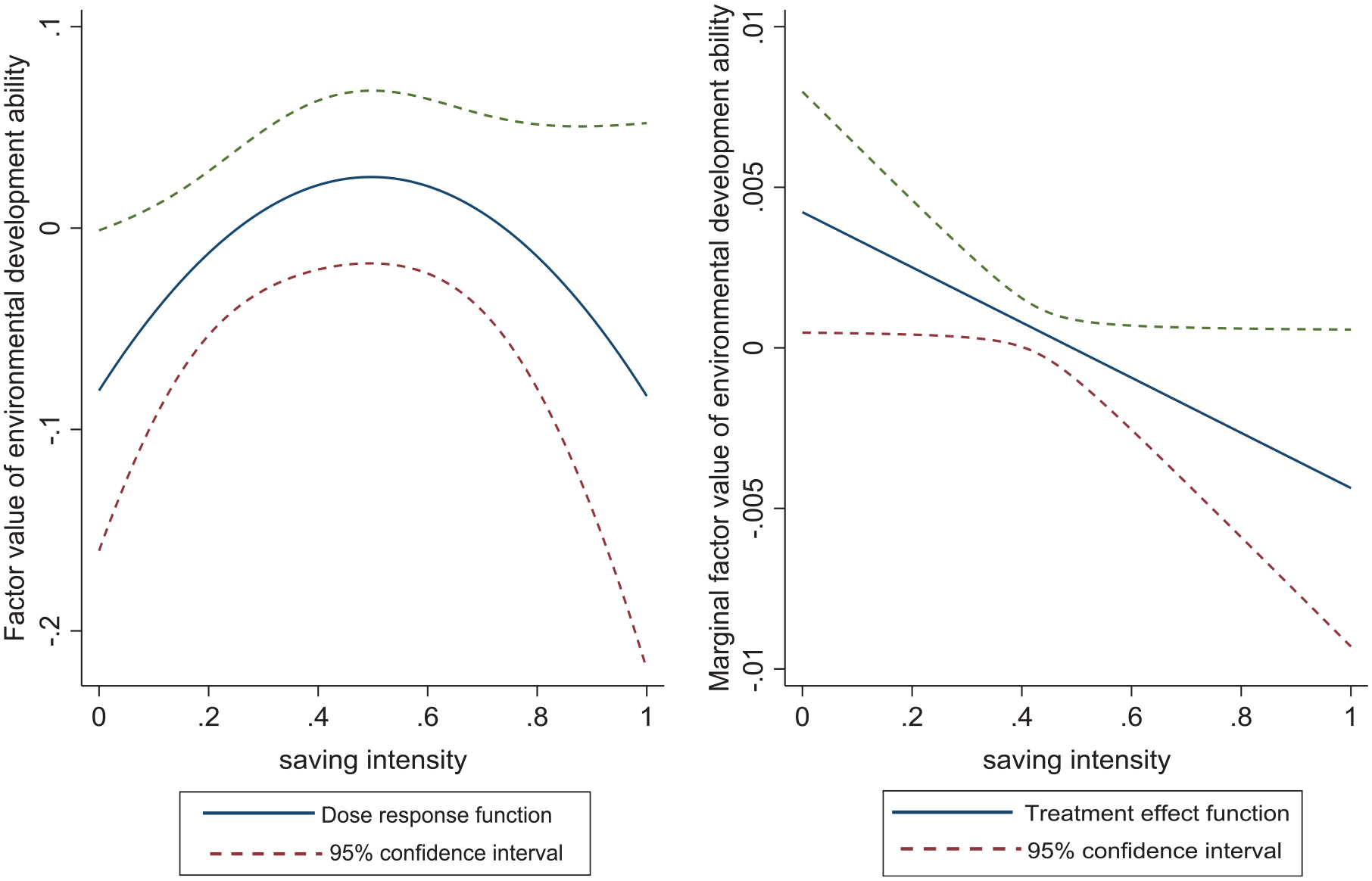
The effect of family saving rate on environment development ability.
Generalized Propensity Score Matching Estimation Results.

Note. The treatment effect is +0.01, and the value of T is in parentheses.
p < .05. ***p < .01.
As shown in Figure 2 and Table 4, the effect trend of family saving rate on population development ability is in the shape of an inverted U-shaped curve. The treatment effect was positive and significant in the 0% to 48% storage treatment intensity range, but insignificant in the 48% to 68% range; it was negative and significant in the 68% to 100% range. When the saving intensity is converted into the family actual saving rate, the family actual saving rate is in the −100% to 35% range, and the increase in saving rate is beneficial to the family. When the family actual saving rate exceeds 35%, the positive effect of the increase in saving rate will be suppressed by the negative effect, but will have a restraining effect on the population development ability.
As shown by Figure 3 and Table 4, the effect of family saving rate on the development ability of family relations shows a pattern similar to the effect on the development ability of population; both are in the shape of an inverted U-shaped curve. The treatment effect was positive and significant in the 0% to 44% storage treatment intensity range, insignificant in the 44% to 55% range, and negative and insignificant in the 55% to 100% range. When the intensity of saving is converted into the family actual saving rate, the family actual saving rate is in the −100% to 10% range, and the increase in saving rate is beneficial to the development of the family relationship. When the family saving rate exceeds 10%, the positive effect of the increase of saving rate will be suppressed by the negative effect, but will have a restraining effect on the family relationship development ability.
As shown by Figure 4 and Table 4, the impact model for family saving rate on the environment development ability is different from that of the former two. The treatment effect is positive and significant within the 0% to 45% saving treatment intensity range. After the family saving intensity exceeds 45%, although the treatment effect value tends to be negative, the confidence interval expands rapidly and the treatment effect is no longer significant.
As shown by Figure 5 and Table 4, the impact model for family saving rate on risk resilience is different from the first three, and the saving treatment effect shows a significant linear growth trend after exceeding a threshold. The treatment effect was negative and significant in the range of 0% to 6% storage treatment intensity, and no longer significant in the range of 6% to 37%. However, the treatment effect value increased step-by-step, and became positive when the treatment intensity was 28%, and was positive and significant in the range of 37% to 100%. When the intensity of saving is converted into the family real saving rate, the family real saving rate is within the range of −100% to 28%, and there is no promotion effect of family saving rate on risk resistance. When the family real saving rate is within the range of −28% to 96%, the growth of family saving will significantly improve the risk resistance.
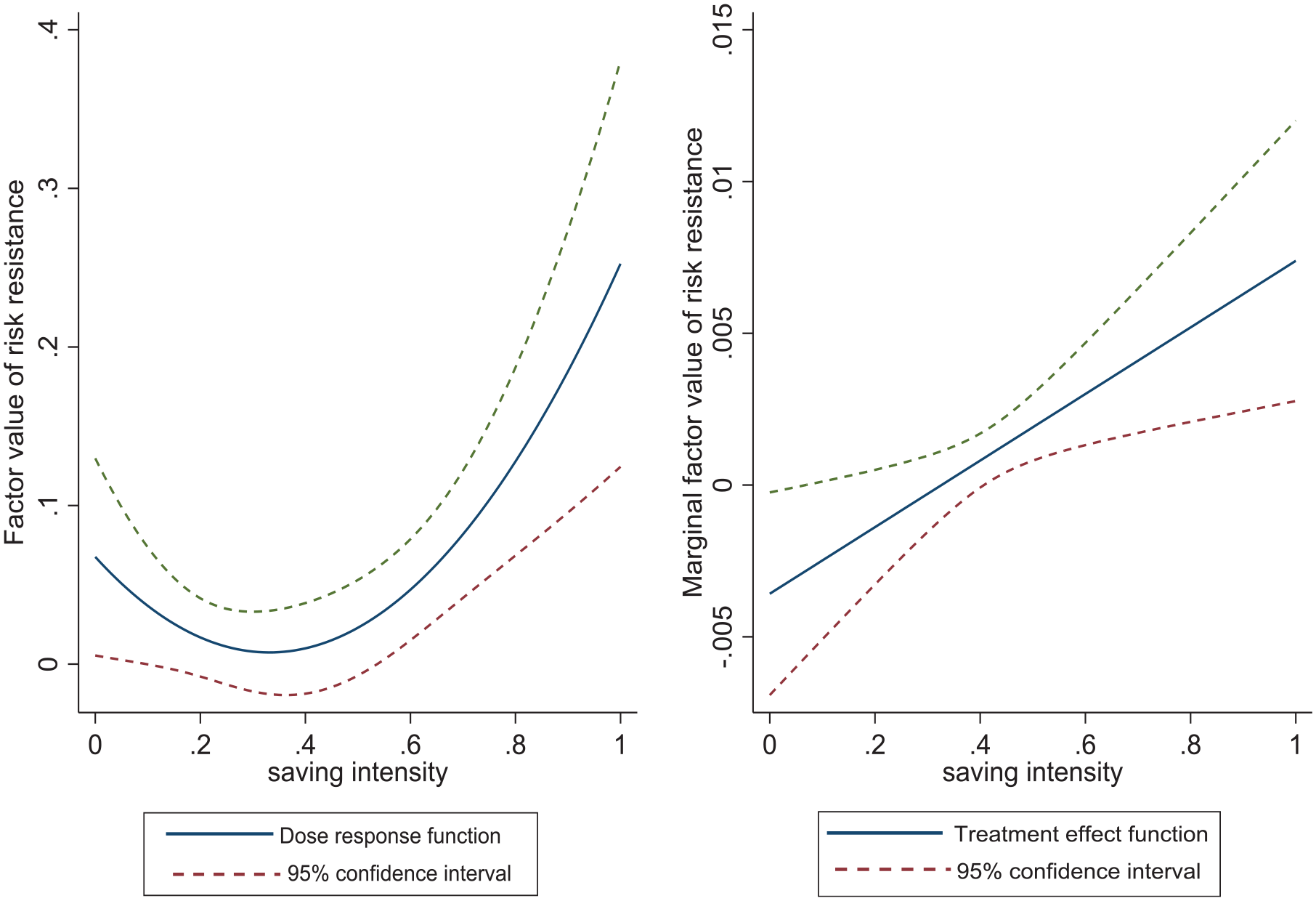
The effect of family saving rate on risk resilience.
Mechanism Analysis and Robustness Testing
SEM-Based Mediation Mechanism Analysis
After the causal inference on the impact of government subsidies and family saving rate on the family development ability, we will now discuss the mediation role of family confidence in the future. It is now known that government subsidies promote neither family members’ confidence in the future, nor improvement in family development ability. Thus, there is no mediation mechanism. While there is evidence of a significant effect of family savings on family development ability, there are three development ability impact models which each show the form of an inverted U-shaped curve. The treatment effect is positive when the saving rate is low, and negative when the saving rate is high. Next, we used the mediation effect model to test whether there is a mediation mechanism of family future confidence in the middle, and whether the mediation transmission mechanism also exhibits the same rule as the inverted U-curve. The family development ability value is the family comprehensive development ability value calculated by EFA. The above GPSM estimation results show that the treatment intensity range of the saving rate’s treatment effect on each family’s population, environment, and relationship development ability is 44% to 68% from positive to negative. Thus, taking 0.68 as the critical value, we divided the families into a positive effect saving group and a negative effect saving group, and tested the mediation mechanism via the SEM method.
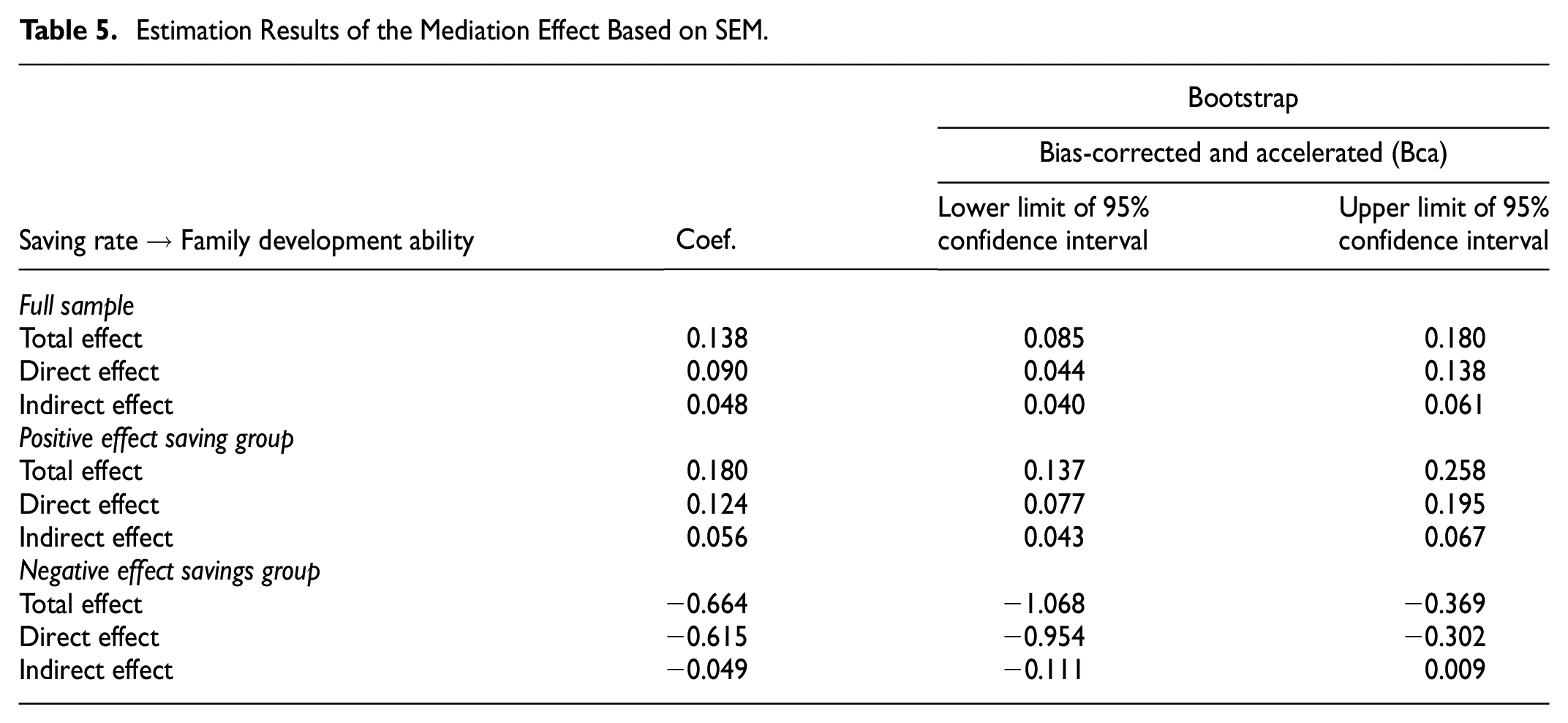
See Table 5 for the estimation results of the mediation effect based on SEM. For the whole sample, the mediation effect of the impact of family savings on family development ability through future development confidence is 0.048. The 95% confidence interval constructed by the Bootstrap method does not include 0, and the proportion of the indirect effect in the total effect is 34.5%. In the positive effect saving group, the mediation effect of family saving on family development ability through future development confidence is 0.056, the 95% confidence interval constructed by the Bootstrap method does not include 0, and the indirect effect accounts for 31.0% of the total effect. As shown, relative to the regression results of the whole sample data, the total effect, direct effect, and indirect effect coefficient values of the family savings in the positive effect saving group on the family development ability have improved. This is consistent with our expectations, and appears in the results after the negative effect saving group’s inhibitory effect is separated. In the sample from the negative effect saving group, the total effect of family saving rate on family development ability is negative and significant; the mediation effect coefficient turns negative; the 95% confidence interval constructed by the bootstrap method includes 0; and the mediation effect of family future confidence is ineffective. This shows that the positive effect of family saving on the family development ability through the transmission of family’s future confidence is limited by the level of saving. Moreover, family saving rate only has a positive effect within a certain range. Research Hypothesis 5 has been validated.
Estimation Results of the Mediation Effect Based on SEM.
Robustness Testing Based on Regression Discontinuous Design (RDD)
GPSM needs as many covariates as possible to calculate the propensity score in order to satisfy the unconfoundedness. It solves the problem of selectivity bias primarily by measurable variables, and cannot control for unobservable heterogeneity. Thus, there may still be a bias problem due to the unpredictable variables. In this section, we use Regression Discontinuity Design (RDD) to test the robustness of the effect of family savings on family development ability. RDD constructs local natural experiments by forming control and experimental groups with no difference in distribution on either side of the cut-off point, thus inferring causal effects.
We adopt the sharp regression continuity design (SRDD) method, taking the family saving rate as the driving variable and the saving rate of 0 as the cut-off point to determine whether each family belongs to the treatment group with saving or the non-treatment group without saving. The general grouping rule of SRDD at the cut-off point C is
The empirical analysis results of SRDD are shown in Table 6. As shown, the family development ability of the experimental group with savings is higher than the family development ability of the control group without savings in the whole sample. These results are significant regardless of whether it is based on the triangular kernel or rectangular kernel function, or whether we select 0.5 times the optimum broadband, normal broadband, or 2 times the optimal broadband. Due to the jump in the conditional density of the covariate family hukou attribute at the cut-off point, we continue SRDD estimation to separate urban and rural samples. This ensures the estimation results’ reliability. As shown in the 0.5 times optimal bandwidth, the estimation value of the treatment effect coefficient for the triangular kernel and the rectangular kernel function of the rural family sample is still significant. In the normal optimal bandwidth and the 2 times the optimum bandwidth, the estimation of the treatment effect coefficient for the triangular kernel and the rectangular kernel function of the urban family sample are still significant. Thus, this study provides strong evidence for the robustness of the previous analysis results.
SRDD Estimation Results for the Impact of Saving Rate on Family Development Ability.

Note. Z-value in parentheses,
p < .01, **p < .05, ***p < .01.
In order to avoid the invalidation of the cut-off point regression result caused by the endogenous grouping problem caused by the artificial manipulated variable, we delete 2%, 4%, 6%, 8%, and 10% of the sample values near the cut-off point, respectively, and then test the robustness results of five groups of SRDD. If they pass the test, the SRDD estimation result is still valid, even in the presence of artificial manipulation. None of the 95% confidence intervals for the estimation coefficients in the five groups of results contain a 0 value. This indicates that the estimation coefficients for SRDD are significant and the estimation results are credible.
Results and Discussion
Based on the CFPS2016 data and the theory of asset building, we first screened out the indicators of constructing family development ability through exploratory factor analysis. This consisted of four potential variables representing family development ability—family population development ability, relationship development ability, environmental development ability, and risk resistance ability. The reliability and validity of the factor structure are verified by confirmatory factor analysis. Then, we used the structural equation model to examine the correlation between the variables. The results showed that family saving is correlated with the family development prospects. Families with higher saving rates usually have better family development ability, but families with poor family development ability often get more government subsidies, which can reflect the accuracy of government subsidies in the target groups. There is no positive correlation between family saving rate and government subsidy. Cash income in the current period helps the target families mitigate urgent problems, but at the same time, it does not help the policy target to save. The performance of family members’ confidence in their future life is correlated with the family’s development ability. However, the correlation between the family saving rate and the government subsidy is also diametrically opposite of the correlation between family members’ confidence in their future lives. Thus, income-based social policy is not applicable to the “ambition-supporting effect” on the target group. The asset-based social policy approach based on promoting increasing family saving rates is more complementary to the “ambition-supporting effect.”
On this basis, in order to solve the endogeneity problems in the study, we make causal inference of the treatment effects of family savings and government subsidies on family development ability. Based on the PSM method, we found that the family saving rate has a greater effect on family development ability than government subsidies. Moreover, the asset-based social policy intervention is more effective in promoting family development ability than income-based social policy. Next, we used the GPSM method to conduct an in-depth analysis of the treatment effectiveness of the asset-based social policy approach. The influence pattern of family saving rate on the family population development ability and relationship development ability is shown as the coexistence of a promotion effect and an inhibition effect. When the family saving rate is less than a critical value, the promotion effect of the increase in family saving rate on family population and relationship development ability far exceeds the inhibition effect; However, when the saving rate exceeds the critical value, the inhibiting effect will outweigh the promoting effect, and the increase in family saving rate will be detrimental to the family population and the relationship development ability.
Based on the research results, it is apparent that there is an optimal family savings value for the effect on family development ability, that is, the more family savings, the better the family development ability. A certain proportion of family savings can help family relations and the quality of the population to develop in a good direction. However, excessive family savings cannot improve family relations and the ability of population development indefinitely. On the contrary, it will increase the burden of family savings and erode the emotional connection between family members, which is not conducive to the family members’ development. In addition, the increase in family saving rate has a significant positive effect on the physical environment within the family, and too high a saving rate will not be harmful to the family’s environment development ability. The family saving rate is a positive factor in improving the family’s environment development ability. However, it needs to exceed a certain critical value in order to promote the family’s resistance to risk. The low family saving rate indicates poor finances for most families. At this time, the family needs to devote the vast majority of its current income to maintaining the necessary consumer goods and services for living. The consumption far exceeds the family income and cannot facilitate asset accumulation. However, when the family consumption/income ratio begins to become reasonable, and the family consciously saves, the value of the family’s risk resilience will increase exponentially with the increase in family saving rate. The treatment effect of family saving rate will also increase linearly.
In sum, this study suggests that a low family saving rate leads to a low family development ability, which is not conducive to long-term family development; However, if the family saving rate is too high, it will not only reduce the family’s disposable income in the current period, but will also have a negative effect on other family development ability. This resulted in a restraining effect, which is also unfavorable to family development. Only when the family saving rate increases within an appropriate range can the family development ability improve significantly. When the actual family saving rate is about 35%, the family development ability shows the comprehensive best value. At this time, the family’s population and relationship development ability values are all in the high position of the inverted U-curve, and the environmental development ability and risk resistance ability are also good. As this study shows, asset-based social policy approach should help families implement a reasonable savings plan based on the family savings status, in order to promote healthy, long-term family development. Finally, the analysis of the mediation mechanism tells us that family savings growth can improve family development ability by increasing the family members’ confidence in the future. Moreover, the asset-based social policy approach shows a strong “supporting ambition effect.” The robustness test based on cut-off point regression verifies the reliability of the asset-based social policy approach’s treatment effect.
At present, the direct cash payment welfare supply remains the mainstream social assistance policy. However, the challenge of this policy form is its high labor costs and controversial effects. If families want to improve their living conditions over the long-term, they must implement future asset accumulation and invest in education, housing, and industry. This is the same for all families, be they poor or rich (M. Sherraden & Gilbert, 2016). Our research shows that family savings are more helpful to the long-term development of families than government subsidies in promoting “capability.” This also suggests that setting up an individual development account would be a positive and feasible way to improve social policies, especially when the policy targets are those who cannot meet their basic living needs. In this case, the individual development account may be more effective. The reason for this is that this segment of the population cannot complete a certain amount of asset accumulation through government subsidies or their own savings. At this time, asset-based social policy intervention is particularly important. However, what is worth further consideration that the asset building theory is a policy guiding ideology which originated in the United States. The individualistic values in American cultural emphasize individual responsibility as the favorable soil for establishing family savings accounts. At the same time, there are wide disparities in social structure and system between China and the United States. This has led to the implementation of an asset-based social policy in China based on the establishment of an individual development account to promote family savings and the accumulation of family assets. This requires further exploration in light of China’s national conditions. For example, which groups benefit more from the accumulation of savings? In addition to the psychological effects that can promote the family’s sense of hope in the future, through what behavioral effects will savings promote family development? Can a community public asset account be established in China, where collective culture is emphasized? These are all issues worthy of further discussion in the context of China.
Footnotes
Declaration of Conflicting Interests
The author(s) declared no potential conflicts of interest with respect to the research, authorship, and/or publication of this article.
Funding
The author(s) received no financial support for the research, authorship, and/or publication of this article.
