




Abstract
Organizational attachment echoes the psychological bond between employee and employer relations, differing from affective component of commitment in terms of employees’ psychological and behavioral involvement. This study examines the extent to which employee perception about procedural, distributive justice and job cognition contributes toward organizational attachment in India. The effect of justice and job cognition variables relates differently to previous studies from western part of the globe. First, in past studies, procedural justice predicted commitment, whereas, for Indian employees, distributive justice contributed to organizational attachment. Second, the contribution of extrinsic job cognition in organizational attachment was evident in the model developed using Structural Equation Modeling (SEM; AMOS). Organizations must take cognizance of the outcomes exhibited by the behavior of managers while following the laid down policies and processes. Cognition of fairness at workplace and attachment can play key role in limiting retention. Practical implications and future research directions are discussed.
Introduction
Organizations working on innovative retention strategies confront various factors contributing to employee turnover. As a cover up, they mainly focus on interventions such as career development, growth-oriented appraisal, providing friendly environment, training, and fringe benefits to build employee commitment (Paul & Anantharaman, 2004). These practices are significantly related to employee intention to stay (Chew & Chan, 2008). The positive actions by management promotes employee attachment for which structural characteristics of the workplace are important in maximizing efficiency (Taplin & Winterton, 2007). Top management puts down the norms and policies through different human resource (HR) interventions that intend toward employee satisfaction and work–life balance. The drafting of policies in the organizational settings followed by fair and equitable treatment with all the employees is certainly questionable! This perception of justice among the employees on the outcomes they receive and the way they are treated (Cropanzano, Bowen, & Gilliland, 2007; Gilliland, 2008) has been investigated to explain employee attitude and behavior through several organizational outcomes such as job satisfaction, organizational commitment, organizational citizenship behavior (OCB), performance, and withdrawal (Cohen-Charash & Spector, 2001; Colquitt, Conlon, Wesson, Porter, & Yee, 2001).
In the growing economy with transformations in organization structure, attrition has become a common phenomenon, and Indian automobile sector is not untouched. In the drive to retain performing employees, several retaining approaches are administered at the workplace. The possibility of shifting the approach from retaining employees to generating organizational attachment among them appears positive and promising. Instead of trying to fix the problem of retention, developing the feeling of attachment toward the organization among all the employees may be a better answer. With increasing foreign investments in Indian automobile sector, the rise in competition opened opportunities for the efficient employees to accept lucrative offers elsewhere. The automotive component industry is taking over a rapid expansion especially in developing countries like India and Brazil. A pressure in these organizations to improve their competitiveness to survive in domestic as well as international markets poses the greatest challenge. Large number of original equipment manufacturers (OEM) entering the market lead to migration of talents and skilled hands. Therefore, strategies for retaining qualified and skilled manpower are drawing attention.
Previous empirical research and their meta-analysis show that antecedents and correlates on employee intentions to stay with the organization can mainly be categorized into three major groups of variables: first, the demographic parameters such as gender, age, position, and so on; second, the job characteristics or its nature; and third, the working environment that includes opportunities for career advancement, training, supervision, and communication (Choudhury & Gupta, 2011; Fields, Dingman, Blum, & Roman, 2005; Griffeth, Hom, & Gaertner, 2000; Huang, Lin, & Chuang, 2006; Price, 2001). The relationship between pay satisfaction, job satisfaction, wages, and turnover intention has been overworked. The point is to generate inner willingness among the employees to stay in the organization and give their best. For this, an investigation of the cognitive and affective processes that influence and instigate attitude and behavior formed the base of this work. Studies have shown that structural characteristics of the workplace created by management decisions influence the efficiency of employees and promote their attachment to the organization (Taplin & Winterton, 2007). Most of the studies on the variables explaining organizational attachment have been through the lens of organizational commitment.
Addressing the challenges in the automobile industry and the necessity for sustaining capable hands in the organization, this research was taken up. The purpose of this article is to examine the influences of procedural justice, distributive justice, and job cognitions (intrinsic and extrinsic) on organizational attachment of the employees in Indian automobile industry. The article contributes value first by empirically analyzing the justice and cognition framework as determinants of organizational attachment among the employees in Indian organizations. India being one of the biggest markets and cheapest workforce attracts many takers. Therefore, to retain the performance and reduce job hopping, developing feeling of attachment among the employees can play key role. Second, it provides practical insights into organizational managers and HR practitioners about the relative importance of job and organization-related aspects at workplace and its role in setting individual attitude and behavior toward the organization. It is anticipated that these insights may be relevant in contemporary organizations by reducing the problem of workforce turnover in the industry and further motivating them through various interventions discussed in the research implications part of the article.
Literature Review
The causes of attrition and strategies for retaining the employees have been predominantly studied by Western researchers in developed economies (Fields et al., 2005; Griffeth et al., 2000; Price, 2001). Most have approached the issue of high employee turnover in the organizations from explanations based on pay satisfaction, job satisfaction, leadership style, supervision, and training. Studies highlighted on the fairness adapted in the policy formation and execution of benefits to the employees (Beugre & Baron, 2001; Li & Cropanzano, 2009). Research shows that voluntary employee turnover is contingent on the amount of congruency between individual values and the organization structure (Ambrose & Schminke, 2003; Zeffane, 1994).These lines are insightful in explaining the workplace parameters, assuming that these can be controlled and modified to retain employees.
The significance of individual cognition has been overlooked in the studies; the behavior of employees provided with similar benefits sharing common organization resources varies. This may be due to the difference in individuals’ cognitive part. The stimulus in the environment of an individual and the way it affects behavior are regulated by cognition. Moreover, attitude and behavior of a person intrinsically guided will vary from that of a person externally driven. On these lines of inquiry, we argue that the impact of employees with an attachment toward the organization is developed through equity at workplace and positive emotions through job cognition.
Organizational Justice
Adam’s perspective (1965) of equity as the principle behind justice builds from the social exchange relationships. According to this, employees perceive their/ others outcome that is pay, reward to be in confirmity with input in form of effort, education of the individual. The just and unjust situations are generally dependent on how the individual values justice (Deutsch, 1985; Hegtvedt, 1993; Mowday, 1983), and the norms of justice develop from the guidelines for interaction (Folger & Cropanzano, 1998). Justice at workplace affects work outcomes such as OCB, work performance, job satisfaction, and work behaviors such as withdrawal, commitment, and supervision evident from past studies (Cohen-Charash & Spector, 2001; McFarlin & Sweeney, 1992; Moorman, 1991).
Employee perception is influenced by the organization policies, procedures, and practices, as well as demographic and personality characteristics. Justice or fairness in these organizational settings influences employee perception that gets reflected in their behavior affecting the outcomes. Justice has mainly been set in two domains: perceived fairness of outcomes as distributive justice and perceived fairness of processes as procedural justice (Holtz & Harold, 2009). Although many researchers have emphasized on overall organizational justice in predicting a number of outcomes (Bobocel, 2013), in this study, procedural and distributive justice are kept independent to indicate the practices that contribute to attachment in organization.
Procedural justice includes in it the interpersonal aspect also, although many researchers have taken it as a separate dimension (Colquitt et al., 2001; Cropanzano & Randall, 1993; Greenberg, 1993). The concept of procedural justice in the framework of legal procedures was introduced by Thibaut and Walker (1975). Later, Laventhal, Karuza, and Fry (1980) added six criteria: the theory of procedural justice judgments, procedures to be consistent across people and time, free from bias, ensure right way of making decisions, confirm to prevailing standards of ethics, and ensure the opinion of groups affected by the decision. Past studies have shown strong relationship of procedural justice with organizational outcomes (cited by Alexander & Ruderman, 1987, in Colquitt et al., 2001).
Job Cognition
In the working environment, cognition of one’s job or job experience influences positive emotions and these emotions or perceptions affect performance (Locke, 1976). Social cognitive theories advocate the importance of working environment and its context on the performance. The employees are assumed to be information workers spending most of their time in absorbing, processing, and disseminating information about issues, opportunities, and problems (McCall & Kaplan, 1985). The knowledge and experience gained in the work environment form their perception, leading to attitude and behavior. Therefore, it has been suggested that integration of work context and its cognition is relevant to study organizational outcomes (Mardas, Theofanides, & Philippidou, 2011).
Of the studies that suggest the importance of job cognition in human behavior, most have focused on its role in social exchange framework (Blau, 1964; Organ & Konovsky, 1989). The study is extended to two job cognition variables. The extrinsic job characteristics and intrinsic aspects of the job measured the different elements of the job at workplace describing its nature (Williams & Anderson, 1991). These variables of job cognition predicted in-role behaviors of the employees. Job cognitions correlated strongly with OCB (Lee & Allen, 2002; Moorman, 1993; Organ & Konovsky, 1989; Williams & Anderson, 1991). The intrinsic job cognition explores the inner desire to use competencies and abilities in the job, whereas the supervisors’ influence, amount of work, opportunities to grow, recognition, and interpersonal relations express the external job cognitions. The way these job characteristics are perceived gives a meaning to the structures at workplace and influences decisions (Walsh, 1995). Therefore, the knowledge structure of individuals influenced by the organization structure can cause change in behavior.
Organizational Attachment
Organizational attachment consists of affective commitment and identification on part of the employee to stay in the organization. This indicates that even during the bad times for the organization, employees may not necessarily take advantage of their employment alternatives; rather, they continue to contribute their knowledge, skills, and abilities voluntarily to protect their organizational assets (Bar-Haim, 2007). Various scholars have also echoed on the importance of psychological bond or attachment between employee and employer as a predictor of retention (Gaiduk, Gaiduk, & Fields, 2009; Meyer & Allen, 1997; Riketta & Van Dick, 2005). Because the workgroup and the organization are common foci of employee attachment, this attachment is strongly related to potential outcome (Riketta & Van Dick, 2005).
Past research on work-related attitudes such as job satisfaction and organizational commitment has been widely studied at various levels and through different independent variables explaining them. Organizational commitment predicted the affective and compliance attitude of the employee (Meyer & Allen, 1997; O’Reilly & Chatman, 1986). The affective aspect denotes how far an individual identifies and is involved with the organization. Studies on commitment showed employees’ attitudes differed in ways consistent with their commitment profiles (Becker & Billings, 1993). Commitment not only needs to consider various foci but also its bases—that is, the motives behind the individual commitment (Porter, Steers, Mowday, & Boulian, 1974). Moreover, the affective commitment mainly consisted of the evaluative and behavioral component of the employee. Organizational attachment adheres more to the cognitive component expressed in behavior. It has been defined as the combination of an employee’s psychological and behavioral involvement (Tsui, Egan, & O’Reilly, 1992). It has been frequently studied and measured as combination of affective organizational commitment and employee intentions to stay (Casper & Harris, 2008; Gaiduk et al., 2009; Mano-Negrin, 1998; Riketta & Van Dick, 2005).
In addition, employee attachment explains loyalty (Hajdin, 2005). The emotional connections toward the job through employment relation have been explored (Mitchell, Holtom, Lee, Sablynski, & Erez, 2001). Studies have also considered the concerns of salary and such benefits in the preview of attachment (Bar-Haim, 2007). Studies and models put forth the view that motivation of employees makes a great deal of difference in employee retention. Although different components of organization help employee to fulfill intrinsic and extrinsic needs, employee departures are inevitable consequences of market providing better alternatives (Hajdin, 2005; Staniuliene, 2007). Indian studies have shown the relation between justice, ethics, trust on commitment, and intention to stay (Purang, 2011).
Our study endeavors to provide an approach of retaining employees through developing attachment toward the organization by considering the cognitive perspective. It is built on the joint role of justice and cognition explaining attachment of employees toward organization. The study extends the prior research by extending the role of job cognition in attachment. The migration of talent due to entry of large number of similar firms has created the need for retention strategies. Such phenomena can be observed not only in automobile but all other sectors in Indian economy. Therefore, to curb this, organization has to build niche in the employees’ psyche and develop understanding on what stimulates the feeling of attachment.
Objectives
To examine the drivers behind organizational attachment, we follow the equity logic and argue that although fair dealings at workplace generate positive feeling and give a message of equity to the employees, the state of cognition about the fairness does play an important role in generating that positive feeling. Prior research has also suggested that job design, fairness of job pay, managerial approaches, job role clarity, employee development opportunities, and communication aspects can directly affect the employee behavior and can be controlled by the employer through different mechanisms (Gaiduk et al., 2009; Griffeth et al., 2000). An investigation of the United States, India, Germany, Hong Kong (China), and Lithuania has shown differential effects of procedural and distributive justice (Fields, Pang, & Chiu, 2000; Gaiduk et al., 2009; Pillai, Williams, & Tan, 2001).
Distributive and Procedural Justice With Organizational Attachment
Distributive justice and procedural justice are positively associated with mutual commitment (Coyle-Shapiro, Kessler, & Purcell, 2004). They have significant interactive effects on organizational outcomes (Cohen-Charash & Spector, 2001; McFarlin & Sweeney, 1992; Rupp & Cropanzano, 2002). The first component of justice being distributive justice has to do with allocation of outcomes. It is at times differentiated at workplace. It is more or less based on “equality of ratios” or equity theory. Procedural justice refers to the means by which outcomes are allocated, but not specifically to the outcomes themselves, often referred to as “fair process effect.” The fair processes lead to intellectual and emotional recognition, creating trust and building voluntary cooperation (Cohen-Charash & Spector, 2001; Kim & Mauborgne, 2005). This generates commitment and often affects job satisfaction (Nadiri & Tanova, 2010; Tyler & Blader, 2000), although some research show vice versa, that is, justice generates job satisfaction (Aurier & Siadou-Martin, 2007) leading to affective commitment (Loi, Hang-yue, & Foley, 2006; Rifai, 2005). It shows a positive relation with organizational identification (Olkkonen & Lipponen, 2006). Empirical evidence shows it is not necessary that procedural justice predicts only system-referenced outcomes (McFarlin & Sweeney, 1992). Research claimed procedural justice to be strongly associated with job satisfaction (Masterson, Lewis, Goldman, & Taylor, 2000), organization committee (Tyler, 1990), OCB (Skarlicki & Latham, 1996), and performance (Earley & Lind, 1987). Although these studies supported influence of procedural justice on organizational outcomes, contradicting studies were also available.
The interactive effects of distributive and procedural justice accounted for significant unique variance in the psychological distress of an employee or job stress (Cropanzano & Mitchell, 2005; Lambert, Hogan, & Griffin, 2007; Tepper, 2001). Effect is seen in employee health (Elovainio, Kivimäki, & Helkama, 2001), workplace sabotage (Ambrose, Seabright, & Schminke, 2002), and trust consisting of credibility and benevolence (Philippe & Beatrice, 2007). The relevance of the present study gains importance as it evaluates the effect of justice on Indian culture; most of the research in past is based on Western culture. Past research has shown that justice is evaluated differently in different cultures (Leung & Bond, 1984; Major & Deaux, 1982; Mueller, Iverson, & Jo, 1999).
The current research builds on the argument that the role of distributive and procedural justice in predicting employee behavior can be applied to developing organizational attachment among them. Distributive justice appeared to be more important in predicting personal outcomes such as pay satisfaction and job satisfaction, whereas procedural justice more strongly affected organizational commitment (Cohen-Charash & Spector, 2001; DeConinck & Stilwell, 2004; Lambert et al., 2007; McFarlin & Sweeney, 1992). Meta-analytical estimates suggested that relationships between distributive justice, work attitudes, and behaviors were mostly mediated by procedural justice perceptions (Viswesvaran & Ones, 2002). The unique variance between procedural and distributive justice shows procedural justice to be highly related to work attitude and behavior. It may be due to higher contribution of procedural justice in predicting fairness of the organization as a whole (systemic justice) as compared with distributive justice (Beugre & Baron, 2001). Therefore,
Job Cognition, Justice, and Organizational Attachment
The literature on cognition has argued the role of knowledge and experience in predicting work attitude and behavior. Past studies have discussed the organization characteristics such as goals, structures, and procedural constraints on employee behavior (Mardas et al., 2011; Philippidou, 2007; Rainey, 2003). The effect of expectancy based job cognitions on OCB and job satisfaction was observed to be influenced through beliefs (Kemery, Bedeian, & Zacur, 1996). The two job cognitions variables (intrinsic and extrinsic) were differentially related to OCB (Williams & Anderson, 1991). Discretionary behavior exhibited by an individual, not explicitly recognized by reward system, is reciprocated out of fair treatment offered by the organization (Organ, 1990). Although most have focused on how cognition may affect the extra-role behavior and job satisfaction (Brief & Roberson, 1989; Kemery et al., 1996; Lee & Allen, 2002; Moorman, 1993; Organ & Konovsky, 1989), we explore the contribution of justice and job cognition in determining the employee attachment toward the organization.
Specially, we follow the multilevel model by Judge, LePine, and Rich (2006), which examined the dynamic nature of emotions at work, work attitudes, and workplace deviance. As a result, more than half of the total variance in workplace deviation was within individual and predicted by justice. Because individual trait was observed to moderate interpersonal justice, we assumed the contribution of intrinsic cognition in organizational attachment. Research on trickle down model suggests procedural justice perceptions lead to subordinates OCB (Tepper & Taylor, 2003), explained by employees reciprocating fair treatment by performing citizenship behaviors. Investigation of the cognitive and affective processes that underline attitudes and behavior shows their influence on individual emotions (Ashkanasy, 2002). Work on equity sensitivity and its impact on organizational commitment and intention to leave further strengthen the assumptions made in this study (O’Neill & Mone, 1998). Past studies in the Indian subcontinent focused on the individual’s perception of the psychological climate on organizational outcomes (Biswas & Varma, 2007). The ability of well-being and hassle free environment in Indian organizations predicted positive relation with affective commitment, strengthening the base of this study (Jain et al., 2009). Results in cross-cultural research observed that Indians exhibited higher willingness to affective commitment (Ramamoorthy, Kulkarni, Gupta, & Flood, 2007). Thus,
Method
Sample and Survey Procedure
Total 200 survey questionnaires were distributed among the three levels of executives of large and medium-size Indian automobile manufacturing organizations employing more than 500 employees situated in the central Indian subcontinent. Written assurance of confidentiality of their response was given in the opening paragraph. A total of 189 executives participated in the study. The data were collected through stratified convenient sampling method covering executives from different level, departments, experience, and age. To address the issue of internal homogeneity in the population, questionnaires were distributed to 50% executives of each department (strata) of respective organization. Later, the researcher approached the respondents for collecting filled questionnaires. Out of 200 questionnaires, 189 responses were collected in three to four rounds of efforts. Special care was taken to ensure the representation from different levels and group of the respondents.
Descriptive Statistics
Sample includes executives of different departments, namely, HR, Finance, Marketing, Production, and Inventory. Participation in the study was voluntary and participants were assured to keep their identity anonymous. Two hundred questionnaires were distributed by the researcher and 195 were returned within 2 weeks with the return rate of 97%. One hundred eighty-nine surveys (94%) were found acceptable to be used in the analysis and were sufficient for Structural Equation Modeling (SEM; Bentler & Chau, 1987). Questionnaires were rejected due to missing data such as demographic information or other important information vital for the analysis; and questionnaires were eliminated with extreme values found beyond three SD in box plots at both ends. The majority of respondents (74.2%) were undergraduates, while 25.8% were post graduates. Years of experience ranged from 6 months to 34 years with a median of 8 years and age of the respondents ranged from 21 to 55 years with the median of 32 years in the population.
Measures
A three-section questionnaire was administered, including an opening paragraph stating the purpose of the study and an assurance of complete anonymity of individual responses. Except for personal demographic information (e.g., age, gender, designation, experience, etc.), all other measures used a 5-point (1 = strongly disagree; 5 = strongly agree) scale.
Job cognition
The 15 items measure developed by Williams and Anderson (1991) was used to measure the job cognition containing two subvariables: intrinsic and extrinsic job cognition. It asks employees to describe the extent to which these statements are accurate descriptions of the nature of job. Intrinsic job cognition consisted of 8 items and had a coefficient alpha value of .78 originally, which is comparable with the calculated value of .65. The subvariable extrinsic job cognition containing 7 items had coefficient alpha value of .71 originally, which is very close to the calculated value of .72. Sample items included “My manager understands employee” (extrinsic job cognition); “Have freedom to use my own judgment” (internal job cognition). A confirmatory factor analysis (CFA) with AMOS 18 was conducted to test the dimensionality of Job cognition. The goodness-of-fit statistics confirmed the unidimensionality of the scale. The CFA was based on using raw data as input and maximum likelihood estimation. The analysis showed that the model fitted the data reasonably well (χ2 = 81.57, df = 78, p < .369; Goodness-of-Fit Index [GFI] = 0.899; Incremental Fit Index [IFI] = 0.990; Comparative Fit Index [CFI] = 0.989; Normed Fit Index [NFI] = 0.807; Tucker–Lewis Index [TLI] = 0.985, Root Mean Square Error of Approximation [RMSEA] = 0.023).
Organizational justice
A 23-item scale developed by Sweeney and McFarlin (1997) was used to assess the fairness of organizational justice in the organizations. The original scale consisted of two subscales—Procedural and Distributive Justice. Procedural Justice subscale was composed of 12 items with the alpha coefficient reliability given by authors as .84, which is comparable with .76. Distributive Justice subscale was composed of 11 items with alpha reliability coefficient .81 given originally, which is far above the calculated value of .50 in the study. Sample items for the Distributive Justice included “Promotions or unscheduled pay increases here usually depend on how well a person performs on his or her job.” CFA was conducted to test the distributive justice with different fit indices. The analysis showed that the model fitted the data reasonably well (χ2 = 48.82, df = 37, p < .09; GFI = .91; IFI = .95; CFI = .95; NFI = .83, TLI = .92, RMSEA = .06).
Organizational attachment
Six-item scale of Gaiduk et al. (2009) was used to assess the organizational attachment. Sample items included, “I would not leave my job even for a better salary at another company.” The alpha reliability coefficient was reported .74 originally. CFA was conducted to test the organizational attachment with different fit indices and shows that the model fitted the data well (χ2 = 8.61, df = 8, p < 0.37; GFI = 0.97; IFI = 0.99; CFI = 0.99; NFI = 0.91, TLI = 0.98, RMSEA = 0.029). The coefficient alpha of .62 in this study (see Table 1) was comparable.
Means, Standard Deviations, and Correlations of Study Variables.

Note. n = 189. Decimals are omitted from intercorrelations and alphas; diagonal entries in parenthesis (bold) indicate coefficients alpha.
p < .05. ***p < .01.
Data Analyses Procedure
Data were handled in two phases. In the first phase, the data were cleaned with the help of box plot and deleted/modified the extreme cases in the responses. The extreme values beyond 3 SD from the median were deleted and those within the limit were modified to next higher/lower acceptable values. In the second phase, a two-step procedure (Anderson & Gerbing, 1988; Medsker, Williams, & Holahan, 1994) was used to test the hypotheses. In the first step, the distinctiveness of the self-report measures used in the study was tested. In the second step, hierarchical multiple regression analysis was done followed by structural model analyses that specified the nature of the hypothesized relationships among the constructs. Five fit indices used in estimating measurement models were chosen to assess the fit of structural models: the GFI, CFI, IFI, NFI, TLI, and RMSEA were also considered (Bentler, 1990; Bentler & Bonett, 1980; Bollen, 1989; Joreskog & Sorbom, 1989).
Results
The means, standard deviations, zero order correlations of the study variables are shown in Table 1. The correlation of organizational attachment with each of the predictor variables including intrinsic job cognition, extrinsic job cognition, procedural justice, and distributive justice are all significant p < .01. The largest correlation among these predictor variables is .433. This does not raise the question of multicollenearity or lack of discriminant validity among the variables (Stevens, 1996). H2a and H2b predicted that intrinsic and extrinsic job cognition have positive relationship with organizational attachment. These hypotheses were tested in hierarchical multiple regression followed by SEM shown in Tables 2 and 3.
Hierarchical Multiple Regression Analysis.

Note. Dependent variable: Organizational attachment.
p < .10. **p < .05. ***p < .01.
Unstandardized and Standardized Parameter Estimates in Confirmed Model.
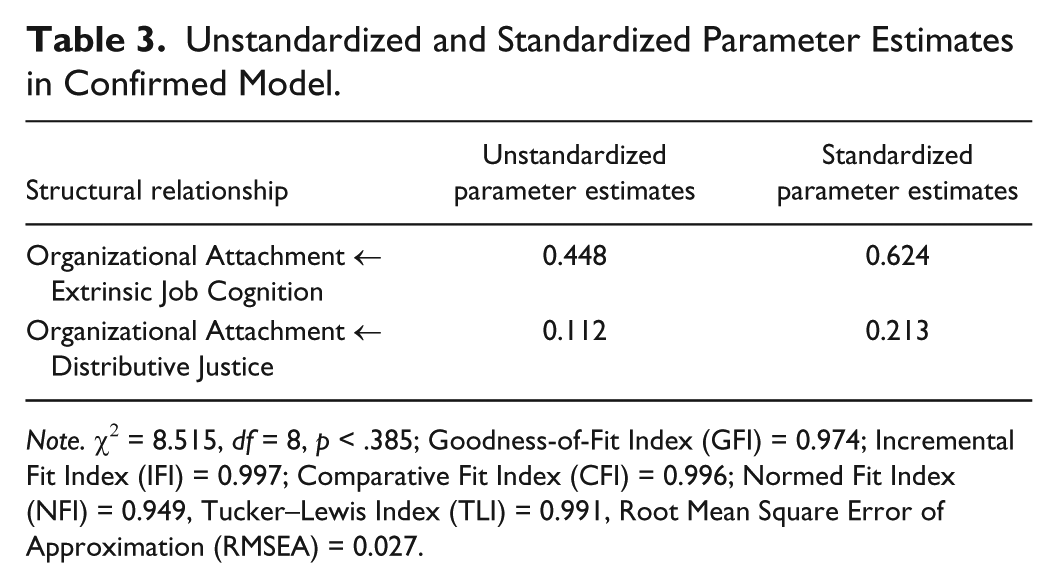
Note. χ2 = 8.515, df = 8, p < .385; Goodness-of-Fit Index (GFI) = 0.974; Incremental Fit Index (IFI) = 0.997; Comparative Fit Index (CFI) = 0.996; Normed Fit Index (NFI) = 0.949, Tucker–Lewis Index (TLI) = 0.991, Root Mean Square Error of Approximation (RMSEA) = 0.027.
The hierarchical multiple regression Model 1 shows that demographic variables age, total experience, and experience in organization do not contribute in the model (F = 0.573, ns; R2 = .020). The regression Model 2 shows that predictors extrinsic job cognition (β = .318, t = 2.401, p < .05) and distributive justice (β = .238, t = 1.907, p < .10) contribute significantly. The R2 value shows the significant contribution explaining 27% variance in Model 2 (R2 = .27, F = 4.282, p < .01). These results partially supported H2 as extrinsic job cognition significantly contributed in Model 2. Results do not support H1 as procedural justice does not contribute in organizational attachment. The peculiar feature that emerged in the analysis is that the contribution of distributive justice toward organizational attachment was not hypothesized. These two contributing variables were taken in the SEM for further analysis.
To verify the distinctiveness of the measures, a CFA including all the variables was conducted. The analysis included three variables. CFA analysis clearly indicated the superiority of model (χ2 = 8.515, df = 8, p < .385; GFI = 0.974; IFI = 0.997; CFI = 0.996; NFI = 0.949). In conclusion, results of the CFA and measurement model analysis indicate that the measures have sound psychometric properties. Before testing the hypothesized relationship, the study examined the relationship of salient demographic variables presumed to be related to the entire construct taken into the study. Demographic variables of age, experience and experience in current organization, extrinsic job cognition, intrinsic job cognition, distributive justice, and organizational attachment are strongly correlated with each other, followed by hierarchical multiple regression in the analysis, and gave sound basis for further analysis. Hierarchical regression analysis gave the idea to consider the variables for SEM.
In the model, covariance path from extrinsic job cognition to distributive justice was considered an exogenous variable and was proposed as a direct predictor of organizational attachment. Parameter estimates for structural relationships (unstandardized and standardized) are reported in Table 3. Salient SEM results are summarized in Figure 1.

Hypothesized model.
First, extrinsic job cognition and distributive justice were found to be related to organizational attachment in the model. Thus, H1 is rejected as procedural justice has been excluded in the regression and distributive justice emerged as significant contributor in the model, which was not under the purview of the proposed hypothesis. H2 is partially accepted as extrinsic job cognition contributes in explaining the organizational attachment (H2a) and intrinsic job cognition does not affect organizational attachment (H2b).
Discussion
Summary of Research and Theoretical Implications
The present framework integrates the literature on job cognition, procedural and distributive justice, and organizational attachment in response to how organization can develop feeling of attachment among their employees and retain them. These drivers have rarely been jointly examined. Some previous studies have focused on aspects of justice, commitment, and satisfaction (Gaiduk et al., 2009). Their study indicated significant role of job and organizational variables in attachment. Fairness in the procedures used to assign and evaluate work predicted organizational attachment. Our study extends these lines of research not only by examining key aspects of organizational attachment from the industry but also by considering job cognition as an important variable in developing the feeling of attachment toward the organization. Most importantly, we contrast the past findings that established the contribution of procedural justice on organizational commitment. We revealed the significance of distributive justice at workplace and contribution of extrinsic job cognition while linking them to the attachment perspective.
First, this article offers a unique perspective on understanding organizational attachment by focusing on justice and cognition drivers. The seed of attachment grows with trust (Pillai, Scandura, & Williams, 1999) that is built through justice. Cross-cultural study by them shows significant relation of procedural justice with organizational commitment and job satisfaction in countries like America, Germany, and China. However, in India, the relation was insignificant. Cultural dimensions such as collectivism/individualism and power distance get reflected in the differences between the effects of distributive and procedural justice between Hong Kong and the United States (Fields et al., 2000). It was observed that in Hong Kong, procedural justice moderated the relation between distributive justice and job satisfaction, intending to stay. In a similar study in the United States, procedural justice was found to moderate the relation of distributive justice with supervision only. The gap between practices and policies undermine employee trust (Masterson, 2001; Searle et al., 2011). This difference is evident in form of perception developed toward procedural and distributive justice. Distributive justice negatively related to emotional exhaustion, also negatively influenced organizational commitment and turnover intentions (Cole, Bernerth, Walter, & Holt, 2010). It indicates that perceptions of unfairness among employees may take an emotional toll on individuals, affecting their organizational attitude and behavioral intentions.
Second, we examined the relationship between job cognition and organizational attachment. Job attitude of an individual is influenced by job cognition and reflected in organizational attitude and behavior. No studies in the past is available that speaks of the significant role played by the extrinsic components of job cognition contributing toward organizational attachment. The organizational environment builds faith in an employee; this cognition influences attitude such as satisfaction (Bandura & Wood, 1989). An understanding of specific leverage points that are extrinsic components of job can be helpful in generating attachment toward the organization.
Third, this study has taken one step forward in expanding the influence of research on retention strategies by use of distributive justice and providing a work environment with healthy interpersonal relations and opportunities for advancement affecting organizational attachment. Predictors of employee turnover illustrate that leaving job and moving to the same job in different organization were increased by less concerned supervision exhibited by the supervisor, higher job stress, and low job satisfaction (Fields et al., 2005). These predictors are affected by the degree of fairness toward the subordinates by the supervisor. Present research findings as shown in Figure 2, represent significant progress above the limited number of previous studies on justice and organizational outcomes.

Model confirmed after statistical treatment with the variables.
Fourth, this study has useful implications for related areas of research. The model established in the study opens the doors of further investigation into other factors that seem to contribute in building attachment.
Practical Implications
Our results indicate that retention through attachment of employees in the organization requires equitable treatment (equity theory) and positive perception on the extrinsic job components. Managers that are perceived to make unfair decisions and act in a disrespectful manner can deplete subordinates’ valued resources. Victims of such injustices feel low and often show withdrawal behavior (Cole et al., 2010; Tepper, 2001). Fairness perception in social environment is contagious (Harris, Harvey, & Kacmar, 2009; Hollensbe, Khazanchi, & Masterson, 2008) and can be encouraged by training the managers and encouraging them to follow justice guidelines (Brockner, 2006). The process of cognition formation and contribution of extrinsic factors of job such as interpersonal relations in dyadic relationship, working conditions, and role of recognition at workplace should be well understood by the managers to generate feeling of attachment.
Conclusions, Limitations, and Future Research Directions
This study, as a first attempt in its kind, departs from previous work on organizational outcomes by examining both the role of justice and cognition in organizational attachment. In conclusion, our findings suggest that distributive justice and extrinsic job cognition are not only important but also promising for future research on organizational attachment perspectives in India, and potentially around the world.
The limitations of this study offer objectives for future research construct. First, for accuracy and simplicity, we have only studied one type of industry in India. Caution should be exercised in generalizing our findings to other industries. Second, the data for this study are cross-sectional, so a longitudinal or experimental study can further provide concrete evidence to the model. Third, this study established a model with the best goodness of fit with the variables; further studies may explore the influence of other variables and their intervening relationship. This study could not establish strong relations with demographic variables; maybe such study in service industries can explain any influence.
Footnotes
Declaration of Conflicting Interests
The author(s) declared no potential conflicts of interest with respect to the research, authorship, and/or publication of this article.
Funding
The author(s) received no financial support for the research and/or authorship of this article.