




Abstract
The cultivation of computational thinking and programing education have gained prominence in K-12 education worldwide. Primary school teachers should be proficient in visual programing and using microcontrollers to teach programing courses. To cope with these trends, a learning activity was developed and implemented in Taiwan’s primary teacher education curriculum. The activity aimed to help preservice primary teachers learn about Scratch visual programing and micro:bit microcontroller boards by engaging in a physical computing project involving the design of an educational motion sensor game about energy. The results of the preliminary study found that the preservice primary teachers who participated in the activity were able to collaborate and develop motion sensor games suitable for primary school students. They also demonstrated significant improvements in their computational thinking concepts (t(10) = 3.13, p < .05) and energy knowledge test scores (t(10) = 2.74, p < .05). Furthermore, most participants expressed satisfaction with the activity, implying the activity’s feasibility for teacher education.
Keywords
Introduction
The cultivation of computational thinking (CT) among students has become crucial in the field of education. CT refers to the logical thinking used by computer scientists to solve problems (Anderson, 2016; Grover & Pea, 2013; Santos et al., 2018). This educational trend was advocated by Wing (2006), who argued that CT should be a basic skill set for everyone. At present, several countries, such as the US, UK, Australia, South Korea, and Taiwan, have actively adopted CT as a major K-12 educational goal (Hsu et al., 2018; Tsai et al., 2022; Voogt et al., 2015). Programming education is frequently associated with the cultivation of CT among students; through the programming process, students can learn about CT concepts (Brennan & Resnick, 2012). Further, many scholars have advocated that learning programming is the most effective method for students to learn about CT (Ausiku & Matthee, 2021; Shute et al., 2017; Zhang & Nouri, 2019). Accordingly, programming education has received increased attention alongside CT, and several countries, such as the UK, Japan, Finland, and Taiwan, have provided programming courses in their primary school (Brown et al., 2014; Ministry of Education, 2020a; Seow et al., 2019). Therefore, both CT and programming have recently become integral to K-12 education in many countries (Papavlasopoulou et al., 2019).
As part of the effort to make programing easy to learn for primary students and to generate interest in programing, visual and block-based programing language, such as Scratch, Microsoft MakeCode, and App Inventor, has been commonly applied in primary schools worldwide (Portelance et al., 2016; Price & Barnes, 2015; Weintrop & Wilensky, 2015). Taiwan’s technology education curriculum also recommends the use of visual programing software from the third grades (Ministry of Education, 2020a). Visual programing uses graphical objects to produce programing instructions (Myers, 1990); this makes it easier for novice programmers to learn programing without challenging text-based syntax. For example, the Scratch software developed by MIT Media Lab is a widely-used visual programing software in primary school programing courses. Coding in Scratch software is like stacking blocks, where students can write programs simply by dragging and stacking the graphical programing instructions (Price & Barnes, 2015). Moreover, Scratch makes computer game design simple; research indicates that it is a common programing education activity for students to design digital games using Scratch (Garneli et al., 2015; Mladenović et al., 2018). Numerous studies have highlighted that using Scratch can enhance students’ computational thinking skills (Mladenović et al., 2018; Rodríguez-Martínez et al., 2020; Sáez-López et al., 2016; Zur-Bargury et al., 2013).
Another major trend in primary school programing courses is the design of physical computing projects, which involve the use of visual programing on physical computing devices, such as Arduino and BBC micro:bit microcontrollers, and using different sensors to allow these devices to interact with their surroundings. For example, in 2016, the United Kingdom introduced the use of micro:bit into primary school programing courses (Ball et al., 2016). Taiwan also recommended introducing primary school students to microcontroller boards in the fifth and sixth grades (Ministry of Education, 2020a). Physical computing refers to using programmable microcontrollers and electronic sensors to perform tangible programing (Kotsopoulos et al., 2017). Through physical computing activities, students can learn to use computer programing to control electronic devices, such as controlling LED lights or motors. They can also use programing to create interactive inventions, such as self-driving cars, robots, etc. The benefit of physical computing is that it allows students to make abstract programing concepts concrete and tangible. It also provides students with hands-on experience (Hodges et al., 2020; Przybylla & Romeike, 2014). For example, the micro:bit is a small, programmable physical computing device with built-in sensors such as accelerometer sensors. It can be programed using visual programing software such as Scratch, making it easy to learn and fun to use. Currently, students from more than 50 countries worldwide use micro:bit to learn programing or design physical creations (Austin et al., 2020). Several studies have indicated that the use of micro:bit can help enhance students’ computational thinking skills (Song et al., 2020; S. Y. Wu & Su, 2021).
Thus, in response to the global trend that emphasizes CT and programing education, utilizing visual programing and microcontrollers has become a crucial component of the current programing education curriculum in many primary schools worldwide, including Taiwan. However, the emphasis on programing education affected the K-12 teacher education, particularly primary school teachers who mostly teach all kinds of subjects, because primary teacher education rarely valued the training of programing in the past (Ng, 2017; Rich et al., 2017). For instance, in the context of primary teacher education in Taiwan, the Ministry of Education requires preservice primary teachers to complete at least 36 credits of professional education courses and 10 credits of specialized education courses (Ministry of Education, 2020b). Professional education courses involve pedagogical theories, methodology, teaching strategy, and teaching practicum courses. On the other hand, specialized education courses provide preservice primary teachers with knowledge of primary school subjects, such as Mandarin Chinese, mathematics, social science, natural science, art, technology, and physical education. Hence, there are only a few primary teacher education courses that could enhance preservice teachers’ programing knowledge in Taiwan. In other words, to address the trend that emphasizes programing education in primary schools, it is crucial to prioritize preservice primary teachers’ visual programing and physical computing capabilities within the limited timeframe of Taiwan’s current teacher education programs.
Given Taiwan’s limited teacher training time, this study aimed to develop a meaningful learning activity to enhance the capabilities of preservice primary teachers in visual programming while concurrently using physical computing equipment. Programming education in primary school of Taiwan is typically included in the technology education curriculum. Hence, this study selected a specialized education course of preservice primary teacher education, entitled “Introduction to Technology,” to implement the learning activity. Considering technology education in Taiwan emphasizes hands-on activities, and many studies have also recommended game design as a popular way of learning programming that excites student interest (Kafai & Burke, 2015; B. Wu & Wang, 2012). Furthermore, the widespread use of micro:bit microcontrollers can use the Scratch programming software to develop simple motion control games. Thus, this study attempted to develop a motion sensor game-design project in the above primary teacher education course to motivate preservice primary teachers to learn about visual programming and microcontrollers, thereby enhancing their CT concepts.
Serious games are an effective tool for helping students learn (Baptista et al., 2015). Therefore, if preservice primary teachers are expected to engage in the creation of motion sensor games, creating educational games would be more meaningful. In addition to learning about developing motion sensor games, preservice teachers can further think about how to help students learn through these games. Therefore, this study involved a real-world game-design project that required preservice primary teachers to develop an educational game that could promote learning among primary school students; this game must be tested by primary school students after completion. Furthermore, given the growing attention of an increasing number of educational institutions toward the 17 sustainable development goals (SDGs) of the United Nations (Kioupi & Voulvoulis, 2019), this study also required preservice teachers to incorporate energy-related SDGs into the educational motion sensor games they were developing; this way, primary school students may gain energy-related knowledge while playing the games.
In summary, this study mainly aimed to equip preservice primary teachers with the basic abilities to teach programing courses through a physical computing project while improving their CT concepts, programing attitudes, and energy-related knowledge. Given the current trends of programing courses in primary schools, this project must be developed using the micro:bit and Scratch programing software. Furthermore, to increase the authenticity and meaning of the learning activity, this project required the teachers to develop an energy-related motion sensor game that can be played by primary school students. The goal was to make this a feasible learning activity for cultivating programing abilities among preservice primary teachers in Taiwan. Therefore, to determine the feasibility of this plan, a preliminary study was performed on a teacher education course to address the following aspects:
To explore the performance of preservice primary school teachers in the physical computing project.
To examine the changes in the CT concepts, programing attitudes, and energy-related knowledge of preservice primary teachers after the physical computing project.
To explore the perceptions of preservice primary teachers after the physical computing project.
Physical Computing Project
The micro:bit microcontroller board has a built-in accelerometer, which can detect movement in three dimensions and sense any tilting or shaking in the board. It also has a radio antenna, which can transmit information about the detected movement to other microcontroller boards. Thus, we can use two micro:bit microcontroller boards, one connected to the computer via USB and the other powered by an external power source to serve as the controller of a motion sensor game. By shaking the micro:bit microcontroller board with the external power source and transmitting messages via wireless radio waves to the other microcontroller board connected to the computer, we can control Scratch game to form a motion sensor game. To facilitate the learning of visual programing and microcontroller boards among preservice primary teachers, this study devised a physical computing project. The project involved the use of two micro:bit microcontroller boards and bDesigner, a block-based programing software similar to Scratch but with more block-based programing instructions that enable control of micro:bit boards. Participants were tasked with creating a motion sensor game that integrates learning about energy knowledge.
This project was implemented in an elective “Introduction to Technology” course, which is 2 credits and is offered by the teacher education center of a university in southern Taiwan. The course was held twice a week, with each session lasting 50 min. The first 8 weeks were focused on teaching the students how to use the visual programing language to control the built-in LED lights, buttons, three-axis accelerometer, and external buzzer of the micro:bit board. The course also involved teaching the students how to use two micro:bit boards to create a simple motion sensor game and the IFTTT (If This Then That) web services to upload game scores to a cloud database. Over the 6 weeks that followed, the students divided themselves into groups to complete their projects. This study provided each group with two micro:bit boards, a USB cable, and an external power expansion board. However, each group also had to prepare their own supplies, such as cardboard, tape, hot glue, and ready-made objects. Furthermore, this study integrated the engineering design procedures of Cunningham (2009) and Ranalli and Ritzko (2013) to guide students. The project required the students to define problems, gather information, develop solutions, create the game, test the game, and improve the game, in this order. During the first week, the students were asked to confirm the project’s problems and collect information on energy education and game creation. Game planning and creation began during the second week. During the fifth week, the games were demonstrated and tested at a primary school. Finally, during the last week, the groups presented their final products.
Methods
Given the lack of appreciation for programing courses in teacher education in Taiwan, this study involved only preliminary research conducted through an elective course. Consequently, this study was designed as a quasi-experiment involving the pretest and posttest of a single group. Its purpose was to examine the feelings of preservice primary teachers and changes in their CT concepts, programing attitudes, and energy-related knowledge after completing the physical computing project to assess the suitability of this project. The research participants, research process, and research tools used are described as follows.
Research Participants
This study selected an “Introduction to Technology” course related to technology education offered by the teacher education center of a national university in southern Taiwan as the experimental course. The study participants were all second-year students in the primary education program. Due to the course being an elective, only 13 students were enrolled. During the project activity, the students divided themselves into four groups. However, only 11 students became this study’s research subjects since two of them did not participate in the entire experiment. Among the participants, 1 was male, and 10 were female. None of the research subjects had previous experience using the micro:bit. Only two female students had taken a programing course before. Nevertheless, all participants had short-term experience using the Scratch visual programing software.
Research Procedure
This study was performed over a period of 14 weeks, with two 50-min classes every week. It involved learning courses on the use of the micro:bit microcontroller board from Week 1 to Week 8. From Week 9 to Week 14, the project design activity was executed, and the participants were required to test their products at a specified primary school during the penultimate week and collect feedback from primary school students. All students presented their completed games and reports during the final week of the project activity. In determining the effectiveness of this project, the participants were required to complete a pretest and posttest on their CT concepts, programing attitudes, and energy-related knowledge before and after of the project design activity. They were also required to complete a perception scale after the project.
Research Instruments
Computational Thinking Test
The CT test developed by Tsai et al. (2022) was used to examine changes in the CT concepts of preservice primary teachers after participating in the physical computing project. This 10-item scale was designed based on the seven CT concepts involved in Scratch visual programing (sequences, loops, events, parallelism, conditionals, operators, and data), proposed by Brennan and Resnick (2012). The first seven items address one CT concept, and the last three combine multiple CT concepts. The highest possible score is 100, the Kuder–Richardson reliability of the scale is 0.62, and the mean difficulty and discrimination are 0.66 and 0.39, respectively.
Computer Programing Attitude Scale
The computer programing attitude scale developed by Tsai et al. (2022) was used to determine changes in the programing attitudes of preservice primary teachers after participating in the physical computing project. This scale comprises four dimensions—confidence, preference, usefulness, and gender—with each dimension constituting four items, accounting for a total of 16 items. Each item is scored on a 5-point scale, with options including strongly agree, agree, neutral, disagree, and strongly disagree. Example items from this scale are as follows: “I have confidence in learning computer programing” (confidence dimension), “I enjoy computer programing” (preference dimension), “Learning computer programing is not helpful at all for my future” (usefulness dimension), and “Boys are more proficient in computer programing than girls” (gender dimension). The scale has a Cronbach α of .89.
Energy Knowledge Test
Changes in the energy-related knowledge of preservice primary teachers were measured with an energy knowledge test designed by Tsai et al. (2022). This test comprises 20 multiple-choice items on basic energy-related knowledge, including questions such as “Which of the following is not a form of primary energy?” and “What is the largest source of energy production in Taiwan?” The highest possible score is 100, the Kuder-Richardson reliability of the test is 0.51, and the mean difficulty and discrimination are 0.88 and 0.20, respectively.
Participation Perception Scale
A participation perception scale, adopted and modified from Tsai et al. (2022), comprising 13 items was used to assess the perceptions of preservice primary teachers after participating in the physical computing project. These items measure the participants’ feelings regarding their attained knowledge and engagement in the project on a 5-point scale, with a Cronbach α of .86. The items are listed in Table 4.
Results
Project Results
All motion sensor games completed by all groups are presented in Table 1. Groups 1 and 2 presented in their games the main character inspired by Demon Slayer: Kimetsu no Yaiba, an anime series popular among students at the time. Given the character’s ability to perform water attacks, both groups created educational games on hydropower. In the game developed by Group 1, the player uses a handheld sword to attack obstacles that prevent the dam from generating power. In the game developed by Group 2, the player is required to rapidly wave a sword to facilitate water storage in the reservoir. In the game developed by Group 3, inspired by Taiko no Tatsujin, the player is required to strike the correct green energy icon on the beat with a handheld drum stick. In the game developed by Group 4, similar in principle to Whac-A-Mole, the player must control a joystick and mallet to strike the correct energy symbol. Among these games, those developed by Groups 3 and 4 were more educational because they promote the understanding of green energy and energy symbols during the gameplay. Although Groups 1 and 2 developed games based on hydropower, the gameplay involved only removing obstacles and storing water; in these two games, the gameplay received greater attention than educational value.
Project Results.

Regarding the game controller design, the game developed by Group 1 involved a sword as the sensor controller. The sword was made using cardboard and wrapped in colored paper. The micro:bit was affixed to the sword hilt, and the three-axis accelerometer was used to detect whether the user was rotating or swinging the sword. These actions were performed to make the game character move or strike the obstacles. The game developed by Group 2 involved affixing the micro:bit on a ready-made toy sword. The three-axis accelerometer was used to detect whether the user was swinging the sword, which, in turn, would control the reservoir water levels in the game. The game developed by Group 3 involved a drumstick as the game controller. The micro:bit was secured on a ready-made rolling pin, and the three-axis accelerometer was used to detect user movements to control the drumming action in the game. The game developed by Group 4 involved a wireless joystick and mallet as the controllers. Two micro:bit microcontrollers were affixed to a ready-made plunger and a toy mallet, and the three-axis accelerometer was used to detect the movements of the joystick and mallet to determine the motion of the mallet in the game. Among these controller creation efforts, Group 1 invested the most effort, whereas the other groups used ready-made products. However, Group 4’s use of a plunger as a joystick was the most creative choice.
Each game required the player to enter their name at the beginning. After the game ended, IFTTT was used to upload the player’s name and score to a spreadsheet stored on Google Drive. After each group presented their games to the primary school for testing, they announced the game scores to the students and rewarded high scorers. Noteworthily, each group developed a fully operational motion sensor-based game with the Internet of Technology (IoT).
Analysis of Computational Thinking Concepts
A CT concept test was administered to preservice primary teachers before and after the physical computing project to explore whether the project activity helped improve their CT concepts. According to the pretest and posttest results presented in Table 2, the mean test score was 50.90 (N = 11, SD = 16.40) before the project and increased to 63.64 (N = 11, SD = 13.62) afterward. The paired samples t-test results were t(10) = 3.13, p < .05, Cohen’s d = 0.94, indicating that the posttest scores were significantly higher than the pretest scores and effect size was large. This result indicated that the physical computing project might have helped reinforce the CT concepts among the study participants.
Computational Thinking Concepts Test Scores.

p < .05.
The preservice primary teachers’ performance on different CT concepts was analyzed further, as shown in Table 2. As seen, the participants performed well in questions on sequences, parallelism, and conditionals (the highest possible score for each concept was 10 points) before the project. However, the participants performed poorly on events, data, operators, loops, and mixed concepts (the highest possible score was 30) before the project. The paired samples t-test results revealed considerable changes in the events and mixed concepts test scores, indicating that the physical computing project could help reinforce events and mixed CT concepts. However, the project might not have helped improve the CT concepts on operators and loops among preservice primary teachers.
Analysis of Computer Programing Attitudes
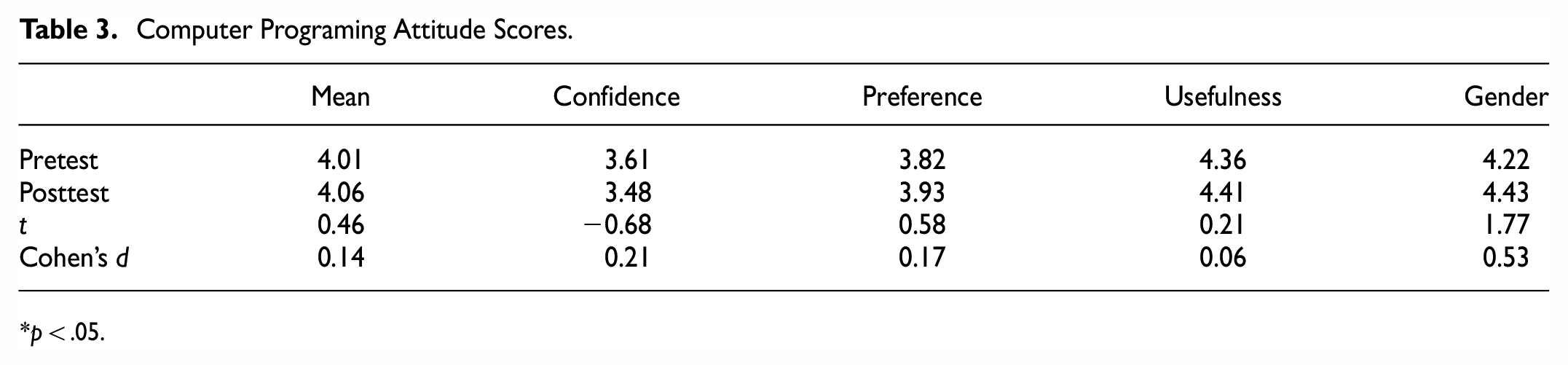
All preservice primary teachers were asked to complete a computer programing attitude scale before and after the physical computing project to explore whether the project affected their computer programing attitudes. Responses were scored on a 5-point scale, ranging from 5 (strongly agree) to 1 (strongly disagree). As shown in Table 3, a universal positive trend among the participants’ attitudes toward computer programing before and after the project, with no major difference between the mean pretest and posttest scores, which were 4.01 (N = 11, SD = 0.59) and 4.06 (N = 11, SD = 0.43), respectively. Additionally, the paired samples t-test results revealed no significant difference (t(10) = 0.46, p > .05, Cohen’s d = 0.14), indicating that the physical computing project might not have considerably improved the computer programing attitudes of the preservice primary teachers.
Computer Programing Attitude Scores.
p < .05.
Participants’ scores in different dimensions were further analyzed to explore the changes in programing attitudes, as presented in Table 3. Notably, none of the participants exhibited considerable changes in their pretest and posttest programing attitudes in any dimension, and all of the observed changes in the confidence, preference, usefulness, and gender dimensions were positive. However, the participants scored lowest on the confidence dimension for computer programing, and their mean posttest scores were lower than the pretest scores.
Analysis of Energy Knowledge
An energy knowledge test was administered to preservice primary teachers before and after participating in the physical computing project to explore whether the project helped improve their energy-related knowledge. The results indicated that the mean score of the preservice teachers on the energy knowledge test increased from 82.7 (N = 11, SD = 13.30) to 93.18 (N = 11, SD = 6.43) before and after the project. In addition, the paired samples t-test results were t(10) = 2.74, p < .05, Cohen’s d = 0.83, indicating that the posttest scores were significantly higher than the pretest scores and effect size was large. This result indicated that the physical computing project might have helped the preservice primary teachers enhance energy-related knowledge.
Analysis of Participation Perception
All participants were asked to complete a participation perception scale after the physical computing project in order to examine the feelings of the preservice primary teachers toward the physical computing project. The responses were scored on a 5-point scale, ranging from 5 (strongly agree) to 1 (strongly disagree). Table 4 shows that every item had a mean score of 4 or higher and that the overall mean score was 4.76, implying that the preservice primary teachers were highly satisfied with their participation in the project. In addition, the participants’ responses to questions regarding their learning perceptions revealed that most of them perceived the project as an effective means to learn about Scratch visual programing, micro:bit microcontroller boards, energy, and IoT. This finding confirms that the project achieved its original goal: to help preservice primary teachers learn about visual programing and microcontroller boards. Furthermore, according to the participants’ responses regarding project participation, most experienced a sense of accomplishment toward their designed game and reported that being able to present their work to a primary school was a meaningful exercise. This finding confirms that the design of the project is meaningful.
Participation Perception Responses.

Note. Items were adopted and modified from Tsai et al. (2022).
Discussion
CT and programing education have gained prominence in K-12 education worldwide. Hence, primary education in Taiwan has started emphasizing the learning of visual programing and microcontroller boards. However, some adjustments are required in Taiwan’s teacher education to cope with these trends. Therefore, this study developed and implemented an innovative and meaningful learning activity in Taiwan’s primary teacher education curriculum. The goal was to encourage preservice primary teachers to learn about visual programing and microcontroller boards by engaging in a physical computing project involving the design of an educational motion sensor game about energy while simultaneously attempting to improve the CT concepts, energy knowledge, and programing attitudes of these teachers.
After learning and receiving guidance on the project activity, the participants cooperated with their teammates and developed four educational motion sensor games. Two of the developed games were about hydropower generation, and the other games involved recognizing energy symbols. In addition to designing the game rules, sprites, and interfaces with the Scratch visual programing tool, the participants combined micro:bit microcontrollers with cardboard or ready-made tools to create the game controllers. The games were tested by primary school students. The players could control the games with a sword, drumstick, or joystick. The study results revealed that preservice primary teachers who had no experience with microcontroller boards could be guided by this activity to engage in physical computing and create meaningful motion sensor games. This indicates that the physical computing project developed in this study was feasible. This finding supports previous research regarding physical computing projects conducted by preservice primary teachers, including a study by Tsai et al. (2022). Their research allowed preservice teachers without prior experience in using microcontroller boards to develop a multiplayer educational computer game using Scratch and Arduino; ultimately, all preservice teachers were able to complete the project tasks in this study. Therefore, promoting Scratch game development projects for preservice primary teachers should be feasible and can be continuously applied in teacher education to enhance their skills in visual programing and microcontroller board.
An analysis of the pretest and posttest scores of the participants revealed that, in addition to helping preservice primary teachers develop an educational motion sensor game, the project promoted the preservice teachers’ test scores on CT concepts and energy-related knowledge. A subsequent analysis of the results of the CT concepts test revealed a significant increase in the event and mixed CT concept performance of preservice teachers. This finding is consistent with many previous studies that indicate learning Scratch can help improve computational thinking (Brennan & Resnick, 2012; Cetin, 2016; Rodríguez-Martínez et al., 2020; Sáez-López et al., 2016, 2020). Moreover, designing Scratch games can enhance students’ computational thinking concepts (Kafai & Burke, 2015; Mladenović et al., 2018; Zur-Bargury et al., 2013), and learning the micro:bit board can improve students’ computational thinking abilities (Song et al., 2020; S. Y. Wu & Su, 2021). However, further research is required to determine whether the observed improvement in computational thinking scores of preservice primary teachers in this study was primarily due to project-based learning or other factors. Including a control group in future experiments is also necessary.
However, in the present study, the participants did not demonstrate improvements in some CT concepts, namely operators and loops. Although this observation echoes the assertions in some previous studies, which argue that novice programmers often struggle with CT concepts related to operators and loops (Denner et al., 2012; Grover & Basu, 2017), it indicates that preservice teachers striving to teach CT and programing in primary schools should endeavor to continue learning about operators and loops. One recommendation is to provide more opportunities for preservice primary teachers to practice math operations related to programing and utilizing loops. Moreover, an analysis of the results of the energy knowledge test revealed a significant improvement in the energy knowledge of preservice teachers, indicating that the participants may expand their knowledge of energy by developing an energy education game. This outcome not only supports the findings of previous studies indicating that game-design activities can be used to advance the scientific knowledge of students (Carolyn Yang & Chang, 2013; Ke, 2014; Tsai et al., 2022), but also verifies the feasibility of using the development of an educational game as a game-design project. Teacher education in the future could allow preservice primary teachers to develop motion sensor games for other subjects to enhance their knowledge in different subjects.
The present study initially expected that the project activity might enhance not only the preservice teachers’ CT concepts and energy knowledge but also their attitudes toward computer programing. However, according to the analysis of the participants’ programing attitude scores, the preservice teachers who participated in this activity demonstrated positive attitudes toward computer programing before the activity. Furthermore, there was no significant change in their programing attitude scores after the activity, suggesting that this activity may not be effective in improving the preservice teachers’ attitude toward programing. In addition, the results revealed that preservice primary teachers have low confidence levels in computer programing, which conforms with the results of a previous study (Tsai et al., 2022). These outcomes indicate the need to increase the confidence levels among preservice primary teachers in computer programing. It is recommended that future activities involving physical computing be conducted over a longer period to enhance the preservice teachers’ programing confidence.
Finally, an analysis of the participation perception surveys revealed that the preservice primary teachers were highly satisfied with the proposed physical computing project. Most agreed that the activity allowed them to acquire skills in visual programing and microcontrollers and gain energy-related knowledge. These outcomes confirm that the project activity can help preservice primary school teachers enhance their CT concepts and energy knowledge. Furthermore, most participants reported experiencing a sense of achievement from the activity and increased willingness to continue engaging in creating technology products. These responses confirm that the proposed activity is meaningful and suitable for primary teacher education. This study’s findings are similar to those of Tsai et al. (2022), who used Scratch with Arduino boards for preservice primary teachers to conduct projects and found high levels of satisfaction. Even without prior experience using microcontroller boards, most preservice teachers expressed satisfaction with their learning outcomes when using the board combined with Scratch to develop educational games. This finding suggests that such project-based activities could be consistently incorporated into teacher education.
Conclusion
With educational systems worldwide starting to focus on CT and coding in primary schools, transformations in the basic skills required for primary school teachers have been observed. In addition to developing their own CT concepts, primary school teachers should improve their proficiency in visual programing and the use of microcontrollers to teach programing courses. These new teaching skills can be continually enhanced through in-service professional development activities, preferably with the groundwork laid during the preservice teacher education phase. The objective of this study was to equip preservice primary teachers in Taiwan with these requisite teaching skills. Due to the limited number of hours currently available for programing courses in primary teacher education in Taiwan, this study attempted to teach preservice primary teachers Scratch visual programing and micro:bit microcontroller boards while promoting changes in their knowledge of energy and attitudes toward programing through a project that involved developing educational motion sensor games about energy.
The results of this preliminary study confirmed the feasibility and educational value of the proposed physical computing project. Specifically, the preservice primary teachers who participated in the activity were able to collaborate and develop motion sensor games suitable for primary school students. They also demonstrated significant improvements in their CT concepts and energy knowledge test scores. Further, most participants expressed satisfaction with the activity, indicating that this activity can be further expanded and promoted in primary teacher education in Taiwan.
However, the limitation of this study lies in that it involved only the pretest and posttest of a single group with few samples. Therefore, future studies are suggested to increase the number of participants and adopt a more rigorous experiment design by adding a control group, in order to confirm whether the activity does enhance the CT concepts and energy knowledge of preservice primary teachers. Moreover, further research is necessary to examine how preservice teachers conduct their projects and the challenges they encounter in engaging in these projects. Meanwhile, as this project was conducted as a group activity, whether preservice teachers can individually complete the project assignment requires further research.
Footnotes
Declaration of Conflicting Interests
The author(s) declared no potential conflicts of interest with respect to the research, authorship, and/or publication of this article.
Funding
The author(s) disclosed receipt of the following financial support for the research, authorship, and/or publication of this article: This study was financially supported by the National Science and Technology Council, Taiwan, under Grant no. MOST 109-2511-H-415-008-MY3.
An Ethics Statement
Ethical approval for this study was waived by Announcement No. 1010265075 of the Health Department of the Taiwan Executive Yuan because this study was conducted in a general teaching environment and all subjects were all adults.
