




Abstract
The unique memorable experiences provided to customers directly determine a business’s competitiveness. The extant tourism literature has provided limited explanation of the factors that characterize this memorable tourism experiences. Hence, this study is trying to address two purposes: first, to evaluate the motivating experience factors that leads travelers from different cultural origins to different preferences when selecting their travel destination, and second, to assess the respective relevance of the identified factors in the destination’s competitiveness. A mixed, electronic and paper-based survey, with a specific reference to the Mediterranean destinations, was conducted in a sample size of 156 travelers. A multiple chi-square analysis was performed to identify factors that lead to specific selections and to assess the relationship between culture group (Eastern vs. Western) and tourist experiences. Further analyses were performed to identify the predominant/primary reasons for differentiation in the selection of destination. The findings show cultural differences in the memorable experiences and the respective criteria that travelers use while selecting/reselecting a traveling destination. Finally, the study draws conclusions, provides some managerial implications, and suggestions for future work.
Introduction
The tourist’s expectations and demands have persistently changed in recent years, which also contributed to altering the specific form and structure of tourism. Certain factors play a fundamental role in contemporary tourism management such as economic, cultural, historical, environmental, natural, and social factors (Weiermair, 2000). Yet, tourism experts claim that the paradigm of tourism management should change in a direction of becoming more innovative and creative by considering the aspect of cultural identity and the notion of the tourist’s experience (Ritchie, 2004). The phenomenon of destination management emerges in contemporary notion of tourism in the sense that it enables individuals with a unique opportunity to consider various perspectives of tourism (Richards & Wilson, 2006).
Tourism is mostly a social interaction occurring among representatives from different cultures. In fact, culture and tourism are perceived as forming a quite beneficial relationship dominated by the idea to reinforce the attractiveness of different places and regions throughout the world (Kajanus, Kangas, & Kurttila, 2004). By illustrating its prevailing social interactive nature, tourism refers to the various feelings, expectations, and reactions of tourists. Individuals are free to express their feelings, as customer evaluation and satisfaction occupy an important status in tourism management (Richards & Wilson, 2006).Culture appears a significant denominator associated with the basic idea to make the actions of individuals understandable to a certain social group. Therefore, the distinct cultural and social experiences shared by travelers provide valuable insights into destination management in terms of increasing the competitiveness of particular destinations (Yang, 2007).
Data and Method
This study used a quantitative survey questionnaire method to analyze the motivating cultural experiences of tourists from Eastern and Western culture and why they selected certain Mediterranean destinations for vacation. One hundred fifty-six participants from 29 countries of origin were used, with the division between East and West focusing on culture rather than geographic location. Therefore, there was a split between Asian, Middle Eastern, and Eastern European participants and their Western European, North American, and Australasian counterparts. The work provides an analysis of the data, focusing on the results of the survey and why they produced such results. Moreover, the study assesses the specific methodology used, why two different sources of sample were needed, and emphasizes the nature of the questionnaire construction and its procedures.
Research Goals
This study attempted to address two main issues including the evaluation of motivating experience factors that help lead travelers from different cultural origins to different perspectives when selecting their travel destination. In addition to this, the work attempted to assess the respective relevance of the identified factors in the destination’s competitiveness. These two aims underline the main purpose of this work and the aim of this article is to present the interpretation of the results from the mixed electronic/paper survey with reference to an explanation of the methodology and the scientific rigor surrounding the overall study.
Research Questions
There were two main research questions for this study. The questions include,
Research Hypothesis
The creation of the research questions led to the development of four research hypotheses that were tested on this study. The hypotheses included,
Construct of the Questionnaire
The data analysis procedure for this study focused on the evaluation of responses from the participants concerning a questionnaire survey given to them, either on paper or through electronic form. The survey presented the participant with 31 questions that explored a range of factors involved in the vacation decision-making process. The responses were collated and grouped according to the cultural origin of the individual participant, with the key demographic information split between those from an Eastern and those from a Western culture. The use of the survey is one of the most common in research studies because of its ease of distribution and ability to achieve a great sampling of data without having to exert time or resources by the researcher (Sirakaya-Turk, Uysal, & Hammit, 2011; Woodside & Martin, 2008). The survey focused on a range of questions that the participant had to answer, including frequency of travel, vacation packages that could interest the participant, and questions that determined specific reasons for the vacation as chosen by the individual (business, leisure, type of vacation sought). The survey focused mainly on destinations within the Mediterranean region.
The questionnaire survey was designed and conducted through a complex process that needs to be underlined and evaluated in this current section. The data collected through the survey gave participants an opportunity to comment on the purpose of their trips, potential experiences that attracted them the most, preferred types of accommodation, means of transport, and a wide range of other topics, enabling the researcher to assess comprehensively the tourism habits and experiences of different cultures. Smith (2010) acknowledged that the use of the survey was the most important tool that a researcher could have in gathering reliable data on subjects within the field of tourism. This view is supported by Richards and Munsters (2010), who stress that the use of the survey, if properly and carefully designed, can present an opportunity unsurpassed for research in tourism. The literature expresses the view that the design of the survey and its methods of analysis are crucial though and that the researcher should take great care to ensure that the questions are appropriate. In this manner, the research was consulted heavily before the survey was designed, enabling previous research methodologies to be assessed and critiqued before this survey was created, a common and important technique within research studies in general (Ritchie, Burns, & Palmer, 2005).
Finally, it is important to mention that two types of population samples were used including those that took part in the electronic survey and those that completed the paper survey. This was because the research wished to gain data from a range of ages in society and it was felt that the sole use of the electronic survey might put off certain people and lead to their not taking part. Therefore, the paper survey was also offered as a choice and this was appreciated. It also meant that it was possible to have an immediate feedback; one more related to the destination they were at the very moment as the paper survey was conducted on the field.
Analysis Performed
The most important part of the process was providing the researcher with an opportunity to assess the responses as given by those hailing from a Western background in comparison with those from Eastern nations. This involved using the procedure of the chi-square analysis. It is noted in the literature that the chi-square analysis gives a “criterion for verifying on probabilistic grounds, the consistency of a theoretical hypothesis with a set of experimental data” (Fornasini, 2008, p. 193). Moreover, it is described as a way of investigating whether there is a possible relationship between two categorical variables (Healey, 2011; Howell, 2008; Larson-Hall, 2010), in this case, the notion of Eastern versus Western culture in terms of the tourism decision-making process of individuals on the survey. Using the chi-square method, it was possible to test the differences using the chi-square testing form of analysis (Clark, Riley, Wilkie, & Wood, 1998; Seba, 2011). The use of this process enabled the researcher to gain more detailed information and provide results that could be commented on using different cultural backgrounds as means to an end.
Results and Discussion
The results for this study presented a number of interesting findings with regard to cultural differences apparent in motivating cultural experience factors when determining a holiday. This section presents an analysis of the results from the perspective of the cultural differences between the East and the West. The main findings from the study are discussed in this section as well as a summary of all of the results from the survey. The study involved 156 participants and the numbers were fairly evenly split between the two major cultural groups. The majority group was that of those of a Western origin (51.6%), but this was a small majority with 77 participants from Eastern countries (48.4%). The demographic information also indicates that the majority of those questioned in the survey were female (55.1%) (Table 1).
Demographic Information From Study.

The application of the chi-square testing format of analysis led to a number of key findings in the study. The most important finding in terms of significance was that of the chi-square testing of the culture group and the variable of the purpose of the trip (Table 2).
Purpose of Trip.

Possible Interests at Destination.

The chi-square between culture group and purpose of the trip was also significant, χ2(5) = 18.95, p = .002, which suggested that there was a relationship between culture group and purpose of the trip. Western cultures preferred to vacation more for leisure and less for business. Eastern cultures preferred to vacation more for business and adventure, and less for leisure.
It is also important to analyze the importance of the question relating to the purpose of the trip and the specific differences between the two cultures. It is apparent that those from the Western culture were far more likely to want to experience a combination of interests, combining leisure, adventure, and a range of other purposes. This was markedly different from those from the East, where leisure was the most important purpose (but almost half as less participants that those from the Western culture), followed by business.
The other important finding, in terms of the general attitudes toward vacations as noted by the participants, was concerning the interests at the destination.
Participants were asked about their preferences surrounding heritage, history, nightlife, sports, culture, spiritual philosophies, or a combination of factors.
One common theme, expressed earlier, was that the participants from an Eastern country were far less likely to select “combination” as an option. In addition, the chi-square between culture group and what interests the participant the most about their destination, χ2(6) = 26.36, p < .001, suggested that there was a relationship between culture group and the interest. Western cultures were more interested in a combination of interests and less interested in the culture. Eastern cultures were more interested the culture and less interested in a combination of interests. In this way, the findings not only suggest that the preferences between different cultural groups are different but also give us the information that those from Eastern countries are much more specific in their vacation plans and wish to go on holiday for a particular purpose rather than including a range of interests within the holiday.
An interesting finding from the study was that when questioned, those from Eastern countries were much more likely to wish to travel more. The results (Table 4) suggest that the participants from the West were more likely to state that they did not want to travel more frequently.
Frequency of Travel in the Future.
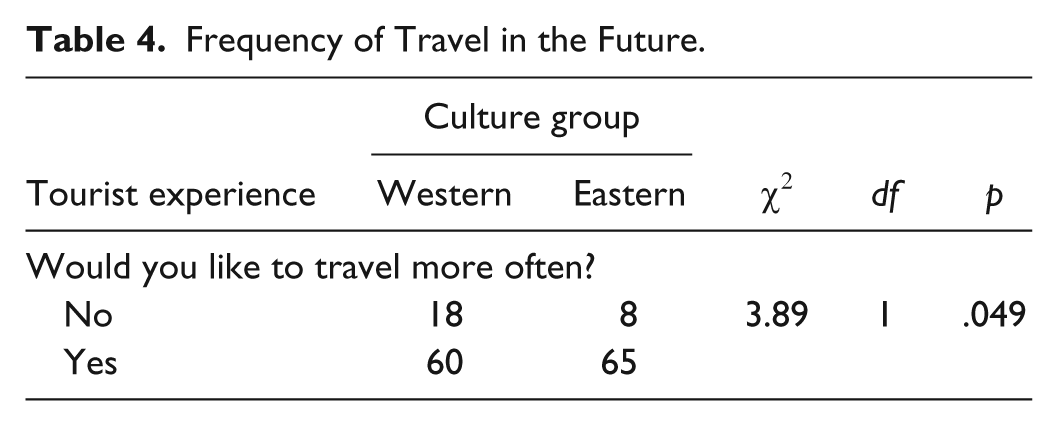
The literature highlights that this may be the case due to the relatively new opening up of travel opportunities for those in the Eastern countries that were not necessarily available two decades ago (Elsner & Rubies, 1999). Moreover, the majority of those questioned from Western cultures were from the United States, and the literature has expressed the view that Americans do not travel to other countries that frequently on average (Ioannides & Timothy, 2010).
The survey also questioned the participants in terms of their desire to visit the destination country again, reflecting their enjoyment of their stay and whether they would consider it again in the future. The results indicate that both cultural groups would consider visiting the destination country again, although the results were slightly more positive for those from the Western culture group. The chi-square between returning to the destination and culture group, χ2(2) = 10.89, p = .004, confirmed the relationship between returning and culture group. Western cultures tended to not have plans to return. Eastern cultures tended to have plans to return or partially have plans. Furthermore, in Table 5, the relation between cultural groups and whether they have visited the destination previously is obvious.
Potential Second Visit.

Similar to the above findings, the chi-square between preferred time at the chosen destination and culture group, χ2(4) = 18.41, p = .001, also shows that there was a relationship between preferred time and culture group. Western cultures tended to prefer short stays or very long stays (few days, 2 weeks, or 1 month). Eastern cultures tended to prefer staying for 1 week to 10 days.
The results of the assessments that focused on the nature of the terrain preferred by the two groups indicated that that terrain and landscape were of relative importance to the groups and that the specific types varied depending on the cultural group. Chi-square analysis showed that the significance was .020, which underlines a potential difference between the two groups. It was identified that while those from the Western group preferred a combination of terrain and landscape interests, the Eastern culture individuals preferred beaches and were far less interested in a combination of terrains, again indicating the preference for a chosen and particular vacation by those influenced by the Eastern culture. (Table 6)
Terrain.

The results also indicated that there were differences in the attractions to a destination for those from the Eastern and the Western cultures. The results show that Eastern tourists are more motivated by culture and heritage attractions, whereas the Western tourists are more attracted by the history of the destination and the combination of factors overall (Table 3).
The family value of vacations was also assessed by this work. The analysis of the data provided by the survey results suggests that those from an Eastern cultural background were far more motivated by locations that had facilities for families than their Western counterparts. As can be seen from Table 7, it is evident that those from the Eastern background were more concerned about family facilities at a vacation, although the majority of both groups of individuals did not choose this factor as having any relevance. The lack of other demographic information in this question limits the findings, because age may have played a key part in the fact that not many individuals were focused on family friendly locations.
Family Facilities.

Another set of specific assessment and results focused on the accommodation types preferred by the two individual groups in the study. The results for this question proved interesting because of the relative similarity of the findings between the two groups. Although those from Western cultural backgrounds were willing to experience a combination of accommodations (as opposed to the Eastern group that vehemently opposed them), the results were similar with the majority preferring hotels or rented flats or villas. Through this, it was clear that although the results were often very different, there were occasions that led to the results from both groups being very similar, as highlighted in this example (Table 8).
Accommodation.

In addition, the chi-square between culture group and water activities of interest, χ2(5) = 16.12, p = .005, suggested that there was a relationship between preferred water activities and culture group. Western cultures preferred a combination of water activities and fishing and kayaking. Eastern cultures tended to prefer no water activities or scuba diving.
In addition, the chi-square between culture group and the preferred gourmet experience, χ2(2) = 10.87, p = .004, suggested that there was a relationship between culture group and preferred gourmet experience. Western cultures preferred culinary or culinary and wine. Eastern cultures tended to prefer wine over wine and culinary.
However, the chi-square between culture group and preferred entertainment, χ2(3) = 8.89, p = .031, indicated that there was a relationship between preferred entertainment and culture group. Western cultures tended to prefer beach bars and not parties. Eastern cultures tended to prefer parties The chi-square between having business facilities, χ2(1) = 4.64, p = .031, shows that there was a relationship between having business facilities and culture group. Western cultures tended to not want business facilities. Eastern cultures tended to want business facilities.
In addition, the chi-square between preferred means of transport to a tour destination and culture group, χ2(4) = 12.34, p = .015, demonstrates that there was a relationship between preferred means of transportation and culture groups.
When the chi-square between seeing places from famous films and culture group, χ2(1) = 6.68, p = .010, was assessed, it was also found that there was a relationship between seeing places from famous films and culture group. Western cultures tended to not want to see places from famous films. Eastern cultures tended to want to see places from famous films.
Furthermore, the chi-square between visiting shops and culture group, χ2(1) = 4.61, p = .032, suggests that there was a relationship between visiting shops and culture group. Western cultures tended to not want to visit shops. Eastern cultures tended to want to visit shops.
The chi-square between kinds of packages and culture group, χ2(3) = 8.27, p = .041, proves that there was a relationship between kinds of packages and culture group. Western cultures tended to prefer hotel rooms only. Eastern cultures tended to prefer all inclusive.
The chi-square between how fulfilling the experience was and culture groups, χ2(2) = 6.56, p = .038, also indicated that there was a relationship between fulfillment and culture group. Western cultures tended to be fulfilled. Eastern cultures tended to be only partially fulfilled.
The chi-square between seeing places from famous films and culture group, χ2(1) = 6.68, p = .010, suggested that there was a relationship between seeing places from famous films and culture group. Western cultures tended to not want to see places from famous films. Eastern cultures tended to want to see places from famous films.
The chi-square between visiting shops and culture group, χ2(1) = 4.61, p = .032, indicated that there was a relationship between visiting shops and culture group. Westerns tended to not want to visit shops while Eastern cultures tended to do so.
The chi-square between kinds of packages and culture group, χ2(3) = 8.27, p = .041, proves that there was a relationship between kinds of packages and culture group. Western cultures tended to prefer hotel rooms only. Eastern cultures tended to prefer all inclusive.
The chi-square between how fulfilling the experience was and culture groups, χ2(2) = 6.56, p = .038, also indicates that there was a relationship between fulfillment and culture group. Western cultures tended to be fulfilled. Eastern cultures tended to be only partially fulfilled.
The results from the survey data analysis suggest that there are important cultural differences that exist between the participants from Western nations and those from their Eastern counterparts. Overall, the survey also highlights that the Eastern culture participants were much more likely to have a specific purpose for a vacation to a certain destination, while those in the West were more likely to wish to entertain a range of interests during the vacation. The quantitative and statistical data reflect that there are differences relating to the desire to travel more frequently, the type of trip planned, and the interests that first attract the participant to the destination country in the first place.
Interpretation
The study wished to analyze the motivating cultural factors in the destination decision-making process and found that the analysis of Eastern cultural backgrounds to that of Western cultural backgrounds ensured that significant differences existed between participants from the two groups. The study used chi-square analysis tests to assess the data and found that those from Eastern backgrounds were more likely to have a specific interest or purpose for a trip, traveled more for business, and did not wish to combine a range of interests in their vacation.
The results have an impact on the empirical discussion revolving around cultural differences and the impact that this can have on the tourism decision-making process. The findings indicate that there are many cultural differences in terms of the selection of the traveling destination and that this should be enhanced by further study.
The data collected by this study have importance to the tourism industry and to the industry stakeholders. For those living and working in the industry in Mediterranean destinations, it highlights how to advertise and attract tourists from different cultures and provides them with information on the types of vacation desired by potential tourists in their region. The research findings supported the four hypotheses presented at the beginning of the study and help to highlight the differences between the tourists from the Eastern and Western cultures and the types of vacation that they are attracted by.
Cultural values are rather powerful because they affect all aspects of life, including the motivation of travelers as shown in this study. It is important to note that Western tourists are more inclined to seek novelty in their tourist experiences, while Eastern tourists extensively prefer to be with the family, which is an essential part of Eastern collectivist cultures (Maoz, 2007). The cultural values pertaining to individualistic cultures seem to prevail in the respective choice of destinations, and thus the aspect of tourist satisfaction differs based on the tourist’s motivations and specific activities (Livin, Crotts, & Hefner, 2004). The concept of individuality-collectivity in the tourism context of this study shows the dominant role of cultural differences between Western and Eastern tourists. The individualism-collectivism value dimension reflects important predictions in terms of destination image and preferences (Quintal, Lee, & Soutar, 2010). This eventually turns an important determinant of tourist satisfaction.
Differences in cultural values between Western and Eastern tourists indicate that individuals based in different parts of the world tend to experience tourism products in a different manner. Nevertheless, the process of constant socialization and social interaction suggests that such individuals are thoroughly oriented to narrow cultural boundaries in their way of experiencing and perceiving different tourism aspects (Livin et al., 2004)
Limitations
The study did acknowledge that the sample population could be larger and that it would be necessary to also provide demographic information regarding age and income, which would help to increase the analysis of the data (Marsden & Wright, 2010). It is argued that the more demographic information received in a study leads to a higher level of data analysis and comparison, enriching the results and leading to an enhancement of the knowledge of any particular subject (Groves, Fowler, & Couper, 2009; Ott & Longnecker, 2010). This is because the demographic information in tourism studies should be analyzed within narrower fields as well as just a division between the East and the West. The study was also limited due to the focus on Mediterranean countries (as the focus was on summer destinations). This was reflected in the small number of participants who went there for business; this proportion would perhaps be higher if the destination had been different and so other studies would be needed to assess different types of destination. In addition, because of the nature of the data, no information was collected on the socioeconomic status/wealth of the people. This was mentioned earlier and this information would need to be further evaluated in the future.
Footnotes
Declaration of Conflicting Interests
The author(s) declared no potential conflicts of interest with respect to the research, authorship, and/or publication of this article.
Funding
The author(s) received no financial support for the research and/or authorship of this article.