




Abstract
As a contribution to the widespread debate on the “gender reading” of the “built environment,” this article aims to situate the subject in a new context, the Iranian society. To depict the subject, two distinct traditional architectures of the region, associated with their respective socio-spatial organizations, have been comparatively explored: the “Introvert” and “Extrovert.” These two almost ageless “Introvert” and “Extrovert” architectures, evolved through centuries in different geographical parts of the country, are spatial patterns aptly illustrating how the “gender structure” of each social organization has contributed to the formation of the relevant “physical space” and, further, how the specific “gender relationships” are pertinently structured within each one of the two types of the spaces. Based on a systematic approach and through concentration on the macro-socio-spatial organization, this article is to explore the gender/space associated variations within either of the social systems they belong to. This perspective is particularly instrumental in pinpointing the Introvert and Extrovert architectures in the context of their social organizations and carefully scrutinizing “gender” and “space” categories as systematically integrated variables.
Keywords
Introduction
This article is an attempt to present new perspectives on the traditional spaces in Iran, and to stimulate discussion around the interactive relationship between “gender” and “space.” It focuses on the continual effects of the “gender structure” on the “spatial organization” of the built environment, and the reciprocal influence of the latter on the reproduction of the former. Such reactions can be observed in the traditional built environment in Iran, from the architecture of single buildings—especially houses—to that of the public ones, whether urban or rural structures. These subtle effects will be brought to light by probing into the two prevailing forms of spatial organizations, the Introvert and Extrovert architectures, which have almost simultaneously developed in the country throughout Iranian history, and depicting how each type distinguishes itself from the other and what the significance and outcome of such distinction is. The gender/spatial integration will be highlighted, taking heed of the pertinent macro-social system.
Gender category has already been extensively analyzed by an array of scholars, as a changing social construct (Alcoff, 1996; Butler, 1999; Castells, 2001; Friedmann, 1996; Giddens, 1999; Lips, 2003; McDowell, 1999; Rendell et al., 2000 among others). Gender is a major power structure that, together with race, class, age, nationality, ethnicity, and the like, defines our identities: “Our lives are structured by a small number of crucial relations of power and gender is one of them” (McDowell, 1999, p. 248).
Gender structure, expressing power relations between men and women in society, shapes the masculine and feminine identities as crucial parts of our human status. Since antiquity, gender structure has been regulated by patriarchal social orders on the basis of unequal power relations nearly throughout the world. It is almost generally accepted that “ . . . patriarchy refers to the system in which men as a group are constructed as superior to women as a group and so assumed to have authority over them” (McDowell, 1999, p. 16). The system, probably the main cause of women’s and children’s oppression, is still quite powerful in many parts of the world, deeply rooted in local cultures and faiths.
Gender identity develops through the process of socialization in family and other social institutions. Social moulding and socialization may thus explain how men and women acquire their gender identities by social patriarchal prescriptions, templates, or models of behavior relevant to each sex (Connell, 1987). Socialization process continues to produce and reproduce gender identities that seem to remain unchanged unless new factors appear on the scene in the social systems.
Topic of “space” has already been investigated by a number of scholars, providing sufficient literature on space as a multilayer category produced physically and socially (Krier 1979, Lefebvre, 1991, McDowell, 1996, 1999, and others). In actual fact, the “physical space,” in its interconnection with society, has been explored as the manifestation of social organizations. The changing nature of the space has likewise been thoroughly studied, either simply on the basis of its physical features or in connection with its social/physical traits.
Furthermore, the relationship between “gender” as a social construct and “space” as a physical one has been thoroughly delineated by different scholars (e.g., Ardener 1997; Doerhoefer, 2003; Durning & Wrigley, 2000; Hills, 2000, McDowell, 1996; Rendell et al., 2000; Terlinden, 2003; Torre, 2000). However, studies on this interconnection have led to the fact that gender is constituted differently in different spaces, because “social life takes place in and through space” (Pratt & Hanson, 1994, p. 6). Social organization differs from area to area and from city to city, not only in different parts of the world but also in different parts of a country or region. The same point holds true for gender. In other words, the gender power relations and the extent of patriarchal oppression are also differentiated in different places. Therefore, “ . . . there is a clear geography to gender relations . . . in the extent of women’s subordination and relative autonomy, and correspondingly in male power and domination” (McDowell, 1999, p. 12). Various gender characteristics or gender identity of men and women living under patriarchal orders in various spaces also follow suit.
Common approach to gender/space relationship makes reference to the patriarchal gender division of labor between men and women, that is, allocating the housework or domestic labor to women and the public waged work to men. Spatial manifestation of this binary distinction of activities is presented on private/public dichotomy of spaces.
This article, reflecting on the gender/space relationship, is to investigate gender differences through spatial differences. Distinct spatial forms of architecture in distinct places represent distinct gender structures associated with their social orders.
Integration of gender and space which is explored in different social contexts in Iran can also be observed by means of a systematic approach. The “social organization,” as the macro-social system of a society, consists of certain subsystems, including the material factors such as space (physical space) and the non-material ones such as gender. Interactions within the system are affected by the subsystems and their conditions. Each subsystem is likewise influenced by the interactions and interchanges of other variables. On the whole, the changes in a system and its subsystems are all interconnected, so are the materials and the non-materials. Therefore, it is the same for both the material space and the non-material gender.
Besides making a contribution to the gender/spatial discussion, the major justification for the concentration of this inquiry on the traditional patterns through a systematic approach to the social organizations resides in the fact that they are more homogeneous and rather simpler systems with relatively more recognizable variables. Modern social systems, on the contrary, are quite complicated in comparison with the traditional ones, entailing a complex of variables, and are thus affected by various external factors that make the interconnections of the variables too intricate. Hence, by examining the latter we can more clearly note the interplay between the variables, between the non-material gender and the material space, and actually the spatial manifestation within the built environment. In addition, it should not be overlooked that the systems’ age-old longevity is also a great help in making a systematic analysis of their characteristics.
Iran has a wide range of geographical regions and climates. This geographical variation, together with the ethnic, socio-economic, and cultural diversity of the population, has given rise to various types of spatial forms of the built environment and residential settlements. Among the country’s socio-spatial organizations, this study concentrates on two distinct and dominant forms of architecture, known among the Iranian scholars as Introvert and Extrovert architectures.
These two physical forms of the built environment have appeared in different geographical areas of the country. Introvert architecture is mostly observed on the peripheral plains surrounding the central deserts. These areas, the hot arid zones of Iran, mostly cover the central part of the country and are where the two tremendously large deserts, Kavir and Lut, are located. Extrovert forms, on the contrary, appear in the other geographical zones, either on the slopes of the mountainous areas or on the fertile fields of the North of Iran around the Caspian Coast. The varying geography in areas with a predominantly Extrovert type has inevitably led to variety in the development of this form (Figure 1).

Areas of introvert and extrovert organizations.
Extrovert and Introvert architectures are clearly different in their spatial arrangement, both in private space and in public structure. Moreover, it is important to observe their characteristics in comparison. Pirnia, a renowned expert on the Iranian architecture, insists that the architectural buildings in Iran are generally of two spatial types, Introvert and Extrovert. He likens the Extrovert buildings to a cage where there is a view of the outside world. According to him, most of the houses, both in West and East Asia, such as Japan, are constructed in this way. These types of buildings are known as the “Pavion” in France and “Kushk” in Iran. Even when there is a yard around the building, it is still Extrovert. In Kurdistan and Lorestan, two western provinces of Iran, and in some other areas of the country, an Extrovert house includes some rooms and probably a balcony. But in many other areas, mostly due to geographical causes, another kind of spatial form, the Introvert architecture, dominates. In this spatial form, architects cut direct connections between the inside and outside, the internal spaces of the building being connected to the outside by an internal courtyard in the center of the building (Pirnia, 1990, pp. 30-32).
These two major spatial forms, Introvert and Extrovert, represent two different social organizations that have developed in diametrically opposed societies. The socio-economic and cultural aspects of each form are contradictory to the other ones.
Although these spatial forms have been studied by a number of architects and other scholars from various points of view (Benevolo, 1990; Bromberger 1991; Costello, 1989; Memarian, 1992; Pirnia, 1990; Sultanzadeh, 1986; Tavassoli, 1982), the inquiries were not based on a general perspective of macro-social systems or as spatial manifestations of the two different social organizations under study. Neither have they been examined from a gender-based standpoint, a perspective central to our discussion.
By and large, concepts of Introvert and Extrovert point to what we term as the “inner” and “outer,” respectively. While the “inner” refers to the internal spaces, the house and, as we will expound later, the family life and mostly the women inside, the “outer” pertains, inversely, to the external spaces, the public and the public activity, and specially the men outside.
The roots of the Introvert architecture can be traced back to the ancient Persia, the pre-Islamic Iranian Empire. However, its development has mainly commenced during the Islamic era, from the 7th century. No comprehensive study is available on the origin of the Extrovert form and its further development. It seems that the two forms have evolved alongside, but in different geographical regions. This study will examine the typical features of each of the two architectural forms which, despite their changes over time and space, have always maintained their particular characteristics. These forms have developed in both villages and cities, but they found their distinct features in the more developed urban areas. Furthermore, the impact of the mainstream urban culture and practices could be traced to when the more rural societies gradually evolved into finding an urban scale.
The last century witnessed massive social upheavals in the country, including radical modernization and urbanization. This process of rapid change has affected the form and function of the social/spatial organizations and drastically transformed the traditional architecture, replacing it with newer, different forms. These traditional architectures partially stood against adapting to new necessities, especially in case of the more transformed cities such as Tehran, not only because of their physical limitations, but due to the conditions having resulted from the way and the pace of social change. This is particularly true for the Introvert architecture that has been the dominant form in the most developed urban areas of the country, a number of which, such as the city of Isfahan, used to be the capitals of numerous Iranian dynasties. Such age-old cities have undergone excessive changes and their substantially altered architecture is observable. Regrettably, most of the buildings of architectural value have been either demolished or abandoned, apart from those that have been preserved as historical sites.
Introvert Spatial Form
Introvert architecture is a well-known spatial pattern, the predominant form in the Islamic societies (Benevolo, 1990; Kotnik, 2005; Pirnia, 1990; Tavassoli, 1982, among others), especially in the Middle Eastern and North African countries. For the residential buildings, this form is mainly known as the “courtyard house” or “central courtyard house.” In Iran, this architectural pattern has likewise been historically interpreted as a typically Islamic form of housing, chiefly developed during the Islamic era. This spatial organization, despite major effective geographical factors, is suitably adapted to what is considered an Islamic social order (Kotnik, 2005).
In the Introvert architecture, the closed spaces of a building are all set around a central courtyard that plays a decisive role, not only as a multifunctional space for the house or as the main space for circulation, connecting various spaces of the building located around the courtyard, but as a provider of light and air for the peripheral spaces as well. As the name indicates, the closed spaces of the Introvert buildings—especially, the houses—have no openings to the outside, all the doors and windows opening into the courtyard, whether directly or indirectly. Actually, the courtyard in an Introvert house is a medium linking the indoors to the outdoors. In this way, the internal spaces of a house or building have a very limited contact with the external ones (Memarian, 1992).
In this system, the only opening to the outside is the entrance door that indirectly connects the internal open space of the courtyard to the outside world (Figures 2, 3, and 4). In other words, the indoor yard has no view of the passage outside, even when the door to the house is open. This is because there is a bending corridor behind the entrance that blocks the view of the indoor courtyard, impeding outsiders from seeing the residents’ life and activity inside the building. Naturally, the impediment has a dual role, the second one being the obstruction of the residents’ direct view of the outside space. Hence, such a house/building is considered Introvert in its spatial form and in its life and activity as well. In the case of the houses mostly owned by the wealthier families, the architectural separation of the private space in each house has often been developed into a rich composition of two housing sections placed in one house. One, the andarooni, meaning “the inside,” is inhabited mainly by the females, and the other, the birooni, meaning “the outside,” is used by the family males and their male visitors (Khatib-Chahidi, 1997, Tavassoli, 1982; Figure 5).

Introvert house with central courtyard.

Introvert organization, public texture of introvert houses, city center, and neighborhood around.
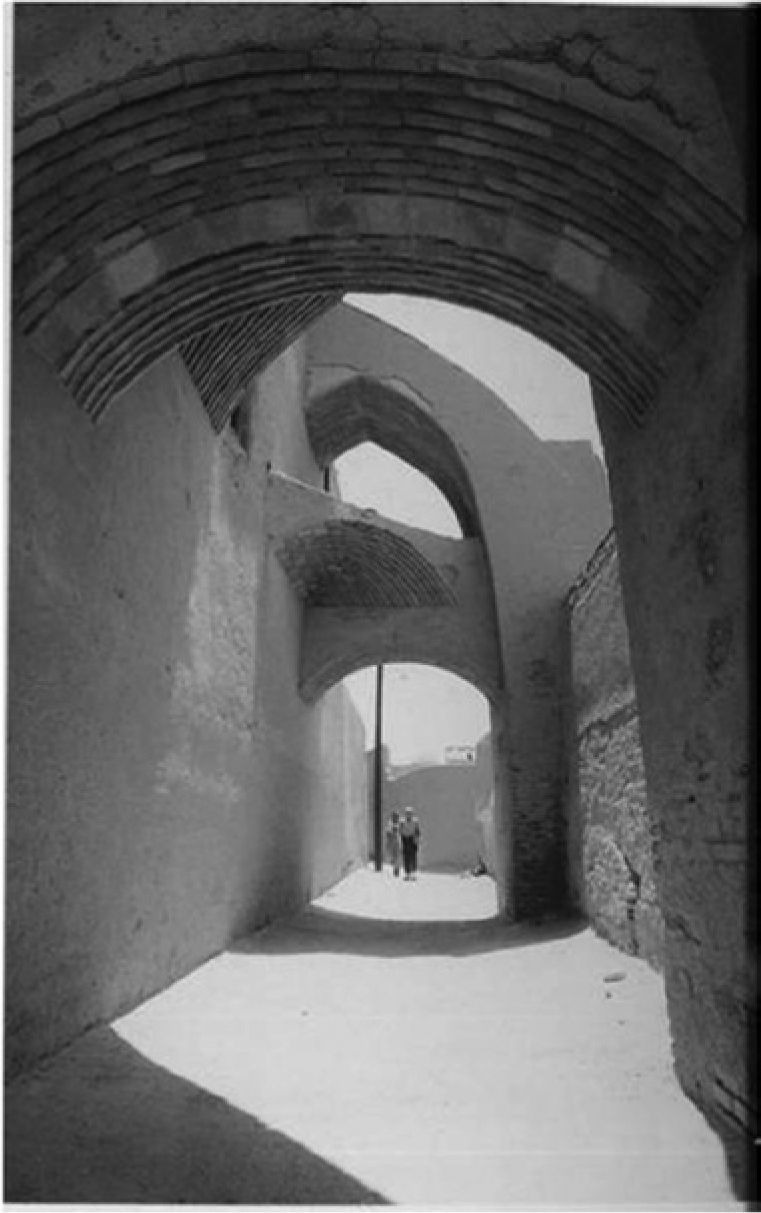
Introvert texture public passage with no opening to the house (Except the entrances).

An aristocratic family’s housing complex including anderun (spaces around small courtyard) for family’s private and birun (spaces around large courtyard) for men’s reception.
In this type of spatial organization, the division between private and public spaces has considerable influence on the development of the public structure of the urban and rural complexes. Hence, there is a “hierarchical,” gradual trend from private-space houses to semi-private/semi-public space of the neighborhood, further extending to the most public spaces of the villages or cities. General fabric is formed in such a way that the private boundary of the house is preserved not only by the spatial organization of the house but also by the hierarchical public texture (Tavassoli, 1990). This hierarchical texture, in its most typical form, starts from the dead-end alleys where the doors of the houses open up to them. Dead-end alleys are the most private form in the hierarchy of the passages, each passage in turn connecting to other ones that gradually display ever more public features. In other words, the dead-end passages mostly open into the smaller series of the usually wider passages. This hierarchical trend continues toward the center of the texture that constitutes the most public spaces of the texture (Figure 6).

Introvert spatial organization, hierarchical texture from dead end alleys to city center.
Now, a bunch of questions could be raised. What type of a social organization does this spatial form represent? What kind of social life, social values, and beliefs are associated with the Introvert spatial organization? And probably more pertinent to our topic, what sort of “gender structure” and “gender relations” is preserved in this characteristic feature? The “gender relations”—a major non-material construct—and the “spatial organization”—a material one—are variables associated with the social macro-system, so are their characteristics. As a matter of fact, they both signify the same social organization that draws a strict social line, separating private from public life: “In the Islamic societies, the segregation of gender typically leads to the courtyard house, with its characteristic feature of enclosure” (Kotnik, 2005, p. 472).
In the social system, the private boundaries of a family are totally separated from those of the public sphere. Apparently, since early written history, women have belonged to the private space of the house, having almost no presence in public life and social activity outside the house. Instead, men were the ones considered as fully responsible for all public activities in society. The dominant gender structure was, and still is, incapable of tolerating the uncontrolled presence of women in public spaces. In such strict Islamic societies, women either have to lead their whole life in their private sphere of home or, under certain circumstances, their public presence is restricted to controlled, segregated places in public spaces. The treatise “Hodud al-Aalam,” an old text dating from the 11th century, stresses the fact that women in most part of the country, especially in the central and southern regions, are far from having an active role in social life, their domain of activity being confined to the house (Hodud al-Aalam, AD 11, quoted by Sultanzadeh, 1986, p. 204). Mernissi has analyzed such social systems in the more traditional Muslim societies: “Traditionally, only necessity could justify a woman’s presence outside the home, and no respect was ever attached to poverty and necessity. Respectable women were not seen on the street” (Mernissi, 1987, p. 143).
It is worthwhile noting that the separation between private and public spaces has eventually culminated in the devising of special door-knockers, exclusively used by males or females, installed on the entrance door of each house and thus specifying the sex of the person knocking at the door and entering the private space (Khatib-Chahidi, 1997; Soltanzadeh, 1994): “The sex of any caller was told by the sound of the knock. If a man, the women disappeared or adjusted their veils, if a woman, men withdrew” (Khatib-Chahidi, 1997, p. 134). The idea was to ensure a total protection of the private space of the house and the family life, supposedly shielding women’s life and activity from the public life outside the house (Figure 7).
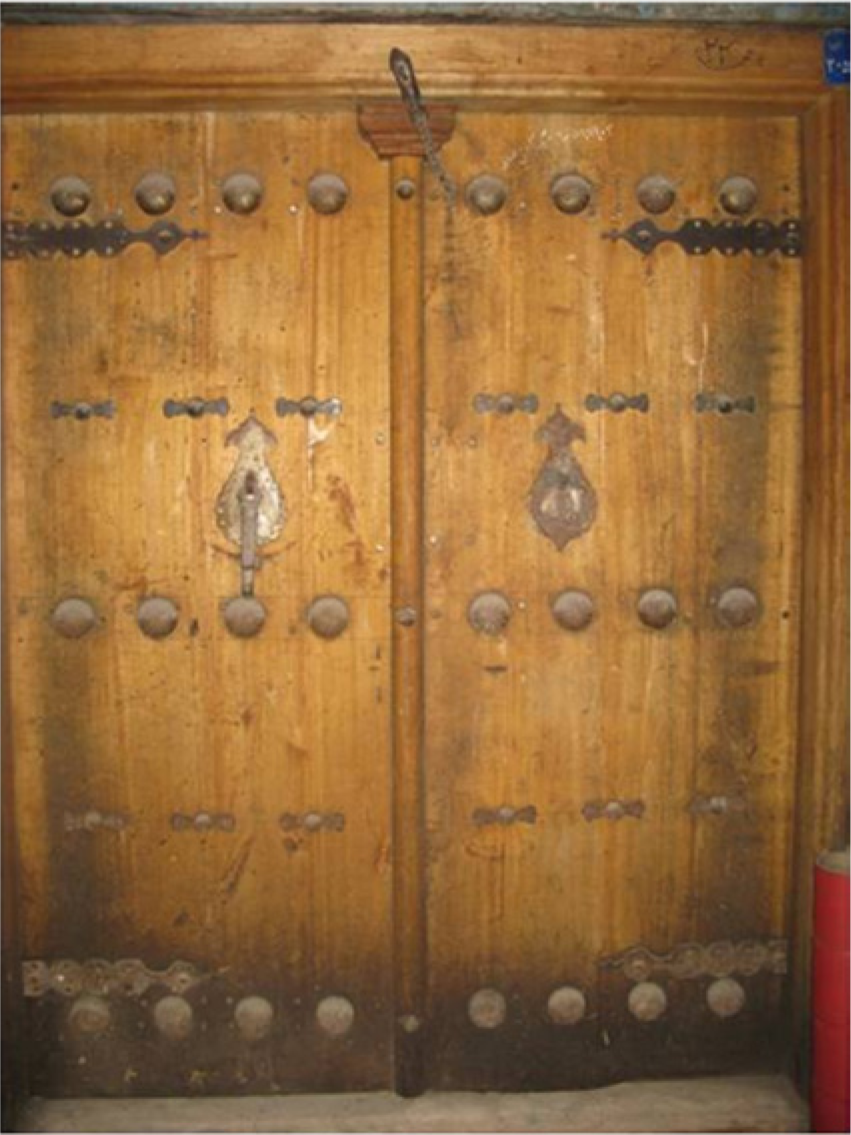
Introvert organization separate knockers for women (Right) and men (Left) on the front door.
Admittedly, women’s participation in certain public activity such as public gatherings and especially in religious ceremonies has not merely been a passive presence, simply as inert onlookers. However, in such public gatherings, the two sexes occupy thoroughly separate spaces, even in the same events and places. The male and female entrances to public buildings like mosques are distinctly separated, and in other places such as the public baths, the time periods for using the space differ for men and women.
This radical separation of private and public spaces is associated with the strict division of the “gender roles” within the “gender structure,” constituting a patriarchal basis for the social authority in society: The institutionalized boundaries dividing the parts of society express the recognition of power in one part at the expense of the other” (Mernissi, 1987, p. 137) or “The spatial division according to sex reflects the division between those who hold authority and those who do not” (Mernissi, 1987, p. 138).
The interrelationship between gender and space is presented by the reflection of a highly closed “gender structure” on the “Introvert spatial form” on the one hand, and reciprocally the fulfillment of the radical “gender formation” in this sort of “spatial organization,” on the other. As Castello has pointed out, in a pre-industrial city, emphasis on family privacy influenced the physical design of the houses, as well as the social relations within the family (Costello, 1989, p. 128).
Likewise, the social organization of these Introvert spaces displays the same characteristics. Introvert architecture is basically considered as a spatial pattern that tends to conceal what exists or occurs inside the buildings and houses. It emphasizes hidden elements and facades; the very beauty of the architecture could be observed only when you are inside the building or in its courtyard. Passing through the public routes, you can just view the two lines of walls on the sides of the passage, with no architectural ornaments or no openings apart from the entrances. Introvert social structure hides the indoor people, activity, familial life and especially women’s activity, inside the houses, drawing a sharp line between the private and the public, and thereby stressing what should not be seen by strangers, and insisting on the privacy, seclusion, and secrecy of the house. This tendency toward secrecy in form and function is a unique trait of what came to be metaphorically labeled as “Introvert” socio-spatial organization.
Extrovert Spatial Form
Extrovert architecture is characterized by a more open spatial layout for single buildings/houses as well as public texture. The social organization and gender relations that have led to this style are distinctly different from those of the Introvert buildings. The distinctions in the social organizations and the gender relations are manifested in the differences between the two well-defined styles of architecture.
Extrovert spatial organizations appear in two prevalent forms in Iran, either in the form of buildings with yards that are located on the plains of the Caspian Coast or as houses built on the terraced slopes of the hills or mountains. In the former kind, the yard usually surrounds the closed space of the building/house, while in the latter, many of the houses have no yards at all, chiefly because of a shortage of flat land in such areas.
In both types of the Extrovert spatial organization, the private space of the house provides an open connection to, and is relatively in greater contact with, the outdoor spaces around the house such as public passages or pathways (Memarian, 1992). This is made possible by means of windows, doors, and especially balconies, which open to the outdoors, either directly or indirectly, through the mediation of a yard next to the closed spaces (Figures 8 and 9).

Extrovert house with yard, direct connection between indoor yard and outdoor space.

View of an extrovert house.
In marked contrast to the Introvert system, the yard itself, if present at all, enjoys the same or more direct connection to the outside world. A yard is not necessarily a walled space, being surrounded by tall walls. There might be a short wall or a transparent fence around the yard, or it might totally lack an enclosing wall or fence of any sort, thus providing a rather full view of the indoor and outdoor spaces, reciprocally (Figure 10). This arrangement is of great import, considering the fact that the yard is a very significant space, just like a balcony, which comprises of an area allotted to much of the private life of the family. Moreover, in numerous cases with no private open-space yards, and mostly in the mountainous lands where doors, windows, or balconies directly open into the public passages, the separation between private and public spaces is at its minimum (Figure 11).

Extrovert house, no fence around the private open space, overlooked balcony and yard.

Extrovert texture, mountainous type, no clear boundaries between public and private spaces: The private open space or roof of the neighbor or public passage?
The semi-open space balcony, in the Extrovert organization, is an important multifunctional space of the house, especially in the absence of a yard, where certain activities of the family are performed (Figure 12). The balcony not only plays a communicative role, mediating between the closed and open spaces, but it also acts as a major space for the house, similar to a room, where various life activities might daily occur in most seasons (Memarian, 1992, p. 120). It opens into either a yard or the public space in the neighborhood area, in both cases enabling one to have a better view of the surroundings. In the slope lands, the buildings arrangement essentially provides both private and public spheres with a reciprocal view of one another. The same is true even for the plain lands where there is a yard encompassing the building. This is because the yard in this case, as already pointed out, is not a walled space, and in many instances no boundary is specified for such yards, with the exception of some transparent or short walls surrounding certain ones. Hence, nothing blocks the public view of the private life activity in the balcony, and vice versa (Bromberger, 1991, p. 65).
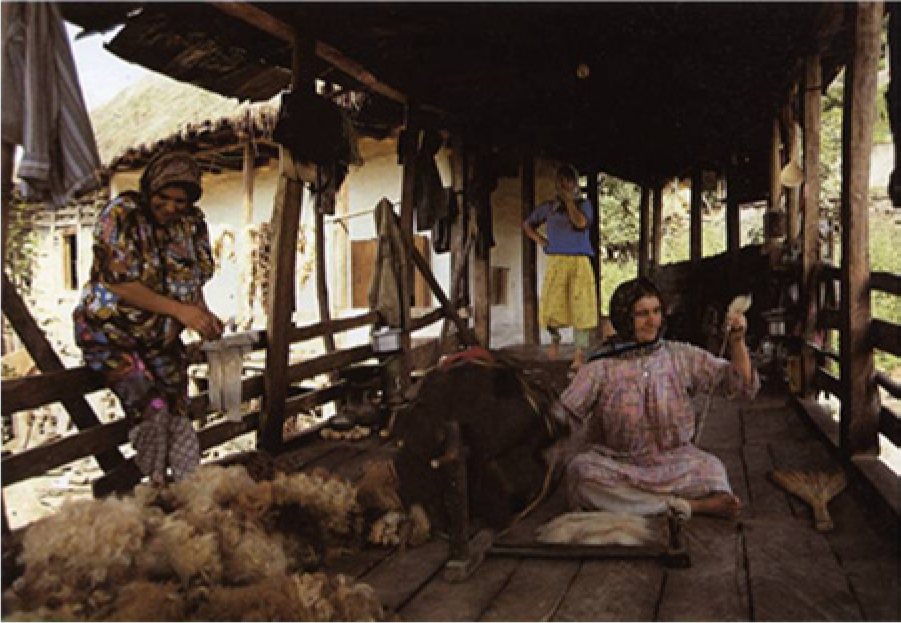
The overlooked balconies in extrovert house, place of women’s daily activities.
In certain nationally famous old villages in the mountainous areas of the country such as Hajij (in the west) and Masouleh (in the north), the geographical features of the land have given rise to a type of spatial organization where no clear boundaries can be found between the private and public spheres (Figure 11). In these two villages, for instance, the roof of each lower house generally acts as a yard for the upper one, the connected neighboring roofs forming a route for passers-by. In such cases, the distinction between the private and public domains seems to be extremely obscure, both displaying almost the same physical features (Ahmadi, 2001, p. 76).
Furthermore, the complex structure in these rural or urban regions is evidently of the same Extrovert spatial organization as that of the houses discussed above. In this case, contrary to the public texture of the Introvert architecture, one does not witness an orderly “hierarchical” trend from the most private to the most public (Figure 11).
The social life associated with this sort of spatial organization has its own distinct characteristics. Thus, the social values and gender relations in this case present certain features that are in stark contrast to those we discussed earlier for the regions where the Introvert architecture prevail. However, the patriarchal division of the gender roles, allocating the private space of the house to women and the public spaces of the cities and villages to men, in this case, renders life and society somehow more flexible. Hence, the women do not entirely belong to the private space, but are also involved in the outdoor activity in the public realm. For instance, women in Gilan, a northern province of the country, directly participate in agricultural production and farm management (Bromberger, 1991, p. 29). The women living in the northern fertile regions have always had direct involvement and responsibility in economic affairs (Figure 13), enjoying relatively greater authority at home and more freedom in society (Hodud al-Aalam, AD 11, quoted by Sultanzadeh, 1986, p. 204).

Extrovert organization, direct participation of women in agricultural production at rice paddies.
In these societies, power relations in the family and between the genders within the dominant patriarchal system are relatively more balanced. This ensues from the presence of more equality and less rigidity in the division of the gender roles in the family, a division much more flexible in comparison with those of other patriarchal systems of the segregated gender roles. When we consider the division of the gender roles between men and women in the Gilan province, for example, we plainly notice the typical differences related to women’s status in society (Bromberger, 1991, p. 29).
In the second type of the Extrovert organization in the mountainous regions, where economic life is mostly based on livestock production and husbandry, women’s participation in economic affairs has always been deemed to be a natural affair (Figure 14).

Extrovert organization, women participation in public activities besides men.
Contrary to the socio-spatial Introvert organization, the Extrovert spatial configuration openly exhibits its facade, elements, and beauty to the outdoor public and does not much refrain from showing what happens within the house, the life activity, and the women working inside. It is due to its endowment with such material and social aspects that this type of architecture is metaphorically labeled as “Extrovert.”
Dress
To better grasp the differences between these two social organizations, we may delve into some other elements associated with them. Men and women’s items of clothing are among the material aspects of such social organizations, manifesting their gender structure and gender values: “Dress serves as a discursive daily practice of gender” (Huisman & Hondagneu-Sotelo, 2005, p. 44). Inquiring into the rules and traditions related to such items can shed more light on the difference between the two social systems and their pertinent gender relationship. As somewhat expected, women’s dress perceptibly depicts the extent of the legitimacy of their spatial presence. The existence or non-existence of disparity between their clothing in the public and private spheres is a testimony to the divergent socially accepted women’s presence in the two domains.
In a public space, a woman’s dress in the Introvert social organization is totally different from that of her counterpart in the Extrovert one. The type of clothing with which women publicly cover themselves in the former type signifies their forbidden, illegitimate presence in public sphere (Figure 15). It emphasizes women being rather unrecognized in public. They have to cover their entire bodies with a large piece of cloth, a head-to-toe veil, known as “chador” in Iran, and even keeping their faces and hair hidden, so that they could not be recognized by anyone. This is a social rule demonstrating women’s (lack of) status in society: “The veil means that the woman is present in the men’s world, but invisible; she has no right to be in the street” (Mernissi, 1987, p. 143). In general, a woman in her home or in the presence of her closer relatives (people referred to as “mahram” in Islam, i.e., those she is not legally permitted to marry) is allowed to be clad in comfortable, informal clothes, whereas in public or in the presence of other family members (people referred to as “namahram” in Islam) she has to fully cover her hair and body as described above.

Invisible presence of women in public realm of introvert spatial organization.
In the Extrovert social organizations, on the contrary, women’s clothing in public and private spaces is generally the same, with no obligation to differ (Figure 16), this being due to the social acceptability of the women’s public presence in such environments. Moreover, women’s dress reflects the same values of the social organization as those of the architecture or public spatial organization, the characteristics that Bromborjeh cites as the basic pattern in the lifestyle and culture of the residents of the Gilan province, where the so-called “open element” is preferred to the closed one (Bromberger, 1991, p. 65).

Women’s dress in public realm in a Caspian Coast Province.
Gender and Space in Reciprocal Relation
To observe the differences between the social/spatial organizations of the Introvert and Extrovert, and to focus on the pertinent gender/space relationships, the systems were assumed to be virtually invariant and stable, despite the fact that they are in perpetual alteration in time and place. However, the space involved in such interactions, has its own particular impact: “ . . . space is socially produced but that space is also a condition of social production” (Harvey & Soya, quoted by Rendell et al., 2000, p. 101). In other words, a spatial organization not only interacts with the surrounding circumstances, preserving the social gender norms and values and reproducing the gender structure that has originally contributed to its own shaping, a point we have endeavored to abide by in this study, in our systematic approach to the traditional spaces. Moreover, it effectively interferes with the social system and gender structure, making them undergo alterations and modifications: “ . . . once space has been bounded and shaped it is no longer merely a neutral background: it exerts its own influence” (Ardener, 1997, p. 2). Based on this stand, space not only affirms the gender relations, as already expounded on the traditional spaces, but still more importantly, it causes new changes in those relations and partially directs the social context and contributes to creating new relationships. In fact, the current development theories of spatial planning, programming, and designing are mostly based on the notion of this active role of the space: Is space indeed a medium? A milieu? An intermediary? It is doubtless all of these, but its role is less and less neutral, more and more active, both as instrument and as goal, as means and as end. Confining it to so narrow a category as that of “medium” is consequently woefully inadequate. (Lefebvre, 1991, p. 441)
In its effective status, space could be particularly studied through an investigation into the social-spatial changes in the Iranian society, in view of an ever-increasing domination of the “International Architectural Style” and the ensuing subversion of the local traditional forms, during the 20th century.
Conclusion
To summarize, two typical Introvert and Extrovert social/spatial organizations that have been dominant in Iran throughout history as two diametrically opposed systems, manifestly demonstrate how deeply integrated such systems are and how gender and space are systematically acting as interrelated variables. The interconnections between the patriarchal gender structure of the “private woman/public man” and the spatial organization of the private/public spaces actually present the relationships between the material “space” and non-material “gender.” What these spatial organizations signify, could be explicitly found out through studying their integrated social systems.
Varying extent of strictness over the separation of the spatial domains of the two sexes, permeated through their related organizations to the same degree, has prevailed in different places and times, by means of the spatial segregation of the private from the public. In other words, the physical space vividly reflects the relevant gender structure.
An Introvert organization presents a sharp separation between the private and public life and restricts women to the private realm, entirely excluding them from public presence and activity. This gender pattern is simultaneously expressed by the spatial organization, causing strict division between the private and public spaces. The Extrovert organization, in stark contrast to the Introvert, displays much more flexibility in private/public separation due to its respective social life, gender roles, and spatial organization of the built environment.
Epilogue
The rather well-defined relationship between the gender structure and spatial organization, especially when we focus on the physical space, as delineated in this study, has not followed the same form of development in modern spaces, especially in those of the more complicated urban areas. Processes of systematic production and reproduction are in continuous variation in consequence of the newly emerging factors that exert a more complex influence on the social systems. During the last century in Iran, the agents of change, both national and international, and especially the remarkable processes of modernization, secularization, and urbanization have influenced these relatively homogeneous social/spatial organizations, the Introvert and the Extrovert, drastically changing the centuries-old and seemingly unchangeable situations. From this time on, women gradually started to change their social status. This momentous, conflict-ridden period of change deserves to shed further light on.
Indeed, commencing from about the middle of the 19th century, a transition to a modern social system, vigorously affected by ever-increasing communications with the West, has been linking the country to world capitalism, forcing it to get involved in the world commodity exchange. This process of socio-economic and cultural change continued during the Constitutional Revolution at the turn of the century. Later when the political power was assumed by a secular government (the Pahlavi dynasty), such changes were accelerated. Thus, the Iranian society has experienced enormous social challenges and cultural crises as it changed from a traditional society to a modern one. A remarkably incessant transformation that is still extensively in progress and could not be kept at bay even after the Islamic Revolution, manifesting itself in different challenging forms.
As a result, the Introvert arrangements underwent substantial alterations, leading to drastic changes in its social and physical features, and in women’s status as well. From the outset, the waves of modernity challenged the inherent characteristics of the Introvert, rather than those of the Extravert, system. Introvert socio-spatial organizations have long been the dominant form in the major cities of the country, including Tehran, the capital. In addition, Tehran has been the focal point for all such changes that have gradually propagated throughout the country.
Mainly from this time on, women having mostly adopted modern ideas and behavior could be deemed as the agents of change in the process of transformation. In spite of their scanty participation in the public movements of the time, women’s conspicuous presence in public life took place in the educational sector. They eventually came to take substantial steps to get formal education. During, and just after, the Constitutional Revolution, some initial attempts were made to establish modern schools for girls, by few women belonging to the elite groups of the middle or upper classes, mostly inspired by constitutionalism, who had themselves attained modern education by private teachers or foreign missionaries. Such notable initiators, despite being amidst the hue and cry of the protesters and caught between contending forces, kept up their concerted efforts to found a series of organizations, associations, publishing houses, and the like. Hence, ever since the last century, women’s social status has been witnessing a tremendous change. Arduously striving, women managed to continue to higher education, join work force, and attain some political power. All in all, they still spare no effort in struggling for their rights, against all sorts of animosity and adversity.
Besides the socio-cultural impact and side-effects of the worldwide modernism and as their spatial manifestation, the spatial structure of the city and the building form, the country’s Introvert arrangements, have mostly changed to some sort of the Extrovert. In different parts of the country, especially in the urban areas, the architectural form has more and more come to absorb features resembling those of the International Style of Modern Architecture and thus to lessen the more traditional traits. It, however, still exhibits its social structure in its own way. How the structure of the cities and buildings came to be influenced by the International Style and what their new characteristics are, do not concern us here. Suffice it to point to the gender/space relationships and the simultaneous change of the gender and space in this case, too. Meanwhile, it is noteworthy that the patriarchal relationship long persisting in the Iranian society, despite country’s drastic changes, can still be traced through its spatial manifestation, though not explicitly by its physical characteristics, as previously demonstrated in the examples given for the Introvert/Extrovert architectures. Actually, the most significant point in gender/space interconnections is the way the social/cultural features are represented through space in a differentiated form. The space no longer epitomizes the social qualities by its physical characteristics. Hence, it seems that the gender reading of the architectural space, that is, the built environment in general, is now better suited to a spatial investigation, extending to a multilateral definition of space that embraces not only the physical characteristics but also the spatial activity and behavior. It is to include untapped areas such as the spatial experiences or spatial attitudes, which under certain circumstances can more potently demonstrate the gender differences in various Iranian societies. This is certainly an important subject matter in its own right and needs to be accurately investigated.
Footnotes
Declaration of Conflicting Interests
The author(s) declared no potential conflicts of interest with respect to the research, authorship, and/or publication of this article.
Funding
The author(s) received no financial support for the research and/or authorship of this article.