




Abstract
Although gender ideologies influence many outcomes, research shows they often fluctuate across the life course. Family structure transitions are one mechanism through which gender ideologies change. Divorced and single adults report more egalitarian ideologies than stably married adults. Little research has examined whether children in these families experience similar gender ideologies. Based on parental role modeling, we would expect children in non-traditional families to exhibit more egalitarian gender ideologies. We examine family structure and youth gender ideologies in two contexts, essentially two case studies: Germany and South Korea. Using Starting Cohort 3—Grade 5 (N = 4,021) and Starting Cohort 4—Grade 9 (N = 9,913) of the Germany National Educational Panel Study (NEPS) and Cohorts 1 (N = 2,844) and 2 (N = 3,449) of the Korea Youth Panel Survey (KYPS), we uncover counterintuitive findings that youth gender ideologies do not vary across family structures. Child gender is the most salient predictor of gender ideologies across contexts.
Plain Language Summary
Little research has examined whether children experience more egalitarian or less egalitarian gender based beliefs across various family structures, including step-families, single parent families, and two parent families. Based on parental role modeling, we would expect children in non-traditional families to exhibit more egalitarian gender beliefs. We examine family structure and youth gender ideologies in two contexts: Germany (NEPS) and South Korea (KYPS). Using Starting Cohort 3—Grade 5 (N = 4,021) and Starting Cohort 4—Grade 9 (N = 9,913) of the Germany National Educational Panel Study (NEPS) and Cohorts 1 (N = 2,844) and 2 (N = 3,449) of the Korea Youth Panel Survey (KYPS), we uncover counterintuitive findings that youth gender ideologies do not vary across family structures, but that it is the youth’s gender that is the most important predictor of a youth’s gender beliefs.
Introduction
In recent decades, there has been rapid change in family formation patterns and attitudes toward romantic partnering (Mather, 2010). As cohabitation, divorce, and remarriage have become more common, gender ideologies among adults have also adapted, primarily toward more egalitarian ideologies (Dorius & Alwin, 2010; Pampel, 2011; Philipp et al., 2022). This shift toward egalitarian ideologies varies in intensity and direction across contexts but can have a significant impact on both societal and individual-level outcomes (Christie-Mizell et al., 2007; John et al., 1995). For example, gender ideologies impact both attitudes, such as men’s and women’s perceptions of fairness over the division of household labor (John et al., 1995), and instrumental outcomes, such as labor market earnings for mothers (Christie-Mizell et al., 2007). While much of the previous literature linking family structures and gender ideologies focused on how family structure affects the ways adults perform gender roles with their partners, little research has looked at how living in non-traditional families might affect their children’s gender ideologies. This is particularly important because young people may be sensitive to changing family structures and parental gender attitudes since they spend more time with their parents than with other adults (Kiecolt & Acock, 1988).
Research on changes in family structure and gender ideologies has also focused primarily on English-speaking countries, especially US data (cf. Bumpass & Lu, 2009; Davis, 2007). However, the degree to which societies have experienced a second demographic transition to a broader set of family structures and greater self-actualization for women (Zaldi & Morgan, 2017) is not uniform across nations, or even among similar countries such as the US and the UK (Dufur et al., 2016; Campbell & Parcel, 2010; Mather, 2010). Furthermore, young people living in different socio-historical contexts have different experiences and expectations of gender roles and “appropriate” gendered behaviors (Eun, 2007; Grunow et al., 2018; Huschek et al., 2011).
Employing gender systems theory (Ridgeway, 2011; Ridgeway & Correll, 2004), the present study contributes to the literature in two ways. First, we argue that family structure may influence children’s gender ideologies, perhaps because they alter the ways parents model behaviors and attitudes at home. By examining how family structures are associated with youth gender ideologies, we examine how adult choices about family structure influence the gender ideologies of young people. We further extend ideas about potential connections between family structure and youth gender ideologies by looking across different ages. Second, we expand inquiries about both the influence of family structure on child outcomes and the ways children construct their gender ideologies to non-English-speaking contexts by examining the relationship between family structure and youth gender ideologies in two countries with important similarities and differences, Germany and South Korea. We predict that youth in single-parent families will have the most egalitarian gender ideologies and that those with stepparents or social parents will be more egalitarian than those with two married biological parents. Furthermore, we predict that girls will be more sensitive than boys to the potential influence of family structure on gender ideology.
Literature Review
Gender systems theory defines gender as “a primary cultural frame” (Ridgeway, 1997, 2006, 2007, 2009, 2011) which “acts as a fundamental principle for organizing social relations in virtually all spheres of social life” (Ridgeway & Correll, 2004, p. 521). Conceptualized in this way, according to Ridgeway (2011, p. 4), “[g]ender, like race, is a categorical form of inequality in that it is based on a person’s membership in a particular social group or category, in this case, the categories of females and males.” Accordingly, when understood as a cultural frame, gender is regarded more as a system of inequality related to social beliefs regarding men and women, and less as an individualized identity or social role. Subsequently, gender systems “almost always act[s] as a diffuse background identity in social relations that is not, in itself, the ostensible focus of the actors’ attention” (Ridgeway, 2011, p. 69). As such, gender systems become an omnipresent standard for the evaluation of others—and self—with regards to gender-consistent regulations salient to specific circumstances. To that end, Ridgeway (2011, p. 71) notes that gender is effectively salient in affecting behavior in two broad classes of settings: (1) in mixed-sex contexts and (2) when settings are such that gender is culturally linked to stereotypic skill sets believe to be inherent to one sex or the other.
Gender Ideologies
Gender systems theory outlines how gender ideologies affect individuals’ opinions and behaviors. Gender ideologies are widely accepted cultural beliefs about both the relative worth and essential nature of women and men. In the modern Western world, gender ideologies are most often based on a definition that frames gender categories as two naturally explicit and “opposite” sexes. Westerners generally believe that genders are anchored in biological sex and fit into these two boxes. Culturally accepted conceptualizations of both femininity and masculinity remain deeply woven into both social traditions and actual institutions. Societal definitions of feminine and masculine performances also influence gender-specific behaviors—such as the division of labor within the home—and identities. Gender ideologies are circulated and amplified through pop culture and media, as well as through practices and interactions in workplaces, schools, and families. Although people’s attitudes and behaviors about gender vary widely, infractions against hegemonic gender ideologies may be penalized through legal or social sanctions. Furthermore, gender ideologies create forceful cognitive biases about the capabilities of ourselves and others. Ridgeway (2011) suggests gender systems and gender ideologies create self-fulfilling biases and lead people to be unable or unwilling to undertake roles and behaviors viewed as gender-nonconforming. As a result, gender ideologies bias individuals toward finding enjoyment in roles and behaviors that are gender-conforming.
Gender systems scholars consider gender ideology a compelling force in the creation and continuance of gender inequalities. Much of modern sociological research, therefore, attempts to explain variation in gender attitudes among groups, across societies, and over time. One key site for generating and reinforcing ideas and norms about gender, even across different cultural contexts, is the family setting (Rubin, 1998).
Family Structure and Gender Ideologies
Adult gender ideology is tied to relationship status and family structure through a division of labor and other behaviors generated by gendered systems (Batalova & Cohen, 2002; Davis et al., 2007). For example, egalitarian couples tend to divide housework more equally than couples who subscribe to traditional gender roles (Davis et al., 2007). On average, married couples tend to hold more traditional gender ideologies in all aspects of life (Cotter et al., 2014; Gupta, 1999), while single and divorced people typically do their own housework regardless of gender, and may adopt more egalitarian views (Amato & Booth, 1991; Kiecolt & Acock, 1988; Moors, 2003; Vespa, 2009). Cohabiting women are often similar to single women in terms of egalitarian ideology and the division of labor (Batalova & Cohen, 2002; Davis et al., 2007; Domínguez-Folgueras, 2013). The research on remarried adults, though limited, suggests that although such adults still exhibit many traditional gender behaviors, they are more egalitarian than adults in stably married couples (Lucier-Greer & Adler-Baeder, 2011). It is of course possible that differences in gender ideology by family structure are due to selection into particular family structures. For example, individuals with less egalitarian gender ideologies might seek not only marriage, but more traditional marriages with distinct separation of gender roles and division of labor in the marriage. Similarly, when people with less egalitarian gender ideologies do experience family transitions, they may respond differently both in terms of their own gender experience, performance, division of labor, and in how they reflect those beliefs to their children. However, research indicates that people with more egalitarian views experience a shift toward more traditional ideologies after marriage (Gupta, 1999).
While research exists on the association between relationship status, family structure and adult gender ideologies, thus far there has been limited research on how family structure might affect youth gender ideologies. Although children look to parents as role models for appropriate gender behavior, the modeled behaviors of parents vary by family structure (Boehnke, 2011; Davis & Greenstein, 2009; Davis & Wills, 2010; W. A. Goldberg et al., 2012). Single parents and cohabiting adults are more likely to model egalitarian gender behaviors than married parents. Data from the United States suggests that, similar to the ways gender ideologies vary across family structures for adults, children with stepparents rather than a single parent tend to have more traditional gender ideologies, and those with married parents tend to hold less egalitarian views than children with stepparents (D. L. Carlson & Knoester, 2011; Halpern & Perry-Jenkins, 2016; Janning et al., 2011). Children, particularly boys, with divorced parents were more likely to hold egalitarian gender ideologies about female employment (Philipp et al., 2022). In addition, stepparents may have less influence than biological parents on children’s gender ideologies because relationships with stepparents may not be as strong or meaningful (D. L. Carlson & Knoester, 2011). This may lead to weaker modeling and reinforcement of gender ideologies and gender systems.
Sex Status and Gender Ideologies
Not surprisingly, a significant component of youth gender ideology is an individual’s assigned sex, which creates children’s initial assignment into gender systems. Young girls experience the world differently than young boys, which leads to different gender ideologies. What is more, fathers and mothers may parent their children differently based on their children’s sex (Davis & Greenstein, 2009; A. E. Goldberg et al., 2012; Perales et al., 2021; Raley & Bianchi, 2006). For example, parents may teach boys to take more risks and girls to avoid risk-taking (Morrongiello & Dawber, 1999). Furthermore, mothers and fathers communicate and teach about sex and gender differently for boys and girls—girls talk more with their mothers about sex, while boys talk more with their fathers (Hutchinson & Montgomery, 2007). Girls may also be more likely to hold egalitarian gender ideologies because of greater personal investment in the outcomes of gender norms such as workforce participation, household division of labor, and educational opportunities.
Extending Questions About Intergenerational Effects of Family Structure Beyond the US
We ask here whether gender systems theory can explain patterns of associations between family structure and youth gender ideology outside the US setting, especially when the powerful effects of assigned sex are taken into account. While research on gender systems has often focused on the United States or other Western countries, it is important to consider questions related to gender in multiple contexts because gender-related cultural norms, values, opportunities, and family formation norms vary across those contexts. In this paper, we examine the relationship between family structure and youth gender ideologies in South Korea (hereafter Korea) and Germany, two non-English-speaking countries that are economically similar but culturally and historically different, both from each other and from the US patterns described in previous research. Both Korea and Germany are advanced economies, with low unemployment and relatively low inequality (World Bank, 2017, 2018a, 2018b). Korea and Germany have low total fertility rates (TFR; births per woman); in 2018, Korea had a TFR of 0.977, and Germany had a TFR of 1.57 (World Bank, 2018c). Both countries also have similar divorce rates; in 2017, Korea’s crude divorce rate was 2.1 divorces per 1,000 population, and Germany’s crude divorce rate was 1.9 divorces per 1,000 population (OECD, 2017c). However, the two contexts have notable differences. An important social feature of Korea is high educational attainment; 70% of 25- to 34-year-olds have a college degree (OECD, 2018), whereas only 30% of Germans of the same age have college degrees (OECD, 2017a).
In spite of their high educational attainment, gender systems theory would argue that Germany and Korea are very different contexts. Korea is one of the most unequal contexts for women among OECD countries as measured by earnings, labor market participation, and representation in government. The Korean work world remains highly gendered despite the high educational achievement of its young people and the country’s rapid development. The gender pay gap in Korea is the highest in the OECD, with female workers earning only 63% of the median male wage. Furthermore, only 56% of women are employed (OECD, 2017b). Conversely, the female employment rate in Germany, which is a little more than 70%, remains lower than male employment but is 10% higher than the OECD average (OECD, 2017b). While Germany also has a gender pay gap, they are closer to equity, with women earning on average 17% less than men (OECD, 2017b), compared to a 37% difference in Korea. We might, then, expect to see more egalitarian gender ideologies among youth in Germany compared to Korea.
As for family structure and family transitions, the two contexts share interesting similarities but also display important differences. While Korea and Germany currently have similar divorce rates, they have come to those places in very different ways. Over the last 30 years, Korea has seen an increase in crude divorce rates as part of a second demographic transition, from 1.1 divorces per 1,000 people in 1990 to 2.1 divorces per 1,000 in 2017 (OECD, 2017c). Despite this social change, attitudes to divorce in Korea are more conservative than in Europe and the stigma against divorce remains high (Eun, 2007). Germany, like many other European countries, has also experienced higher divorce rates (around 2.0 in 2017), though this number increased starting in the 1960s before stabilizing and then decreasing since the late 1990s (OECD, 2019). In Germany, individuals are more tolerant of divorce and cohabitation, though there is some regional variation in these attitudes (Kalmijn & Uunk, 2007). In addition, German youth are more likely to live in non-traditional family structures than are older cohorts (Raab, 2017). In Asian countries like Korea, children are more likely to reside with their parents than in the West (Qian & Sayer, 2015); while we focus on younger children and youth, Korean youth may be more impacted by family structure than Western youth because it remains an atypical state in their culture. In turn, this may mean that gender ideologies among children in Korea are more sensitive to family structure than those in Germany.
In addition, it is important to understand how gender systems and gender ideologies are organized and operate in countries with differing cultural, economic, and family settings. Gender ideologies in Asian settings differ from Western settings in a few ways. One could argue that because Korea is a highly developed and economically advanced country it may operate similarly to a Western country like Germany. Gender ideologies may be converging across Western and non-Western contexts (Dorius & Alwin, 2010). On the other hand, as many Asian countries have historically been highly influenced by patriarchal, familial, and collectivist beliefs (Slote & De Vos, 1998; Urbaeva, 2019), their gender ideology development may differ from Western countries that favor individualism.
Summary and Objectives
The following research questions frame our study: Does family structure influence gender ideologies for children? Are such patterns similar or different across contexts, specifically across high-income, industrialized eastern and western countries? If such patterns exist in Germany and Korea, do they persist even when accounting for the powerful effects on gender ideology of children’s assigned gender? To address these questions, we use cross-national data to examine how family structure might be associated with youth gender ideologies.
Based on previous research from the United States on the importance of family structure and gender ideologies (Davis et al., 2007; Gupta, 1999), we expect that in both Korea and Germany, youth in non-traditional family structures will have more egalitarian gender ideologies. Among these youth in non-traditional families, we expect youth in single-parent families to have the most egalitarian gender ideologies, followed by youth with stepparents (D. L. Carlson & Knoester, 2011; Chen et al., 2016; Halpern & Perry-Jenkins, 2016; Janning et al., 2011). We also expect that the associations between living in a non-traditional family structure and youth gender ideology will be stronger in Korea, where divorce is less common, gender roles have developed within a gender system that has historically been more rigid, and gender inequality is more severe. Finally, we expect girls to be more sensitive to the potential influence of family structure on gender ideology than boys, and that girls will hold more egalitarian gender ideologies across all family structures and contexts. We expect the effect of child gender to be stronger in Korea, where gender gaps are larger. In addition, since socialization processes start early and have long lasting effects, and because older youth will have had more time to internalize gender and gender roles, we expect youth sex to be more strongly correlated with the development of gender ideologies among older youth.
Data and Methods
To examine gender ideologies in Germany, we used the German National Educational Panel Study (NEPS), which is a nationally representative longitudinal study of students in German schools (Blossfeld et al., 2011). NEPS consists of six cohorts at different stages of their educational pathway and utilizes a multi-stage stratified cluster sampling strategy where schools, then classes, and then students within those were selected for participation, in order to construct a representative sample of students; these students were then followed up with across multiple waves. For Korea, we used the Korea Youth Panel Survey (KYPS), which is a longitudinal survey of Korean adolescents, taken yearly from 2003 to 2008, focused on youth career development and behavior throughout elementary, junior, and high school. The KYPS also uses a multi-stage stratified cluster sampling strategy, selecting first from school districts, then schools, then classes. We use two cohorts from each survey: a younger cohort starting in fifth grade which was first sampled in 2010 (NEPS) or fourth grade (KYPS), and an older cohort starting in ninth grade (NEPS) or eighth grade (KYPS). The NEPS and the KYPS both contain a number of measures of gender ideology, including attitudes about division of labor, career paths, and perceptions of femininity. Both datasets also include detailed information on family structure transitions, as well as a rich set of demographic variables. Cohorts across data sets surveyed youth at ages when they are particularly sensitive to changes in family structure (M. J. Carlson, 2006; Mitchell et al., 2015).
From the NEPS, we use wave two from cohort 3 (age 11) and wave three for cohort 4 (age 16). From the KYPS, we use wave three from cohort 1 (age 12) and wave three for cohort 2 (age 16). We have excluded cases that are missing information on gender ideology outcomes and family structure (von Hippel, 2007). For Germany, this results in total analytic sample sizes of 4,021 for the younger cohort and 9,913 for the older cohort. For Korea, the analytic sample sizes are 2,844 for the younger cohort and 3,449 for the older. We examined each of the four cohorts individually and then compared the results in each country across the age groups.
Gender Ideology Measures
Gender ideology is often interpreted as “the underlying concept of an individual’s level of support for a division of paid work and family responsibilities that are based on the notion of separate spheres” (Davis & Greenstein, 2009, p. 89). To measure gender ideology, we included measures of attitudes about gender in education, gender in the workplace, perceptions of femininity, and household labor divisions. These factors reflect the measures of gender ideology used in previous research (Davis & Greenstein, 2009). For Germany, we used a four-item scale that includes the following statements: “boys and girls should have the same chores at home,”“girls can handle technical devices just as well as boys,”“girls should be able to learn the same professions as boys,” and “for some professions, men are better suited than women.” Responses to each statement include “disagree completely,”“disagree,”“agree,” and “agree completely.” For Korea, we created a three-item scale that includes the following statements: “to a woman, marrying a nice man is more important than her own social success,”“to a woman, following the opinions of others is more desirable than insisting on her own,” and “being quiet and obedient is a desirable feminine virtue.” Responses to each statement include “disagree completely,”“disagree,”“neither disagree nor agree,”“agree,” and “agree completely.” We recoded some variables so that higher values reflected more egalitarian views in all cases (German Cohort 3 α = .712, Cohort 4 α = .696; Korea Cohort 1 α = .584, Cohort 2 α = .66). We constructed our scale using row means of the gender ideology statements. Finally, we dropped cases with more than two missing statements and standardized both the Korean and German gender ideology scales for comparability across cohorts and countries. See Table 1 for a full description of all measures.
Description of Variables in NEPS (Germany) and KYPS (Korea) Data (Weighted).

Note. Germany: Cohort 3 N = 4,021 and Cohort 4 N = 9,913. Korea: Cohort 1 N = 2,510 and Cohort 2 N = 2,648.
Family Structure Measures
We used available parental and household data to create measures of family structure. For Germany, we used parent data, including marital status, whether the parent lives with a partner, relationship to the child, and the year they began living with a partner. For cases where parent data were unavailable, we used youth data, including household composition and the relationship of respondent to adult. For Korea, we used youth and household data only. In cases where family structure was missing in the target wave, we used measures from previous waves to fill in values; after that, we dropped cases where family structure was still unknown.
We measured family structure in three categories: (1) biological married family, which captures youth that live with two married biological parents; (2) single-parent family, which captures youth that live with a single biological parent; and (3) disrupted family, which includes all other family structures, almost all of which are stepfamilies that have experienced divorce and remarriage. Due to the relatively small number of cases in Korea of youth living in any family structure other than with their married biological parents, we were unable to use more detailed measures of family structure that could examine nuances such as cohabitation, post-birth marriage to a biological parent, etc. To allow for cross-country comparisons, we collapsed more detailed categories in the German data to match this configuration. Sensitivity analyses using the German data and an expanded set of family structures did not uncover additional or divergent patterns to the ones we report below (available upon request).
Youth Assigned Gender
Because girls might be more personally attuned to and invested in gender norms and societal laws or practices regarding the home and workplace, they are more likely to hold egalitarian gender ideologies than are boys. In addition, past research has shown that parents raise their sons and daughters differently, which might influence their gender ideologies (Davis & Greenstein, 2009; Hutchinson & Montgomery, 2007; Raley & Bianchi, 2006). We include youth assigned gender in our models, treating child gender as a binary measure, where 0 equals “female” and 1 equals “male.” No further categories, such as for youth who might identify as non-binary, were available in either data set.
Control Measures
We include measures of maternal education because previous research shows that more educated adults generally have more egalitarian gender ideologies, which might transfer to children through modeling (Alwin, 1989; see also Davis & Greenstein, 2009). Youth might also hold more egalitarian views on gender when their mothers have been employed outside the home. We include only maternal measures of education and employment both to account for single-mother families where paternal resources may not be as readily available and because of the ways we expect maternal role modeling to affect gender ideologies. Measures of maternal education and employment vary slightly between Korea and Germany because of differences in data in the NEPS and the KYPS. Maternal education is measured in five categories for both Germany and Korea, though the categories differ slightly to accommodate differences in the educational systems in the two country contexts. In Germany, categories include the following: less than high school equivalent, high school, some college, Bachelor’s/Master’s, and Doctoral/Similar. In Korea, fewer women pursue graduate-level education, so we adjusted the measures to avoid having too few cases in the highest category. In Korea, we combined Master’s degrees with Doctoral degrees instead of Bachelor’s to avoid having too few cases in the highest category. In both countries, though, higher values are equivalent to more education. Maternal employment is measured in six categories in the NEPS: unemployed, homemaker, student, side job, part-time, full time, and a final category for “no mother in the home.” In contrast, the KYPS provides less detail on maternal employment, so the Korean measure consists of just three categories: not in the labor force, part time, and full time.
Other socioeconomic factors, including family income, can influence parental gender ideologies. Income in both the KYPS and the NEPS is a continuous variable, reporting average monthly household income. Income in the KYPS is measured in increments of 10,000 Korean Won, which we converted to Euros for ease of comparison. We converted both German and Korean measures to yearly income and logged the variables to reduce skewness, giving a range of 7 to 14 for the NEPS and 0 to 11 for the KYPS.
Given that some religions more strongly endorse traditional gender ideologies than others and given that individuals who frequently participate in religious activities may accept those gender ideologies (Whitehead & Perry, 2019), we include measures of youth religious affiliation and youth religiosity (German data only). Religious denomination measures include three categories: “Roman Catholic,”“Protestant,” and “Other.” Religiosity measures are on a 5-point scale ranging from “not at all religious” to “very religious.” Religion and religiosity measures are not available in the Korean data. We also include mother’s age at birth in the German models only, as this variable is unavailable in the Korean data.
We note that one important variable that could even more directly test our ideas about how family structure might be associated with youth gender ideologies, parental gender ideologies, is unfortunately not available in either data set, a point we return to in the discussion section below. In addition, while we have tried to match our Korean data to the German data in as many ways as possible—such as family structure, ages of youth, and so on—we note that we are only making conceptual comparisons in two separate contexts, not attempting to perform statistical tests of differences between models in the different countries. As a result, we are unable to fully examine variables that may be of interest or that may not be completely compatible across each dataset. In this way, we are utilizing essentially two case studies—Germany and South Korea—as a way to explore conceptual differences further.
Missing Values
To treat missing values on variables other than the gender ideologies dependent variables, where possible and when appropriate, as with family structure, youth age, and youth gender, we used previous waves to fill in missing data. For the key independent variable of family structure and the dependent variable of gender ideology, we dropped cases when the missing data could not be filled in using these methods. For missing information in control variables—some variables ranged from 10% missing to about 30% missing—we performed multiple imputations, generating 25 complete datasets to ensure confidence (see Johnson & Young, 2011). We performed these imputations using the chained equations in Stata 16. Comparing original, imputed, and combined data before and after imputation, we found similar distributions for both across all countries and cohorts.
Analysis
We first provide descriptive statistics for the variables used in our model (see Table 2). We then conduct multivariate analyses on each cohort, using weighted linear regression in a series of models (see Table 3 for German models and Table 4 for Korean models). We employ weighted linear regression to address heteroskedasticity in error terms in the data (Cleveland & Devlin, 1988). Alternate specifications that accounted for an ordinal approach to the dependent variables (such as ordinal logistic regression) produced very similar results (available upon request), so we report the weighted linear model here. Our first model for each cohort includes only family structure and gender ideology (Model 1). Our next model includes only youth sex and gender ideology (Model 2). Our final model includes family structure, youth sex, gender ideology, and all controls (Model 3). We run separate models for Germany and separate models for Korea. Because data on mother’s age at birth, religion, and religiosity are unavailable in the Korean data, cross-country comparison is not possible with those variables, so we include those in the German models only.
Number and Percentage of Youth Across Family Structures, and Means and Standard Deviations of Gender Ideology (and Other Controls) Across Family Structures (Weighted) German NEPS Data and Korean KYPS Data.

Weighted Linear Regression of Gender Ideology Scale by Family Structure (Model 1), Gender (Model 2), and Controls (Model 3): German NEPS Data.
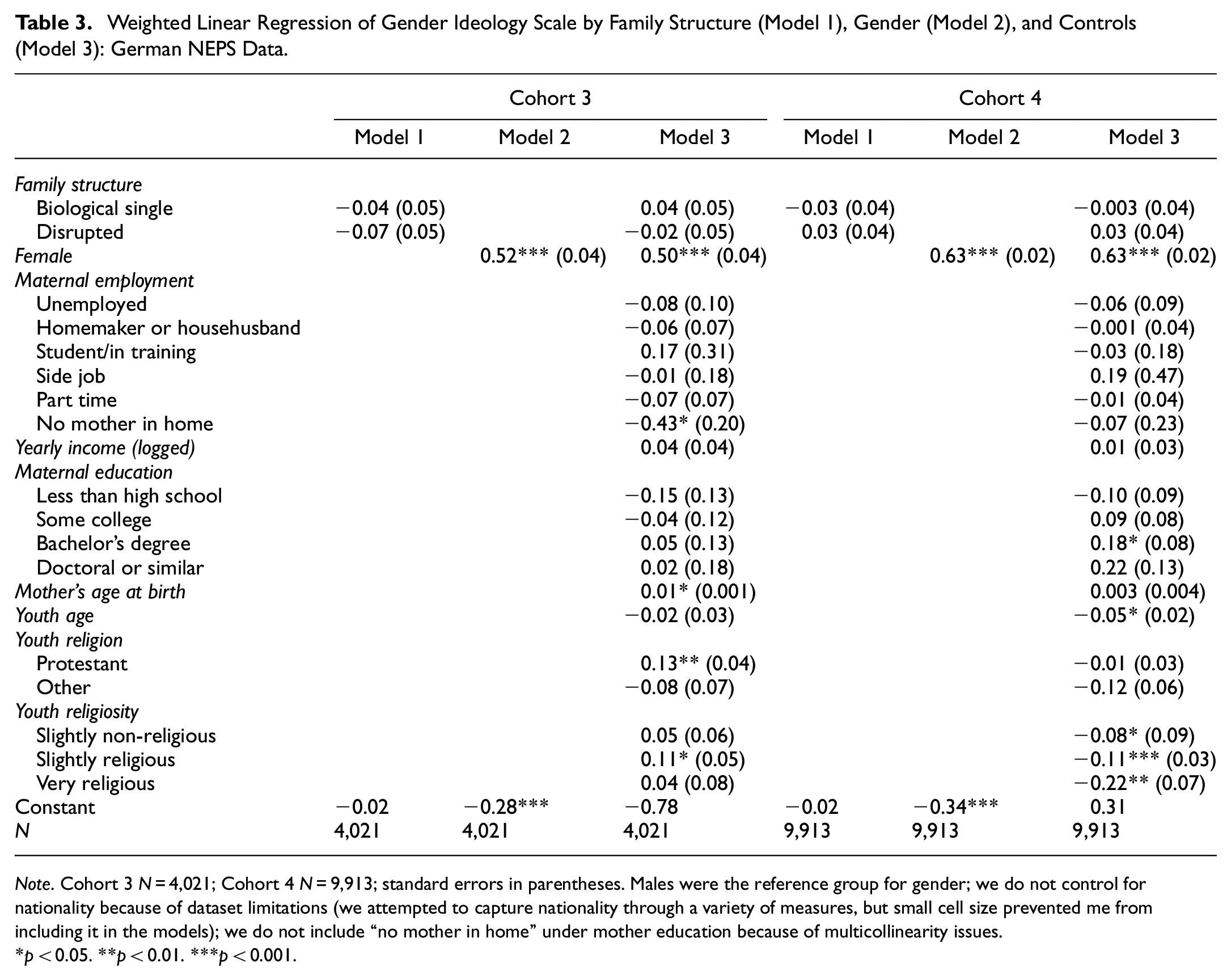
Note. Cohort 3 N = 4,021; Cohort 4 N = 9,913; standard errors in parentheses. Males were the reference group for gender; we do not control for nationality because of dataset limitations (we attempted to capture nationality through a variety of measures, but small cell size prevented me from including it in the models); we do not include “no mother in home” under mother education because of multicollinearity issues.
p < 0.05. **p < 0.01. ***p < 0.001.
Weighted Linear Regression of Gender Ideology Scale by Family Structure (Model 1), Gender (Model 2), and Controls (Model 3): Korean KYPS Data.

Note. Cohort 1 N = 2,510; Cohort 2 N = 2,648; standard errors in parentheses. Males were the reference group for gender; high school for education, and full-time work for maternal employment. There are no variables for religion, religiosity or maternal age at birth in the KYPS data.
p < 0.05. **p < 0.01. ***p < 0.001.
Results
Our findings indicate that the majority of youth in Germany (72% in cohort 3 and 71% in cohort 4) live in biological married families. Fifteen percent live in a single-parent family and 14% live in a disrupted family structure. In Germany, the majority of those in the disrupted family structure were in stepfamilies. An even larger majority of young people in Korea live in a biological married family (over 90% for both cohorts), and very few live in either a single-parent or disrupted family structure (3%–6% for both cohorts). These results echo findings from previous research that suggest greater stability in family structures in Germany compared to other western economies (Dufur et al., 2016). This also echoes research on Korea that shows divorce rates and remarriage rates remain low in comparison to western countries (Eun, 2007).
Looking at gender ideologies across family structures (Table 2), we see that most young people in both countries have middle-range gender ideologies. Contrary to our expectations, we found little variation in means of gender ideology across family structures; what variation we did see suggests that, as expected, youth in non-normative family structures have higher means of gender ideologies than those in two-parent biological families.
In both Germany and Korea, mothers in biological married families and mothers of younger children have higher education than those in other categories. Older youth in Germany are more likely to have mothers working full time than are the children in the younger cohort, perhaps reflecting mothers feeling more able to work longer hours when their children are more able to manage themselves in daily tasks. For the younger cohort in Korea, youth in biological married families and disrupted families have a higher percent of mothers working full time; in the older cohort, a greater percentage of youth in single-parent families have working mothers. In both Korea and Germany, youth in disrupted family structures have the highest proportion of working mothers, an interesting finding given that most of these mothers have partners who likely bring financial resources into the family. For youth religion, available only in the German data, older youth in all family structures are less likely to be religious.
The results of our multivariate analyses are presented in Tables 3 (Germany) and 4 (Korea). For both Germany and Korea, results in Model 1 were similar. Before including any controls, family structure was not significantly associated with gender ideology in either cohort for either country (Model 1). This is surprising, as we expected youth in single-parent or disrupted family structures to be more like adults in those family structures in previous studies using US data and to report more egalitarian gender ideologies. The results in Model 2 more closely reflect the differences we expected to see between boys and girls. Girls tend to have more egalitarian gender ideologies (+0.52 and +0.63 standard deviations for German Cohorts 3 and 4; +0.53 and +0.67 standard deviations for Korean Cohorts 1 and 2, respectively), and this difference is statistically significant (Model 2).
After adding controls to our multivariate analyses (Model 3), we find several other statistically significant factors associated with youth gender ideology. For both Korea and Germany, maternal education is correlated with gender ideology. In Korea, maternal employment and income matter for gender ideology development, while in Germany, religion, religiosity, and maternal age all matter. In Germany, for Cohort 4, having a mother with a Bachelor’s degree is associated with a 0.18 standard deviation more egalitarian gender ideology; being slightly non-religious, slightly religious, or very religious (compared to not at all religious) was associated with 0.08, 0.11, and 0.22 less egalitarian gender ideology, respectively. For Cohort 3, being Protestant was associated with 0.13 standard deviation more egalitarian gender ideology, compared to being Roman Catholic. For Korean Cohort 1, having an unemployed mother was associated with 0.10 standard deviation less egalitarian gender ideology, and for both cohorts, having a mother with a Bachelor’s degree was associated with 0.14 standard deviation more egalitarian gender ideology. See Tables 3 and 4 for more detail.
Finally, youth sex has the strongest association with youth gender ideology in all four cohorts, even after accounting for all controls. In Model 3, girls in both Germany and Korea are more likely than boys to support egalitarian gender ideologies, and the magnitude of the coefficients for all four cohorts are almost identical to those in Model 2: +0.50 and +0.63 for German Cohorts 1 and 2; and +0.54 and +0.69 for Korean Cohorts 1 and 2. We speculated that girls might be more sensitive to the influence of family structure, based on the assumption that parents raise sons and daughters differently (see Davis & Greenstein, 2009; Perales et al., 2021; Raley & Bianchi, 2006), which might in turn affect gender ideology development. To test this relationship, we ran models that included an interaction term for youth sex and family structure. We found no support for the idea that girls’ gender ideology development is more sensitive to family structure than boys, although this may be a result of small cell sizes due to the relatively small number of youth in non-traditional family structures, especially in Korea (results available upon request).
Discussion
In this paper, we set out to better understand the differences in gender ideologies among youth in biological married families, single-parent families, and disrupted family structures, between youth in Korea and Germany, and between male and female youth. Given that adults in non-traditional family structures, such as those who have divorced and remarried, exhibit more egalitarian gender ideologies (Boehnke, 2011; Davis & Greenstein, 2009; Davis & Wills, 2010; W. A. Goldberg et al., 2012), we expected that the children in these families would also express more egalitarian gender ideologies, perhaps because of the role modeling behaviors they saw in their parents (Morawska, 2020; Yang et al., 2021). Furthermore, due to differences in equality levels and societal beliefs, differences in the gender systems in these countries, as well as variations in family structure across contexts, we expected to find that Korean and German contexts shaped youth in various family structures differently. We also expected to find that girls would be more susceptible to the influence of family structure, and we aimed to uncover the role that child gender plays in the development of gender ideologies for understudied youth. However, we found support only for the last of these assertions. Family structure was not an important predictor of youth gender ideology in either Germany or Korea.
The disconnect between the ways family structure shapes adult gender ideologies and the ways youth gender ideologies are unaffected by family structures is surprising. Our results contradict past research looking at adults that finds that non-normative family structures often lead to more egalitarian ideologies (Boehnke, 2011; Davis & Greenstein, 2009; Davis & Wills, 2010; W. A. Goldberg et al., 2012). The fact that this result did not appear for youth, regardless of nationality or cohort, suggests that family structure may matter less for developing youth ideologies for a variety of reasons. Gender ideology development might be influenced by other areas of family life not captured by our measures of family structure (Davis & Wills, 2010; Perales et al., 2021; see also Kretschmer, 2018 and Kleinschrot et al., 2023). For instance, according to Halpern and Perry-Jenkins (2016), it is parental gender ideology and doing gender behaviors that predict more egalitarian ideologies in their children. Relationship quality may also matter more than the structure of the relationship (Janning et al., 2011). Measures of such concepts—both relationship quality and parental gender ideology—were not available in the data we use here, but it would be possible for future data to distinguish between effects of family structure and effects of family interactions and ideologies that are associated with family structure. In addition, youth of the ages we studied may also spend less time with their family structures than with their peers, at school, or on social media—all actors that are major agents of socialization. These additional, powerful agents of socialization that model gendered behaviors and beliefs may have more of a salient role in gender ideology development for youth than parents do, as explored by gender systems theory.
We note, however, that our findings for Germany and Korea differ substantially from previous work using US data, which found significant associations between family structure and youth gender ideologies. One potential explanation for this disconnect relates to differences in family structure diversity. In past research using US data to examine gender ideologies and family structure, scholars find that step-families and cohabiting families vary with regards to gender ideologies (D. L. Carlson & Knoester, 2011). In our samples, few children live in those family structures, especially cohabiting families. However, a much larger proportion of children in both Germany and Korea live with married biological parents than do in the US. If family structure across our contexts were more diverse, as in the United States, perhaps youth in Germany and Korea would view alternative family structures as more normative, and our results would be more similar to those derived from US data as our models could be more statistically comparable.
Another possibility is that studies looking at the United States tend to use data from the 1980s, 1990s, and early 2000s (D. L. Carlson & Knoester, 2011; Halpern & Perry-Jenkins, 2016). The predictors of gender ideology today may have shifted. Today, we see that across most countries, egalitarian gender ideologies have become more common as countries, including those typically seen as more traditional, have modernized and become secularized (Dorius & Alwin, 2010; Urbaeva, 2019). We find support for this, as there are limited differences in the role of the country in influencing how family structure shapes gender ideology of youth. Additional support for this perspective comes in the form of the significant association between youth gender ideology and maternal education levels. Higher maternal education operates to encourage more egalitarian gender ideologies for both German and Korean youth, echoing work on youth in the US (Alwin, 1989; see also Davis & Greenstein, 2009). As universally available education, particularly for girls and women, is a hallmark of modernization, as countries embrace educational opportunities for women it is possible more egalitarian gender ideologies follow.
Finally, we find that, across all cohorts and within both countries, being female is significantly associated with holding more egalitarian gender ideologies. This suggests that, in conclusion, even in a country with more normative ideologies and expectations about gender on a societal-level like Korea, girls are on average more likely to express egalitarian gender ideologies. A child’s gender position, then, has a unique effect in that it does not operate through other mechanisms, but is a directly salient component in forming views on how gendered systems shape the world. If girls are more egalitarian, regardless of family structure or country of birth and residence, this has major consequences for their later lives, especially in how their views and expectations may come into conflict with societal views about gender and the role of women in and outside the home (Bolzendahl & Myers, 2004; Thijs et al., 2019). As girls, regardless of country and family structure, occupy a disadvantaged position in society, and as they are recipients of stricter socialization efforts (Davis & Greenstein, 2009; Raley & Bianchi, 2006), they may see more advantage in holding egalitarian ideologies as they seek to enhance their position in society through education and greater workforce participation (Bolzendahl & Myers, 2004; John et al., 1995; Thijs et al., 2019).
Conclusion
Limitations
Our study has some limitations. Most importantly, we are unable to control for parental gender ideologies, meaning our measure of family structure is forced to serve as a potential proxy for those ideologies. Given the robust research suggesting differences in adult gender ideologies across family structures, we are confident those differences persist here, but it would be preferable to have direct measures of parental gender ideologies in the same models. The Korean data contained no indicators of key concepts like religiosity or maternal age at birth, making those comparisons difficult. Data sets across both countries lacked nationality or race indicators, but immigrant or racial minority status might also play a part in the development of youth gender ideology, so future scholars should utilize these measures more fully. In addition, we acknowledge that there are other aspects of family structure not captured, such as transitions between different structures or the length of time spent in each family structure. Given the weak connections between family structure and gender ideology we found across two diverse contexts we study here, we question the degree to which these more nuanced approaches might identify new connections, but we note this is an empirical question that could be addressed with other data. In addition, we are limited to using quantitative data here, but in-depth interviews or other mixed-methods approaches could more thoroughly address the richness and breadth of how both parents and children understand, express, and perform gender.
Future Research and Policy Applications
We suggest that in future research, given the strong relationships between youth sex and gender ideology, more extensive categories of gender identification beyond the binary male-female should be studied. Youth who hold non-binary gender identification may be more likely to be egalitarian than those who do not. In addition, we suggest that scholars interested in gender ideology development and its consequences should look at these youths later in their lives, as they may later experience more tension between their personal beliefs and opportunities available to people of their sex and gender. While the use of panel data will be useful to explore how sex status shape an individual’s experiences across the life course, researchers should also engage in repeated cross-sectional data collection efforts to help identify shifting trends and cultural expectations.
In conclusion, this research thus contributes to our understanding of the creation and reinforcement of gender inequality, both within the home and within broader society, and highlights the importance of testing theories about gender across multiple contexts. Ridgeway (2011) explained how gender ideologies create and reinforce the belief that people must be gender-conforming and should undertake roles and opportunities that conform to their gender. We find that youth’s gender shapes their gender ideologies; this can have consequences for their later life opportunities across many institutions and settings. The views people have about gender and gender roles shape the experiences of individuals and the narratives utilized by society to frame the choices individuals make about their careers and lives, such as women choosing careers that promote work-family balance, or even staying out of the paid labor force altogether. Our findings suggest the need for broader policy targeting gender inequity, especially in contexts like South Korea where non-traditional family structures are still much less common and remain heavily stigmatized. Tailoring policies and programs that help parents model more gender egalitarian behaviors and attitudes within more stable and more traditional family structures is needed to reshape gender systems in locations not experiencing more extensive family structure change.
Footnotes
Author Note
An earlier version of this paper, excluding the Korean comparison, was presented at ASA’s 2017 conference and was accepted as Alyssa Alexander’s Master’s thesis at Brigham Young University.
Declaration of Conflicting Interests
The author(s) declared no potential conflicts of interest with respect to the research, authorship, and/or publication of this article.
Funding
The author(s) received no financial support for the research, authorship, and/or publication of this article.

Data Availability Statement
This paper uses restricted data from the National Educational Panel Study (NEPS): Starting Cohort Grade 9, http://dx.doi.org/10.5157/NEPS:SC4:10.0.0 and Staring Cohort Grade 5, http://dx.doi.org/10.5157/NEPS:SC3:9.0.0. From 2008 to 2013, NEPS data was collected as part of the Framework Program for the Promotion of Empirical Educational Research funded by the German Federal Ministry of Education and Research (BMBF). As of 2014, NEPS is carried out by the Leibniz Institute for Educational Trajectories (LIfBi) at the University of Bamberg in cooperation with a nationwide network.