




Abstract
The cognitive abilities that are necessary to make mating interactions effectively have been described as “Mating Intelligence.” This is an evolutionary construct that has just recently initiated to receive practical consideration. This research work investigated the psychometric properties of the Persian translation of the Mating Intelligence Scale in Iran. A total of 760 male and female heterosexual participants (380 for each sex) were recruited from colleges. Participants completed a self-reported questionnaire and they also reported some demographic information such as age and their qualification degrees and major. The male and female version of the Geher and Kaufman Mating Intelligence Scale were used to gather data. We performed a confirmatory factor analysis to confirm the structure of the original version of both scales. The values of fitness indicators show that in both samples, the model benefits from good fitness. The results show that the scale and its subscales in both samples have proper reliability coefficients. In general, the use of the mating intelligence questionnaire is appropriate regarding the Iranian population due to the excellent validity and reliability and can be used in screening and therapeutic and educational situations.
Introduction
Human mating involves choosing a mate and competing for a mate, and these ultimately lead to continuity of generation (Schmitt, 2015). According to Buss and Schmitt (1993), humans have been equipped with both long-term and short-term mating strategies but they do not apply them at the same time. Sexual Strategies Theory expressed shows that women and men have shaped a set of mating strategies. For instance, the long-term mating strategies are determined by extended courtship, longer relationship, love, allocating more resources for a long-term relationship, and reproduction. It seems that in our time, marriage and its obligations are formed based on long-term mating strategies. However, short-term mating strategies refer to a temporary sexual relationship that is more focused on sexual pleasure.
Although according to the Sexual Strategies Theory, both men and women benefit from long-term and short-term mating strategies, there are significant differences in how each one applies these strategies. Although men tend to look for a mate with physical attractiveness and fertility value, women, in contrast, look at men’s positions as well as resources and the ability of long-term provisioning (Cloud & Perilloux, 2014; Grillot, Simmons, Lukaszewski, & Roney, 2014; Schmitt, 2014).
Findings of Sexual Strategies Theory have been confirmed in different cultures (Eastwick, Luchies, Finkel, & Hunt, 2014; Lippa, 2009; Yong & Li, 2012). Although Sexual Strategies Theory has substantially acknowledged the differences between males and females in mating strategies, there is no clear answer to the fact “what are the differences between women and men?” In other words, which strategies they peruse to be regarded as valuable mates.
Mate choosing, based on physical fitness indices, is likely to lead to the emergence of individuals who can reproduce themselves (Singh, 1994). Hence, mate preferences are considered to be adaptive behaviors that should promote successful reproduction (Reeve, Kelly, & Welling, 2017). This evolutionary process depends on two factors, for which both are based on physical fitness indices. The first factor helps to show the potential value of mate, and the second factor refers to the ability to understand the signals displayed by potential mates.
According to the strategic pluralism theory, human mating value directly affects his or her short-term and long-term mating strategies (Gangestad & Simpson, 2000; Geher, Kaufman, Garcia, Kaufman, & Dawson, 2016; Schmitt, 2015). The value of a man’s mating is largely determined by his position and prestige, which depends on a combination of factors including intelligence, sense of humor, social popularity, long-term ambition, and interpersonal domination. However, in women, mate value depends more on physical characteristics, such as attractiveness and youthfulness (Schmitt, 2015). These factors and attributes can be formulated as Mating Intelligence or the “system of mind’s reproductive,” which facilitates the formation of a reproductive strategy by a complex set of mating strategies (Geher et al., 2016).
Mating Intelligence is one of the new structures recently added to the evolutionary psychology literature. We are adopting Miller, Tybur, and Jordan’s (2007) definition of mating intelligence as high-level cognitive processes associated with human mating. Geher and Kaufman (2013) believe that Mating Intelligence is different from other concepts in the field of mating because of its more vibrant, more abstract, and more intellectual nature. The initial structure of Mating Intelligence was introduced by Geher and Kaufman (2007), and they defined this structure in four areas. The cross-sex reading includes all issues that are related to some knowledge of a person’s potential mate interests. In the mating-relevant self-deception category, knowledge is associated with the general confidence of the individual as a mate. However, other deception of the mating-relevant includes the ability to manipulate the potential mates. The cognitive courtship display also refers to cognitive strategies that are used to attract a mate. A kind of caring mechanism that includes various psychological traits such as vocabulary (Rosenberg & Tunney, 2008), humor (Greengross & Miller, 2008), altruism (Barclay, 2010), and creative writing (Kaufman & Kaufman, 2009). Concerning men, there is another component called sexual overestimation, which is referred to as the sexual interest of men to multiple partners. In the case of females, this component was called commitment skepticism which is referred to as the test of the devotion of mates, as they bear greater expenditure in the case of abandonment.
According to available evidence, the two-gender mating processes are distinct and involve different cognition (Buss, 2003). For example, mating intelligence in men is more relevant to short-term mating opportunities, while women have the interest to involve themselves in long-term prospects. In various studies, the relationship between mate selection and multiple indicators has been studied. Although the mate selection is not the same as the mating intelligence, reviewing researches that are related to this concept can help to get an insight into the mating intelligence. Baker, Sloan, Hall, Leo, and Maner (2015) revealed some pieces of evidence about the effect of mating cues on memory displays in men. Pandeirada, Fernandes, Vasconcelos, and Nairne (2017) showed a potential mnemonic tuning for the faces of potential partners. Research has also shown that external factors such as family members, parents, and friends can influence the process of selecting a mate (Knobloch & Donovan-Kicken, 2006; Zhang & Kline, 2009).
Along with the mating intelligence introduction in evolutionary psychology, the studies have begun to operationalize this structure. In one of the most significant studies, Geher and Kaufman (2007) published two self-report questionnaires (one for each sex) which have helped to measure this emerging structure. In the other study, O’Brien, Geher, Gallup, Garcia, and Kaufman (2010) tried to evaluate the psychometric indices of these two questionnaires. The results of this research showed that these two surveys have good psychometric indices in measuring mating intelligence.
Mating and related structures, such as intelligence, are culture-dependent. Evolutionary psychologists believe that culture has an important role in the formation and types of mating strategies (Pirlott & Schmitt, 2014). Iranian culture had features that can influence these strategies, so that they are rooted in traditions and religion as well as a movement toward modernization. However, in spite of structural changes in Iranians society in recent decades, they still have characteristics and features that differentiate them from other cultures. This differentiation necessarily reveals further study of mating strategies in this culture. In other words, we are interested in examining mating intelligence and its components in Iranian culture in the light of our own cultural background. Considering the essential need for measuring mating intelligence in the field of marriage counseling and family therapy, as well as testing the application of this questionnaire in different cultural fields, we decided to evaluate the psychometric indices of this questionnaire in a sample consisting of Iranian male and female students.
Method
Participants
A total of 760 male and female heterosexual participants (380 for each sex) were recruited from the students of an institution. The sample size was determined by some considerations (Tabachnick & Fidell, 2007). Participants’ ages ranged from 19 to 37 years (M = 27.5, SD = 3.6). Regarding educational qualification, in the male sample, 225 participants were bachelor students, 97 participants were MA students, and 58 participants were PhD students. In the case of female sample, 235 participants were bachelor students, 92 participants were MA students, and 53 participants were PhD students. All participants were never married.
Procedure
Participants were recruited from a university in a city of Iran. Participants completed two self-reported questionnaires and reported some demographic information such as age and their qualification degree and major. Participators were informed about the nature of the study, that participation was voluntary and anonymous, that they could withdraw from the study at any time, and that they were not obliged to respond to all questionnaire items. Also, the research plan was approved by the Ethics Committee of the university. We performed a confirmatory factor analysis (CFA) to confirm the structure of the original version of both scales.
Measure
Participants were asked to complete the Geher and Kaufman (2007) Mating Intelligence Scale, male and female version. This scale is mainly based on the multiple intelligence theory and in part based on the theory of emotional intelligence. From the viewpoint of developers, mating intelligence is rooted in sexual differences, reflecting individual differences in the perceptions of sexual strategies. Geher, Camargo, and O’Rourke (2008) presented a new framework for formulating this new structure. According to this framework, the fitness components of the mating intelligence and its cognitive component are distinguished. From this perspective, mating intelligence is exclusively a human attribute that evolved to reach the goals of courtship and varies from person to person. Accordingly, Geher et al. (2008) have proposed dimensions of mating intelligence on the basis of the fitness and mating cognitive mechanisms that predict the success of reproduction based on Darwin’s theory.
The scale was changed in somewhat ways from its original form. The original True/False answering format was changed to a 5-point Likert-type scale (like as O’Brien et al., 2010, study). In the male scale, Items 1, 7, 10, 12, 18, 19, 20, 22, and 24 and in the female scale Items 2, 4, 8, 9, 11, 13, 16, 19, 21, and 23 were reverse scored. The scale consisted of 24 questions and five subscales. We excluded four items in both scales that capture mating success and analyzed 20 items following the Geher et al. (2016) study. The cross-sex mind reading subscale has items such as “I am pretty good at knowing if a woman is attracted to Me” and “Honestly, I don’t think I understand men at all!” The self-deception subscale has items such as “If a woman does not seem interested in me, I figure she does not know what she is missing” and “I look younger than most women of my age.” The other-deception subscale has items such as “I am good at saying the right things to women I flirt with” and “I have a sense of style and wear clothes that make me look sexy.” The courtship display subscale has items such as “People tell me that I have a great sense of humor” and “I am not very artistic.” The last of it in the male scale is the sexual overestimation subscale which has items such as “Women tend to flirt with me pretty regularly” and in female scale is the Commitment Skepticism subscale which has items such as “Most guys who are nice to me are just trying to get into my pants.” The Mating Intelligence Scale took approximately 15 min to complete. Psychometric characteristics of this scale are well-documented in some earlier studies. Geher et al. (2016) confirmed the validity of this scale using exploratory factor analysis (EFA) in a sample of 1,200 men and women. They reported the reliability for men and women versions, 0.76 and 0.55, respectively. O’Brien et al. (2010) also reported the reliability of male and female versions 0.77 and 0.57, respectively.
Following a back-translation procedure, all items were translated into Persian by an English translator. Then, an independent translator translated all items back into English. Finally, the authors approved the final version of the scale.
The research method was correlational and the structural equation modeling (SEM) was used. SEM is a powerful multivariate statistical technique that is used to analyze structural relationships. This method has been used by biologists, economists, educators, marketing researchers, medical researchers, and a wide range of social and behavioral researchers. One of the reasons for the wide application of this method in various sciences is that it allows testing the theories quantitatively. CFA is a statistical technique that focuses on modeling the relationship between observed indicators and underlying latent variables (factors). CFA is a special case of SEM can be distinguished from the EFA in that CFA determine whether a prior well-established model fits the data (Gallagher & Brown, 2013). As we examined the validity of a well-established scale of mating intelligence, we used CFA. The reliability of the full scale and subscales was evaluated by Cronbach’s alpha and omega coefficient.
Results
Before the analysis, the normality of data was checked by the Kolmogorov–Smirnov test, and its result confirmed normality of data. All analyses were done separately for each sex. The analysis was performed using the SPSS software version 16 and the AMOS version 16 software.
In the case of validity assessment, a CFA, along maximum likelihood estimation was performed to confirm the structure of the original version of both scales. In the male sample, the values of fitness indicators show that this model benefits from moderate fitness. The outcome of CFA shows that root mean square error approximation (RMSEA) equal to 0.076, comparative fit index (CFI) was 0.91, goodness of fit index (GFI) was 0.89, adjusted goodness of fit index (AGFI) was 0.85, normed fit index (NFI) was 0.87, incremental fit index (IFI) was 0.91, Tucker–Lewis index (TLI) was 0.89, and χ2/df was 3.18 of which demonstrated a moderate fit with observed data. In the female sample, the outcome of CFA shows that RMSEA equal to 0.078, CFI was 0.94, GFI was 0.89, AGFI was 0.85, NFI was 0.91, IFI was 0.94, TLI was 0.92, and χ2/df was 3.28 of which demonstrated a moderate fit with observed data. Some of the covariance among factors was significant in both samples. Tables 1 and 2 presented the correlation matrix and descriptive statistics in male and female samples.
Male Correlation Matrix and Descriptive Statistics (Confirmatory Factor Analysis Factors; N = 380).

Significance level .01.
Female Correlation Matrix and Descriptive Statistics (Confirmatory Factor Analysis Factors; N = 380).

Significance level .01.
The factor loadings for the scale items in the both samples were presented in Tables 3 and 4.
Confirmatory Factor Analysis on Male Questionnaire (N = 380).

All factor loadings are significant at .001.
Confirmatory Factor Analysis on Female Questionnaire (N = 380).
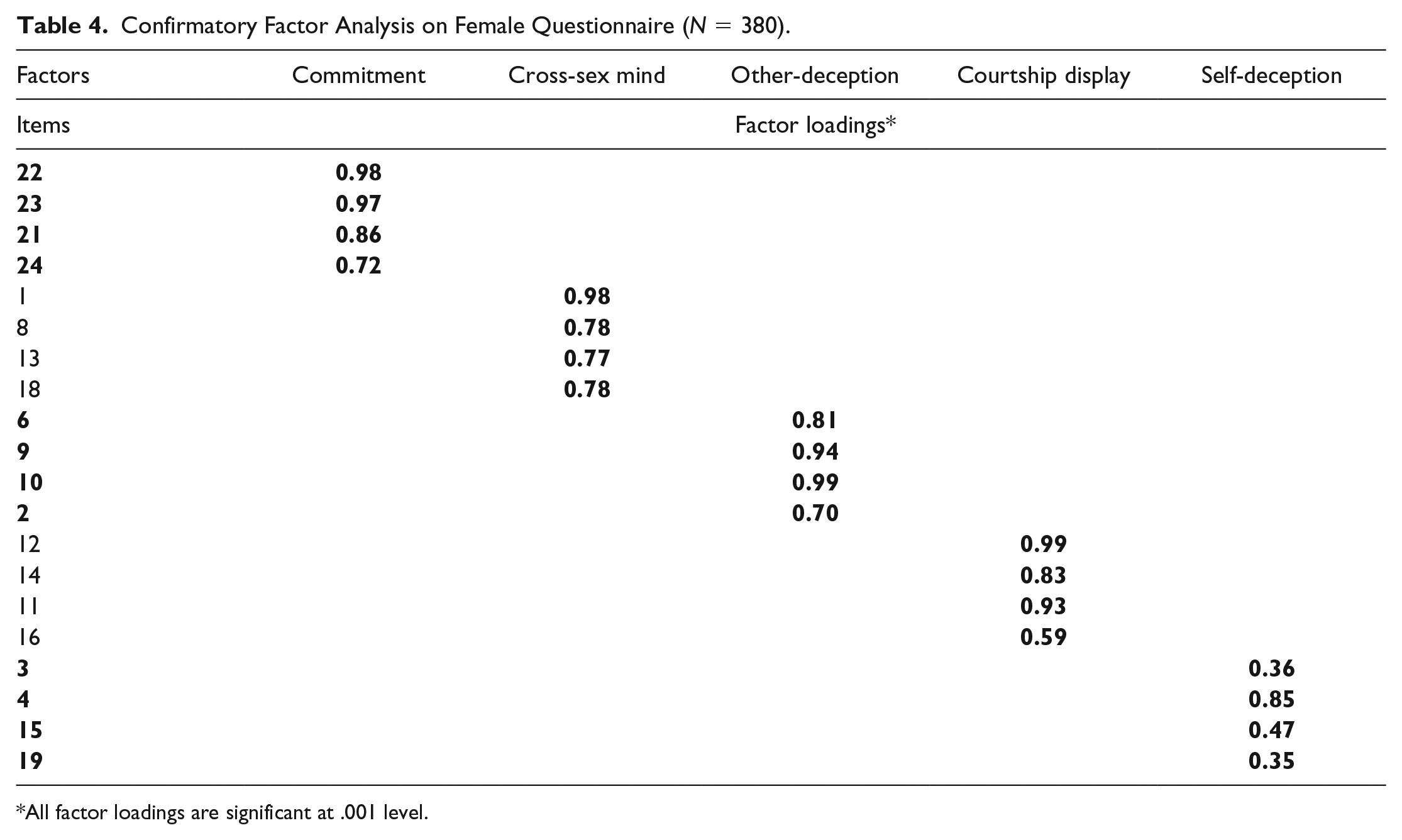
All factor loadings are significant at .001 level.
According to Tables 3 and 4, coefficients of all items in male and female samples were above 0.40; Cronbach’s alpha and omega coefficients were used for the evaluation of the reliability of the scale and its subscales. Reliability for the total scale and subscales in male and female samples were presented in Table 5.
Reliability Analysis for the Mating Intelligence Scale and Subscales in Female and Male Samples (N = 380).

Discussion
The purpose of this study was to evaluate the psychometric properties of the Mating IQ Scale in college students. In general, according to the results, the questionnaire is suitable for measuring mating intelligence. The evidence obtained from carrying out the confirmatory analysis revealed that the factor structure of the Persian version Mating IQ Scale is consistent with the original version. Also, the reliability coefficients for all factors and the total questionnaire in both samples (except self-deception subscale in the female sample) were higher than 0.70, which indicates the appropriate reliability. The results are in line with studies that examine the validity and reliability of this scale (Geher et al., 2016; O’Brien et al., 2010).
Our results revealed in the male sample, consistent with the original version, the five-factor structure was confirmed. The results showed all items had a high loading factor on its subscales. However, we observed that fitness indices were moderate. In the female sample, the results showed the five-factor structure was confirmed. Considering that the model fitting indices were moderate in both samples, we, following McNeish, An, and Hancock (2018), employed the measurement quality to explain this issue. According to McNeish et al. (2018), when there are some poor model fit indices, alternatively we can apply a measure of reliability to show the measurement quality of the work. In Table 5, we have reported the Cronbach’s alpha and omega coefficient for the mating intelligence scale and subscales. According to Table 5, despite moderate model fit indices, we have high omega coefficient and high-reliability coefficients for the total scale and subscales in both samples, except self-deception subscale in the female sample. Our results showed that the reliability of this subscale was 0.62.
According to the related literature, the mate selection based on self-deception required to cognitive misinterpretations so that it causes individuals to unconsciously underestimate their defections and overestimate favorable attitudes to self. This tendency is the result of self-confidence and value-dependent attributes that are directly influenced by culture.
Cultural traditions to evaluate the positive qualities and attributes of women in Iranian culture are such as to even prevent them from revealing their true positive qualities. Therefore, the relatively moderate items factor loading in this scale (self- deception) and low-reliability coefficient of it, may be explained by the cultural effects. Therefore, it can be claimed that in Iranian culture, the process of human mating and its required cognitive abilities in female is less affected by self-deception.
As observed in the results section, the results of this study provide a psychometrically valid and reliable version of the mating intelligence (MI) questionnaire that can be used in Iran, and the observed factor structure is related to five factors in male and female samples. Based on the finding, this questionnaire can be used to explore various aspects of mating IQ considering the necessity of having an objective tool for measuring mating IQ. This questionnaire is not only designed to evaluate mating IQ but can also be used as a tool to assist counselors and psychologists to provide marriage and family counseling services. The questionnaire can also serve as a useful tool for researchers to explore mating IQ with different goals. Researchers can use this tool as a pretest and posttest in assessing the impact of educational training on mating IQ and its components.
In general, the MI questionnaire is an appropriate tool that can be used in Iran due to the excellent validity and reliability and can be used in screening and therapeutic and educational situations. This tool is one of the most useful tools available to study the various aspects of mating IQ as far as researchers who have the interest are concerned.
Along with the results, this study has been accompanied by limitations, of which the barriers related to gathering data tool and the study sample are the most important of these limitations. First, the MI scale should be used as one of the information sources about mating IQ along with other measurements. Also, despite the good psychometric properties, this scale is still a self-report questionnaire, and hence its results should be interpreted with caution.
Finally, the sample is limited to college students aged 20 to 40 years, which can limit the generalization of the results. Therefore, it is suggested that the psychometric properties of the questionnaire be examined in other samples of different age and educational levels. Also, the validity of this questionnaire has been evaluated by the use of one method (factor analysis). Therefore, future studies could evaluate the validity of the MI scale with other methods of evaluating validity such as the criterion method.
The findings in this study contribute to the growing literature on mating IQ and help to broader evolutionary psychological research in non-Western societies. Future studies should also pay attention to the correlations of mating intelligence. It is recommended to examine more deeply the correlation of MI with sexual behavior and actual patterns of mate selection in male and female samples.
Footnotes
Declaration of Conflicting Interests
The author(s) declared no potential conflicts of interest with respect to the research, authorship, and/or publication of this article.
Funding
The author(s) received no financial support for the research, authorship, and/or publication of this article.
