




Abstract
As people age, the community gradually becomes the main place for their daily activities. In old residential communities in China, variations in behaviors and venue choices of older adults reflect gender differences. This study focuses on the behavioral gender differences in old residential communities and the characteristics of venue use under the influence of the unique policies and culture of China. Semistructured interviews, behavioral mapping, and photo recording were utilized for data collection. The results showed that gender differences were reflected in the variability of behaviors and venue use of older adults. These differences are due to people’s living habits and gender characteristics as well as the top–down development of feminism in China. This study highlights the important role played by policies and culture in behavioral differences and stresses that systematically environmental construction could be used as a balanced means to address gender differences in old residential communities. This study also suggests minimizing activities with a strong gender orientation, balancing the gender allocation of service staff for older adults, and emphasizing space flexibility and versatility could help achieve a gender-balanced community environment.
Introduction
With the implementation of the one-child policy and long-term outflow of younger generations, the effects of aging are being felt acute in Northeast China (Yu et al., 2018). Currently, there are three older adult-care modes in China: home-based care, community care, and facility care (State Council, 2017). With children making up a smaller proportion of the population, community care has gradually become the main mode for older adults in the city (B. Li et al., 2016); it has also become one of the most important older adult-care models in cities (Yu et al., 2018). Old residential communities are products of China’s housing distribution system carried out in the 1980s and 1990s (Housing distribution system: In the late 1970s, in order to solve the housing problem caused by population growth, Chinese government departments and state-owned enterprises established a system for distributing apartments to employees in the form of welfare. In the 1980s and 1990s, a large number of adaptive apartment-style residential areas were built by the Chinese government and state-owned enterprises. These communities were built in the city center, each apartment with an area of about 50 to 70 m2, providing urban residents a guaranteed home for life. These communities are called old residential communities). The government and state enterprises built the communities, and owing to the date of construction and low migration rate of residents, the aging population in these districts is particularly prominent (Fan et al., 2018). In addition, due to a lack of design relevant to the needs of older adults in these areas, it is difficult for the community public space to meet older adults’ individual needs (Yu et al., 2018). In 2017, the 13th Five-Year Plan for the older adult population emphasized the need to adapt these communities to improve older adults’ quality of life, including providing suitable public activity space for different types of older adults (State Council, 2017). Therefore, it is important to understand the characteristics of behavior and venue use of different types of older adults in the public spaces of these residential communities.
Gender is one of the central axes of difference among people. Therefore, understanding behavioral differences as mediated by gender is of great benefit to the development of residential environment design and renovation strategies, formulation of relevant policies, and improvement of the quality of life (QOL) of older adults residing in residential communities (Bell et al., 2001; W. Sun et al., 2015). However, gender differences are rarely considered a factor in “equality” in a socialist system (S. J. Du, 2005). According to policy, men and women usually have the same rights and obligations and are treated the same, while the differences between them are ignored (Y. Liu, 2016). With regard to older adults in China, most of the research on this population considers them an independent group. Research on older adults is often carried out from the perspective of changes in health (Zhai, 2016; Zhang & Qin, 2019), while some of their basic characteristics such as gender are ignored. In China, the traditional idea of male superiority and female inferiority still influences older adults’ lives and behavior (Lin et al., 2020).
Against this background, the primary goal of our study was to identify how older adults’ behavior in community public spaces differ according to gender. This study was conducted on older adults living in the old residential communities of Dalian in Northeast China, focusing on the behavioral gender differences in communities and the characteristics of venue use under the influence of China’s unique policies and culture. For this purpose, the study used semistructured interviews, behavioral mapping, and photo recording. It explored behavioral similarities and differences in older adults within the context of communities built under China’s socialist system and a male-dominant culture. The findings call attention to the important role played by policies and culture in behavioral gender differences. In addition, this study supports the idea that systemic and environmental construction can provide a balanced means to address gender differences in old residential communities.
Literature Review
Gender differences can be reflected on many levels and have received attention in different fields. Traditionally, women are more socially active than men and are more willing to engage in intimate social activities, such as discussing private issues. In contrast, men’s socialization focuses on similar personal interests (Fehr, 1996). Spain (2014) pointed out that gender differences are more pronounced in a public space. Therefore, analyzing behavioral differences by gender in individuals using a public community space is an effective way to understand gender differences in behavioral needs and characteristics.
At present, most design studies on gender differences critique the masculine design in modern society, emphasizing that designs should pay more attention to women’s perspectives and usage needs (He, 2007). Different from western cultures, in which western feminism has had a strong role in reflecting on and socially critiquing urban construction and architectural design development (Weisman, 1994), gender differences have not received as much attention in the architectural design field in China (Y. Wang, 2004; Xiong & Li, 2019). This can be attributed to the “equality” principle of socialism, which guarantees the equality of men and women in terms of social status, without the need for women to demonstrate and/or fight for it (C. X. Huang & Gu, 2003). Currently, most domestic perceptions of equality between men and women agree that they should be treated the same. This egalitarianism masks the differences between men and women, especially in research on older adults. Older adults are usually classified according to behavioral ability, ignoring gender differences. The single-gender perspective is often defaulted to be a holistic view (Xiong & Li, 2019).
In ancient times, Chinese women were regarded as men’s appendages, and the concept of three forms of obedience and four virtues set the behavioral standards for Chinese women (The three forms of obedience: Obedience to father before marriage, obedience to husband after marriage, and obedience to son after husband’s death; the four virtues: morality, proper speech, modest manner, and diligent handicraft). The awareness of feminism in China originated from the May Fourth Movement in 1919, when the spread of Marxist feminism influenced some scholars and initiated the liberation of Chinese women. In this period, feminism mainly reflected the expectations of men as the main spokesperson for women. It was a transformation of men’s discourse on women and even women’s rights. It discussed women’s employment, education, and the right to free marriage (Y. Liu, 2016). In the late 1970s—the period of reform—with the development of the economy and exchange between Chinese and Western cultures, women’s self-awareness began to increase through the study of western feminism (Huang & Gu, 2003).
It was not until the 1990s that feminism gradually entered civil society from the government system and universities (Y. Liu, 2016). However, Chinese feminism, which started from the system and gradually developed in the people, has not changed some of the perceived gender differences remaining in Chinese cultural consciousness (Y. Liu, 2016). While women have obtained the same working rights as men in society, they still undertake the same housework as in the past. People still think that men’s work revolves around that which is beyond or outside the home and women’s work revolves around the home and family (Cai et al., 2003).
In 2002, the All-China Women’s Federation pointed out the need to establish a community service entity for women with “Opinions on Strengthening the Work of Women in Communities” (All-China Women’s Federation, 2002) to help laid-off female workers achieve re-employment in the community service industry. This initiative received a positive response across the country and has shown remarkable results within a few years (Ma & Qiu, 2002; Xiao, 2005). According to a survey conducted by W. Chen (2010), due to higher female intervention and participation in community services, women have become more engaged in community activities than men.
However, male older adults are also primary users of, and benefit from, the community environment (Rantakokko et al., 2016). After retirement, as physical functioning declines, the range of people’s living spaces also gradually shrinks. According to Rowles’ (1978) analysis of living spaces, due to aging, older adults stay closer to home where things are generally more accessible. As a result, the community gradually becomes the place where older adults gather the most. In 2017, the State Council issued a policy stating that community care will be one of the main older adult care models in the future, and the community environment needs to be strengthened for older adults (State Council, 2017). Whereas the community has taken on more responsibility for the implementation of what might be considered “women’s work,” men’s sense of belonging in the community needs bolstering after retirement.
The construction of older adult adaptive communities in China has mainly focused on the construction of facilities, venues designed for specific activities, and the provision of community care services (X. R. Q. C. C. Wang, 2014). Among these various aspects, research on community older adult care services started earliest. In 1994, Gu (1994) suggested considering the provision of a community older adult care service in China. Subsequent research on older adult community care facilities gradually began—on space, functional demands (Hu & Ye, 2020), construction, renovation (Zhou & Zhou, 2009), and facility operation (Z. Y. Sun, 2007). As a whole, research has mainly focused on landscape design in residential areas and the construction of suitable spaces.
From the perspective of gender differences, the significance of research on architectural spaces keeping in mind female occupants and their perspectives was first explored by Z. Chen (2003), who focused on traditional dwellings. He (2007) and D. Liu (2005) have both put forward suggestions for incorporating female perspectives into city design. X. M. Li (2018) and C. F. Huang (2019) proposed suggestions regarding living environments for older adults and the construction of nursing homes from the perspective of gender differences. However, none of these studies discussed behavioral gender differences within communities or the characteristics of space use under the influence of the unique policies and behavioral habits in China.
Research Design
Methodology
In this study, interviews, behavioral maps, and photographs were used as data, which are the main instruments of environmental psychology research (Bell et al., 2001). A widely used self-report measure, interviews help researchers obtain information, which may otherwise be unclear, through direct dialogue with the interviewees (in this study, the author mainly asked the older adults: “What places do you use daily?”; “What kind of activities do you usually participate in?”; and, “Why did you choose this place?”). A behavioral map is an accurate record of a person’s actions in a specific time and space. Observers can use a preconstructed coding format to record a person’s actions in one or more venues (Bell & Smith, 1997) and demonstrate the relationship between behavior and environment objectively (Bell et al., 2001; Cosco et al., 2010). However, as is common during mapping, people move too fast, and it is difficult to record their behavior (Bell et al., 2001). Thus, photographs were included to assist the mapping, which can provide unique information that other instruments cannot obtain (Tinkler, 2013) and also preserve the scene, so that it can be analyzed after the survey (Ball & Smith, 1992).
Sample Selection
This study was conducted in Dalian, a major city in northeast China. With the implementation of the one-child policy and long-term outflow of younger generations, the effects of the growing aging population are acute in Northeast China (Yu et al., 2018). The aging population is relatively high in Dalian, and old residential communities are relatively concentrated (Yu, 2017). Three communities were selected as behavioral mapping objects: X.H.W., B.Y., and H.S.J. (Table 1). These three residential communities were built in the 1980s and 1990s and were products of the housing distribution system. The residences in these communities are 5- to 7-storeyed buildings with 5 to 6 units, each unit with 10 to 21 apartments, with an average area of about 60 m2 and two bedrooms and one living room per apartment. A large proportion of the residents have lived here since the residential communities were built; they are now aged, and most live alone or with their spouses. In addition, the buildings have been built without an adaptive design to accommodate older adult individuals.
Basic Information of the Communities Surveyed.

Note. Data sources: XB, ZH, and SDJ neighborhood committees, 2018.9.
To determine the sites for behavioral mapping, we interviewed six older adults about their daily activities in their respective communities (Table 2). These six older adults were recommended by the neighborhood committee. They all lived in the old residential communities and had resided there for more than 10 years. They often partook in activities in community public spaces and were familiar with the community. From the interviews, we learned that the public areas regularly used by older adults mainly included the neighborhood space, public squares, community activity rooms (Community activity room: Owned by the community, a place for older adults to engage in indoor activities during the day), streets, and daycare centers (Daycare centers: In the community, private or government-run facilities to provide day care for older adults and organize day activities). Based on the results of this interview, we positioned these five sites for a behavioral map in the community.
Composition of the Interviewees (N = 6).

Note. a: 1. Entertainment, 2. Chatting, 3. Onlooking, 4. Exercising, 5. Walking, 6. Resting.
b: 1. Neighbor space, 2. Public squares, 3. Community activity rooms, 4. Streets, 5. Day care centers.
Before conducting the survey, the basic plan of the survey sites was mapped. The mapping included both outdoor and indoor venues. The mapped external venues included the main streets, squares, and building outlines, and the mapped internal venue included only the floor plan of the building.
Data Collection
The initial interviews were conducted in the community’s public space by the first author with six older adults: four women and two men, and focused on the venue and daily behavior of older adults. The interviews were all recorded, and the duration of each ranged from 22 minutes to 70 minutes. These interviews were the basis for subsequent behavior mapping surveys.
The behavioral mapping data were collected in the early autumn season. Dalian has a temperate monsoon climate, a cold winter and a dry, hot summer with some rain, both of which are not suitable for outdoor activities (Qu et al., 2016). Therefore, early autumn is the season when the climate has little influence on activity locations for outdoor and indoor activities. Furthermore, since the daycare center conducting the survey was open from 8:30 a.m. to 5:30 p.m. and the community room was open from 8:00 a.m. to 5:00 p.m., the recording time was selected between 8:00 a.m. to 6:00 p.m. on weekdays, and samples were taken every 2 hours.
Due to differences in survey sites, behavior mapping recording was conducted several times. When recording large outdoor venues, the first author invited two assistants to record on two or three spots at the same time, and each of them recorded the activities of the older adults in a small range on the map. Photographs were taken while performing behavioral mapping recording. Older adults were recorded using a ■ for males and ▲ for females. Special labels were used for young groups and staff members during recording. A total of 172 older adult men and 191 older adult women were recorded (Figure 1). Based on the data from the behavioral mapping observations, this study also used chi-square tests to analyze the correlations between gender, behavioral characteristics, and venue use of older adults in their communities.
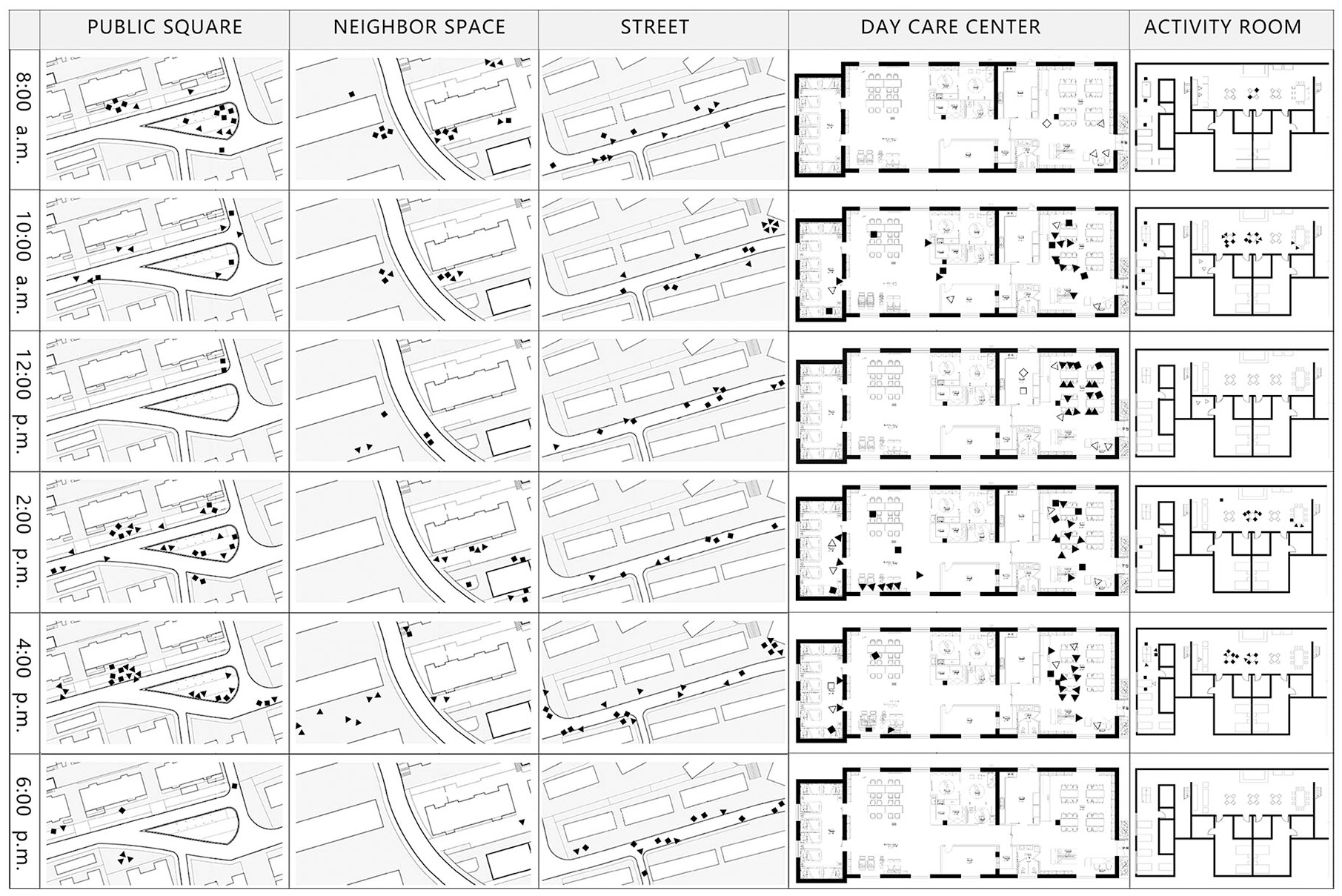
Behavioral mapping.
Data Analysis
Narrative and statistical descriptions were used for data analysis. In adherence with Barker’s (1968; Barker & Schoggen, 1973) definition and method of descriptive research, the data processing in this study is divided into four parts.
In the beginning, we collated and analyzed the collected mapping and visual data to determine the different types of behaviors of older adults. The data showed that their activities mainly included entertainment, chatting, onlooking, exercising, walking, and resting. Second, based on the behavioral mapping and photo data, behavioral characteristics of older adults in residential areas were documented, and we proposed the hypotheses that the behavior and venue choice of older adults are related to gender. Third, referring to Noon and Ayalon’s (2017) processing method for visual data, the data from older adults in the behavioral map were coded by the first author, which included gender, behavior type, venue use, time, and other information from the photos on the map. Statistical analysis was conducted based on the encoded data in Step 3, and the hypothesis in Step 2 was verified by chi-square tests and mean comparison (as the expected cell counts were more than five).
Ethical Issues
Before conducting the interview, all six participants provided informed consent to allow their data to be used for research. Concerning the pictures and behavior map recordings, the indoor recordings were approved by the staff of the indoor spaces. Nonetheless, it is impossible to acquire the consent of all people involved, especially in outdoor spaces. Therefore, it is usually considered acceptable to use these data without expressed consent (Cosco et al., 2010; Noon & Ayalon, 2017; Wiles et al., 2012). To protect the privacy of the recorded individuals, the names of the communities were replaced by abbreviations, and the photos were blurred. This procedure was approved by the researchers’ university.
Results
Based on the data from the behavioral mapping, from 8:00 a.m. to 6:00 p.m. on weekdays, mainly older adults were present in the community. There was no significant gender imbalance within the overall population, which was different from the results of D. Liu (2005), who found that there were more older women in these communities than men. However, there was a gender imbalance in the use of some venues and participation in activities. Based on Noon’s previous analysis of older adults’ behavior within their communities (Noon & Ayalon, 2017), we used two subcategories for behavioral analysis: social behavior and independent behavior. The former indicated behaviors related to interacting with other people or participating in organized activities, while the latter referred to behavior independent of others. Since many behaviors had both independent and social attributes, some behaviors of the older adults in the community were not classified, including exercising, entertainment, chatting, onlooking, resting, and walking (Table 3). Venues where older adults generally gathered were divided into indoor public and outdoor public spaces. Indoor public spaces included community activity rooms and daycare centers, while outdoor public spaces included the neighborhood space, public squares, and streets (Table 4). Data from the interviews and behavioral mapping will be uncovered by behavior type and venue use of older adults.
Descriptive Analysis of Behavioral of Older Adults by Gender.

Descriptive Analysis of Venue Selection of Older Adults by Gender.

Gender Differences in the Behavior Types of Older Adults
The behavioral map in Figure 1 shows the gender differences among older adults, which were mainly reflected in specific behavior types, but there was no significant gender difference in social or individual activities. From the perspective of specific behavior types, older adult women participated in conversational activities significantly more than men, χ2 (df = 1) = 9.105, p = .003, with the male mean (0.296) lower than the female mean (0.450). Behavioral mapping data showed that social behaviors of older adult men in the community were concentrated on entertainment (29%), chatting (30%), and exercise (12%); however, older adult women were more focused on activities like small talk (45%) and entertainment (19%). During the survey, we learned that women were more habitual while men were more purposeful. Men participated in entertainment activities significantly more than women, χ2 (df = 1) = 5.230, p = .022. This outcome was also consistent with the interview data. As a 74-year-old woman indicated, “It depends; I usually sit downstairs and bask in the sun, chat with others, and sometimes watch them play cards,” and a 68-year-old man said, “I usually ask a friend to play chess downstairs.”
In addition, during social activities, older adults tended to form social circles according to gender, and it was rare for older adults of both genders to engage in the same activities together. Activities such as rest and gossip were generally carried out by older adults of the same gender (Figures 2 and 3). Furthermore, most group activities were divided by gender (Figure 4). However, this phenomenon was weaker for game-based activities, such as playing cards, and older adults often engaged in mixed-gender social behaviors when they were playing games or onlooking (Figure 5).

Social: Older adults playing cards outside (females only).

Social: Five older women chatting; of them, one is with an assistant.

Older adults gathered in the square according to gender; a man sitting alone, with four women chatting behind him; two men chatting on the right of these four women, and three other women chatting beside them.

Older men playing mahjong in the open space with women looking on.
In addition to spontaneous social activities, gender differences were reflected in participation in organized activities. A behavioral mapping survey of the daycare center found that during daily activities, the participation rate for older adult women was higher (9%) than for older adult men (1%) (Figure 6). In addition, there were more female than male staff members in daycare centers and neighborhood committees.
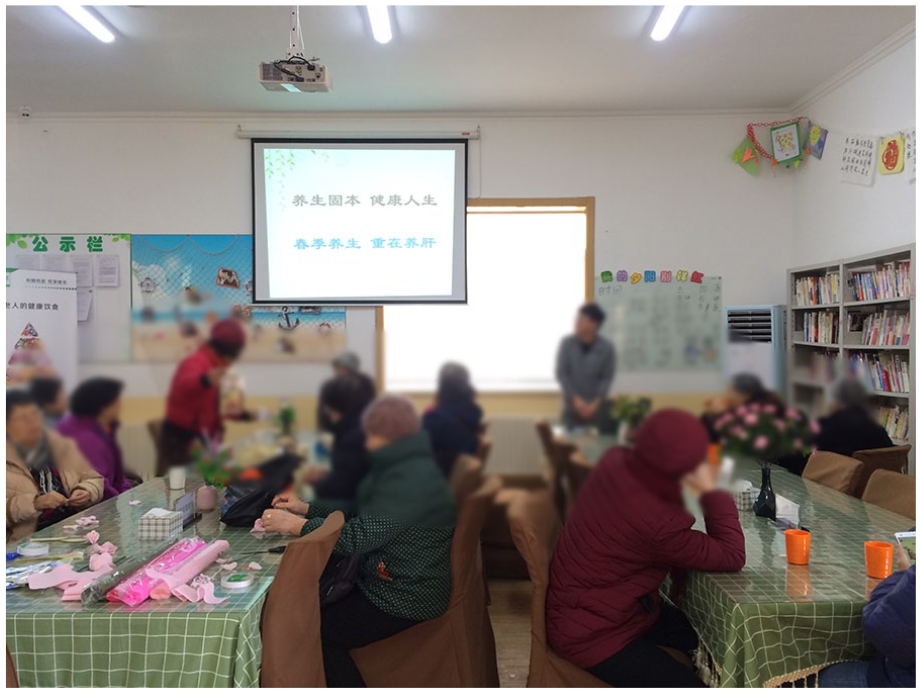
Older adults engaging in activities in the daycare center (most of them were females).
Furthermore, the data showed that older men exercised more than women, χ2 (df = 1) = 9.282, p = .002, with the male mean (0.122) higher than the female mean (0.036). This difference was mainly reflected in the use of exercise equipment in the community; older men were willing to use the independent equipment provided by the community. At the same time, many older adult women were willing to participate in square dancing for exercise. However, since square dances often start after 6 p.m. and the age of the participants vary vastly, the location of the square was not included in this study. This might be the reason that the results showed men exercising more than women.
Gender Differences in the Use of Venues for Older Adults
Gender differences in the use of venues among older adults were mainly reflected in the use of indoor spaces, χ2 (df = 1) = 5.204, p = .023, while there was no significant difference in the use of specific outdoor spaces. For the use of daycare centers, compared to male groups (5%), female groups (27%) were more willing to use community daycare centers, χ2 (df = 1) = 31.31, p = .000. Older men were more willing to use relatively “free” venues, and most daycare centers are privately operated. The operators’ consent is required before using facilities, and some charge a membership fee. In addition, some older adults expressed that the building showed “physical aging and needs to be taken care of,” which demotivated many independent older adults from using these sites and facilities. Furthermore, since the operators of daycare centers are mostly women, they tended to be more appealing for female older adults with regard to activities such as making dumplings and Chinese paper cutting (Figure 7). Many older adult men did not think these activities were “suitable” for them.

Older adult women engaged in Chinese paper cutting activities in the daycare center (most of them were females).
For the use of community activity rooms, the opposite phenomenon occurred. Older adult men (29%) used them more frequently than women, 19%, χ2 (df = 1) = 5.230, p = .022. The interview data showed that some older adult women, such as a 91-year-old woman, felt “It is not necessary to go to the activity room; I can chat with friends downstairs.” As for men, an older adult man (68 years old) stated, “Maybe I will play cards there in the winter,” indicating that men thought the activity room was more suitable for “purposeful activities,” such as card games and table tennis (Figure 8).

Older adult men playing ping-pong in the activity room.
Regarding the use of outdoor space, we found that the venues older adults used in the community were relatively fixed, and the people who appeared in one place usually appeared there again. The interview data suggested that older adults tended to use “places they are familiar with.”
Discussion
This study explored behavioral differences in community public space use by gender in older adults living in old residential communities in Dalian, China. Different from the masculine design, which is currently widely criticized, or the view that the community primarily belongs to women (D. Liu, 2005), this study found no significant gender orientation in the overall environment use in the community. However, there were some gender differences in behaviors and venue choices.
In terms of behaviors, older adult women were more willing to engage in social activities than older adult men and to have more intimate interactions by gossiping. In contrast, older adult men were more willing to participate in purposeful activities by finding a common hobby and carrying out purposeful activities together. This finding is consistent with Noon’s and Ayalon (2017) study. However, this phenomenon was not the same as the gender differences observed in participation in organized activities in the community. W. Chen (2010, p. 86) posited that this phenomenon could be attributed to the effective implementation of “putting urban women’s work to the community,” as advocated by the Women’s Federation in recent years. As more women engaged in community-related work, community-level activities, surveys, and feedback were developed more frequently from a female perspective, so women built a stronger sense of community identity (X. Y. Li & Chen, 2008).
Under the concept of socialist equality, gender differences in the social division of labor were balanced by public policy. With the guidance of public policy, many community activities were more focused on the perspective of women. Nevertheless, conceptually, the influence of feudal patriarchal ideas such as “men outside the home, women inside” has not disappeared after thousands of years of social reinforcement (Qing, 2019). This has led many retired older adult men to think community affairs are “family affairs,” and their interest in community activities has gradually weakened compared to that of women (W. Chen, 2010). Besides, due to the high participation of and more resources for women, women’s enthusiasm for participating in community activities has been further enhanced, and gender imbalances have gradually appeared in the activities of community organizations. In addition, the retirement age is earlier for women than men, and the average life expectancy for women is also longer (United Nations, 2017). This leads to a higher proportion of older adult women in the community, which may promote gender imbalance in community activities and hinder the integration of older adult men into the community.
In terms of venue selection, older adult women were more willing to use daycare centers than men, and the time spent there was mainly concentrated on engaging in specific activities. On the contrary, there were more men than women who used community activity rooms. As community activity rooms provide, for example, free table tennis, chess, and card rooms, they are more suitable for purposeful activities. In outdoor public spaces, gender differences in older adults were reflected in whether their spatial features met the requirements for their activities. This finding was different from Marcus’ argument that in urban spaces, men pursue social communication and participatory “front yard” space experiences, while women pursue “backyard” space experiences (Marcus & Francis, 1997). In the community, there was no significant connection between gender and privacy of the venues—whether it was the front courtyard, the side of the road, or the square. Compared to older adult women, older adult men did not seek to socialize while selecting a venue and their decision was more activity-driven. In contrast, venues chosen by older adult women were more suited to socialization.
In terms of creating a community environment, although the socialist system emphasizes equality between men and women, the current view of gender equality is reflected in the idea of the “same for men and women,” and no gender differences have been considered in the old residential community design. Taking gender differences into account is not accomplished simply by building facilities and environments from a male or female perspective but requires comprehensive consideration of diverse, gendered needs. For example, minimizing activities with a strong gender orientation, balancing the gender allocation of service staff for older adults, and emphasizing space flexibility and versatility could help achieve a gender-balanced community environment.
Conclusion
As people grow older, their focus gradually shifts from work to family. As the aging process continues, physical functioning declines, and the community gradually becomes the main place for the daily activities of older adults. In old residential communities in China, gender differences are reflected in the variability of behaviors and venue use of older adults. On one hand, these differences are due to people’s living habits and gender characteristics. On the other hand, due to the top–down development of feminism in China, gender differences in communities that affect female voices are constantly improving in the community, while the male voices are gradually fading. This reflects the effect of China’s policy interventions on gender. As a result, a lack of intervention or excessive interference may cause a degree of gender imbalance. Therefore, the gender-specific differences in venue use should be fully respected through environmental design, while the behavioral differences brought about by traditional cultural habits can be guided through cultural communication and policy intervention. In addition, proper guidance through systemic and environmental construction can be used as a means of creating gender balance. Thus, we hope that this research can contribute to the reconstruction and design of community public spaces for older adults.
However, participants were sampled from old residential communities in Dalian, where older adults account for a relatively large proportion of the residential population and live for a long time. These adults like to gather together in public spaces, but this phenomenon might be different in other types of communities and cultures. This is a limitation of this research. In follow-up studies, different types of communities should be analyzed with a more in-depth investigation of different cultures, and the background of the residents should be considered. This would provide more extensive theoretical support for the study of older adult gender-related behavior differences within such communities.
Footnotes
Acknowledgements

Declaration of Conflicting Interests
The author(s) declared no potential conflicts of interest with respect to the research, authorship, and/or publication of this article.
Funding
The author(s) disclosed receipt of the following financial support for the research, authorship, and/or publication of this article: This research is funded by the National Nature Science Foundation of China, General Program, grant no: 51978119.