




Abstract
Virtual research collaborations (VRCs) have become an important method of conducting scientific activity; however, they are often regarded and treated as traditional scientific collaborations. Their success is measured by scholarly productivity and adherence to budget by funding agencies, participating scientists, and scholars. VRCs operate in complex environments interacting with other complex systems. A holistic (or organicist) approach is needed to make sense of this complexity. For that purpose, this study proposes using a new perspective, namely, the complex adaptive systems theory that can provide a better understanding of a VRC’s potential creativity, adaptability, resilience, and probable success. The key concepts of complex systems (diversity, interaction, interdependency, feedback, emergence, and adaptation) utilized in organization studies are used to discuss the behaviors of VRCs, illustrated with real-life examples.
Introduction
Scientific collaborations have become the primary manner of conducting scientific research. Seventy percent of researchers in the United States reported that they work together with an immediate group and other collaborators (National Science Board [NSB], 2010). In general, scientific collaborations are a family of purposeful working relationships between two or more people, groups, or organizations to research phenomena, to develop a scientific instrument or technology, to build a facility, and to publish a study (Hackett, 2005). These collaborations have been studied extensively by scholars through quantitative, qualitative, or mixed-methods research designs (Agar, 2006; Bennett & Gadlin, 2012; Cloud, 2001; de Solla Price, 1963, 1977; Ding, Foo, & Chowdhury, 1999; Glanzel, 2002; Glanzel & De Lange, 1997; Garfield, 2009; Hara, Solomon, Kim, & Sonnenwald, 2003; Harper, 2003; Sangam, 2009; Shrum, Genuth, & Chompalov, 2007; Vasileiadou, 2009; Wagner, 2002; Wuchty, Jones, & Uzzi, 2007).
The nature of scientific collaborations has changed in the last decade. The problems that scientists now deal with require different resources (human, technology, and equipment) and having these resources in one single place is not always possible. Earlier, such problems were either left alone or required huge resources to bring researchers together—neither of which is ideal. However, because of current advances in information and communication technologies, a new form of research collaboration has emerged: virtual research collaborations (VRCs) or distributed research networks.
This article offers a framework that is based on complex adaptive systems (CAS) to provide a more comprehensive understanding of the virtual research team dynamics. The article begins with the literature on VRCs and what is missing from it, and builds the argument that VRCs are CAS. Providing support for this argument is a list of key CAS features used in organizational studies, demonstrating how they correspond to examples from real VRCs. Approaching VRCs from the CAS perspective would benefit scholars in team science, organizational studies, information science, communication studies, psychology, and even practitioners of virtual team science because a holistic understanding of VRCs is possible through CAS.
Background
A virtual organization is “a group of individuals whose members and resources may be dispersed geographically and institutionally, yet who function as a coherent unit through the use of cyberinfrastructure” (Cummings et al., 2008, p. 1). It is important note that entirely virtual or face-to-face teams rarely exist today (Bell & Kozlowski, 2002; Kirkman & Mathieu, 2005) as generally both colocated and virtual members exist within an organization simultaneously; thus, virtuality should be considered in terms of degree. The two key characteristics of virtual organizations are having an organizational structure without sharing a physical space, and using computer-mediated communication to function (Cogburn, Santuzzi, & Vasquez, 2011). Knowledge creation has become a collaborative enterprise (Jones, Wuchty, & Uzzi, 2008; Wuchty et al., 2007). The number of internationally coauthored papers has tripled in the last two decades (NSB, 2010), demonstrating the prominent shift toward VRCs.
VRCs are different from traditional scientific collaborations in a couple of areas. By definition, VRCs are not bound by geographical proximity. As research questions have become more complex and address large-scale phenomena such as climate change, space science, or energy sources, it has become too difficult to maintain the necessary expertise to tackle these problems in one physical location. The diversity of researchers’ affiliations and geographical locations in a research network is an indicator of distribution. In addition, addressing these complex questions requires responses from experts in different fields or disciplines. The researchers, working from various locations, have adopted digital collaboration tools for communication and data/information sharing to succeed in their efforts. Communication software such as Skype, Adobe Connect, and Google Cam; document and data sharing tools such as Dropbox, Google Docs, and Skydrive; and collaborative research tools and cyberinfrastructure such as WorldWide Telescope and DataONE are some of the digital collaboration tools that have become increasingly prominent in researchers’ lives. The VRCs’ distributed and diverse networks tend to be less structured and hierarchical as they operate with a more flexible organizational structure. This does not imply that they are leaderless; generally, there is a core group of individuals who drives the VRC’s collaboration, in addition to the principal investigator(s), who is/are responsible to the funding agency. Table 1 summarizes the differences between traditional and virtual collaborations.
Differences Between Traditional Collaborations and VRCs.

Note. VRC = virtual research collaborations.
Virtual scientific collaboration has become a necessity and almost a norm to conduct scientific activity. However, virtual organizations have their intrinsic challenges: (1) logistical problems, such as communicating and coordinating work across time and space, (2) interpersonal concerns, such as establishing effective working relationships with team members in the absence of frequent face-to-face communication, and (3) technology issues, such as identifying, learning, and using technologies most appropriate for certain tasks. (Furst et al., 2004, p. 7)
Research on virtual organizations is relatively new, but addresses a wide range of issues. According to a study conducted by Powell, Piccoli, and Ives (2004) using a life cycle model, studies on virtual organizations focus on four general categories: (a) input (design, culture, training), (b) socioemotional processes (trust, cohesion, relationship building), (c) task processes (communication, coordination, task-technology fit), and (d) output (performance, satisfaction). The network characteristics (e.g., centrality, hubs, and incoming/outgoing links) of virtual organizations have become a fertile research area lately, because of the advances in social network analysis. For instance, Cronin and Meho (2006) and Haythornthwaite (2009) have studied the relationship between network traits and its performance, and Panzarasa, Opsahl, and Carley (2009) focused on information flow and team dynamics.
The growing number of multidisciplinary research projects has increased the number of studies on the diversity of virtual teams as well. For instance, when there is too much diversity 1 researchers establish cliques, stop communicating, and even disrupt each other’s efforts (Adamic & Glance, 2005; Stvilia, Twidale, Smith, & Gasser, 2008). Furthermore, scholars have investigated the performance (generally based on scholarly/nonscholarly production and adherence to budget and deadlines) of virtual teams (Ancona & Caldwell, 1992; Aubert & Kelsey, 2003; Janicik & Bartel, 2003; Jones et al., 2008; Kacen, 1999). Scholarly production is the gold standard, and there is a vast literature on coauthorship practices; however, its limitations have also been documented in information science. It is hard to differentiate the contribution of a scientific collaboration’s members, such as when hyperauthorship (publications with more than 100 coauthors) or honorary authorship (a person is listed as a coauthor for the sake of reputation not contribution) exist, or even in some cases when the efforts of certain members might not be reflected in the article’s authorship (Katz & Martin, 1997; LaFollette, 1996; Subramanyam, 1983). Through a CAS perspective, we can explore not only coauthorship practices but also different dynamics of virtual collaborations.
All of the studies mentioned above are valuable additions to the scientific body of knowledge; however, there are two shortcomings in the literature on virtual research organizations. First, the existing studies that address scientific research contexts focus on small teams or groups. To date, studies that considered larger organizations were set only in commercial organizations or business virtual teams, not science organizations (Kirkman, Gibson, & Kim, 2012; Martins, Gilson, & Maynard, 2004). Although there are some similarities between profit-based (commercial) and non-profit-based (research) virtual organizations; they are actually different kinds of organizations because of their raison d’être, which are respectively profit and answering a research question. In addition, an understanding of their dynamic composition and evolution is needed (Tannenbaum, Mathieu, Salas, & Cohen, 2012), as VRCs operate for many years and team composition changes, as members graduate, move on to new projects, retire, or otherwise transition from the team. Second, there is a gap in the existing literature on virtual research organizations that also applies to every kind of scientific collaboration, virtual or otherwise, which is that the studies tend to treat research teams as traditional organizations. However, in today’s interconnected world, most of them are actually CAS, which resist reductionist explanations, exhibit unpredictable behavior, create a disproportionate impact, and are highly interactive within themselves and with their environment. Briefly, complex systems are based on nonlinear relationships among the system’s components, and they are nonreductionist (Mitleton-Kelly, 2003). A nonlinear system’s behavior cannot be explained through a linear equation. The literature on virtual teams uses linear theories to explain their behaviors. As it was pointed out in Falk-Krzesinski et al. (2011), “What is key to recognize is that linear or sequential process models could not adequately capture the complexity inherent in SciTS [Science of Team Science] and may even be misleading,” and referring to Mabry, Olster, Morgan, and Abrams (2008), they suggest a complex systems approach.
There are a limited number of studies that approach VRCs from a CAS theory perspective. Aragon and Williams (2011) focus on collaborative creativity. Murase, Doty, Wax, DeChurch, and Contractor (2012) highlight a network approach to capture multilevel interactions. Wagner (2008) proposes research networks between developed and developing nations for development, Naik and Kim (2010) develop a framework to explain the VRCs’ success through adaptation. Curşeu (2006) treats team cohesion, trust, and conflict as emergent states in virtual teams and brings them together through the CAS perspective.
Complexity Theory
There is not a single unified theory of complex systems (Anderson, 1999; Mitchell, 2009; Mitleton-Kelly, 2003). Instead, there are different foci and approaches, such as that of the Santa Fe Institute or Prigogine or interpretations in social sciences (Cudworth & Hobden, 2012; Merali & McKelvey, 2006; Walby, 2006). Complexity theory has close ties with chaos theory and other concepts from biology, physics, and chemistry, such as catastrophe, autopoiesis, chaos, dissipative structures, autocatalytic process, attractors, multiagent systems, thresholds, and transformational processes, fractal geometry, fuzzy logic, and systems theory (Mitleton-Kelly, 2003; Salem, 2009; Smith & Jenks, 2006). Scholars define CAS according to their disciplinary interests and focus on related concepts, respectively. Therefore, one has to be careful about substituting these concepts, because even though there might be a huge overlap among them, they are not the same. For instance, autopoiesis, introduced by Maturana and Varela (1973), means self (auto) creation (poiesis), which is different from self-organization, which is a critical concept in complexity theory (explained later). Maturana (1987, p. 71) himself states that he would “never use the notion of self-organization, because it cannot be the case . . . it is impossible. That is, if the organization of a thing changes, the thing changes.” Another example is chaotic systems, which are nonlinear like complex systems, yet very different in that chaotic systems are not emergent and their constituents are not interdependent. In short, one has to be careful using these concepts for complexity theory.
A very prominent feature of complex systems is the nonlinear interactions among its variables. However, since Descartes, linear modeling has dominated the scientific world because of its freshness, competence, and convenience for calculations. Linear systems are simple and deterministic, and therefore, variables in linear systems can be manipulated (at least theoretically) and are definitely predictable. The main hypothesis behind this view is that a phenomenon is the aggregation of its components—which are variables—so it should be broken down into its smallest units and they should be studied to understand it.
However, many phenomena in life are neither linear, norreducible into simplistic units, nor both. A nonlinear system is more than the sum of its parts due to feedback loops (Waldrop, 1992). In nonlinear systems, small inputs can have large system effects (or vice versa), and there is a sensitivity to initial conditions that makes prediction almost impossible (Anderson, 1999; Thietart & Forgues, 1995).
The problem is that working with nonlinear systems is beyond human computational ability. When nonlinear relations are realized, the related data are not preserved and/or the nonlinear relations cannot be measured or calculated due to their complexity. This happens because “modeling the nonlinear outcomes of many interacting components has been so difficult that both social and natural scientists have tended to select more analytically tractable problems” (Anderson, 1999, p. 217), which produces deficient and incomplete reflections of reality. Thus, scholars end up with a discipline that is not consistent with natural phenomena, and is not helpful for controlling or predicting phenomena, as a result of its dependency on linear modeling. Sometimes nonlinear relationships were simply disregarded by unrealistic but more tractable or feasible assumptions. For instance, in economics it is assumed that “there is equilibrium in markets,” despite all the opposing evidence (Waldrop, 1992, p. 255). Also, in archaeology, social and economic systems are assumed to be in equilibrium (Bentley & Maschner, 2007). Both these assumptions contradict reality. Because of its messiness, the study of nonlinear systems had not attracted much interest until the 1960s, when, with the development of computers, computational power increased enormously, and thus, solving nonlinear equations became easy (Gleick, 1987). Consequently, physicists, meteorologists, economists, and chemists adapted nonlinear models for their disciplines.
The main difference between linear and nonlinear systems is the focus of attention given by researchers to variables and interaction, respectively. Instead of focusing on units, in complexity theory, researchers focus on interactions. Interaction is an intricate relationship among units or variables and is generally short ranged (Cilliers, 1998). For example, information is generally received from immediate neighbors. As the information travels from unit to unit, it can be enhanced, suppressed, or altered in many ways, such as in the telephone game. Positive and negative feedback loops exist in interactions; hence, some actions are encouraged and some discouraged. Everything that is related to the system could be found in interactions, and the level of analysis becomes interactions in complexity theory. As Nobel laureate chemist Prigogine (1997) argued, this new paradigm is interested in instability, disorder, diversity, and nonlinear relationships, rather than the traditional mechanistic Newtonian view, which dealt with stability, order, equilibrium, and linear relationships.
There is not a unified CAS theory, but in definitions there are some indispensible concepts, such as agents, interaction, coevolution, and emergence. Here two definitions are offered: The theory of complex adaptive systems (CAS) originated in the natural sciences and articulates how interacting agents in systems adapt and coevolve over time, and who, through their interactions, produce novel and emergent order in creative and spontaneous ways. (Webb, Lettice, & Lemon, 2006, p. 34) A complex adaptive system consists of a large number of agents, each of which behaves according to some set of rules. These rules require the agents to adjust their behavior to that of other agents. In other words, agents interact with, and adapt to, each other. (Stacey, 2003, p. 237)
According to Kauffman (1993), when the relationships are simple, the system’s behavior is easy to understand, explain, and predict, which is what is done in linear modeling. In the other extreme, when immeasurable nonlinearity dominates the system, it looks random and chaotic. Complexity, sometimes referred to as “order in disorder,” is between them, not easy to understand, but not impossible either.
Complexity theory focuses on “organizing rather than organization” (Weick, 1979) and prescribes, “. . . science of process rather than state, of becoming rather than being” (Gleick, 1987). It is continuous recreation of interactions and relations between units, which also results in dynamic equilibrium. It is this continuous recreation, redefinition, and emergence that makes it harder to understand, predict, and equalize.
According to Holland (1998), in complex systems, overall patterns are greater than the sum of its parts, and also, such systems may act coherently without domination by a central source, which means the system cannot be localized to its subsets. This approach suggests the bounded rationality principle. The units cannot know the big picture due to lack of information and their limited information processing ability. They can only know about their immediate neighbors. Thus, they position themselves according to them. This concept is very common in explaining survival and extinction in habitats in evolutionary biology. No creature knows what is going on in this planet, but they all position themselves in relation to their cohabitants, by developing camouflage skills to hide or growing muscles to run faster, for example. The whole habitat is in a state of dynamic equilibrium tied to each agent. This is called coevolution (Pascale, Millemann, & Gioja, 2000; Waldrop, 1992). Table 2 provides a list of recurring concepts in the analysis of organizations from a CAS perspective using seminal articles from the organization science literature.
Characteristics/Principles of Complex Adaptive Systems.

A human system, such as a VRC, is a CAS; therefore, it needs to be studied as one. However, the growing body of literature on the topic does not treat them as such. Through CAS, a VRC could be studied from a micro to a macro level, and even to the environment that it operates within. Here are the features of CAS that are used to develop a framework, which will help researchers to understand VRCs better and help them to use their potential.
CASs Framework for VRCs
Large Number of Diverse Agents
For a system to be considered a complex system there must be multiple agents interacting with each other. These agents are different vectors or have different agendas and they try to pull or influence the system accordingly. The more the agents/vectors, the greater the likelihood of encountering chaos or complexity (Thietart & Forgues, 1995). It looks like a messy, chaotic bunch that does not have a purpose or make sense.
By definition this characteristic exists in a VRC, for which a number of researchers and/or organizations establish a working relationship to conduct research, to develop an instrument or technology, to build a facility, and to publish a study. Furthermore, although every agent works toward the same goal, the raison d’être of the collaboration, every agent also has his own objectives. These individual objectives are not necessarily aligned with each other, but instead, are affecting and being affected by each other. “In each system, each agent is different from the others (diversity), and its performance depends on the other agents and the system itself, each of which can influence the other’s behavior” (Benbya & McKelvey, 2006, p. 18). This diversity at certain conditions results in an emergent property. A system’s behavior cannot be reduced to a single agent’s behavior, because diversity and variety give each agent a different role (or vector; Holland, 1995). There is no single dominant vector in the system. Each one is a counteracting force in the system trying to actualize its own goals. This is the reason why it looks like incomprehensible behavior.
VRCs exhibit this feature. For instance, in a VRC, in terms of academic career advancement, there will be a diversified group of researchers, ranging from senior researchers to junior researchers to graduate students (or even undergraduates), with each having a different goal, such as advancing the quality of human lives, getting tenure, collecting data for a dissertation, enhancing a reputation, engaging in competition, and so on. This diversity does not have to be limited to academia. There might be researchers from research centers, laboratory staff from labs, and engineers with different affiliations—each, again, with different personal agendas. In addition, there could be contractors, such as software developers from industry, whose goal is to make profits. In cross-disciplinary projects, disciplinary diversity should be taken into consideration as well—each with different workflows, value and belief systems, and backgrounds. This is only an individual level diversity. Sectoral and organizational diversity could be added to this example, when public-private partnerships exist, and/or inclusion of nonprofit organizations. This simple example demonstrates how different motivations and goals would create counteracting forces in a system.
Interaction/Connectivity/Interdependence
Interaction could be limited in physical systems. They are simple, predictable, and linear, with little room for surprises or changes. Human systems, however, are based on interactions. “Complex behaviour arises from the inter-relationship, interaction, and interconnectivity of elements within a system and between a system and its environment” (Mitleton-Kelly, 2003). As Axelrod and Cohen’s (1999) complex system definition asserts, “(a system is complex when) . . . there are strong interactions among its elements, so that current events heavily influence the probabilities of many kinds of later events.” The action of one agent has an impact on other agents and even on other systems.
Merali (2006) describes an interconnected world as “a complex multi-dimensional network which connects a diversity of agents (individuals, groups, institutions, nations, computers, software components, etc.) through multiple and diverse communication channels” (p. 217). A VRC fits the bill. In a VRC, researchers (agents) have to interact with each other because that is the reason they come together in the first place. They need each other’s expertise, resources, reputation, or other attributes; hence, they interact. Their research is also interdependent, especially in inter- and transdisciplinary projects. For instance, in a VRC that studies climate change, environmental scientists, atmospheric scientists, marine scientists, ecologists, biologists, and even social scientists have to interact with each other, design their research so that they get input from each other, report their findings to each other, and then continue doing this cycle over and over, for they operate in a system where everything is connected to each other. They interact through print (journals, reports, etc.), online (emails, data repositories, videocons, etc.), and face-to-face media (conferences, workshops, etc.) as much as they can.
The more interdependent their tasks, the more researchers have to interact, if they want to succeed. For instance, the members of the Goddard Center for Astrobiology, a VRC funded by the NASA Astrobiology Institute [NAI], investigate “how organic compounds are created, destroyed, and altered during the formation and evolution of a planetary system, leading up to the origin of life on a planet such as Earth” (NAI, 2012). Thirty-one researchers from seven different institutions in the United States examine the distribution of organic matter and water in the solar system and how they were delivered to Earth. The astronomers and physicists in the team establish taxonomy of icy bodies and their potential for organics and water, chemists analyze the formation, distribution, and abundance of organics with the input from astronomers, geochemists, earth scientists, and microbiologists investigate processes affecting the origin and evolution of organics in planetary systems along with astronomers. The success of the collaboration depends on the interaction among researchers from different disciplines. In fact, the collaboration is designed to make researchers from disciplines work together, because their tasks are interdependent. They frequently use face-to-face (when possible) and remote collaboration technologies to interact with each other. Because the members of the Goddard team are affiliated with seven different organizations, their interaction relies on the use of information and communication technologies.
Feedback, Unpredictability, and Nonlinearity
A group of diverse researchers who interact with each other to achieve individual and organizational goals is clearly a system. Any communication or action will have an impact on its members; however, this impact does not have to be proportional. Indeed, it is highly likely that the impact will be different on each agent, due to diversity. Because of the nonlinear relationships, the impact might have an amplifying effect (positive feedback) on some members, and might have a dampening effect on others (negative feedback). Feedback loops are typical of nonlinear (and complex) systems and are one of the main sources of unpredictability in CAS. In addition, these feedback mechanisms or processes are the primary reason why scholars cannot isolate a variable and study it in isolation. This feature results in the principle that the whole is greater than the sum of its parts. As Anderson (1999) puts it, “. . . complex systems resist simple reductionist analyses, because interconnections and feedback loops preclude holding some subsystems constant in order to study others in isolation” (p. 218). Because of transfer of energy or information among agents, impacts lose their proportion. The strength of the feedback process is often determined by the degree of the connectivity (Mitleton-Kelly, 2003). The impact does not have to be equal on others. Some might be affected more—which makes sense because agents do not know the big picture; they are affected by their immediate neighbors. Like in the Chinese telephone game, the impact is disturbed by each agent; thus, a uniform impact on each agent almost never happens.
Kirkman et al. (2012) argued that virtual team development is described as nonlinear, referring to the relationships between the organizational environment, group structure, technology, and diversity. In VRCs, through interaction and interdependency, there are constant feedback loops at play, where impacts might be amplified or dampened, but are definitely untraceable. As discussed earlier, team members provide input to each other’s research; however, where a senior scholar sees an opportunity to collaborate, a junior scholar might sense a threat to his or her career. In addition, some members might have more pull than others and their impact might be disproportionate to their seniority or expertise. The response of a researcher in a commercial organization to a cyberinfrastructure designed to share data, could be different from that of a researcher in a government agency. In short, reactions will vary. Furthermore, because of bounded rationality, agents have limited information on the overall state of the network or system. The individual actions, which are affected by agents’ “diverse social and cultural environments and backgrounds, their personal experiences, and events, and information about events from their immediate environment and their extended networks” (Merali, 2006, p.218), will give rise to an emergent behavior of the network. The results of these nonlinear relationships are simply unpredictable.
The feedback loops and nonlinear relationships create a condition called sensitivity to initial conditions—which results in unpredictability. The butterfly effect—a butterfly in the Amazon flaps its wings and causes a tornado in Texas—is the famous example of sensitivity to initial conditions. Anderson observes, “. . . the behavior of complex processes can be quite sensitive to small differences in initial conditions, so that two entities with very similar initial states can follow radically divergent paths over time” (Anderson, 1999, p. 218). For instance, an animosity between two researchers could doom the collaboration from the start; it is not easy to fix such problems through computer-mediated communication. Another example could be the anxiety and discomfort that some members feel toward computer-mediated communication. The leadership team should take these into consideration when establishing the VRC.
The Edge of Chaos/Far From Equilibrium
Systems do not stay in equilibrium forever. They react to internal and external (environmental) factors, and equilibrium changes. They can exist or fluctuate between three states: stable, chaotic, and in-between (Anderson, 1999; Benbya & McKelvey, 2006; Lewin, 1999; Thietart & Forgues, 1995). The “in-between” phase is actually when the system behaves in a “complex” way. Scholars named this phase differently: for Kauffman, it was the melting zone, for Cramer, critical complexity, for McKelvey, the region of emergent complexity (Benbya & McKelvey, 2006, p. 17), and for Pascale et al. (2000)—the edge of chaos. This is where action takes place and emergence happens. In this zone, according to Mitleton-Kelly (2003), “open systems exchange energy, matter, or information with their environment, and when pushed ‘far-from-equilibrium,’ create new structures and order” (p. 10). Here, higher levels of mutation and experimentation happen, which could become critical in a system’s resistance or response to external threats (Pascale et al., 2000). Being away from equilibrium gives the system a chance to come up with a better configuration that increases the likelihood of its survival.
A VRC that is ordered, rigid, and top-down does not operate in this zone. It cannot respond to the changes in the environment and be adaptive. A VRC that is on the other end—chaos—is actually not a system or a collaboration anymore. It cannot reach the criticality that is needed for emergence. The leader (or the management) of the VRC is responsible for creating such an environment where the members can thrive. Creativity, novelty, and innovation cannot happen without a little serendipity.
Furthermore, funding for a collaboration is not a short-term investment. During the life of a collaboration, membership composition changes. After the funding comes through, the very first thing a VRC does is to employ new postdoctoral researchers and graduate students. Graduate students graduate or might be assigned to different projects; postdoctoral researchers might find other jobs and move on to other research areas; depending on the progress of the project, new expertise might be needed, and thus, new staff (in different levels) might be employed; new collaborators might join the project; researchers could retire, pass away, change jobs and research interests and thus leave membership. In a nutshell, team composition, team dynamics, and team capabilities do change over the years. Nothing is in a static equilibrium and a dynamic analysis—such as temporal team composition data or temporal network analysis—is needed.
Emergence, Self-Organization, and Strange Attractors
When the system receives energy, matter, or information, it absorbs them until it reaches the critical point—which is the edge of chaos. At this point, through the interactions among agents, excess energy, matter, or information generates a form, pattern, behavior, or structure. This is called emergence or self-organization. Emergence is the process whereby the global behavior of a system results from the actions and interactions of agents (Sawyer, 2005). The emergent structure is neither planned nor predicted. As Anderson (1999) puts it, “. . . complex systems tend to exhibit ‘self-organizing’ behavior; starting in a random state, they usually evolve toward order instead of disorder” (p. 218). This does not contradict the second law of thermodynamics, because of the excess energy (or information) the system received. Benbya and McKelvey (2006, p. 16) summarize this occurrence, referring to Kauffman, Cramer, and McKelvey: “In other words, new behavior patterns appear as consequences of agent interaction. No single program or agent completely determines the system’s behavior, despite the fact that each of the heterogeneous agents holds some common schemata. These systems self-organize when they find themselves in the ‘region of emergent complexity’ at the ‘edge of chaos’ (Cramer, 1993; Kauffman, 1995; McKelvey, 1999)". Each agent contributes to the emergent property differently; thus, it is unpredictable.
These novel forms, patterns, and structures emerge around the excess energy, matter, or information, which are strange attractors (Anderson, 1999) for importing is more likely to occur into an open system, and the more open it is, the more likely the attraction will occur. At this point, around attraction, complexity (or chaos) gets ordered and becomes an identifiable configuration (Thietart & Forgues, 1995). A new order (equilibrium) is reached. In human systems, it generally creates irreversible structures or relationships (Mitleton-Kelly, 2003), such as national education systems or the concept of minimum wage. Some scholars perceive the emergence as the most important feature of complexity theory (Sawyer, 2005) because every feature so far serves its occurrence. A great number of diverse agents interact and feed each other in a special environment where the system reaches a critical point, so that a relationship, form, or pattern “emerges.”
In VRCs, an emergent property could be a new working group that arises as a response to a new question or phenomenon that must be dealt with before forward progress can occur. Another example is a publication or a patent or a product (such as a software, cyberinfrastructure, or protein). The members might decide that their investigation has reached a critical point where it needs to be shared with the rest of the scientific community. A collegial relationship could emerge that passes beyond the lifetime of the project and turns into a network or an invisible college. A group of concerned scientists could coauthor white papers or peer-reviewed publications that could result in an emergence of a science mission or a research field, such as climate research. The severity and magnitude of the problem (climate change led to infinite numbers of VRCs working on it) or an opportunity (a volcanic eruption gave birth to an island in 2011 and led to a VRC funded by NAI to study it) or available resources (NSF Data Solicitation led to forming of DataONE, a VRC that emerged to develop a cyberinfrastructure for Earth Science data) could act as an attractor and cause VRCs to form around them. These emergences are generally self-organized and form from the bottom-up. It is hard to predict these events. A rigid management style might deter such emergences, and possibly harm productivity and performance of the collaboration. Letting the VRC loose is not an option either, as the leaders—principal investigator(s)—are responsible to the funding agency, and there are certain deadlines that have to be met. For financial systems, which are basically human systems, Arthur (1999) suggests governments should avoid both extremes of coercing a desired outcome and keeping strict hands off, and instead seek to push the system gently toward favored structures that can grow and emerge naturally. Not a heavy hand, not an invisible hand, but a nudging hand. (p. 108)
This suggestion is very applicable to the governance and management of VRCs.
Adaptation to Environment (Context)
The emergent property is the adaptation or the new temporary equilibrium, depending on where one looks. The system cannot continue as it was, and through generating new patterns, forms, behaviors, relationships, and structures, it adapts to the new conditions and environment. Having just one strategy or one kind of agent is not desirable, because when the conditions change, that strategy or agent may no longer be optimal or suitable (Mitleton-Kelly, 2003; Pascale et al., 2000). It could result in annihilation. Thus, systems do not spend all of their resources on one objective, but instead, they try to have diversity and variation, which builds on resilience. For instance, the immune system has multiple mechanisms, not one, to respond to pathogens. Or, companies invest in research and development, and training, to be able to respond to changing market conditions. McKelvey (2001) defines this process as “adaptive tension.” If systems do not explore this “space of possibilities,” they become fragile.
The natural laws for molecular systems or DNA in organic systems, or consciousness, or rules or relationships in human systems, are actually all schemas for the actions of agents; their actions are bound to these schemas. “The existence of these shared schemas, together with the agents’ individual schemas (diversity), opens up the possibility of changes to these rules, or in other words, evolution and learning” (Benbya & McKelvey, 2006, p. 19). These schemas can change, and that change is adaptation; that change is learning—and it is crucial to survival.
In the VRC context, a new approach or structure might be needed to tackle a research question. For instance, in 2008 Mars Rover Phoenix identified perchlorate in the Martian regolith. A new approach was definitely needed to investigate them. Therefore, NAI funded a VRC that studied perchlorate at Mars analog sites (NAI, 2012). Another example is from DataONE. They established a new working group—exploration, visualization, and analysis—that was not in the original plan, when they realized that they could promote their project and increase its acceptance and diffusion among the scientific community through visualization, and also do more science with it (Aydinoglu, 2011). VRCs become more flexible and change their structure to respond to the changes inside (the collaboration itself) and outside (the environment). Their resilience improves and thus they adapt.
Coevolution/Multidimensional
The adaptation, and thus the evolution, are not alone but are together—including the environment, which is a collection of systems with other agents. Every agent in the system is interconnected to each other, and feedback mechanisms carry information from one to another; hence, a change in one creates a response (and change) in another, then that one in another, and so on. It continues like that until every agent repositions (changes or mutates) him/herself. In Stacey’s (2003) definition of a CAS, this feature becomes clearer: A complex adaptive system consists of a large number of agents, each of which behaves according to some set of rules. These rules require the agents to adjust their behavior to that of other agents. In other words, agents interact with, and adapt to, each other. (p. 2)
This is in fact a continuous cycle: “As the elements react, the aggregate changes; as the aggregate changes, elements react anew” (Arthur, 1999, p107). If an agent or a group of agents cannot adapt, they do not survive; they become extinct or die or leave the system. The same concept is named “structured coupling” in living systems by Maturana (2002). He describes the dynamic interplay between the entity and its environment as such: In this process the structure of the living system and the structure of the medium change together congruently as a matter of course, and the general result is that the history of interactions between two or more structure determined systems becomes a history of spontaneous recursive coherent structural changes in which all the participant systems change together congruently until they separate or disintegrate. I have called this structural dynamics, including the structural coherences between the interacting systems that results from it, structural coupling. (pp. 16-17).
Both Falk-Krzesinski et al. (2011) and Börner et al. (2010) agree that the “interrelationships between parts and their relationships to a functioning whole, [is] often understood within the context of an even greater whole,” which is the mantra of CAS. For instance, the scientific arena is very competitive about securing resources, because these resources are directly correlated to the survival of an individual scientist or a collaboration. In addition, because of the interactive network structure, it is very dynamic. VRCs are open systems. Emergent properties (information, best practices, opportunities, methodologies, structures, etc.) are shared, disseminated, and adapted at an increasing rate. In fact, the whole process of academic publishing is about disseminating and sharing. None of the elements can be cut out.
Because subsystems are open systems and there is interaction among them that leads to coevolution, the unit of analysis becomes a moving target. An agent could affect a system; a system could affect other systems. In CAS theory, these continuous impacts are explained through fractals—self-similar patterns at different scales. Thietart and Forgues (1995) argue that organizations generally have a fractal form. Furthermore, similar patterns, structures, and behaviors are found at the organizational, unit, group, and individual levels. The effects are both contagious and similar. For instance, an individual’s decision to sell stocks in the market might be represented at the market level—which means everybody is selling that same stock. (The emergent property is the decline in that stock’s price). Moreover, it is contagious among different types of systems. “Complex systems are multidimensional, and all the dimensions interact and influence each other. In a human context the social, cultural, technical, economic and global dimensions may impinge upon and influence each other” (Mitleton-Kelly, 2003, p. 5). Given that the system is functioning under the right conditions, a change in a researcher’s behavior could change a team’s behavior, which could change a VRC’s behavior, which could change other VRCs’ behaviors, which could change a funding agency’s behavior, which could change other funding agencies’ behaviors, which could change the scientific arena, which could change the economics of a nation, and so on. An example of this effect is the Internet, which originated as basically a military technology, but has changed so much in our scientific, economic, educational, and social lives.
This is a holistic or organismic view—where all of the elements are connected to each other, and by changing themselves they are changing everything around them. This concept is closely related to previous concept: adaptation to environment—or learning (conscious or unconscious). An ever-changing environment requires new responses (which has to be discovered, developed, or learned from others) to survive. Kolb and Kolb (2009) uses structural coupling, which is “the way a system interacts with its environment, recurrently renewing and recreating itself. . . . These structural changes produce changes in the future behavior of the system and its environment” to describe the process of an organism’s learning and development (p. 311). Organizations do learn in a similar fashion; therefore, by learning and adapting, the habitat and the entities inside it change.
Furthermore, Kirkman et al. (2012) addresses the need and lack of multilevel analysis from agents to system. Given the fractal structure of CAS and the systems approach, analysis at different levels can be possible. An ecosystem or organicist approach through a CAS understanding might reveal the relationships among individual researchers, teams, other teams (multiteam systems), organizations, and even beyond. Thus, our understanding of the nonlinear relationships between the effectiveness of an individual and a team, the impact of research, the effectiveness of a lab, the impact of a research funding program, and so on would increase enormously. Clearly, more research is needed to explore the multilevel relationships in VRCs.
Conclusion
The nature of scientific collaborations has changed, as a result of the advancements in information and communication technologies. The environment in which scientific collaborations operate has changed because of technological, economic, political, and social transformations. Therefore, a new understanding of VRCs is needed for scholars, practitioners, and the funding agencies.
CAS theory deals with how interacting agents in a dynamic system adapt, coevolve, and produce novel structures. The framework developed in this study through CAS theory concepts (diversity, interaction, interdependency, feedback, emergence, and adaptation) provides us with a holistic and comprehensive perspective to assess the potential creativity, adaptability, resilience, and probable success of VRCs. VRCs are indeed diverse (with multiple goals, disciplines, and organizations involved), interacting and providing feedback (as members communicate with each other frequently), interdependent (individual tasks are connected to each other), and emergent (new relationships are established and publications, technology, software, and equipment are produced and shared with others). VRCs are intrinsically adaptive (proactively changing their environment, while also reactively being changed by it). Table 3 matches the CAS concepts with VRCs.
Matching the VRCs Features With CAS Framework Concepts.
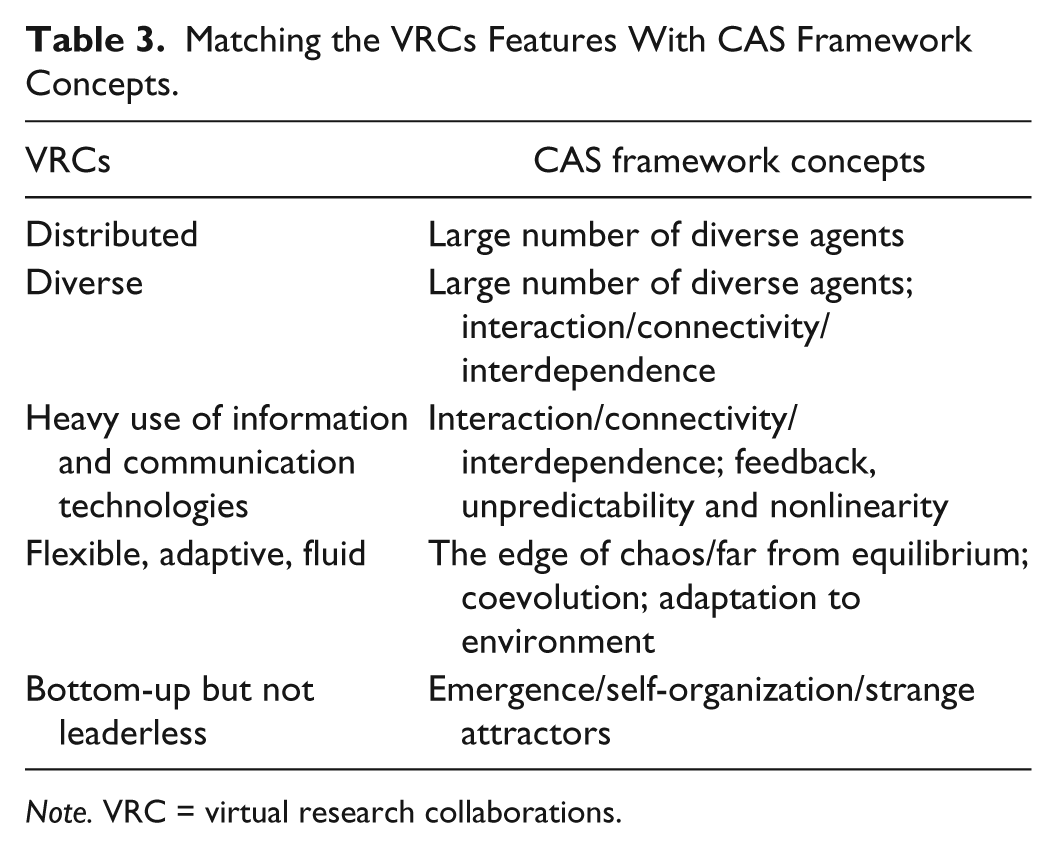
Note. VRC = virtual research collaborations.
Falk-Krzesinski et al. (2011) identified seven research areas critical to the future of the science of team science (including virtual teams): (a) measurement and evaluation of team science; (b) structure and context for teams; (c) characteristics and dynamics of teams; (d) management and organization of teams; (e) institutional support and professional development for teams; (f) disciplinary dynamics and team science; and (g) definitions and models of team science. Through the CAS framework, these research areas can be studied together or the findings from previous studies can be brought together. For instance, using the CAS Framework, the potential success and capability of a collaboration could be evaluated prior to the funding agencies’ committing their already limited resources to support that collaboration. The publication record of the grant proposers is an important metric for evaluation, yet it is a limited tool for predicting the success of the venture. The CAS Framework, being an organicist or holistic approach, considers not only the publications, but also other stages of scientific research as well. Referring back to Falk-Krzesinski et al.’s (2011) seven research areas above (a) the context a VRC operates in translates to the environment a CAS operates in. (b) and (c) Complexity theory can provide a lot of value to scholars studying the network structure of VRCs, such as relationships, hubs, edges, centralities, but also brings new perspective to multiteam systems. (d) Concepts like emergence and self-organization can explain bottom-up formations, shared leadership practices, and working group structures, in VRCs. (e) Institutional support is another system that needs to be taken into account in the CAS perspective. (f) Diversity and interaction aspects of complex systems and its implications in VRCs have already been covered in this study. (g) Models and concepts in CAS can help researchers make sense of real-life VRCs.
In conclusion, a VRC operates in a complex environment. Nonlinear relationships at different levels (individual, organizational, and even international) dominate the interactions among agents. These dynamics, and thus the potential of a VRC, extend well beyond the publication record of researchers. CAS theory provides a tool to integrate analyses done at different levels. The importance of diversity and interaction among team members, the role of leadership, and the resilience and adaptation of a VRC to both internal and external threats, could all be explored, explained, and strengthened through the CAS Framework.
Footnotes
Acknowledgements
The author acknowledges Suzie Allard, associate professor and associate director, School of Information Sciences, University of Tennessee.
Declaration of Conflicting Interests
The author(s) declared no potential conflicts of interest with respect to the research, authorship, and/or publication of this article.
Funding
The author(s) received no financial support for the research and/or authorship of this article.