




Abstract
To achieve their purposes, organizations must constantly learn, adapt, and grow, a process typically referred to as change. Research shows that only a relatively few change efforts achieve great success—most just get by while the majority fail to reach predefined performance goals and objectives. That the success of planned change is relatively rare led to the following questions: (a) What facilitates or inhibits the change process? (b) How do these facilitators and inhibitors evolve within an organization? and (c) What are the implications of understanding this evolutionary process relative to achieving a more sustainable level of performance? This article addresses these questions and presents a holistic model for creating an open, fully transparent environment in which the many differences of potential relevance to a change are put in the open for analysis. The approach, the Full Dimensional Systems Model, assumes there are multiple, interrelated domains of influence that affect change and that these must each be appreciated and addressed simultaneously to achieve sustainable performance improvement.
Keywords
Man and cell perform identical acts of synthesis, one biologically, the other psychologically.
They first seek nutrition: physical or mental. Second they ingest what they can use, discriminating
among materials through screening processes. Third, after ingestion, they digest the materials,
breaking it down into smaller units. Fourth, this material is then reassembled for use in
self-extension. Finally, this total act of growth is reacted to by the environment, and both the
cell and the man modify their subsequent behavior based on this response or feedback from the
environment (forward).
Traditional Change Strategies Typically Fail
To achieve their purposes, organizations must constantly learn, adapt, and grow, a process referred to as change. Research shows, however, that only a relatively few structured change efforts achieve great success—most just get by while the majority fail to reach predefined performance goals and objectives (Mansfield, 2010; Salem, 2008; Schneier, Shaw, & Beatty, 1992). At issue is what underlies this phenomenon of underperformance. Studies of complex social systems suggest that the major reason for failure lies in the way decision makers think about and execute the change process (Smith, 1999). If one looks at the typical change process, it is apparent most decision makers view organizations from an objective perspective—as an assemblage of parts that can be arranged and rearranged to produce predictable outcomes; however, the magnitude of the failure of planned changes led us to ask the following questions:
Research Question 1: What factors facilitate or inhibit the change process?
Research Question 2: How do these facilitators and inhibitors evolve within an organization?
Research Question 3: What are the implications of understanding this evolutionary process relative to achieving a more sustainable level of performance?
The answers to these questions led us to propose an alternative approach to understanding and changing organizational performance, one that supposes that organizational learning and change involves understanding the organization from the objective and the subjective perspectives simultaneously. We call this the Full Dimensional Systems Model (FDSM), a perspective which draws heavily on the concepts associated with complex adaptive system (CAS). The FDSM perspective assumes there are multiple, interrelated domains of influence that impact change and that these domains must each be appreciated and addressed simultaneously to achieve sustainable performance improvements. The FDSM provides a valid and powerful rationale for determining how to implement meaningful change within organizations as well as identifying probable outcomes and consequences from those changes.
Flaws in Traditional Approaches to Thinking About Change
The fact that organizational change frequently fails underscores the flaws inhering in traditional approaches to change. These approaches to change are flawed in four ways. First, the need for change is framed in almost exclusively objective terms, thus overlooking important subjective issues. Second, the change problem is viewed as a puzzle to be solved (Ackoff, 1974; Mansfield, 2010), and the challenge is collecting and analyzing enough data until all the pieces form the right solution. Third, using this approach means that decisions are often based on flawed and/or incomplete information. Fourth, decision makers tend to develop detailed change strategies (often based on the data collected around the need for change), assuming that, if they follow the plan, the puzzle will be solved and the organization will come through the process better structured to meet the needs of their clients. This typical mental model leads to a misalignment of how decision makers perceive and respond to the “hard reality of reality itself” (Wolfberg, 2006).
Myths and Other Dangerous Half-Truths About Change
Adherence to traditional approaches to thinking has produced a number of myths, or dangerous half-truths, about how to make change happen (Kelly, Hoopes, & Conner, 2005; Pfeffer & Sutton, 2006).
Myth 1—Change starts at the top
Organizational change starts with a goal and a plan created by senior management. This approach is usually met by what is referred to as resistance and typically does not work in the fast changing systems of today because the change strategy reflects the same paradigm that created the problem in the first place. The truth seems to be that change depends on the participation of many system members (agents) in an essentially self-organizing process. It may also depend on change agents who consciously influence self-organization toward new and more adaptable patterns of relationship.
Myth 2—Efficiency comes from control
Change is possible only when every detail is mapped out in precise terms. This prejudice ignores the fact that every process improvement adds new and/or changes existing subsystems, which adds even more complexity to subsystems/systems that already have problems. The result is that many efforts to solve problems actually lead to more serious ones.
Myth 3—Prediction is possible
It is assumed by many managers that an action in one place will have a replicable effect in another. This, it turns out, is usually false, in part because a complex system consists of many agents, with different ideas, biases, prejudices, and expectations, and each of these concepts interact with many subsystems to determine outcome. Even small variations in the patterns of interaction can produce enormous variation in outcomes. In other words, complex systems are usually very sensitive to inconsistencies in mind-sets and processes.
Myth 4—Change is manageable
Assuming the course of change is predictable, many managers make a related assumption—that you can manage the change process by developing and then implementing complex plans. The fallacy of this myth was very clearly illustrated by the recent Gulf of Mexico oil tragedy that cost 11 lives and did untold damage to the Gulf’s ecosystem. The assumption was made that through design and control alone, the company could achieve the aim of hazard elimination—This turned out not to be the case.
The validity of these myths is not supported by the facts. Decisions made in the manner described above often produce unanticipated and unintended consequences. A typical occurrence is illustrated in one of the organizations we studied (Owen & Mundy, 2005) where a shared services human resources model was created to improve the efficiency and effectiveness of human resource delivery. Although the delivery model seemed very efficient, it produced the unexpected and unintended consequences of bringing about a loss of direct contact with customers and direct accountability at the local level. The result was that the quality of service delivery actually declined significantly as did the level of customer satisfaction and, instead of saving money, costs soared as a quiet revolt of internal customers ensued.
An important effect of these flaws is the creation of what might be thought of as ripples of dissonance in an organization. These ripples, which represent the diverse patterns of self-interest (significant differences) that exist relative to the change, behave like attractors and exhibit all the properties associated with attractors, that is, the emergence of self-organized, adaptable networks, and so on. The “psychological mathematics” of how this region of dissonance is resolved, then, is at the root of much of the wasted energy observed when an organization tries to implement a large-scale (organization-wide) change or intervention. Any change that involves new patterns of relationships among members, new ways of behaving, and new processes requires a different mental model than the one that is typically used to understand and execute change.
A New Way of Thinking Is Needed
Our contention is that decision makers must shift from a puzzle-solving perspective (a typical fact-based approach) toward a mystery-solving perspective (a value-based approach). The puzzle-solving perspective rests on the assumption there is one right answer; as soon as it is discovered, events can be expected to flow in a predictable manner (Mansfield, 2010). The mystery-solving perspective rests on the assumption there is no one right answer or even a right way to get to an answer; rather, there is an array of possible outcomes, none of which is predictable. Because there are many possible outcomes and consequences associated with any organizational change decision, decision makers need to be able to anticipate and understand the implications of their decisions, and how to respond should the improbable outcome become a reality (Wolfberg, 2006). The only way to do this is for decision makers to create a fully transparent environment in which the many differences of potential relevance to a change are put in the open for analysis.
Although there are many organizational change methods available, few are based on such a mystery perspective. The result is that change efforts are generally disconnected from a significant pool of knowledge. The bottom line is that the way a change agent views the causes of change determines how she or he sees the world and, therefore, determines how she or he intervenes on behalf of the organization. If change agents see the organization as a machine, then they use interventions consistent with this view; if they see it as a complex, multidimensional system, then they use methods appropriate to that paradigm to change (Kim & Mauborgne, 1999).
Modern organizations are complex. Simply moving from the organizational chart to examining how work gets done in most organizations easily demonstrates this. Work is a complex process involving multiple interactions between the members of an organization and their teams, teams and other teams, teams and other organizations, and so on. Changes in one part of an organization will invariably have an effect on other parts of the organization—some obvious and others less so. As organizations grow and change through time, their complexity grows and changes as well.
Anderson (1999) proposed integrating four attributes of CASs into our thinking of modern organizations: agents, feedback loops, self-organization, and coevolution. All human systems comprised numerous semi-independent agents, each of which is capable of autonomous action; such action follows that agent’s schema of the organization. A schema is a mental model of how the world works and how to interpret events in that world. These schema act like self-fulfilling prophecies and thus can have powerful and sometimes disruptive effects on a change.
A second concept is that agents are connected to one another by feedback loops. One agent’s behavior can affect the behavior of numerous other agents in self-reinforcing cycles of influence. These feedback loops underscore the importance of coevolution. Third, agents coevolve with one another. A given agent’s adaptations impact the efforts of agents to adapt, and these coadaptations lead to patterns or waves of self-organization that flow throughout the organization. Finally, CASs evolve over time through the entry, exit, and transformation of existing agents, and new agents can be formed by recombining elements of previously successful agents. Furthermore, the linkages between agents also evolve or coevolve over time, shifting the pattern of interconnections and their strength. The FDSM approach introduced in this article is an extension of Anderson’s arguments.
Change in CASs: A Metaphor
How can organizations hope to adapt to the ever increasing level of complexity and in the process remain vibrant, responsive, and healthy? The answer to this question lies in the principles of CASs. Dooley (2002) offers the following three principles about the nature of the CAS: (a) order is emergent as opposed to hierarchical, (b) the system’s history is irreversible, and (c) the system’s future is often unpredictable. The basic building blocks of the CAS are agents. Agents are semiautonomous units that seek to maximize some measure of goodness of fit by evolving over time in response to the environment.
Rather than focusing on macro strategic-level changes, complexity theory suggests that the most powerful processes of change occur at the micro level (e.g., the individual and groups) where relationships, interactions, experiments, and simple rules shape emerging patterns. As everything in an organization is interconnected, large-scale change occurs through the integration of changes that affect the smallest parts. Organization change occurs through the evolution of individuals and small groups. Like biological changes, these changes are sometimes not incremental but dramatic. From a complexity perspective, everyone can be a change agent if they are aware of options to help the organization adapt to its environment. A metaphor will serve to clarify these points.
A jazz ensemble is a CAS. Each musician is autonomous. They interact as they play. They bring their own intents, biases, levels of interest, experience, and aesthetics to the performance. A minimum number of rules are put in place regarding set, place, time, and so on. Usually, the players know one another very well, and they are all very competent in the theory and practice of jazz music. The music is a balance of control and improvisation (in the moment changes or adaptations in the melodic and/or harmonic line). They listen to each other and adapt themselves to fashion their music. Their enthusiasm influences the other members of the band and the receptivity of the audience. The audience influences the band. In the end, the quality and creativity of the performance is the result of the interaction of all these elements. These emerging patterns influence not only the current selection but also the next piece as well as successive pieces.
This metaphor illustrates how creativity and efficiency emerge naturally in human organizations. Some basic rules, positive contacts, and relationships among members allow solutions to emerge from the bottom up. In this CAS, the musicians and the audience all act as autonomous system agents; the setting, roles, rules, and duration of the concert constitute the container/context; the contribution of each instrument and the continuous change of melodies and harmonies are significant differences, whereas the influencing processes between musicians and their audience are transformative exchanges; the continuous successions of music are the self-organizing patterns. Each of these concepts is highly interdependent. Table 1 highlights the important differences between the traditional change paradigm and the CAS change paradigm.
Organizations As CASs—The New Paradigm

Note: CASs = complex adaptive systems.
The paradigm described on the left-hand side essentially views the organization as a machine. This view evolved from the Newtonian view of the universe. As applied to organizations, it leads to the traditional paradigm we call “COP”—control, order, and prescribe. From the COP point of view, organizations are just an assemblage of parts that can be understood by known methods of analysis such as the scientific method. The machine works through detailed specification of requisite roles and then strict enforcement of the rules of engagement. This paradigm seems to work in cases in which the system is closed, change is slow, interdependencies are low, certainty is high, and variability is low.
The paradigm on the right views the organization from the lens of the CAS. Such systems are based on acknowledgment, empowerment, and creativity. As applied to organizational change, the power for change resides in empowered agents and groups of such agents who are given the space to create new modes of operation and the freedom to test these new modes against reality. Let us examine in more detail some of the properties of these CASs that influence the change process.
Properties of CASs Influencing the Change Process
Complex systems are in a constant state of change
System agents are constantly interacting and coevolving, as are the CASs with which the system interacts. It is not surprising, then, that the introduction of planned change into an organization introduces even more complexity into an ongoing process. A planned change modifies the internal and external contexts in which the organization must function; in turn, the context modifies the change process, thus requiring further learning and adaptation. In other words, change is not just about execution; it is also about continual learning and adaptation. For change to succeed, learning and adaptation must be ongoing.
This need, however, is in opposition to the priorities of most organizations that are characterized by a constant search for stability. There is a natural and ongoing conflict then between the necessity for ongoing learning and adaptation and the need for stability, and such conflict is the origin of a state of dissonance present in most organizations to which different groups of agents react in different ways. This dissonance is the by-product of significant differences that exist within the organization, and how the organization deals with this dissonance, both as cause and as effect, is a critical factor in the organizations’ ability to learn and grow (Dietz, 2005; Festinger, 1957).
Change dynamics are affected by attractors
Every context can be understood in terms of the concept of attractors. An attractor is a region of the organization’s context that exerts a “magnetic” appeal for the system, seemingly pulling the system toward it (Briggs & Peat, 1989). Attractors “include anything that affects the patterns [of behavior] that are developed by and observed in [an organizations] agents” (Dietz & Porter, 2009, p. 380). For example, vision and mission statements are attractors that organize and direct the flow of energy within and through an organization toward a shared purpose. However, fear and anxiety are also attractors that can fragment the flow of energy into numerous subgroups or subcultures that actively “resist” the change process. In fact, any difference can act as an attractor that can either facilitate or inhibit the change process.
The most important feature of an attractor is that it requires some form of resolution as it creates dissonance in agents (Seidman, 2007; Dietz, 2005). An attractor can create actions that are aligned with the broad purposes of the organization, thus facilitating the change. It can also create actions that are at variance with these same purposes, thus inhibiting the change. This is what happens when a change process gets derailed—Agents become aligned around diverse and discrepant attractors that then inhibit the change process.
Change dynamics are affected by diversity or significant differences
In every organization, there is a wide range of diversity. For example, there is diversity among the various roles required to achieve the purposes of the organization. According to Ashby (1968), every organization must create and maintain a certain level of diversity to achieve its purposes; however, diversity is also the source of important differences among the agents of an organization, such as differences in values and beliefs, hopes and aspirations, expectations and feelings of vulnerability, and so on.
Any difference that exists in a system can shape the pattern of self-organization that emerges in the system. There are two dimensions of differences that are important determinants of the patterns that emerge: power and distance. For example, people in a system have different levels of power and they are more or less familiar with issues of relevance to the system. Examples of such differences include position and salary, tenure, gender, level of expertise, and status. The many differences that exist in a group are important to many different individuals at the same time.
How the organization chooses to surface and integrate significant differences in the group will determine the course of self-organization. Many change processes are thwarted by a lack of shared understanding of the total range of “differences” that comprise the organization. More relevant to the change process is the power of differences in the system to serve as attractors. Each natural group in an organization has its own unique agenda, and in serving this agenda, create attractors of self-interest. These differences must be taken into account for change to succeed.
Change dynamics are affected by agents’ unique values and expectations
An important source of differences is diversity in agents’ values and expectations (schemas or mental models). Each agent is autonomous and comes to the organization with his or her unique values and expectations, and tends to act in terms of his or her self-interest. Agents’ schemas or mental models have a deterministic effect on the manner in which the system evolves over time. In other words, organizational events in the organization are shaped by the interaction of these schemas (Kim & Mauborgne, 1999).
If there is a high degree of overlap between the organization’s values and expectations and those of its agents, then a high level of coordinated work can take place. If there is a low degree of overlap between the organization’s purposes and those of its agents, this creates regions of dissonance, and these regions of dissonance act as attractors. When this integration is lacking, groups of agents are likely to fragment and organize around attractors that are incompatible with the mission of the organization (Lienonen & Järelä, 2006).
Emergence and self-organization are properties of CAS
Capra (2002) stated that “in order to maximize a company’s creative potential and learning capability, it is crucial for managers and business leaders to understand the interplay between the organization’s formal designed structures, and its informal self-generating networks” (p. 122). System theorists refer to the evolution of self-generating networks as emergence or self-organization.
It is important to understand this principle in the context of the natural diversity that exists within the organization. The dissonance created by this diversity leads to the development or emergence of self-organized networks of agents, each with its own self-interest and each with its own need for self-extension (Olson & Eoyang, 2001). Unless these emergent networks are understood and appreciated, they will serve to inhibit the process of learning and change. While this tendency toward self-organization is often referred to as resistance or defiance, it is more fruitfully understood as an illustration of unintended consequences.
When a change is introduced, it creates dissonance among agents relative to the degree the change is perceived to be a threat (Hall & Hord, 2004). As agents consider the effects of change on their self-interest, new patterns of self-organization emerge to minimize the effect of the change. If shared meaning is generated and maintained throughout the organization, then the entire organization will move in the same direction, and such emergence is reduced or is channeled into pathways that are consistent with the meanings held by agents. If the agents fail to understand the relevance of the change for their own self-extension, they will organize around those attractors that they believe will enable such self-extension. If many agents share the same dissonance, they will self-organize into groups that enable self-extension but which are at variance with the change process (Lienonen & Järelä, 2006; Mink, Mink, & Owen, 1987). Table 2 summarizes these core concepts.
Core Concepts of CAS
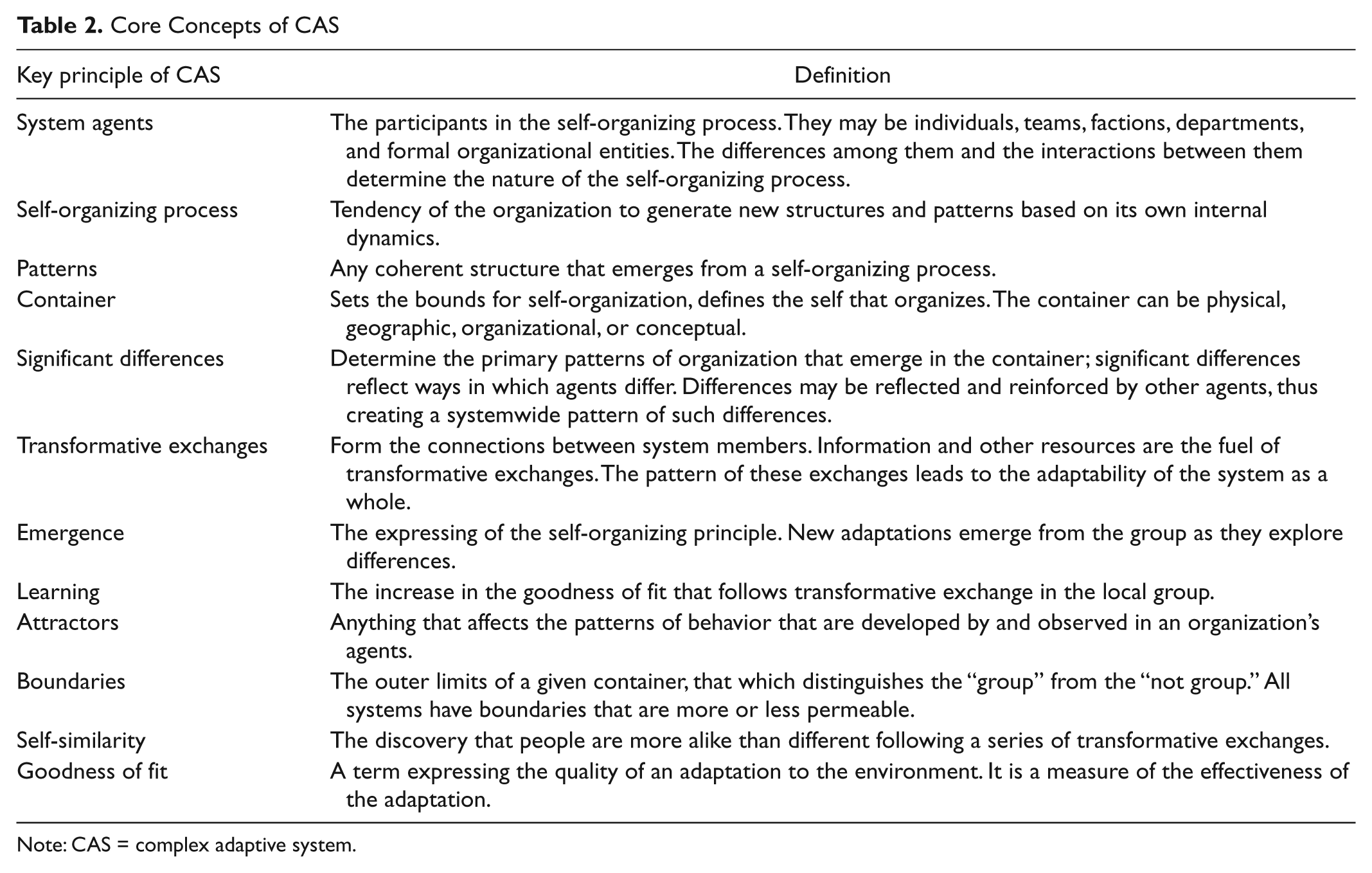
Note: CAS = complex adaptive system.
A Full-Dimensional Perspective
Principles of the Full-Dimensional Perspective
Three assumptions lay at the heart of the FDSM perspective: (a) People typically work in complex systems, (b) every human system includes objective and the subjective elements working at the individual and the organizational levels, and (c) the “health” of the organization is determined by the degree of integration of four processes: shared meaning, internal connectedness (focuses experiences), external responsiveness (enables right actions), and goodness of fit (clarity of purpose). Let us consider these assumptions in more detail.
People Work in Complex Systems
Heraclitus, a noted authority on change, wrote more than 2,500 years ago that “you cannot stand in the same river twice.” Today, more than ever, organizational leaders are called on to deal with the constancy of change. As the rate of change increases, the pressure mounts for leaders to understand how to get their people and their organizations to change in a way that gets results.
Organizations are purposive (Capra, 2002; Land, 1986; Senge, 2006). Figure 1, which shows a simple organizational system, illustrates three key points about systems. First, the system provides a space or a container (designated by the boundary) that in turn provides members the opportunity, information, and resources needed to achieve the intended purpose of the organization (Mink, Owen, & Mink, 1997). Second, to succeed, the parts of the system must work together in a coordinated fashion. This is illustrated in the overlapping of the three system components. Third, to be successful, the organization must be in constant interaction with the external environment, gathering and using relevant information to be able to maintain the required coordinated effort. Consider then the much greater complexity of the organizations in which people work. To function effectively over time, this coordinated interaction must be constantly adjusted. To achieve this and maintain a level of coordination, organizations must have the capacity to learn and adapt skills sets, relationship, and working relationships over time (Smith, 1999; Wadsworth, 2003).

A simple organizational system
Every Human System Includes Objective and the Subjective Elements Working at the Individual and Organizational Levels
The full-dimensional perspective is a holistic mode of thinking about organizations. It recognizes that objective and subjective elements of organizational life at the individual/group and organizational levels affect the course of the change process. This means to properly understand an organization, the analyst must take into account each of these dimensions and levels simultaneously, and he or she must also recognize that each dimension and level functions by laws unique to that dimension and/or level. This involves an understanding of not only knowledge and skill sets (objective levels) and the role of intentions and expectations (subjective) at the individual and group levels but also the interplay of processes and systems (objective) and belief systems (subjective) at the organization or system level (see Figure 2).
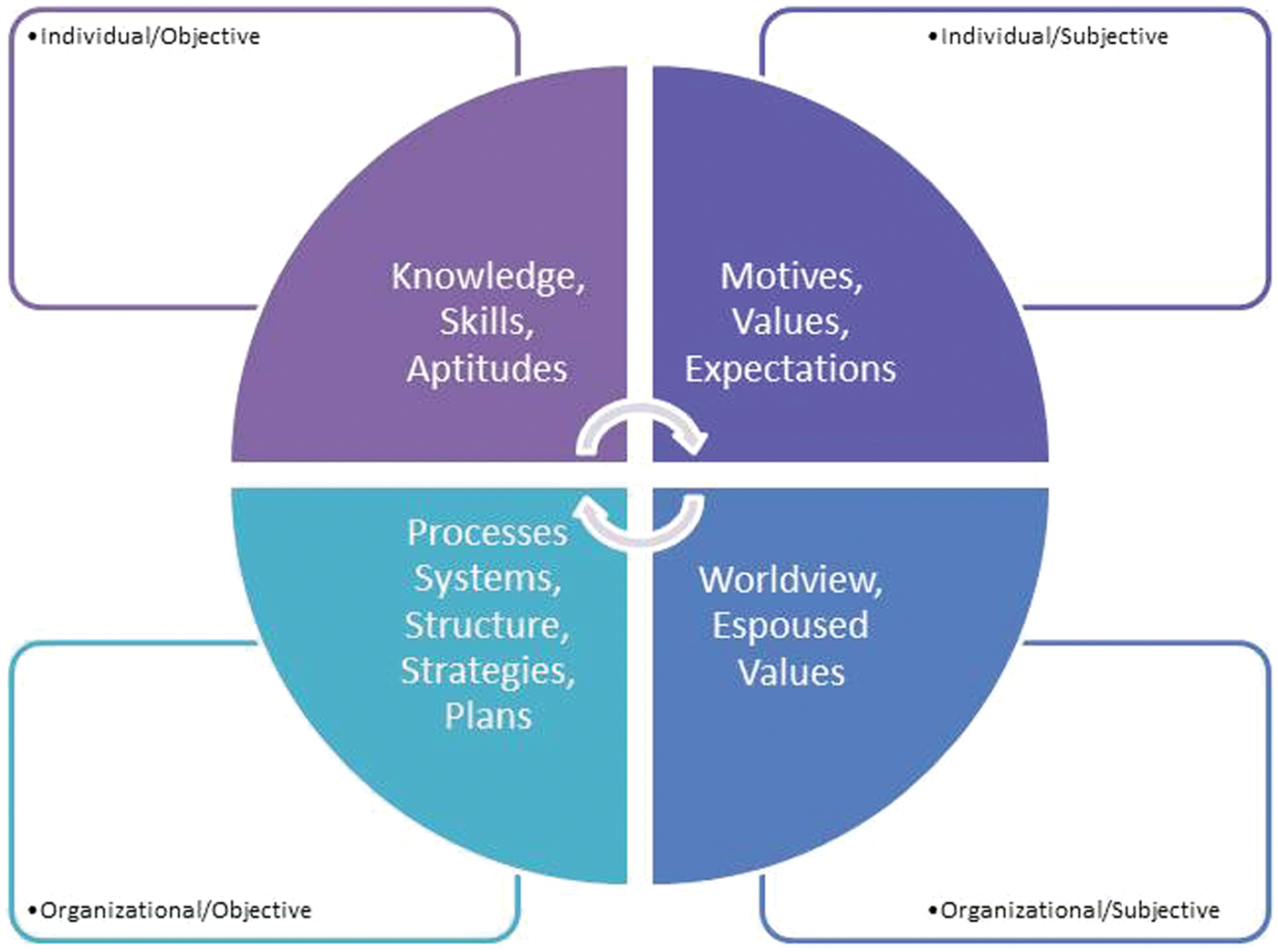
The complex nature of human organizations
The left side of the model depicts the objective dimension, and phenomena on this side of the model are observable and directly measurable. The right side depicts the subjective dimension. Phenomena on this side of the model are created in people’s minds and cannot be directly observed or measured.
The upper left quadrant is the domain of individual competencies (knowledge and skills), all the things that you observe the individual doing or working with. The lower left quadrant is the domain of systems and processes, the view from outside of the group. It includes the organizational and management structures, the technology used to create outputs, formal/informal metrics, and formal/informal systems of acknowledgment, recognition, and respect.
The upper right quadrant is the domain of individual intentions and expectations (schema), the view from the interior of the individual. It includes the beliefs, values, and commitments the individual brings to all situations. The lower right quadrant is the domain of shared collective practices (the norms and routines of the organization), the view from the interior of the group. This quadrant includes the shared worldviews and their attendant shared beliefs that shape the organization’s culture. These are generally captured in the values, norms, and routines of the organization that evolve from them. This quadrant has a powerful effect on the culture that evolves in the organization and thus determines the character and reputation of the organization. These four quadrants must be constantly aligned and realigned with the shared meanings and the external environment if the organization has to achieve effective and sustainable progress toward its purposes.
Four Processes Are Involved in Learning and Adaptation
The extent to which organizations are able to handle the complexity of continually integrating
shared meaning, internal connectedness, and responsiveness to valid information within a specific
context is the extent to which they will be successful at learning and adapting (Dietz and Mink, 2005). In fact, Jaques and Clement (1991) maintain that handling complexity is at the heart of the competence to deal with problems. How well or how
badly managers handle their problems is in turn at the heart of not only the way in which they are
regarded by their subordinates but also the strength of their leadership. (p. 9)
As we have stated above, learning and adaptation requires the integration and alignment of multiple dimensions of reality, including the objective and subjective at the individual and group levels. Our work with organizations has led us to identify four key processes that determine the success with which any organization is able to achieve intelligent self-extension (Mink, Mink, Downes, & Owen, 1994; Dietz & Mink, 2005). The processes are the principles of
shared meaning,
internal connectedness,
external responsiveness, and
goodness of fit to a given context (see Figure 3).

The four attributes of a learning organization
Shared meaning
Shared meaning is an important determinant of the ability of an organization to learn and grow (i.e., change). The concept of meaning refers to “the symbolic significance members attach to the organization’s vision, mission, values, and desired results” (Dictionary.com). The principle of shared meaning refers to the degree to which the organization is unified around a shared set of meanings about beliefs, experiences, actions, and results.
In the truest sense, human organizations evolve from a sense of shared meaning that provides the framework for all organizational behavior. When an organization is able to align members, processes, systems, and aspirations around a sense of shared meanings about what is important and worthwhile, it enables its members to fulfill important psychological needs for purpose, and this, in turn, creates high levels of commitment and motivation. Shared meaning is not given, however, for it requires members to develop and assign a particular and specific meaning to information, and to develop a shared grasp of its significance or implications for their own as well as others’ behavior. At issue then is how organizations go about creating shared meaning, especially during times of needed change, and how they “live” this meaning on a day-to-day basis. Change is more likely to be successful if leadership (a) creates an organizational environment that promotes change behavior and deters behaviors that inhibit change and (b) behaves in ways consistent with that intended environment. This is because human systems are highly sensitive to inconsistencies between espoused meanings and actions.
Internal connectedness
To be connected is to operate as a unified system to create and reinforce the shared meanings of the organization. The principle of internal connectedness refers to the way the individual capabilities, expectations and aspirations, group systems and processes, and shared collective practices are brought together so as to realize the shared purposes of the organization. The aim of the integration of people, processes, and working relationships is to create a space in which people can engage in purpose-relevant experiences. Purpose-relevant experiences are those that are clearly interpretable as being relevant and contributing to mission accomplishment. In a sense, the shared meanings enable the creation of a space in which people can engage in experiences and take actions that are consistent with the nature of the desired change.
External responsiveness
The principle of external responsiveness refers to the ability of the organization, its units, and its individuals to assimilate (gather) and accommodate (use) information to increase the goodness of fit with the environment. Assimilation and accommodation are the two complementary processes of adaptation, through which awareness of the outside world is internalized. Although one may predominate at any one moment, they are inseparable and exist in a dialectical relationship.
Assimilation is the capacity to gather and take in information for the purpose of understanding the ever-changing environment. In doing this, organizations must exhibit intelligence in choosing which information is relevant to making decisions about how to respond to that environment. Second, organizations must be capable of accommodating the data; that is, it must be capable of “self-extension” or adaptation. Self-extension is an alteration or adjustment in the capabilities, systems, individual expectations, and/or culture by which the organization improves its condition in relationship to its environment. It is also a coordinated change in behavior of individuals and groups in response to new or modified surroundings.
In assimilation, what is perceived in the outside world is incorporated into the internal world, without changing the structure of that internal world, but potentially at the cost of “squeezing” the external perceptions to fit—hence, pigeonholing, siloing, and stereotyping. In accommodation, the internal world has to accommodate itself to the evidence with which it is confronted and thus adapt to it, which can be a more difficult and painful process. External responsiveness means the organization learns the ability to discriminate information that is fit for purpose from that which is not, which in this case refers to the degree that new data enhance the ability of organization to realize its purposes. Information is valid when it is relevant to and efficacious for decision making and action.
External responsiveness, then, is the organization’s collective ability to ingest, analyze, understand, and use information to respond to the forces and changes in the internal and external environment. In many organizations, responsiveness is often diminished because decision makers tend to operate from the left-hand side of the model, by virtue of their training and by virtue of the fact that information in the right-hand side of the model is often seen as threatening. Organizations struggle to understand the subjective side of the model because the level of trust and openness is insufficient to enable a dialogue about that which is perceived to be threatening.
As with internal connectedness, to be externally responsive, organizations must address objective and subjective issues. For example, when introducing new technology, not only must costs versus benefits be considered but also the concerns of those who are expected to use the new technology. While the former is obvious, less obvious is the impact of consumer concerns on the adoption of a new technology. Concerns are the feelings people have about the technology and shift in focus over time from awareness to personal to task to innovation and improvement. Unless and until organizations understand these subjective concerns, customers may resist even what appears to be a highly beneficial change. The reality is that organizations often overlook these subjective issues, and this is because of decision maker’s tendency to view organizations in mechanical or engineering terms (objective dimension) and to ignore the more subjective, yet powerful forces of human beliefs and values and shared collective practices (subjective dimension).
Goodness of fit in relation to a given context
Every decision made and action taken by an organization occurs within a context or setting. Context is defined as, “The set of circumstances or facts that surround a particular event, or situation” (Dictionary.com). An organization’s context refers to the immediate and extended environment in which its purposes are to be achieved, and to be successful, decisions and actions must be fit for purpose in the context in which it functions.
The FDSM
Figure 4 shows the FDSM. The model shows that to integrate and thus achieve a sustainable goodness of fit to the context, decision makers must align people and their competencies, values, and expectations (agents); processes and systems; and working relationships. This may be relatively easy when change involves doing more of the same; it becomes infinitely more complex when change involves weaving together new people, new processes, and new ways of working together. This is because in the container that is the organization, the laws governing the subjective-based elements of the system (human agents) are fundamentally different from the laws governing the objective-based elements of the system. These laws are the topic to which we now turn our attention.

The full dimension systems model
FDSM assumes that modern organizations are best viewed as complex adaptive human systems (CAHSs) that thus obey the principles of such systems. There are six principles that are of particular importance to understanding the dynamics of CAHS: agents, attractors, self-organization, emergence, feedback loops, and coevolution. At any moment in time, these principles are at work to determine the flow of energy into, through, and out of the CAHS. Many of the observed phenomena associated with these CAHSs, for example, the failure of a majority of change initiatives, are due to the operation of these principles. The FDSM strives to improve our ability to assess and lead what happens in the CAHS, and in the process change vicious feedback loops to virtuous ones.
FDSM assumes that to understand and change a CAHS, decision makers must seek to understand the organization from a full-dimensional perspective, namely, the objective and subjective dimensions at the individual and organizational levels. FDSM assumes that the ability of the organization to stay fit for purpose is a function of its ability to continually and simultaneously integrate inputs into the system across individual competencies and plans (objective), individual values and expectations (subjective), organizational processes and systems (objective), and organizational worldviews and beliefs (subjective) with the exigencies of the external environment.
Self-organization is always going on in an organization around significant differences. Under “normal” conditions, this self-organization is unmanageable and produces many unintended consequences, not the least of which is a disruption to the change process. What is needed is an approach that surfaces the tensions that produce this self-organization, and although it cannot be managed, it can be contained to flow in a more optimal manner.
FDSM also provides a number of assumptions about how to facilitate change. One is that the role of leaders is to create a space (container) for dialogue among agents about significant differences (attractor types). When transformative exchanges about significant differences between agents occur, self-similarity among agents evolves/coevolves. The development of self-similarity facilitates the emergence of new levels of understanding of the challenges facing the organization, and new levels of understanding of and ability to adapt to the external environment occur. In this way, self-sustaining and vicious feedback loops that are at work to inhibit change can be converted to virtuous feedback loops that work to promote new learning and new ways of adaptation to the external environment.
Facilitating Change From the FDSM Perspective
Change in a CAHS is an iterative process in two phases. First, there is the ongoing interaction of system agents, which is followed by an emerging pattern of self-organization. The phases happen on many dimensions and at many different parts of the organization across time (Mansfield, 2010). In a CAHS, the parts affect the whole, and the whole affect the parts. It is a result of the operation of the principle of self-organization—As parts of the system interact, over time with each other and with the whole, new patterns emerge. By the same token, the whole acts to constrain the parts. These emerging patterns affect how future structures and patterns interact to influence the emergence of other future patterns.
Conditions for Self-Organization
Knowing that the interaction of the parts with the whole and the whole with the parts influences and constrains future emergence does not provide the change agent with options for action. In FDSM, three additional concepts are required to influence the patterns of self-organization that emerge:
container,
significant differences, and
transformative exchanges.
By understanding these three principles, the change agent can support meaningful self-organization.
There must be a container
The container establishes the semipermeable boundaries within which change can take place (Olsen & Eoyang, 2001). It is within this container that current patterns have emerged and within which new ones can evolve. The container holds the parts of the system together so that the process of self-organization can occur. A container acts as a cohesive force and can take many forms, for example, a magnet like a compelling vision, a fence like group membership, or natural affinities like culture, position, gender, and personal history. Containers are not mutually exclusive, and an individual can coexist in more than one container at a time (Perrow, 1974), such as in a matrix organization in which a person has two supervisors. The point is this: Without a meaningful container, change is not possible for there will be insufficient interaction for self-organization to occur.
Significant differences must be openly surfaced
Any difference that exists in a system can shape the pattern, that path of self-organization that emerges in the system. There are two dimensions of differences that are important determinants of the patterns that emerge: power and distance. For example, people in a system have different levels of power, and they are more or less familiar with an issue of relevance to the system. The many differences that exist in a group are important to many different individuals at the same time. How a group chooses to handle these differences can have a large impact on the course of a change. Focusing on one difference to the exclusion of others can narrow the focus on a group such that its overall effort will have a high probability of being ineffective; too broad a focus often reduces a group to total inactivity as it struggles to cope with the level of complexity. The bottom line is that how you choose to surface and integrate differences in the group will determine the course of self-organization.
Transformative exchanges must occur among system agents
Transformative exchanges is the third of the conditions that shape self-organizing processes in complex systems. Exchange refers to contact between the agents of the system. As agents interact with other agents in the organization, they provide energy in the form of ideas and information to those other agents in the system and cause a disturbance in existing patterns. If the energy is sufficient, it causes a new pattern to self-organize; if the energy is insufficient, then coherent systemwide new patterns fail to emerge. In such cases, agents may feel confused or isolated. If there are too many exchanges, agents may suffer from overstimulation and inactivity because of the overload.
The Self-Organizing Process: Conditions for Change
Within an organization there are many systems and subsystems, each of which contains and shapes individual and group behaviors, and within any container, significant differences also shape individual and group behaviors. For example, across an organization, differences in strategic importance of groups may determine which management voices are the most powerful. This is because in each container, a unique set of significant differences determines the patterns of behavior for individuals and the group as a whole.
Differences are not sufficient to facilitate or generate change. This requires transformative exchanges between the agents of the container. Such exchanges involve the exchange of energy among and between agents, and thus open the way for the emergence of new patterns of behavior. This is an important role of the change agent—to shift the container, the differences, and the exchanges among the agents to activate a process of self-organization. The objective of this process is to activate the self-organizing path, see how the system responds and learns, and then design the next intervention. The aim, however, is not to predict or control it, which is not possible. It is important to keep in mind that no condition stands alone, but all are interdependent. Changing one condition means the others will change too. Nevertheless, it is possible to use this interdependence to simplify the change process. Amplifying an organizational strength will automatically lead to amplification of other conditions. For example, in an organization that is already strong in face-to-face communication, this strength can be used to facilitate dialogue among members that will serve to surface and resolve differences and break down needless barriers that artificially separate people into containers.
In terms of FDSM, three core processes are required to facilitate change:
amplifying communications among system agents in the container,
enabling the emergence of self-similarity, and
taking action to increase the goodness of fit with the environment.
Amplifying communications
In a complex organization, there is no single point source of change. In fact, change efforts based on this machine model assumption of change are doomed to failure. The reality is that there are multiple sources of change, and these must be allowed to emerge through the establishment of multiple connections among system agents and change agents. This can be done through dialogue groups of various sorts.
In the traditional approach, the power for change is assumed to lie with leadership, and employees are seen as mere inhabitants who have to be forced into change. This assumption is not valid, neither in reality nor from a CAHS paradigm perspective. Power comes from system agents, who through dialogue and transformative exchanges come to develop new perspectives of the organization and its need for and readiness to change. This then begs the question about what the leader’s role is. The role of leaders is to enable and support the exploration of significant differences through engaging agents in transformative exchanges. This poses a special challenge for the change agent, who must pay special attention to the leader’s readiness and willingness to increase connectivity and transparency regarding system dynamics.
Enabling the emergence of self-similarity
Many, if not most, organizational interventions focus on the concept of consensus. However, even though diversity of opinion may be sought early in the process, in the end, decisions are made that assume a high degree of consensus. The reality, of course, is that this push toward consensus generally leads to the suppression of important significant differences. One consequence of this is the suppression of the creativity that emerges from the self-organizing potential of the group.
Paradoxically, focusing on differences is generative and leads to the discovery of a level of self-similarity that is not obvious from most change interventions. This is because the existing significant differences have already been integrated into current patterns, not ignored. By amplifying communications, surfacing connections, old patterns can give way to new. This is why, in a change organized around the principles of the FDSM, goals and plans are emergent as opposed to predetermined. By focusing on differences and not consensus, the basic human requirements of inclusion and engagement are met. This, in turn, enhances the level of openness and transparency. This is illustrated in Figure 5. The figure shows that it is the process of creating the opportunity for transformative exchanges between agents that produces the new idea or learning that makes learning and adaptation possible, a paradoxical outcome of enabling the group to discover they are more alike than different.

Facilitating transformative exchange results in the emergence of self-similarity
Increasing goodness of fit
Much consulting work that is based on the machine view is based on defining the gap between the present and the desired state, and then working to reduce those gaps; however, by pre-defining the preferred future in specific terms, individuals often find it hard to find a role within this highly prescribed state of affairs. In short, they do not know what actions will be beneficial. FDSM offers an alternative to this by enabling system agents, in the context of the whole, to define theory of local aspirations and to take local actions to close local gaps. This pattern of individual actions in immediate contexts is referred to as goodness of fit with the environment.
What happens, as local agents have transformative exchanges about local significant differences in the context of the whole, relevant gaps become obvious as do steps that can be taken to reduce these gaps. These steps are aligned with the aspirations of the whole because they are nested in and part of the whole.
Summary
In writing about organizations, Charles Perrow (1972) wrote, Its ideal form [an open organization] is never realized for a variety of reasons. For one thing
it tries to do what must be (hopefully) forever impossible—to eliminate all influences upon the
behavior of its members. Ideally, members should act only in the organization’s interests. The
problem is that even if the interest of the organization is unambiguous, men do not exist just for
organizations. They track all kinds of mud from the rest of their lives with them into the
organization, and they have all kinds of interests that are independent of the organization. . . .
The ideal form also falls short of realization when rapid changes in some of the organization’s
tasks are required. [Most organizations] are set up to deal with stable, reliable tasks; that is the
basis of organizational efficiency . . . But when such changes are frequent and rapid the form of
organization becomes so temporary that the efficiencies required of an organization cannot be
realized. (pp. 4-5)
This statement expresses the fundamental realities of organizational life; that is, change is constant, increasingly rapid, and difficult to respond to successfully. Our thesis is that the root cause of most failed change is the mental model or mind-set decision makers bring to the task, which is to view the organization from an essentially linear, objective point of view. From this point of view, when the need arises, organizations can be deconstructed and rearranged in a logical, objective manner to achieve new or improved outcomes.
We contend that such a view is flawed. Change is not a linear or reductionist process. It is a human process that is modeled better by biology and complexity theory than economics or physics. The flaw lies in the way decision makers analyze and try to change organizations. Simply designing and executing effective processes and systems is inadequate to effect meaningful change because individual and collective values, aspirations, and expectations (i.e., self-interest) play an important and vital role in creating the way an organization responds to a need for change.
In this article, we hypothesized this seeming conundrum can be overcome by applying a new paradigm to organizational analysis and change. This paradigm is based on the concepts and tools of biology and complexity theory, and we refer to it as the FDSM. From this view, organizations function in the objective and subjective dimensions and at multiple levels, including the organizational, group, and individual levels. To effect sustainable change, decision makers must understand organizations holistically. This is because self-interest lies in the subjective side of organizational reality. Self-interest produces a range of subtle differences in organizations that sets into motion the dynamic characteristics of all complex human systems, namely, emergence and self-organization. It is these emergent patterns of organized self-interest that produce the failure of change initiatives.
FDSM suggests that to be able to effect sustainable change, three things must be constantly monitored and corrected, namely, the degree of shared meanings of values and goals, the degree of internal connectedness among the objective and subjective aspects of the organization, and the degree to which the organization is responsive to its context.
A full-dimensional analysis of the organization is always the result of a collaborative process, and such a process can only take place through an open, transparent dialogue regarding the issues that exist in a given organization. Paradoxically, it is only by surfacing and having dialogue about these issues that a greater degree of shared understanding, internal connectedness, and external responsiveness can be realized.
This article also raises more new questions than the questions for which it proposes answers. In fact, this article points the way toward what we call a new research agenda. One question decision makers and researchers need to explore more fully is to understand the dynamics of differences in self-interest in organizational dynamics. The question is not how to get rid of these differences but to align and realign them in pursuit of the common good. A second line of research is to determine the extent to which our hypothesis concerning the level of transparency regarding differences is actually correlated with sustainable performance.
Footnotes
Declaration of Conflicting Interests
The author(s) declared no potential conflicts of interest with respect to the research, authorship, and/or publication of this article.
Funding
The author(s) received no financial support for the research and/or authorship of this article.