



Abstract
Cyber dating abuse is a significant issue among emerging adults, with harmful implications for both victims and perpetrators. This study had two main objectives: first, to validate previous findings regarding the association between victimization and perpetration of cyber dating abuse; and second, to explore the moderating role of resilience in this relationship, offering new insights into how resilience may influence these dynamics. The sample consisted of 547 participants, including 324 females and 223 males, aged 18 to 25 years (M age = 19.95 years, SD = 1.69). Participants completed validated scales to assess cyber dating abuse perpetration and victimization, as well as resilience, using a multi-item questionnaire. Regression analyses revealed a significant association between cyber dating abuse victimization and perpetration. Although resilience had a statistically significant moderating effect on this relationship, the strength of the moderation was weak. Preventive initiatives should take these findings into consideration when addressing cyber dating abuse. Implications for future research are also discussed.
The purpose of the current study was to examine the connection between cyber dating abuse victimization and cyber dating abuse perpetration. Additionally, we aimed to explore the moderating role of resilience in this relationship. Participants in this study were recruited from the platform Prolific. Inclusion criteria were: (1) aged between 18-25 years old; (2) Spanish nationality; (3) having been in a romantic relationship in the last year. All participants were informed about the purpose of the study, as well as their anonymous and voluntary participation. They filled two research scales regarding their involvement in cyber dating abuse and resilience. The primary conclusion of the present study is that experiencing cyber dating abuse is significantly associated with an increased risk of being a perpetrator of cyber dating abuse. These results underscore the need for further research to clarify the direction of the associations between victimization and perpetration. Additionally, more studies should focus on examining moderating factors that affect the links between victimization and perpetration. Fundamentally, this study identifies potential intervention and prevention targets, providing inspiration for future research in the field of cyber dating abuse.
Introduction
As societies advance technologically, communication and interaction methods undergo profound modifications, offering significant potential to enhance interpersonal and dating relationships (Monteiro et al., 2023; Rodríguez-de Arriba et al., 2024; Zapor et al., 2017). However, these advancements also introduce opportunities for maladaptive and potentially harmful online behaviors, particularly among young adults (Li et al., 2023; Marganski & Melander, 2018). New technologies have not only changed how abuse can be enacted but have also lowered the barriers for abusive behavior by requiring minimal effort, providing immediate access to victims, and reaching an extensive audience (Buelga et al., 2012; Mishna et al., 2018; Zweig et al., 2014). Consequently, abuse now transcends traditional temporal and physical boundaries, allowing perpetrators to employ a wider range of covert and overt abusive behaviors (Martínez-Soto & Ibabe, 2024; Rogers et al., 2023; Van Ouytsel et al., 2020).
These behaviors are facilitated by a wide range of digital tools, from accessible everyday technologies like mobile phones, social media, email, and messaging apps to more specialized tools such as GPS trackers and spyware. Such technology allows for control, harassment, and abuse in intimate relationships with unparalleled immediacy and a sense of omnipresence, often creating an illusion of constant surveillance over victims (Afrouz, 2023; Galende et al., 2020). These actions are frequently subtle and difficult to recognize as forms of violence, making detection and intervention more challenging (Mahoney et al., 2022).
Previous research highlights a wide range of terminology used to describe this phenomenon (S. Caridade et al., 2019; C. Kim & Ferraresso, 2023; Rogers et al., 2023; Taylor & Xia, 2018). Fernet et al. (2019) identified over 30 constructs, with “cyber dating abuse” emerging as the most prevalent and inclusive term in scientific publications (Gámez-Guadix et al., 2018; Rocha-Silva et al., 2021). Originally defined by Zweig et al. (2014) as “the control, harassment, stalking, and abuse of one’s dating partner via technology and social media” (p. 1306), cyber dating abuse is a multidimensional construct that encompasses various abuse types, including direct aggression and control (Burke et al., 2011; Cava et al., 2023). Among these, control is the most common form (Ellyson et al., 2021; Ortega-Barón et al., 2022), with many behaviors overlapping and often experienced simultaneously (Rogers et al., 2023).
The average age of onset for cyber dating abuse behaviors is around 16, although some individuals experience it as early as 11 (Ellyson et al., 2021). Fernet et al. (2019) note that emerging adults (ages 18–25) are particularly vulnerable, with a recent meta-analysis showing prevalence rates of 44.6% for perpetration and 43.4% for victimization, which are higher than in adolescent populations (Li et al., 2023). However, most research has focused on high school students, with limited studies examining cyber dating abuse among community samples of broader adult populations (Mahoney et al., 2022; Oyarzún et al., 2021; Watkins et al., 2018).
A significant body of research identifies various personal and demographic factors associated with cyber dating abuse, including gender and sexual orientation. Findings on gender have been inconsistent or hardly showed differences between male and female victimization (Branson & March, 2021; Martínez-Soto & Ibabe, 2024). However, studies on sexual orientation consistently report higher rates of both victimization and perpetration among LGBTQ+ individuals (Dank et al., 2014; Semprevivo, 2021).
Cyber dating abuse has been linked to various mental health and behavioral issues, including depressive symptoms, low self-esteem, emotional distress, posttraumatic stress, hostility, anger, and substance use (alcohol, cigarettes, marijuana, and hard drugs; S. M. M. Caridade & Braga, 2020; Duerksen & Woodin, 2021; Hancock et al., 2017; Lu et al., 2018; L. A. Melander & Marganski, 2020; Toplu-Demirtas, Akcabozan-Kayabol et al., 2022). Additionally, it is associated with an increased risk of suicide (Gracia-Leiva et al., 2020).
Associations Between Cyber Dating Abuse Victimization and Perpetration
Numerous studies have examined prior experiences as victims or perpetrators as risk factors for subsequent offline and online abuse within dating relationships (Ellyson et al., 2021; S. Y. Kuo et al., 2023; Pusch & Reisig, 2021; Rey-Anacona et al., 2023). These findings suggest a bidirectional nature of online dating abuse (Langhinrichsen-Rohling et al., 2012), where partners often assume both victim and offender roles (Borrajo, Gámez-Guadix, & Calvete, 2015). A systematic review and meta-analysis by Park and Kim (2019) found that individuals identifying as dating violence perpetrators were also more likely to report being victims, and vice versa.
Studies consistently show that victimization is a significant predictor of online abuse perpetration in dating relationships, regardless of the gender (Kellerman et al., 2013; Marshall et al., 2013; Martinez-Pecino & Durán, 2019; Zapor et al., 2017). For instance, Leisring and Giumetti (2014) found that individuals engaging in both minor (e.g., insults) and severe online abusive behaviors (e.g., threats or public humiliation) often reported being victims of the same behaviors. In a U.S. study of young adults, 59.2% reported both using and experiencing at least one cyber dating abuse behavior, while 32.5% reported experiencing such behaviors without engaging in any, and 8.3% reported engaging in abuse behaviors without experiencing them (Ellyson et al., 2021). In Spain, Durán-Segura and Martínez-Pecino (2015) identified the “victimized aggressor” profile.
Despite extensive research, no comprehensive theory fully explains the relationship between victimization and perpetration. Different authors have used multi-theoretical frameworks to address this association (Cénat et al., 2022). One prominent explanatory model is social learning theory (Bandura & Walters, 1997), which suggests that witnessing violent interactions is a risk factor for young people to adopt similar violent strategies in their own relationships (Curry & Zavala, 2020; Van Ouytsel et al., 2020).
Resilience
Although much research has explored cyber dating abuse, relatively few studies have investigated resilience as a protective factor. Moreover, despite decades of research on resilience, there is still no clear consensus on its definition, conceptualization, or measurement (Denckla et al., 2020; Troy et al., 2023). Vella and Pai (2019) highlight that some researchers conceptualize resilience as a personal quality (Ahern et al., 2008) or inherent trait (Hu et al., 2015), focusing narrowly on individual attributes. However, this trait-focused view has faced criticism, as it places full responsibility for healthy development on the individual (Aksoy et al., 2023).
Conversely, several researchers (Fang et al., 2022; Kalisch et al., 2019; Masten et al., 2021; Masten & Motti-Stefanidi, 2020; Ponce-Garcia et al., 2016) adopt a systems approach, conceptualizing resilience as a dynamic, multisystemic process that facilitates the capacity to withstand or recover from significant disturbances threatening adaptive functioning and development (Denckla et al., 2020). This perspective suggests that resilience emerges from complex adaptive processes activated by stressors, involving various protective factors (Kalisch et al., 2019). Moreover, exposure to significant risk factors is essential for resilience to develop (Chmitorz et al., 2018).
Risk factors include individual characteristics and environmental or situational conditions that increase the likelihood of behaviors such as violence (García del Castillo et al., 2016). Conversely, protective factors refer to attributes of individuals and their environments that buffer the influence of risk factors on violent behavior (Claussen et al., 2022). While research on protective factors in cyberdating abuse is limited, some studies have identified resilience as a potential protective (S. M. M. Caridade & Braga, 2020; Lachapelle et al., 2022).
Most existing studies focus of resilience in mitigating the adverse effects of intimate partner violence on mental health and well-being. For example, Humphreys (2003) found that resilience in battered women was inversely correlated with psychological symptoms and distress. Anderson et al. (2022) found lower levels of perceived stress in resilient female victims of sexual violence, and Hajian et al. (2018) showed that resilience reduces the likelihood of suicide attempts. However, Choi et al. (2021) found no protective effect of resilience on anxiety in young mothers who were victims of intimate partner violence.
In a similar vein, some research has examined resilience as a mediator or moderator between intimate partner violence and mental health issues. For instance, Catabay et al. (2019) found that resilience partially mediated the relationship between perceived stress and depressive symptoms among women exposed to sexual violence. Castiglioni et al. (2023) showed that resilience mediated the impact of mental health symptoms on emotional processing, cognitive processing, self-perspective, perceived threat to life, and trauma integration. Fernandes et al. (2022) found resilience to be a partial mediator of the relationship between psychological violence and alcohol use in victims of psychological abuse. Other studies have explored resilience as a mediator or moderator between childhood violence exposure and dating violence victimization and perpetration (Munoz & Pence, 2016).
Although resilience is often conceptualized as a protective factor against interpersonal violence (Domhardt et al., 2015; Lachapelle et al., 2022), little research addresses its role specifically in cyber dating abuse. Some studies suggest resilience may decrease the likelihood of technology-facilitated sexual violence victimization (Snaychuk & O’Neill, 2020) and reduce both bullying and cyberbullying victimization and perpetration (Donnon & Hammond, 2007; Hinduja & Patchin, 2017; Wu et al., 2018). In a longitudinal study, Chen et al. (2023) found a bidirectional relationship between resilience and victimization, with resilience acting as a protective factor against bullying. Gianesini and Brighi (2015) demonstrated that moderate levels of resilience help protect youth from cyberbullying involvement, promoting healthier adjustment. However, Muncaster and Ohlsson (2020) did not find resilience to significantly impact sexting perpetration or victimization.
In intimate partner violence, findings consistently reveal a negative association between victimization and resilience in both adolescents and adults (Dosil et al., 2020; Fernandes et al., 2022; C. Kuo et al., 2022; Tsirigotis & Łuczak, 2018). However, the association between perpetration and resilience is less explored. Dosil et al. (2020) noted that adolescent perpetrators of relational violence scored lower on resilience. Conversely, Howell et al. (2018), in a sample of adult female victims of intimate partner violence, found no inverse relationship between perpetration and resilience, potentially due to the high prevalence (85%) of bidirectional violence among participants.
Research on resilience in the context of cyber dating is sparse. Víllora et al. (2021), in a study of college students, found that factors shaping resilience, such as social support and planning, were related to both victimization and perpetration in cyber dating abuse. Similarly, Lachapelle et al. (2022) found that perceived support from friends reduced the risk of cyber dating abuse among adolescents and young adults. However, Wallace et al. (2023) found no protective effect of resilience (individual or community level factors) on cyber dating abuse victimization in adolescents.
Present Study
The high prevalence of cyber dating abuse among emerging adults, along with its subsequent negative health effects, underscores the need to understand mechanisms that could reduce and mitigate the perpetration and victimization of cyber dating abuse, thereby informing intervention, prevention, and public health policies. This study aimed to build on prior research by providing further insights into the connections between cyber dating abuse victimization and cyber dating abuse perpetration, as well as investigating the role of resilience in this relationship. Although various methods have been used to assess resilience (Álvarez et al., 2022), this investigation employed a multidimensional scale that evaluates both individual attributes and social factors to avoid the limitations of viewing resilience solely as a trait or static characteristic. To our knowledge, no previous study has examined resilience as a potential moderator of the relationship between cyber dating abuse victimization and perpetration.
Therefore, the objectives of this study were as follows: (a) to measure the association between cyber dating abuse perpetration and victimization among young adults, and (b) to explore the moderating role of resilience in this relationship. Accordingly, the following hypotheses were posited:
H1: Cyber dating abuse victimization would be positively associated with cyber dating abuse perpetration.
H2: Resilience would moderate the relationship between cyber dating victimization and perpetration.
Method
The research conducted in this study utilized a cross-sectional survey design.
Participants
Participants in this study were recruited from the platform Prolific. Inclusion criteria required participants to: (1) be aged between 18 and 25 years; (2) have Spanish nationality; and (3) have been in a romantic relationship within the past year. Exclusion criteria included participants who did not meet these demographic requirements or failed to complete the survey. Additionally, participants who did not pass an instructional manipulation check, which was embedded in the survey to verify attention to instructions, were excluded from the final analysis.
We used G*Power software to determine the minimum required sample size, which was set at 351 participants based on an alpha level of 5%, a power of 80%, a minimal model R-squared of 5%, and allowing for 10 predictors in the model. To ensure adequate data, we intentionally oversampled, resulting in responses from 592 adults. After applying exclusion criteria, including the manipulation check, 45 participants were removed, yielding a final analytic sample of 547 participants (Mage = 19.95 years, SD = 1.69). The sample included slightly more females (n = 324) than males (n = 223), with the majority identifying as heterosexual (88.5%).
Procedure
Data were collected between March 1 and April 1, 2023, using Microsoft Forms as the survey platform. The study was conducted entirely online through Prolific, an international recruitment platform that allows researchers to access a diverse pool of participants while maintaining high data quality standards. The online setting provided participants with the flexibility to complete the survey at a time and location of their choosing, offering privacy and minimizing potential social desirability bias often associated with in-person data collection on sensitive topics. This online format not only ensured confidentiality but also increased accessibility for a geographically dispersed sample of Spanish emerging adults.
The study was conducted in accordance with the 1964 Declaration of Helsinki, its later amendments, and comparable ethical standards. The study protocol was reviewed and approved by the Social Research Ethics Committee (SREC) of the University of Castilla-La Mancha. All participants were informed about the purpose of the study, as well as their anonymous and voluntary participation. Before answering the survey questions, participants gave their informed consent online. Filling in the online survey took 10 min on average. Participants were compensated €2.15.
Measures
Cyber Dating Abuse
The scale developed by Borrajo, Gámez-Guadix, Pereda, and Calvete (2015) was employed to measure cyber dating abuse. The scale comprises 20 items divided between two factors: victimization (item example: “My partner or ex-partner has checked my social networks, WhatsApp or email without my permission”) and perpetration (item example: “I have checked my partner’s or my ex-partner’s social networks, WhatsApp or email without their permission”). Participants responded regarding their experiences of victimization and perpetration during the last year with a response scale ranging from 1 (never) to 6 (on more than 20 occasions). Scores were obtained by summing items, where higher scores indicated a higher degree of self-reported cyber dating abuse victimization or perpetration. Cronbach’s alpha in the current sample was .87 for the victimization scale and .81 for the perpetration scale.
Resilience
The Scale of Protective Factors-24 (SPF-24; Ponce-Garcia et al., 2015) was used to assess resilience. The scale comprises 24 items measuring social-interpersonal and cognitive-individual sources of resilience. Item examples: “My friends/family are supportive of one another”; “I am confident in my ability to solve problems”. Participant responses indicated their level of agreement with each item on a 7-point Likert scale ranging from “1 = completely disagree” to “7 = completely agree.” We used the scale to obtain one score for resilience by summing all the items, where a higher value indicated higher resilience levels. Cronbach’s α internal consistency reliability for the SPF was .91 in the current sample.
Control Variables
Participants provided information about their age, self-identified sex, and sexual orientation. Sex and sexual orientation were recoded into binary variables: self-reported sex (0 = women and 1 = men), sexual orientation (1 = heterosexual, 2 = non heterosexual).
Analysis Plan
The statistical analyses were conducted using SPSS version 28. Initially, descriptive statistics were examined to gain an understanding of the sample’s characteristics and study variables. Pearson product correlation analyses were then employed to determine significant correlations between cyber dating perpetration, victimization, and resilience. To test the associations among cyber dating abuse perpetration, victimization, and resilience, and also to test the moderator effect of resilience on the possible relationship between cyberbullying perpetration and victimization, hierarchical multiple regression analyses were used. Finally, ModGraph-I (Jose, 2013) was used to input statistical data derived from multiple regression analysis and to further analyze the moderating role of resilience.
Results
The main descriptive statistics for the variables included in the study are presented in Table 1. In terms of the prevalence of the cyber dating abuse perpetration and victimization, the mean scores are less than two. Considering that the response range is from 1 to 6, these are low prevalence scores. A t test for sex revealed differences between women and men participants in cyber dating abuse perpetration (t(547) = 2.721, p = .006, d = 0.23) and victimization (t(547) = 2.45, p = .012, d = 0.21). Women reported slightly higher rates of perpetration (M = 1.47; SD = 0.60) than men (M = 1.33; SD = 0.57). Women also reported slightly higher rates of victimization (M = 1.81; SD = 0.95) than men (M = 1.62; SD = 0.81). No sex differences were found in relation to resilience levels (t(547) = −0.68, p = .493).
Descriptive Statistics and Correlations Among all Variables.

p < .01. *p < .05.
Descriptive statistics showed that non-heterosexual participants reported higher rates of victimization (M = 2.05, SD = 0.99) compared to heterosexual participants (M = 1.69, SD = 0.88), while heterosexual participants reported higher resilience levels (M = 5.45, SD = 0.87) compared to non-heterosexual participants (M = 5.08, SD = 0.91). However, due to the overrepresentation of heterosexual participants in the sample (88.5%), conducting a t-test was deemed inappropriate, as such an analysis would not provide reliable or meaningful statistical comparisons between groups. Therefore, these descriptive differences should be interpreted with caution, and generalizations cannot be made for non-heterosexual individuals. In order to control for the influence of sex, sexual orientation, and age, these variables were entered in the subsequent regression analyses as control variables.
Based on the Pearson correlation matrix, a positive relationship was found between cyber dating abuse perpetration and victimization. Negative relationships were found between resilience and cyber dating abuse perpetration and victimization, although the relationship between resilience and cyber dating abuse perpetration is low.
Moderation Analysis
The objectives of this study were to measure the association between cyber dating abuse perpetration and victimization and to explore the potential moderating role of resilience in this relationship. To test these objectives, a hierarchical regression analysis was conducted, with perpetration as the criterion variable. The participants’ age, sex, and sexual orientation were included as control variables in Step 1. In Step 2, cyber dating abuse victimization was added. Resilience was introduced in Step 3. Finally, in Step 4, the interaction effect between cyber dating abuse victimization and resilience was examined. All predictor variables were standardized, and the interaction effect was calculated based on these standardized variables. Table 2 presents the results of the hierarchical regression analysis, including Steps 1 to 4.
Regression Analyses Examining the Associations of Resilience and Cyberdating Abuse Victimization and Relatedness With Cyberdating Abuse Perpetration as the Criterion.

Note. n = 547.
0 = women, 1 = men.
0 = heterosexual, 1 = non-heterosexual.
p < .05. **p < .01. ***p < .001.
The results presented for Step 1 did not show a significant effect from participants’ age, sex, or sexual orientation. However, the results in Step 2 revealed a significant main effect of cyber dating abuse victimization. In line with Hypothesis 1, young adults who reported having suffered cyber dating abuse were much more likely to also report higher levels of cyber dating abuse perpetration. The results presented for Step 3 revealed that resilience was not significantly associated with cyber dating abuse perpetration. In line with Hypothesis 2, the results of Step 4 showed that the interaction cyber dating abuse victimization x resilience was significant (B = −0.030, p = .008), moderating the association between cyber dating abuse victimization and perpetration. The mod graph was used to further explore the significant relationship found.
The moderation graph in Figure 1 illustrates how resilience moderates the relationship between cyber dating abuse victimization and perpetration. The graph represents three levels of resilience and three levels of cyber dating abuse victimization. While there is only a slight distinction between the three resilience levels, it might be observed that young adults with higher levels of resilience seem to be less likely to engage in cyber dating abuse perpetration, especially when they experience higher rates of cyber dating abuse victimization, followed by medium levels of resilience, and, lastly, low levels of resilience.
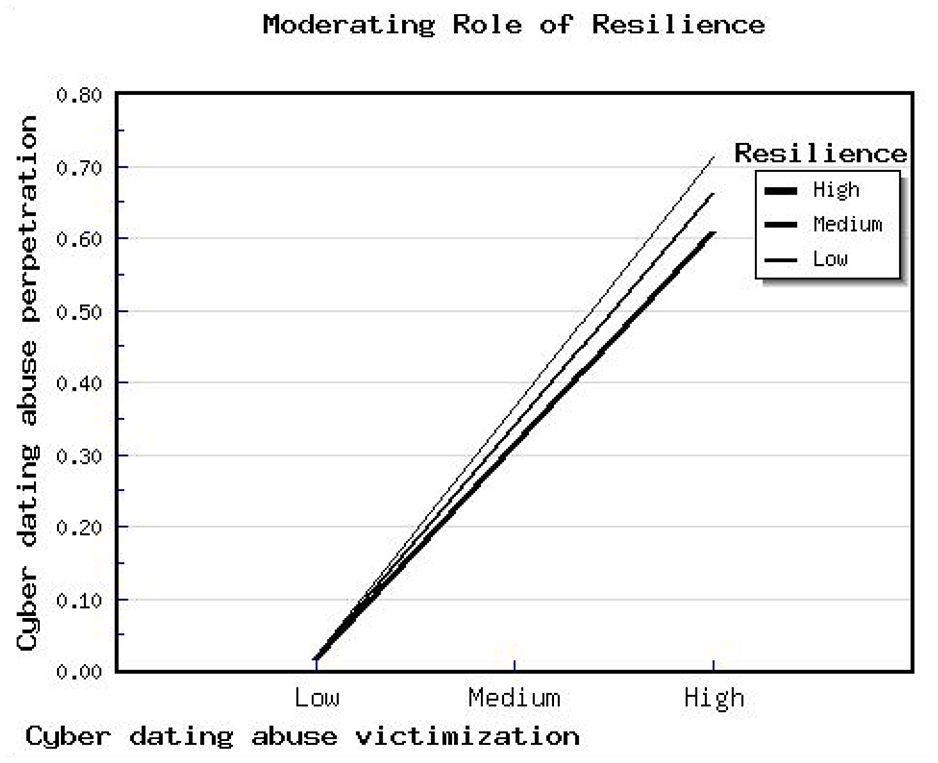
Mod graph illustrating interaction effect of resilience and cyber dating abuse victimization on cyber dating abuse perpetration.
Nonetheless, to further examine the significance of resilience as a moderator, the simple slopes were plotted for the values of high, medium, and low levels of resilience, as shown in Figure 1. The results indicated that the positive relationship between cyber dating abuse victimization and perpetration remains significant for the group with high level of resilience (B = 0.333, SE = 0.056, t = 5.947, p ≤ .001), medium level of resilience (B = 0.380, SE = 0.028, t = 13.676, p ≤ .001), and low level of resilience (B = 0.341, SE = 0.067, t = 5.065, p ≤ .001). Consequently, the moderation effect observed in the regression analyses appears to be minimal, given that no significant differences were found between the resilience levels groups.
Discussion
The purpose of the current study was to examine the connection between cyber dating abuse victimization and cyber dating abuse perpetration. Additionally, we aimed to explore the moderating role of resilience in this relationship.
In relation to objective 1 and Hypothesis 1, the present study demonstrates a positive relationship between perpetration and victimization in cyber dating abuse. This finding aligns with the study by Rey-Anacona et al. (2023), which found that, although victimization and perpetration are distinct behaviors, they are closely connected. Such a relationship may suggest that perpetrators and victims often share common characteristics and engage in similar behaviors (Erbiçer et al., 2025; Taylor & Xia, 2022). Alternatively, as noted by Fernández-González et al. (2020), this overlap might result from shared risk factors that increase the likelihood of individuals being both perpetrators and victims of cyber dating abuse.
Therefore, these findings closely align with previous research, which also suggest a frequent association between perpetration and victimization (Ellyson et al., 2021; Taylor & Xia, 2022; Zapor et al., 2017). Although we cannot determine causality, whether victimization triggers perpetration or vice versa, the role of victimization appears crucial in the cycle of cyber dating abuse. As suggested by Park and Kim (2019), victimization processes may contribute significantly to the development of individuals as both victims and perpetrators.
There are various approaches to explaining this finding. On one hand, social learning theory suggests that abusive behaviors may stem from direct exposure to similar behaviors. Alternatively, repeated exposure to cyber dating abuse could lead to desensitization, fostering a greater acceptance of abusive behaviors and, ultimately, involvement in those behaviors as perpetrators (Luo & Bussey, 2022). Another potential explanation, as suggested by Hussain et al. (2023), is that individuals who experience cyber dating abuse may feel powerless and develop low self-esteem, which can contribute to aggressive traits such as anger, hostility, and aggression. Some authors also propose that violence may sometimes occur as an act of self-defense (S. M. M. Caridade & Braga, 2020). However, research indicated that self-defense accounts for only a small proportion of violent behaviors among both men and women (Babcock et al., 2019; Leisring & Grigorian, 2016). More research is needed to explore the factors that contribute to this reciprocal relationship.
Our study sought to examine whether resilience would moderate the relationship between cyber dating abuse victimization and perpetration. Correlation analyses revealed a moderate negative association between resilience and cyber dating abuse victimization and a weaker negative association between resilience and perpetration. These results aling with previous research on offline violence (Fernandes et al., 2022; C. Kuo et al., 2022; Tsirigotis & Łuczak, 2018). Resilience is often linked to improved conflict resolution skills (Ashraf et al., 2023), suggesting that resilient individuals may be more inclined to engage in constructive communication and problem-solving rather than resorting to abusive behaviors. This tendency could reduce involvement in cyber dating abuse victimization and perpetration. Conversely, involvement in cyber dating abuse may undermine resilience. However, given the study’s design, we cannot draw definitive conclusions on causality. Further research is needed to explore the association between cyber dating abuse and resilience.
In relation to Objective 2 and Hypothesis 2, regression analyses revealed that, after controlling for previous variables, a significant interaction between cyber dating abuse victimization and resilience emerged, affecting the likelihood of cyber dating abuse perpetration. This interaction suggests that resilience influences whether individuals are more or less likely to perpetrate abuse after experiencing victimization, leading partial support to Hypothesis 2. However, further analysis of individual slopes indicated that this interaction, while statistically significant, was weak, suggesting that resilience’s moderating influence is limited in this context.
These results underscore the complexity of the relationship between victimization and perpetration in cyber dating abuse, implying that resilience alone may not be a sufficient protective factor for those experiencing victimization. Other factors may exert a stronger influence on perpetration. Previous research suggests that variables such as emotional regulation, self-esteem, moral disengagement, and mental health challenges could also shape perpetration behaviors (Hancock et al., 2017; Lu et al., 2018; Monteiro et al., 2023; Sánchez-Hernández et al., 2024; Wallace et al., 2023). Future studies should explore these factors alongside resilience to gain a more comprehensive understanding of the mechanisms driving cyber dating abuse perpetration. Future studies should consider exploring these factors in combination with resilience to gain a more comprehensive understanding of the mechanisms behind cyber dating abuse perpetration.
Additionally, the results showed differences by gender and sexual orientation. Women reported slightly higher perpetration and victimization rates than men, suggesting that cyber dating abuse affects both genders rather than being limited to one. This finding aligns with the gender symmetry perspective (Straus, 2011), which posits that rates of nonsexual assault perpetration are approximately equal for men and women (S. M. M. Caridade & Braga, 2020; Gilbar et al., 2023; Li et al., 2023; Martínez-Soto & Ibabe, 2024; Muñoz-Fernández et al., 2023) or, in some cases, even higher among women (Burke et al., 2011; Mahoney et al., 2022; L. Melander & Hughes, 2018; Toplu-Demirtas, May, et al., 2022).
While non-heterosexual participants reported higher victimization rates than heterosexual participants, consistent with previous research (Borrajo, Gámez-Guadix, Pereda, & Calvete, 2015; Butler et al., 2023; Dank et al., 2014), the predominance of heterosexual individuals in our sample prevented us from analyzing these differences for statistical significance. Additionally, non-heterosexual participants reported slightly lower resilience levels than heterosexual participants, which aligns with previous studies (De Schrijver et al., 2022; Krueger & Upchurch, 2022). This result may be explained by minority stress theory (Meyer, 2003). Sexual and gender often face discrimination and prejudice due to their marginalized social status (Klein et al., 2023), which can exacerbate relationships conflicts and limit effective conflict resolution strategies (Martin-Storey & Fromme, 2016). This stress may also inhibit the development of resilience at the individual, interpersonal, and structural levels (Schmitz & Tyler, 2019).
Limitations and Suggestions
Although this study has several strengths, some limitations should be noted. First, this study was limited by a relatively small sample size (N = 547), which may affect the generalizability of the results. Future research should aim to replicate these findings with larger and more diverse samples to strengthen the robustness and external validity of the conclusions. Additionally, studies including diverse populations, such as older adults, sexual minorities, and racial minorities, would provide more comprehensive insights into how sociodemographic factors influence cyber dating abuse. The lack of research among LGBTQ+ populations highlights the urgent need to investigate cyber dating abuse in these groups, particularly considering the unique challenges they may face.
Second, the cross-sectional design of the current study prevents the establishment of causality among the studied variables. Future research should adopt a longitudinal design to better understand the temporal relationships between cyber dating abuse victimization, perpetration, and moderating factors such as resilience. Longitudinal studies would allow researchers to track the evolution of these behaviors and provide clearer insights into causality.
Third, our research does not allow us to determine whether victimization and perpetration occurred within the same relationship. The co-occurrence of victimization and perpetration should be interpreted as behaviors across multiple relationships for a given individual, as suggested by Ellyson et al. (2021). To address this limitation, future studies should aim to include both partners when examining cyber dating abuse dynamics, which would allow for a more precise analysis of the interaction between victimization and perpetration within the same relationship.
Fourth, the present study was limited to the examination of a single moderator: resilience. While resilience is an important factor, future research should explore other potential moderators, such as self-esteem, moral disengagement, mental health, and emotional regulation, as these variables may have a stronger impact on the relationship between victimization and perpetration. Including additional moderators could provide a more nuanced understanding of the factors that increase or decrease the likelihood of dual-role victimization/perpetration in cyber dating abuse. Research even suggests that individuals who experience both victimization and perpetration may constitute a distinct group from pure perpetrators or pure victims (J. Kim et al., 2023). Understanding these factors could significantly improve the effectiveness of prevention and intervention efforts.
Fifth, although one of the strengths of this study was the use of an instrument that assesses personal and social variables, it may be beneficial for future studies to incorporate other factors that shape resilience. Variables such as problem-solving, optimism, cognitive flexibility, positive attributional style, religiosity or spirituality, positive emotions, hardiness, and sense of coherence have been identified as important resilience factors (Helmreich et al., 2017). Exploring these variables could enhance our understanding of how resilience functions as a protective factor against cyber dating abuse.
Sixth, the participants in this study were exclusively Spanish emerging adults, limiting the generalizability of the findings to other populations. Replication of these results in a more heterogeneous sample, including diverse age groups, racial minorities, and sexual minorities, is necessary. Future studies should specifically aim to better understand the role sexual orientation plays in cyber dating abuse and identify the factors that place LGBTQ+ individuals at greater risk.
Finally, the use of self-report methods may introduce information bias, as participants may underreport or overreport their experiences. To address this limitation, qualitative studies could provide deeper insights into the context and nature of cyber dating abuse, offering a more comprehensive understanding of these behaviors.
Practical Implications
The findings of the present study offer valuable implications for the prevention and intervention of cyber dating abuse. A key practical implication is the recognition of the co-occurrence of victimization and perpetration in cyber dating abuse. This suggests that individuals who are victims may also engage in abusive behaviors toward their partners, and vice versa. Therefore, intervention programs should not treat perpetrators and victims as separate groups; rather, they should address individuals who may play both roles. Programs should be designed with flexibility to target dual-role individuals (offenders/victims) and should address the shared underlying factors that contribute to both victimization and perpetration.
Effective interventions should focus on promoting adaptive coping strategies and emotional regulation among both victims and perpetrators. For example, encouraging individuals to use adaptive strategies when dealing with conflict (Luo & Bussey, 2022) and helping victims manage anger (Stith et al., 2004) could reduce the likelihood of the dual-role dynamic. Recognizing that some individuals may oscillate between the roles of victim and perpetrator is critical for designing holistic programs that mitigate both risks.
While our results did not reveal a strong moderating role of resilience in the relationship between victimization and perpetration, resilience was found to be significantly associated with both behaviors. Therefore, resilience-building should be an integral part of prevention efforts, though not the sole focus. Intervention programs should incorporate resilience-enhancing strategies, including problem-solving skills, active coping strategies in conflict situations, and identification of personal strengths. As highlighted by Helmreich et al. (2017), strengthening social connections and fostering self-efficacy through support networks can further enhance resilience. Programs aimed at increasing communication skills within these networks can also help individuals cope with the emotional toll of cyber dating abuse (Buelga et al., 2024).
Additionally, interventions should address a range of risk factors known to contribute to cyber dating abuse. These include attitudes that justify violence, poor emotional regulation, substance use (alcohol and drug abuse), and myths surrounding romantic relationships (Duval et al., 2020). By dispelling harmful beliefs about romantic love and teaching constructive ways to handle conflict, intervention programs can reduce the risk of abusive behavior (Jaureguizar et al., 2024; López-Garrido & Sánchez-Santamaría, 2024). Furthermore, promoting the positive use of communication technologies, as tools for healthy relationship-building rather than abuse, should be a core aspect of prevention efforts.
Gender-specific interventions are also necessary, as gender differences in the experience and perpetration of cyber dating abuse suggest the need for tailored approaches. Interventions should account for both male and female vulnerabilities, addressing how gender roles may influence abusive behavior and victimization.
Lastly, special attention must be given to sexual minorities. Our findings, consistent with the minority stress theory, underscore the heightened vulnerability of non-heterosexual individuals to cyber dating abuse. As such, interventions targeting this population should focus on strengthening social support systems and building resilience specific to the stressors faced by LGBTQ+ individuals. Programs should aim to reduce the unique risk factors that contribute to cyber dating abuse within these groups, while promoting a stronger sense of community and personal resilience.
Conclusion
This study reveals a significant association between cyber dating abuse victimization and perpetration among emerging adults, suggesting that individuals who experience victimization are more likely to engage in perpetration. While resilience had a statistically significant moderating effect, its impact was weak, indicating that resilience alone may not fully protect against perpetration. Future research should investigate additional factors, such as emotional regulation and mental health, to better understand the dynamics of these behaviors, and longitudinal studies are needed to clarify the directionality of the relationship between victimization and perpetration. In conclusion, this study highlights the need for interventions that address both victimization and perpetration, with an emphasis on resilience and other psychological factors.
Footnotes
Declaration of Conflicting Interests
The author(s) declared no potential conflicts of interest with respect to the research, authorship, and/or publication of this article.
Funding
The author(s) disclosed receipt of the following financial support for the research, authorship, and/or publication of this article: This research was financed by the Government Delegation in the Autonomous Community of Castile-La Mancha and the European Regional Development Fund (SBPLY/19/180501/000303).
Ethic Statement
The study protocol was reviewed and approved by the Social Research Ethics Committee (SREC) of the University of Castilla-La Mancha (Approval Number CEIS-698533-H7S0).
Informed Consent Statement
Informed consent was obtained from all subjects involved in the study.

Data Availability Statement
The datasets used and/or analyzed during the current study available from the corresponding author on reasonable request.