




Abstract
Although a wealth of studies on companies’ environmental behavior exists, little is known about the factors with the greatest influence on the evolution of such behavior. Thus, employing empirical data on China and an agent-based simulation model, this study examines the evolution from defensive to preventive environmental behavior. The results show that community support is the most important factor in this process, followed by managers’ environmental awareness and companies’ financial ability. However, financial ability is the most significant factor in the evolution from preventive to enthusiastic environmental behavior, followed by managers’ environmental awareness and community support. Our identification of the most important factors can serve as a basis for decision makers to focus on improving the operational effectiveness of environmental policies.
Keywords
Introduction
Rapid urbanization and industrialization have resulted in severe environmental problems, for example, the degradation of air quality, particularly in China, the largest CO2 emitter (Li, Wu et al., 2014). The main source of pollution in China is industrial pollutants, for example, agricultural land continues to degrade because of industrial pollutants, and the cost of agricultural losses attributable to pollution is estimated as US$ 1.43 billion (Wei, Guo, Marinova, & Fan, 2014). Meanwhile, groundwater in industrial parks has been conjunctively contaminated by natural processes and industrial activities, which, in turn, are increasing associated health risks (Li, Younger et al., 2014). Industrial companies thus play an important role in the process of anti-pollution and sustainable development (Cadez & Czerny, 2016; P. Li et al., 2011). In response, policymakers in China are paying much attention to pollution-related issues by enacting polices aimed at protecting the environment and achieving green and low carbon development. However, environmental behaviors differ by company (Yusof, Abidin, Zailani, Govindan, & Iranmanesh, 2016) and are influenced by government rules (Zhao, Zhao, Zeng, & Zhang, 2015), local residents (Davari & Strutton, 2014), and market competition (Verma & Duggal, 2015). Ownership, size, and financial ability also affect companies’ environmental behavior (Fürst & Oberhofer, 2012; Montalvo, 2008). These influencing factors are dynamic and interactive. Under these pressures, companies react with varying environmental behaviors, including defensive, preventive, and enthusiastic behaviors (Y. Liu, 2009), which are also dynamic and evolving. Furthermore, numerous companies are still reluctant to make efforts beyond those stipulated under legal environmental requirements (Ormazabal & Puga-Leal, 2016). Although alternate measures can be applied to manage companies’ environmental behaviors toward the promotion of cleaner production, determining, for example, whether the alternate measures are effective at inducing company behaviors is difficult. Therefore, it is critical to study the evolution of companies’ environmental behavior and critical factors influencing their evolution. Employing an agent-based model, this study aims to analyze these critical factors and, in doing so, offers a promising basis for policymakers to support cleaner production and improve companies’ environmental behavior.
Literature Review
There has been limited empirical research on the topic, although recently, a few interesting studies have emerged in the literature.
Internal Factors: Ownership, Size, and Financial Ability
Companies’ environmental behaviors are shown to be influenced by internal factors (Fürst & Oberhofer, 2012; Montalvo, 2008; Wirth, Kulczycka, Hausner, & Koński, 2016), including ownership, size (Shvarts, Pakhalov, & Knizhnikov, 2016; Teles, Ribeiro, Tinoco, & Caten, 2015), and financial ability (Farag, Meng, & Mallin, 2015).
There is a relationship between the environmental behavior of companies and ownership. Evidence from China has shown that state-owned companies have better environmental behavior than private companies because state-owned companies bear more social responsibilities (He, Gao, Pan, & Wang, 2010). Companies’ strategic, institutional, and organizational contexts also play important roles in the relationship (Alt & Spitzeck, 2016; Lyon, 2003). Meanwhile, the research of Gray and Deily (1996) indicated that large steel plants are less inclined to be compliant, whereas large-scale copper producers report that they have established policies regarding long-term corporate social responsibility (Wirth et al., 2016).
There is no unified conclusion on the relationship between firm size and environmental behavior. It is generally believed that large companies have more capital than smaller companies and can use this to improve their environmental behavior (Y. Liu, 2014). However, studies have shown that the relationship between firm size and environmental behavior has not been confirmed to be significant (Y. X. Chen & Hu, 2016). A company’s leadership values can be regarded as the mediating variable (Egri & Herman, 2000) that affects companies’ environmental behavior.
The financial ability of a company directly affects whether the company has enough capital to improve its environmental behavior. There is a significant relationship between these two factors. Enterprises that engage in good environmental behavior are more likely to receive financial support than firms that engage in poor environmental behavior, and this support is related to the implementation of green financial policy (Shen & Ma, 2014). Gottsman and Kessler (1998) indicated that financial markets could encourage a company to alter its environmental behavior.
Governmental Regulations and Subsidies
Governmental regulations, such as governmental inspection and enforcement, are an important external factor influencing companies’ environmental behavior (Reijnders, 2003), a finding that is widely supported by authors including López-Gamero, Claver-Cortés, and Molina-Azorín (2009) and Tang and Tang (2012). However, according to Montalvo (2003, 2008), in the absence of technology and environmental risk considerations, governmental regulations could negatively affect the promotion of companies’ environmental behavior. Another government-related factor with notable influence is subsidies. Although some researchers, such as Mestelman (1984) and Earnhart (2004), claimed that subsidies positively affect pollution reduction, others have argued that subsidies are inefficient instruments (Hahn, 1990).
Market Competition
In addition to governmental regulation, market competition has an obvious effect on companies’ environmental behavior, which echoes Johnstone and Labonne’s (2009) finding that large facilities are motivated to improve their environmental behavior to gain a competitive advantage; this finding is also supported by Wen and Chang (1998). However, according to Y. Wang, Chen, Chen, and Duan (2007), market pressure is not the main factor influencing industrial companies’ environmental behavior in China, which is in line with Nishitani’s (2009) conclusions regarding Japan.
Public Pressure
Through market channels and government channels, the public can affect the environmental behavior of companies. W. Chen and Soyez (2003) and Dasgupta, Laplante, Nlandu, and Wang (2000) considered developed countries and highlighted public pressure as a key factor determining companies’ environmental behavior. In particular, community characteristics significantly affect a facility’s environmental performance (Becker, 2004). In Russia, a company’s management and the population in the surrounding regions affect corporate environmental responsibility (Shvarts et al., 2016).
Methodologies Used by Previous Studies
Previous studies have applied interdisciplinary methods such as qualitative and quantitative indexes (B. Zhang et al., 2008) to examine companies’ environmental behavior, and this method is very convenient and fast. The questionnaire method uses actual data to analyze the environmental behavior of enterprises (X. Liu et al., 2010), but the cost is high. Other methods have included structural information (Krut & Munis, 1998), a balanced score card (BSC; Kaplan & Norton, 1992), and an econometric method (López-Gamero et al., 2009; B. Zhang et al., 2008). These methods can effectively measure the environmental behavior of enterprises to a certain extent, but the dynamic analysis of the environmental behavior of enterprises is insufficient.
However, the above-mentioned influencing factors are dynamic and interactive, and their importance differs according to the company’s current stage of environmental behavior. Ormazabal and Puga-Leal (2016) show that lower maturity stages are related to formal requirements, whereas higher maturity stages are related to internal improvement. The factors may also be sector specific (Johannsdottir, 2015).
Therefore, an agent-based model best fits the objective of this research. Holland (1992) terms the relationship a multi-agent system. Because the agents are interactive, predictive equilibrium models may prove ineffective (Bergh & Gowdy, 2003), whereas an agent-based model could serve as a powerful analytical method for analyzing this complex system. Most mathematical models are analytical rather computational and typically comprise systems of differential equations that establish structural relationships among variables of interest. In contrast, an agent-based model relies on a complex adaptive system with agents represented as states on a fixed geographical grid (cellular automata), which eases the process of constructing a large population of heterogeneous agents and environmental resources. In addition, an agent-based model allows for the incorporation of more complex initial states and transition rules and thus has been applied in certain studies (Genoese, Sensfuss, Most, & Rentz, 2007; Guerci, Ivaldi, Pastore, & Cincotti, 2005; Veit, Weidlich, & Krafft, 2009).
In sum, previous studies employing multiple methods have sought to explore the factors influencing companies’ environmental behavior in different areas and in doing so have offered numerous meaningful conclusions and recommendations. Nevertheless, empirical research for the systemic and dynamic identification of critical factors influencing the evolution of companies’ environmental behavior remains sparse, rendering the topic worth studying. Thus, this research adopts an agent-based computer model with the aims of (a) simulating the evolutionary path of companies’ environmental and (b) examining the key influencing factors. The results are based on computer simulation experiments rather than assumptions. The research findings will serve as a promising basis for environmental decision-making.
The remainder of this study is organized as follows. Section “Literature Review” discusses the methodology used to explore the evolution of companies’ environmental behavior; more specifically, a conceptual and computational model is used to employ an agent-based simulation method. Section “Method” presents three computational experiments that were conducted to simulate interactions between the evolution of environmental behavior and its influencing factors. Section “Results and Discussion” details the findings, and accordingly, section “Conclusions and policy suggestions” offers insights that can contribute to enhancing the operational effectiveness of environmental policy.
Method
The relationship between companies’ environmental behavior and its influencing factors is complex and dynamic and includes several agents such as governments, residents, and consumers. Because of the complex relationships among these agents, the multi-agent modeling method is very appropriate. Due to the complexity of economic systems and the diversity of multi-agent simulation modeling methods (Helbing & Balietti, 2013), there is no universally recognized standard protocol for establishing agent-based models. However, the research of Grimm et al. (2006) and Helbing and Balietti (2013) provided valuable suggestions for using agent-based simulation models that were adopted in the present study.
Purpose and Variables
The agent-based simulation model aims to (a) simulate the evolutionary path of companies’ environmental behavior and (b) examine the key influencing factors.
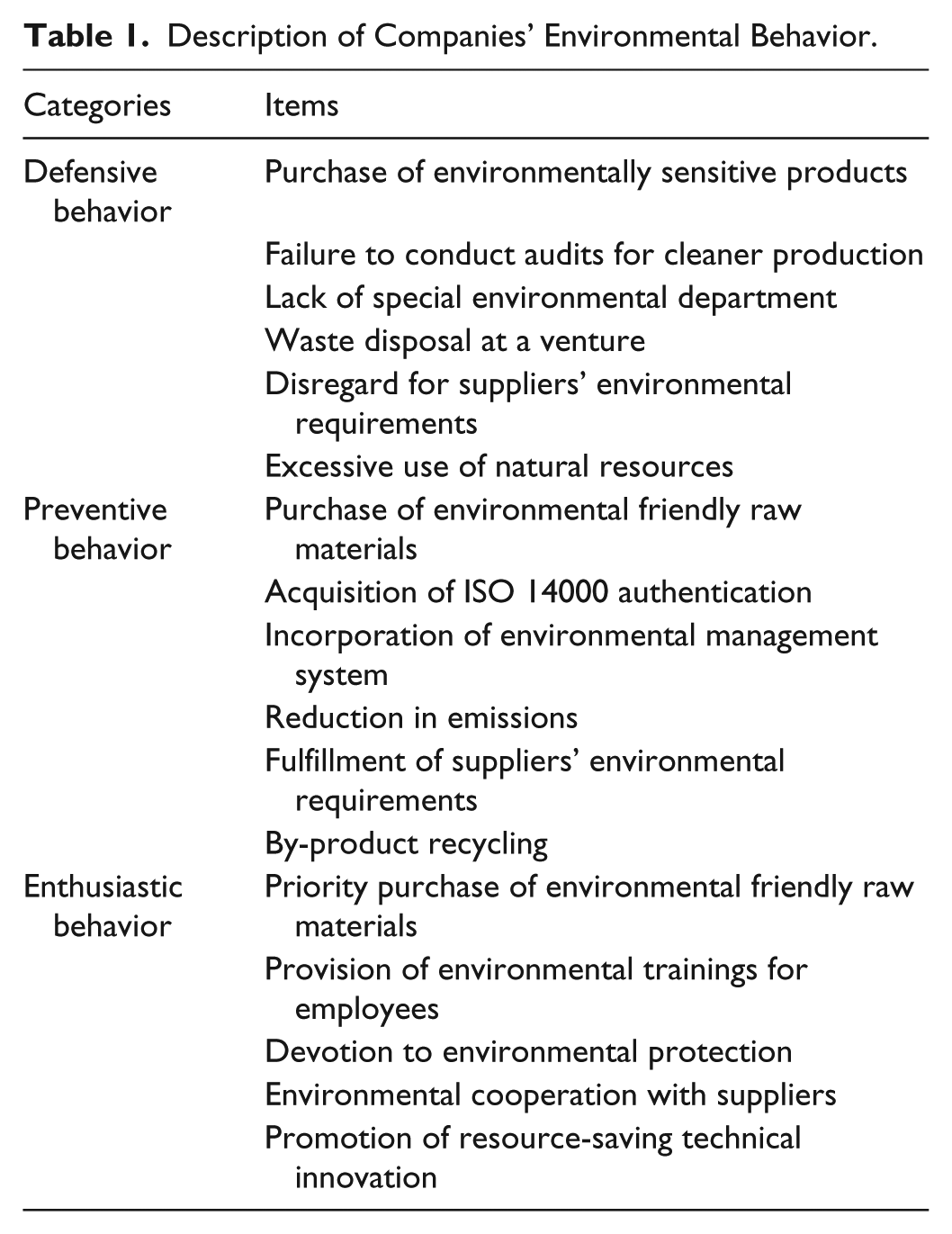
This study constructs companies’ environmental behavior as a multidimensional variable. Y. Liu (2009) specified a domain for environmental behavior and identified three categories of companies’ environmental behavior: defensive, preventive, and enthusiastic behavior (see Table 1). Defensive behavior companies are resistant to adhering to environmental rules. The focus of the decision is on the profit of these companies. In daily operational activities, environmentally sensitive products will be purchased as raw material. There is no effective use of waste from production, and no special environmental management or cleaner production department has been established within the company. Companies with preventive behavior purchase environmentally friendly raw materials and rely on relevant environmental standards to manage their business and recycle waste. Companies with enthusiastic behavior actively engage in environmental behavior. These companies actively rely on environmental standards in the enterprise management system and prioritize the purchase of environmentally friendly raw materials. These organizations also conduct research and development in the areas of energy savings and environmental protection technology.
Description of Companies’ Environmental Behavior.
To identify the critical influencing factors, the computational model simulates the evolution of companies’ environmental behavior and the interactions among the influencing factors. According to the rules established by the NetLogo simulation platform, 1 the variables of a computational model are identified using global, turtle (company), patch, and local variables. A global variable has only one value, and any agent can access it; this variable focuses on the whole simulation program. However, local variables are only used in part of a specific program. Each turtle (agent) variable has its own value and is focused on the individual level. Each patch variable also has its own value and is focused on the simulation environment (Table 2).
Summary of the Main Variables.

Process Overview and Scheduling
The categories of environmental behavior tend to interact with each other and present a different evolution path. Most companies’ environmental behaviors follow the evolution path from defensive and preventive to enthusiastic behavior (Y. Liu & Ye, 2012). In the first stage of defensive behavior, a company is inactive and might even delay or oppose new environmental rules because they directly or indirectly affect its profits. Thus, environmental management is perceived as an avoidable cost (Robert, Gunningham, & Thornton, 2003). However, influencing factors may cause some companies to go bankrupt. According to data obtained from the Ministry of Environmental Protection of China (MEPC), between 2010 and 2011, approximately 1,000 firms in China were shut down by local governments because of heavy metal pollution.
However, some companies survive and progress to the preventive behavior stage. For example, the factors, such as the financial abilities, have caused some firms in China’s Jiangsu Province to alter their defensive behaviors to preventive ones, and subsequently, these firms reported increased profits (H. Li, 2011). Here, companies integrate environmental management into their businesses. However, greater constraints posed by influencing factors may only render certain companies successful in changing their preventive behaviors to enthusiastic ones. In the enthusiastic behavior stage, companies develop environmentally friendly products. This stage is achieved when the firm’s behavior has the characteristics of being proactive and innovative, for example, Baosteel company which ranked 359 in the 2011 Green Rankings for the top 500 companies worldwide. However, prior to 2005, Baosteel did not use environmental equipment to recycle wastewater; thus, its environmental behavior was considered as preventive and even defensive. Guan, Huang, Liu, Liu, and Chen (2005) stated that profit (p) is significant in China; that is, a company’s environmental behavior is contingent on its profits. In other words, companies would survive if their profits were greater than x1 or x2 and their environmental behaviors would evolve accordingly.
The literature review provided in section “Literature Review” highlights multiple factors influencing the evolution of companies’ environmental behavior. Both external and internal factors have significant effects on and play different roles in the process (Y. Liu, 2009). Some factors have a greater impact than others and thus are deemed as critical influencing factors. It is imperative that policymakers pay more attention to these critical factors and progressively implement them to improve management efficiency. The conceptual model and theoretical framework adopted in this study identify the relationships among different factors (Figure 1).

Conceptual model of companies’ environmental behavior and its influencing factors.
Design Concepts
Emergence of the system
Emergence is the description of the entire system phenomenon, and the foundation is the individual characteristics of the system. The presented model is based on different companies. In the process of identifying the interactions among various factors, companies show different behavioral characteristics. Then, different evolutionary paths emerge in the whole system.
Adaptation and fitness of agents
The adaptability of the agents leads to complexity and emergence. Facing various factors’ effects, companies will constantly change their behavior patterns and then adapt to the environment. The companies in the simulation system are defined as profit-maximizing individuals and act according to this rule. Meanwhile, companies also have the ability to adjust their behavior according to changes in the external environment.
Prediction and sensing of agents
All types of agents in the system have the ability to make predictions. These agents make different decisions and actions by predicting the future. For example, companies will predict future environmental rules and market changes, including changes in various factors. Thus, they could adjust their environmental behavior. One of the adjustment rules that companies follow is the trade-off between costs and benefits. Sensing is one of the reasons why companies can achieve these goals. Agents can also perceive changes in the external environment through sensing.
Interaction and collectives
There is an interactive relationship between agents in the system. There are also interactive relationships among the system, environment, and various influencing factors. In the process of continuous interaction and collective movement of various agents of the simulation system, the evolution path and law of the system emerge. For example, there are interactive relationships among companies, governments, markets, and communities. The interactions among these agents promote the evolution of corporate environmental behavior as a whole.
Stochasticity and observation
Stochasticity is one of the important rules of the simulation model. The distribution position of each agent in the system is random. To facilitate observation, the behavior rules of each agent in the system can be expressed by data or graphics. The rules can also be illustrated by a three-dimensional (3D) graphics display. The observer can also adjust the values of each variable by setting up different simulation scenarios. Therefore, the change in agents’ behavior and the evolution law of the whole system can be observed in the dynamic state.
Initialization and Simulation Platform
The initial values are derived from the literature, and the survey data were acquired from the National Bureau of Statistics of China and Shanghai Securities Newspaper. From 2006 to 2009, more than 500 industrial firms in China’s Yangtze River Delta were surveyed using a questionnaire (see the appendix). However, certain variables such as financial ability were not included. Thus, since 2011, means such as emails and web-based data collection were used to ascertain the variables (Table 3). Data were obtained for a total of 167 firms, such as manufacturers of beverages and chemical fibers. The data for the 167 firms were inputted into the platform while maintaining the firm location as a stochastic variable.
Initialization and Input of the Main Variables.

The values for total assets standards were obtained from the National Bureau of Statistics of China.
Shanghai Securities Newspaper (April 23, 2011).
The values for x1 are set according to survey data for 167 firms.
The computational model simulates the relationships among the agents using the NetLogo simulation platform, a multi-agent programming language and modeling environment that can simulate complex phenomena. The platform has been widely used across fields because its parameter values can be easily changed and it provides an updated image of the system over time along with the trends of the key variables. The model’s controls are on the left-hand side, and the graphics window shows that the model’s world is on the right. Figure 2 is a screenshot of a NetLogo user’s interface that is visible upon opening and running a model.

Computational model: NetLogo simulation platform.
Computational Experiments Design
This section presents three computational experiments that simulate the interactions between companies’ environmental behavior and its influencing factors. To compare the various levels of influence, Δ(Pr/De) and Δ(En/Pr) are defined as follows:


where De, Pr, and En are the number of companies with defensive, preventive, and enthusiastic behaviors, respectively. (Pr/De) si is the ratio of companies with preventive behavior to those with defensive behavior in three cases (i = 0, 1, 2). (En/Pr) si is the ratio of companies with enthusiastic behavior to those with preventive behavior in three cases (i = 0, 1, 2). The importance of factors in companies’ environmental behaviors can be identified on the basis of changes in Δ(Pr/De) and Δ(En/Pr) in the three cases. Table 4 presents the initial variables and parameters for the three cases (S0-S2).
Parameters for Three Computational Experiments.

Results and Discussion
Financial Ability and the Evolution of Companies’ Environmental Behavior
According to the simulation results, Pr/De and En/Pr change with an increase in companies’ financial ability. Compared with the 46.41% change in Δ(Pr/De), the change in Δ(En/Pr) is more dramatic (50.62%). Thus, financial ability plays a more important role in the evolution from preventive to enthusiastic behavior than from defensive to preventive behavior. These results are partly supported by Russo and Fouts (1997) and Wagner’s (2015) empirical finding that environmental performance is positively linked with economic performance (Figure 3). For most firms, exerting greater effort to engage in environmental practices increases their costs and negatively affects firm profit. For example, firms engaged in activities damaging the environment could incur costs and thus suffer reduced revenues. A lack of sufficient financial ability would further impair their profitability and cash flows, hindering their survival and evolution to preventive behavior.

Results of three computational experiments for financial ability.
Managers’ Environmental Awareness and the Evolution of Companies’ Environmental Behavior
The results also show that an increase in managers’ environmental awareness causes changes in Pr/De and En/Pr. Δ(En/Pr) has a change rate of 42.74%, which is significantly higher than the 14.21% change in Δ(Pr/De). Thus, managers’ environmental awareness plays a more important role in the evolution from preventive to enthusiastic behavior than that in the evolution from defensive to preventive behavior. Weaver, Trevino, and Cochran (1999) and F. Wang, Cheng, Keung, and Reisner (2015) partly echo this finding, stating that top management commitments can encourage ethical practices in organizations (Figure 4). Liang and Reiner (2009) and Koropp, Kellermanns, Grichnik, and Stanley (2014), for example, have shown that a manager’s behavioral characteristics could affect decision-making; particularly, the decision-making power is concentrated. The majority of pollution-related costs can be avoided if a manager has high environmental awareness and an inclination to account for environmental management by, for example, setting up an EMS (environment management system). Meanwhile, firms undertake certain preliminary measures to improve their EMS, and thus, their environmental behavior has evolved to preventive behavior. When basic compliance with governmental rule is not a concern for companies, managers’ environmental awareness can be key in the evolution to enthusiastic behavior.

Results of three computational experiments for managers’ environmental awareness.
Governmental Financial Subsidies and the Evolution of Companies’ Environmental Behavior
The simulation results in Figure 5 indicate that governmental financial subsidies have a slight effect on the evolution of companies’ environmental behaviors. An increase in the availability of an annual financial subsidy marginally changes the rate of Pr/De to 0.37% and that of En/Pr to 0.33%. This result suggests that pollution abatement subsidies continue to be inefficient instruments in China.

Results of three computational experiments for the availability of annual financial subsidies.
Market Share and the Evolution of Companies’ Environmental Behavior
Figure 6 also shows that market share has a slight effect on the evolution of companies’ environmental behavior. An increase in the availability of annual market share causes a slight change in the rate of Pr/De to 0.32% and that of En/Pr to 0.37%. In other words, the market response to a green product is affected by public awareness and commitment as well as the overall economic state. Currently, the rate of green consumption in China is growing. It is possible that Chinese consumers are conscious of environmental protection but lack strong purchasing behaviors motivated by green consumption (Liao & Li, 2010). Therefore, competing priorities may inhibit their commitment to engaging in better environmental behaviors (Figure 6).

Results of three computational experiments for the availability of annual market share.
Governmental Regulation and the Evolution of Companies’ Environmental Behavior
Figure 7 indicates that an increase in the level of governmental regulation changes the rates of Pr/De and En/Pr. Compared with the change in Δ(Pr/De) of 6.62%, that in Δ(En/Pr) is more obvious at 16.87%. The level of regulation plays a more important role in the evolution from preventive to enthusiastic behavior than the evolution from defensive to preventive behavior. China’s regulatory systems have not yet been overshadowed by pressures from market competition and embedded social networks; thus, stricter regulatory and fee systems can be successful to a certain extent (Figure 7).

Results of three computational experiments for the regulation level.
In general, firms that engage in preventive behavior do not oppose new environmental rules; instead, they attempt to integrate environmental management into their business (X. L. Wang, 2003). This requires significant investments, and firms with sound financial ability would take advantage of the business opportunity to explore new environmentally friendly products. In addition, such firms more actively participate in activities related to environmental protection and, as a result, progress to the enthusiastic behavior stage.
Community and the Evolution of Companies’ Environmental Behavior
Figure 8 indicates that increased community support changes the rates of Pr/De and En/Pr. However, compared with the 9.01% change in Δ(Pr/De), that in Δ(En/Pr) is more obvious (20.69%). Thus, community support is more critical in the evolution from preventive to enthusiastic behavior than the evolution from defensive to preventive behavior (Figure 8).

Results of three computational experiments for community support.
Given the detrimental effects of environmental pollution, firms with defensive environmental behaviors often have a conflict of interest with the community, and such issues are more likely to cause a mass incident than other social problems (Brown, 2007). As a result, polluting firms that engage in defensive environmental behavior are often penalized or shut down (M. J. Zhang, 2009). However, according to Van Rooij (2010), resident dependency on firms decreases activism, and communities are less likely to against the firms upon which they depend. Thus, in the absence of a local community, firms with defensive behavior are unlikely to survive, let alone progress to the preventive behavior stage. Communities often use “informal regulations” to enforce pollution abatement. Growing environmental awareness in communities has significantly improved green product market (Coulson, 2007). A firm’s environmental image is an important criterion in certain consumers’ preferences. A firm known to pollute the local environment might face a hostile community generating “informal penalties” for poor environmental behavior. Therefore, firms with preventive behavior gain more community support than those with defensive behavior. Moreover, continuous community support would cause a firm to more actively engage in environmental behavior, which would eventually evolve to enthusiastic behavior.
In sum, various influencing factors play different roles in the evolution of companies’ environmental behavior. These critical factors have been identified through the simulation results, and the simulation provides the average values of the different factors’ Δ(Pr/De) and Δ(En/Pr) (Figure 9). The most important factor in the evolution from defensive to preventive behavior is community support (18.27), followed by managers’ environmental awareness (12.04) and financial ability (6.36). However, in the evolution from preventive to enthusiastic behavior, financial ability is the most important factor (97.03), followed by managers’ environmental awareness (56.95) and community support (29.7) (Figure 9).

Critical factors influencing companies’ environmental behavior.
Conclusions and Policy Suggestions
Conclusion
This study conducted three computational experiments to simulate the interactions among influencing factors and empirically showed that various factors play different roles in the evolution of companies’ environmental behavior. In the evolution process from defensive to preventive behavior, community support is the most important, followed by managers’ environmental awareness and financial ability. However, in the evolution process from preventive to enthusiastic behavior, financial ability is the most crucial factor, followed by managers’ environmental awareness and community support. In other words, the critical influencing factors are dynamic, and their importance differs according to the company’s current stage. The findings of this study should help policymakers better focus on the key factors and accordingly encourage companies to progress to different stages. For example, the requirements imposed by China’s urban government in Zixing City differ according to each company’s stage of environmental behavior. 2 A roadmap that can be used to improve environmental performance has emerged, providing a strong framework for policymaking. For example, the Ministry of Environmental Protection of the People’s Republic of China has issued standards for environmental behavior evaluation, 3 and many local governments have established related standards for the different stages of companies’ environmental behavior and its influencing factors.
Policy Suggestions
The existing measures in China used to promote companies’ environmental behavior mainly focus on government rules such as tax abatement, fines, and subsidies. However, pollution abatement subsidies are inefficient instruments and are often criticized because they are provided by the government. To elaborate, taxpayers eventually offset the costs that should be borne by the polluter. Furthermore, the government subsidies in China cause companies to be less efficient and negatively affect the financial ability of firms (R. R. Liu, 2013). Thus, this step alters the organizational structure and business practices needed to support the development of a company’s financial ability. This research also shows that a manager’s environmental awareness is important in the evolution of environmental behavior. Here, higher educational institutions play an important role in the transition (Sterling, 2004). Most managers graduate from higher education institutions with an MBA or EMBA. The content that the managers learn while attending university courses could affect their behavior, a finding partly supported by Moore (2005). In fact, Lewis, Walls, and Dowell (2014) showed that CEOs with an MBA degree are more likely to disclose environmental information than those with a law degree. In addition to environmental awareness education (e.g., MBA and EMBA), providing internal training programs and developing a first-hand understanding of pollution exposure are necessary. Finally, this study showed that community support is important. Therefore, providing communities with information about companies’ environmental behavior could improve companies’ environment behavior.
Despite the contributions of this study, it is not free from limitations. This research does not include all factors influencing companies’ environmental behavior. Therefore, it restricts the number of variables that can be included in the model and the actual data available. Furthermore, in reality, agents are more intelligent, and their action rules could be more complex. Future research will focus on including more factors in the simulation models. Meanwhile, in terms of the design of each agent, future research will enhance the behavioral dimension of the agents and make them closer to reality. Nevertheless, the findings of this explorative study provide a starting point for further detailed research.
Footnotes
Appendix
Description of the Questionnaire Factors, Facets, and Items.

| Facets | High scorers show corporations . . . |
|---|---|
| International reputation risks | Feel the pressure of losing international reputation is high |
| International routine | Feel the pressure of binding international routines is high |
| Public voice | Feel the pressure of the public voice is high |
| Public image | Feel the pressure of losing public reputation is high |
| Legal risks | Feel the pressure of forceful legal clause is high |
| Routine inspection | Feel the pressure of routine inspection is high |
| Penalties applied by regulators | Feel the pressure of penalties applied by regulators is high |
| Market share | Feel the pressure of losing market share is high |
| New product exploitation | Feel the pressure of new product exploitation is high |
| Financial risks | Feel the pressure of fines and compensation is high |
| Drastic competition | Feel the pressure of drastic competition is high |
| Consumer demand | Feel the pressure of consumer demand is high |
| Factors | |
| Community and NGOs | |
| Market | |
| Governmental regulation | |
| Facets | High scorers perceive corporations as . . . |
| Purchase environmental sensitive products | Defensive behavior in terms of fulfilling EM |
| No clean production audit | Defensive behavior in terms of fulfilling EM |
| No special environmental department | Defensive behavior in terms of fulfilling EM |
| Waste disposal at a venture | Defensive behavior in terms of fulfilling EM |
| Ignore environmental requirements of suppliers | Defensive behavior in terms of fulfilling EM |
| Excessive use of natural resources | Defensive behavior in terms of fulfilling EM |
| Purchase environmentally friendly raw materials | Preventive behavior in terms of fulfilling EM |
| Achieved ISO 14000 authentication | Preventive behavior in terms of fulfilling EM |
| Established environmental management system | Preventive behavior in terms of fulfilling EM |
| Reduce emissions | Preventive behavior in terms of fulfilling EM |
| Meet environmental requirements of its suppliers | Preventive behavior in terms of fulfilling EM |
| Recycle its by-products | Preventive behavior in terms of fulfilling EM |
| Prioritize the purchase environmentally friendly raw materials | Enthusiastic behavior in terms of fulfilling EM |
| Provide environmental training to employees | Enthusiastic behavior in terms of fulfilling EM |
| Devoted to environmental protection | Enthusiastic behavior in terms of fulfilling EM |
| Environmental cooperation with its suppliers | Enthusiastic behavior in terms of fulfilling EM |
| Conduct resource-saving technical innovation | Enthusiastic behavior o in terms of fulfilling EM |
| Factors | |
| Defensive behavior | |
| Preventive behavior | |
| Enthusiastic behavior | |
Note. We used the questionnaire designed by the first author in 2009. For more information, please refer to Y. Liu (2009) and Y. Liu and Ye (2012). NGO = nongovernmental organization; EM = environmental management.
Data Availability
The surveyed firms’ environmental behavior data used to support the findings of this study are restricted by the privacy protection of the firms. However, data are available from the authors for researchers who meet the criteria for access to confidential data.
Declaration of Conflicting Interests
The author(s) declared no potential conflicts of interest with respect to the research, authorship, and/or publication of this article.
Funding
The author(s) disclosed receipt of the following financial support for the research, authorship, and/or publication of this article: This work is supported by the National Natural Science Foundation of China (grant nos 71501140 and 71834004), State Key Research and Development Plan of Ministry of Science and Technology (2018YFC0213600), and Fundamental Research Funds for the Central Universities (YJ201855).