




Abstract
The study explored whether the 25-item Motivations Underlying English Language Learning (MUELL) Scale designed in this study is a reliable and valid psychological measure and relates significantly to achievement. To achieve the objectives, the MUELL was administered to 493 female learners who studied English as a foreign language (EFL) in three branches of a semiprivate language institute in Mashhad, Iran. When the data were subjected to principal axis factoring (PAF) and the extracted latent variables (LVs) were rotated via Varimax with Kaiser Normalization, three factors appeared, that is, Intrinsic, Extrinsic, and Communicative. Reliability and correlational analyses showed that the MUELL and its underlying factors are highly reliable and show significant relationships with each other. Although Intrinsic and Extrinsic LVs correlate highly with the Communicative than with each other, none of them show any significant relationship with the total English achievement for three groups of achievers. However, the written achievement scores of high and low achievers correlate significantly not only with the MUELL but also with Extrinsic and Intrinsic LVs, respectively, in opposite directions. The results are discussed and suggestions are made for future research.
Introduction
Although Dornyei (1999) referred to motivation as “one of the most elusive concepts in applied linguistics and indeed in educational psychology in general” (p. 525 as cited in Mandopoulou-Sergi, 2004), Gardner (1985) considered it as “the combination of effort plus desire to achieve the goal of learning the language plus favorable attitudes towards learning the language” (p. 10 as cited in Benson, 1991). This article argues that the elusive nature of motivation stems from the language whose learning is explored in relation to motivation as well as the indicators through which it is assessed as reflected in its theoretical and empirical backgrounds.
Theoretical Background
The majority of scholars do distinguish English as a second language (ESL) from English as a foreign language (EFL); however, they use the terms “ESL” and “EFL” interchangeably (e.g., Brown, 2007; Yule, 2006). Stern (1983) even opposed the distinction and regarded EFL merely as a variant of ESL. He argued that “it is no more absurd to say that for an immigrant into an English speaking-country English is a ‘foreign language’ as it is to say that English is a ‘second language’” (p. 17).
The argument made by Stern (1983) has led scholars to approach motivation within an ESL context and then generalize its underlying LVs to the EFL learning. Brown (2000), for example, believed that three orientations underlie the ESL, that is, instrumental, integrative, and assimilative. While goals such as furthering a career and translating texts are used instrumentally by ESL learners, becoming a part of the second culture is adopted as an integrative goal. Assimilative orientation, however, requires replacing the native culture with that of second, in Taft’s (1964) terms, “conforming strictly to particular groups norms of behavior to be absorbed into that community” (p. 129). Such conformity is virtually impossible within an EFL context as revealed by studies conducted within such a context.
Empirical Background
Benson (1991), for example, used a survey study to collect the answers of 311 EFL learners in Japan and designed a questionnaire consisting of a set of 12 possible reasons showing why they studied English. The set was adapted from Cooper and Fishman (1977). By analyzing the participants’ responses and without running any factor analysis, Benson divided the reasons into three categories, instrumental, integrative, and personal. He announced that “surprisingly, integrative and personal reasons for learning English were preferred over instrumental ones” (p. 34), implying that the motivations underlying the EFL learning are different from those of ESL.
Similarly, Mori and Gobel (2006) developed a motivation questionnaire consisting of 30 items and administered it to 453 second-year university students in Kyoto, Japan. The items were divided into nine hypothesized general motivational components, that is, expectancy, past experience, attainment value, intrinsic value, extrinsic utility value, cost, attitudes toward cultures and people of English-speaking communities, grade related, and effort. When they applied Principal Component Analysis (PCA) to their data, rotated them via Varimax with Kaiser Normalization (VKN) and used eigenvalues of one and higher along with the scree test, they extracted four factors called Integrativeness, Intrinsic value, Amotivation, and Attainment value.
As the first component extracted by Mori and Gobel (2006), Integrativeness comprises 10 indicators among which, “I would like to make British friends” has the highest loading (.81); however, the researchers use the indicators with lower loading such as “I am studying English because I would like to live abroad in the future” (.56) and “I would like to use the English I studied when I travel overseas” (.54) to name their first latent variable (LV) as Integrativeness. In other words, making friends via the English language is the main reason for Japanese students, and there is no single item showing these students’ willingness to identify themselves with English speakers.
Due to the different number of hypothesized general motivational components and the type of LVs extracted in various studies via different methods of factor analysis, this study was designed to find out what LVs underlie the reasons expressed by the EFL learners themselves within the foreign language context of Mashhad, Iran. Among the three methods of LV extraction, that is, maximum likelihood (ML), PAF, and PCA, the PAF was used in this study to comply with Khodadady and Golparvar’s (2011) findings about the validation of the 21-item Religious Orientation Scale (ROS) developed by Allport and Ross (1967) and Feagin (1964).
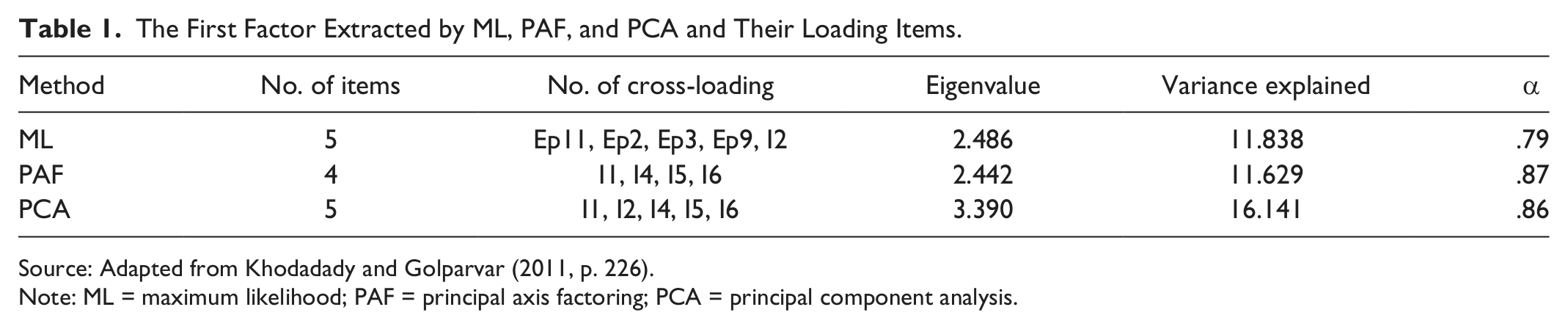
To validate the Persian ROS within an Islamic context, Khodadady and Golparvar (2011) administered it to 329 undergraduate university students majoring in agriculture, English language and literature, theology, and architecture at Ferdowsi University of Mashhad. When they applied the ML, PAF, and PCA to their data, they extracted four LVs. The constituting items of LV1 are shown in Table 1. As can be seen, the three methods differ in terms of the type and number of items that load acceptably, that is, .30 and higher, on the first LV. Whereas the items comprising LV1 extracted by the ML are logically heterogeneous, that is, extrinsic (E) and intrinsic (I), those of the PAF and PCA are homogeneous in being intrinsic. (The letters “p” and “s” in the items specified as “Ep” and “Es” stand for “extrinsic personal” and “extrinsic social,” respectively.)
The First Factor Extracted by ML, PAF, and PCA and Their Loading Items.
Source: Adapted from Khodadady and Golparvar (2011, p. 226).
Note: ML = maximum likelihood; PAF = principal axis factoring; PCA = principal component analysis.
Although the PCA extracts the first LV from more homogeneous items than the PAF does, that is, five and four, respectively, the total amount of variance explained by the LVs extracted by the PCA, that is, 54.984, remains the same while that of the PAF decreases, that is, 44.768, “indicating that rotating the loadings does not affect the variances explained by the PCA and thus renders it questionable as a method of factorial analysis” (Khodadady & Golparvar, 2011, p. 227).
In addition to using the PAF to extract and rotate the LVs underlying the MUELL in this study, the LVs were correlated to each other to explore the strength of their relationships. The overall achievement scores obtained by the learners in their EFL classes were also correlated with the LVs to explore whether there was any significant relationship between motivations underlying EFL learning and its achievement.
Method
Participants
In all, 493 female learners registered at Tollab (n = 325, 65.9%), Sanabad (n = 100, 20.3%), and Daneshjoo (n = 68, 13.8%) branches of Khorasan English Language Institute took part in the present study voluntarily. They were placed in 27 levels on the basis of their EFL achievement scores obtained in the previous term. (For new applicants, written placement tests and interviews are held to place them in one of the specified levels.) While 9 did not specify how old they were, the age of the remaining 484 learners ranged from 9 to 50 (M = 19.12, SD = 7.32). These participants had registered at elementary, intermediate, and advanced levels of English at the institute. They all spoke Persian as their mother language.
Instruments
Although three questionnaires were used to collect data, two of them are described in this section to narrow the scope of the article, that is, a bio questionnaire (BQ) and a questionnaire dealing with Motivations Underlying English Language Learning (MUELL). The participants’ EFL achievement scores were also obtained from their teachers. (The third questionnaire deals with Social Capital whose relationship with motivation will be reported in a separate study.)
BQ
Three open-ended questions dealing with the participants’ name, age, and gender were raised in the BQ. A number of other questions related to the parents’ and siblings’ educational level and familiarity with the English language, family income, the number of sisters and brothers as well as changing schools during academic year were also raised. However, due to their irrelevance to the present study, they were not reported. (The relationship of these variables with the third questionnaire will be explored in a separate article.)
MUELL Scale
The MUELL Scale was developed in this study on the basis of reasons brought up by many EFL learners in their English classes at several language institutes in Mashhad, Iran. After eliciting the orally expressed reasons, they were written down, screened, and matched with those brought up by Benson (1991); Detaramani and Chan (1999); Dornyei and Csizer (2002); Margolis (2009); Moiinvaziri (2008); Mori and Gobel (2006); Mori (2004); Noels, Pelletier, & Vallerand (2003); Schneider (2001); and Takahashi (2005). The 5 reasons, that is, 6, 7, 8, 16, and 22, were different from the 20 found in the literature, and therefore, those 5 reasons were added to the pool to construct the 25-item MUELL used in this study.
The reasons comprising the MUELL were then translated into Persian by using schema theory that entails providing the best Persian equivalents for the words/schemata constituting the reasons brought up in the MUELL. The equivalents are chosen on the basis of the syntactic, semantic, and discoursal relationships the English schemata enter with each other (Khodadady, 2008; Seif & Khodadady, 2003). The Persian MUELL was used to ensure that the participants who were learning the EFL at elementary level had no problem in understanding its content.
The participants were required to read the items comprising the Persian MUELL one by one and indicate whether they completely disagreed, disagreed, disagreed somewhat, had no idea, agreed somewhat, agreed, or completely agreed with them. The values of 1 to 7 were assigned to these choices, respectively. However, after collecting the data and running factor analysis, the three choices of completely disagree, disagree, and disagree somewhat were combined to form a single choice called disagree. The same was done to agree somewhat, agree, and completely agree to establish agree as another single choice. These two choices along with the third, that is, no idea, were used to describe the functioning of items in a more straightforward manner (see Table 2).
Descriptive Statistics of Items Comprising the MUELL.

Note: MUELL = Motivations Underlying English Language Learning; A = agree; NI = no idea; D = disagree.
EFL Achievement Scores
The EFL teachers of Khorasan English Language Institute have to assess their learners’ speaking ability on the basis of their participation in class activities and discussions and report a single oral score for each individual learner. They are also required to hold quizzes and midterm and final examinations and report their average as a single written score. These two scores are added up and averaged to get the total score upon which administrative decisions are made. The oral, written, and total scores of participants at the level at which they had registered at the time of research were obtained from the institute to explore the relationship between motivation and EFL achievement.
Procedures
Upon designing and translating the items comprising the MUELL questionnaire into Persian, it was printed and submitted to the authorities of Khorasan English Language Institute. Upon securing their approval to administer it in their three branches, the registrar’s office was consulted to have adequate number of copies prepared. As an instructor of the institute, the second researcher of this study attended and administered the MUELL in coordination with the administrative staff and EFL instructors. The data were collected under standard conditions in spring 2012. To explore the relationship between MUELL and EFL achievement, the participants were divided into three groups on the basis of their achievement z scores. Those falling above +1, between +.99 and −.99, and below −1 were assigned to high, middle, and low achievers, respectively.
Data Analysis
The descriptive statistics of the indicators comprising the MUELL was first calculated to specify their functioning. For specifying the LVs underlying the MUELL, the PAF was used, and the LVs extracted were rotated via VKN. Following Tabachnick and Fidell (2001), the magnitude of .32 was adopted as the minimum acceptable loading of an item because it shares 10% of variance with the other items loading on a given factor. If an indicator loaded acceptably on two or more LVs, its highest loading on a single LV was considered as its main contribution to that particular LV, and it was removed from the list of indicators contributing to other LVs. The eigenvalues of 1 and higher as well as the highest loadings on a single LV were adopted as the only criterion to determine the number of LVs underlying the MUELL. The reliability of the MUELL and its underlying LVs were estimated through Cronbach’s alpha. The LVs were then correlated not only with each other but also with the English achievement scores reported in participants’ academic records. The descriptive, factorial, and inferential statistical analyses were all conducted via IBM SPSS Statistics 20 to address the following three research questions.
Research Question 1: How many LVs underlie the MUELL?
Research Question 2: How strongly do the LVs correlate with each other?
Research Question 3: Do MUELL and its underlying LVs correlate significantly with the EFL achievement?
Results
Before analyzing the LVs extracted, the Kaiser–Meyer–Olkin (KMO) statistics was checked for sample adequacy. Because the obtained statistics is in 90s, that is, .94, it indicates the data collected in this study marvelously use a common-factor model (Kaiser, 1970, 1974). The significant Bartlett’s Test of Sphericity, that is, χ2 = 6863.905, df = 300, p < .001, showed that the sample intercorrelation matrix did not come from a population in which it is an identity matrix.
Table 2 presents the descriptive statistics of the items comprising the MUELL. As can be seen, the skewness indices range from −3.079 (Item 8) to 1.617 (Item 20). Although positive and negative skewness indices indicate that a given distribution is not normal, they provide indispensible information related to the attributes investigated. For example, Arditti (1967) and Scott and Horvath (1980) showed that investors prefer positive skewness in return distributions. Boyer, Mitton, and Vorkink (2008), however, found that “expected skewness helps explain the phenomenon that stocks with high idiosyncratic volatility have low expected returns.”
In this study, high negative skewness indices have been obtained because the majority of participants agreed with certain activities (see Table 1). Ninety-three percent of participants, for example, agreed (A%) that speaking English gives them a very good feeling (Item 8). Similarly, the same percentage agreed that when they overcome the problems involved in learning English, it encourages them to learn more (Item 6). These results indicate that the normality of distribution is of little use in validating psychological measures such as the MUELL.
Table 3 presents the 25 items constituting the MUELL and their loadings as well as cross-loadings on three rotated factors extracted in this study. As can be seen, Items 1, 2, and 3 have loaded on two LVs, whereas Item 18 has loaded on three. The highest loadings of these items on a single factor were treated as their main contributions to that factor, and their cross-loadings on other items were considered noncontributory. These results thus answer Research Question 1 and show that three LVs underlie the scale.
Loading and Cross-Loading of Items on Three LVs.

Note: LV = latent variables.
Loading less than .32
Table 4 presents the descriptive statistics of MUELL and its three underlying LVs. As can be seen, it is a highly reliable measure of motivation, that is, α = .92, as is its LV1, that is, α = .91. Although LV3 consists of only two items, it is almost as reliable as the LV2 consisting of seven items, that is, α = .80 and .82, respectively. The three LVs explain 51% of the variance in the MUELL.
Descriptive Statistics of MUELL and Its Three Underlying LVs (n = 493).

Note: LV = latent variable; MUELL = Motivations Underlying English Language Learning.
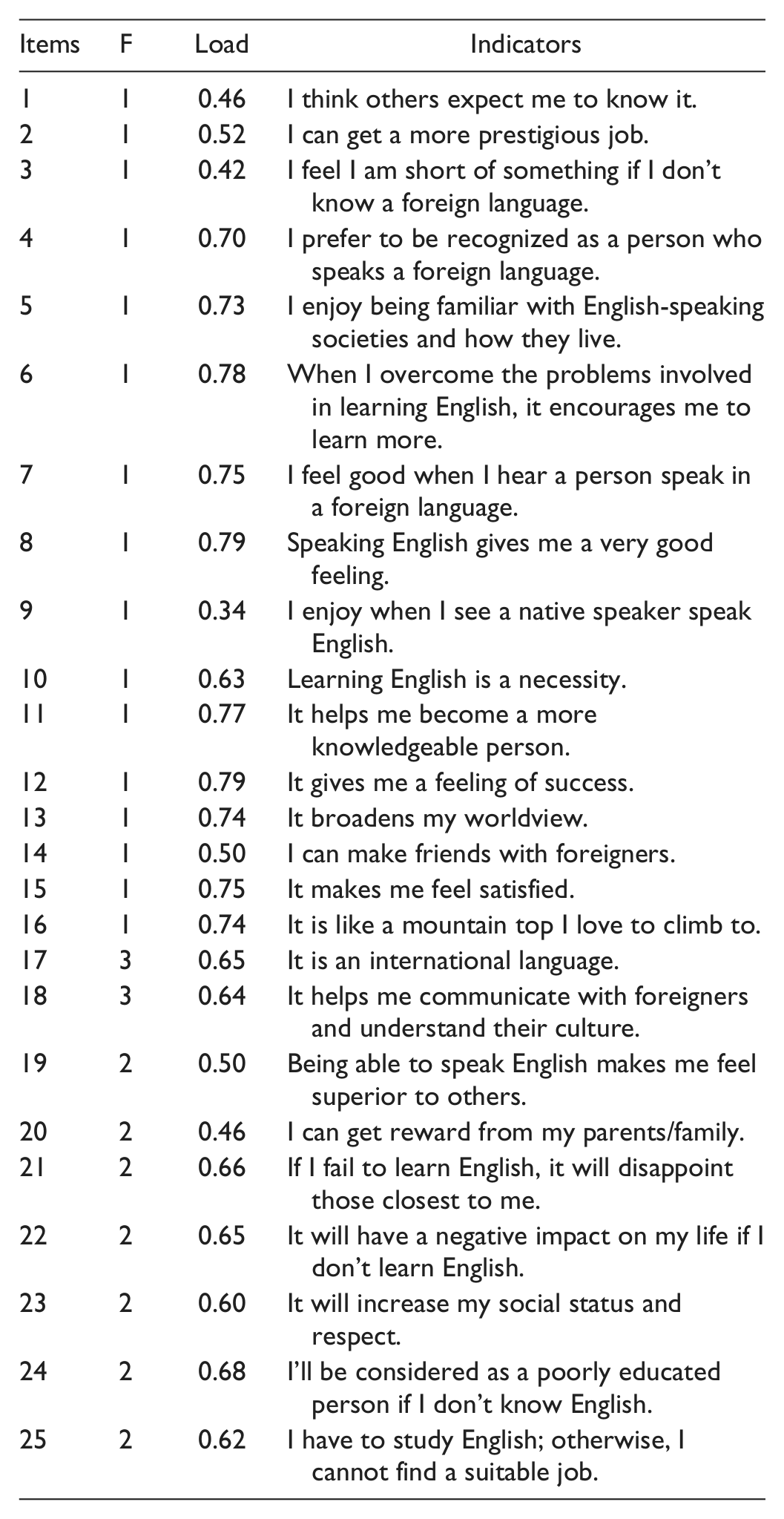
Sixteen items, that is, Items 1 to 16, load acceptably on LV1 called Intrinsic in this study. (All the items comprising the MUELL, the LVs upon which they load acceptably, and the magnitude of their loadings are given in the appendix.) The learners who are intrinsically motivated experience a good feeling not only when they speak English themselves and are recognized as an English speaker but also when they hear native speakers as well as others speak it. When they learn English, they feel successful and satisfied, get encouraged and become knowledgeable, and consider themselves broadminded. However, not knowing English makes them feel they lack something. Enjoying familiarity with English-speaking societies and viewing learning English as a necessity are also indicators of Intrinsic motivation.
Seven items, that is, Items 17, 18, 20, 21, 22, 23, 24, and 25, load acceptably on LV2 called Extrinsic in this study. Extrinsically oriented EFL learners think that they will be considered as a poorly educated person if they don’t know English and they will disappoint those closest to them if they fail to learn English. They also think that not learning English will have a negative impact on their life in that they cannot find a suitable job. However, mastering English will not only increase their social status but also get them reward from their parents/family. Furthermore, being able to speak English makes the learners feel superior to others.
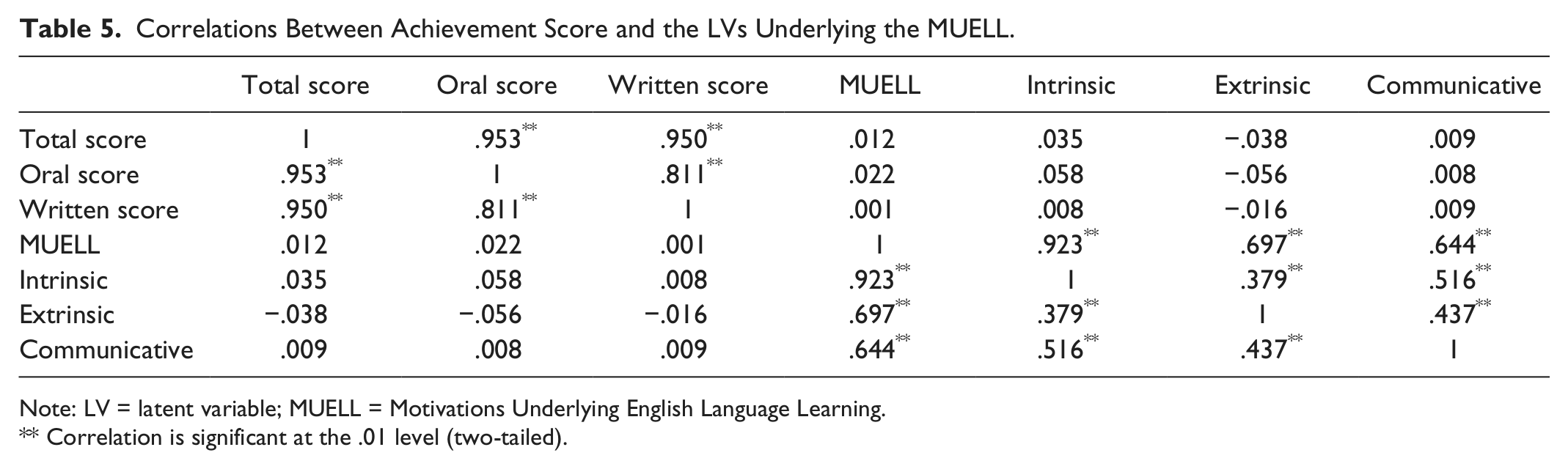
Two items, that is, Items 17 and 18, load acceptably on LV3 called Communicative in this study. The EFL learners in Khorasan English Language Institute learn EFL because it is an international language, and it helps them communicate with foreigners and understand their culture. As can be seen in Table 5, the communicative motivation correlates significantly with Intrinsic and Extrinsic motivations, that is, rs = .56 and .46, p < .01, respectively, explaining 31% and 21% of variance in the two. In fact, the significant relationship between the Communicative and Intrinsic motivations, that is, r = .56, p < .01, is stronger than that of the Intrinsic and Extrinsic ones, that is, r = .43, p < .01, indicating that Communicative motivation deals more with personal aspirations than with social concerns.
Correlations Between Achievement Score and the LVs Underlying the MUELL.
Note: LV = latent variable; MUELL = Motivations Underlying English Language Learning.
Correlation is significant at the .01 level (two-tailed).
The most unexpected finding of this study is the lack of a significant relationship between EFL achievement and the MUELL. Neither was any significant correlation found between achievement and Intrinsic, Extrinsic, and Communicative motivations as shown in Table 4. To explore the relationship further, the participants were divided into high (n = 54), middle (n = 336), and low (n = 67) achievers on the basis of their total achievement z scores as shown in Table 6. (The score of 36 participants were not reported to the registrars’ office when the research was conducted.) One-way ANOVA analysis as well as Scheffe Multiple Comparisons showed that the scores of the three groups were significantly different from each other (F = 377.635, df = 2, p < .001).
Descriptive Statistics of Scores Obtained by Three Ability Groups.
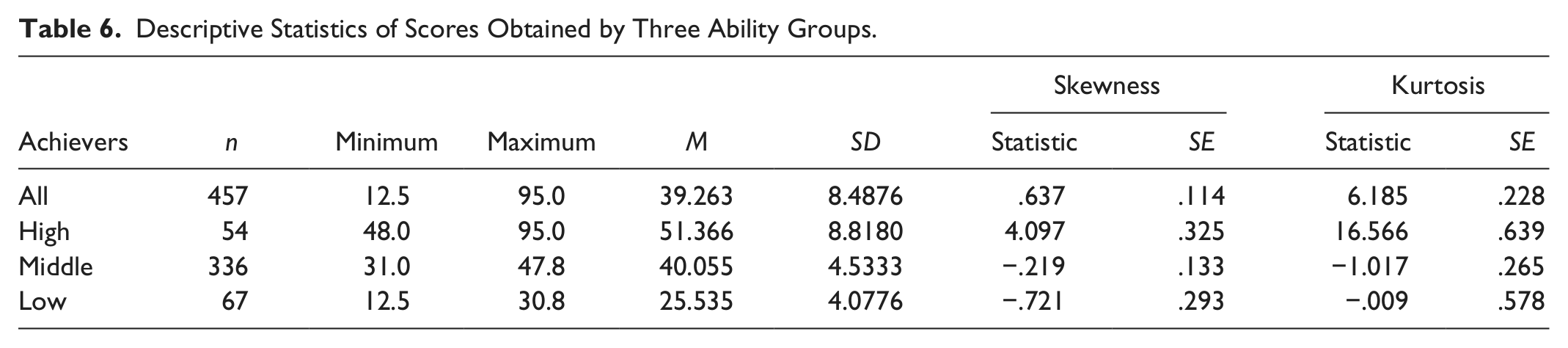
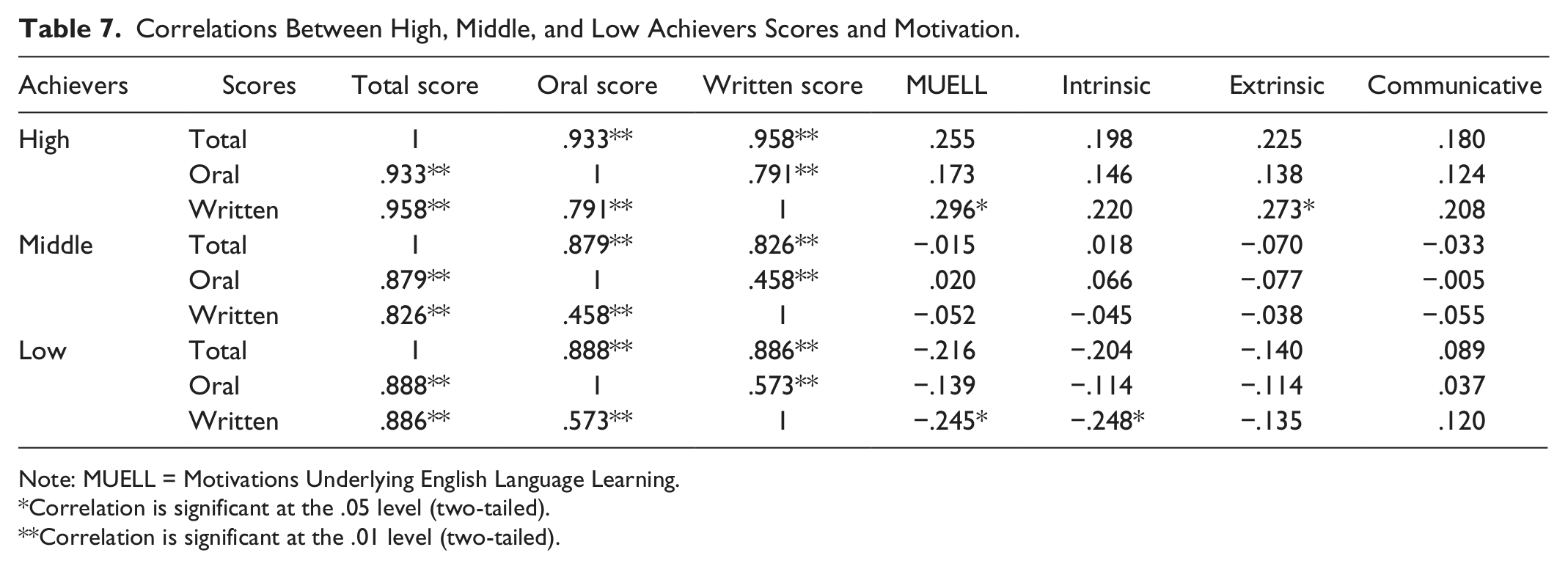
Table 7 presents the correlation coefficient obtained between the three groups of achievers and MUELL as well as its three underlying factors. As can be seen, high and low achievers’ written scores correlate significantly with the MUELL, that is, rs = .30 and −.25, p < .05, though in opposite directions. These results provide a partial answer to Research Question 3 and show that as the EFL learners achieve more in their written English, their motivation increases in general. They also indicate that low achievers become less motivated as they achieve less in their written English.
Correlations Between High, Middle, and Low Achievers Scores and Motivation.
Note: MUELL = Motivations Underlying English Language Learning.
Correlation is significant at the .05 level (two-tailed).
Correlation is significant at the .01 level (two-tailed).
Although the written achievement of high and low achievers show significant relationships with motivation in general, it reveals a different pattern of the underlying LVs. Written achievement correlates positively and significantly with Extrinsic motivation, that is, rs = .30 and .27, p < .05, for the former, whereas it relates negatively to Intrinsic motivation, that is, rs = .30 and −.25, p < .05, for the latter. These results indicate that because high achievers are extrinsically motivated, they strive for high achievement in written EFL. However, the less the low achievers learn written EFL, the less motivated they become intrinsically.
Discussion
Unfortunately, there is little research available to compare the results of the present study with, although, as cited in Noels et al. (2003), some scholars have found a negative correlation between Integrative motivation and language proficiency (e.g., Gardner & Lambert, 1972; Lukmani, 1972; Oller, Hudson, & Liu, 1977). This might be attributed to the lack of interest in motivation and EFL achievement within an EFL context.
Chihara and Oller’s (1978) findings are, however, compatible with those of the present. They adapted and translated an attitude questionnaire into Japanese and administered it along with a cloze test used by Oller et al. (1977) to 123 “Japanese adults enrolled in basic, intermediate, and advanced EFL classes at the Osaka YMCA in Japan” (p. 57). They found no significant correlation between integrative motivation and EFL proficiency as measured by the cloze test. Similarly, their Instrumental motivation “scarcely correlated with EFL proficiency (.04, p > .05)” (p. 66). A replication of the present study is, therefore, needed to find out whether administering a language proficiency test along with the MUELL will reveal similar patterns of relationships.
The findings of the present study show that as a psychological construct, motivation consists of three dimensions within an EFL context, that is, Intrinsic, Extrinsic, and Communicative. They provide empirical support for Dornyei’s (2010) argument that in such a context, the traditional approach toward understanding motivation in terms of integrative orientation does “not make sense” (p. 75). Even replacing the integrative motivation with an Intrinsic one does not help EFL learners either because they resort to Extrinsic rather than Intrinsic dimension to become high achievers in their written EFL.
Conclusion
The development and validation of MUELL Scale with learners of EFL in Mashhad, Iran, shows that Intrinsic, Extrinsic, and Communicative LVs underlie the scale. Not only the scale itself but also its LVs are highly reliable and relate to each other strongly. They do not, however, correlate with the oral, written, and total achievement score of female EFL learners. The lack of any significant relationship between the MUELL as well as its LVs with the achievement holds equally true for middle achievers who represent more EFL learners than high and low achievers do. Future research is required to find out whether male EFL learners’ achievement in general and middle achievement in particular relates to motivation and its underlying LVs.
Although middle achievers of EFL do not use their Intrinsic, Extrinsic, and Communicative motivations to learn English, they do use their cognitive styles to gain proficiency. Khodadady, Fatemi, and Etminan (2012), for example, administered Group Embedded Figures Test (GEFT) and S tests as measures of cognitive styles and language proficiency, respectively, to 253 undergraduate and graduate students of English and established a significant relationship between the two for middle proficiency learners. Future research must show whether middle language proficiency relates significantly to any type of motivation.
In contrast to middle achievers, high achievers do use their External motivation to learn written English. Low achievers, however, lose their Intrinsic motivation when they achieve a little in written EFL. In contrast to Intrinsic and Extrinsic motivations, Communicative motivation does not relate to oral high, middle, and low achievement in EFL and thus calls for further research. However, it remains to be seen whether explicit teaching of spoken EFL will bring about significant correlations between oral achievement and Intrinsic, Extrinsic, and Communicative motivations. The replication of this study with male EFL learners may also shed more light on the relationship between achievement and motivation.
Footnotes
Appendix
Factors Upon Which the 25 Indicators of MUELL Load Acceptably.
| Items | F | Load | Indicators |
|---|---|---|---|
| 1 | 1 | 0.46 | I think others expect me to know it. |
| 2 | 1 | 0.52 | I can get a more prestigious job. |
| 3 | 1 | 0.42 | I feel I am short of something if I don’t know a foreign language. |
| 4 | 1 | 0.70 | I prefer to be recognized as a person who speaks a foreign language. |
| 5 | 1 | 0.73 | I enjoy being familiar with English-speaking societies and how they live. |
| 6 | 1 | 0.78 | When I overcome the problems involved in learning English, it encourages me to learn more. |
| 7 | 1 | 0.75 | I feel good when I hear a person speak in a foreign language. |
| 8 | 1 | 0.79 | Speaking English gives me a very good feeling. |
| 9 | 1 | 0.34 | I enjoy when I see a native speaker speak English. |
| 10 | 1 | 0.63 | Learning English is a necessity. |
| 11 | 1 | 0.77 | It helps me become a more knowledgeable person. |
| 12 | 1 | 0.79 | It gives me a feeling of success. |
| 13 | 1 | 0.74 | It broadens my worldview. |
| 14 | 1 | 0.50 | I can make friends with foreigners. |
| 15 | 1 | 0.75 | It makes me feel satisfied. |
| 16 | 1 | 0.74 | It is like a mountain top I love to climb to. |
| 17 | 3 | 0.65 | It is an international language. |
| 18 | 3 | 0.64 | It helps me communicate with foreigners and understand their culture. |
| 19 | 2 | 0.50 | Being able to speak English makes me feel superior to others. |
| 20 | 2 | 0.46 | I can get reward from my parents/family. |
| 21 | 2 | 0.66 | If I fail to learn English, it will disappoint those closest to me. |
| 22 | 2 | 0.65 | It will have a negative impact on my life if I don’t learn English. |
| 23 | 2 | 0.60 | It will increase my social status and respect. |
| 24 | 2 | 0.68 | I’ll be considered as a poorly educated person if I don’t know English. |
| 25 | 2 | 0.62 | I have to study English; otherwise, I cannot find a suitable job. |
Declaration of Conflicting Interests
The authors declared no potential conflicts of interest with respect to the research, authorship, and/or publication of this article.
Funding
The authors received no financial support for the research and/or authorship of this article.
Author Biographies