




Abstract
This phenomenological study investigates the cultural meaning of femininity to immigrant Latina women and its significance in the consideration of decisions related to maintaining breast health. Theories of culture and health promotion support the concern for women’s need for access to health care in relation to breast health and the cultural barriers that interface between the connections of femininity, body image, and mental health. For Hispanic women, breast cancer is the most commonly diagnosed cancer generating distress for the individual, partner, and family. The importance of best practices in health promotion and risk reduction strategies in the early screening of women is emphasized in the literature. However, the voice of immigrant Latina women in describing their perspective of femininity and breast health and how it may affect choice and decision making related to breast self-care practices has not been studied. Five themes emerged from the data analysis conducted with Giorgi’s phenomenological method leading to an unfolded description of femininity: power of feminine identity through motherhood, hardiness is sustainability to overcoming adversity, connection to self and others, satisfaction meeting cultural gender-role expectations, and contemplative prevention to maintain breast integrity. The findings of this study will contribute to the increasing body of evidence-based practice related to understanding the impact of culture related to breast health. While the concept of femininity can be challenged not only by a diagnosis of breast cancer but also by other diseases and life conditions, understanding the cultural meaning of femininity to Latina women is pivotal to health care professionals as they partner with Latina women and community support groups to develop empowerment strategies and programs that promote choice and decision making involving breast health.
Introduction
The concept of femininity can be challenged not only by a diagnosis of breast cancer but also by other diseases and life occurrences. However, for Hispanic women, breast cancer is the most commonly diagnosed cancer. In comparison with non-Hispanic women, Hispanic women are 20% more likely to die of breast cancer, are less likely to have breast cancer diagnosed at the earliest stage, and are more likely to be diagnosed with larger tumors. These outcomes may be due to under or no utilization of mammography screening, delayed follow-up of abnormal screening results, health care disparities, and cultural factors (Abraido-Lanza, Chao, & Gammon, 2004; American Cancer Society [ACS], 2009). Simon (2006) emphasized the importance of incorporating culture into early detection strategies for underserved women to foster better patient outcomes in terms of early detection and reduction of risk.
Women diagnosed with breast cancer may experience distress that affects all their relational ties among family, work, and community (Waldrop, O’Connor, & Trabold, 2011). Evaluation of the best treatment decision requires a clear sense of self related to gender, femininity, and personal power, irrespective of external influence (Borrayo, 2004; Martinez, 2006; Ruiz, 2005). The resources for a woman diagnosed with breast cancer may not be identifiable, available, or accessible, especially to an immigrant Latina woman when language, legal, medical, and cultural barriers may be too difficult to overcome (Ashing-Giwa, Padilla, Bohorquez, Tejero, & Garcia, 2006). In their ethnographic study, Hunt and deVoogd (2005) found that clinicians did not understand the Latina culture’s role in decision making and that their cultural stereotyping (e.g., that the Latino culture is religious, fatalistic, family-centered, male-dominated, superstitious, and favoring folk beliefs) can negatively affect the quality and delivery of clinical care.
Cultural values and beliefs shape behavior. The cultural value of the Latina’s gender-role and expression of femininity is embedded in “gender-specific scripts” called Marianismo and Hembrismo (Acquino, Machado, & Rodriguez, 2002; Ruiz, 2005). Marianismo—derived from the Catholic belief in the Virgin Mary—ascribes superior morality and spirituality to the Latina woman, who is considered able to endure suffering more than men. Her traditional femininity is portrayed as submissive, religious, modest, and humble, and a woman who will sacrifice for her children. Hembrismo, a less common gender-role in the Latina culture and often in conflict with the Marianismo script, represents the strong, resilient, and confident Latina woman.
Marianismo and Hembrismo are intricately connected to Latina spirituality and theology (Gonzalez, 1989). Latina women have historically lived through sociopolitical injustices and poverty and have maintained their ties to family and community through religious communion and experiencing the sacredness of everyday life through prayer to Mary and the Saints and belief in Jesus (Marianismo) and in response to marginalization, exploitation, have addressed issues of injustice through empowerment and leadership (Hembrismo).
Through the Catholic Social Teaching Tradition, Latinas form their identities through the worldview of interdependence and caring for family, the community, and religious traditions and practices (Pope-Davis & Coleman, 2001). Justice is the central theme within Latina spirituality, enacted in everyday life by striving for better social, work, and health conditions for the family and community (Gonzalez, 1989).
Feminine identity in today’s Latina immigrant woman is divided between mothers struggling to integrate the family’s traditional values into their daughters’ expectations of emerging womanhood and their daughters’ negotiating the complex communications in culture to establish their voice and personal power (Denner & Dunbar, 2004). Examining multiple ethnicities of adolescent girls encountering adolescence, Kaplan and Cole (2003) found that low-income Latina girls, like other adolescents, experienced challenges with social pressure, separation from family, and valuing a senses of feminine identity. They had low and self-concept and high rates of depression.
Pecor (2004) examined the impact of body image importance and gender-role identity in the psychosocial adjustment of ethnically diverse woman diagnosed with breast cancer and found more significant differences across age rather than ethnicity. Younger woman attributed more importance to body image but had lower body image satisfaction and poorer psychosocial adjustment than older woman.
Thus, not surprisingly, cultural implications and prescribed roles for Latina women are strong influencing variables on how they perceive themselves in relation to their spouse/significant other and other family members (Hunt & deVoogd, 2005; Ruiz, 2005; Simon, 2006). Yet, although various studies have focused Latina women’s need for culturally competent access to health care and the conflicting changes in traditional and modern femininities in relation to breast health, a gap exists in the literature presenting the voices of Latina women’s lived experience of femininity and how it may affect one’s identity and decision making in face of breast cancer.
Background
The coalition used in this study is a community organization that provides supportive assistance to immigrant Latina women facing a breast cancer diagnosis. In addition, a major goal of the organization is to offer breast cancer prevention and risk reduction strategies through culturally sensitive community education. Their charter stipulates their vision of being a breast cancer information resource that will serve and strengthen the community by responding to their needs and working together to address them. The mission of this organization represents Latina Hembrismo, caring for women in the community through leadership and activism (Rodriguez, 2002) reaching out to other groups such as the researcher’s academic community to explore strategies to ensure social justice and empowerment for women at risk for breast cancer.
The researchers were invited by the coalition to attend the monthly support group meetings of Latina women who were living with breast cancer. These meetings were co-led by a member of the coalition and a trusted Latina woman from the community who herself was a breast cancer survivor. The researchers were initially asked to participate in the group process to provide health care knowledge and symptom management support to these women all of whom were diagnosed with breast cancer. As the researchers gained acceptance and trust by the group members, they were asked to assist the coalition in developing a culturally sensitive health promotion program related to breast health.
A preliminary meeting was held with the organizations board of directors to explore the potential of establishing an academic/community partnership to facilitate a research and service-learning project with the members of the Latina Support Group. The board members outlined three needs of the Latina community specific to maintaining optimum breast health care: (a) education in maintaining and sustaining well-being pre and postbreast cancer diagnosis, (b) empowerment strategies to enhance self-esteem, and (c) identifying cultural beliefs related to their collective sense of femininity and choice as they navigated multiple roles and cultural role expectations.
To gain a better understanding of Latina immigrant women’s perceptions of breast health in relation to gender-roles, cultural identity, and body image, the authors asked Latina women who were not diagnosed with breast cancer how they defined femininity. It was hoped that the findings to this qualitative research question would provide the knowledge to guide the researchers in developing a culturally sensitive series of health promotion interventions to educate and raise the awareness for breast health in this specific Latina community.
Research Design
A phenomenological approach was used for this exploratory descriptive study. Phenomenology is a holistic approach to studying the human experience as lived (Giorgi, 1985). Its underlying philosophy is that only the individual can describe the richness and depth of meaning of his or her own experience (De Castro, 2003). Phenomenology attempts to study the human experience as it is lived. It is not just a research method but is also a philosophy and a process of becoming. It is holistic by nature, expressing the richness and depth of the lived experience. The subjective descriptions of the lived phenomena constitute the data, which the researcher interprets at various levels of abstraction (Giorgi, 1985).
Giorgi Modification of the Phenomenological Method
Armedeo Giorgi (1985) supported the idea of psychology as a human science that involves a phenomenological research approach based on descriptions of lived experiences. The process proposed by Giorgi and further clarified by Parse (2001) involves seven steps. These steps are dwelling with the data, returning to the data for description elaboration, identifying natural meaning units, identifying themes, identifying focal meanings, synthesizing situated structural descriptions, and synthesizing a general structural description.
In data analysis, the researcher dwells with each original description, reading through the entire description of the situation to grasp a sense of the whole. The researcher identifies areas of the description that need further clarification and returns to the subject for an elaborated description of the data (Giorgi, 1985). In phenomenological methodology, there are three major processes of analysis: intuiting, analyzing, and describing (Parse, 2001). Intuiting is the process of becoming familiar with the subject’s description of the phenomenon. The process requires concentration, total immersion, and absorption in the data and by the data. “Each description is read continuously to reflect and weigh the essences of the phenomenon as they appear” (Parse, 2001, p. 19). The researcher must be open to the phenomenon as it reveals itself through the description of the lived experience by the participants. Analyzing is “the rigorous intentional tracing of the elements and structure of the phenomenon revealed through intuiting” (Parse, 2001, p. 20). Analyzing includes viewing the phenomenon holistically (Spiegelberg, 1976, in Parse, 2001). Describing is concerned with the major characteristics of the phenomenon. The process ends with “an elaboration of the meaning of the elements and structure of the lived experience” (Parse, 2001, p. 20). A phenomenological approach was used for this exploratory, descriptive study.
The phenomenological method is inductive, descriptive research aimed at experiencing the phenomenon fully. This philosophical approach does not seek to validate a preselected theoretical perspective but rather seeks to describe the phenomenon under study with no preconceptions (Omery in Giorgi, 1985). The subjective descriptions of the lived experience of the phenomenon constitute the data. The researcher strives to understand the meaning of the experience from the participant’s perspective. “The goal of phenomenology is to describe the total structure of the lived experience, including the meanings that these experiences had for the individuals who participated in them” (Omery in Giorgi, 1985, p. 50). The descriptions of the data are interpreted by the researcher at various levels of abstraction. Qualitative research takes into account the researcher’s frame of reference, descriptions of the phenomenon by the participants, and propositions that are derived through analysis that generate and enhance theories (Parse, 2001).
Recruitment
The investigators presented the proposed study to the aforementioned Latina women’s support group and asked them to refer Latina women (sisters, cousins, and friends living in the community) who were between the ages of 18 and 40, married or living with a significant other, and with no diagnosis of breast cancer. The researchers’ contact information was distributed. Potential participants referred by this support group were invited to a recruitment meeting during which the study was described and what was expected of the participants. All written materials related to the project were presented in English and Spanish. The translations were validated by an individual fluent in both languages to ensure that the context of the communications was valid. Three study participants were recruited from this group. The recruitment protocol was further modified with Institutional Review Board (IRB) approval to include referrals from all individuals involved with the support center. Nine additional women joined the study for a total of 12 study participants. The study participants were not known to the researchers. Written informed consent presented in English and Spanish ensured the right to confidentiality and the right to withdraw from the study. No participants withdrew from the study. There were no known risks or harm to the participants. The researchers were available during and after the study to answer questions and to provide emotional support and referral to health care providers.
Data Collection
The participants were provided with written instructions in English and Spanish describing the study data collection protocol that involved having them write in either English or Spanish a written description of an experienced life situation relating to femininity.
The following directions were on the situation recording English Version data tool:
Describe as fully as possible a life experience in which you felt feminine. Try and describe how you felt. Consider where you were, who was around, who was involved in the situation, and how those who were with you responded. Concentrate on your feelings. Please do not stop writing until you feel that you have discussed your experience of feeling feminine.
Data Analysis
The raw data, as written, were analyzed using Giorgi, Knowles, and Smith’s (1979) Phenomenological Analysis Methodology. The data were constantly reviewed throughout the research process by the principal investigators who were skilled in qualitative research and content analysis methodology. Rigorous adherence to the steps involved in the methodology that included constant comparison of the essence of data interpretation was followed.
Findings
Five themes emerged during the data analysis that contributed to the unfolded description of the meaning of femininity to Latina women.
Theme 1: The Power of Feminine Identity Through Motherhood
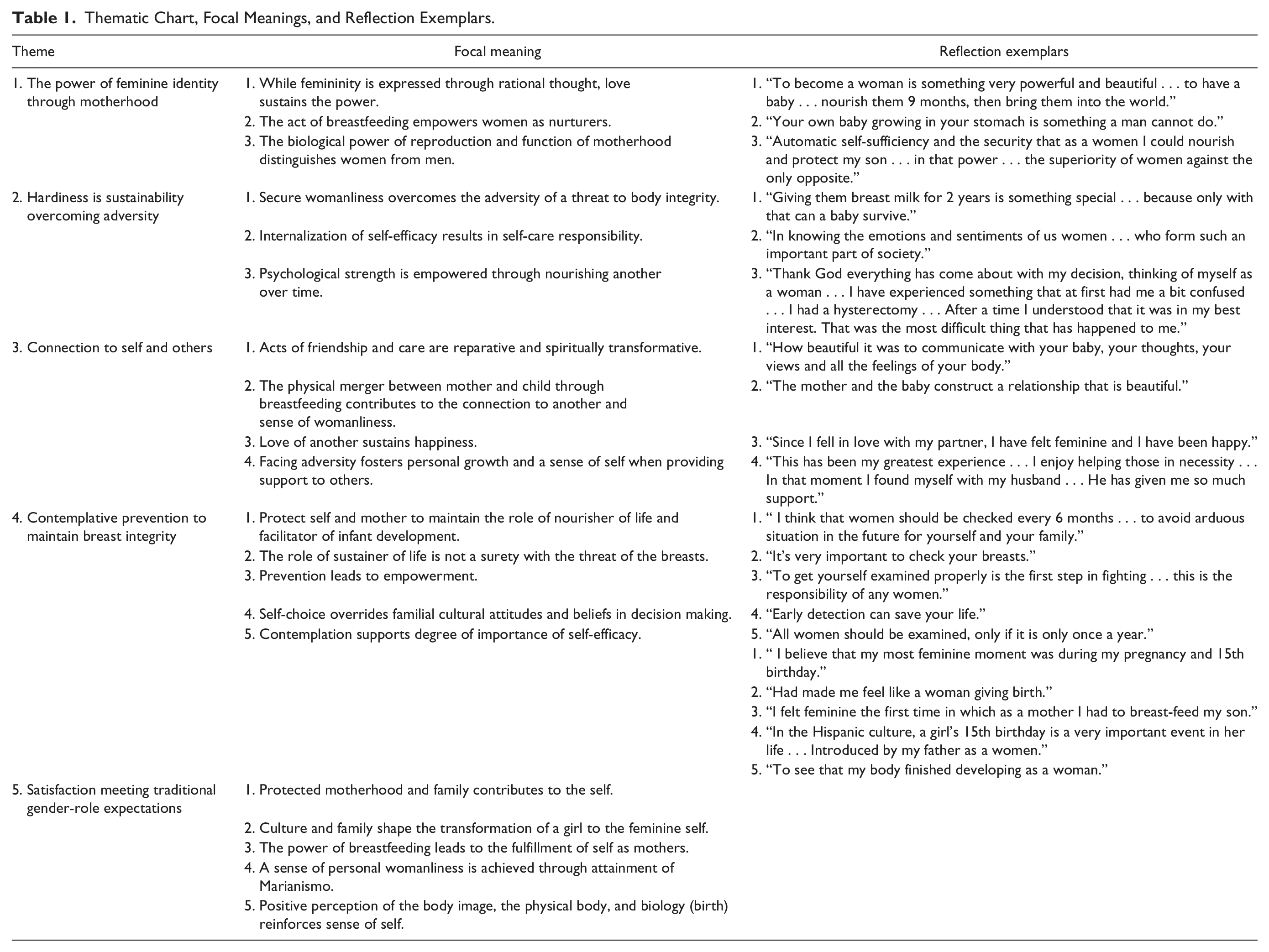
Femininity unfolds in this theme as a cognitive, emotional, and spiritual experience, viewing the psychological impact of one’s femininity and gender-roles on the health and development of the child. Focal meanings that were analyzed from the natural meaning units were identified by the following threads: (a) While femininity is expressed through rational thought, love sustains its power; (b) the act of breastfeeding empowers women and is essential in facilitating the bond between mother and child; and (c) the biological power of reproduction and the separate gender function of motherhood identifies the unique power of a Latina women.
In this theme, femininity demonstrates the interconnection between Marianismo, the loving and nurturing mother who is instilled with Hembrismo and she is also aware of her reproductive power in face of any marginalization that has occurred throughout history.
Theme 2: Hardiness Is Sustainability to Overcoming Adversity
This theme stressed that a woman’s inner strength is fostered by the integration of caring for the self and others, which builds and interweaves an experience of confidence, even in the face of disruption of femininity with the forced transition to menopause. Focal meanings were analyzed from the natural meaning units identified by the following threads: (a) secure womanliness overcomes the adversity of a threat to the body’s physical wholeness, (b) internalization of self-efficacy results in self-care responsibility, and (c) psychological strength is empowered through nourishing another person over time.
The challenge to the Latina women in protecting the Marianismo role of motherhood is the strengthening of Hembrismo when faced with adversity that affects health. Finding the balance and courage to understand that reproductive life transitions can lead to a renewed vision of the self reinforces the natural hardiness of overcoming difficult situations Latinas have faced over time.
Theme 3: Connection to Self and Others
Focal meanings were analyzed from the natural meaning units and identified the following threads that involve care–friendship–love and spirituality. This theme stressed the interpersonal communication involved in the early mirroring and bonding involved in mother/child care. The physical merger between mother and child through breastfeeding contributes to the connection to another and sense of womanliness. Acts of friendship and care are reparative and spiritually transformative to the woman while the love of another sustains happiness.
This theme relates the depth of sacredness found in the Marianismo experience. The intertwining of connection to others in family and friendship is a spiritual practice that bolsters femininity.
Theme 4: Contemplative Prevention to Maintain Breast Integrity
The awareness that breast cancer can lead to a serious and perhaps life-threatening interruption of the maternal role reflects a theme of contemplation, personal responsibility, and proaction. The thread of contemplative prevention emerged from an analysis of the focal meanings that related to self-efficacy, choice, and culture.
Here, we see a progression from Marianismo in the previous theme to the practice of Hembrismo through personal activism.
Theme 5: Satisfaction Meeting Cultural Gender-Role Expectations
The final theme involved the Latina women’s expected cultural roles and behaviors that are formed during their process of emotional, social, and physical development. The thread of satisfaction emerged after an analysis of focal meanings that involved personal fulfillment and satisfaction gained through motherhood, breastfeeding, and the attainment of Marianismo. Hembrismo in relation to cultural gender-role expectations is implicit, as the achievement in caring for the family and community requires the strengths revealed in the earlier themes (Table 1).
Thematic Chart, Focal Meanings, and Reflection Exemplars.

Discussion
What stands out in the unfolded description of how these Latina women viewed the meaning of femininity is the subtle turn from the traditional sociohistorical cultural view of Latina women as sacrificial, passive, and fearful (Marianismo) to a socioecological view of an empowered resilient women (Hembrismo), grounded by a foundation of connection to self and others that is transformative to the individual, collective, behavioral, and community experience (Ashing-Giwa, 2010; Jezzini, Guzman, & Grayshield, 2008).
Acculturation
Laroche, Kim, Hui, and Tomiuk define the acculturation process as “a social process composed of changes in cultural patterns that occur after individuals of different cultures come into continuous firsthand contact with each other” (in Jezzini et al., 2008, p. 3). The authors explain how the impact of a successful acculturation process in the lives of Latina immigrant women can improve the psychological adjustment to life transitions, foster physical health, and enhance self-esteem, along with satisfaction with occupational performance in work and school. The acculturation process may be one factor that strengthened the participants’ meaning of femininity to include enhanced awareness, confidence, and choice.
It is the acculturation process that perhaps raises the awareness that caring for one’s self, examining one’s breasts, and going for screenings as preventive measures are essential for sustaining the healthy roles embedded in Marianismo and Hembrismo, mother, nurturer, and leader of the family. Unlike some women in Latin countries, who fear self-examination because of the taboo of touching one’s breast and thus are at risk for not detecting an incidence of breast cancer, the Latina immigrant participants in this study have stepped beyond the terror of cultural restrictions toward the body to self-empowerment (Torres, 2010).
Spirituality
The essence of everyday life of the Latina woman is bound in the sacredness of her devotion to Mary, the mother of Jesus, her ideal, role model, and mother of wisdom. Through viewing Mary as strong and courageous, the Latina woman is able to live through rituals that support her and her family, and through acculturation and education, Hembrismo is the underlying energy in pursuing social justice and an egalitarian community (Gonzalez, 1989).
Core Elements
The five emerging themes can be organized through four core elements that illuminate the interconnections within the unfolded description of the meaning of femininity: the inner self, the cultural collective, empowered behavior, and community participation as delineated by interior and exterior categories from the quadrant framework of Wilber’s Integral Theory (Esbjorn-Hargas, 2010; Wilber, 1997). Integral theory is a philosophy posited by Ken Wilber that brings together ideas and concepts or paradigms as described by Wilber that can be developed into a model that allows for the examination of a phenomenon under study. The framework to analyze the diverse paradigms is the method of the quadrant (Wilber, 1997).The quadrants are divided into four boxes that indicate a Personal Outside (upper-right quadrant) to describe the exterior world; the upper-left quadrant describes interior experiences; the lower-left quadrant describes the world of the collective, interior experience; and the lower-right quadrant describes the world of collective exterior things such as systems or the natural environment (Table 2; http://www.mindstructures.com/ken-wilber-integral-theory).
Relationship of Themes and Core Elements.

The Inner Self core element is exemplified by three themes: Power of Feminine Identity Through Motherhood, Hardiness Is Sustainability to Overcoming Adversity, and Connection to Self and Others. The study participants described a feminine identity that is rooted in a powerful voice of nurturing motherhood and signified by the importance of the breast (Jezzini et al., 2008). Inner qualities of resilience and hardiness present aspects of the participants’ commitment of being engaged in activities that are related to maintaining one’s health, a sense of control in making decisions about what is best for the self and others, and the ability to face challenges that are stressful (Kobasa, 1979). Caring for the self and others, one’s family and friends, and community is a theme that unites the inner self with the theme of the cultural collective. Satisfaction meeting cultural gender-role expectations through caring for others while maintaining as strong sense of self is highly valued (Gil & Vazquez, 1996).
Exterior Elements of the Meaning of Femininity
The exterior core elements describe behaviors that are performed as a result of inner integration of the first three themes mentioned above. The fourth theme Contemplative Prevention to Maintain Breast Integrity incorporates a sense of empowerment, hardiness, and identifying the importance of breast health with one’s cultural gender-roles through thinking through strategies and decision making for prevention of breast cancer (Prochaska & DiClemente, 1983).
Supporting this theme is the notion that along with successful acculturation, the history and present state of breast cancer advocacy has had a significant impact on Latina women (ACS, 2009). As coalitions are formed to reach out to women in their communities, emphasis on earlier strategies for breast cancer screening should be in place.
Summary
The findings from this study will help guide the coalition in developing strategies to implement their goals. A clearer understanding and portrayal of feminine identity emerged from the data descriptions of the participants. Health promotion interventions must be culturally sensitive and designed with a cultural relational approach that fosters mutual empathy and empowerment among participants in a cooperative setting (Comstock et al., 2008; Jordan & Hartling, 2002; Ruiz, 2005).
This study has laid the foundation for the development of health promotion breast health strategies grounded in the cultural meaning and description of femininity as described by Latina women. The coalition discussed the following strategies that could be implemented as part of an educational program to promote breast health awareness in the Latina community served by the coalition. These strategies may include (a) conducting workshops focusing on breast health, empowerment, and decision making; (b) developing bilingual education materials in English and Spanish; and (c) creating a wellness curriculum with an interdisciplinary service-learning component. The cultural and relational understanding of the Latina women’s heritage and confluence of femininities in psychological, social, spiritual, and gender-role domains are pivotal to a culturally sensitive holistic approach to health care.
Footnotes
Declaration of Conflicting Interests
The author(s) declared no potential conflicts of interest with respect to the research, authorship, and/or publication of this article.
Funding
The author(s) disclosed receipt of the following financial support for the research and/or authorship of this article: Susan Neville received US$500 from The Alpha Phi Chapter, Hunter Bellevue School of Nursing (New York City, NY), Sigma Theta Tau International Honor Society of Nursing.
Author Biographies