




Abstract
The name of the eminent neurohistologist Santiago Ramón y Cajal (1852-1934) was occasionally mentioned in commercial labels by the Spanish industry advertising mineral waters from natural spring sources and their medical benefits. Concomitantly with his landmark neuroanatomical research, Cajal had served as director of the Alfonso XIII National Institute of Hygiene. In that capacity, his name had to be included in certificates as a mere bureaucratic formality. Cajal had an early interest in bacteriology, and introduced a pioneering chemical vaccine against cholera during the 1885 epidemic in Spain. However, in a letter to the Madrid press, he vehemently denied any involvement with actual chemical analyses or commercial promotion of products such as bottled water, medicinal wines, disinfectants, and even toothpaste. In this episode, we realize that Cajal’s view was absolutely contrary to the impression one might have gathered on the basis of the commercial documents alone.
Introduction
The life of the ingenious neurohistologist Santiago Ramón y Cajal (1852-1934), Spain’s restive spirit fittingly hailed as “El gran sabio Español” or great Spanish savant (Caullery, 1934; Ferrari Billoch, 1957; Hasselberg, Pettersson, Mörner, Wirsén, & Santesson, 1908), remains an inexhaustible repository of history bits. As a child, he painted and experimented with explosives (Ramón y Cajal, 1988; Triarhou & del Cerro, 2008a). As an academic physician, besides studying nervous tissue, he pioneered the invention of a cholera vaccine (Ramón y Cajal, 1885a, 1885b), practiced hypnosis for labor analgesia (Stefanidou, Solà, Kouvelas, del Cerro, & Triarhou, 2007), analyzed cross-sections of photographic film under the microscope (Triarhou & del Cerro, 2008b), and conjectured on the psychology of poets (Triarhou & Vivas, 2009).
The present article examines certain claims made by the bottled water industry in commercial documents, implying Cajal’s involvement in the capacity of an analytical chemist. Among other things, Cajal is mentioned as director by the Cabreiroá mineral water company of Verín, Galicia, and as having performed chemical analyses for the Carabaña mineral water company of Madrid.
Cajal had entered the Spanish medical corps after obtaining the doctor’s degree in 1873. Having a strong national character and being in excellent physical shape, he served as a lieutenant physician in the Third Carlist War, and subsequently as a captain in the Cuban War. His stay in Cuba was marked by hardship and disease. The decline of Spain’s colonial policy, a war fought in a hostile climate, and corruption among military officers led Cajal to be stationed in a theater of operations with a rigid logistical system of “trails,” which would end up in military failure and a loss of the colony. Disappointed and seriously ill from malaria, Cajal returned to Spain on a sick leave. Shortly thereafter, thanks to Dr. Genaro Casas, he became a university lecturer, ending his military career (Moreno-Martínez & Martín-Araguz, 2002).
During his military service in Cuba, Cajal nearly died of dysentery. Later, during his Valencia years and his tenure as anatomy chairman there, he witnessed the 1885 cholera outbreak. Owing to his knowledge of microbiology (Ramón y Cajal, 1905; Ramón y Cajal Junquera, 2000), he managed to protect his family by boiling the water (Ramón y Cajal, 1988).
The Claims
Jaraba de Aragón
One of the earliest links of Ramón y Cajal’s name with mineral waters dates to 1895 in the balneario (spa) of Serón in Jaraba (41°11′36.24″ N, 1°53′0.96″ W, altitude 763 m), 135 km from Zaragoza (Giménez Herrero, 1994; San Martín Bacaicoa & Valero Castejón, 2004).
Cajal is mentioned as having frequented Jaraba and other resorts in Aragón. In a dedication, dated August 16, 1895, he appears as having written that, after spending a few days in the spa establishment of Serón, he had the opportunity to observe “significant relief and surprising revolutionary cures in diseases such as lithiasis and its common complications of the urinary tract, in gout, in chronic rheumatism, in diabetes mellitus, and in uterine catarrhoea.” The beneficial effects at the popular summer resort and sanatorium were attributed to the action exerted by the chemical constituents of mineral water on nutrition and secretions (de Gregorio y Guajardo, 1895; Giménez Herrero, 1994; San Martín Bacaicoa & Valero Castejón, 2004).
Cabreiroá de Verín
Verín (41°56′27″ N, 7°26′9″ W) is a town in Galicia (Province of Orense), located 15 km north of the Portuguese city of Chaves, at an altitude of 373 m. The denominated wine region of Monterrey is located in the surrounding area. Three mineral water bottling plants are based in Verín: Cabreiroá, Fontenova, and Sousas.
The Cabreiroá mineral water company was established and began commercial bottling at the source in 1906 (the year that Cajal and Camillo Golgi were awarded the Nobel Prize in Physiology or Medicine). Xosé García Barbón (1831-1909), a Verín native and benefactor, officially started the works after returning from a long and successful stay in Cuba, where he had founded his own bank, as well as the Galician Center of La Habana. Besides founding the Hotel Spa of Cabreiroá, Barbón built in Vigo the theater that bears his name (Teatro García Barbón, also housing the Centro Cultural Caixanova) and the School of Arts and Crafts (Escola Municipal de Artes e Oficios).
The health properties of the Cabreiroá spring water were praised internationally. In 1907, Cajal’s post as “director” was printed on labels (Baeza Rodríguez-Caro et al., 2003; Murillo, 1913). Cabreiroá mineral water was imported in Argentina by the Echegaray brothers (Figure 1).

Left: Ramón y Cajal featured in an export advertisement for the Galician bottled water company of Cabreiroá, which he directed (from an Argentinian magazine [ca. 1908]; authors’ archive). Upper right: Statue of Ramón y Cajal dedicated in 2006 on the occasion of the company’s centennial (Pablos, 2009). Lower right: A label from the Cabreiroá water company, with the name of its director, Santiago Ramón y Cajal, appearing at the lower right corner, encircled (Baeza Rodríguez-Caro et al., 2003).
The Cabreiroá company has engaged in the bottling and marketing of its mineral water for over a century. It was advertised that Ramón y Cajal had certified the excellent status of this water and its mineral-medicinal properties. The resort in the vicinity of the spring was in operation through the 1950s (Grupo 2T C.A., 2010).
Ramón y Cajal is reported to have been an ardent supporter of the therapeutic properties of mineral waters (de la Rosa & Mosso, 2004). In September 1909, Cajal spent a few days in Cabreiroá and apparently told a Galician newspaper, “Thanks to the virtues of the Cabreiroá spring I have regained my health that was seriously compromised by the debilitating effects of a chronic intestinal catarrhoea and by the threat of hepatic colic” (Rodríguez Miguez, 1995, p. 107). The words of the man who embodied the national glory would be used to promote the brand.
The company is still in operation (www.magmadecabreiroa.es). The spring is located 100 m under the ground. An octagonal temple stands at the fountain’s head. The incandescent magma trapped beneath the Earth’s crust releases gas mixing at the spring with the water, which rises naturally at 16°C. It was clinically prescribed for gastroenteropathies, according to the Calpe manual of medical sciences (Doz, Manzaneque, Llord y Gamboa, Rodríguez Pinilla, & Camaleño, 1922) published under Cajal’s editorial direction (Figure 2).
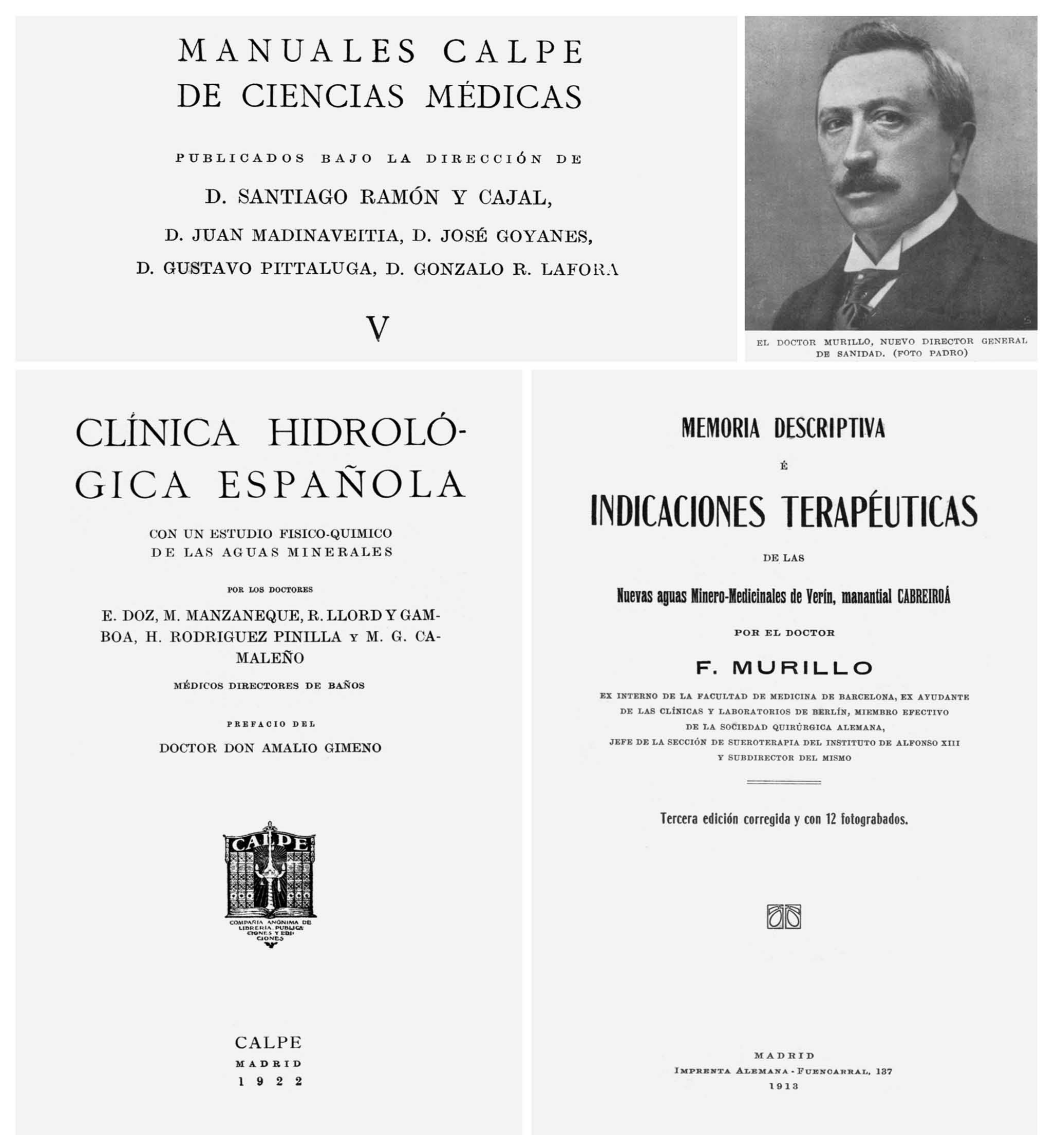
Upper left: Editorial committee of Calpe’s manuals of medical sciences, headed by Cajal. Upper right: Doctor Murillo, new director general of hygiene (photo by Padro, appearing in Revista Blanco y Negro [Madrid], issue of December 30, 1923, p. 2). Lower left: Monograph titled “Spanish Hydrological Clinic” in the Calpe medical science series (Doz, Manzaneque, Llord y Gamboa, Rodríguez Pinilla, & Camaleño, 1922). Lower right: Murillo’s monograph on the Cabreiroá Spring (Murillo, 1913).
In the celebrations that marked the centennial of Aguas de Cabreiroá, S.A., homage was paid to Ramón y Cajal and his “analyses” from the early 1900s. A bronze statue, sculpted by the Galician artist Manuel García Vázquez de Buciños, was erected to honor the Nobel Laureate (Editorial, 2006; Gabinete de Comunicación da Xunta de Galicia, 2006). The base bears an identification. On it, Cajal appears as a gentleman (“caballero”) with his frock-coat (“levitón”), walking and holding in his right hand a bottle, whose contents he apparently intends to analyze. The mastery of the sculptor details a face that denotes intelligence and passion, deep intense eyes, and a chin carefully covered by the trimmed thin beard and moustache beneath the protruding nose (Pablos, 2009).
An Argentinian magazine advertisement [ca. 1908] (Figure 1, left) had claimed, The greatest bacteriologist of the world, Doctor S. Ramón y Cajal, who won the Nobel
Prize by competing with the most eminent scholars of all nations, has affirmed with
the unequivocal authority of his signature that the Cabreiroá natural mineral water is
bacteriologically pure and of excellent hygienic conditions. The best table water for
habitual consumption. Pure, crystalline, fresh, light, of great taste, very
absorbable, lightly effervescent. Grand prizes obtained abroad by scientifically
proven merits: Paris, May 1908; Genoa, July 1908; Brussels, October 1908. Cabreiroá
water is absolutely natural, without chemical manipulations nor artificial
additives. The salubrious action of Cabreiroá water is perfectly explained by its absolute
bacteriological purity and by its remarkable chemical composition. The mineral salts
it contains are dosed by nature in a very harmonious and balanced form, such that
each, in producing the rightful action, enhances the effect of the others. Thus, the
extraordinary proportion of carbonic acid, further makes it eminently digestive,
favoring the absorption of alkaline salts, which in turn operate on the blood,
removing all of its impurities; the bicarbonates operate on the stomach and the
digestive tract, while the lithium oxide exerts its action on the liver and the
kidneys. Information brochures available. Exclusive dealer for South America: Echegaray
Brothers and Co., 1002-1026 Victoria Street [Buenos Aires]. Turn off the faucet.
Cholera threatens us, typhoid fever lurks. We must guard against all proper infectious
diseases of the season that are acquired through contaminated water from wells,
cisterns, etc. mainly in the field. Drink only Cabreiroá water.
The label (Figure 1, lower right) mentions, among other things, “Minero-medicinal water of Verín . . . Pleasant and digestive . . . Naturally carbonated . . . Hygienic analysis . . . The Director, Santiago Ramón y Cajal. Owners and distributors: Jacinto and Francisco Fernandez Álvarez, Verín, Orense.” It was advertised as “indispensable for diseases of the stomach, intestine, liver, kidney and diabetes. Ideal table water.”
Another figure, mentioned to have praised Cabreiroá was José Casares Gil (1866-1961), the president of the Royal Academy of Pharmacy between January 1940 and June 1958 (Rodríguez Miguez, 2006).
Declared a public utility by Royal Order on December 15, 1906, Cabreiroá achieved reputation for its exceptional qualities, top-ranking not only in Spain but also among famous mineral waters abroad (Figure 3). Its annual exports exceeded 600,000 bottles in 1908; competing against similar national and renowned foreign brands, such as Vichy and Royal of France, and Ems and Fachingen of Germany, Cabreiroá was awarded the Grand Prix with special distinction by the Jury of the joint 1908 Spanish–French Exposition of Zaragoza (Editorial, 1908).
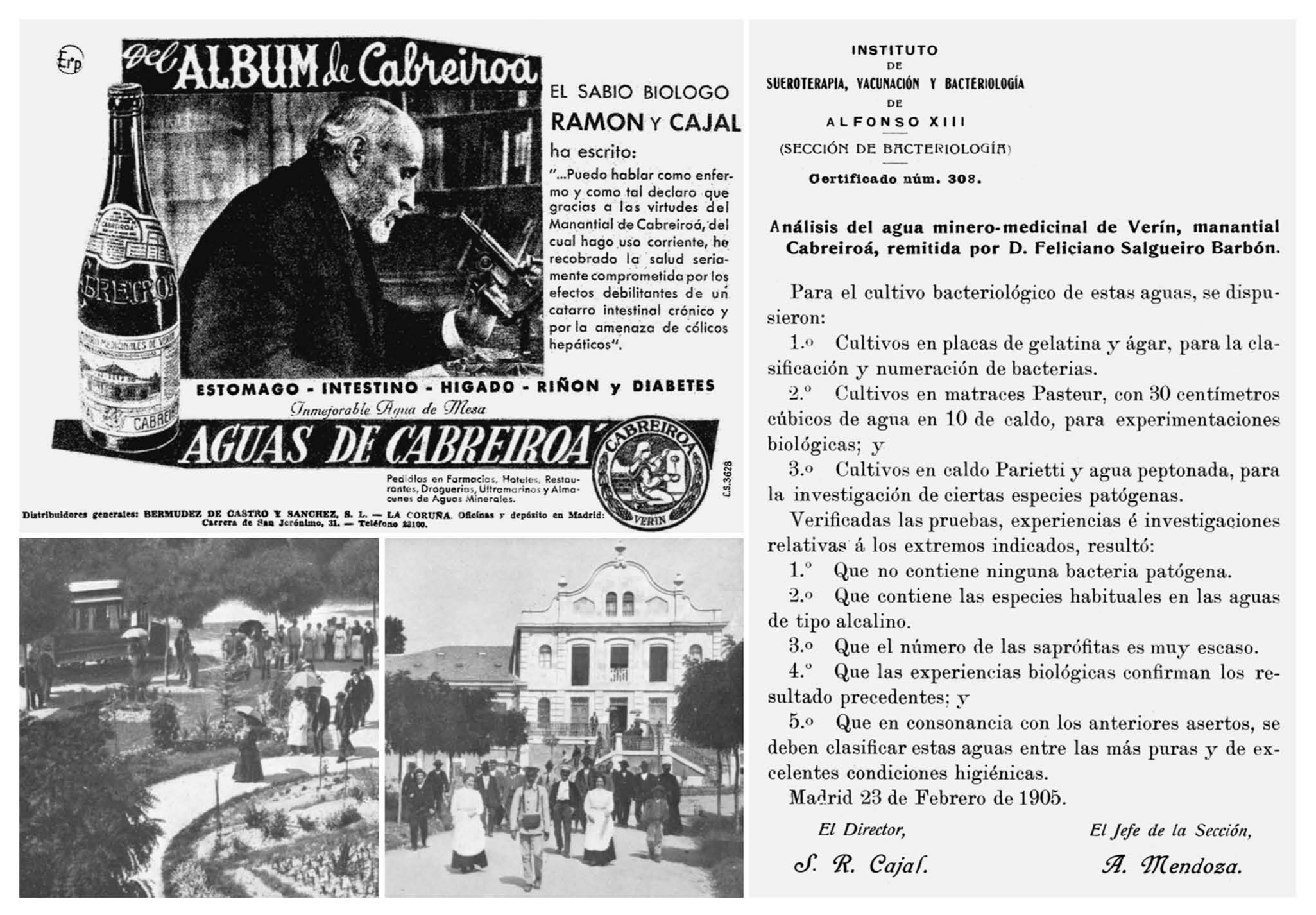
Upper left: An advertisement of Cabreiroá mineral water in the Madrid publication Revista ABC, citing Ramón y Cajal’s comments on its medicinal properties and appearing in print 10 years after his death (issue of November 7, 1944, p. 2). Lower left: The kiosk and garden toward the terrace (far left figure) and the grounds (center figure) of the Cabreiroá spring establishment (Murillo, 1913). Right: Certificate of Cajal’s bacteriological analysis on the official letterhead of the “Royal Spanish Institute of Serum Therapy, Vaccination and Bacteriology” (Murillo, 1913).
Perla del Castellar
Cajal’s name was also associated with La Perla del Castellar water in
Villarrubia de Santiago (39°59′1″ N 3°22′7″ W, altitude 750 m), 65 km from Toledo (Rodríguez Miguez, 1995), which was
recommended for its composition of sodium sulfate as a purgative, and promoted for the
treatment of scrofula and herpes (Figure
4). The following advertisement had appeared in August 1907 in Barcelona’s
newspaper La Vanguardia (Figure 4, upper right): Natural purgative waters and salts “La Perla del Castellar,” analyzed by Dr. S. Ramón
y Cajal and other national and foreign eminences, unique in the world, with real
medicinal thenardite. Laxative, antibilious, appetizing, diuretic and essentially
cleansing. Never irritates or weakens, the most gentle, efficient and economical of
all laxatives. Free sampling: Segalá, Rambla Flores, 4. Sold everywhere. Warehouse:
Balmes, 83.

Left: Two bottles of Carabaña company’s La Favorita mineral water from the outskirts of Madrid. The reverse bottle label on the right shows Cajal’s chemical analysis. Salt residue still exists at the bottom of the bottle’s inside [ca. 1928]. A detail of the label with Cajal’s name can be seen at the lower right figure; the flat image of the label was obtained by rotating the bottle manually on the scanner glass surface, while the light drum was advancing. Upper right: An advertisement for Perla del Castellar water approved by Cajal, appearing in Barcelona’s newspaper La Vanguardia (Thursday, August 22, 1907, p. 9; also appearing on Sunday, August 25, 1907, p. 11; bottles and documents from the authors’ private collection).
“Thenardite” (anhydrous Na2SO4) is found in arid evaporite environments, such as dry and volcanic caves. Named after Louis Jacques Thénard (1777-1826)—professor of chemistry at Collège de France, Faculty of Sciences and École Polytechnique of Paris—thenardite forms yellowish, reddish-to-grey-white prismatic crystals and is fluorescent. In humid conditions, it gradually absorbs water and converts to the mineral “mirabilite” (Na2SO4·10H2O; en.wikipedia.org/wiki/Thenardite).
Agua de Carabaña
In the late 19th century, the mineral water industry of Carabaña La Favorita was born when the Chávarri family acquired the property of the spring and surrounding land, and built a spa that became very popular. The Carabaña mineral water was rendered commercially available by Ruperto Jacinto Chávarri on December 11, 1883. It was exported to England, Portugal, Prussia, and Germany. In the early 20th century, Carabaña bottled water was sold in many other countries, including France, Italy, Cuba, and Panama.
Cajal was mentioned as having carried out chemical analyses of Carabaña spring water (Figure 4), along with Gabriel de la Puerta y Ródenas (1839-1908), professor of chemistry at the School of Pharmacy of the University of Madrid. The water was promoted for its curative and medicinal properties. On May 4, 1928, the product became officially qualified as “Highly Recommended for Public Use” (Editorial, 1991, p. 63).
The water contained sodium sulfate (Doz et al., 1922). The town of Carabaña (40°15′25″ N, 3°14′4″ W) at Cerro de Cabeza Gorda is 50 km outside Madrid. For centuries, since Roman times, water from the spring had been used for body care with internal and external applications, also known to local countrymen and shepherds. From the mid-1800s, the water was distributed in carafes to nearby places and was used to treat various ailments.
Carabaña’s minero-medicinal water gained recognition at Universal Expositions with 12 gold medals and 10 honorary diplomas, including the 1889 Exhibition in Paris. At the beginning of the 20th century, Carabaña water was commercialized in Europe and America, where an estimated figure of four million bottles were being sold in the 1930s.
The water was prescribed for gastrointestinal and hepatic diseases, and externally for skin treatments (Editorial, 1913). The commercial descriptions mentioned “purgative, laxative, antibilious, purifying, anti-herpetic,” “medicinal jewel for maintaining health and for curing diseases,” and “treasure of health.” Beginning in 1904, the company manufactured medicinal soap bars enriched in mineral salts collected from the evaporation of natural spring water. The company remains active today (www.aguadecarabana.com), producing and marketing natural health products.
The following information appears on the label of the bottle shown in Figure 4 (cf. also Editorial, 1913, p. 4): Chemical analysis carried out by his excellence Dr. Santiago Ramón y Cajal, Nobel
Prize in Medicine. The water of Carabaña has the following composition: Baumé
aerometer grades 14.3; density 1.109; anhydrous salts per liter of water: Na sulfide
0.0493; Na sulfate 114.7357; Mg sulfate 2.1621; Ca sulfate 1.5416; Al sulfate 0.0115;
Na phosphate 0.1975; Na chloride 1.6301; Ca chloride 0.1886; F and Mn small
quantities. By its marked quantity of Na sulfate that this water contains (114.7357
g/L) and the other mineral elements it can be considered as typical of the group of Na
sulfate mineral waters, the sulfur variety.
Carabaña is one of the best known waters of Madrid, operating since 1883 and being still sold commercially in pharmacies. It comes from the Charca de la Salina (“Salty Pond”); the source is known as La Favorita. Estimated daily flow is 9,500 dm3 (Fraguas, 2007; Navarro García, 2010).
In the early 20th century, bottled water was exported by the Carabaña Company to France, Italy, and Portugal, and to the Spanish colonies, including Cuba, Puerto Rico, and the Philippines. The sales, in 1907, were estimated to three million 0.5-L bottles. Shortly after, business was expanded to the production of Epsom salts and soap (el Sáb, 2009).
Agua de Carabaña ranks among the highest in the world regarding the concentration of calcium (505 mg/L) and magnesium (552 mg/L; Vasey, 2006).
La Toja
The “Isla de la Toja” (also “Illa da Toxa” or “Illa de Louxo”) is located in the Rías Bajas in the Province of Pontevedra in Galicia, at distances of 30 km from Vilagarcía, 32 km from Pontevedra, and 18 km from Cambados. Famous for its spa, it is covered by green vegetation and surrounded by a sea of crystal clear water. Its thermal mud and medicinal water springs were discovered in the 19th century. Its soaps (“el jabón La Toja”) had been a favorite of the Buenos Aires señoras.
The 50°C spring with its hypertonic sodium chloride composition, in a granitic terrain of probable volcanic genesis, was indicated for gynecologic conditions (Doz et al., 1922). A liter of “agua de La Toja” in addition contained 20.2 ml anhydrous carbonate, 10.8 ml oxygen, 29.2 ml nitrogen, 0.40 g Mg sulfate, 0.98 g Ca sulfate, 0.18 g Mg carbonate, 0.87 g Ca carbonate, 0.10 g Fe sesquioxide, and 0.12 g silica (Doz et al., 1922).
On the basis of the physicochemical properties of its spring, Cajal is reported to have
called the thermal station at La Toja “a true temple of health” (Pérez, 1983, p. 32). He is mentioned to have
expressed his views of La Toja as follows: Nature created here a salutary and almost unique spring seen as incomparable. The
peaceful island is bathed by the most beautiful Galician estuaries, invigorating sea
breezes scented by the balmy emanations of the forest, temperature being always
spring-like under a clear and bright sky. Art and science, working in concert, have
realized the work of nature. By this time, La Toja has fallen into the hands of
skilled craftsmen, who have been striving to provide the swimmer with the excellence
of a hydrotherapy facility wisely organized, a magnificent residence, a true temple
devoted to health, which combines into a happy marriage the refinements of the most
demanding comfort with the most scrupulous precautions of hygiene. (Otero Pedrayo, 1954, p.
322)
The Counter-Claim
At first glance, one might surmise that the water analyses in the commercial documents and labels bearing Cajal’s name reflected yet another aspect of his diverse scientific avocations.
On one hand, it appears less complicated to explain why Cajal might extol, on several occasions, the medicinal properties of spring waters of the Iberian peninsula. After all, such claims were likely rooted in medical paradigms of his age. The 1800s had seen a widespread enthusiasm for water cures, Darwin being one of thousands of famous patients at water spas. In that aspect of conventional medicine, Cajal might not be doing much different than his contemporaries or anything particularly rigorous by the standards of his work in neuroanatomy.
Furthermore, it is understandable that Cajal, an amateur astronomer and nature lover, felt for the unspoilt corners of his land, such as the tiny town of Verín, one of the many along slow roads from Santiago de Compostela to Salamanca. These are places where the traveler can soak his spirit in the essence of Spain. The night sky is velvet blue, the stars shine as they do not shine in our light-polluted cities. And the silence! It is a silence that “heals the mind.”
On the other hand, there is a questionable quality as to how water bottlers were using Cajal’s reputation to promote products. Sometimes, a “Great Man” style in industrial advertising can be insufficiently critical, lacking the hard evidence from properly controlled studies for the products being truly efficacious.
The reply comes from a unique, and surprising letter, from Ramón y Cajal himself, hosted in the Diario Ilustrado ABC on April 22, 1926 (Figure 5), under an unmistakable title: “How My Modest Name Is Exploited by Certain Unscrupulous Industries” (Ramón y Cajal, 1926). Cajal reiterates that he never practiced any industrial analysis, neither as an individual nor as director of the Alfonso XIII Institute, and clarifies that, if his name appears in some documents, it is only owing to a bureaucratic formality requiring to include the formal approval (B.° V.° or “bueno visto”) of the director of the Institute.

A fragment of Cajal’s letter published on April 22, 1926, in Revista ABC (Vol. 22, no. 7272, p. 21) in Madrid (Ramón y Cajal, 1926).
The complete text of the letter reads as follows (authors’ English
translation): The most cultivated writer Gómez de Baquero said that the
least Spanish virtue is respect. My case eloquently corroborates that sensible
observation. I allude to a misuse initiated since I was nominated, at the suggestion of
the illustrious doctor Cortezo, director of the Alfonso XIII National Institute of
Hygiene. This misuse, committed by quite a lot of industries, consists in gratuitously
attributing to me the execution of the analysis of specifics, of medicinal wines, of
mineral waters, disinfectants, cigarette paper, toothpaste and other products, of which
I have no idea. Such a myth has spread so, that it has even invaded the foreign press
(including a current claim in a Swedish newspaper), and has generated within Spain, in
magazines of great prestige, commentaries hardly pleasant to me. And yet the tide keeps
rising. Today I was informed that the Radio Company has credited me with the analysis of
the waters of Venta del Hoyo (waters of which I have not the slightest idea), and that a
witted merchant, in whose house I purchased a spray gun for disinfectants (I paid,
naturally), advises his clients to consult me on its efficacy. Finally, as I write these
lines, I am informed that in the central theater there appears a sign, which
gratuitously attributes to me the analysis of the waters of Hoznayo. It is urgent, then, to straighten things, by stating that: First. I have never conducted any industrial analysis, neither as an individual nor as
director of the Alfonso XIII Institute, a position that I resigned 6 years ago. Second. That the experts’ certificates handed over to individuals by the said Institute
were authorized by the signature of the section chief, the true author of the analysis,
with the approval of the director, stamped at the bottom, as required by
regulations. Third. That the tariff of prices, extremely reasonable, were approved by the
Directorate of Health, in accordance with a ruling, under which half the amount of the
honorarium is destined to bolster the infrastructure and the rest to subsidize the
personnel, which, during the initial years of the organization of the Institute, was
receiving inadequate stipends. If the industrial references had pointed on their labels or in their magazine
advertisements the official establishment where the expert work was carried out, the
name of the authoring professor directly responsible, plus the approval of the director
(a bureaucratic imperative, which only expresses the mere sentiment of confidence in the
competence and integrity of the analyst), I would be content with all the claims; but
the fact is that almost all claims published by the advertisers systematically and
maliciously omit the name of the Institute, eliminating that of the illustrious
chemistry professor charged with the service, and it is only stated analyzed, or
consulted, by Dr. Cajal, etc., even though the report entails bland judgments
or formulates restrictions, reservations, and even failures outright unfavorable. Some will think that all this is suspicions or cogitations of mine. No. Insofar as,
even in the minute, the whole truth should always shine, for the
deplorable tolerances I have suffered, as stated earlier, molestation attacks by doctors
and journalists. Even in La Libertad, a master of journalists, whom I
wholeheartedly revere and admire, expressed 4 or 5 months ago, without naming, and in a
pious tone, caustic ironies. Let the aforementioned industries, then, rectify their conduct toward me. Erase my name
from their claims and labels and reproduce that of author of the analysis. I appeal to
their rectitude and nobility. Announce that, attributing to me a work for which I am not
competent brings me into a ridiculous, unjust, and unlawful position. Ridiculous,
because everyone knows how oblivious I am in analytical chemistry; unjust, because I
would appear to supplant or silence the personality of the illustrious professors, among
others, that of Mr. Obtulio Fernández, Professor and Chairman of Pharmacy, an academic
and one of the few eminent chemists honoring Spain; unlawful, because, not paying the
medical patent signals that I defraud the Treasury. I trust, therefore, that the
preceding reasons will make an impression on the industries, which, for 14 or 16 years,
exploit, in exchange for a few pesetas given to the Alfonso XIII Institute, my humble
name. I simply aspire to completely forget me. But if, as I suspect, they persist in
their attitude, I shall be compelled to consult an attorney and to take the matter to
the Courts. These will say whether, in citing a public document, it is permissible to
dispense with the signature of the one who authored it, and whether a mere ritualistic
approval is equivalent to the paternity of the one who performed in person, and with
full competence and responsibility, the meritorious expert work.—S. Ramón
Cajal
Discussion
This episode is an example of how the exhaustive documentation on a historical topic can prevent us from conceivably passing a message that would not correspond to reality, and from spreading a false legend. By reading Cajal’s letter, we see that his view was absolutely contrary to the impression that one might have gathered on the basis of the commercial documents alone.
The story reminds of the Dutch botanist-physician Herman Boerhaave (1668-1738) in
18th-century Leiden, who was often disgruntled by fake publications with incorrect
statements and had also sent a letter to the local newspaper warning about claims (mis)using
his name (Koehler, 2007). His
note appeared in De Leydsche Courant on October 9, 1726 (Schulte, 1959; cited by Koehler, 2007). In sharp words, it
went as follows: Whereas some booksellers of this and other countries, for the
sake of lucre only, have highly injured me, and scandalously cheated the public, by
printing in my name several books from lectures procured (as they pretended) from my
auditors, who were it so, make a very ill requital for my best endeavours to serve them;
I find myself obliged to declare that I owe none such for my works, being fraudulently
published without my knowledge, contrary to my will. (Lindeboom, 1974, pp. 141-142)
Cajal’s medical interests covered a wide spectrum from neuroembryology (de Castro, López-Mascaraque, & de Carlos, 2007; Hamburger, 1980; Lagercrantz, 2006; Puelles, 2009) and neurohistology (Andres-Barquin, 2001, 2002; Berciano & Lafarga, 2001; DeFelipe, 2002; DeFelipe & Jones, 1992; Gibson, 1994; Lafarga, Casafont, Bengoechea, Tapia, & Berciano, 2009; Llinás, 2003; Loewy, 1971; López-Muñoz, Boya, & Alamo, 2006; Sotelo, 2003) to cardiology (de Fuentes Sagaz, 2001) and tumor biology (Martínez, Marín, Junquera, Martínez-Murillo, & Freire, 2005). His first interest in bacteriology and the pathology of inflammation developed early and continued in parallel with his neurohistological work (Iturbe, Pretó, & Lazcano, 2008; Otis, 2001; Ramón y Cajal, 1885a, 1885b, 1905; Ramón y Cajal Junquera, 2000; van Buskirk & Porter-Sánchez, 1961). Cajal’s fascination with microbes and the organism’s ways of fighting them is also reflected in his early fiction novels (Otis, 2001).
Bottled waters were marketed for their mineral contents, as well as (presumably) for the absence of pathogenic bacteria.
Cholera, another of Cajal’s subjects of interest, was a concern in major European cities well into the beginnings of the 20th century. For example, the death of the beloved Ana Cecilia Luisa Dailliez from water-transmitted fiebre tifoidea in Madrid in 1912 led Mexican poet Amado Nervo (1870-1919)—also known as Juan Crisóstomo Ruiz de Nervo—to write some of the most sorrowful poetry in the Spanish language. Nervo had spent the first years of the 20th century in Europe, especially Paris, where, in 1901, he met the love of his life and they lived happily for 11 years, until her untimely death. Out of his grief and desperation, Nervo wrote his most important work, La Amada Inmóvil (“The Immovable Loved One”), published posthumously in 1922. One can easily imagine don Amado and don Santiago crossing each other in some street of Madrid!
The scientific interests of Ramón y Cajal (1885a, 1885b) had converged with those of Eduardo García Solá (1884, 1885a, 1885b), the Spanish pathologist who became rector of the University of Granada, through simultaneous publications on the virulent bacillus and its treatment during the 1885 cholera outbreak in Spain. The foundations of the promising new science of bacteriology had been laid by the brilliant contributions of Robert Koch (1843-1910) in Berlin, who had recently discovered the Vibrio cholerae (Koch, 1884, 1886, 1893).
Cajal introduced for the first time the pioneering concept of a chemical vaccine (Ramón y Cajal Junquera, 2000). For that ground-breaking work on producing a vaccine against cholera, Cajal was presented by the Provincial Government of Zaragoza with a Carl Zeiss microscope. Compared with the new Statif and profuse objectives, Cajal’s earlier, hard-earned Verick microscope now “seemed like a rickety door bolt” (Andres-Barquin, 2001; Ramón y Cajal, 1988). The Zeiss instrument opened up totally new horizons, enabling Cajal “to attack the delicate problems of the structure of the cells without misgivings and with the requisite efficiency” and eventually to decipher the minute structure of the nervous system. From that work, and that microscope, modern neurobiology was born.
Footnotes
Acknowledgements
The authors express their gratitude to Dr. Peter J. Koehler of Atrium Medical Center, Heerlen, the Netherlands, and to Dr. John Waller of Michigan State University, East Lansing, Michigan, the United States, for invaluable input.
Declaration of Conflicting Interests
The author(s) declared no potential conflicts of interest with respect to the research, authorship, and/or publication of this article.
Funding
The author(s) received no financial support for the research and/or authorship of this article.