




Abstract
Two procedures were adopted to assess decision-making styles in the workplace: (a) the administration of traditional standardized self-report questionnaires and (b) open-ended questions about the way respondents would take decisions in a critical business case. Seventy-four adults were given two questionnaires: the Preference for Intuition and Deliberation, which assesses “deliberative” or “intuitive” decision style, and the Style of Learning and Thinking, which assesses thinking styles as “left” (namely, analytical-systematic) or “right” (that is, global-intuitive). Participants were also presented with a business case that involved taking a decision. Responses to the business case were used to classify approaches to decision making as “analytical-systematic” or “global-intuitive.” Results showed that the questionnaires correlated consistently with scores from the business case, thus supporting the notion that the assessment of decision style through self-report questionnaires is reliable and valid.
Keywords
The contemporary picture in the world of work presents a complex challenge to those responsible for the selection of staff, to trainers, and to those working in human resources. On one hand, there are the increasing requests from companies for specific profiles with precise individual qualities and knowledge about competencies in the sector; on the other hand, there is a labor market offering a wide availability of resources with different methods of training (Dowling, Welch, Festing, & Engle, 2008).
As far as the selection of staff is concerned, an important consideration is the ability to evaluate and discriminate between candidates taking several aspects into account, including the request from the company and the opportunities offered by the labor market. In particular, together with the assessment of technical and specialist knowledge, the general characteristics of the candidate take importance in connection with cognitive, relational, motivational, and organizational aspects, as well as self-management (Pynes, 2007; Rupp & Thornton, 2005). Also in the area of human resource management, the need arises to take into consideration these general characteristics of the person to recognize and increase their operating capacities in the context of the workplace (Buford, 2006; dos Santos Moreira, 2008). Acknowledging these general characteristics makes it possible to evaluate important aspects of work-related activities, such as the approach to problems, the manner of relating to superiors and with colleagues on the same level, the managing of emotionally charged situations (e.g., stress situations), the ability to learn, leadership, and so on.
These general characteristics include cognitive styles, namely, the preferred methods of cognitive organization and functioning, as these emerge in perceiving, memorizing, learning, judging, and problem solving, all of which reflect general individual differences that are also relatively stable over time (Guilford, 1980). Cognitive styles lead individuals to adopt similar attitudes and behaviors in a variety of domains. They concern, in fact, general approaches to mental functioning, irrespective of the incidental demands of specific cases (Sternberg, 1997). Cognitive styles differ from abilities in that cognitive styles are measured in terms of manner of performance, whereas abilities are measured in terms of level of performance (Zhang & Sternberg, 2007).
Several authors agree that one consistent characteristic that distinguishes people from one another is the tendency to consider either the details of a situation or the whole picture (Riding & Rayner, 1998; Schmeck, 1988). Analytical individuals have a focused attention: they have an interest in operations and procedures or the “proper” ways of doing things and prefer step-by-step planning; their thinking is controlled and consciously directed. Global individuals tend to scan, and so form overall impressions, and this includes allowing their feelings to enter into decision making; their mental organizational planning involves random or multiple accessibility of components and different kinds of association between them.
The existence of stylistic differences has been proved in the specific field of decision making (Driver, 1979; Driver, Brousseau, & Hunsaker, 1990; Galotti et al., 2006; Harren, 1979; Hunt, Krzystofiak, Meindl, & Yousry, 1989). Some authors have provided empirical evidence that the way people make decisions is stable over time and in different situations (Schwartz et al., 2002; Scott & Bruce, 1995). Also in this field, the most common and unifying characteristic is represented by the dichotomy between analytical-systematic and global-intuitive styles (Chaiken & Trope, 1999; Klaczynski, 2001; Nygren, 2000; Stanovich & West, 2000). People characterized by an analytical-systematic style prefer to solve problems and make decisions through a slow process (Betsch, 2004; Epstein, Pacini, Denes-Raj, & Heier, 1996), which implies a comprehensive (Scott & Bruce, 1995), systematic (Agor, 1989; Rowe & Mason, 1987), elaborated (Betsch, 2004), and logical evaluation of alternatives (Rowe & Mason, 1987; Scott & Bruce, 1995). People characterized by a global-intuitive style, by contrast, tend to decide through a fast, effortless, and automatic process (Betsch, 2004; Epstein et al., 1996), which is usually holistic, based on hunches and feelings (Agor, 1989; Scott & Bruce, 1995), and that results in creative outcomes (Rowe & Mason, 1987).
The analytical-global distinction is encompassed by a broader style, namely, the left- and right-thinking style (Torrance, 1987, 1988; Torrance, Reynolds, Riegel, & Ball, 1977). Such a distinction was originally inspired by the notion that human cerebral hemispheres have specialized functions, but nowadays the claim that a specific hemispheric activity is associated to a given thinking style is questionable (Hugdahl & Westerhausen, 2010; Springer & Deutsch, 1997), so that left and right have to be assumed as metaphors denoting distinct modalities of thinking rather than actual brain localizations. Left style is concerned with verbal, logical, analytical, and abstract tasks; the left style implies a preference for the sequential processing of information and a systematic approach to solving problems. Right style refers to nonverbal, holistic, spatial, and concrete thinking and implies a preference for parallel processing, perceptual representation in the form of synthesized patterns, and intuitive and creative problem-solving. In this way, the left-thinking style is connected with analytical-systematic styles, whereas the right-thinking style shares some features with global-intuitive decision styles. Analytical and systematic thinking, similar to the left style. tends to value particular details, and is characterized by proceeding in small steps, taking account of all the variables involved. Intuitive and global thinking, associated with the right style, prefers to take a view of the whole, reflects the need to focus on situations and problems in all their complexity, and proceeds by means of holistic associations.
Decision-making styles are usually assessed by means of self-report instruments, which require people to evaluate themselves by describing introspectively the way in which they perform certain tasks, by checking personal habits or preferences or by endorsing statements about what they think of themselves. This may be done by asking participants to keep a diary of what happens to them during a certain period, by interviewing them, or by administering questionnaires.
Although self-report scales remain the method most commonly used to study stylistic differences, including preferences, beliefs, and abilities, it has been argued that it is actually difficult to use questionnaires to investigate constructs of this kind (Aiken, 2002; Gregory, 2007). This is partly because self-report questionnaires tend to include references to general decision-making styles, for example, “I prefer making detailed plans rather than leaving things to chance” (Kaufmann, 1979; Scott & Bruce, 1995); “I think before I act” (Betsch, 2004; Kaufmann, 1979); “I am a very intuitive person” (Scott & Bruce, 1995; Torrance, 1987); and “My feelings play an important role in my decisions” (Betsch, 2004; Torrance, 1987). For some respondents, the style may depend on the situation; for example, they may adopt a global-intuitive style for financial choices and an analytical-systematic style for life choices. To answer such general questions, the respondent has to strike a mental balance between the different kinds of situation in which choices are to be made; this balance may not be easy to achieve or may be biased toward cases that come most easily to mind when filling in the questionnaire. As a direct result, the questionnaires end up as instruments capable of grasping only a particular picture of reality and providing measurements that fall short of a comprehensive and objective evaluation of the constructs that are supposed to be assessed instead (Antonietti, 2003).
A possible solution to these problems might be to collect other kinds of data. In fact, other sources of data might help to deal with problems arising from the use of self-report questionnaires. In particular, a more concrete and specific approach and a more direct reference to the world of work could bring people’s decision-making styles to light more effectively. Such an approach should be especially relevant for those who are interested in assessing styles in relation to the workplace. For this reason, a real business case was constructed, in which respondents were invited to focus on describing their own behavior when taking on the role of someone who has to face taking decisions. In this way, the respondent was involved in a realistic workplace problem situation; this is to develop processes of thought and decision making to find a hypothetical situation consistent with the objectives of the company, bearing in mind the limitations and opportunities that could occur. Basically it is a matter of simulating an effective company situation, and such an approach is nowadays considered an efficient assessment procedure (Dunkley, 2000).
The main goal is to test whether self-report measures of individual stylistic differences, obtained through questionnaires, relate to the behavior in a realistic workplace case. More precisely, the purpose is to ascertain the relationships between two standardized questionnaires—the Preference for Intuition and Deliberation scale (PID; Betsch, 2004) and the Style of Learning and Thinking questionnaire (SOLAT; Torrance, 1987)—and the business case. If the assessment of styles based on the questionnaires matches the assessment based on the responses given to the real business case, we can argue against the above-mentioned criticisms and support the notion that self-report measures are valid instruments that mirror what people do in actual situations.
To relate the standardized questionnaires to the business case, we need to check whether the latter is a reliable and valid measure. Thus, preliminary goals were as follows. First, we aimed to test the reliability of the scoring system that has been created by converting the answers given to open questions to points on a marking scale. Furthermore, we attempted to assess whether scores concerning the business case we devised showed a normal distribution, to test whether the stylistic features measured by this instrument can be conceptualized, as in the case of the questionnaires, as extremes of a continuous characteristic and to allow us to compute statistical analyses that can be applied to this kind of distribution.
A secondary objective is to identify differences in the decision-making style brought out by the instruments due to variables such as age, gender, and expertise level (trainees vs. already trained employees).
Methods
Materials
PID questionnaire
The PID scale (Betsch, 2004) assesses an individual’s tendency to use an intuitive mode or the one seized on in the moment of decision. The questionnaire is based on the assumption that some people have more confidence in a rational way of elaborating information (a deliberative system), whereas others count more on an experiential way of elaborating information (an intuitive system). We chose PID because it is one of the most recent self-report questionnaires devised to measure decision style, and in its construction the author took into account some of the previous instruments of the same kind (in particular, the Rational-Experiential Inventory; Epstein et al., 1996). Moreover, the Italian version of the instrument that was employed in a recent study (Iannello, 2010) replicated the results obtained in the original study (Betsch, 2004). PID assumes individual inclinations toward intuitive decision making, which is based on affective reactions toward the decision option, and deliberate decision making, based on beliefs, evaluations, and reasons.
A number of empirical findings support these assumptions. It has been shown that intuitive people include affective reactions in their choices, whereas deliberate people refrain from doing so (Betsch & Kunz, 2008). Moreover, intuitive participants are faster in making decisions (Betsch, 2004; Schunk & Betsch, 2006), and their decisions are better predicted by implicit attitudes (Richetin, Perugini, Adjali, & Hurling, 2007). In particular, PID can be valued as a measure that assesses the inclination to intuitive versus deliberate decision making with an emphasis on the affect-cognition and on the implicit–explicit distinction (Betsch & Iannello, 2010). In fact, intuition is defined as a decision that takes as its criterion the direct affective reactions in confronting options. Deliberation, however, is based on cognition (beliefs, values, and thinking). People with a high deliberative score show themselves to be perfectionists, with a great need for structuring and wanting to take optimal decisions. However, people with high intuitive scores take rapid decisions and display personality traits such as extraversion and openness to experience.
The questionnaire contains two subscales, Intuition and Deliberation. There are 18 questions altogether: 9 assessing the preference for deliberation (PID-D) and 9 assessing the preference for intuition (PID-I). Examples of items on the two subscales are as follows:
“Before making decisions I first think them through” (PID-D). “I listen carefully to my deepest feelings” (PID-I).
Participants express their degree of agreement with each statement on a scale with five possible responses, with one corresponding to complete disagreement and five corresponding to complete agreement.
The Italian version of the questionnaire was used for the present study. Both PID subscales showed acceptable reliabilities (α = .73 and α = .78 for the PID-I and PID-D, respectively). The pattern of intercorrelations between the two subscales showed a tendency to negative correlation, even if it did not reach the level of significance, as previously found by Richetin et al. (2007).
SOLAT questionnaire
The SOLAT questionnaire (Torrance, 1987) is intended to measure individual differences in the prevalent way of thinking. We chose this instrument because it can be considered a comprehensive measure of cognitive style as it assesses all aspects that traditionally have been identified as distinctive and specific thinking styles. In the Italian version (Antonietti, Fabio, Boari, & Bonanomi, 2005), SOLAT consists of 28 items, each containing two distinct statements, one corresponding to the right-thinking style and the other to the left-thinking style. Examples of statements referring to right thinking include “I prefer to be shown how to do things,” “When solving problems, I prefer to create a visual image of the situation described,” and “I like to bring lots of ideas together”; whereas statements referring to left thinking include “I like to read an explanation of what I have to do,” “I like to analyze problems by reading the text carefully and listening to the teacher’s instructions,” and “I like to separate ideas and analyze them one by one.” The statements for each item corresponding to left and right thinking are in random order, and the respondent has to choose the most suitable statement.
There are four possible responses to each item: choosing the first statement or the second statement, and choosing both statements (if the participant agrees with both) or neither (if the participant does not agree with either). While scoring, separate counts are made of all responses for right thinking only, all responses for left thinking only, and all responses for both or neither of the two statements. In this way, three relative overall scores are obtained for each participant, which are, respectively, for left, right, and integrated thinking. Integrated thinking indicates a balance between the characteristics of both types of thinking (left and right).
Business case
This describes a situation in a company in which the respondent finds himself or herself in the role of a manager who has to take decisions and propose actions concerning a problem. More precisely, the situation described requires the participant to immerse himself or herself in the situation by taking the role of a manager in the field of mobile phones in a multinational company to which the introduction of a revolutionary technical solution is proposed. This includes the modification of the production cycle, which is coordinated by another person responsible. This solution could also bring advantages to another area of the company, but the person responsible is temporarily absent and cannot be contacted. A decision has to be made before the person responsible returns. The text of the business case is reported in the appendix. Three questions are posed; they require a description of the actions that the respondent intends to carry out, the decisions that have been taken, and the motives that led to the decisions.
The business case involves compiling information on the stylistic profile of the individuals. The responses to the business case are analyzed with reference to all three questions. The internal coherence of the process, as a result of which a decision is made, is taken into consideration. In particular, consideration is given to the way the respondent faces the critical situation and takes decisions, starting with evaluations conducted on the case presented. An answer key is created to analyze the responses to the business case with the objective of recognizing the respondent’s decision-making style. The focus is on certain aspects of the decision-making style—global-intuitive versus analytical-systematic—which may emerge from the responses. Four analytical-systematic and four global-intuitive aspects have been identified. These aspects were devised by considering the features usually attributed to the two styles (see the introduction). The description of each indicator is reported in Table 1.
A Description of the Indicators Drawn From the Business Case

It is worth remembering that the analytical-systematic style is characterized by the detailed, comprehensive, and stepwise considerations of all the elements involved in the situation. This is mirrored by the indicators aimed at highlighting how the respondent took all the elements into account—including the implicit assumptions (AS1) and the possible obstacles (AS3)—by considering them separately (AS2) and proceeding in a sequential, logical way (AS4). With respect to the global-intuitive style, this defines a person who considers a situation in a rapid and holistic way, relying on feelings and sometimes producing creative outcomes. The corresponding indicators reflect these features because they allow evaluators to check whether the respondent has tried to represent the situation as a whole (GI1) and speed up the process by foreseeing the possible consequences (GI2), by trusting feelings (GI4) and making associations rather than logical connections, so being led to find innovative ideas (GI3). Furthermore, identifying consequences and making associations also help in reaching a broader view (GI1).
For each of the four analytical-systematic aspects and four global-intuitive aspects, all participants receive an evaluation according to the degree to which these aspects are reflected in their responses:
Completely absent (score 0); Only mentioned in passing in the response, identifiable in a vague way but not clearly defined or explained (score 1); Referred to in the reply in a definite and explicit way (score 2); Recur several times and explicitly in the response (score 3).
Also analyzed is the thematic content of the response provided by the business case candidate, and five different aspects are identified:
Relational (R): This refers to expressions referring to the necessity for building relations, for group work, in comparison to the need to consider diverse points of view about the situation. Technical (T): This refers to expressions concerning the cycle of production, including feasibility, the evaluation of efficiency and efficacy, and advantages and disadvantages. Psychological (P): This refers to expressions that imply psychological processes, such as persuading, motivating, and cooperating, and to psychological dimensions such as resistance and difficulty in the face of innovation and change. Financial (F): This refers to expressions that show evidence of attention to the economic outcomes of the situation, to the market referred to, to costs and benefits, and to the possible earnings. Cultural (C): This refers to expressions relating to the values of the company and to its mission.
Also, each thematic aspect is given a point on the 4-value scale mentioned above according to how often it occurs in the respondent’s response.
Participants
The research involved 74 candidates for a range of positions at the Chamber of Commerce, Industry, Craft Trade, and Agriculture of Milan (Italy), with a total of 24 men (32.4%) and 50 women (67.6%). The mean age was 24.56 years (SD = 2.34).
Participants were mainly (72.9%, 74% of the women and 70.8% of the men) people who were still attending university courses but who already had work experience because they had spent a period of at least 6 months in a company. To pass the selection process, however, they needed to undergo a further training period. For this reason, they were labeled as “trainees” (low work expertise). The remaining participants were not yet attending university or training courses and had been working in a company for at least 1 year. They were labeled as “trained” (high work experience).
The university faculties from which the students came are divided into four categories, as follows: economics (35.2% of the students); law (24.1%); humanities (22.2%); social sciences (political and communication sciences, 18.5%). The ratio of male to female students was approximately equal for each faculty.
Procedure
The submission of the business case and the two questionnaires took place in the course of normal selection procedures. Each candidate, at the beginning of the selection interview, was given a file containing the business case and 20 min to complete it. They were then given 10 min to fill in both questionnaires. Candidates were told that these preliminary tasks were for research purposes only and would have no bearing on the subsequent interview. To reassure them of that, their responses were anonymous and they saw the interviewer placing their response sheets randomly in the stack of completed protocols.
All protocols, both the standardized questionnaires and the business cases, were scored by an assessor who was unaware of the personal features (age, gender, job status, and faculty attended) of the respondents and to the ratings obtained in the instruments scored before.
Results
Application of the Business Case
The first step was to validate the use of the scoring key in the analysis of the business case. Ten protocols were extracted at random from the business cases. Two independent judges analyzed the responses given by the participants using the scoring key and came up with their respective evaluations. There was a high level of interassessor agreement (92% of cases). In cases of disagreement, the criteria for categorizing the open responses were further refined so that a unanimous decision could be reached. The scoring of the protocols for the successive analyses was carried out by a single judge.
For each participant, a score was calculated for each aspect (AS1, AS2 . . ., GI1, GI2, . . .) by adding the scores obtained for each of the three responses (given, respectively, to the questions concerning the actions, decisions, and motives). For each participant, a total score for analytical (AS total) and global (GI total) styles was computed by adding the previous scores (AS total = AS1 + AS2 + AS3 + AS4; GI total = GI1 + GI2 + GI3 + GI4). If participants failed to give a response to one of the three questions, they were left out of the analyses. They were also excluded if they did not complete all the items in the questionnaires. This explains why there is variation in the numbers of participants included in the subsequent analyses.
Data concerning the distribution of scores computed for each aspect and total analytical-systematic and global-intuitive scores can be summarized as follows (data are not reported here to save space). In the case of measures of central tendency, the mean, the median, and the mode tended to coincide. Furthermore, the mean scores of each of the four aspects of the analytical-systematic approach were similar, as were the scores of the four global-intuitive aspects. Also, the total analytical-systematic and global-intuitive scores were similar, thus proving that the measures for the two ways (analytical-systematic vs. global-intuitive) of approaching the business case reflect one another. The standard deviations of the scores for each aspect were similar, and the same applies to the total analytical-systematic and global-intuitive scores. The ranges of scores showed that distributions stretched from the lowest possible score and included a sufficient number of intermediate scores up to the highest score. Skewness and kurtosis values were acceptable. In short, the business case appeared to be able to discriminate between respondents with respect to their tendency to reason and make decisions in an analytical-systematic or global-intuitive manner. In addition, the business case highlighted the aspects of the two styles in a symmetric way: elements belonging to the four analytical-systematic and to the four global-intuitive categories were detected in the respondents’ answers with similar frequencies. Finally, Cronbach’s alpha values were acceptable for all items (Table 2).
Cronbach’s Alphas and Correlations Coefficients (Pearson’s r) Between Total Scores and Scores of Each Aspect of the Business Case

p < .05. **p < .01.
Correlations between scores were as expected. All scores concerning the analytical-systematic aspects showed significant positive correlations with the total analytical-systematic score, and all scores concerning the global-intuitive aspects showed significant positive correlations with the total global-intuitive score (Table 2). Moreover, all analytical-systematic scores were negatively correlated with the total global-intuitive score, and all global-intuitive scores were negatively correlated with the total analytical-systematic score. The analytical-systematic scale was negatively correlated with the global-intuitive scale (r = −.45, p < .001).
Factor analysis, according to the principal component method, was induced to extract, by applying the scree test, two factors that accounted for 56.87% of the variance and that corresponded to the analytical-systematic and global-intuitive styles (Table 3). All the analyses support the internal consistency of data coming from the business case.
Component Matrix After Varimax Rotation Concerning Scores in the Business Case

Relationships Between Questionnaires
As far as the fourth goal was concerned, we first analyzed the relationships between the two standardized questionnaires (PID and SOLAT) to check whether they were as expected. Both instruments concern the measurement of cognitive styles but are linked to different fields of application (respectively, decision making in particular and general style of thinking). Spearman’s ρ correlation coefficients are presented in Table 4. The two PID subscales are negatively correlated with each other, as is also the case for the SOLAT scales.
Correlations (Spearman’s ρ) Between the Questionnaires

Note: SOLAT = Style of Learning and Thinking; PID = Preference for Intuition and Deliberation.
p < .01.
The PID Deliberation subscale correlated positively with left and integrated thinking styles and negatively with the right-thinking SOLAT subscale. The PID Intuition subscale was positively correlated with the right-thinking style and negatively with the left-thinking style as assessed by SOLAT. These correlations between PID and SOLAT were in line with the findings of previous studies in which the two instruments were applied, together with other instruments, with different samples of adults (Iannello, 2010; Iannello & Antonietti, in press).
Relationships Between the Business Case and the Questionnaires
The focus subsequently turned to the relationships between the self-report questionnaires and the business case test, devised to distinguish participants with an analytical-systematic style from those with a global-intuitive style. Correlation coefficients between the analytical-systematic and global-intuitive scores and between the scores obtained on the PID and SOLAT questionnaires were computed (Table 5). Correlations were as expected: most analytical-systematic scores correlated positively with both deliberative and left-thinking styles and negatively with the intuitive and right styles, which was the opposite of what happened in the case of the global-intuitive scores.
Correlations (Spearman’s ρ) Between the Analytic-Systematic and Global-Intuitive Aspects Emerging From the Responses to the Business Case and Scores in the Questionnaires
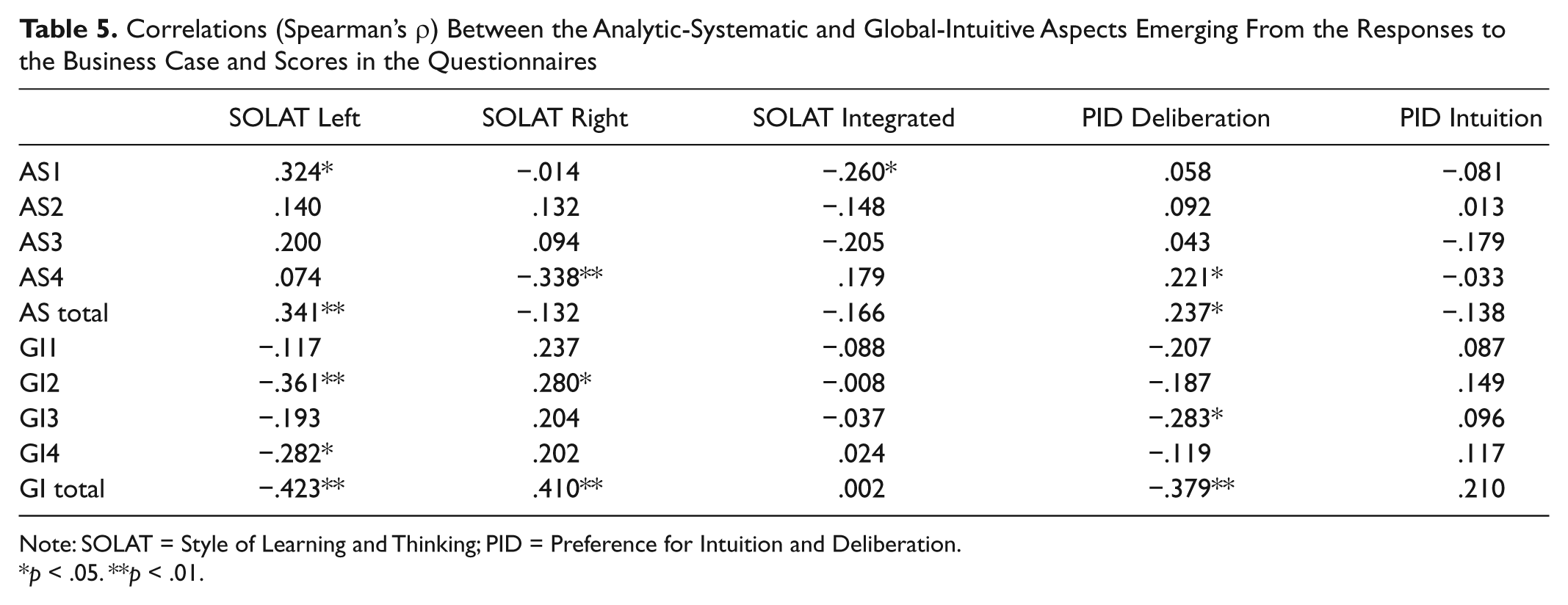
Note: SOLAT = Style of Learning and Thinking; PID = Preference for Intuition and Deliberation.
p < .05. **p < .01.
In detail, with regard to the analytical style, it was found that the “Consideration of explicit assumptions guiding the decisions (AS1)” correlated positively with the SOLAT left-thinking subscale and negatively with the SOLAT integrated-thinking subscale. The “Identification of steps, series of operations and actions (AS4)” showed a positive correlation with the PID deliberation subscale and a negative correlation with the SOLAT right subscale. Analytical-systematic total scores showed significant positive correlations with both deliberation PID and left-thinking SOLAT scores, and negative correlations with the other scores.
As regards the global style, it should be noted that the “Anticipation of consequences and identification of difficulties and opportunities (GI2)” correlated positively with the SOLAT right-thinking subscale and negatively with the SOLAT left subscale. The “Association of the given situation with a range of elements (GI3)” showed a negative correlation with the PID deliberation subscale. The “Expression of feelings and impressions (GI4)” was negatively correlated with the SOLAT left subscale. Finally, global-intuitive total scores correlated positively with right SOLAT scores and negatively with PID deliberation and SOLAT left scores, the correlation with the SOLAT integrated subscale being approximately 0.
As regards the level of analysis of the thematic contents of the responses (relational, technical, financial, psychological, and cultural aspects), the total score for each response was calculated for each participant for each aspect of content by adding up the scores obtained for the first, second, and third questions, concerning, respectively, what the responder would do in that situation (action), the decision(s) taken, and the motives underlying both the action(s) and the decision(s). No significant correlations emerged between PID and SOLAT scores, and the difference between deliberative versus intuitive and left versus right thinking on one hand and the scores for the thematic aspects of the responses in the business case on the other hand. The only trend that emerged concerned the psychological aspects, which were more often mentioned by participants showing a tendency toward right thinking as assessed by SOLAT. A relation of this kind could be explained by the fact that the intuitive participants are more sensitive to the mental dynamics (emotive and interpersonal aspects) created by problems in the workplace.
The Influence of Personal Variables
The last aim of the research is to identify differences in the three instruments due to variables such as age, gender, and status (trainee vs. trained). ANOVAs assuming age (using two categories: below 25 years vs. 25 years and above), gender, and status as independent variables failed to show significant differences. This was consistent with the lack of differences in decision and thinking styles due to the variables mentioned above that have been reported previously (Iannello, 2007).
Discussion and Conclusions
Decision-making styles may play an important role in the workplace (Hayes & Allinson, 1998). As part of the process of staff selection, it is useful to evaluate cognitive style to be able to predict the behavior of a candidate in the workplace situation. The styles are in fact relatively stable psychological characteristics that are common to different domains and that influence work practice and determine particular behaviors, such as mode of learning and execution of tasks. In particular, because in all fields of work an individual is required to take decisions, it is important to determine a candidate’s decision-making style to identify the congruence between the candidate’s personal characteristics and the kind of decision making required or prevalent in a certain field of work. For instance, if the job requires a thorough examination of all the aspects of the situation in question and the objective evaluation of all pros and cons, the analytical-systematic style is preferable. However, if the employee has to make decisions quickly because the goal is to satisfy customers’ needs rapidly, a global-intuitive style is better as it involves the consequences of the different choices (Sadler-Smith & Badger, 1998). Assessing the decision style is important not only to guarantee the match between an individual’s cognitive functioning and the characteristics of the work tasks but also to make employees themselves aware of their own style, so that they recognize the advantages and limitations of their style, judge the functionality of their style in the various tasks that they must face, and eventually adopt countermeasures when their own style is not the best one to deal with the situation (Rowe & Mason, 1987).
Being aware of individual decision styles is also important in the management of human resources and in training (Rayner & Cools, 2010). Tracing someone’s cognitive profile from the perspective of the workplace can be useful in several respects. Specifically, it could represent a useful tool for understanding an individual’s way of solving problems and making decisions. Furthermore, identifying personal cognitive styles could be seen as a starting point for evaluating individual ways of completing assignments, the propensity for risk taking, and finally the ability to learn from experience and mistakes (Allinson & Hayes, 1996). Thus, tracing personal cognitive profiles could be very useful during the process of staff selection because information concerning thinking style makes it possible to construct a cognitive profile of the candidates/workers to find out which of them are most suited to the positions that need to be filled (Scholtes, Joiner, & Streibel, 2003). Moreover, identifying personal cognitive profiles could be a useful tool within the orientation and vocational process because it can represent the basis for finding the instructional and professional opportunities that best fit the personal characteristics (Walsh, Savickas, Hartung, & Osipow, 1995).
Furthermore, information relating to cognitive styles can be used in the field of training. In particular, cognitive profiles can be useful for preparing training initiatives with the goal of sensitizing, professionalizing, and creating self-knowledge in line with a strategic theme for the company, as with styles of thinking and decision making, enabling all participants to produce evidence of their own strong and weak points. In other words, this makes it possible for participants to carry out self-analysis, self-evaluation, and self-development. In addition, cognitive style information can be used to structure all training intervention in the form of maximizing learning, and favoring the acquisition of the proposed content, through the choice of diverse and ad hoc teaching methods.
For example, several variables connected with cognitive style influence the acquisition of knowledge: the choice of the order of presentation of arguments, the use of visual aids and support materials, and the use of interactive multimedia technologies and exercises and simulations. According to a person’s cognitive profile, it can also prove opportune to choose the type of training intervention. According to the so-called “cognitive style matching hypothesis,” when the training procedures applied within an instructional setting are consistent with the learner’s style (matching condition), better outcomes result than in mismatching conditions (Ford & Chen, 2001).
From all these considerations, it seems useful to have at one’s disposal instruments for style assessment that can be applied easily and consistently in the fields of staff selection and professional training. Questionnaires are the instruments that are often employed to achieve these goals, above all for their ease of administration and the short periods of time required for compilation and scoring. Self-report questionnaires, however, have been criticized because of the alleged limitations mentioned in the introduction. From this comes the need to show that assessment based on questionnaires reflects the stylistic differences that emerge when individuals are asked to face an actual workplace situation.
In the present study, we describe the application of two standardized self-report questionnaires and a realistic workplace case. The analyses carried out on the responses to the business case led to the validation of a scoring key that is useful for revealing the participant’s tendency, preference, or habit with regard to systematic-analytical or global-intuitive modes of thinking. The consistent factorial structure of the business case supported it as a valid measure of decision-making style. In addition, a high correlation was found between the two questionnaires, thus showing that decision styles show some features that are typical of certain thinking and learning styles. It emerged that the tendency to apply a specific set of strategies (logical and systematic analysis vs. intuition) in decision making reflects a more general tendency to rely on one of the two kinds of thinking processes in cognitive tasks.
The main findings concerned the connections between responses to the questionnaires and the business case. The aspects associated with a global-intuitive cognitive style that appeared in the responses to the business case showed positive correlations with the intuitive scales of the two questionnaires and negative correlations with the analytical-deliberative scales. The aspects associated with an analytical-systematic style showed positive correlations with the analytical-deliberative scales of the two questionnaires and negative correlations with the intuitive scales. The study of the relations between the cognitive style, measured by means of the two questionnaires, and the responses to the business case showed, on one hand, that intuitive decision makers (according to PID) gave more responses of the GI type (in particular, GI4), whereas deliberative decision makers gave more responses of the AS4 type. On the other hand, right thinkers (according to SOLAT) mentioned elements of the GI type (in particular, GI2 and GI3) more often, whereas left thinkers mentioned elements of the AS type (in particular, AS1 and AS4) more often.
Finally, the last aim of the study was to identify possible differences in the three instruments due to personal variables. The styles of decision making and thinking appeared not to be affected in any significant way by gender, age, or status in the workplace, as has been mentioned previously (Antonietti et al., 2005).
Overall, the study produced evidence in favor of self-report questionnaires. The consistency of the correlations between the scales of each of the questionnaires and of the correlations between the scores for PID and SOLAT confirms the validity of the two self-report instruments used. Styles assessed through these questionnaires are reflected by the indicators drawn in the light of and through the request to get involved in a concrete professional situation and to describe how we might behave in that situation. The absence of any difference in the questionnaire scores depending on the personal characteristics of the participants is consistent with earlier findings and provides support in favor of the stability of the styles, which appear to be characteristics deeply rooted in the individuals, regardless of gender, age, and work experience.
Contrary to the skepticism toward self-report questionnaires mentioned in the introduction, it seems that using such instruments, which are easy to administer and score, is a relevant practice. Several studies confirmed the accuracy and validity of such questionnaires, and standardized norms are sometimes available, allowing assessors to evaluate the relative reliance of an individual of a specific style. The doubts that might arise concerning the adequacy of this kind of instrument are answered by the results of this study, which showed that the identification of styles through self-report questionnaires is in accordance with what can be gathered by analyzing the way the respondents cope with a specific decision-making problem in a real company context.
Footnotes
Appendix
You have worked for several years at a major multinational company specializing in the production of mobile phones and characterized by innovative design and technology. The company is structured into “product areas,” each of which is coordinated by a manager. Today the company’s main goal is the continuous production of innovatory to remain at the top of the market and continue to demonstrate its technological value. You have been the director of the cell phone area for about a month. An external consultant, who has worked with the company for many years, offers a particularly innovative and revolutionary technical solution that would improve the production of cell phones but would result in a modification of the production cycle coordinated by Dr. Fasani. In addition, this innovation would have major advantages in the production of fixed phones, the product area managed by Dr. Casoli, with whom you are on good terms. Dr Casoli is currently abroad at a major trade show and will return in just 3 days.
Declaration of Conflicting Interests
The author(s) declared no potential conflicts of interest with respect to the research, authorship, and/or publication of this article.
Funding
The author(s) received no financial support for the research and/or authorship of this article.