




Abstract
By neglecting endogenous factors, existing studies that usually focus on examining the effect of exogenous characteristics on entrepreneurial decision-making logic has drawn conflicting conclusions. This paper explores the influences of cognitive styles on entrepreneurial decision-making logic, as well as the moderating role of environmental uncertainty. Using a multiregional sample of 336 Chinese entrepreneurs, the study obtained results by conducting multiple linear regression. Entrepreneurs with an intuitive cognitive style tend to apply causal logic, while those with an analytical cognitive style are inclined to adopt effectual logic. Environmental uncertainty moderates the effect of cognitive styles on some dimensions of entrepreneurial decision-making logic. In an uncertain environment, entrepreneurs with an intuitive cognitive style reduce the use of the logics of affordable loss and leveraging contingencies, while entrepreneurs with an analytical cognitive style reduce the use of the expected return logic. This paper clarifies the relationship between intuitive and analytical cognitive styles, which are always considered to be antithetical. This implies that they always coexist, instead of competing with each other in entrepreneurial decision-making. This finding verifies that entrepreneurial decision-making logic is the result of interactions between cognition and the environment, inspiring scholars to explore it from the combination of multiple elements.
Plain language summary
Entrepreneurial decision-making logic significantly affects entrepreneurial performance. It contains two main types which are causal logic and effectual logic. Causal logic has four dimensions: goals-orientation logic, expected returns logic, competitive analysis logic, and avoiding contingencies logic. Effectual logic has four dimensions: means-orientation logic, affordable loss logic, partnerships logic, and leveraging contingencies logic. There’s not much known about why entrepreneurs follow certain logic to make decisions. This paper explores the influences of cognitive styles on entrepreneurial decision-making logic. Cognitive style reflects individual differences in perceiving, thinking, learning, solving problems, and building connections with other people. It is categorized into two types: analytical and intuitive. This study empirically analyzes data from a sample of 336 entrepreneurs in China. It finds that entrepreneurs with an intuitive cognitive style tend to apply causal logic. Entrepreneurs with an analytical cognitive style are inclined to adopt effectual logic. Environmental uncertainty moderates the effect of cognitive styles on some dimensions of entrepreneurial decision-making logic. In uncertain environment, entrepreneurs with an intuitive cognitive style reduce the use of logics of affordable losses and leveraging contingencies, while entrepreneurs with an analytical cognitive style reduce the use of expected return logic.
Keywords
Introduction
Entrepreneurial decision-making occurs throughout the entrepreneurial process, and its effectiveness is directly related to entrepreneurial performance (Deng et al., 2022). Although the extant literature has acknowledged the importance of entrepreneurial decision-making, little attention has been paid to its underlying logic.
Causal logic and effectual logic are two main types of entrepreneurial decision-making logic (Sarasvathy, 2001). Causal logic consists of the following steps: identifying an opportunity, including a new product, a new firm or a new market; conducting competitive analysis and market research to develop a business plan; assembling and acquiring resources and stakeholders appropriate for implementing the plan; and adapting to the environment as it changes over time. Effectual logic emphasizes that entrepreneurs often begin with their own existing means, namely, “who I am, what I know, whom I know.” They determine what they can do and the possible effects based on a set of given means. At the same time, they actively interact with people they know to obtain stakeholder commitments and generate new means or new goals. In this process, more means and resources can be obtained by entrepreneurs, and the goals of new ventures become clearer as their constraints increase. In addition, environmental changes have constant impacts on the entire effectual decision-making process by influencing existing means, new means, and new goals (Sarasvathy, 2008).
A few studies explore the antecedents of the two logics, but they draw some conflicting conclusions. This makes one of the most important questions unanswered “Why do some entrepreneurs choose a certain logic?” This situation leaves much of the law of entrepreneurial decision-making unknown (Scazziota et al., 2023). Sarasvathy (2008) suggests that MBA students prefer using causal logic, while habitual entrepreneurs favor effectual logic. However, later research revealed that novice entrepreneurs also tend to use effectual logic, questioning the traditional view that prior entrepreneurial experience improves the leverage of effectual logic (Frese et al., 2020).
There are two limitations in the existing research. First, most of them explore the influence of different exogenous characteristics such as experience on entrepreneurial decision-making logic, neglecting endogenous factors (e.g., entrepreneurial cognition). Tryba and Fletcher (2020) demonstrate that decision-making is complex and mainly relies on cognitive style. It consists of an individual’s most common ways of interpreting the environment and collecting and processing information, which is necessary for entrepreneurial decision-making. However, there is scant research examining the relationship between cognitive style and entrepreneurial decision-making logic. Second, the existing studies ignore the effect of the environment. According to the social cognition theory, entrepreneurial decision-making is significantly affected by the interactions between cognition and the environment. It is important for entrepreneurs to adjust decision-making logic with shifts in the environment (Sassetti et al., 2022).
In response to these issues, this paper tries to explore the following research question: “How do cognitive styles influence entrepreneurial decision-making logic, especially in an uncertain environment?” In doing so, this paper makes several contributions. First, it clarifies the relationship between intuitive and analytical cognitive styles, which are not antithetical. This implies that they always coexist instead of competing with each other in entrepreneurial decision-making. Second, it adds a new research angel of entrepreneurial decision-making logic from the perspective of cognitive style. Third, it verifies that entrepreneurial decision-making logic is the result of interactions between cognition and environment, inspiring scholars to explore it from the combination of multiple elements. Fourth, this paper helps entrepreneurs make effective entrepreneurial decisions according to their cognitive style and environmental uncertainty.
Literature Review
Entrepreneurial Decision-Making Logic
Causal logic and effectual logic are always regarded as single constructs, leading to inconsistent conclusions are drawn (Ruiz Jiménez et al., 2021). Scholars have suggested exploring them from the perspective of different dimensions, which indicate four main differences between causal logic and effectual logic (as shown in Table 1). First, causal logic aims to find the best means to achieve goals by starting from a clear set of goals, while effectual logic strives to create new ways to obtain possible good outcomes using existing means. Second, causal logic emphasizes expected returns through revenue analysis, while effectual logic focuses on affordable loss through cost analysis. Third, causal logic favors competitive analysis, while effectual logic prefers partnerships with stakeholders. Finally, causal logic avoids contingencies and views them as threats, while effectual logic leverages contingencies and regards them as opportunities to create the future. In addition, causal logic is related to ex-ante rational planning, whereas effectual logic is associated with ex-post emergent strategies (Osiyevskyy et al., 2023).
Differences Between Causal Logic and Effectual Logic.

This paper adopts the dimensions proposed by Brettel et al. (2012) and analyzes the impact of cognitive style on each dimension. Through expert interviews and a pilot study, Brettel et al. (2012) divide causal logic into four dimensions: goals-orientation logic, expected returns logic, competitive analysis logic, and avoiding contingencies logic. They also divide effectual logic into the four dimensions of means-orientation logic, affordable loss logic, partnerships logic, and leveraging contingencies logic. They are the most in line with Sarasvathy (2001) and most recognized by scholars (Alsos et al., 2020; Ruiz Jiménez et al., 2021).
Cognitive Style
The most widely recognized definition of cognitive style is individual differences in perceiving, thinking, learning, solving problems, and building connections with other people (Witkin et al., 1962). Brigham et al. (2007) note that cognitive style is stable over time and can be measured using psychometric techniques, and that it is related to the form rather than the content of information processing. It describes one’s dominant thinking mode rather than better thinking processes.
Allinson et al. (2000) are the first to study cognitive styles in the field of entrepreneurship. They categorize cognitive styles into two types: analytical and intuitive. Otto and Greenway (2016) assume that differences in the cerebral hemispheres lead to variations in cognitive styles, claiming that the cognitive style of the human brain’s right hemisphere is intuitive. They conclude that successful entrepreneurs often possess an intuitive cognitive style; they are highly risk-tolerant, innovative, and proactive, tackling problems intuitively according to prior experience. The human brain’s left hemisphere is associated with an analytical cognitive style; professional managers are typically analytical, excelling in collecting and analyzing external information and dealing with challenges more rationally.
Cognitive styles are essential in explaining entrepreneurial behavior but are not the only determinants (Sukoco et al., 2022). Entrepreneurs implement different actions based on information projected from the external environment. Thus, entrepreneurial cognition studies must consider the entrepreneurial environment, and the compatibility between cognitive styles and the entrepreneurial environment has gradually become a focal point for research (Abdelfattah et al., 2023).
Environmental Uncertainty
The concept of “uncertainty” originated in the field of economics, where Knight (1921) defined it as a risk that cannot be measured or calculated, emphasizing unpredictability. Environmental uncertainty reflects an individual’s perception of the probability distribution in the environment, that is, he or she does not know how many things will occur in the environment or the likelihood of the occurrence (Jiang & Tornikoski, 2019). This refers to the fact that actions must be implemented without adequate information about the environment and that it is difficult for individuals to estimate changes in the environment. Jaworski and Kohli (1993) consider environmental complexity, dynamism and hostility to be typical characteristics of environmental uncertainty.
Environmental uncertainty is widely regarded as an important contextual condition. Existing studies have mainly examined its moderating effect on the relationship between entrepreneurial decision-making logic and outcomes. But few studies have evaluated how it moderates the effects of antecedents on entrepreneurial decision-making logic. He and Li (2024) claim that environmental uncertainty not only negatively moderates the relationship between effectual logic and subsequent actions, but also has a moderating influence on the mediating effect of entrepreneurial implementation intention on entrepreneurial action. Alzamora-Ruiz et al. (2020) analyze how environmental uncertainty moderates the effect of causal and effectual logic on innovation in technology-based SMEs. Taghvaee and Kambiz (2023) examine a three-way interaction effect of market orientation, environmental uncertainty, and effectual logic on new product performance. Environmental uncertainty moderates the influence of market orientation on new product performance, while effectual logic plays a moderating role in the relationship between market orientation and new product performance in uncertain environments.
Hypotheses
This paper develops hypotheses based on social cognition theory, a prominent framework in the field of social psychology. It examines how individuals structure their knowledge and organize information about the social world, encompassing beliefs, memory, expectations, motivation, cognitive style, and self-reinforcement. This theory is employed to elucidate the reasons behind and mechanisms through which individuals behave from a cognitive perspective. It posits that individual behavior is shaped by the interplay between personal cognition and external environment. According to social cognition theory, cognitive style and environmental factors play a pivotal role in shaping entrepreneurial decision-making logic.
Intuitive Cognitive Style and Effectual Logic
Entrepreneurial resources are always scarce, and entrepreneurial opportunities are fleeting. It forces entrepreneurs to proactively seek out possibilities for various combinations of established means and to be more open-minded in making the most of available resources to develop entrepreneurial opportunities as quickly as possible (Mansoori & Lackéus, 2020). Sassetti et al. (2022) find that entrepreneurs with an intuitive cognitive style tend to think according to experience and intuition, which is called “instant judgment from an overall perspective.” They prefer to integrate their available means and resources to accelerate the decision-making process (An et al., 2020).
With the decision-making logic of affordable loss, entrepreneurs do not seek to maximize gains, which usually requires extensive information processing. Rather, they quickly analyze their status quo and determine their maximum affordable loss (Martina, 2020). Sadler-Smith (2016) indicates that entrepreneurs with an intuitive cognitive style tend to think holistically and are not good at detailed work, such as long-term information collection and analysis. When faced with a problem, intuitive entrepreneurs cannot make decisions relying on a large amount of information but must fall back on their feelings and experience. They are more likely to make a quick decision after weighing whether they can afford the worst outcome (Marques et al., 2022).
With the decision-making logic of partnership, entrepreneurs favor collaboration with stakeholders. Tryba and Fletcher (2020) find that entrepreneurs with an intuitive cognitive style are usually inspired by directly interacting with people and things. Marques et al. (2022) verify that intuitive entrepreneurs emphasize “creativity” and “flexibility” in problem solving, as well as identify the intersection of mutual interests. They are more likely to form alliances and gain support from stakeholders to deal with problems.
With the entrepreneurial decision-making logic of leveraging contingencies, entrepreneurs are more flexible to contingencies (Osiyevskyy et al., 2023). Marques et al. (2022) indicate that entrepreneurs with an intuitive cognitive style are usually more creative and may be better at innovatively interpreting the information contained in contingencies and collecting the information needed to respond to them. Sadler-Smith (2016) also suggest that entrepreneurs with an intuitive cognitive style are relatively flexible. They are usually good at combining unfamiliar and complex information with their existing resources, adapting to changing circumstances, identifying opportunities from contingencies, and taking advantage of them. Thus, the following hypotheses are proposed:
H1. Entrepreneurs’ intuitive cognitive style is positively associated with their preference for effectual logic.
H1a. Entrepreneurs’ intuitive cognitive style is positively associated with their preference for the logic of means-orientation.
H1b. Entrepreneurs’ intuitive cognitive style is positively associated with their preference for the logic of affordable loss.
H1c. Entrepreneurs’ intuitive cognitive style is positively associated with their preference for the logic of partnerships.
H1d. Entrepreneurs’ intuitive cognitive style is positively associated with their preference for the logic of leveraging contingencies.
Analytical Cognitive Style and Causal Logic
Analytical cognitive style is the other system through which individuals gather and process information. When entrepreneurs make decisions, the intuitive information processing that simply stimulates experience is not always effective (Marques et al., 2022). Thus, they also apply an analytical cognitive style to collect and evaluate information by logical reasoning and detailed judgment (Allinson et al., 2000). Lanivich et al. (2023) indicate that entrepreneurs with an analytical cognitive style prefer systematic investigation. They gather and process information according to their goals. This is exactly what goals-orientation logic emphasizes. In addition, Kickul et al. (2009) argue that individuals with an analytical cognitive style favor rational analysis and future prediction. This equates to the goals-orientation logic which emphasizes systematic analysis to determine goals based on predictions (Hauser et al., 2020).
Due to the analytic cognitive style is serial, rule-governed and deliberately controlled (Marques et al., 2022), analytic entrepreneurs are more likely to gather and process information to predict their maximum possible returns. Then they make decisions according to the returns. Alsos et al. (2020) indicate that the expected return logic is based on the “linear and goals-driven analytical process,” emphasizing the use of probability theory and statistical principles to calculate expected returns before starting entrepreneurial activities. The analytical cognitive style and the expected return decision-making logic share the same connotation, and the thinking processes following an analytical cognitive style could explain why entrepreneurs use the expected return decision-making logic.
Marques et al. (2022) demonstrate that analytical entrepreneurs often care about details, concentrate on hard data, and take a step-by-step approach to address entrepreneurial activities. They are also more adept at systematic research and able to process detailed information over a long period (Allinson et al., 2000). In solving problems, entrepreneurs with an analytical cognitive style are more sensitive to risk than those with an intuitive cognitive style (Barbosa et al., 2007). They collect as much information as possible to improve their own product differentiation and increase their firm’s competitive advantage (Mansoori & Lackéus, 2020; Sarasvathy, 2008).
Kickul et al. (2009) suggest that entrepreneurs with an analytical cognitive style are more confident in their ability to assess and integrate resources. However, they are less confident in seeking and identifying new opportunities, and they are unwilling to take risks. Frequent contingencies in the early stage of entrepreneurship contain opportunities as well as “threats,” making the future more uncontrollable and increasing entrepreneurial risk (Jiang & Tornikoski, 2019). Entrepreneurs with an analytical cognitive style are more likely to evaluate the risks associated with contingencies rather than explore the entrepreneurial opportunities brought by them. Entrepreneurs with an analytical cognitive style usually have a lower risk propensity, and they are more sensitive to risk than those with an intuitive cognitive style (Barbosa et al., 2007). They are more inclined to avoid contingencies. Therefore, the following hypotheses are proposed:
H2. Entrepreneurs’ analytical cognitive style is positively associated with their preference for causal logic.
H2a. Entrepreneurs’ analytical cognitive style is positively associated with their preference for the logic of goals-orientation.
H2b. Entrepreneurs’ analytical cognitive style is positively associated with their preference for the logic of expected return.
H2c. Entrepreneurs’ analytical cognitive style is positively associated with their preference for the logic of competitive analysis.
H2d. Entrepreneurs’ analytical cognitive style is positively associated with their preference for the logic of avoiding contingencies.
Moderation of Environmental Uncertainty
When the level of environmental uncertainty is high, it is quite difficult to gather useful information to evaluate entrepreneurial opportunities. In such an environment, entrepreneurs with an intuitive cognitive style use their existing means (e.g., knowledge and prior experience) to make quick decisions, not relying significantly on external information assembly (Sadler-Smith, 2016). The greater the environmental uncertainty is, the more prone the situation is to all kinds of unexpected problems (Jiang & Tornikoski, 2019). Entrepreneurs with an intuitive cognitive style are more flexible and creative (Sukoco et al., 2022), integrating different means as well as available resources with an open mind, thereby seizing fleeting entrepreneurial opportunities.
The entrepreneurial environment is filled with uncertainty and ambiguity, which is an important reason for the extremely low success rate of entrepreneurship. Due to entrepreneurial failures, entrepreneurs not only suffer considerable mental pressure but also may face financial crises. Thus, entrepreneurs tend to invest resources according to their perceived affordable losses to reduce loss and stress overall (Martina, 2020; Sarasvathy, 2001). In a context of high environmental uncertainty, it is more difficult for entrepreneurs to collect market information or predict the future. Kickul et al. (2009) indicate that entrepreneurs with an intuitive cognitive style tend to make immediate judgments based on feelings and prior experience. In uncertain environments, they make quick decisions within the limits of affordable loss, reducing their reliance on external information (Hauser et al., 2020).
In situations of high environmental uncertainty market competition becomes fierce, and many unpredictable changes occur in chains of supply and demand. It becomes more difficult for entrepreneurs to collect and process information; those with an intuitive cognitive style are more inclined to seek and even brainstorm information by interacting with people (Tryba & Fletcher, 2020). Marques et al. (2022) argue that entrepreneurs with an intuitive cognitive style have a stronger sense of entrepreneurial self-efficacy and are more confident in problem solving. Their confidence overcomes their fear of entrepreneurial failure, enabling them to proactively reach out to stakeholders to build partnerships (Scazziota et al., 2023).
In uncertain environments, entrepreneurial opportunities are implicit and cannot be obtained through public data analysis. The discovery of entrepreneurial opportunities is closely related to entrepreneurs’ thinking patterns and mentality (Scazziota et al., 2023). The probability of contingencies increases with environmental uncertainties, and entrepreneurs with an intuitive cognitive style can be “flexible” and “innovative” in responding to such contingencies, showing strong adaptability (Sukoco et al., 2022). Although it is difficult to collect information in uncertain environments, entrepreneurs with an intuitive cognitive style are more likely to respond to contingencies through feelings and experience (Lanivich et al., 2023). They are good at leveraging contingencies in uncertain environments (Mansoori & Lackéus, 2020). Therefore, we propose the following hypotheses:
H3. Environmental uncertainty positively moderates the positive influence of intuitive cognitive style on effectual logic.
H3a. Environmental uncertainty positively moderates the positive influence of intuitive cognitive style on means-orientation logic.
H3b. Environmental uncertainty positively moderates the positive influence of intuitive cognitive style on affordable loss logic.
H3c. Environmental uncertainty positively moderates the positive influence of intuitive cognitive style on partnerships logic.
H3d. Environmental uncertainty positively moderates the positive influence of intuitive cognitive style on leveraging contingencies logic.
In uncertain environments, it is difficult for entrepreneurs to obtain and process useful information, and individuals with an analytical cognitive style are often unable to fully utilize their strengths (Abdelfattah et al., 2023). Models and methods from traditional management, which originate in a relatively stable environment, cannot be effectively applied in uncertain environments (Sadler-Smith, 2016). This hinders entrepreneurs with analytical cognitive style from setting goals and acting on them.
In the context of an uncertain environment, the probability of possible future events is likely to be unknown. It becomes hard for entrepreneurs to collect and process information. Entrepreneurs’ prediction of the future is very difficult. Although entrepreneurs with an analytical cognitive style prefer to use market information and structured decision-making models to calculate expected returns, they have difficulty doing so (Jiang & Tornikoski, 2019). Thus, they reduce the use of expected returns logic.
It is difficult to collect information to analyze firms’ competition using the traditional decision-making model in uncertain environments; thus, competitive analysis is limited. Entrepreneurs with an analytical cognitive style have difficulty in collecting and processing information and have to reduce competitive analysis. In addition, in uncertain environments more complex problems arise, making it even more difficult for analytical entrepreneurs to solve problems through analysis (McKelvie et al., 2020).
The more uncertain the environment is, the more difficult it is for entrepreneurs with an analytical cognitive style who focus on making decisions based on analyzing information to assess the risks and opportunities inherent in contingencies (Kickul et al., 2009). In addition, more unexpected events occur in an uncertain environment. Entrepreneurs with an analytical cognitive style who prefer dealing with problems through analysis do not have enough information to deal with unexpected events. They have to adopt avoiding contingencies logic. Therefore, we propose the following hypotheses:
H4. Environmental uncertainty negatively moderates the positive influence of analytical cognitive style on causal logic.
H4a. Environmental uncertainty negatively moderates the positive influence of analytical cognitive style on goals-orientation logic.
H4b. Environmental uncertainty negatively moderates the positive influence of analytical cognitive style on expected return logic.
H4c. Environmental uncertainty negatively moderates the positive influence of analytical cognitive style on competitive analysis logic.
H4d. Environmental uncertainty negatively moderates the positive influence of analytical cognitive style and avoiding contingencies logic.
The conceptual model is shown in Figure 1.
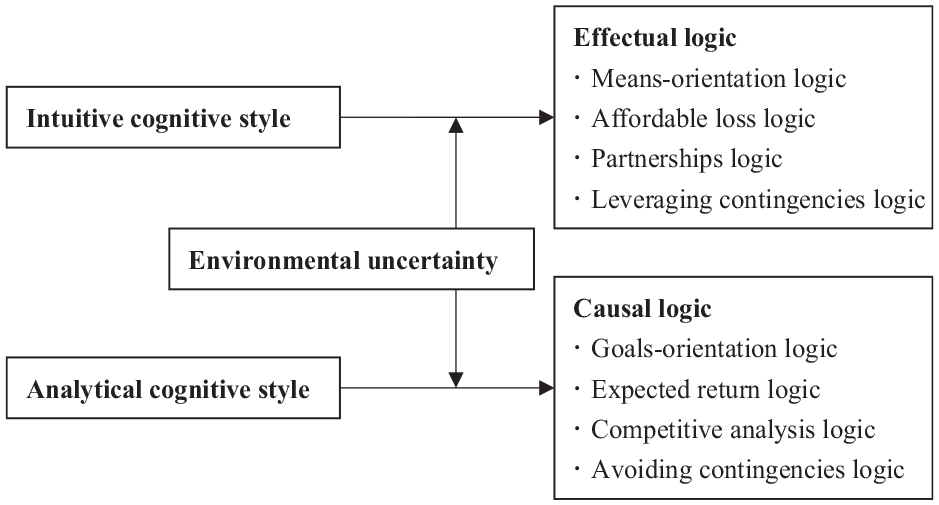
Conceptual model.
Methodology
Sample
A questionnaire was used to collect data for this study. We followed the steps proposed by Churchill (1979) in the questionnaire design, initially designing scale items based on established scales. To avoid errors in translation, the scale items were first translated into Chinese by team members and then translated back into English by three different team members for further revision. Then, on the basis of the first draft, our team discussed the questionnaire design several times and communicated with scholars in the field of entrepreneurship and psychology. Finally, to test the feasibility of the questionnaire and the respondents’ understanding of the questions, a pilot test was conducted with 10 entrepreneurs. Based on the results, the questionnaire was further revised.
We collected questionnaires through Wenjuanxing, a well-known online questionnaire platform in China. A randomly distributed reward of 5–100 RMB per person was provided to encourage respondents to participate in the survey. The questionnaires were distributed in two ways: a) by contacting entrepreneurs directly at provincial entrepreneurship incubators and entrepreneurship training institutions, and then inviting them to complete the questions on Wenjuanxing; and b) by pushing the QR code of the questionnaire on Wenjuanxing in the entrepreneurs’ WeChat groups. Data from the China Internet Network Information Center shows that the number of monthly active users of WeChat exceeded 1.31 billion in 2022, accounting for 92.9% of China’s total population of 1.41 billion people. The number of entrepreneurship incubators in China exceeds 5,000, nurturing 200,000 startups, and China’s science and technology statistics indicate that China conducts more than 50,000 entrepreneurial training courses each year, with more than 3 million people participating. This suggests that our sampling methods are able to reach a large enough population, and representative samples were obtainable. A total of 645 responses from 27 provinces and cities in China were collected.
First, we removed 279 cases who finished the questionnaire in less than 300 s. It took an average of 300 s for members of the research team, who were already familiar with the questionnaire, to finish all the items, and we felt it would be almost impossible for respondents to complete it in less than 300 s when they were unfamiliar with it. Thus, it was fair to assume that these respondents did not fill out the questionnaire carefully and the validity of their data was questionable.
Second, following Busenitz et al. (2014), we defined an entrepreneur as an individual who participates in entrepreneurial activities in the early entrepreneurial process, possesses equity in the enterprise, and is entitled to make decisions about the enterprise. Samples that did not meet the following three conditions were removed: (a) no equity in the enterprise; (b) ordinary employees; and (c) individuals who joined an enterprise more than 8 years after its establishment. Thus, 30 further cases were removed, and a final total of 336 valid samples were retained.
The demographics of the sample are shown in Table 2. A total of 45 entrepreneurs started their businesses in the manufacturing industry (13.39% of the respondents), 44 in the wholesale and retail industry (13.1% of the respondents), and 41 in the professional service industry (12.2% of the respondents). There were 210 male entrepreneurs (62.5% of the total), 157 young and middle-aged entrepreneurs aged 31–40 (46.73% of the total), 138 entrepreneurs with a bachelor’s degree (41.07% of the total), and 209 first-time entrepreneurs (62.2% of the total).
Demographics of the Sample.

A t-test was conducted to check for sample selection bias. We analyzed the difference in all constructs between the samples collected by the two ways. The results indicated that there was no significant sample selection bias (t = 1.973, p > .1).
Variables
All the variables were measured with mature Likert-7 scales as also used in the extant literature, with 1 representing the lowest level and 7 representing the highest. The measurement items are shown in Supplemental Appendix I.
Independent Variables
Intuitive-Analytical Cognitive Style
Epstein et al. (1996) develop the Rational-Experiential Inventory (REI) which contains 31 questions. Then Epstein and Pacini (1999) develop a simpler version of the REI, known as the short-REI, for use in organizational behavior research, including only the five most valid items for each cognitive style. This study measured intuitive-analytic cognitive style using the short-REI.
Dependent Variables
Entrepreneurial Decision-Making Logic
This paper measures effectual logic and causal logic by the scales developed by Brettel et al. (2012). Two common academically accepted measurements for entrepreneurial decision-making logic are the scales developed by Chandler et al. (2011) and Brettel et al. (2012). Chandler et al. (2011) regard causal logic as a well-defined unidimensional construct; their scale does not measure the dimensions of causal logic, although the four dimensions of effectual logic are measured separately. In this study, hypotheses are proposed for the dimensions of both causal logic and effectual logic, and therefore these scales did not meet our research needs. The scale developed by Brettel et al. (2012) overcomes this problem by measuring each of the dimensions of causal logic and effectual logic separately (Frese et al., 2020; He & Li, 2024).
Moderating Variables
Environmental Uncertainty
This paper used the scale developed by Jaworski and Kohli (1993) to measure environmental uncertainty.
Control Variables
We controlled for some factors that may affect entrepreneurial decision-making logic. Many studies confirm that entrepreneurial experience significantly influences the choice of entrepreneurial decision logic (Frese et al., 2020). Deng et al. (2022) criticize these studies for lacking credibility because they do not consider other factors (e.g., age, gender, and education) that also influence entrepreneurial decision-making. Individuals of different ages, genders, and education gather, organize, and evaluate information differently, which means that their entrepreneurial decision-making logics differ (Allinson et al., 2000). We selected gender (GEN, dummy variable, “female” = 0, “male” = 1), age (AGE, continuous variable), education (EDU, dummy variable, “junior high school and below” = 0, “high school” = 1, “college” = 2, “bachelor” = 3, “graduate and above” = 4), and whether the entrepreneur had prior entrepreneurial experience (EE, dummy variable, “no prior entrepreneurial experience” = 0, “prior entrepreneurial experience” = 1) as our control variables.
Statistical Method
Using SPSS 27.0, this study conducted multiple hierarchical regression analysis which has been widely adopted for analyzing the effects of multiple factors on the dependent variable simultaneously. It is one of most popular methods used in the research on entrepreneurial decision-making logic. Earlier studies often analyzed the concepts and dimensions of entrepreneurial decision-making logic through theoretical derivation (Sarasvathy, 2001). Then, case studies were utilized (Galkina & Chetty, 2015). With the scales developed by Brettel et al. (2012), empirical research became dominant and most of them used multiple linear regression (Frese et al., 2020; He & Li, 2024).
Results
Reliability and Validity
As shown in Table 3, the Cronbach’s α scores for all variables were above .8, indicating that the measurements were reliable. The factor loadings are all greater than 0.5 (as shown in Supplemental Appendix I), indicating that the items in the scales well reflect the dimensions of the variables. The composite reliability (CR) scores for all variables were above 0.8, showing that the scales are able to measure their essence. The average variances extracted (AVE) were all greater than 0.500, and the diagonal line shows the open-square value of the AVE, which was greater than the absolute value of the correlation coefficients in both the rows and columns (as shown in Table 6), indicating good discriminant validity.
Reliability Analysis and Validity Tests.

As shown in Table 4, χ2/df is less than 5 (the smaller the better), normed fit index (NFI), goodness-of-fit index (GFI) and comparative fit index (CFI) are greater than 0.8 (the larger the better), and the root mean square error of approximation (RMSEA) is less than 0.1 (the smaller the better). These indicating that the variables have good convergent validity.
Confirmatory Factor Analysis of Variables.
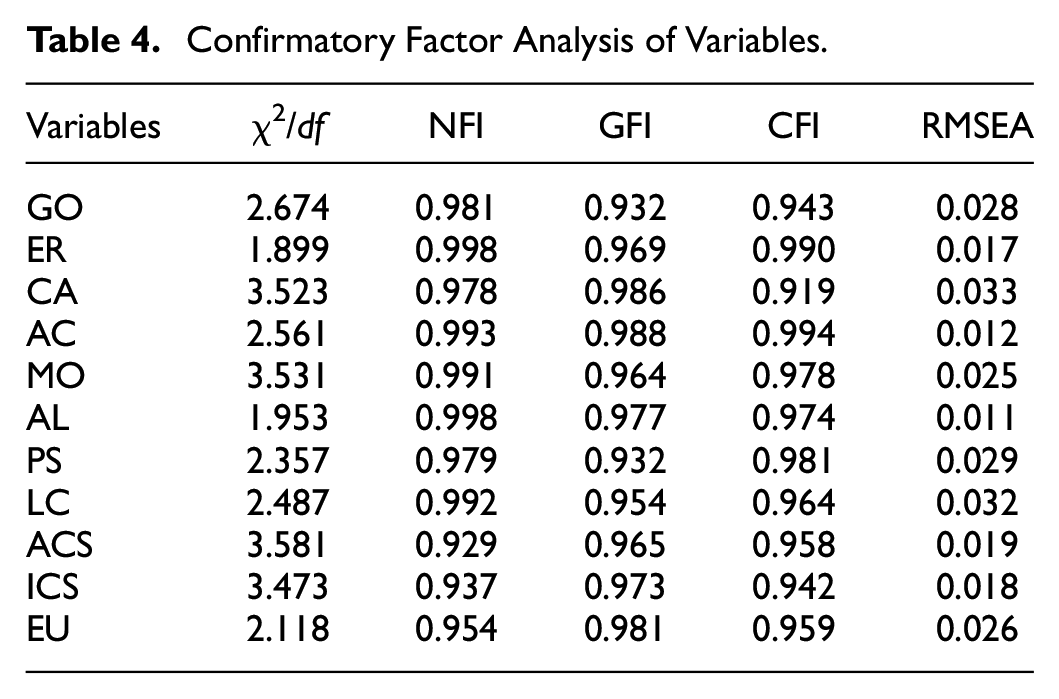
Table 5 presents the results of the discriminant validity of all variables using AMOS 24.0. For all three-factor models, χ2/df is less than 5, the normed fit index (NFI), Tucker-Lewis Index (TLI) and comparative fit index (CFI) are greater than 0.8, and the RMSEA is less than 0.1. These indicates that all the three-factor models fit the observed data better than the alternatives, and the discriminant validity of our theoretical model is acceptable (Fornell & Larcker, 1981).
Model Comparison in Confirmatory Factor Analysis.

Common Method Biases Test
To reduce common method bias, we followed suggestions by Podsakoff and Organ (1986) and clarified at the very beginning of the questionnaire that: (a) the choices were not right or wrong; (b) respondents were invited to answer the questions using their intuition; and (c) the results would only provide statistics for our study and would not involve any information about their entrepreneurial projects. In addition, the questions were presented in a simple and easy-to-understand manner, without any technical terms or academic expressions.
To check for the common method bias in the variables, we conducted Harman’s one-factor test. Through principal component analysis, we found that there were eight common factors with eigenvalues greater than 1. The variance of the first factor explained 37.326% of the total variance, which does not exceed the 40% level. The cumulative explanatory variance of the eight common factors was 66.055%, indicating that there was no serious common method bias in this study.
Descriptive Statistics and Correlations
Table 6 presents the results of the descriptive statistics and correlation coefficients for the variables.
Descriptive Statistics and Correlation.
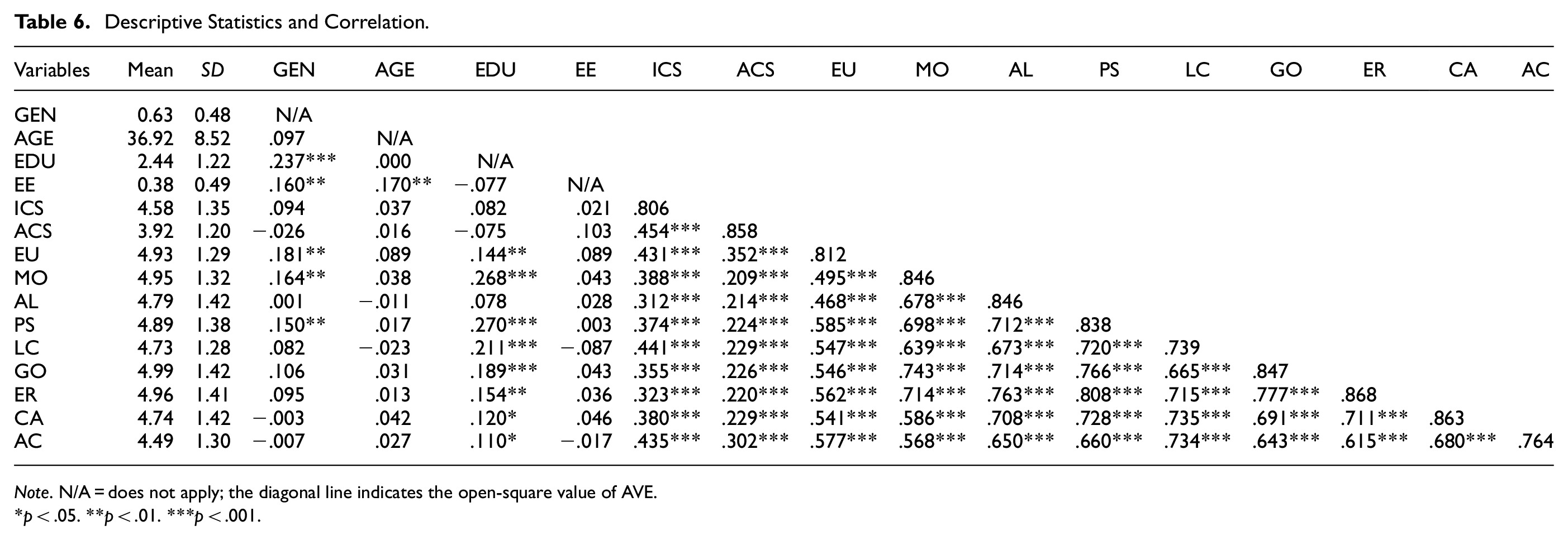
Note. N/A = does not apply; the diagonal line indicates the open-square value of AVE.
p < .05. **p < .01. ***p < .001.
Regression Analysis
Table 7 presents the results of the regression analysis of intuitive cognitive style, effectual logic and environmental uncertainty. To avoid multicollinearity between variables, the variables were centralized. In models 1 to 3, the dependent variable is the logic of means-orientation. The F values of models 1 to 3 are significant, indicating that the regression model is significant. With the addition of the independent variable, the moderator, and the interaction terms, the R2 of models 2 to 3 significantly increases. In Model 2, intuitive cognitive style has a significant positive influence on means- orientation logic (β = .360, p < .001). H1a is supported. In Model 3, it can be concluded that environmental uncertainty has no significant moderating effect on the relationship between intuitive cognitive style and means- orientation logic (β = −.092, p > .05), which indicates that H3a is not supported.
Regression Analysis of Intuitive Cognitive Style and Effectual Logic.

p < .05. **p < .01. ***p < .001.
For the dependent variable of affordable loss logic, the F values of models 5 to 6 are significant, indicating that the explanation by the regression model reaches the significance level. In Model 5, intuitive cognitive style has a significant positive influence on the logic of affordable loss (β = .307, p < .001). H1b is supported. In Model 6 the regression coefficient between the interaction term of intuitive cognitive style and environmental uncertainty is −.117 (p < .05), indicating a significant negative effect. This finding suggests that intuitive entrepreneurs’ tendency to use affordable loss logic weakens under higher environmental uncertainty, and H3b is reversely supported.
For the dependent variable of partnership logic, the F values of models 7 to 9 are significant, indicating that the explanation by the regression model reaches the significance level. According to Model 8, intuitive cognitive style has a significant positive influence on partnerships logic (β = .351, p < .001). H1c is supported. In Model 9, the regression coefficient between the interaction term of intuitive cognitive style and environmental uncertainty is −.077 (p > .05), indicating that environmental uncertainty has no significant moderating effect on the relationship between intuitive cognitive style and partnerships logic. H3c is rejected.
For the dependent variable of leveraging contingencies logic, the F values of models 10 to 12 are significant, indicating that the explanation by the regression models reaches significance. According to Model 11, intuitive cognitive style has a significant positive impact on preferences for leveraging contingencies logic (β = .429, p < .001). H1d is supported. In Model 12 the regression coefficient of the interaction term is significant (β = −.125, p < .01), indicating that when environmental uncertainty is higher, entrepreneurs with an intuitive cognitive style tend to leverage contingencies. H3d is reversely supported. From the above analysis, it is clear that HI is supported and H3 is partially supported in reverse.
Using the Johnsonã Neyman procedure, we further examined the effect of intuitive cognitive style on the logics of affordable loss and leveraging contingencies for different levels of environmental uncertainty. As shown in Figure 2, when the environmental uncertainty is below 5.402 the confidence region of the conditional effect does not contain 0, indicating that intuitive cognitive style has a significant effect on affordable loss logic. The effect is not significant if the environmental uncertainty is greater than 5.402. Figure 3 shows that intuitive cognitive style has a significant effect on the use of leveraging contingencies logic only if environmental uncertainty is less than 6.76.
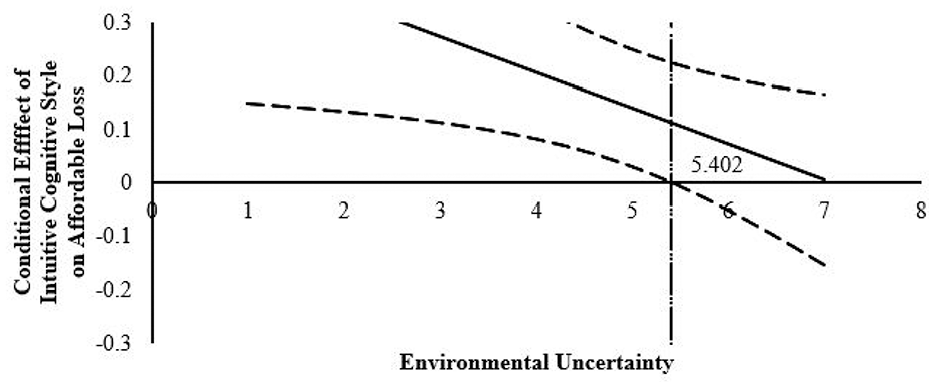
Johnson–Neyman plot for the interaction of intuitive cognitive style and environmental uncertainty on affordable losslogic.
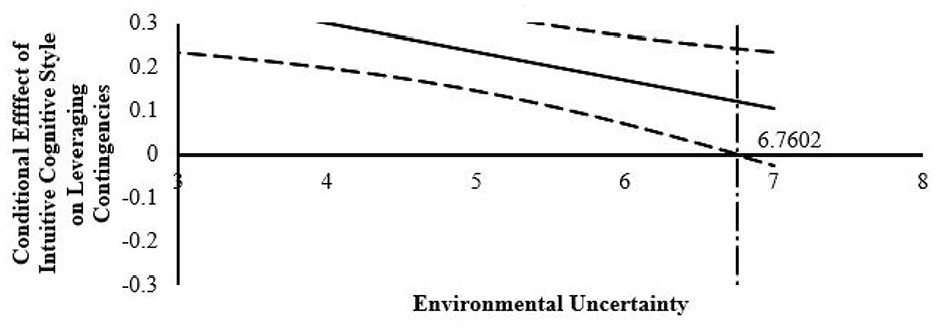
Johnson–Neyman plot for the interaction of intuitive cognitive style and environmental uncertainty on leveraging contingencies logic.
Table 8 presents the results of the regression analysis for analytic cognitive style, causal logic and environmental uncertainty. The variables are centralized to avoid multicollinearity. For the dependent variable of goals-oriented logic, the F values of models 1 to 3 are statistically significant, indicating that the explanation by the regression model is significant. In Model 2, analytical cognitive style has a significant positive influence on goals-orientation logic (β = .240, p < .001). H2a is supported. In Model 3, it can be concluded that environmental uncertainty has no significant moderating effect on the relationship between analytic cognitive style and goals-orientation logic (β = −.087, p > .05). H4a is rejected.
Regression Analysis of Analytical Cognitive Style and Causal Logic.

p < .05. **p < .01. ***p < .001.
For the dependent variable of expected return logic, the F values of models 4 to 6 are significant, indicating that the explanation by the regression model is significant. In Model 5, analytical cognitive style has a significant positive effect on expected return logic (β = .232, p < .001). H2b is supported. In Model 6 the regression coefficient of the interaction term is statistically significant (β = −.101, p < .05), showing that when environmental uncertainty is higher, entrepreneurs with an analytical cognitive style tend to apply the expected return logic. H4b is supported.
For the dependent variable of competitive analysis logic, the F values of models 8 and 9 are significant, indicating that the explanation by the regression model is significant. According to Model 8, analytical cognitive style has a significant positive impact on competitive analysis logic (β = .235, p < .001). H2c is supported. In Model 9, it can be concluded that environmental uncertainty has no significant moderating impact on the relationship between analytical cognitive style and competitive analysis logic (β = −.091, p > .05). Therefore, H4c is not supported.
For the dependent variable of avoiding contingencies logic, the F values of models 11 and 12 are significant, indicating that the explanation by the regression model reaches significance. As shown in Model 11, analytical cognitive style has a significant positive impact on avoiding contingencies logic (β = .317, p < .001). H2d is supported. In Model 12, it can be concluded that environmental uncertainty has no significant moderating effect on the relationship between analytical cognitive style and avoiding contingencies logic (β = −.081, p > .05). H4d is not supported. The above analyses show that H2 is supported and that H4 is partially supported.
A Johnson–Neyman plot provides evidence for a positive relation between analytical cognitive style and expected return logic when environmental uncertainty is below 3.3256. The analytical cognitive style does not have a significant effect on the expected return logic if environmental uncertainty is above it (see Figure 4).

Johnson–Neyman plot for the interaction of analytical cognitive style and environmental uncertainty on expected return logic.
Post Hoc Test
This paper further explores whether novice and expert entrepreneurs differ in the influence of their cognitive style on their entrepreneurial decision-making logic. Supplemental Appendix II shows the effect of entrepreneurial experience on the relationship between intuitive cognitive style and effectual logic. In Models 2, 5, 8, and 11 we added an interaction variable (intuitive cognitive style*entrepreneurial experience) to examine whether entrepreneurial experience moderates the influence of intuitive cognitive style on effectual logic. Unfortunately, no significant results were found. In Models 3, 6, 9, and 12 the regression coefficients of an interaction variable (intuitive cognitive style*environmental uncertainty*entrepreneurial experience) were also not significant, indicating that entrepreneurial experience does not change the moderating effect of environmental uncertainty on the relationship between intuitive cognitive style and effectual logic. Supplemental Appendix III shows the influence of entrepreneurial experience on the relationship between analytical cognitive style and causal logic. We did not find any significant results.
From the above analysis, it can be concluded that there are no significant differences between novice and expert entrepreneurs in terms of the influence of cognitive style on entrepreneurial decision-making logic. Although entrepreneurial experience may influence entrepreneurial decision-making logic, it cannot fully explain it (Brettel et al., 2012; Scazziota et al., 2023). Cognitive style is the essential determinant of entrepreneurial decision-making logic, reflecting the ways in which entrepreneurs prefer to collect and process information related to decision making. It affects entrepreneurial thinking, and thereby impacts entrepreneurial decision-making logic (Tryba & Fletcher, 2020).
Robustness Test
We conduct some analyses to test the robustness of our results. First, we modified the sample screening criteria to ensure the generalizability of our research results. Based on the Global Entrepreneurship Monitor, we change the sample to individuals who joined a new business within 42 months of its establishment. Analysis of this sample indicates that intuitive cognitive style is positively related to effectual logic. It positively influences the means-orientation logic (β = .452, p < .001), affordable loss logic (β = .278, p < .001), partnerships logic (β = .531, p < .001) and leveraging contingencies logic (β = .489, p < .001). In addition, analytical cognitive style has a significant positive influence on causal logic. It positively affects goals-orientation logic (β = .317, p < .001), expected return logic (β = .259, p < .001), competitive analysis logic (β = .431, p < .001) and avoiding contingencies logic (β = .279, p < .001). Environmental uncertainty negatively moderates the influence of intuitive cognitive style on affordable loss logic (β = −.159, p < .05) and leveraging contingencies logic (β = −.201, p < .01), as well as the effect of analytical cognitive style on expected return logic (β = −.191, p < .05). The results indicate that our findings are robust.
Second, we generate a random subsample of 150 by using Stata’s sample command. We rerun the analysis on this subsample, and the results are similar. The results show that intuitive cognitive style has a positive effect on means-orientation logic (β = .317, p < .001), affordable loss logic (β = .356, p < .001), partnerships logic (β = .293, p < .001) and leveraging contingencies logic (β = .377, p < .001). Moreover, analytical cognitive style is positively related to goals-orientation logic (β = .295, p < .001), expected return logic (β = .219, p < .001), competitive analysis logic (β = .311, p < .001) and avoiding contingencies logic (β = .431, p < .001). Environmental uncertainty negatively moderates the influence of intuitive cognitive style on affordable loss logic (β = −.191, p < .05) and leveraging contingencies logic (β = −.096, p < .01), as well as the effect of analytical cognitive style on expected return logic (β = −.135, p < .05). Our hypotheses are still supported.
Finally, we adopt the Impact Threshold of the Confounding Variable (ITCV) method to detect the issue of omitted variables. We run the ITCV test using our regression in our main analysis and the results of the ITCV tests indicate that an omitted variable would have to be significantly related to both dependent variables (i.e., means-orientation logic) and dependent variables (i.e., intuitive cognitive style) at greater than .291. As shown in the correlation table (Table 5), none of the other variables in our model exceeded the threshold. If our data have an omitted variables problem, we would need to replace 46.72% of the cases (157) with a zero-effects sample in their entirety to invalidate our inferences. This suggests that it is highly impossible to omit variables in our data. Therefore, we find strong evidence that the source of endogeneity is not biasing our results.
Discussion
In a series of multiple hierarchical linear regression analyses on survey dataset investigating 336 Chinese entrepreneurs’ decision-making logics, this paper examines the influence of intuitive-analytic cognitive styles on entrepreneurial decision-making logic, as well as the moderating effect of environmental uncertainty. Several conclusions can be drawn from our empirical results.
First, entrepreneurs with an intuitive cognitive style are more inclined to use effectual logic, while entrepreneurs with an analytical cognitive style are more likely to use causal logic. Intuitive entrepreneurs tend to make “time and cost efficient” decisions according to the logics of means-orientation, affordable losses, partnerships, and leveraging contingencies. Analytical entrepreneurs favor the logics of goals-orientation, expected returns, competitive analysis, and avoiding contingencies to ensure that their entrepreneurial decision-making follows a predetermined path.
Second, environmental uncertainty negatively moderates the influence of intuitive cognitive style on affordable loss logic and leveraging contingencies logic, while it does not affect means-orientation logic or partnership logic. Kickul et al. (2009) argue that entrepreneurs with an intuitive cognitive style are more confident in identifying and developing opportunities. High environmental uncertainty often brings opportunities for innovation, and they tend to invest more resources than their affordable loss to seize new opportunities. Hauser et al. (2020) indicate that entrepreneurs with an intuitive cognitive style usually make decisions according to their feelings and experience. When environmental uncertainty increases, issues such as what contingencies may occur and the probability of their occurrence usually remain unknown (Knight, 1921). Entrepreneurs may not have encountered similar situations in the past and may not have had much business experience. They cannot evaluate the benefits of leveraging contingencies and may be less likely to use leveraging contingencies logic. For the logics of means-orientation and partnerships, environmental uncertainty does not have a moderating effect. Entrepreneurs with an intuitive cognitive style focus more on their own knowledge and experience (Abdelfattah et al., 2023), and thus integrate the means and resources available in the entrepreneurial process. They do not analyze the external environment in detail, regardless of environmental uncertainty. Moreover, Barbosa et al. (2007) suggest that entrepreneurs with an intuitive cognitive style have greater risk tolerance. They do not pay much attention to the entrepreneurial environment even when environmental uncertainty is high. They employ emotional thinking and attach great importance to the satisfaction of decision-making. Under conditions of high environmental uncertainty, they are more satisfied with controlling the size of their enterprise than taking risks in partnerships (Sadler-Smith, 2016).
Third, environmental uncertainty negatively moderates the influence of analytical cognitive style on expected returns logic, while it does not change the influence of goals orientation logic, competitive analysis logic, or avoiding contingency logic. The linear mindset of entrepreneurs with an analytical cognitive style indicates that they conduct goal analysis regardless of the environmental conditions. They gather information, conduct a predictive analysis, and make entrepreneurial decisions based on goals even if the environment is highly uncertain (Osiyevskyy et al., 2023). Due to their risk aversion, entrepreneurs with an analytical cognitive style are not affected by environmental uncertainty because of their linear thinking inertia; they still conduct a competitive analysis regardless of circumstances (Barbosa et al., 2007). In highly uncertain environments entrepreneurs with an analytical cognitive style find it more difficult to remain fully informed as contingencies occur (Kickul et al., 2009). To grasp information more comprehensively and driven by linear thinking, they do not attach much importance to environmental uncertainty and tend to avoid contingencies.
Implications
Theoretical Implications
First, it implies clarifying the relationship between intuitive and analytical cognitive styles, suggesting that they coexist in shaping entrepreneurial decision-making logic. Existing studies always regard them to be antithetical (Kickul et al., 2009). This paper finds that intuitive cognitive style is positively related to effectual logic and that analytical cognitive style has a positive influence on causal logic. This indicates that intuitive and analytical cognitive styles do not compete with each other but work together in entrepreneurial decision-making.
Second, this paper adds a psychological perspective on the antecedents of entrepreneurial decision-making. The extant literature explores the influence of exogenous factors, such as prior experience and social capital, but they often draw inconsistent or even contradictory conclusions (McKelvie et al., 2020). This paper analyses the influence of cognitive styles on entrepreneurial decision-making logic, inspiring further studies examining entrepreneurial decision-making logic from more diverse perspectives (Alsos et al., 2020).
Third, this paper verifies that entrepreneurial decision-making logic is the result of interactions between cognitive style and the environment, inspiring scholars to explore entrepreneurial decision-making logic with a combination of multiple elements. Existing studies have often analyzed the direct impact of a single factor, such as entrepreneurial experience, on entrepreneurial decision logic (Scazziota et al., 2023). This has resulted in only a limited understanding of entrepreneurial decision-making logic.
Practical Implications
This study inspires entrepreneurs to make decisions more effectively by choosing an appropriate entrepreneurial decision-making logic according to environmental uncertainty and cognitive styles. In general, entrepreneurs with an analytical cognitive style use more causal logic, while entrepreneurs with an intuitive cognitive style rely more on effectual logic. However, in highly uncertain entrepreneurial environments, analytical entrepreneurs should not attach too much importance to expected returns, while intuitive entrepreneurs should not rely too much on affordable losses and leveraging contingencies.
Furthermore, this paper inspires educational institutions to integrate new content about entrepreneurial decision-making and cognitive styles. According to the existing tenets, which are taught in most business schools, entrepreneurs are mainly trained to make decisions through causal logic. Some pioneers have realized the importance of effectual logic and tried hard to popularize it, but business schools generally do not teach entrepreneurs how and when to choose the right decision-making logic. This paper enlights that entrepreneurial educators should develop diverse content for the education of entrepreneurs with different cognitive styles.
Limitations and Further Directions
This study has several limitations. First, this paper only analyzes the impact of intuitive cognitive style on effectual logic and the impact of analytical cognitive style on causal logic. Causal logic and effectual logic are not negatively related or opposites; rather, they overlap with each other in some respects and can even be used together (McKelvie et al., 2020). The combined effects of causal logic and effectual logic were not included in this analysis. The relationships between intuitive cognitive style and causal logic, as well as between analytic cognitive style and effectual logic, have not been explored. Future work could explore these issues.
Second, this paper only explores the direct effects of cognitive styles on entrepreneurial decision-making logic. The mediating variables between cognitive styles and entrepreneurial decision-making logic, such as self-efficacy, need to be developed. Other moderating variables, such as entrepreneurial orientation, can also be explored. Future studies can examine more complex relationships between cognitive styles and entrepreneurial decision-making logic, such as moderated mediation effects or mediated moderation effects.
Third, the measurement of entrepreneurial decision-making logic is expected to improve. This paper adopted the scale developed by Brettel et al. (2012), which has been recognized by many previous studies but has also been questioned. It does not analyze the logic underlying a specific decision, simply capturing a general decision-making approach that is used during venture formation or product innovation (Alsos et al., 2020; McKelvie et al., 2020). Sarasvathy (2001) regards entrepreneurial decision-making logic as an act of considering only one hypothetical decision at a time. We recommend that scholars further elicit what they intend to measure—that is, the behavior of entrepreneurs or their decision-making logic—and then choose appropriate measures accordingly. Further work should integrate questionnaires, experiments, case studies and other research methods to grasp the essence of entrepreneurial decision-making logic.
Fourth, the representativeness of the research data needs to be further improved. This paper uses cross-sectional data, and the distribution of samples was uneven across regions and industries. Entrepreneurial decision-making constantly occurs during the process of entrepreneurship. The cognitive style evolves over a long period of time, and future research should try to overcome the shortcomings of cross-sectional data, possibly using panel data across regions and industries to engage in a dynamic tracking survey.
Conclusions
This paper examines the influence of intuitive-analytic cognitive styles on entrepreneurial decision-making logic, as well as the moderating effect of environmental uncertainty. The empirical results show that entrepreneurs with different cognitive styles prefer different entrepreneurial decision-making logics. In addition, their relationships are moderated by environmental uncertainty. This study indicates that intuitive and analytical cognitive styles are not antithetical. They coexist in shaping entrepreneurial decision-making logic. It also verifies that entrepreneurial decision-making logic is the result of interactions between cognition and the environment.
Supplemental Material
sj-docx-1-sgo-10.1177_21582440241273297 – Supplemental material for The Influence of Intuitive-Analytical Cognitive Styles on Entrepreneurial Decision-Making Logic: Moderated by Environmental Uncertainty
Supplemental material, sj-docx-1-sgo-10.1177_21582440241273297 for The Influence of Intuitive-Analytical Cognitive Styles on Entrepreneurial Decision-Making Logic: Moderated by Environmental Uncertainty by Yalong Wei, Dan Long and Lihua Fu in SAGE Open
Footnotes
Declaration of Conflicting Interests
The author(s) declared no potential conflicts of interest with respect to the research, authorship, and/or publication of this article.
Funding
The author(s) disclosed receipt of the following financial support for the research, authorship, and/or publication of this article: The Fundamental Research Funds for the Central Universities, Grant Number JS2023ZSPY0052.

Data Availability Statement
The data supporting this study’s findings are available from the corresponding author upon reasonable request.
Supplemental Material
Supplemental material for this article is available online.
References
Supplementary Material
Please find the following supplemental material available below.
For Open Access articles published under a Creative Commons License, all supplemental material carries the same license as the article it is associated with.
For non-Open Access articles published, all supplemental material carries a non-exclusive license, and permission requests for re-use of supplemental material or any part of supplemental material shall be sent directly to the copyright owner as specified in the copyright notice associated with the article.
