




Abstract
The primary objective is to compare the difference in preschool teachers’ understanding of the five competencies of social-emotional learning (SEL) in India. The purpose is to assist teachers in reflecting on their emotions and knowledge about SEL, which is important for their personal and professional development. However, the research on preschool teachers’ own SEL is very limited in the state of Punjab in India. Therefore, this study examined 90 teachers’ understanding of SEL via a survey and a self-reported questionnaire. The data were analyzed using descriptive statistics (mean and standard deviation) and parametric t-test in SPSS. The results revealed that private preschool teachers of the Ludhiana and Patiala districts of Punjab have better knowledge about the competencies of SEL than public preschool teachers. The findings highlight the need to improve the SEL of both public and private preschool teachers, focusing on public preschool teachers through continuous and effective training interventions.
Keywords
Introduction
Childhood is a crucial stage of development that forms the foundation of holistic development and psychological wellbeing (UNICEF, 2018). A growing body of research has shown that it is essential to develop students’ social-emotional learning (SEL) competencies (Oberle et al., 2016). The studies have concluded that preschool years are the crucial developmental period wherein the development of social-emotional learning is a crucial milestone in the lives of preschool children (Denham et al., 2014; Odom et al., 2008). Social-emotional learning is associated with a child’s academic-social-emotional-motor skills development and school readiness (Bierman et al., 2008; Oberle et al., 2014; Trentacosta & Izard, 2007). Social-emotional Learning (SEL) is defined as “the process through which children and adults learn and apply a set of social, emotional, behavioral, and character skills required to succeed in schooling, workplace, relationships, and citizenship” (Jones et al., 2017). Schools are the platforms that support children in developing eloquent social connections, cultivating self-potential, and enhancing their social and emotional learning competencies under the supervision of teachers (Galindo & Sheldon, 2012; Jones & Bouffard, 2012; López-Pérez & Fernández-Castilla, 2018). Thus, teachers play a requisite role in a child’s social-emotional learning and development (Taylor et al., 2017).
Preschool teachers are the engine that powers SEL interventions and practices in preschools and classrooms (Schonert-Reichl, 2017). Since early childhood teachers play an essential role in developing students’ social-emotional learning competencies, it is necessary to explore their understanding of social-emotional learning competencies to teach more effectively (Jones & Bouffard, 2012; López-Pérez & Fernández-Castilla, 2018). Teachers’ social-emotional learning and knowledge about SEL competencies are essential, especially in the Early Childhood Care and Education (ECCE) profession. This knowledge is essential in order to master the social and emotional obstacles inherent in their profession (including online teaching, low salaries, and limited opportunities for self and professional development) that result in high work-related pressures, poor mental health, and emotional enervation among them (Jones et al., 2017; McMullen et al., 2020; Thorpe et al., 2020). The role of preschool teachers is intricate and multifaceted, demanding an obligation to continuous development, resilience, and emotional competence to take on numerous challenges (Beltman et al., 2020; Irvine et al., 2016; Liu et al., 2018).
Recent advances in research have suggested that socially and emotionally competent teachers play a fundamental role in building solid and positive teacher-student relationships in preschools (Jennings et al., 2017; Zinsser & Curby, 2014). Moreover, teachers who can recognize their social-emotional wellbeing can successfully implement SEL interventions in their classrooms (Hen & Goroshit, 2016). To develop and to promote students’ social and emotional learning, which is the fulcrum of their holistic development, “teachers themselves need the social and emotional skills required to communicate with students and to handle stressful situations that can occur in the classroom” (Brackett et al., 2012). Thus, SEL is key to teachers’ occupational well-being and positive student development (Aldrup et al., 2020; Cumming, 2017). Ample research has been done on promoting the understanding and knowledge of SEL among teachers in developed nations, including the United States, Australia, the United Kingdom, and Hong Kong (Yoder, 2014). Until recently, however, in India’s context, limited studies have been conducted on preschool teachers to gauge their understanding and knowledge about SEL and its competencies.
The present study is about preschool teachers’ current knowledge of SEL and its five competencies in the state of Punjab in India. The study is critical because of two significant reasons. Firstly, the SEL understanding in teachers will help them recognize and manage emotions impacting their personal growth. Secondly, the understanding of SEL in preschool teachers will motivate them to improve their teaching to face the social and emotional challenges inherent in their teaching profession and build positive teacher-student relationships (Aldrup et al., 2020; Jennings & Greenberg, 2009). Furthermore, it is necessary to compare teachers’ understanding in different settings. For this reason, the purpose of this study is to compare the difference in preschool teachers’ understanding of the competencies of SEL in regards to the private and public preschools in India. Comparing the two different school types is important because it aims to provide the public and private preschool teachers with an opportunity to reflect on their SEL and teaching philosophy. The comparison will help to know whether or not there is any basic understanding of SEL among preschool teachers. Also, the findings will allow the educationalists, school administrations, and policy-makers to know which school type has more socially and emotionally knowledgeable teachers and which school type requires immediate attention through training interventions.
Moreover, the motive behind this study is to know where the education and training system is lacking in the personal and professional development of preschool teachers in India. The present study aims to address the areas that require immediate improvements in areas of SEL development. Further, the purpose of the current study is to assist preschool teachers in explicitly monitoring themselves and their knowledge about SEL competencies so that they can manifest SEL into themselves and teach these skills to students. The teachers’ understanding of SEL competencies will reflect on their emotions, feelings, thoughts, and social skills. The results will direct preschool teachers’ attention to the importance of SEL and work on SEL areas and competencies that require improvement and professional development. Therefore, this study aims to conceptualize social-emotional learning and its competencies in the literature review. Additionally, the study discusses the relevance of basic understanding of social-emotional learning and its competencies among preschool teachers.
Therefore, this study focused on the following objectives:
To measure preschool teachers’ basic understanding of social-emotional learning and its competencies.
To compare teachers’ understanding of social-emotional learning between the private and public preschools located in two districts, namely Ludhiana and Patiala of the state of Punjab in India.
The present study attempts to answer the following two questions:
(1) Is there any basic understanding about social-emotional learning and its five competencies among preschool teachers? and
(2) Is there any difference between public and private preschool teachers’ understanding of social-emotional learning and its five competencies?
Literature Review
Conceptualizing Social-Emotional Learning and Its Competencies
Early childhood teaching is customarily indicated to require a high degree of emotional work and social interaction (Jeon et al., 2016). Nevertheless, limited studies explore the teachers’ understanding and knowledge of their own social and emotional wellbeing. The consideration of teachers’ SEL is an essential domain for teachers’ personal social-emotional growth, professional development, and for promoting a safe and supportive classroom environment, positive social involvements, and their social-emotional wellbeing (Collie et al., 2012; Jennings & Frank, 2015; Jennings & Greenberg, 2009; Klusmann et al., 2008). The field of SEL developed some 25 years ago with the publication of Goleman’s Emotional Intelligence (1995) and Gardner’s Multiple Intelligences (1993), creating an extensive body of philosophy, research, and practice that encouraged practitioners to implement SEL curriculums for pre-K-12 students in and out of schools. In 1994, Collaborative for Academic, Social, and Emotional Learning (CASEL) was established as an international non-profit society to form evidence-based SEL as an indispensable part of school education. CASEL (2018) described SEL as “the process through which children and adults understand and manage emotions, set and achieve positive goals, feel and show empathy for others, establish and maintain positive relationships, and make responsible decisions.” Social-emotional learning (SEL) and Social-emotional competence (SEC) are interrelated and multivariate construct which includes one’s ability to identify emotions in themselves and others, being able to manage their emotions appropriately, having positive interactions with teachers and students, and solving problems effectively (Zins & Elias, 2007). Five core teachable social and emotional competencies essential to SEL are self-awareness, self-management, social awareness, relationship skills, and responsible decision making (CASEL, 2003). Together, this suite of competencies forms the personal skills necessary for individuals to connect with others and meet the challenges of life, as explained in Table 1 below.
Teacher Social-emotional Learning (SEL) Competencies.
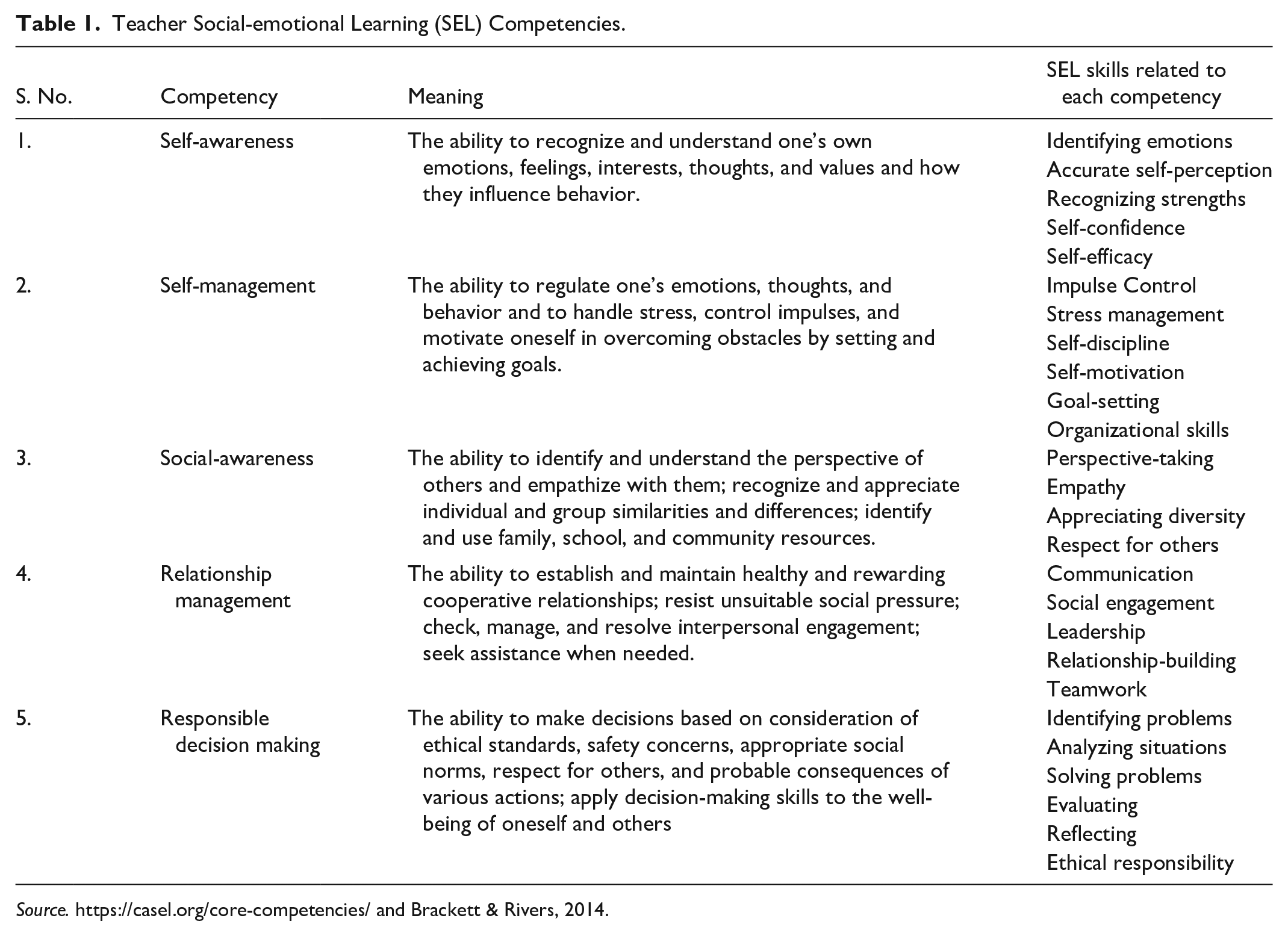
Even the previous research on SEL has shown that among preschool teachers, self-awareness may be evident from their understanding of the knowledge, abilities, and capabilities they have or need to cultivate, their sagacity of self-efficacy in their teaching, and their optimistic mindset about their students and their existing skills and future progress. Beyond the classroom, this can be seen in teachers’ buoyancy and affirmative state of mind while interacting with colleagues and parents of students (Ryan et al., 2015; Wang et al., 2015). Similarly, the competency of self-management can be apparent from the teachers’ ability to regulate their emotions while engaging with students and colleagues in preschool, their coping skills, motivation, and engagement in the classroom, and their capability to set clear and compelling goals (Collie & Martin, 2016; Martin et al., 2012; Mattern & Bauer, 2014). Social awareness in the preschool teachers’ can be visible from their efforts exerted while recognizing and empathizing with the perceptions of students, student’s families, and colleagues; from their sense of care toward them; and from their awareness of social norms of proper conduct in their dealings with the school community (Domitrovich et al., 2016; Perry et al., 2015; Weissberg et al., 2015). In the preschool, relationship management may manifest as the teachers’ skills to interact with students and colleagues in compassionate ways, develop and model suitable conflict-solving ways, and seek or offer assistance to students and colleagues as needed (Collie et al., 2016; Zinsser et al., 2014). Finally, the last competency of SEL, that is, responsible decision making, can be seen through teachers’ actions while making decisions in the classroom, making judgments about students’ behavior and from their problem-solving skills (CASEL, 2018; Weissberg et al., 2015). The evidence in literature is mounting on the need and importance of Social-Emotional Learning (SEL) for teachers’ well-being and students’ positive academic-social-emotional-mental outcomes in preschool (Banerjee et al., 2014; Humphrey et al., 2020). Therefore, the policymakers are beginning to realize the prominence of SEL for early educators as they are the engines for driving successful SEL interventions in preschools and classrooms.
Relevance of Basic Understanding About Social-Emotional Learning and Its Five Competencies Among Teachers
It is deep-rooted that teachers’ social-emotional learning is crucial to their effective working in the school—including their use of effective classroom management techniques, provision of student learning support, and creation of supportive learning settings for students (Kunter et al., 2013; McLean & Connor, 2015; Shen et al., 2015). More recently, educationists have begun to acknowledge the importance of teachers’ social-emotional wellbeing (Jennings & Frank, 2015). Studies have reported the importance of developing teachers’ understanding of SEL. Understanding SEL can help preschool teachers recognize and manage their emotions and create and practice positive emotions (such as joy and enthusiasm) to stimulate SEL in themselves and their students (Jennings, 2011). It can enhance their self-awareness by developing a realistic understanding of their proficiencies and identifying their emotional strengths and weaknesses (Elias, 2009). Furthermore, social-emotional understanding can impact teachers’ social awareness and relationship management. SEL knowledge can help teachers, both in their personal and professional development.
Even previous research has concluded that teachers with strong understanding of SEL can develop healthy relations with students, which positively impacts students’ academic performance, achievements, social functioning, emotional competence, and school engagement (Murray & Zvoch, 2011; Spilt et al., 2011). Socially and emotionally competent preschool teachers can help students build positive interactions with their peers, display positive behaviors, learn with happiness, and manage conflicting behaviors starting from the early years (Gest & Rodkin, 2011; Kaur & Sharma, 2021b). This strong teacher-student relationship can result in the child’s successful school adjustment and positive school outcomes (Baker et al., 2008).
Therefore, to develop students’ social-emotional competence, it is essential to develop an understanding of SEL amongst teachers first to teach more effectively. This understanding is needed because SEL can improve teachers’ emotional expressiveness while interacting with preschool children and colleagues, and build supportive relationships through mutual understanding and cooperation (Jennings & Greenberg, 2009). SEL in teachers can support them in making responsible decisions, exhibit prosocial behavior, and manage their responses even when emotionally provoked by challenging circumstances (Goddard et al., 2004). Thus, SEL in preschool teachers is essential for promoting self-development, portraying positive attitudes toward teaching, improving relationships within and outside preschool, and promoting a supportive and caring classroom environment for preschool students (Domitrovich et al., 2016; Weissberg et al., 2015).
However, limited studies have been conducted on preschool teachers and their understanding of SEL in India. Also, it is necessary to compare teachers’ understanding in different settings and demographic variables. For this reason, this study has specifically tried to compare the current understanding of SEL based on public and private preschools. A study done in the Faridabad district of Haryana in India found a significant difference in emotional competence between private and public school teachers. The results showed that teachers in private schools were more emotionally intelligent than their public school counterparts (Garg & Kapri, 2016). Further, studies have concluded that the quality of “teaching and learning” was the main reason for choosing private schools over public schools in India (Von Stumm & Plomin, 2021; Young Lives, 2017).
Therefore, the present study attempts to study the level of preschool teachers’ understanding of SEL in the Punjab state of India. Though India is considered the hub of the Early Childhood Care and Education (ECCE) services, the current picture of the early education system in the state of Punjab in India, specifically in the rural and economically disadvantaged areas, seems to be nerve-wracking (Kaur & Sharma, 2021a). The concerns in the school system in Punjab (India) have reached beyond poor quality of ECCE frameworks, social-emotional complications, and poor academic grades (State Council of Educational Research and Training [SCERT] Report by Sisodia et al., 2019). The efforts to improve the quality of teaching has increased pressure on teachers, including demands for higher qualifications (Cumming et al., 2015), long working hours and low payscale (Thorpe et al., 2020), increased teachers’ feelings of anger, insensitivity, frustration, and anxiety (Aldrup et al., 2020; Dicke et al., 2015), and depleted emotional and mental health (Eadie et al., 2021; Irvine et al., 2016; Jones et al., 2017). Therefore, understanding social and emotional learning in preschool teachers is inextricably linked to their social-emotional wellbeing, mental health, student learning, and developmental outcomes (King et al., 2016; Smith & Lawrence, 2019). In the current study, the authors have conveniently opted to survey the teachers in the two districts, Patiala and Ludhiana, in Punjab. Though Punjab has both public and private preschools with modern teaching equipment (Singh, 2015; Singh & Mukherjee, 2017), the study’s primary aim was to check if there exists any difference in the SEL understanding among preschool teachers.
Methodology
Study Context
The study aims to reflect on the preschool teachers’ current understanding of their SEL and its five competencies. Secondly, this study aims to assess whether or not there is any significant difference in the understanding level about SEL between private and public preschool teachers teaching in Punjab state of India. The comparison is to access the gap in social-emotional learning competencies between private and public preschool teachers in Punjab (India). The analyses will allow preschool teachers to reflect on their social-emotional learning competencies. Furthermore, the findings will direct policymakers and educationalists to rethink teachers’ professional and personal development in our current education system (UNESCO, 2016).
Design of the Study
The current study utilized a descriptive survey method to study the level of understanding of five competencies of SEL among preschool teachers in Punjab (India). To solve the need, a self-reported survey instrument was designed, and the responses of preschool teachers were analyzed using SPSS.
Tools
Several self-report questionnaires are available to gauge emotion regulation, social awareness, and relationship management skills in teachers and adults. The below-given survey instruments were adapted, and a questionnaire for examining teachers’ understanding of SEL via its five competencies was prepared.
Self-Awareness Outcome Questionnaire (SAOQ) by Sutton (2016).
Measurement of Teachers’ Social-Emotional Competence-Development of the Social-Emotional Competence Teacher Rating Scale by Tom (2012).
Social and Emotional Learning (SEL) Knowledge Scale for Preservice Teachers by Buchanan et al. (2009).
Social and Emotional Learning (SEL) Beliefs Scale for Preservice Teachers by Brackett et al. (2012).
The CASEL Guide to Schoolwide SEL (2019) by CASEL (2018).
The researcher constructed Social-Emotional Learning (SEL) Scale for teachers (refer to Appendix) to examine their understanding of SEL based on their prior and current knowledge. This scale consisted of 113 items with 5-point Likert scale covering five subscales: (a) self-awareness with the reliability of .816, (b) self-management with the reliability of .767, (c) social awareness with the reliability of .741, (d) relationship management with the reliability of .805, and (e) responsible decision making with the reliability of .846. The total reliability of the test is .991, which indicated greater internal consistency of the items in the SEL scale.
Participants and Procedures of the Study
This study is based on a stratified random sampling of 90 preschool teachers selected from two districts, namely, Patiala and Ludhiana of Punjab in India. This sampling method was chosen because of its intention to focus on the defined strata of preschool teachers from two specific districts of Punjab in India. The sample was free from the researcher’s bias but may have missed the complete representation of the sample. The permission of the District Education Officer (DEO) was taken to select the schools for conducting the survey. Ninety preschool teachers teaching the age-group 3 to 6 years were recruited for the study. The preschools selected belonged to both rural and urban areas of Punjab. Out of 90 teachers selected for this study, 45 teachers belonged to two private preschools (one from Ludhiana and one from Patiala) and 45 belonged to three public preschools (one from Ludhiana and two from Patiala) located in Punjab (India). A cross-sectional survey design was employed to investigate the research questions. Before conducting the survey, an awareness session was conducted where participants were provided with information about the study and an online consent form. Participation was voluntary, and participants were informed that their information would be confidential and securely stored. All participants provided informed consent. The survey took teachers approximately 20 minutes to complete the questionnaire for measuring the level of understanding about SEL in them.
Socio-Demographic Profile of the Respondents
In the SEL scale for teachers, the first part of the scale included five questions relating to the demographic profile of the respondents as given in Table 2 below. In this section, the frequency and percent of the responses were calculated for each of these sections.
Profile of the Respondents.

The above Table 2 shows that respondents included 90 preschool teachers from private and public preschool, teaching children within the age group of 3 to 6 years. Out of 90 respondents, 45 teachers belonged to two preschools (one private and one public) located in urban areas of Punjab, and 45 teachers belonged to three preschools (one private and two public) located in rural areas of Punjab. Total respondents were 90, 75 were female, and 15 were males. Talking about the years of professional teaching experience, 37 preschool teachers have been teaching for 0 to 10 years, 47 teachers have been teaching for 11 to 20 years, and 6 have been teaching for over 20 years in preschools. In the profile of education qualification, 38 out of 90 preschool teachers have done masters, 43 teachers have done masters with specialization degree, and 6 teachers were doctorates. Teachers reported that the total student population size of the five preschools was approximately 650. This indicates that the number of children per classroom, headed by two teachers, ranged from 10 to 15. All the participants belonged to the districts of Ludhiana and Patiala in the state of Punjab in India.
Statistical Techniques Used
Descriptive statistics (mean and standard deviation) is used in this study. Furthermore, Cohen’s D is measured to report effect size, representing how large an effect is, and the parametric t-test is applied in SPSS to determine whether the difference exists in the level of understanding of five competencies of SEL between private and public preschool teachers, teaching in preschools of Ludhiana and Patiala districts of the Punjab state in India. Then, the results are reported and discussed.
Results
Findings of the Teachers’ Understanding About Social-Emotional Learning and Its Five Competencies
This section answers the research question on the basic understanding of social-emotional learning and its five competencies among preschool teachers. According to Table 3, the mean results reveal that the value of preschool teachers’ understanding of SEL is 426.60, and the median is 433.00. The Skewness is −0.292 (within the range of −1 and +1), and Kurtosis is −0.352 (between −3 and +3). According to the results, it can be concluded that the data is normally distributed, and the positive mean value signifies that most of the preschool teachers in this study have a good understanding of social-emotional learning (Singh, 2015). The findings revealed that yes, the preschool teachers in Ludhiana and Patiala districts of Punjab state in India have good basic understanding about social-emotional learning.
Frequency Distribution of Teachers’ Understanding About SEL in Preschools of Punjab.

Further, the teachers’ understanding of the five competencies of SEL, namely self-awareness, self-management, social-awareness, relationship management, and responsible decision-making, was examined and reported in Table 4. The mean value of understanding relationship management competency was highest in preschool teachers, followed by social awareness, self-awareness, responsible decision making, and self-management. Also, the Skewness and Kurtosis lie within their acceptable range. The findings signify that most preschool teachers in this study have a good understanding of the five competencies of social-emotional learning. The results show that knowledge of the SEL and its five competencies is essential for preschool teachers, regardless of the difference in the type of schools they are working in (Zinsser et al., 2014).
Frequency Distribution of Teachers’ Understanding about Five Competencies of SEL.

To answer the second question, if there is any difference in the preschool teachers’ understanding of social-emotional learning and its five competencies between public and private preschool teachers. It is evident from the above Table 5 that the mean value and standard deviation of teachers in private preschools are higher than the mean value and standard deviation of teachers in public preschools located in the Ludhiana and Patiala districts of Punjab (India). The results reveal that yes, there exists a significant difference between public and private preschool teachers’ understanding about social-emotional learning in Ludhiana and Patiala districts of Punjab state in India. The findings highlight that the preschool teachers’ understanding of SEL in private schools is better than teachers’ understanding in public preschools. Also, to accompany reporting the results, effect sizes are calculated using Cohen’s D to measure how large is the difference in preschool teachers’ understanding of SEL in Punjab (India) in below-given Table 6.
Mean Comparison of Teachers’ Understanding About SEL by School Type.

Calculation of Cohen’s D.

Note. Cohen’s D is one of the most common ways to measure effect size, representing how large an effect is. Cohen’s D is used to indicate the standardized difference between the two means used to compare. This can be used to accompany reporting of t-test. The result of Cohen’s D means use the general “rule of thumb” guidelines where: Small effect = 0.2; Medium effect = 0.5; and Large effect = 0.8.
The effect size value of Cohen D is 0.998, which is more than 0.8 (large effect size limit). The result represents a large effect, indicating that the two means are likely different. This concludes that there is a large effect and a major difference in the understanding level of SEL between public and private preschool teachers in Punjab. The teachers in private preschools in Punjab (India) have a better understanding of SEL than teachers in public preschools. The findings highlight the dire need to improve the SEL of teachers teaching in public preschools in Punjab (India). To investigate the details, the mean and standard deviation of all five competencies of SEL was measured separately. The data is in the ordinal scale (Likert scale), normally distributed and within the acceptable ranges of Skewness and Kurtosis. Further, to answer the research question and test the difference in the level of understanding of each competency of social-emotional learning between private and public preschool teachers in-depth, an independent t-test was applied in SPSS, as shown in Table 7.
Independent Sample t-test to Compare Means of Five Competencies of SEL by School Type.

p < .05. **p < .01. ***p < .001.
There are five competencies of social-emotional learning. As an answer to the research question, all five competencies of SEL were analyzed separately to compare the difference in private and public preschool teachers’ reflections about SEL. It is clear from Table 7 that for self-awareness competency, the mean score of private preschool teachers (4.06) is higher than public preschool teachers (3.52). The value of “t” for the mean scores of the two groups is 4.24, which is more than the table value at 0.05 level (1.98) and 0.01 level (2.63). It indicates that there is a significant difference that exists in the understanding level of self-awareness between the private and public school teachers. The primary skills of this competency are identifying the feelings and thoughts in the form of words in self, seeing one’s strengths and weaknesses, having accurate self-perception, and differentiating between real and unreal emotional expression (CASEL, 2013). The knowledge of self-awareness among private preschool teachers in Punjab is comparatively more than public preschool teachers. The findings indicate a need for public preschool teachers in Punjab in India to recognize and reflect on their own emotions, feelings, thoughts, and behaviors. The second competency of SEL is self-management, which is the ability to regulate one’s emotions, control impulses and stress, and motivate oneself in setting and achieving goals. The results reveal that the mean scores of private preschool teachers (3.91) are higher than public preschool teachers (3.36). The value of “t” is 3.94, which is slightly more than the table value at 0.05 level (1.98) and 0.01 level (2.63). It shows that there is little difference between private and public preschool teachers in the level of understanding of self-management competency in the study. The results reflect that both private and public preschool teachers can manage their emotions, thoughts, stress, impulses, and behavior.
The third competency of social awareness refers to the ability to understand the perspective of others and empathize with them. The results highlight that the understanding of social awareness among private preschool teachers (mean scores = 4.06) is higher than those in public preschools (mean scores = 3.58). The value of “t” for the mean scores of the two groups is 4.14, which is more than the table value at 0.05 level (1.98) and 0.01 level (2.63). It shows that there is a significant difference that exists between private and public preschool teachers. The findings highlight the need to address perspective-taking skills, appreciating diversity, and empathizing with others among public preschool teachers in Punjab (India). The fourth competency of SEL is relationship management. It refers to creating and sustaining healthy, cooperative, and communicative relationships with people around. The results indicate that the mean score of private preschool teachers (4.17) is much higher than public preschool teachers (3.55). Also, the “t” value is 4.69, which is more than the table value at 0.05 level (1.98) and 0.01 level (2.63). It indicates a significant difference in the understanding level of relationship management between the private and public school teachers in the present study. Lastly, it is clear from the table for responsible decision-making competency that the mean score of private school teachers (4.00) is higher than public preschool teachers (3.52). The value of “t” for the mean scores of the two groups is 3.57, which is more than the table value at 0.05 level (1.98) and 0.01 level (2.63). It indicates a significant difference in the knowledge about the responsible decision-making competency between the private and public preschool teachers in the state of Punjab in India.
Furthermore, to accompany reporting of the t-test results, effect sizes of all five competencies are calculated using Cohen D in Table 8.
Calculation of Cohen’s D for Five Competencies of SEL.

The results from above Table 8 indicate a large effect, indicating that the two means are likely different in all the five competencies of SEL, calculated separately. This concludes that there is a large effect and a major difference in the understanding level of all five competencies of SEL between public and private preschool teachers. The findings emphasizes on the need to improve the SEL of both public and private preschool teachers, focusing on public preschool teachers through continuous and effective training interventions in Punjab (India).
Therefore, based on the results, the study answers the research questions. It can be reported that:
Yes, the preschool teachers teaching in the Ludhiana and Patiala districts of Punjab in India have basic knowledge and understanding of social-emotional learning and its five competencies.
Yes, there is difference between public and private preschool teachers’ understanding of social-emotional learning and its five competencies. The level of understanding and knowledge of all five social-emotional learning competencies in private preschool teachers is higher than public preschool teachers in the Ludhiana and Patiala districts of Punjab in India. Thus, the findings highlight the need to improve the public preschool teachers’ understanding of SEL and its competencies in Punjab (India). This understanding and reflection of SEL will result in teachers’ personal and professional development and supplement their teaching of SEL to students.
Discussion
The importance of Early Childhood (EC) teachers’ wellbeing has brought into the light the need to focus on social-emotional learning (SEL) among them (Ashraf et al., 2017; Eadie et al., 2021). The core subject of this study was the significance of SEL among preschool teachers. This article has discussed the concept and meaning of social-emotional learning and the five competencies, as defined by CASEL. Furthermore, this article has shown the rationale behind the focus on social-emotional learning of preschool teachers. The article has discussed the importance of teachers’ understanding of SEL teaching in preschools. Ample research has been done on promoting the understanding and knowledge of SEL among teachers in developed nations. Recently, Indian educationalists have also acknowledged the significance of social and emotional learning in the holistic development of preschool teachers and students in the National Education Policy (NEP) 2020 of India. NEP of India states that the education system needs to focus on “developing good human beings capable of rational thought and action, possessing compassion and empathy” (Jha & Parvati, 2020). However, there is no empirical research done to examine the preschool teachers’ understanding of SEL in private and public preschools located in the state of Punjab in India.
The present study has examined the level of preschool teachers’ understanding of social-emotional learning concerning the private and public preschools located in two districts, namely Ludhiana and Patiala in the state of Punjab in India. The aim behind comparing the two different school types was to facilitate the private and public preschool teachers to reflect on their own social and emotional learning and development. Moreover, if any difference in understanding of SEL arises in findings, policymakers and educational authorities can think to develop and implement interventions for teachers’ SEL development. The results revealed that the preschool teachers in Punjab have a good understanding of SEL and its five competencies. However, in the awareness session, the authors found out that both private and public preschool teachers are lacking in the knowledge and understanding of SEL and its competencies. But, while comparing, there exists a significant difference in the level of teachers’ understanding of SEL and its five competencies, namely, self–awareness, self-management, social awareness, relationship management, and responsible decision-making between private and public preschool teachers. The findings revealed that private preschool teachers have better knowledge about SEL and its competencies than public preschool teachers. This difference in the level of understanding can be because of the lack of Early Childhood teachers’ training interventions for public preschool teachers that focuses on promoting their social-emotional learning and holistic wellbeing in India. The need of the hour is to design and implement continuous and effective SEL training programs for private and public preschool teachers to improve their understanding of SEL in the preschool of Punjab (India). The study’s findings direct that the Ministry of Education and preschools in Punjab should develop teaching philosophies, strategies, curriculums, training programs, and interventions that focus on developing a positive, safe, and inclusive learning environment, especially for the public preschool teachers. These initiatives will promote teachers’ social-emotional learning and competence. Teachers’ professional and personal development will support inclusive teaching of SEL skills to preschool students and promote trust-building with students at school (Humphries et al., 2018; Schonert-Reichl, 2017). This is because a socially and emotionally competent teacher will help preschool students’ happiness, academic, social, and emotional wellbeing by creating a supportive classroom environment (Kaur & Sharma 2021b; Schonert-Reichl, 2017).
Moreover, SEL knowledge will help preschool teachers to manage their emotions, understand the emotions of pre-schoolers and colleagues, develop positive relationships, make ethical decisions, overcome occupational stress, and face challenging situations in and out of preschools (Hen & Goroshit, 2016; Jennings et al., 2017). School-based interventions, awareness sessions, and training workshops to foster SEL in preschool teachers, in general, can influence their emotional wellbeing, self-perception, teaching quality, commitment to professional ethics, and social competence (Ashraf et al., 2017; Zinsser & Curby, 2014). This study does not attempt to generalize results for all. However, this study has focused on examining the level of social-emotional learning among preschool teachers teaching in private and public preschools located in Punjab in India.
Conclusion
The present study is important for readers, policymakers, and educational authorities. It attempts to compare the differences in understanding social-emotional learning and its five competencies between private and public preschool teachers teaching in preschools of Punjab (India). This article is a piece of original empirical research in social-emotional learning in the context of Indian preschools, especially for private and public preschools located in the Ludhiana and Patiala districts of Punjab (India). The article is an initiative to accentuate the importance of social-emotional learning among preschool teachers. Finally, this article highlights the need to focus on preschool teachers’ social and emotional competence as a foundation for the holistic development of teachers themselves and preschool children’s holistic well-being.
Nevertheless, there are constraints to this study that warrant consideration. First, the data collection and testing have been done specifically with the Indian preschool teachers, teaching in Ludhiana and Patiala districts of Punjab state in India only. Second, the article has focussed only on examining the teachers’ understanding of social-emotional learning. Third, the limitations of this study concern mostly the sample and the self-reported dimensions. The sample was primarily composed of female preschool teachers who teach in preschools. This recommends limiting the generalization of results across male preschool teachers and all school levels. In addition, this article employed only self-report questionnaires, which may bias the results. Therefore, future studies should address the above limitations and examine the understanding of teachers’ social-emotional learning at all school levels in India. Additional research should focus on designing a training module and implementing a training intervention in preschools to enhance the social-emotional competence of preschool teachers. Finally, future research should emphasize ways to enhance teachers’ SEL and how they contribute to enhancing the social-emotional competence of preschool children.
Footnotes
Appendix
Acknowledgements
We thank the administrators and teachers of the Private and Public preschools in Ludhiana and Patiala districts of state of Punjab in India for their invaluable contributions.
Declaration of Conflicting Interests
The author(s) declared no potential conflicts of interest with respect to the research, authorship, and/or publication of this article.
Funding
The author(s) received no financial support for the research, authorship, and/or publication of this article.
Ethical Approval
The manuscript complies with publication ethics of Sage Open. Informed consent was obtained from all individual participants included in the study.
