




Abstract
Positioning dimensions, reflexive and discursive, present a portrait of learning and cognitive processes understood in the context of social participation. Reflexive positioning emphasizes self-identity and resilience for learning; discursive positioning underlines communication necessary for social interaction to bind people in a network. Communication that connects might also disconnect creating a condition for learning. An interpretive biographical study of 11 men and women living in a shelter using an inductive analysis of multiple data sources explored this presumption. One major conclusion suggested that when transitional residents face a gap in cognitive skills and the ability to use what they learned in social networks, the experience creates a condition for learning.
Introduction
This article represents portions of an interpretive biographical study buttressed with terminology and premises of three theories that I completed for my dissertation. In this study, I addressed the problem that positioning practices experienced by some adult learners might be understood to sever rather than connect learning to participation. To understand this social phenomenon, I identified two research foci, learning and affirming knowledge after formal and informal instruction, and recruited adult male and female transitional residents living in a shelter as participants. There were two central questions; first, how do adults who have experienced positioning relate their story of learning as transitional residents; second, in what ways, if any, do the content and context of a classroom help adult learners to reconnect with social networks within transitional residency?
I wanted to explore reasons contributing to learning, social participation, and social cognitive development that could surface from a combination of formal instruction and experience in some adult learners. Because I presumed that most adults older than 21 years have had significantly more experience and might be better able to explain how and what they learned, I added age as a parameter. Through responses to written statements and interview questions, adult men and women living as transitional residents provided feedback on social situations that became transitional requiring them to use social knowledge and cognitive skills for continued survival.
Participant Selection Strategy
To select participants, I used criterion-based sampling incorporating diversity in race and ethnicity, education, and age as selection criteria. To match and identify gender differences in themes that might emerge, the plan was to recruit men and women between 18 and 60 years. I tried to exclude individuals who had recovery history (e.g., recovery from traumatic episodes, substance abuse and imprisonment, mental and emotional disorders); however, it is possible that some volunteers had a history of any one or a combination of the recovery episodes.
Conceptual Frameworks
The problem explored in this study was whether positioning dimensions would challenge an individual’s ability to learn from classroom content or his or her ability to practice learning in social networks. I recognized that a research emphasis must not ignore the learning thought to occur in adult learners entrenched in the social phenomenon. Positioning concepts explain how some adult learners use social skills they develop incident to other cognitive development processes as a means of social adjustment, social participation, and adaptation to change. The foundation for identifying and including principle assumptions from adjoining frameworks surfaced from Harrè and Langenhove’s (1999) observations of social relationships, communication, and authority.
Basing a study solely on the principles identified in the positioning theory would have de-emphasized the important learning feature adult learners experienced through a social practice that could become clearer if themes supporting adult learning processes were identified. Therefore, I also considered premises from two other frameworks, social cognitive and social learning theories.
Social cognitive theory (Bandura, 1986) holds that how an individual behaves socially occurs in concert with what an individual already knows and how that person connects knowledge to social relationships; thus explaining the partnership between learning and participation. Rotter’s (1982) social learning framework explained that behavior is learned, experience creates learning, and an individual assesses the value of learning based on projected benefits that can be enjoyed from learning. He identified four basic principles: the potential for behavior, expected response to certain conditions, positive feedback, and cognition.
I had considered transformative learning principles understanding that transformative learning is a process of learning occurring through questioning, reflection, confirmation, and examining of experiences against norms and beliefs (Cranton, 2006). I did not include transformative learning as a framework for two reasons.
Transformative learning highlighted the experience and the individual framing of knowledge about an experience through a system of beliefs, such as family and culture that could influence how an individual reflects on an event. I did not focus on individual cultural or family beliefs that adult learners in my study may have held about social positioning practices, or why the practice affected particular individuals, but rather on social positioning as a channel to learning and participation.
Literature Review Synopsis
At the center of the literature investigation were terms, positioning, adult learning, and social participation, that I used to create research categories. Topics that included conditions for learning, context of learning, social environment of learning, and earlier research supplemented my investigation. I added subthemes to include gender, race, and age as possible underlying variables influencing cognition and learner ability to strengthen the discussion of social participation. The investigation into positioning included discussion of social capital, an inference drawn from the definition of positioning.
Positioning
I inferred that the common ingredient in positioning and social capital is communication. Communication helps individuals learn from other individuals within networks and could strengthen self-identity in the learning process. Communication also connects individuals to resources needed to improve social capital. This means that hindered access might contribute to changes within networks and could lead to changes in positioning (e.g., self-identity, interaction, and social capital). When this occurs, positioning becomes discursive because the same communication that connected people to social networks might also sever the connection. Adult learning was the next research category.
Adult Learning
Merriam, Caffarella, and Baumgartner (2007) expressed that adult learning is “an integration of context and learner perspective” (pp. 433-437). To uncover specific characteristics, I sought to identify likenesses and distinct differences between condition for learning, context for learning, and environment of learning.
Condition of Learning
In the literature, researchers (Clark, 2005; Jarvis, 2004) emphasized that what people know and how they use knowledge for repeat or new experiences can create a condition for learning. They pointed out that a condition for learning could require individuals to (a) acknowledge a dissonance between what they know and how to use knowledge, (b) try to identify learning needs, and (c) pursue new avenues for affirming knowledge. A learner may conclude that learning needs receive attention within the context of the learning environment. This raised the question of whether there is a significant difference between context and environment of learning.
Context of learning could be defined as a physical location where learners assemble to receive instruction designed to increase knowledge (Belzer, 2004; Butcher, 2006; Dewey, 1961; Fenwick, 2003; Harrè, 2002; Harrè & Langenhove, 1999; Kappel & Daley, 2004; Mannion, 2001; Rogers, 2002; Surra & Perlman, 2003). Environment of learning refers specifically to the relationship between learners, learners’ interpretation of instructional content, and the relationship between the learner and the facilitator (Barlas, 2001; Bless, Fiedler, & Strack, 2004; Cain, 2002; Deaux & Martin, 2003; Douglas, 2000; Gauvain, 2001; Merriam & Brockett, 1997; Valsiner & van Der Veer, 1988). In addition, an environment of learning might imply a learner’s readiness to learn through relationships cultivated within the learning environment. Researchers (Lawlor, 2004; Linehan & McCarthy, 2000) concluded that condition for learning, context, and the environment of learning interconnect because communication is the common thread. How does being conditioned to learn adjoined with the relationship between learners and facilitators create an opportunity to affirm knowledge? I presumed that the answer could be explained through social participation.
Social Participation
Several ideas that I identified in the literature supported the idea that social participation might affirm learning. Authors researched used phrases such as “trust and respect” (Bacchi & Beasley, 2005, p. 56), “learning processes are cyclical” (Jarvis, 2006, p. 130), “participation as an extension of learning” (Smith, 2006), and learning comes through self-knowledge and an understanding of self in relation to others (Warr, 2006).
As an adult learner, I experience the constant need to seek identity within a social world, wanting to learn from and through acts of participation. It is my opinion that similarly with other adult learners, self-identity is a major factor in being conditioned to learn. Valsiner and van Der Veer (1988) asserted that to think and to know represent an awareness of the social world and the social world informs knowledge. Demographic indexes such as race, gender, and age entered my investigation for their possible influence on one’s awareness of the social world and learning needs.
Age, Race, and Gender
Researchers (Martinson, 2006; Rybash, Hoyer, & Roodin, 1986; Salthouse, 2004; van Hooren et al., 2007) discussed the influence of age, race (Allaire & Whitfield, 2004), and gender (Andruske, 2003; Hayes, 2001) on social participation relating to social conflict (Harrè & Slocum, 2003). From my analysis, I inferred that race, gender, and age, combined with conflict do not deter learning and participation but in fact may strengthen the resolve to learn. However, these social constructs were not central in understanding how adults learn while in transitional residency. Adults learn and participate in the social nature of the environment in which they find themselves. Finally, I confirmed the lack of literature specifically addressing transitional residents and learning, and social participation as an affirmation of learning in that same population.
Framing the Interpretive Biography
Pilot Study
I conducted a pilot study to corroborate the effectiveness of a written questionnaire that I planned to use during my field project. Specific characteristics of learning and participation that could help in understanding how adults learn in context were paramount and at the core of developing questionnaire statements. Accordingly, I assigned category names to questionnaire statements: (a) positioning as a reason for change, (b) learning prompted by change, and (c) participation as affirmation of adult learning. Based on responses from participants in the pilot study, some questionnaire statements required revision or elimination. Table 1 displays a partial list of questionnaire statements that I reviewed.
Item Analysis and Revisions Based on Research Categories

I used two methods to identify themes: (a) written questionnaire completed by all volunteers and (b) a think-aloud exercise completed by 50% of the group. My analysis suggested a connection between themes emerging from written statements and responses spoken during the think-aloud exercise. Preliminary themes surfacing included relationship, self-identity, change, readiness, flexibility, acceptance, reflection, faith, control, need, searching, creativity, and goals. The purpose of the larger study was to determine whether similar or divergent themes and subthemes would emerge from a similar but different participant group.
Selecting a Methodology for the Larger Study
Believing that discussion with individuals currently living the experience rather than testing under controlled conditions would increase understanding of how adults learn under certain conditions, I identified and used a qualitative methodology to study positioning and learning. This meant considering five qualitative research traditions for their objectives and their challenges: a phenomenological study, case study, grounded theory, and an ethnographic study. I rejected each tradition because their focus was outside the purpose of my study. A fifth research tradition, life history or interpretive biography, was better suited.
Creswell (1998) explained that an interpretive biography tells a story that is a recreation of a person’s storyline and represents an interpretation of reality. An interpretive biography allowed me to record the language used by participants to relate experiences of learning and to observe adults using information acquired from classroom and experiences to practice what they learned. An interpretive biographical inquiry allowed me to seek understanding of a phenomenon using experiences of individuals closest to the phenomenon.
Organization and Design
Organization of questionnaire statements was Step 1 of the process that I used to analyze data. I identified three categories of statements: positioning, learning as adults, and social participation. Research Question 1 asked how adults who have experienced positioning relate their story of learning as transitional residents. There was some overlap between categories because some statements explored content in two categories. For example, one questionnaire statement requiring participants to end the statement with their own words read “If I have a life changing experience tomorrow, what I currently know will ______,” applied to both the positioning and learning as adults categories.
In my second research question, I explored how content and context of a classroom helped adult learners to reconnect with social networks within transitional residency. Data collected in the learning as adults and social participation categories helped to understand this concern.
Questions asked during interviews or used as observation indicators were a derivative of initial questionnaire statements completed by paper and pencil and organized using the same research categories. For example, Question 35 organized in the learning as adults research category stated, I am more conditioned to learn new information because of life experience. For my interview question I asked, “What does it mean to you personally to be ‘more conditioned’?”
When observing my participants, I proposed that a pattern of behavior would explain how some adult learners explain motivation to learn and participate. During my inductive analysis, a different pattern emerged.
Using this approach helped later when framing the inductive analysis. Corbin and Strauss (2008) found that
Context doesn’t decide experience. People play an active role in shaping their lives by the way they handle or fail to handle the events they face, their action and responses based on their views of those events. Analyzing data for context is not much different from analyzing data for concepts or categories. (p. 88)
Data Collection Strategies
Questionnaire responses, participant stories audiotaped during interviews, and observations of participants engaged in structured learning settings were data collection strategies used for inductive analysis. I proposed that some responses are observable from which learning is discernible. The term discernible from my perspective meant active participation in discussion in the classroom environment and collaboration with other learners. The final data collection strategy was my journalized notes.
My observations and journalized notes gave the narrative additional voice and signature. The latter created concern for me as the researcher. Clandinin and Connelly (2000) explained that signature requires balance. It was important that my voice not overshadow the storyline shared directly by the participants who were telling their story.
Narrative of Learning
Eleven residents, 10 women and one man, volunteered. At first, the plan was to have equal numbers of men and women as participants; however, the disproportionate numbers of men and women housed in the shelter made that goal unlikely.
Setting the Stage
There was a historic event occurring in the background while I was collecting data. To understand how positioning dimensions might create a conduit to learn meant that I had to assume that events occurring inside and outside the shelter were reality to everyone and subject to individual interpretation. When the study began in October 2008, the United States was preparing to elect its 44th President. Personal interviews began the Sunday after voters elected Barack Obama as President. I had not planned to focus on the events. While talking with participants, they engaged me in impromptu discussions about the election. I used this opportunity to gain insight into their feelings on how the election and activities leading up to the election created opportunities to reflect on self-identity and learning.
I designed the study to encourage participants to reflect, to reconstruct, and to express how they perceived themselves as individuals and as participants in the larger society of social networks. When participants reflected, they connected the past to the present, and the social with the personal, to identify learning moments while learning how to create new learning opportunities while in transitional residency. They evaluated their willingness to learn and their perspective on future participation within society as well as positioning dimensions as a conduit for opportunities to learn new information.
Interpretive Biography
Six out of the 11 adults agreed to an interview after completing the written questionnaire. However, because of illness and departure from the study site, 4 adults completed the interview phase.
By design, questions in the positioning category represented two levels. The first level included background questions and helped to establish rapport with each participant. These questions concerned the types of books they preferred, their favorite sports, and their hobbies. The second level was more self-reflective in nature. These questions asked participants about their self-perception, how they manage life-changing experiences, their relationship to family, learning needs, how they felt about themselves as transitional residents, and their learning experiences during their residency. My primary interest concerned self-esteem when it came to pride in personal accomplishments and a possible increased ability to engage in new learning.
Participants talked about their capacity for new learning from several perspectives. One indicator of capacity for new learning was their flexibility, or openness to new information. They were able to learn from an experience, positive or negative, and bring that information forward into a new experience. Building on the notion of learning from experience, I asked them to discuss ways in which experience might foster a desire to learn more or to participate in social networks. Each participant indicated that the desire to learn could prompt his or her return to social networking where they could affirm what they had learned from the experience of transitional residency and formal classroom instruction. In the words of one participant, learning “motivates you, saying ‘I can do anything I want to do.’” With regard to social networking, participants expressed views such as, “I love to work with people,” “It makes me want to participate in society more.” Connecting with others and motivation to learn were seen as related by the participants. Participants expressed eagerness to remain connected with present social networks and to connect with new networks after transitional residency.
As participants prepared for their life journey beyond transitional residency, how prepared did they perceive themselves to be for meaningful learning? I asked participants if they had learned primarily through recalling the details of a particular experience or through reflection. They preferred reflection because it meant probing an experience to glean knowledge that might reduce the possibility of allowing an experience to delay development and more learning.
Building on whether they felt they were prepared for their life journey beyond transitional residency, I wanted to know what skills had participants learned in transitional residency. They spoke of a sense of accomplishment in terms of goal setting, self-perception, and learning. I found that the notion of self-perception encompassed the importance of being a role model.
They expressed pride in what they had learned that would allow them to move forward toward a goal. They spoke of having opportunities to share information and experiences to teach other adults in transitional residency as an integral part to overall learning for all involved.
In the context of their experiences with other adults, participants discussed learning in terms of openness, self-assessment, and teaching. I inferred self-assessment in how participants spoke about the importance of talking to other adults about their experiences. Participants identified in their questionnaire responses and when interviewed one-on-one that specific instructional topics such as decision making, self-esteem, and social networking learned in transitional residency may have helped them to identify their own learning needs. As this researcher observed participants in the classroom setting, I used their interaction with other adults to identify learning needs. Self-directedness and self-identity emerged as themes of their capacity to identify learning needs. Self-directedness meant that transitional residency might give participants opportunities to connect individual learning needs based on their experiences to finding a personal role in the learning process. I inferred role in the learning process to mean self-identity.
Self-identity meant that a participant was possibly capable of accepting or dismissing information that was in conflict with what they already knew, had already experienced, or was believed to go against what they believed. In addition, self-identity could have meant that they did not rely on what other adults thought when it came to learning. Participants expressed confidence when talking about learning and their role in the learning process.
Discussion turned to the learning environment in terms of how important it was to learn alongside other adults. Participants expressed a notion of community and structure even when there was conflict. Community suggested working together even when not everyone shared the same goal or had the same opinion.
When participants related their story of learning to me, they talked about being conditioned to learn in terms of their readiness to learn new information, being able to trust those providing the instruction, and the role of experience in being ready to learn.
As they talked about their readiness for new information, they emphasized focus, keenness to new learning opportunities, and confidence. I defined focus to mean the capacity to identify and pursue personal goals and not to allow discouragement to change that participant’s course of action toward a personal goal.
One series of statements explored reasons why adults participate in social networks and the importance of practicing networking skills while in transitional residency. A second series asked about the content of classroom instruction to explore how content could help learning and whether participants relied on instructional content to participate with other adults outside the classroom.
A third series explored how participants identify goals and their experience in transitional residency as a means for designing new opportunities to learn and participate. A final series asked how learning might help to set and fulfill personal goals and identity in the learning process by asking about race and gender and how adults feel about either characteristic as influencing learning and participation.
Through questioning, I wanted participants to explore the content of classroom instruction looking specifically at how the content aids learning and participation with other adults inside and outside the classroom. One participant explained, “It is steps that you have to take and you have to be willing to take it and stick with it.”
Participants used the content of classroom instruction as an indicator of opportunities for introspection. For example, they gave individual reasons for learning and participating in networks, for example, to achieve goals they had set or in reinforcing their personal identity.
I asked participants about how race, gender, and age might influence learning and participation. In both the questionnaire and personal interview, they indicated that race, gender, and age cause them to think about what they might be able to achieve. For example, achievement was represented by how they talked about the presidential election and their responses to my question, “Do you think that without learning you could have voted in the election.”
Experiences During the Study
It was important for me to maintain a separate identity during the field study. Using a spatial distancing approach for interviewing helped in maintaining that separate identity; although when certain questions were being asked and as participants became more at ease with the interview process, I felt more intimately distanced from the participant. I was not apprehensive about what would happen. I was prepared to back out of the intimate distance and return to what would have been more comfortable for the participants, social distancing.
Analysis Across Aggregated Data Sources
I used six steps; Step 1 began when I identified the four data collection methods for the study: questionnaire, observations, personal interview, and researcher’s journal notes. The next step focused on organizing collected data. Processing data, such as typing and transcribing was the third step. The next two steps, Steps 4 and 5, stressed coding strategies, and interpretation was the final step.
The method used to interpret written responses began with specific items aligned in research question categories. More than half (51%), or at least six participants had to give the same response to an item for it to be a reportable pattern. For example, responses to Questions 21 and 35 were analyzed alongside statements made during interviews. I inferred community and self-directedness as possible patterns.
21. Opportunities to reflect on a life-changing event and discuss the experience with a group of other adult learners. Participant feedback: 1. (of no importance) 0 2. (not as important) 1 3. (neutral) 0 4. (important but not very important) 7 5. (very important) 3 35. I am more conditioned to learn new information because of life experience. Participant feedback: Strongly agree 4 Agree 6 No opinion 1 Disagree 0 Strongly disagree 0
Open and axial coding helped to identity and organize themes within theoretical frameworks. I used axial coding to identify relationships from interviews. Corbin and Strauss (2008) defined axial coding as a process for identifying relationships between ideas. This was appropriate for confirming themes revealed between four questionnaire statements used as a basis for personal interview questions, which included “If I have a life changing experience tomorrow, what I currently know will___.” and “Because society is changing, I need the following for full participation in a social network.” I referred to their responses during classroom observation and used the spoken and observed data to confirm and inform themes revealed in other data sources.
I accomplished open coding by taking blocks of data, for example, statements from an interview, and reviewing the statements line by line to identify recurrent ideas, confirming the ideas with data collected from classroom observations and research journaling. Support for using two methods to interpret qualitative data came from Hatch (2002) who suggested that information is hidden in data, requiring the researcher to “systematically ask questions of the data” (p. 148). In my study, asking questions of data using multiple sources helped to triangulate my data.
In vivo codes, a method of connecting direct statements made by participants to research categories, helped me to identify themes from the written questionnaire and personal interview statements. Corbin and Strauss (2008) summarized that “people use language to conceptualize events” (p. 82). When analyzing narrative data recorded during interviews, I determined that not all statements were useful for identifying in vivo codes.
I compared themes identified in the pilot study and searched for the same themes in my actual study. During the field study, different themes emerged. For example,
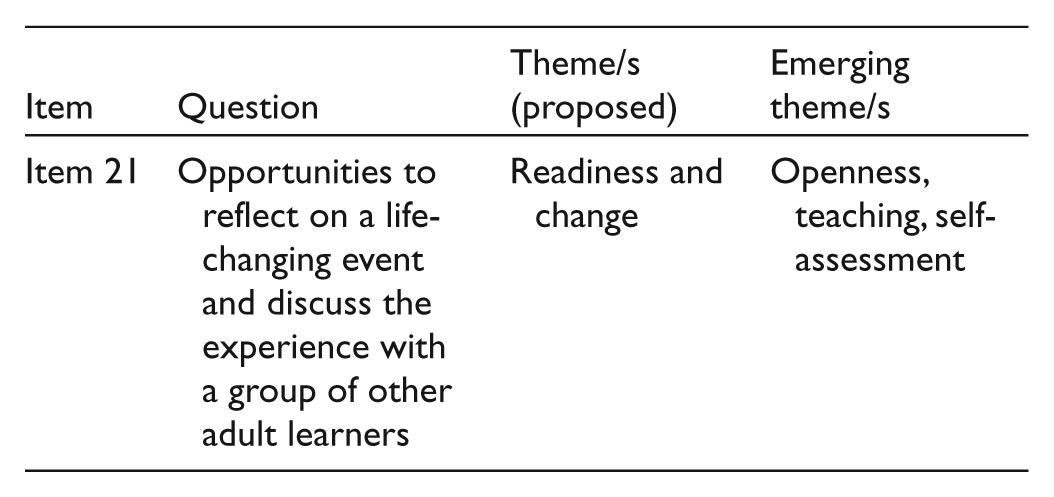


1 Flexibility, openness to new information, self-identity, self-directedness, and community were among key themes inferred from an open coding. Studying and analyzing participants’ social participation was accomplished using observation data. I then used research data to confirm interpretations I discerned from watching social networking practices involving participants and other residents.
Synthesis of Findings
To understand my findings, I found it easier to look at the results in terms of learning sources and habits participants practiced prior to transitional residency, learning sources and habits that were enhanced by and gleaned from transitional residency, what contributed to learning while in transitional residency and how participants changed profile after the positioning experience.
I found that the majority of my participants turned to books before transitional residency, relied on their faith in God while in residency, and drew on their experiences during residency to discover, to interpret, and to find strength to overcome—instead of question—their experiences. They considered learning tangible when they could connect information to achieving a personal goal. Several participants noted that because of their time in residency, they were more receptive to new information and opportunities to learn, and understood the importance of participating to provide encouragement to others. Moreover, they were more confident in their ability to learn and to overcome barriers that could restrict them from achieving personal goals, and had come to embrace the practice of reflecting, seeing reflection as an extra opportunity to learn.
In my second research question, I asked in what ways, if any, do the content and context of a classroom help adult learners in transitional residency to reconnect with social networks within transitional residency? During analysis, I looked through the lens of how classroom content encouraged participation and how classroom content and the environment of the classroom fostered learning. Participants consistently mentioned that being able to talk with other residents helped them to learn. They also stressed that more learning occurred when the teacher and other learners encouraged them to learn.
Evaluating Quality of the Study
I knowingly took a bias into the field. To overcome this as a handicap to performing an objective analysis of what I had observed and heard, I identified three objectives to assure quality of my study for its sound representation of the findings, freedom from researcher bias, and triangulation of the data.
My first objective was to assure that I had inferred findings directly from the data; the second objective was to assure that findings were free of bias. To achieve both objectives, I checked findings for confirmability of information. Confirmability (Trochim, 2001) refers to how the researcher communicates findings and conclusions that when read can be assumed to be true to the data and reasonably free of biases. To overcome potential interference, I used reflexivity and bracketing strategies.
Reflexivity (Watt, 2007) refers to specific strategies used to recognize personal biases prior to entering the field, while conducting the study and during data analysis. Before data collection, I reflected deeply on biases and monitored surfacing of any biases during the data collection and analysis stages. Intentionality of reflection is a second strategy of bracketing.
Bracketing is a method of exploring personal beliefs in an effort to make the investigator more aware of the potential for analyzing data based on personal belief systems taken into the field and not on data collected from participants (Jootun, McGhee, & Marland, 2009). To attain the best result, I incorporated spatial distancing when questioning participants during personal interviews, and through daily journal writing. For privacy, I completed journal entries at a location away from the site of the study. Journal entries took the form of handwritten notes in a college lined spiral notebook, timed and dated. I used a research journal as a personal strategy to test my immediate recall of facts and observations that would minimize a likelihood of wrongly analyzing and comparing what I had heard and observed against my personal value system, biases, and moral standards.
Triangulation was my third objective. I addressed triangulation using the coding and interpretation strategies that detailed a data collection sequence and analysis steps. Coding and interpretation strategies using research categories and conceptual frameworks were important for triangulating data that relied on direct statements and written responses.
I analyzed and corroborated written and verbal statements with observed data to confirm patterns of themes by triangulating the data, giving me more confidence in the credibility of the information that was gathered and in the themes that emerged from the open and axial coding processes.
Conclusions
Six conclusions emerged from my study findings. I believed that these conclusions represented new understandings and awareness of self as learners, and the nature and benefits of learning and participation experienced by transitional residents in this study.
Conclusion 1
I concluded that change and the desire to learn were prompted by a discursive positioning episode. Participants took the time to evaluate their personal positioning episode against what they already knew, had learned, and needed to learn.
For them, the time used to evaluate their individual positioning episode, the learning that emanated from the episode, and learning needs identified because of the episode represented change and social development explained by Merriam (2005). They believed they had come through a social situation that Jarvis (1987) described as an event requiring a response, which can prompt the learning process. Participants identified an association between change and a need to learn. This relationship between change, the need to learn, and the need to practice learning is supported in the literature (Choules, 2007; Imel, 2000; Smith, 2006).
In his description, Smith (2006) correlated change to an opportunity to make discoveries, “self and a learning agenda” (p. 722), adding that the desire to change is intentional. He perceived that change offers people the opportunity to bridge what that individual believes to be a gap between “who they are and who they want to be” (pp. 722-725). Imel (2000) found similarly that change and learning are interconnected, concluding that learning does not necessarily end after change takes place.
Choules (2007) added that learners would seek change if what they were learning helped them in their current context. Smith (2006) also found that people experiencing change require an environment to practice. In this study, transitional residency was the context where participants sought learning and the environment where participants could practice the change prompted by positioning.
As learners in this study developed their ability to identify learning needs, a condition for learning was created. Conditions for learning can be influenced by an individual’s desire to learn (Illeris, 2002), by a person’s experiences and by other people (Merriam et al., 2007). Learning tends to occur when an event is “discomforting, disquieting, or puzzling enough that it cannot be ignored and must be attended to” (Merriam, 2005, p. 8). Similarly, “a condition for learning arises when an individual’s biography and experience are not in harmony with what they know” (Jarvis, 2004, p. 36).
Learning occurs when the learner acknowledges the need. The change that prompted participants to discover a gap in learning had also created a condition for learning to occur during transitional residency.
Conclusion 2
In the context of an individual’s life course, transitional residency was an undesirable and unplanned event. However, participants came to focus on the positive elements of transitional residency that had allowed them an opportunity to extract new information from formal learning and experiences they had had prior to and during the transitional residency period. Belzer (2004) explained that experience permits learners to sort through an experience to identify new information. Much of an adult’s cognitive ability was developed in the context of experience (Rybash et al., 1986).
Experience became a powerful tool when participants made the connection between experiences prior to and during transitional residency. Dewey (1961) explained,
An ideally perfect knowledge would represent . . . interconnections that any past experience would offer a point of advantage from which to get at the problem presented in a new experience. For knowledge furnishes the means of understanding or giving meaning to what is still going on and what is to be done. (pp. 340-341)
Participants came to understand the value of the experience and benefitted from the learning they extracted. Emphasizing an adult’s ability to adapt to a particular context, explained Bandura (1986), is predicated on that person’s ability to reflect on past experiences and to process information, to learn.
Using experience as a tool for teaching and a method of learning, Fenwick (2003) used the phrase, “interpretation of the events complexities” which requires full involvement of the learner (p. 53). When the learner is fully involved, he or she first recognizes that an event has taken place, seeks to understand every component of the event, and then relates his or her knowledge to what has taken place. Learning occurs when the person realizes that he or she understands the event and has the knowledge needed if a similar experience occurs. Experience in many instances can become the alternative facilitator of learning to classroom instruction received from facilitator to learner interaction (Cain, 2002). A learner is a person who has previous experience and knowledge from another context that they view as appropriate for use in a newer context of learning (Kappel & Daley, 2004).
Participants had learning needs based on their individual positioning episode, which created a “search for meaning and understanding” (Jarvis, 2004, p. 36) or a condition for learning. Transitional residents are individual learners, with individual styles and needs for learning; therefore, they need to make meaning of what they are learning is special to them (Daloz, 1999; Gagnè, 1977; Jarvis, 2004, 1987; Rotter, 1982). People are conditioned internally and externally to learn (Gagnè, 1977). When the individual tries to understand something that has occurred (external) based on what she already knows (internal), she is connecting learning to need which conditions her to learn. One of the principles from social learning theory (Rotter) is that learning occurs when the learner acknowledges the need, which can emerge from various sources. Participants in this study were individual learners, suggesting that they would be ready to learn when they could find connection between their own lives, who they were as individuals, and the knowledge they needed to have as an individual (Daloz).
While in transitional residency, participants evaluated their personal positioning episode to reflect on the learning they had gleaned. Learning, an outcome of reflection and as a method of learning, is a technique describing a person’s search for meaning and learning from an event (Bandura, 1986; Dewey, 1961; Fenwick, 2003). Dewey (1961) described reflection as an individual undertaking to find connection between an event and his or her future understanding and actions following that event.
Conclusion 3
The connection between transitional residency, spirituality, and learning surfaced as participants explained how faith helped them to reflect and identify what they had learned or needed to learn from transitional residency. As participants related a story of learning in transitional residency and interjected their personal beliefs about spiritual guidance, they were able to acknowledge their role in the learning process.
For the participants, having the ability and willingness to construct new knowledge and develop was anchored in their faith. Transitional residents pointed out that faith gave them the patience and positive outlook about their experience, which Sinnott (2005) supported in his conclusion that learning is likely to have more meaning in some adults when the learner connects learning to a personal belief system (p. 29).
Jarvis (1987) and Tisdell (2008) supported the connection between faith and learning. Jarvis discussed that reliance on belief systems emerge when people experience something that is unfamiliar based on past knowledge and experience creating a disjuncture, causing that person to question and seek answers and direction through a belief system. Tisdell similarly suggested that, “people construct knowledge in powerful ways through spiritual experience” (p. 34). Sinnott (2005), Jarvis, and Tisdell discussed spirituality and belief systems—not focusing on a specific belief system.
Conclusion 4
The credibility of the instructor and content helped an adult learner find self in the learning process. Based on their confidence in their ability to learn, the fact that they were able to find a connection between what they were learning and personal self, making learning new information more meaningful, is supported in the literature (Daloz, 1999; Deaux & Martin, 2003; Sinnott, 2005). Sinnott (2005) concluded that learners do not separate self from what they are learning because “adult learners bring self to new learning experiences” (p. 27). Similarly, Daloz (1999) explained that adults are ready to learn when they can detect a connection between who they are and what they are learning. Individual identity in the learning process is a method of identifying self because people define themselves by similarities and differences between themselves and others within a social environment, the classroom (Deaux & Martin, 2003).
In the learning environment of the classroom, reflexive positioning practices influenced the participants’ ability to discover self in what they were learning. Positioning practices could be reflexive or discursive. Reflexive positioning, self, means the individual has knowledge, behaves in a certain way based on that knowledge, and has the ability to change his behavior after a discursive positioning episode. A discursive positioning episode is one where people interact with other people in a social network that may cause a person to become temporarily separated from participation in that network. The relevance of reflexive positioning practices to self in the act of learning emphasizes that when an adult realizes there are no threats to self in the act of learning, an adult will become more actively involved in the process.
During classroom instruction, the instructor had credibility when the instructor kept the classroom environment inclusive of all participants and nonjudgmental. This meant that participants could disagree and state opposing opinions within the group, and that the instructor recognized, respected, and considered their opinions as important to every person’s learning experience. A facilitator can enhance the learning experience for learners by acknowledging the many ways people learn and respond and how differences enhance the learning process (Caffarella, 2002).
The content of instruction had credibility to transitional residents when they acknowledged that they could practice what they had learned from the structured learning environment of the classroom and that what they had learned reminded them of their personal obligations in other settings. For example, through instruction, participants were reminded of the election process and individual candidate platforms, and were prompted to use their knowledge by voting, and helping others to learn by discussing the pros and cons of election issues. Learning has more meaning when adults gain confidence that they can apply what they have been taught (Douglas, 2000).
Conclusion 5
When some adult learners recognize that they can achieve personal goals, they seek opportunities to learn, and are willing to share their experiences about learning with other adults. The study considered transitional residency as the context and opportunity for adult learning. The personal goal for most residents included moving into more permanent residency, for some it was important to return to school, and for some it was important to gain steady employment. They were able to discuss how acquiring new knowledge could help them achieve personal changes in their living, in their finances, and their job search. They articulated that personal goals were a possibility, which stemmed from their personal experience, witnessing the outcome of the Presidential election who they believed had been a role model, consistent with observational learning effects discussed by Bandura (1986). Observational learning effects represent how learners watch the behavior of others and become motivated to develop similar patterns of behavior. Transitional residents drew inference from the election of a President, reinforcing their perceptions that barriers can be overcome and that personal goals are achievable.
Transitional residents sought opportunities to learn and to develop socially and cognitively either through the shelter environment or outside of the shelter. When some transitional residents perceived that personal goals could be achieved and considered that seeking opportunities to learn was one mechanism available to them to achieve their personal goals, they were using their capability of forethought which Bandura (1986) explained requires people to become proactive, thinking beyond their current situation, and to become motivated to think into the future.
Transitional residents were willing to share their experiences about learning with other residents using their ability to talk with other residents, remain separated from conflict, and remain role models. Talking with other residents enabled them to remain connected, a connection that occurred during structured learning events or socially outside the classroom.
Conclusion 6
When some adult learners understand that learning requires personal commitment and practicing what was learned, they are more motivated to learn and participate. The claim that transitional residency was a time participants set priorities, focused on personal needs, and made a personal commitment to learning, is supported in the literature (Illeris, 2002; Wlodkowski, 1999). When adults acknowledged that the decision to learn is personal, Wlodkowski (1999) explained that most adults take a more active role in their own learning. Similarly, adults are more motivated to learn if they feel that learning is a personal choice (Illeris, 2002). Understanding that individual learning calls for action by the learner underlines the significance of self in the act of learning. Transitional residents made a personal commitment to learn and then to practice their learning by participating with other adults. Learners understand that “learning used when participating with other learners serves to aid in cognitive development” (Gauvain, 2001, p. 40). When learners experience learning alongside other learners, personal life and social and cultural contexts influence how they learn and use information (Barlas, 2001). People are constantly seeking identity within a social world and want to learn from and through acts of participation (Linehan & McCarthy, 2000; Valsiner & van Der Veer, 1988). Transitional residency was an opportunity for participants to confirm self, to learn, and to participate.
Transitional residents discussed that self-motivation played an important role in learning. They discussed one primary reason for their self-motivation to learn. They found that self-motivation meant being able to talk about what they had learned which is supported in the principles of social cognitive theory (Bandura, 1986) stressing that people are motivated by what they expect to come out of an action. Transitional residents learned that being able to talk about what they had learned came from their classroom experience and were motivated to continue to learn and participate.
They spoke confidently about their accomplishments. By being able to discuss accomplishments, participants were motivated to learn. This sense of accomplishment was comparable with Mannion’s (2001) description that they were creating a style of writing placing the writer as the central character of a story. When they found that they were creating another part of their storyline by talking with other adults, the transitional residents were strengthening their links with other members in a social network (Harrè & Langenhove, 1999). By talking with other residents, participants were allowing the discursive nature of positioning, the social interaction necessary in networks, to help strengthen their self-identity in that network. Harrè and Langenhove (1999) using his positioning theory purported that when people interact with one another, they are functioning as agents to construct the self of other people.
Implications for Future Research
This study examined positioning, adult learning, and social participation through adult transitional residents in an effort to improve understanding about self-identity and resilience in the learning process. The interpretive biography of adult learning provided information on a topic not fully addressed in existing literature. I suggest that a need exists for additional research to understand social constructs not highlighted fully by my study: the role of race, gender, and age individually or collectively in learning and participation in social networks in similar transitional resident populations, to see if similar themes surface.
This interpretive biography identified the importance of self-identity in the learning process. A potential study in the transitional resident population might continue an exploration of how self and self-identity in the learning process promote learning and encourage participation that I believe is an affirmation of knowledge.
Summary
The conclusions expressed from this study supported the principles of social learning theory proposing that behaviors learned through experience often represent a person’s ability to associate new and past experiences to change behavior (Rotter, 1982). In the transitional resident population, when adults were able to reflect on an experience, they were more able to articulate what they had learned. When participants were able to explain what they had learned, they became more receptive to instruction and were able to accept responsibility for learning. As adults accepted responsibility for learning, they were able to participate with other adults to affirm and extend their learning.
This study supported the principles of social cognitive theory. Social cognitive premises (Bandura, 1986) explain that adults behave in concert with what they already know, not necessarily following opportunities to reflect on the learning coming from an experience. Bandura (1986) also explained when people participate with other people that the interaction may not always be to confirm knowledge or to connect with social networks but to learn from other adults. Participants were followed during classroom instruction and while interacting with other adult residents. The observations confirmed social cognitive principles. Participants interacting during class time proved their understanding of instructional content when responding to questions from the presenters or when responding to comments made by other learners. At other times when adults interacted with other adults, discussions varied. There was evidence of reflection in some conversations between adults. For example, adults discussed what they had learned from an experience without giving specific details about the experience.
The primary theoretical base for this study was positioning. Positioning is an idea that people participate in social networks but lose the right to participate because of a social episode (Harrè & Moghaddam, 2003). This study supported the premise of this theory. Adults in transitional residency were at one time active participants in social networks. Social episodes found adults in transitional residency. Social episodes became the experience on which adults reflected to learn. In transitional residency, adults did not stop learning or end participation in social networks. Transitional residency was a context of learning for adults with learning needs. Transitional residency created new social networks. Adults found new connection with other adults. Adults learned through reflection, classroom instruction, and participation with other adults. Positioning created an opportunity to learn, helped participants in this study to identify learning needs, and presented new opportunities to participate and to continue learning.
Footnotes
Declaration of Conflicting Interests
The author(s) declared no potential conflicts of interest with respect to the research, authorship, and/or publication of this article.
Funding
The author(s) received no financial support for the research and/or authorship of this article.