




Abstract
The aim of this article was to review the different evaluation approaches for adult learners and the effect on promoting the quality of teaching and learning. This study aimed to identify new trends in adult education formative-summative evaluations. Data were collected from multiple peer-reviewed sources in a comprehensive literature review covering the period from January 2014 to March 2019. A total of 22 peer-reviewed studies were included in this study. Results were systematically analyzed to answer three questions as follows: what are the new trends in the summative and formative evaluations of adult learners? What are the new trends in the summative and formative evaluations of adult learners engaged in distance learning? And what are the outcomes/drawbacks in the summative and formative evaluations of adult learners? An analysis of the existing literature indicated that those who instruct adults must use a wide variety of pre- and post-assessment tools to match students’ differences with their needs. It also highlighted the importance of “assessment for learning” rather than “assessment of learning” and “learning-oriented assessment” (LOA) for lifelong learning, thus preparing adult learners for future responsibilities and decision making. It also indicated the importance of reflection and immediate feedback for the adult learner. Assessment of mental phenomena such as creativity should have defined terms. The findings of this article supported the argument for more attention to be paid to new trends in evaluations used in adult education. One important result of this kind of evaluation is its facilitation of self-confidence within the adult learning setting.
Keywords
Introduction and Background
The adult education system has changed dramatically since Malcolm Knowles (1970) introduced his theory and definition of adult education (Knowles et al., 2014; Merriam & Brockett, 2011), and the boundaries of “adult education” are broad and difficult to delineate. The term “adult learners” now includes individuals who, following a break in study after leaving compulsory or regular university education, become involved in a diverse range of formal, informal, and non-formal education that results in acquisition of new skills, knowledge, and well-being (Kil et al., 2013; Knowles, 1970; Lee, 2016). The “adult student” category is often limited to those aged 25 and over (Chao et al., 2007). There is some overlap between the categories of “nontraditional student” and “adult student.” The “adult student” is first defined as a student who pursues any program leading to a vocational certificate, degree, or training; second, his or her goal for education is to gain additional or enhance existing work skills; third, he or she considers himself/herself primarily as a worker, not a student; and, finally, is likely to be enrolled in distance education because of his or her numerous responsibilities and multiple life roles (Compton et al., 2006; Ross-Gordon, 2011). Adult education involves adults engaging in sustained, systematic, self-educating activities to gain values, knowledge, attitudes, and new skills.
The adult learning theory suggested by Knowles (1970), which focuses on adult learner engagement in the learning process, irrevocably changed adult education. Currently, emphasis is placed on urging adult learners to actively involve themselves in evaluating their own learning by helping them assess the strengths and weaknesses of their performance objectively, thereby improving their learning process (Knowles, 1970; Merriam, 2001).
Adult Education Evaluations
“Evaluation” and “assessment” are often used synonymously to refer to the process of judging and assigning value to an item. However, the term “assessment” is technically used to judge work, learning, or performance (formally or informally), while the term “evaluation” is used to measure all other aspects of academic endeavors (Martin & Collins, 2011)
During an education program, evaluations are conducted at several stages to determine the value of certain aspects according to a set of guidelines with specific criteria (Boonchutima & Pinyopornpanich, 2013). According to Jones (2003), both assessment and evaluation procedures identify what is being assessed, addressing the nature of assessment and the collection of appropriate evidences. Both assessors and evaluators must be clear about what they are assessing.
Evaluations often include a crucial element for measuring adult learners’ outcomes; thus, such evaluations are connected to public and private decision-making processes that serve important political functions, such as fund allocation, spending analysis, and accountability. Furthermore, evaluations are increasingly linked with the stakeholder’s education, social transformation, and empowerment (McNamara et al., 2010). Assessment and monitoring play a critical role in enhancing the quality and conditions of adult and continuing education programs—not only from the assessor’s perspective but also from the learner’s. The monitoring and evaluation of adult learners are of vast significance, given that such procedures do not restrict their creativity and success (Comings, 2007).
Conventionally, evaluations are differentiated as either formative or summative. “Formative evaluations” are conducted throughout a course to evaluate a student’s learning process and are used to alter, modify, and improve learning. Often, they provide feedback to both educators and learners while the program is still underway (Knowles et al., 2014). On the contrary, “summative evaluations” are retrospective assessments conducted after the learner has completed the course or program. Summative evaluations are utilized to ensure the educator’s accountability, demonstrate achievement, and judge the quality of a program in its entirety (Sewall & Santaga, 1986). Simply, formative methods are an assessment for learning whereas summative ones are an assessment of learning.
Globally, there is a move toward so-called “knowledge-based communities” (UNESCO World Report, 2005). Accordingly, the rapid changes taking place in learners’ everyday lives can lead to new learning requirements and evaluation approaches. Therefore, the development of requirements in the adult learning field and evaluations for unique labor markets are crucial to confronting the various challenges faced by adult learners. In general, adult learning is important and relevant because it provides more opportunities for adults in today’s world (Angelo, 1995).
To summarize, assessment is defined as a continuous process to measure, monitor, and improve learning, degree of achievements, outcomes, and decide how much objectives are accomplished (Fernandes et al., 2012; Parker et al., 2001; Yambi, 2018). On the contrary, evaluation validates and judge the performance or outcome quality degree and level for decision making (Baehr, 2005). Thus, the key difference between the two is that assessment is directed toward learning progression, evaluation is aimed to outcome. Assessment is continuous systematic measures to review and assess the learner improvements, weakness and strength using the obtained data and information for academic support (Yambi, 2018).
In general, assessment is performed on regular scaffolding basis with active participation and involvement of both parties. The assessor is the one who appraises the growth and progress on the predetermined well-defined criteria, whereas the assessee, is the person to be assessed. The whole phenomena purpose is to conclude about learning efficiency and overall performance of the learner and where enhancement is needed. In assessment, the assessor defines and plans the objectives, gathers data and utilizes those evidences to improve the assessee’s required knowledge and skills quality (Baehr, 2005; Parker et al., 2001; Yambi, 2018).
Alternatively, “evaluation” originated from the word “value” which means “the judgment about efficacy and valuability.” Hence, evaluation examines and determine its validity and usefulness.
Basically, evaluation is a systematic measure and observing of quality of achievement against some objectives and standards or via compare and contrast. Thus, evaluation is final phase to assess the grades, mastery, and quality of a completed process (Baehr, 2005; Parker et al., 2001; Yambi, 2018).
Differences Between Assessment and Evaluation
Yambi (2018) stated that the main differences between assessment and evaluation, they are as follows:
Assessment is the process of collecting and examining the data to improve the current and future performance. Evaluation is a judgmental process using standardized criteria to evaluate final grades or scores.
Assessment is investigative diagnostic, as it identifies weak areas to improve. Whereas Evaluation is judgmental since it provides the learner with the overall score.
Assessment serves as a feedback on learning to enhance the performance. In contrast, Evaluation determines if the criteria are fulfilled or not.
Assessment goal is formative or assessment for learning, that is, to improve the performance during the process but evaluation is summative since it is preformed after the program has been completed to judge the quality.
Assessment targets the process, whereas evaluation is aimed to the outcome.
Assessment feedback relies on reflections of strong and weak points. In evaluation, it depends on the level of outcome against predetermined criteria.
The association between assessor and the person to be assessed is student-centered and depends on perception, standards internally and jointly defined. On the contrary, in evaluation the evaluator shares a perspective association with the person to be evaluated against predetermined measures defined by the evaluator.
Summative versus formative assessment
There are several differences between summative and formative assessment. Yambi(2018) allocated a number of differences, the following are some of these differences:
Formative assessment is a continuous monitoring during the learning process.
Summative evaluation is performed at the end point such as completing a unit or a course.
Formative assessment observes the performance during the process and improve it.
Summative assessment is a final graded achievement to judge if the learner has attained the learning objectives.
Formative assessment, targets student’s learning improvement and advancement. Thus, meaningful feedback is required. While summative assessment is aimed to assess student’s accomplishments.
Formative assessment is conducted multiple times during the process, whereas the summative is held after concluding part or course.
Summative assessment includes the full topic or course when assessing. Thus, summative assessment is considered to be more of a “product assessment.”
Formative assessment considers evaluation as a continuous regular process.
Formal versus Informal assessment
There are two main classifications of assessments: formal and informal. Formal assessments when supportive evidences are derived from examination. This type of examination is usually referred as standardized test such as TOFEL. Those measures have been verified in advance and have criteria to support the results. The collected information is calculated into numbers or percentages.
Informal assessment is designed to measure learning progress, comprehension, and performance. For instance, observation, class activities, and feedback are forms of informal assessment.
The employed evaluation should have objectives to be aligned with. Formal assessment should be standardized to measure the overall attainment and to compare equally the students of the same level with each other. On the contrary, informal assessments “criterion referenced or performance-based measures” is used for education comprehension and improvement.
The most efficient teaching strategy is to define the educational goals and align the course instructions to those purposes, followed by evaluating knowledge and skills. Extra activities should be employed for any unachieved goal.
To sum up, formal assessment is the plan that relies on data and assess student learning and achievements. Thus, it assesses capabilities and knowledge of the students versus predetermined criteria, such as standardized and criteria sheet assessment.
On the contrary, informal assessment is unplanned assessments integrated into the class activities to assess comprehension and growth, an example of this is direct observation and educational portfolio.
Both informal and formal assessment are required for efficient teaching, learning, and to reveal an impression about students’ learning progress and quality. For example, formal assessment can be used to measure achievement versus objectives and compare the level with the other students. Informal assessments on the contrary, can be used to assess student progress and define points of weakness and strength to improve teaching and learning (McAlpine, 2002; Weaver, 2017; Yambi, 2018).
Effective Formative Assessment
The effective formative assessment is designed to attain the desired learning objectives and focuses on daily needs and practices. It is aimed to monitor student achievement and progress in achieving the desired goals, thus must be precise, clear, quantifiable, and based on Bloom’s Taxonomy. It should be able to assess individual and group performance and consistent without changing everyday practice to fit the exam. One of the advantages of formative assessment or assessment for learning is to give feedback and directions to adjust teaching strategies to guide and lead students to achievements and success (Trumbull & Lash, 2013).
Formative Assessment Techniques
Several techniques are used for effective formative assessment or assessment for learning, some of them are as follow (Srivastava et al., 2018; Trumbull & Lash, 2013):
Exit ticket/ slip: A question is asked to all students after the lecture, for example what are the main points? This is to measure understanding.
Classroom quizzes: Helps in assessing cognitive skills, allows students to evaluate their own studies
One-minute paper: 60 s for the student to recall at the end of the part or lecture.
Muddiest point: Students identify the most difficult point to comprehend.
Directed paraphrasing: Restate section or lecture.
One-sentence summary: Students will answer the questions in one sentence.
Problem Statement
This study explored new trends in adult education formative-summative evaluations. As adult learners approach education differently than traditional students, teachers and evaluators often have difficulty gauging their levels of learning success and achievement, particularly in distance education environments, where there is often an array of challenges (Vasilevska et al., 2017). This study sought to fill a research gap in this area and identify the newly reported evaluation trends and techniques in adult and continuing education, especially with regard to formative-summative evaluations.
Conventional methods were predominantly used for the purpose of reflecting immediate information acquisition as opposed to enhancing the learning process or ensuring thorough and lasting learning. In recent decades, the presence of adult learners has increased on college campuses. The National Center for Education Statistics (NCES) reported that higher education enrollment has increased and is expected to continue to rise until the academic year 2025–26. The number of learners over 25 is projected to remain steady or increase in the future (Hussar & Bailey, 2017).
Some education experts believe that adult evaluations suffer from a lack of clarity in the current framework; they are time-consuming, complex, and extremely difficult to perform (Hay et al., 2010; Lavin, 1993; OECD, 2008). However, as there is a lack of data regarding new trends in adult evaluations, this article intends to help address this issue. The findings can help inform further educational institutions and policy makers in the development of means for knowledge acquisition and evaluative methods in adult education.
Aim
This study aimed to broadly explore new trends in adult education evaluation and highlight novel aspects to support adult learning in the future.
Objectives
The precise objectives of this study were as follows: (a) explore newly reported trends in adult education evaluation, particularly formative and summative evaluations; and (b) examine the effectiveness and drawbacks of formative and summative evaluations for adult learners.
Research Questions
In view of the research questions, all investigations related to the adult education evaluation in higher education were reviewed
Method
Data Source and Search Strategies
A complete and systematic search of the existing literature was conducted using trends in adult education and evaluation (both formative and summative) as the primary keywords. Data were collected from a variety of peer-reviewed research papers obtained from databases and online libraries including EBSCOhost Research Platform, ProQuest, ERIC, SCOPUS, JSTOR, OAIster, Emerald Reach, PsycINFO, Google Scholar, and Citation Search. A reference list of relevant articles was also examined, the websites of related organizations/universities were searched, and experts were consulted. The literature search covered the period from January 2014 to March 2019.
The following search keywords were used to identify potentially relevant studies in the title, keywords and abstract; “learning” OR “adult learning” OR “distance learning” OR “student learning” AND “evaluation” OR “assessment” OR “formative” OR “summative.”
Inclusion and Exclusion Criteria
For inclusion in the study, articles had to meet the following criteria: (a) relate sufficiently to problems associated with the evaluations of adult learners (summative and formative or adult distance education; b) be peer-reviewed articles; and (c) the full text of the article must be accessible and in English.
Exclusion criteria: The studies if they were (a) not reported in English (b) focus on a specific part of the adult evaluation: summative and formative, for example, the difference between summative and formative evaluation (c) has no intervention or short paper such as poster (d) if the full text was not available and if they are not related to postgraduate students and adult students.
Data Abstraction
The following variables for each study were extracted: author name(s), specialty, publication year, education topic, and evaluation method, specific intervention, number of participants, study design, and study outcomes.
Study Review Process
Following data extraction, the articles were examined and analyzed according to the predetermined categories—summative and formative—as well as the different educational in formal, informal, and nonformal settings.
Results
Search Results
A literature search was conducted covering the period from January 2014 to March 2019. A total of 33,934 peer-reviewed articles were identified. Articles were screened according to title (n = 33,934), resulting in 641 abstracts for review to determine final eligibility status. After methodically examining the abstracts, 475 articles were excluded: 82 that were not written in English and 62 that were either duplicates (15) or did not meet other inclusion criteria (47). The full text of the remaining articles was then reviewed; 22 relevant peer-reviewed articles met all of the inclusion criteria and were selected as suitable for this study (Figure 1).

Flowchart representing the article search and selection process.
Study Outcomes
The 22 peer-reviewed studies included in this study are presented in Table 1. All of the articles were published in the past 5 years (2014–2019), and most (67.2%) were published in the past 3 years. The studies’ sample sizes ranged from nine to 1,050 participants, and the aggregate sample size totaled 2,882 adult participants across all 22 studies. Six studies were related to the health care field (Aycock et al., 2018; Bullock et al., 2018; Elshami & Abdalla, 2017; Freeman & Tashner, 2015; Jamil et al., 2018; Srivastava et al., 2018). Four focused on English as a foreign language (Estaji & Mirzaii, 2018; Jiang, 2014; Mohamadi, 2018; Mohamadi Zenouzagh, 2019). Three were related to engineering and technology (Baleni, 2015; Dascalu et al., 2017; Hansen & Ringdal, 2018) and a further three to education (Baleni, 2015; Elmahdi et al., 2018; Hawe & Dixon, 2017). Two studies were related to science (Baleni, 2015; Keller, 2017) and two to the field of psychology (Barnes & Gillis, 2015; Leiva et al., 2018). The fields of social sciences (Deeley, 2018), physical education (Martos-Garcia et al., 2017), and mathematics (Cross & Palese, 2015) were each represented by a single study. These studies were carried out in different parts of the world: six were conducted in the United States (Aycock et al., 2018; Barnes & Gillis, 2015; Bullock et al., 2018; Cross & Palese, 2015; Freeman & Tashner, 2015; Keller, 2017), three in Iran (Estaji & Mirzaii, 2018; Mohamadi, 2018; Mohamadi Zenouzagh, 2019), and one study each in China (Jiang, 2014), South Africa (Baleni, 2015), Romania (Dascalu et al., 2017), the United Arab Emirates (Elshami & Abdalla, 2017), New Zealand (Hawe & Dixon, 2017), Spain (Martos-Garcia et al., 2017), Scotland (Deeley, 2018), Bahrain (Elmahdi et al., 2018), Norway (Hansen & Ringdal, 2018), Pakistan (Jamil et al., 2018), Costa Rica (Leiva et al., 2018), and India (Srivastava et al., 2018).
Characteristics of the Studies.

Thirteen studies were quantitative, six were qualitative, and two used a mixed-methods approach, as shown in Table 1. Intervention lengths ranged from 4 weeks to 7 months.
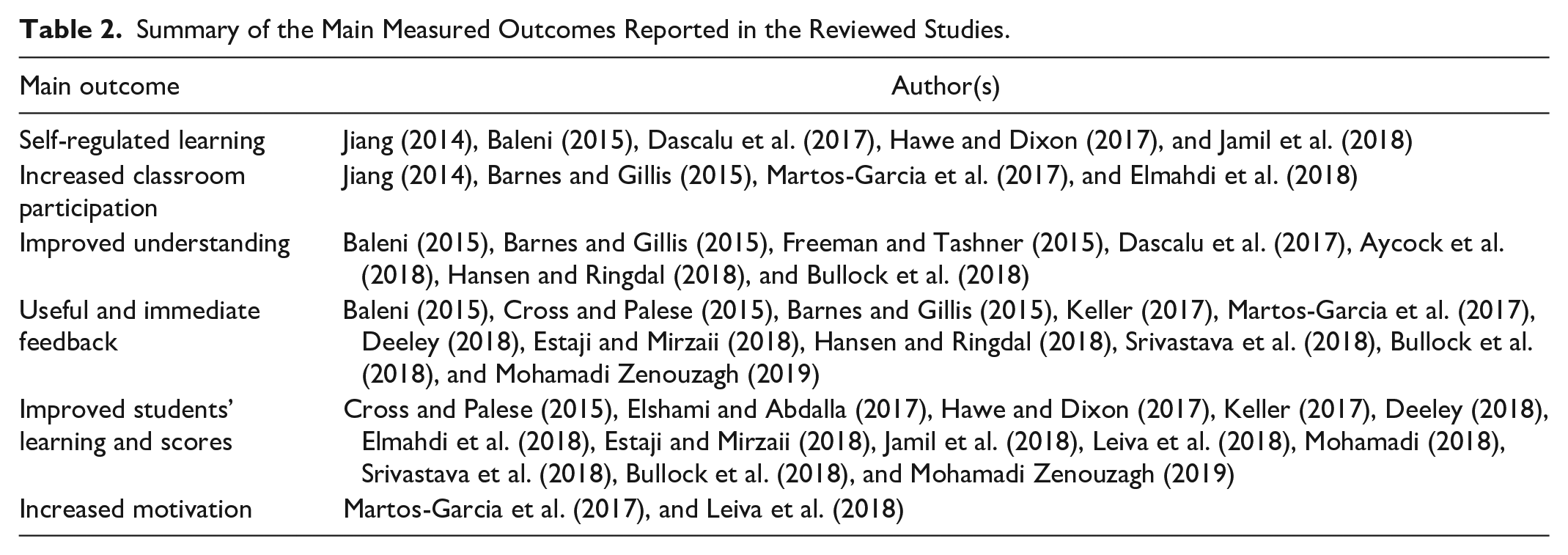
Table 1 displays the characteristics and interventions used in the studies. All interventions aimed at identifying the application and effectiveness of formative-summative evaluations in adult education by determining the respondents’ answers, ideas, perspectives, achievements, and opinions. The main reported outcomes are summarized in Table 2 and Figure 2. Only one disadvantage was reported by Elshami and Abdalla (2017).
Summary of the Main Measured Outcomes Reported in the Reviewed Studies.

Graphical representation of the main measured outcomes reported in the reviewed.
Discussion
Much adult learning occurs within a corporative learning environment comprising the adult learner and his or her teacher, facilitator, or trainer. The latter are required to cover the demands of various kinds of learners in different dynamic, and self-paced environments. The studies reflected the various short- and long-term assessor roles of teachers (facilitators and trainers), who are expected to prepare their syllabi with the necessary pedagogical, instructional design, and learning theory skills to deliver knowledge based on the learning context.
Do Learning Assessments and Evaluation Positively Affect Adult Learners?
Effective learning assessments can help students become better learners while also encouraging them to take better ownership of their education, as opposed to coasting as “surface learners” who only memorize information because of persistent prodding from external bodies, such as educational accreditation bodies (including governmental and private sector organizations and professional associations). In 2013, the National Institute for Learning Outcomes Assessment (NILOA) highlighted institutions’ current assessment activities and described how these institutions were using evidence of student learning outcomes. In particular, NILOA, showed a large increase in the use of rubrics, portfolios, and other classroom-based assessments (Kuh et al., 2014). Dochy et al. (1999) concluded in their investigation that the growing demand for adult education had stimulated considerable interest in re-evaluating the relationship between learning quality and assessments, and that a combination of the different newer forms of evaluation used to assess adult learners’ achievement and progress had helped adult education become more responsible and reflective.
Does Formative and Summative Evaluation Improve Higher Education?
Boud and Falchikov (2006) argued that assessment must be learning-oriented and should foster future lifelong learning. Students must become their own assessors to succeed as adult learners who use their learning to participate in real world contexts and ongoing practices that apply the learning acquired. “Contextualized learning,” or learning by reflecting on real world contexts, is essential for adult learners. A study by Jones (2003) indicated that evaluation procedures must become clearer and more accurate to reveal students’ achievements, and they must continually evolve to reflect new advances, students’ gains, and broader changes. Meyer (2002) revealed the importance of learner success and achievement as a factor affecting online education quality.
In recent years, adult education outcomes have become a concern of the overall educational system, but they have been overshadowed by attention to the criteria for quality formative-summative evaluation as a significant step in the learning process. New trends in adult education recognize, not only the importance of the evaluation process, but also the necessity of quality-based educational development relevant to adult learners’ goals (often work-related). The quality process has three phases: peer evaluations, self-education, and joint evaluations. External evaluations comprise studies and competence evaluations; self-evaluations comprise thoughtful analyses of competence; and consolidation refers to the consolidated outcomes portfolio.
Normally, formative evaluation is used to alter and improve learning—in this case, to provide appropriate feedback to staff—while the program is still underway. Knowles et al. (2014) noted that these two types of evaluation help with the creation and prioritization of goals and program content, offering direction for beneficial adult program planning, re-diagnosis of adult learning needs, and guiding principles for adult program management. They also assist in improving teaching and learning processes by gathering information. Knowles et al. (2014) also encouraged self-evaluation of adult learners’ ideas or learning according to established standards and criteria.
Summative (or terminal) evaluations are used to satisfy accountability, prove a point, or make sound judgments regarding the overall quality of an adult evaluation program (Aboulsoud, 2011). They draw together previously acquired information; for example, collected formative evaluations.
What are the New Demands and Trends in Adult Learner Evaluation?
According to the findings, adult education is widespread, and the number of nontraditional learners is only increasing—in the workplace, online, in communities, as well as in hospitals, centers for migrants, cultural centers, prisons, churches, and universities (Hunter-Johnson, 2017). Program evaluations with learner input is obviously an important aspect of this of nontraditional adult learners. One current trend is the evaluation of e-learning usability. This is particularly relevant for identifying what users want from online education and how to support them and prevent dropout, which, in turn, rests in part on the adult learners’ technical abilities (which may differ more than among younger learners) and the technologies used across different types of e-learning programs (Zaharias & Poylymenakou, 2009).
The new trends in adult education evaluation appear in the form of increased activity in adult education programs to assess learners. In recent years, research on adult education quality within an educational system has focused on the criteria for quality evaluation and measurement. In this regard, divergences certainly remain among evaluators and learners. The main intention of these current trends is to demystify evaluations. How operational are formalized evaluations? Here, it must begin with the instructor’s philosophical concerns regarding education and classroom experiences. In adult education, the instructor (facilitator) believes that it is essential to monitor experiences within the adult learning setting and ensure that his or her teaching methods, assignments, and experiences meet the adult learners’ demands and expectations. With regard to formative evaluations, how can a facilitator know “at that very moment” that his or her course is actually of use to the adult students?
One approach involves breaking down each formative evaluation into three cycles: short, medium, and long (William, 2006). Adult learners bring considerable knowledge and experience into the learning setting. A student-centered approach should be pursued to connect with students’ reflections, needs, experiences, and expectations as well as prioritize them in the education evaluation process (Smith, 2017). This move alone would make the adult learning setting more diverse. Meyer (2002) observed that adults generally want immediate feedback and critical evaluations, expect to be respected to a greater degree than younger learners, and more often than not assume full responsibility for their education. Merriam and Brockett (2011) also noted that feedback is an important component of formative evaluations in adult learning; indeed, the existence of feedback has been shown to improve adult learners’ evaluation quality (McNamara et al., 2010).
One critical area of assessment is evaluating “intelligence” and “creativity,” but these are obviously nebulous areas that are hard to measure with quantitative summative assessments. Therefore, agreement on the technical definition of terms is important (Jones, 2003).
In summary, student-centered approach encouraging reflections, addressing needs and experience with immediate feedback. Assessment targeted to evaluate mental phenomena such as intelligence and creativity is essential to prepare the learner to generate solutions for future obstacles, yet, measures should be well defined for the learners.
The purpose of this article was to review the different evaluation approaches for adult learners and their impact on promoting the quality of teaching and learning. An analysis of the existing literature indicated that those who instruct adults must use a wide variety of pre- and post-assessment tools to match students’ differences with their needs. It also highlighted the importance of “assessment for learning” rather than “assessment of learning” and “learning-oriented assessment” (LOA) for lifelong learning, thus preparing adult learners for future responsibilities and decision making.
Practical Implications
The findings of this article supported the argument for more attention to be paid to new trends in the formative-summative evaluations used in adult education. One important result of this kind of evaluation is its facilitation of self-confidence within the adult learning setting.
Future Tasks
This investigation provided preliminary findings from a literature review to stimulate future research in education evaluation in adult education across various fields.
Limitations of the Study
The inability to access full text of desired research materials was one of this study’s limitations. In addition, in the several sets of questionnaires surveyed, there was the possibility of bias, which is intrinsic to all self-reporting. Second, the researcher was unable to investigate the problem in terms of adult education duration because some of the studies featuring longer exposure resulted in different implications concerning the learners’ high-order abilities.
Conclusion
After revising the ideas above, it would be obvious that evaluation and assessment are totally dissimilar. Whereas evaluation includes creating decisions, assessment is concerned with correcting the deficits and weakness in the performance. Though, they play an essential part in investigating and purifying the performance of a person and outcome.
This article examined new trends in the use of formative-summative evaluations in adult education. An examination of these new trends provides implications for evaluating adult students within the classroom setting. Namely, as adult learners tend to be more responsible for their learning than younger students and bring more experience to the classroom, adult educators have more freedom and flexibility in assisting their students. Therefore, the adult learning environment is perfectly suited for formative evaluation. Finally, these trends parallel those related to the increase in high-stakes standardized testing, which is not always available in adult education scenarios.
Footnotes
Acknowledgements
The author would like to express deepest thanks to the Researchers Support and Services Unit at King Saud University for their editorial assistance.
Declaration of Conflicting Interests
The author(s) declared no potential conflicts of interest with respect to the research, authorship, and/or publication of this article.
Funding
The author(s) disclosed receipt of the following financial support for the research, authorship, and/or publication of this article: This work was supported by the Research Center for Humanities, Deanship of Scientific Research, King Saud University.
