




Abstract
In Portugal, Gypsies (Ciganos) are categorized as ethnical and minority group, and they are particularly vulnerable to poverty and social exclusion. There is no doubt that they are one of the groups that rise more antipathy among the other Portuguese. In what concerns the “social images” built by the dominant society, there is a negative evaluation of the Gypsies and this image has persisted and resisted so far. Therefore, Gypsy identity and culture are considered marginal. However, the historical discrimination against Gypsies and the existence of a scarce interaction with the non-Gypsy society are some interesting results coming out from a qualitative study finished in 2006 about social representations and emotions that emerged in discriminatory contexts related with the educational system. One of the main objectives of this article is to find how Gypsies represent the school, the formal education, and the social agents that intervene in this educational context, like teachers, other school workers, and other students (non-Gypsies). It is possible to notice some discourses that revealed negative perceptions and rejection feelings incorporated by some Gypsies. They feel that they are treated like “inferior” persons and not recognized by the whole society.
Keywords
Introduction
This article discusses some results of a wider and deeper research started in 2002, 1 in which one tries to understand and analyze the representations and the emotions in what concerns discrimination against Portuguese Gypsies living in the Lisbon Metropolitan Area and in the Setúbal Peninsula.
It is considered that it is within the interaction framework that the representations concerning discrimination must be captured and conceptualized. It is important to realize how events, motivations, and their effects occur, as well as the contexts of occurrence. From our point of view, a more dynamic, interactionist and relational perspective is, thus, defensible. The ethnic and national identity is built in a way and in a dialectic relation between the I (Us) and the Others (Them), in which the individuals mobilize references, symbols, and identitarian markers. Following Simmel’s (1908/1986) thought, the perceptions of the differentiations between subjects as something inherent in interaction have been taken into consideration. The relational character between the Us and the Others is portrayed not only in approximations and similarities but also in oppositions and partings. Following Poutignat and Streiff-Fernart’s (1995) approach, ethnic identity is the result of a set of representations that the interacting groups build whenever they are brought face-to-face.
The option for this theme is due, to a great extent, to its present situation in the context of the Portuguese society and also because of the lack of national scientific materials regarding this subject and the selected group.
We chose to study the Gypsies for two main types of reasons: It is a group that contrasts and differentiates from the major society. Despite their condition as national citizens, they constitute a group and an ethnic minority, also classified as an “ill favored minority.” As far as ethnicity in Portugal is concerned, Gypsies suffer a bigger rejection, polarization and dissimilarity.
Specifying with more details the reasons for our choice, it cannot be denied that although the Gypsies have stayed in Portugal for ages, they still remain as an unknown and unrecognized group. Nowadays, most Gypsies who live in national territory are sedentary, although the socially broadcast image of the Gypsy lifestyle is that of an itinerant and nomadic life. Everyday and frequently we come across widespread media-coverage situations that show discrimination actions toward this group; in Portugal, Gypsies are a group that causes polemic and controversy. In the media and in people’s speech, Gypsies appear as a problematic group, as a group that lives within or on the margins of society. In what concerns the cultural characteristics, the Gypsies seem to be configured in a position of high contrast in the context of the Portuguese society—through religious affiliation, use of own languages, a strong endogamy, and also through some aspects that are part of their lifestyle, among which the intensity of the sociability and intraethnic solidarity (based on a strong social organization, whose fundamental pillar is the family) stand out.
It is estimated that there are 12 million Gypsies in the world, of which two thirds live in Europe. The biggest communities are concentrated in Central European countries. In 1999, a report produced by the Work Group for Equality and Insertion of Gypsies for the High Commissioner for Immigration and Ethnic Minorities tells about the existence of 40,000 “Portuguese citizens that might be considered gypsies . . . ” (Alto-Comissariado para a Imigração e Minorias Étnicas [ACIME], 1997, p. 1).
In what concerns the itinerary of empiric research and in a perspective of thorough examination and approximation to the “real object,” the documental analysis, the statistical analysis, and the deep interview were mobilized from among the main techniques. This research is based on a methodological strategy of investigation marked by a certain pluralism and flexibility, where we try to use the most suitable techniques to each level and moment of analysis. It is inserted in the tradition of research known as constructivism, in which the main objective is to portray the multiple realities built through a participated investigation (investigation and participant subjects), in which we try to reach the meanings and interpretations built by the subjects (Snape & Spencer, 2004). Language and speech being two of the main mediations through which the transmission of the social representation is operated, we are going to privilege, as analysis material (central corpus), the testimonies got from the 40 interviews made to individuals belonging to the Gypsy group (with an average duration between 1 hr 30 min and 3 hr). The spatial scope of the present study is confined to all the municipalities that comprise Great Lisbon and Setúbal Peninsula. 2 Therefore, either the space of residence, the workspace, or the space of institutional intervention that directly or indirectly intervenes on the potential respondents will be selected as a starting point; in other words, it is focused in the set of “networks connection” of the individual to the various circles of social inclusion. These various circles assume the interdependence of these sectors and other spheres of functioning, which are referred to the circles of relationship in which the individual is involved, such as care in public services, access to state resources (social, cultural, political, economic, etc.), the working relationship, and even friendship. The information gathered provided a comparison of contexts, situations, experiences, and representation paths, uncovering what is common standard and specific (singularities) to the group and what constitutes diversity. The selection of respondents seeks to combine and mix some criteria (sex, nationality, marital exogamous and endogamous, and professional insertion in various sectors of activity), as the aim was to capture a variety of situations and grasp contrasting situations, illustrative of Portuguese Gypsies sufficient and significant.
The Representations About the “Lived” and “Felt” Discrimination: What Is Being Discussed?
The analysis presented in this article is centered on the social representation built by Gypsies and apprehended through their oral speeches. According to Jodelet (1994), to represent or to be represented constitutes an act of thought through which an individual relates himself to an object and interacts. The social representations elaborate themselves through and within the field of the communication relations and are, simultaneously, a product and process of a mental activity, through which individuals and groups reconstitute the real, giving it a specific significance (symbolic dimension). Processes that derive from a social and psychic dynamic intervene in its production. They configure themselves as ways of social reconstruction of the reality and construct themselves in the social interaction, “conflicting and constituent” (Windish, in Jodelet, 1994, p. 177).
This level of analysis allows a brief incursion in the symbolic domain, namely, through the analysis of the significations that the actors confer to their practices (Vergès, 2001). Every representation is cognitive, as it presupposes knowledge to deal with the collected information. But this act of knowledge is activated through a practice and is influenced by the speech that circulates in society.
The social representations 3 constitute a form of knowledge that allows the apprehension, evaluation, and explanation of the reality (Vala, 1986). One of the main functions of the social representations is to familiarize the individuals with what is strange, with the cultural categories as the basis: to allow to classify and to nominate people, situations, and objects; to compare, explain, and objectivate behaviors.
On studying the social representations, our goal is to understand the way the individuals apprehend the involving world, in an effort to understand it and solve their problems (existential, emotional, relational, etc.). Social sciences study human beings who think, elaborate questions, and try to find answers, and thus (to be able) state that the individuals and the groups move themselves in a context of a thinking society, which they themselves produce through the communications they establish (Oliveira & Amaral, 2007). In short, the social representations are performative, shared, and define a certain social situation, working as a cognitive “map,” making the social reality understandable, thus ordering the social relations and each one’s behaviors as regards the others (Moscovici, 1988).
The production of speech tends to adjust to a situation of power-generating purposes, in line with the intentions of the social agent. This takes place in the language market, where there are power relations and a set of power relations that transcend the situation itself. The field of analysis in this study refers to contacts, cultures, and language groups; it is noted that these interactions are carried out according to the representations, stereotypes, and prejudices that the Gypsies build. The interactions between Gypsies and other groups and their environment occur within a “structured social interaction.” Social agents with their conversations or “talks” enter into communication in a field in which social positions are objectively structured. According to Bourdieu, “the other” that comes into interaction with the “I” is part of a power relation that reproduces the unequal distribution of power intermediated at the level of global society (Ortiz, 1983). The representations produced by each other may be distorted; some of the attributes of the object (human) may appear overvalued, others undervalued, others may even be suppressed, yet with a constituent part of the object. In this preparation process, it is necessary to meet the specific social position and status of each of the groups, which contributes to the specificity and distinctiveness of representations.
But our approach has focused on the representations on discrimination. Our attention will focus on phenomena designated by the French authors (Balibar, 1990; Guillaumin, 1993; Taguieff, 1987, 1991; Wieviorka, 1991, 1993, 1995, among others) as institutional racism, which is based on two ways of functioning, indissociable between themselves: the one of differentiation and the one of hierarchism. The former derives from identitary, communitarian, or cultural references, expressing itself in the rejection and exclusion of the Other, based on cultural difference (the cultural contrasts). The institutional racism does not necessarily refer to the political-administrative organization but rather to social practices that reflect “la marque du racisme” [“the brand of racism”] and that may assume “la forme de pratiques socials floues, presque incertaines” [“the form of social fluid practices, almost uncertain”] (Bataille, 1999, p. 286). Or rather, they assume diffuse, little visible, banal, subtle, dissimulated configurations; therefore, such practices are sometimes devalued and not recognized by the victims themselves because they understand them as socially legitimate. The hierarchization is grounded on the inferiorization of the Other and it corresponds to social processes that aim at placing the Other in a position of the discriminated and of the dominated.
Knowing about events more associated with institutional racism takes us to concentrate our sight on the way some social spaces work, such as the housing market, the labor market, school, police intervention, and so on. According to Philippe Bataille (1999), the diffuse and banal practices that become socially legitimate are accepted as normal. The legitimacy of attitudes and discriminatory practices is based on an ideology whose grounds are negative representations, prejudices, and stereotypes regarding the Other.
Both types of discrimination are not exclusive categories. They may coexist, and there are interconnections, though subtle, between institutional racism and cultural racism. This form of racism is grounded on the construction of the cultural difference, making difference essential, associating it with the construction of representations, prejudices, and stereotypes that condition social relations. The difference is imposed from the outside, invoking, for example, the ethnic, national, or other origins, and that leads to treating the other in a different way. Referring to differentiation, Essed (1991) talks about the objectification of the Other, that is, the attitude that consists in not recognizing legitimacy to someone considered inferior, uncivilized, emotional, or primitive. Thus, the differences that separate the Other from the I (Us) are overvalued and exaggerated. Rather than verbalized, differentiation is often felt, being rooted in the daily social relationships, language, habits, thoughts, access conditions to institutions as well as state resources (Essed, 1991).
The objective is to analyze the representations of social practices and not the individuals, although this study is centered on the daily experiences lived by the individuals, caught through the verbal constructions concerning their experiences. We asked the interlocutors or narrators to situate those experiences in the social context they are involved. The context is a determining variable, taking into account the conditionings, the antecedents, and the consequences inherent to the events reported by the interviewed. In this way, it makes sense to recall here the notion of “everyday racism” as it is defined and used by Philomena Essed (1991). The author considers that racism is not strictly about the social structures and ideologies but rather conceived “as a process it is routinely created and reinforced through everyday practices” (Essed, 1991, p. 2). Thus, it is possible to conciliate the ideological and structured dimensions of racism and the cognitive components, as well as everyday attitudes and experiences. This form of manifestation “is racism, but not all racism is everyday racism” (Essed, 1991, p. 3), involving systematic, recurrent, familiar, and banal social practices. 4 Everyday racism is a multidimensional phenomenon, and its analysis implies that conciliation between the two interactionist perspectives with the microlocalized character and macro and structuralist theories. Thus, we try to get to know and understand everyday experiences, exploring both experiential and cognitive dimension. The emotions experienced in these events emerge in this analysis context as one more dimension of human experience, probably the less visible, less controlled, or even known as built. Its interiority makes it difficult for the externalization, namely, the verbalization and apprehension in a research context.
Since the end of the 1990s of the last century, the social psychologists have renewed their interest about the function of emotions while one of the critical components of the intergroup attitudes. Philippe-Leyens et al. (2002) consider that the most basic reaction toward strangers is emotional; in this way, the contemporary theories of prejudice tend to transfer the center of analysis to its emotional dimensions. Thierry Devos et al. (2002) also affirm that the effective answers concerning national, ethnic, and religious groups are more consistent and reliable predications of attitudes of social distance.
In this context and starting from the presumption that the discrimination occurs in a situation of interaction, it is relevant to give an answer to several questions, such as, “How does discrimination occur, namely in school context?” “Who are perpetrator agents and what are their motivations?” But it is also important to have access to representations, behavior reactions, and emotions experienced by subjects.
The knowledge of events associated with institutional racism led us to refocus our gaze on the functioning of some social spaces, such as the housing market, the labor market, school, and police intervention, among other areas. Here, in particular, this analysis focuses on the perceptions and experiences of the interviewees who are in contact with the education system, which is very relevant given the existence of low levels of schooling between the Gypsies in comparison with the levels of schooling of the non-Gypsy Portuguese and other minority groups (immigrants and nonmigrant) that coexist in Portuguese society.
In this analysis context, the focus is on narratives about personal experiences or situations lived by people with whom the narrators have affective proximity links, as well as the representations and the emotions about some events.
Brief Sociodemographic and School Characterization of the Interviewed Gypsies
It is important to characterize, though briefly, the Gypsy group that was analyzed, namely, the social and demographic aspects and above all some aspects regarding their schooling, of the individuals, and their families.
Among the interviewees, the number of males (22 males to 18 females), as well as a considerably higher number of youths—about two fourths are below 29 years old—is relatively higher. It is among these interviewees that the lowest levels of schooling can be found: In a total of 40 interviewees, 11 of them had never attended school, 7 of whom cannot read or write. However, it is in this group that remain the ones who have attended at least 1 of the 4 years of schooling. More than a half of the interviewed Gypsies cannot read or write (7) or have only got basic reading and writing knowledge (16). This fact is very worrying mainly among women who hardly attend school beyond the first 4 years. None of them succeeded in finishing the GCR (General Certificate of Education), contrasting with men’s situation where 3 managed to go beyond compulsory education; 2 of them even managed to get a degree (Table 1).
Schooling Level According to Gender of the Interviewee
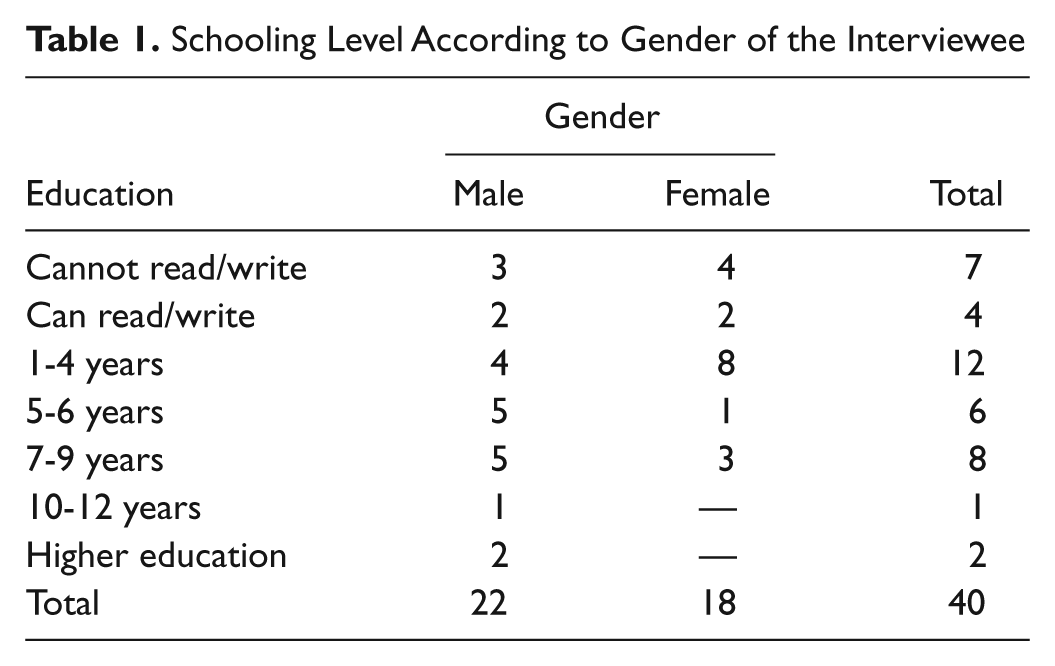
Among the 40 Gypsy interviewees, 32 individuals attended school when they were children, whereas the other 8 did not, mainly females (6 females vs. 2 males). Nevertheless, half of these interviewees went back to school in adulthood. Once more, we can notice that this group of interviewees is ill-favored regarding the major Portuguese population, because in 2001, the illiteracy rate was about 9% (Ine-National Institute of Statistics, Census, 2001).
Girls’ nonpermission to attend school and their early leaving are also due to representations and social opinions produced, reproduced, and transmitted through several generations of Gypsies. They assume such a degree of coercion, which is still difficult to contradict nowadays. The interviewees attribute these practices to the “ideas of the older generation,” to “tradition,” and to the fact that it is not a “social practice” within the group, as the presence of girls in school is likely to degenerate into withdrawal and deviation regarding the group. Therefore, it is necessary to avoid socializing with non-Gypsies, mainly with boys.
In spite of being compulsory to attend the school system during 9 years, this level is far from being accomplished, namely by the Gypsy girls. Among the interviewees’ children, there are 15 youths, 7 girls and 8 boys, between 13 and 18 years of age, who are outside the school system. The difference between sexes is very evident in the precocity with which girls leave school, usually between 11 and 14 years, and mainly between 13 and 14 years; boys leave school a little later, as those who do not go to school are between 16 and 18 years, which means that they quit school when they are 15 to 16 years old. It seems that, despite the Social Insertion Grant, namely, the insertion plan that is proposed to Gypsy families, having generally had positive effects in what concerns the return to and the school attendance of children, youths, and even adults, its efficiency is still limited and with gaps.
As far as children who still attend school are concerned, there are huge discrepancies between the education level and the child’s youth or age. It must be pointed out that, despite the progresses that have been achieved during the last years, there are still children who are enrolled in the education system after the age of 6, and attending kindergarten is far from being usual in the Gypsy group.
The Gypsies’ Representations in Contexts and Situations of Discrimination: The Education System
Regarding this subject, it is important to pay attention to the practices of negative discrimination, which can assume merely manifestations, but they can turn into discriminatory behaviors, as we will refer to later.
During childhood, the experience of contact with school, which is above all one of the main institutions of socialization of the major society, is not always positively evaluated by the interviewees. Alexandrino is 32 and recalls quite well the time when he attended a primary school and when he “felt a little discrimination”; we could perceive that his school experience was an emotional one and was marked by some personal suffering. The tension and anguish inherent in the fact of considering himself different (for him and for the others) may have contributed to his predisposition to victimization. Later, those marks vanished when at the age of 14 to 15 he came back to the formal education system, this time in a professional course. Alexandrino recalls how he isolated himself from the others and could not build relations of friendship and companionship with the Other schoolfellows.
But I suffered because I remember having no friends at school, I didn’t socialise, I even waited for school to finish to play outside, I remember those situations till I got free from that ghost, I think I suffered a bit . . . because, you know, I felt I was being rejected, and people might be treating me equally, but I saw it my own way and thought they were treating me differently, you know, it was that ghost until I got free, until I left school. (32 years old, 6 years of school, administration, commerce, and services employee)
In spite of having only finished the 2nd year of primary school, Monica still remembers the blameworthy way she was treated by her schoolfellows and the troubled relationships between them. The lack of hygiene and cleanliness is the stigmatizing information that composes the stereotype of the interviewee and that affects her as well as many other Gypsy girls. The interviewee says,
When we used to enter school, they would start saying “Look at that Gypsy, the Gypsy is this, the Gypsy is that . . . ” Sometimes the kids, during the school break, kept beating and provoking one another and calling names “you’re a Gypsy, you’ve got lice, you’re all dirty,” it was always like that. (34 years old, services nonqualified worker)
Other interviewees say that they were treated differently, although in a supposedly positive way. Marisa remembers being treated in a privileged way because she was the opposite of the stereotype:
When I was six, I remember my schoolteacher introduced me to the other teachers and said “look at my little Gypsy girl, so beautiful she doesn’t even seem like a Gypsy.” And do you know why? Because a Gypsy is supposed to have lice and be dirty. If it isn’t like this, he isn’t a Gypsy for sure. (29 years old, ninth form, administration, commerce, and services employee)
In some schools, Gypsy children tend to be concentrated in the same class, despite their different ages, also because some of them have strong family and affective relations and therefore they do not want to be kept separated. Usually in these situations, they have to socialize with younger children who quickly top them in the school tasks. According to Gamella (1996), this can make them feel a kind of inferiority and that will lower their personal and social self-esteem. School presumes that cultural and ethnic homogeneity will facilitate learning skills.
For the interviewees, there is a kind of territorial cleavage between the metropolitan areas and urban zones and inland territories and small geographic areas. As a matter of fact, discriminatory events and segregational practices occur in remote places in the inland country, and there are no records of such occurrences in urban areas. They are ways of preventing Gypsy children from socializing with non-Gypsies. This may be considered negative, likely to influence negatively the future representations and relations between Gypsies and the major society, thus emphasizing and reinforcing segregation. João states, “it is worse from that age onwards” (45 years old, can read and write, nonqualified worker, looking for a job). Sara blames non-Gypsies because “Gypsies don’t mind socializing with non-Gypsies, these ones are racist” (68 years old, 4 years of primary school, nonqualified commerce worker). Glória has six children, and they have never experienced this type of practices. The interviewee blames the adults as “children can’t be guilty because adults are racist, you know” (37 years old, can read and write, receives the Social Insertion Income [SII] and helps her husband in the fairs).
Júlio shows his anger for that type of actions as it diminishes the Gypsies’ pride and self-esteem as a group.
The Gypsies are not welcome at school—that is discrimination. For example, in a school there are 20 gentlemen and 10 Gypsies and they don’t want them there. No wonder they are revolted. That explains why many can’t read, that happened many times . . . that’s bad because Gypsies want to be part of society and thus they can’t. People must help. That disgusts me, because you feel down, but that also makes you feel strong. (33 years old, cannot read or write, administration, commerce, and service worker, imprisoned)
The interviewees know through television or they have heard about conflicts in inland regions where non-Gypsy families do not want “to let their children join the Gypsies . . . but that is outside the Lisbon area” (Romana, Gypsy, 34 years old, Portuguese, cannot read or write, housewife). These behavioral reactions of Gypsy populations are classified by Gypsies as racism. The populations that reject the presence of Gypsy children in the schools contradict themselves. For Rui, non-Gypsies tend to state, “No, I’m not racist. I just don’t want to have my children together with Gypsies. This happens because, as I’ve already told you, we are, we the Gypsies, have been trying to integrate for a short time” (32 years old, 7 school years, intermediate- and independent-level technician of commerce and services).
These situations, which cause conflicts between Gypsies and non-Gypsies, turn into accusations against Gypsy children with disruptive and unusual behaviors. Clara reveals that she was “shocked” with what she saw on TV and wonders, “how can there be people who are capable of doing such things?” She still remembers the accusations against Gypsy children: “they even say they beat and took knives and so. People like these should be helped, otherwise, if nobody cares, they will go on” (29 years old, Portuguese, can read and write, nonqualified commerce employee).
The manifestations of hostility are started by non-Gypsies, and for the interviewees, such reactions demonstrate rejection and distance from the major society.
The communication relations between family and school are sometimes troubled, namely, when conflict situations between children or eventually between children and auxiliary teaching staff occur. In these situations, the family intervenes to defend the attacked individual, as Fábio clearly reports:
My brother beat an African, he is 12, and the assistant, who was African too, beat my brother or something like that, he wore glasses, he bled in the teeth. Then my grandma went there and my mother wasn’t there, we were not there, she went out in the morning and we didn’t find her. She defended her race. That was racism. (16 years old, attends a professional course)
Some of the interviewees point out that the teaching–learning process the child is subjected to at school is different from the non-Gypsy one. David refers that there are teachers who, to get rid of some children, let them pass the year, although they have not achieved the minimum objectives:
When they are fed up with those children . . . they can’t stand them anymore . . . they don’t want to be with them for another school year. Although the child requires a bit more attention, they can’t stand her because that’s a naughty child. I think that a teacher must be an expert in dominating, like psychologists. (37 years old, 4 years at primary school, unemployed, nonqualified worker, job seeker)
Some people, like Cristiana, think that in some schools, the teachers neglect the Gypsy child’s learning process. The child, who feels discriminated, consequently rejects school “because teachers only teach non-Gypsies” (43 years old, 9 school years, receiving SII, nonqualified commerce worker). Labeled as “difficult children,” disobedient to rules, aggressive, hyperactive, undisciplined, feeling rejected and unwelcome, they may refuse going to school, feeling outside and frustrated.
David points out the difficulties experienced at school by children who live in poor slums labeled as dangerous and problematic. At school, children are treated in a different way suffering the stigma of being aggressive and “wild” (37 years old, Portuguese, 4 years at primary school, unemployed, nonqualified worker, job seeker).
It’s becoming a relatively usual practice within the territorial context analyzed to enroll the children on a school as soon as they are six. However, it is less common and almost rare to enroll them in nursery schools. At that age, the child and its own family are not prepared for schooling yet, because the children are not used to being closed, nor even sitting for a couple of hours; they have no rules associated with order, assiduity, and so on. Daniel, 38, graduate, has a life and school course that can be still considered singular among Portuguese Gypsies. He thoroughly describes the main difficulties of adaptation of these children in school context:
Then . . . those children getting used to stay there for 6, 7 hours, isn’t it? Almost running—they have that short break—I must admit . . . not 6 hours, from 8 till 13, isn’t it? Around 5 hours with a short break. But that’s too long . . . too long for someone who never . . . who has never been used to . . . habits. Suddenly, you’re there closed—I can’t say imprisoned, because it isn’t, poor guy, it’s not that bad, school isn’t that bad . . . but I try to understand why they can’t find motivation. But that’s not all. They are used to play in the slum.
In the Gypsy context, the strategies of socialization and the type of education usually adopted by parents, which seem to be distant from what school preconizes, must be taken into account. Regarding the socialization of these children, the relational and affective dynamics assumes a particular importance at intrafamily relationships and communitarian ones. According to J.-P. Liégeois (1987), “a child’s education is collective. It usually lives within three or four generations, and its socialisation takes place in this set which reinsures cohesion, coherence, continuity and safety” (p. 61). Actually, socialization is not unidimensional; there is always a game of multiple influences, thus being “multidimensional and systematic” (Seabra, 1994, p. 30), as children’s preparation lies on life experience basis.
It is also worth pointing out teachers’ stereotypes regarding Gypsy families, that cannot help being noticed by the interviewees themselves. They are aware that, generally, parents are considered hostile to school; the functioning codes and the language used by teachers and other school staff seem distant and unintelligible. The noncommunication with school is also related with family projects and family organization; the importance of habitus, which integrates all the past social experiences and of ethnic capital. There is a feeling of being outside school, a telling of impotence regarding school, there is actually a failure of knowledge and expectations.
Among the interviewees, the existence of a real lack of assistance and investment in preschooling of Gypsy children is evident. The lack of or scarce qualifications of parents, as well as the rhythms that mark their economic activity, interfere in the lack of accompaniment of these children. However, parents show a protecting educational style and find that their children either in kindergarten or at school do not deserve the same protection and attention of teachers, thus internalizing exclusion feelings. In these contexts, external to the family and the group, children are not as protected as within the family (Seabra, 1994, p. 98). Nelson is a defender of Gypsy children’s preschooling and says,
That should have been done 20 years ago. Because if it had been done 20 years ago, people would have more time to do other things and kids would be brought up in a different way. They might come back home and behave differently, but something remains there. (30 years old, Portuguese, 6 years of school, administration, commerce, and services employee)
The objective conditions of existence have a great impact on the school life of these children, as well as personal and family motivation. Going to school is still an obligation, not a priority. Jorge refers to the importance of school in the system of values of the Gypsy group:
While the ordinary citizen is educated so that school may be an essential thing in life, as a kid he’s brought up at home, he goes to school because he is made to and when he finishes he’ll go to the fairs, so school won’t be of any good. (47 years old, higher education, intellectual and scientific high-qualified worker)
School is still seen by Gypsies as an institution of the major society (non-Gypsy), with which a relationship of suspicion and fear is kept. According to Jorge, school is for Gypsies a “state entity that has lasted for centuries, and the state has always served to keep us down, to push us, to beat us, it has served for nothing” (47 years old, Portuguese, university degree, intellectual and scientific high-qualified worker).
Besides, the pedagogical procedures at school do not seem to coincide with the ones handled within the family. Learning based on real experiences is privileged, that is, knowledge is knowing how to know, knowing how to be, knowing how to do, and essentially doing to do. As Liégeois (1987) says, the pedagogical procedures “take place in the context of real tasks and through the participation, not through a verbal instruction, and as preparation for a future participation” (p. 63). The pedagogic contents are also very distinct, so the same author points out that for Gypsies, the problems are essentially the daily ones, “those of personal interaction, the logical formal generalisations are unknown, not useful and replaced by real and particular symbolisms that refer to shared and reciprocal experiences” (Liégeois, 1987, p. 63).
It is also worth saying that, due to the living conditions and the set of values of the ethnic Gypsy group, the early contact of the child with books and school articles is not usual. The access to video is easy, as well as to Playstation games, Gameboy, DVD, which can condition their learning in school context. Another kind of difficulties these children may go through has to do with the lack of help when doing schoolwork. Filipe says, “the family relatives are ‘old fashioned,’ they can’t read or write” (29 years old, Portuguese, 3 school years, nonqualified worker, imprisoned). However, the difficulties and limitations regarding reading and writing are also evident as the children tend to write and speak having as reference point the pronunciation used in the oral communication among Gypsies.
The logic of organization within the Gypsy group seems to be far from the way the school institution is structured. Its lifestyle is based on the present, the immediate, the survival, and the management of everyday life, valuing the results rather than the processes. Owning a certain level of schooling is not important for the ethnic and relational capital of the individual within his in-group. Nevertheless, the acknowledgment of the group may occur if the individual gets a degree. Francisco emphasizes that it is not valued “the way to ‘reach’ and when someone gets there, it’s wonderful, everybody talks about it, even if they don’t know the person ‘ah, the Gypsy is this, that Gypsy is that” (29 years old, 12th form, unemployed, administration, commerce, and services employee).
The school life of Gypsy children and youths is nothing more than a short and ephemeral passage, marked by more or less long pauses—absences due to illnesses, weddings, funerals, baptisms, or other ceremonies or even blood quarrels—and due to definitive or transitory ruptures (definitive abandonment and reenrollment) regarding the educational system.
In a lifestyle in which the child is considered the most valued central element within the family, if the child feels no interest or even dislike for school, either for fancy or fear, or certain ingenuity, the family will not easily contradict its will. As a matter of fact, absenteeism depends not only on the attitude of refusal of underage individuals but also on their parents’ lack of interest. Among Gypsies, it is also the family that has the education mission, not school.
For the non-Gypsies, education is clearly permissive, negligent, with no prohibition, rules, physical punishments, and control. But reality goes beyond what is apparent, and indeed these children, from a very early age and in a collective process with great affection, are prepared for their autonomy and independence as well as for the respect for the fundamental and structural values of the Gypsy group. In this context, Francisco refers parents’ behavior whenever the child rejects school:
As soon as the child comes back home crying, or sad, or something, saying that it didn’t like school as parents want to please their children, the first thing they do is “you won’t go to school then,” because what matters is happiness, . . . if the child is happy, everything is alright. (29 years old, 12th form, unemployed)
The child’s happiness and satisfaction, as well as the need to give immediate rewards, also justifies that parents do not try to contradict their child, among other already clarified reasons, owing to the fact that the group is characterized by a lifestyle marked by the present, the instant, the immediate.
Some interviewees do not criticize so much the possible maladjustments concerning teaching methods, syllabuses, and timetables, but above all the strictness and inflexibility of the school institution, namely, in what concerns some cultural practices of the group that directly interfere with the school results. Nelson thinks Gypsies are misunderstood, especially when there are blood quarrels. “Affections are very important for Gypsies” and therefore school “should sometimes understand certain situations. Some youths are about to pass the year and when some things happen, they have to join other families, they quit school and then they fail” (30 years old, 6 school years, administration, commerce, and services worker).
The implementation of the SII in 1996 had a positive impact at short and medium term concerning the brief and relative continuation of the stay of the Gypsy group in the education system. On one hand, it allowed the massive return of children and school age youths to the education system. On the other hand, it allowed an increase, though not a very significant one, of the average levels of schooling within the Gypsy population in general. Jorge is 48 years old and a keen defender of this measure:
Because there was a time when compulsory education, on one hand, and the SII on the other, generated a movement through which all the Gypsy children went to school. . . . However, parents have the minimum motivation to send children to school, unless they know that otherwise they won’t receive that grant. And that’s the carrot and stick approach. Great, I’m in favor of it. That’s alright. (38 years old, higher education, high-qualified worker)
Conclusive Notes
In what concerns the Gypsy group, it’s important to understand what happens within it and how it works internally and in contact with the outside, to realize how difficult and complex the relationship network, established by this group and the school, is.
On a discoursive level, the valorization and importance that school assumes for these interviewees is evident; nevertheless, it’s possible to find signs on the practices level that contradict the discourse. In fact, it can’t be denied that for the last 20 years, the levels of schooling of the Gypsy population have slightly increased, mainly among the male population. At least in this way, they may profit from a basic social right, and, therefore, they acquire knowledge that allows them to decipher some cultural elements of the non-Gypsy society and have access to some if its resources. They tend to attribute an immediate utility to school—reading and writing, getting a driving license, getting the SII, and so on. In the previous generations, of some parents and mainly grandparents and great grandparents, nobody attended school.
Of course, this tendency has to do with wider and global processes, which go beyond the Portuguese society. Indeed, one of the processes that is more closely linked to social mobility courses in the contemporary Portuguese society concerns the rapid increase of the education levels (Almeida, Costa, & Machado, 1993), having a crucial role in the dynamics of the modern societies. Although such a process is far from having had identical repercussions in the ethnic Gypsy group, there is an improvement in the school and socioprofessional profiles of the members of this group. Nevertheless, the inequalities and the contrast factors between Gypsies and the society in general are still being reproduced.
Among the Gypsies, the child quickly becomes a young adult, for the period of adolescence and youth is almost nonexistent. In general, children from an early age help parents in street trading or other work activities. Girls, in turn, tend to stay home and to take care of siblings and perform household chores to prepare for the assumption of the roles of wife and mother because they marry early today, which implies a rapid transition to adult social status, assuming family responsibilities, among which includes ensuring that physical subsistence of the family group made up. But the transition from child to young adult life despite being a little later for boys than for girls, still at an early age, is largely due to strong family pressures and the in-group.
Early school leaving by girls is caused by family decision, and this is basically a social and ethnic conditioning. The repetition of this practice is based on the alleged “tradition” and supposedly “fragile” and more “weak” moral woman, suspecting that his stay in the school system can only result in their perversion and deviation from the in-group. The pressure group and censorship even today determines the parents’ decision.
Among the respondents, the numbers of early school leavers are concentrated in age groups between 10 and 15 years; there was slight but no less important nuances depending on the gender of individuals. Men leave school at the age threshold from 13 to 15 years; except for three cases that were beyond the secondary level, the remnant left school before age 18. Women tend to leave school even earlier, namely, between 10 and 12 years by their own initiative and will.
Considering that education is compulsory during the first 9 years (until 2009 5 ; remember that this research was made between 2002 and 2007), is it possible to register such dropout rates? The social policy measures (Rendimento Mínimo Garantido or Minimum Income Guaranteed) cannot break down and overlap the practices historically and socially legitimized by their families to cause the premature abandonment, particularly of the girls. Among Gypsies, there still persists an attitude of devaluation of the schooling and the education by parents and families, little or no schooling, combined with the maintenance of lifestyles in which it operates early passage of children and preteen to adult life, with the assumption of social responsibilities that this entails.
In addition, Gypsies seem to carry a burden of feelings of rejection and inadequacy with an impact that cannot be neglected on the decrease of the levels of self-esteem and on the assumption, in a relatively indelible way, of emotions such as shame, 6 humiliation, and embarrassment. It is even admitted that there may be a certain predisposition to victimization and that the Gypsy individual will tend to interpret nonintentional meanings in the actions of the other individuals, perceiving any action perpetrated by the non-Gypsies as racism. But it is important to point out that among the interviewees, it is consensual that when Gypsies feel discriminated, namely in a school context, they also feel underestimated and tend to rebel and react “abruptly” because they also feel distressed and nervous, as pride and personal and group self-esteem are affected. The majority of those who have experienced situations perceived as discriminatory states that they feel revolt. Sometimes the revolt is associated with sadness, fury, and anguish. There are also repressed, hidden, and covered feelings that may possibly be perceived through the analysis of the nonverbal components of their behavior.
Footnotes
The author(s) declared no potential conflicts of interest with respect to the research, authorship, and/or publication of this article.
The author(s) received no financial support for the research and/or authorship of this article.