




Abstract
Research on positional segregation in sport focuses on mechanisms perpetuating discrepancies in integrated contexts, including in majority-minority sports. However, theoretical explanations for positional segregation should apply to other status groups, such as ethnicity, that may be more salient in monoracial or nearly monoracial settings. We use 2018 to 2019 data on 790 NHL players and executives along with descriptive models previously applied to questions of racial segregation in sport to evaluate if stereotypes have led to ethnicity-based differences in athletes’ outcomes, using on-ice positions, leadership positions, team management positions, and penalty minutes related to stereotypes in playing style. Results show no evidence for ethnic stacking nor barriers to player leadership in the NHL but substantial differences in team management positions and penalty minutes. Our findings illuminate the degree to which theories concerning racial stereotyping mechanisms might be extended to apply in monoracial settings.
Plain language summary
Much research has shown that stereotypes linked to race are connected to the ways athletes are positioned on competitive fields or courts. This can in turn lead to limited opportunities for minority athletes in terms of endorsement or leadership opportunities. We are interested in whether the theories used to explain these patterns in reference to race can be used to examine the opportunities available to other minority groups. In this paper, we use data on 790 professional hockey players to see whether ethnic stereotypes lead to similar patterns in a mostly-white setting. We use descriptive methods traditionally used to examine spatial distributions of racial minorities in sport along with models that examine access to leadership positions to see how ethnic stereotypes might be used. We also use penalty minutes to try to identify patterns of ethnic stereotypes connected to playing style. We find little evidence that ethnic stereotypes affect player position or leadership opportunities in this mostly-white sport, but good evidence that ethnic stereotypes affect off-ice leadership opportunities and on-ice playing styles. While intriguing, these data cannot examine specific interactions involving stereotypes that players might experience. Our approach here could also be applied to other status groups, such as gender, sexual orientation, or age.
While officiating and judging controversies will likely always exist in sports, the fact that winners of athletic contests are determined by best time, distance, or score means that sports should be able to avoid discriminatory allocation mechanisms because athlete performance can be objectively measured. In other words, in the interest of winning the best player should play, regardless of that athlete’s master status as a member of a particular age, gender, sexual orientation, or racial group. However, a large body of research demonstrates that racialized stereotypes generate a devalued status for non-white groups that blocks opportunities for minority athletes and administrators (Apoifis et al., 2018; Davis et al., 2022; Day, 2015; Pitts & Yost, 2013). Research also suggests that in modern systems, where overt racism is viewed as distasteful, race may be operating in more subtle ways. Specifically, stereotypes rooted in white supremacy assert that white athletes and athletes of color have biological differences, and that those alleged biological differences lead to superior intellect and social acumen for white athletes and superior physical attributes for people of athletes (Harrison & Lawrence, 2004; Hodge et al., 2008). These stereotypes persist in sports in spite of scientific evidence of biological similarity across athletes from different racial groups, to the point where scholars argue that such stereotypes affect managerial decision-making processes, placing athletes of color in less central positions and altering their playing styles and strategies in accordance with the stereotypes (Bopp & Sagas, 2014).
In this paper, we are interested in whether these more subtle stereotyping processes apply to other marginalized status characteristics; here, we look specifically at ethnic differences among within-race comparisons (Fletcher & Hylton, 2017). Similar stereotypes exist across ethnic lines, but the current literature does not examine whether such stereotypes operate to a similar end as the racial patterns found in previous work. We extend the literature in two important ways. First, we explore whether and how discriminatory stereotyping might create segregation by ethnicity in similar ways as has been amply demonstrated for race in sport. To accomplish this, we investigate the potential presence of positional segregation, or stacking, by ethnicity in a majority-white sport, Second, we look at a broader set of outcomes to adjudicate more clearly among competing explanations of how stereotyping works in sports. To examine refinements to theories about stereotyping in sport extending to ideas about leadership, we extend our analysis to player leadership positions and to executive decision-making positions. Finally, to examine more modern theories connecting stereotyping in sport to tasks rather than positions, we explore potential connections between ethnicity and playing style.
We use the National Hockey League (NHL) to examine if and how stereotyping mechanisms operate in settings that are predominantly white but have players of varying intraracial, or ethnic, backgrounds. We use traditional descriptive models of positional segregation to examine whether players are distributed across positions equitably across white ethnic groups, allowing comparison of our findings concerning ethnicity to the long tradition of such research on race. We then use captaincy as a measure of informational and power centrality and examine whether players from intraracial minority groups have different access to leadership positions. As central positions often constitute a pipeline into the management of teams, we examine the distribution of general managers and head coaches to observe whether players from particular intraracial ethnic groups are more likely than others to climb the management ladder. This speaks to a growing body of literature that demonstrates how discrimination blocks and penalizes minority coaches (Davis et al., 2022; Day, 2015); we examine whether similar patterns operate concerning ethnicity in monoracial settings. Finally, we examine possible roots of ethnic stereotyping and extensions to theories about stereotyping and playing tasks by examining penalty minutes as a proxy for style of play. Since the theoretical mechanisms most often used to explain racial discrimination in sport should operate for within-race ethnic stereotypes as well, we expect differences in positions played, likelihood of serving as captain, likelihood of being a general manager or head coach, and penalty minutes accrued across NHL players from different within-white intraracial groups.
Literature Review
Segregation and Discrimination Mechanisms in Sport
The question of whether ethnicity among intraracial groups operates in similar ways to race in sport has roots in a robust literature outlining racial stereotypes and discrimination. Racial stacking is a phenomenon observed in many sports around the world and has been referred to as the longest running thread in the sociology of sport (Smith & Leonard, 1997). While a great deal of stacking research involves team sports in the United States, which has a particular history of colonialism and slavery that contributes to persistent and pernicious racial stereotypes, similar outcomes are found among other sports, including Australian rugby league (Hallinan, 1991), British cricket (Dominic, 1997), European basketball (Chappell & Karageorghis, 2001), South African rugby union (Cros, 2013), and European football (Bradbury, 2013; J. P. Mills et al., 2018). This broad literature also demonstrates that racial stacking is a phenomenon that has spanned not just space, but time, even as opportunities to play at all expand for athletes from underrepresented groups. In each of these cases, historical exploitation of and discrimination against persons of color provides clear roots for stereotypes that are adopted and enacted in sport settings.
Scholars propose competing theories to explain these patterns. One possible explanation is outcome control, suggested by Edwards (1979) to explain racialized patterns of opportunity even in sports where minority athletes make up large proportions, or even the majority, of players. Outcome control theory argues that minority athletes are excluded from the positions that have the greatest influence on the outcome of a game. Positional segregation under outcome control theory is based on stereotypes dealing with the intellectual ability and leadership qualities of minority athletes (Edwards, 2010). These arguments receive further support from differences between minority and majority athletes that go beyond position allocation. For example, black quarterbacks playing in the National Football League are two and a half times more likely to be benched than their white counterparts, despite potential costs to disrupting play (Volz, 2017).
Although proposed later, perhaps the most well-established theory for positional segregation is centrality (Smith & Leonard, 1997), which proposes that positions spatially in the center of the playing surface carry more independence, leadership, and importance than those on the periphery. A common example is American football, where quarterbacks are both spatially and informationally central. Conversely, positions like cornerback are in peripheral areas of the field and separate from key elements of play, therefore lacking both spatial centrality and informational power (Pitts & Yost, 2013; Siler, 2019). Obstacles to the most central positions also lead to fewer opportunities to move into powerful and lucrative positions in coaching or management (Apoifis et al., 2018; Day, 2015).
Bopp and Sagas (2014) expand the exploration of stereotyping patterns by moving beyond stacking to outline a more subtle racial mechanism operating in sports. Racial tasking involves minority athletes playing positions that once were predominantly white, but facing pressure to play those positions differently. Bopp and Sagas showed black quarterbacks, playing a position historically filled by white players, are pressured to assume a running role. Minority players perhaps no longer face barriers to specific positions, but rather face pressure to play those positions differently due to the same stereotypes that used to block them from the position.
If racial tasking is supplanting racial stacking as the best explanation for patterns in sport, minority athletes may still be blocked from advancing to lucrative and powerful coaching and management positions, even after they have broken into central and powerful positions on the field. Research on the ways athletes are framed as leaders indicates this pattern may already be operating in sport, as evidence from European football suggests racial barriers block non-white players from leadership positions (Bradbury, 2013). Minority athletes may be welcomed onto teams, perhaps even into central positions, if their athleticism is viewed as beneficial to a team’s chances of winning, but they may still be framed as less able to lead teams.
How Do Ethnic Stereotypes Operate in Monoracial Settings?
Most of the research on stacking, tasking, and similar discriminatory processes in sport examines racially integrated settings, such as recent research describing American football, where 52% of players at the highest collegiate level are African American and 44% are white (Siler, 2019). While it is notable that race continues to operate in majority-minority settings like American football, we are also interested in whether mechanisms based on stereotypes also exist across different ethnic groups in monoracial or nearly monoracial sports, perhaps also creating similar patterns of positional segregation and other barriers to opportunity across ethnic groups. It is possible that in such settings, we will find little evidence of processes such as positional segregation or obstacles to leadership roles, perhaps because there are fewer links to power differentials and exploitation patterns embedded in colonialism that so clearly underpin the social construction and lived experience of race, but that barriers to racial minorities’ participation will be especially high. Ethnic minorities who do not exhibit easily identifiable markers of otherness, such as different skin color, might seem unremarkable and, therefore, experience few negative consequences to their minority status.
It is also possible, however, that in monoracial settings ethnic minority status will still be visible through more performative markers such as limited ability to speak the majority language, an identifiably minority group name, or differing cultural references. We use ethnicity here to refer to socially constructed identities based on nationality, culture, and traditions within broader racial categories that designate intraracial minority status (Brubaker, 2009; Gonzalez-Lesser, 2020; Wimmer, 2008). While we acknowledge continued debate over how race and ethnicity may be similar or different theoretically and in practice (cf. Bonilla-Silva, 2015; Wimmer, 2008), ethnicity in this discussion includes performed and enacted markers of cultural difference that indicate minority status within the umbrella of a racial group (Bonilla-Silva, 2015; Gonzalez-Lesser, 2020).
To examine how ethnic stereotypes operate in predominantly white settings, we use as a case study the top professional hockey league in North America (the National Hockey League, or NHL). We use the NHL to explore how the powerful mechanisms that perpetuate racial segregation might operate similarly to create or perpetuate ethnic segregation. While predominantly white, the NHL has historically experienced stereotyping and segregation based on broadly defined racial groups, such as stereotypes that block opportunities for players from First Nations, Native American, and Aboriginal groups (Valentine, 2012).
However, there is also evidence of ethnic stereotypes playing a part in hockey opportunities. For example, research demonstrates positional segregation of white Francophone-Canadian players in the NHL (Lavoie, 2003; Longley, 2000).Lavoie (1989) demonstrated that French-Canadian players outperformed their fellow Canadians and US players; the gap between performance and opportunity is suggestive that stereotypes blocking certain athletes from opportunity is not limited to race, but can also operate across within-race ethnic groups. These discriminatory practices persisted at least into the 2000s (Lavoie, 2003). Although relations between English and French-speaking Canada have improved considerably since the Quebec separatist referendums of 1980 and 1995 that may have contributed to the patterns Lavoie found in hockey, fissures still remain (Lalonde et al., 2016). For example, 60% of French-speaking Quebeckers in 2011 felt strongly attached to Canada, compared to 95% of English-speaking Canadians (Jedwab, 2011). These tensions also spill over into sport (Dallaire & Denis, 2000).
The NHL is also a useful setting in which to study ethnic stereotyping because of the ways the league has expanded. At the same time Francophone-Canadian players were experiencing discrimination in the NHL, the league expanded opportunities for players from outside of North America. As a result, many positions have been filled by an influx of players from both Western Europe and Russia. Although we acknowledge that Russia may sometimes be considered part of Europe, given their different routes into the NHL, and particularly the ways Soviet players were explicitly prevented from playing in the NHL for many decades, we treat European and Russian players as different groups. European players rose from 3% of the NHL draft in the 1970s to 32% in the 2000s, with similar increases for Russian players (Kahane et al., 2013). While the very large majority of these players present and identify as white, they do bring different cultural markers and knowledge to the NHL, and heated competition for limited playing spots might exacerbate ethnic tensions among players and cause a reification of ethnic or cultural differences across groups rather than assimilation (for non-sports examples of how resource scarcity can increase ethnic tension, see Seter et al., 2018 and Galindo et al., 2017). Ethnic stereotypes generally have their basis in socially constructed but minutely delineated differences that can be repeatedly enacted to define ingroups (Brubaker, 2009; Nagel, 1994), and the stereotypes that operate around ethnic groups in hockey follow this pattern.
Some basic differences across ethnic groups serve to create boundaries between groups or “other” players who are not from North America. For example, Russian players are often less conversant in English or French than their peers and have distinctively Russian names (Tuboltseva, 2019), making it easy to enact ethnic boundaries that label Russian athletes as “Other” compared to North American players and perhaps contributing to the fact that it is harder for young Russian players to be drafted into the NHL (Christie & Lavoie, 2015).
In addition, stereotypes that go beyond language or naming conventions are linked to particular styles of play. One root of these intraracial stereotypes concerning playing styles is the construction of hypermasculine aggressiveness in Canadian junior hockey leagues, and the ways this masculinity is used to construct a Canadian ethnicity (Kennedy et al., 2019; Robidoux, 2002). To their detriment, European and Russian players are widely viewed as different from this hypermasculine construct, with play that is less physical and aggressive. Research on hockey in non-North American contexts such as Sweden suggests Swedish players grow up in a context where stickhandling and skating are emphasized and the aggressive Canadian style of play criticized or condemned (Stark, 2013). While this is changing, non-North American players tend to play what has become known as a “finesse” style of hockey when compared to the culture of physicality prevalent in Canadian hockey (Allain, 2008; Stark, 2013). Stereotypes persist for Russian players as well, including the idea they are undisciplined, selfish, unpredictable, or have a “mad Russian” approach (Allain, 2016). We note that these stereotypes are not like racial stereotypes that have a long and deep history of white supremacy and active persecution of non-white groups, but we argue that such stereotypes might still generate an in- and out-group status that could drive segregation on and off the field of play. If ethnic stereotypes are operating in the NHL, we would expect to see European and Russian players viewed as poor matches for the most powerful and important positions on teams, including leadership positions. If so, this would provide evidence that ethnicity is acting among white populations in similarly powerful ways to block sport opportunity as race operates in more diverse sport populations.
Such potential cleavages within racial groups suggest a need to move away from theoretical perspectives that focus on centrality and toward the kinds of enacted boundaries that define ethnicity, and, in turn, a need to move away from looking solely at playing positions toward an expanded definition of opportunity in sport. Malcolm’s (1997) argument concerning the ways race operates in cricket less in terms of centrality and more through specific racist tropes linked to colonial histories is a good example of such approaches. Ethnic practices or stereotyping may be related to historic conflicts between Anglophone-Canadians and Francophone-Canadians, between North American colonies and European colonists, or between athletes who grew up in North American democracies and Russians who lived in the Soviet Union during the Cold War. Stereotypes or prejudices growing from such conflicts or other political or cultural disputes are likely candidates for building cross-group boundaries based on ethnicity, even in monoracial or nearly monoracial settings (Nagel, 1994).
The Present Study
We use measures of power, centrality, and enacted cultural differences to test these ideas. First, we adopt the canonical approach of measuring positional segregation by comparing the actual with the expected number of players filling each position by intraracial ethnic minority status. Second, since captaincy is a marker of prestige and informational centrality within the NHL, we measure captaincy and assistant captaincy by intraracial ethnic minority status. We then examine the presence or absence of intraracial ethnic minority leaders in executive positions such as general manager or head coach. Using these canonical approaches of descriptive modelling allows us to compare our findings concerning ethnicity to the large body of research demonstrating discriminatory patterns by race. Finally, to incorporate the more contemporary mechanisms of racial tasking, we evaluate style of play. We use penalty minutes as an indication of style of play (Grossman & Hines, 1996) and compare the number of total penalty minutes and major penalty minutes across intraracial categories.
Methods
Data
We present data on the 826 players on active NHL rosters and 62 general managers and coaches of those teams for the 2018 to 2019 season. We use data from the 2018 to 2019 season because it was the last full NHL season prior to the COVID-19 pandemic. Since the pandemic began in 2020, NHL adjustments to scheduling and travel policy, often driven by national policies in Canada and the United States, have affected players’ ability to cross borders and play. In addition, some players’ opportunities were affected by health crises, health concerns, or vaccination choices associated with the pandemic. We therefore use the most recent pre-pandemic data for our inquiry; data from the 2022 to 2023 season demonstrate very similar patterns (results available upon request). Most of the data were available on official team websites through NHL.com; we supplement that information with data from similar websites such as ESPN.com. Of the 826 players in our data, we include 790 in our classifications of intraracial white groups (players coded as white; see coding schema below). These data and associated code can be accessed at https://scholarsarchive.byu.edu/data/20/.
Dependent Variables
Position
To evaluate the association between ethnicity and playing in positions of spatial centrality, we measure the position teams report players inhabit. The positions are coded from 0 to 4 respectively: goalie, defensemen, left wing, center and right wing.
The majority of stacking research focuses on sports with very large playing surfaces; NHL playing surfaces are relatively small by comparison (61 m × 26 m). As a result, players are more clustered physically in hockey, raising questions about how to define centrality. We address this by examining three different configurations of centrality. The first considers centrality on a horizontal axis; the second considers a vertical axis, and the third splits the ice into an offensive and a defensive half and designates a central triangle in each half (Figure 1).

Potential Centrality Configurations in Ice Hockey. Panel (a) (centrality along horizontal axis); panel (b) (centrality along vertical axis); panel (c) (centrality within one half of playing surface).
Using a horizontal axis, our first configuration involves goalies and centers as spatially central to play, while wings and defensemen are peripheral (Figure 1a). This configuration also tests the outcome control theory (Edwards, 1979) as goalies have a disproportionate effect on game outcomes. Our second approach involves a vertical axis where centers and wings are coded spatially central, while defensemen and goalies are peripheral (Figure 1b). This configuration accounts for the fact that the goalie position is unlike other players on the ice in terms of tasks, roles, movement, and even in that they stay on the ice when other players substitute in and out many times during a game. The final approach considers a central area within each half of the rink that comprises a triangle connecting centers and defensemen (Figure 1c). This configuration recognizes that play often happens on one half of the ice and that defensemen often take the lead in play and in determining spacing of other players on the ice, which is in line with stacking theories that emphasize power and information centrality. In this final centrality configuration, we consider defensemen and centers central positions and wings and goalies peripheral positions.
Leadership
We code whether players are appointed captain or assistant captain. This variable is a set of categories with no leadership position, captain, or assistant captain. These categories are mutually exclusive. One potential weakness of the data is that players may have inhabited a leadership position in other years we do not capture.
Executive Decision Makers
We use the same categories and strategies as above but apply them to all teams’general managers and head coaches, allowing us to extend the question of stereotyping to important executive decision makers off the ice. There are 62 executives in this population (31 general managers and 31 head coaches, representing all of the NHL teams).
Penalty Minutes
To test the stereotype that Europeans, Russians, and Francophone-Canadians play a less aggressive style of play, which may reinforce ethnic outgroups and boundaries in ways that lead to positional, leadership, or other forms of segregation, we measure penalty minutes in two ways. The first comprises total penalty minutes, accrued for any infraction, during the 2018 to 2019 season (Valentine, 2012). Measuring average penalty minutes per season across players’ careers yielded similar results (available upon request).
We also note that players can accrue penalty minutes for minor technical infractions that may not indicate a style of play that embraces aggressive stereotypes. We therefore create a measure of penalty minutes accrued in 2018 to 2019 for three types of specific penalties that are more representative of aggressive styles of play: major penalties (infractions with a higher “degree of violence,” most commonly assessed for fighting), game misconduct penalties (infractions such as checking from behind, illegal check to the head, biting), and match penalties (assessed when players are judged to be deliberately attempting to injure an opponent) (National Hockey League, 2018). Players with more major penalties may also represent particular roles such as enforcers (Valentine, 2012) or play on “checking lines” where aggressive play is expected. For both penalty minutes measures, we exclude goalies, as NHL-style play means that most goalies had no penalty minutes (Nexcluding goalies = 715).
Key Independent Variables
Race and Ethnicity
We attempt to identify the races and intraracial minority status of athletes, GMs, and coaches through a variety of methods, including birthplaces listed on team websites, designations in published media accounts, examinations of pictorial evidence, examinations of surnames or other cultural markers such a native language or tattoos, and consultations with teams and players themselves, including players from the groups in question. Given the socially constructed and performative nature of both race and ethnicity, we may be missing some indicators of either. We may be at particular risk for miscoding multiracial or multiethnic players who “pass” as white or Anglophone-Canadian.
We began with traditional examinations of race (white, black, Asian, First Nations/Native American, and Latino) to determine a baseline for whether typical forms of racial stacking operate in the NHL. We then turned to ethnicity within the athletes we coded as white, which we defined with five groups: Anglophone-Canadians, Francophone-Canadians, Americans (United States), Europeans, and Russians (see Jones et al., 1999, and Lavoie, 2003, for similar approaches). A potential weakness of our data is that our measurement of ethnicity may be conflating nationality with ethnicity, and therefore may miss important distinctions within the groups we designate here (such as Sammi status in Finland). We note, however, that it is unlikely Anglophone-Canadians or Americans making decisions about player positions or captaincy are intimately familiar with stereotypes internal to specific European countries; we argue they are likely basing any stereotypes they use on broader criteria such as those we use here. Even with over 800 athletes in our population, defining ethnicity any more finely than we do here causes cell size problems, but we look forward to future research that uses models such as those we propose here on larger populations. We note that the ways sports expand and develop in different parts of the world might lead to differences in the performance or skill level of athletes from different countries. For example, while the United States typically fields a robust and successful Olympic team overall, the lack of development of field hockey infrastructure in the US means that the US has not qualified a men’s team specifically to the Olympic field hockey competition since 1956 (only competing since then as the host nation in 1984 and 1996), and has never qualified a men’s team to the outdoor World Cup. However, we argue that ice hockey development in the countries represented in these data, almost exclusively from North America, western Europe, and Russia, has been robust and lengthy; indeed, of the 69 Olympic medals awarded in men’s ice hockey, all 69 have been won by countries from these three regions, and by countries from which the very large majority of the players in these data hail.
Control Variables for Multivariate Analyses
Years Played
Years played captures the number of years since the player was drafted into the NHL, excluding years during their career that players may have been “sent down” to the minor leagues.
Weight and Height
While ethnicity may play a part in the way players are distributed across positions, it is likely that players of different sizes are also distributed differentially across positions. We include weight (in kilograms) and height (in centimeters) for each player.
Analytic Plan
We begin by presenting traditional descriptive models to examine whether there is a significant relationship between player ethnicity in the NHL and our outcomes of interest. These models mirror models in both classical and contemporary studies of racial discrimination in sport (for only a few examples, see Chappell & Karageorghis, 2001; Hallinan, 1991; Lewis, 1995; Pitts & Yost, 2013; Siler, 2019; Smith & Leonard, 1997; and, specific to inquiries about professional hockey, Lavoie, 1989 and Valentine, 2012), allowing for a clear comparison of the degree to which similar patterns of ethnic discrimination do or do not exist. We first examine crosstabulations of intraracial ethnic minority status and position, intraracial ethnic minority status and captaincy, and intraracial ethnic minority status and off-ice executive position (general manager and head coach). We then present means comparisons of ethnicity and penalty minutes to move beyond questions of centrality to enacted forms of ethnicity and ethnic stereotypes. Finally, we turn to multivariate models for each outcome. For position and captaincy, we use multinomial regression models to account for the categorical nature of the dependent variables. For both total penalty minutes and total major penalty minutes, we ran two different kinds of models. We used negative binomial regression, which accommodates negatively dispersed distributions well, and OLS regression of standardized versions of both penalty minute variables. The patterns of findings are very similar across both negative binomial and OLS regression strategies, so we report the OLS regressions of standardized penalty minutes here. Data were missing on some variables for a small number of cases; we used Stata 15’s multiple imputation chained equations protocol to impute 20 data sets. We note there is debate over when to use tests of statistical significance when examining sport data (Gibbs et al., 2015). We define the players we study here as the population of all NHL players in a specific season, and thus focus on differences of practical significance in this study as a difference that exceeds one-third of a standard deviation (Hill et al., 2008). In addition to being an appropriate approach to population statistics, this is also a more conservative approach to identifying real-world differences in a relatively small population.
Results
In an effort to provide comparisons to the large literature on stacking, we begin our analyses by examining the racial distribution of players to establish whether a) stacking patterns observed in other sports apply to racial minorities in the NHL, and b) whether the NHL is a sufficiently “monoracial” setting to be able to support our exploration of ethnic stereotyping. There are only 36 interracial minority players (26 black athletes, or 3.16% of the league; three Asian athletes representing 0.38% of the league; four First Nations/Native American athletes, making up 0.064% of the league; and three Latino athletes, representing 0.38% of the league). In total, then, players from nonwhite groups comprise only 4.5% of athletes in the league in 2018 to 2019. The distribution of these racial minority athletes across on-ice positions and leadership positions is almost exactly what would be expected if players were distributed randomly. Black, Asian, and First Nations/Native American players averaged slightly more of both types of penalty minutes than white players, consistent with previous findings on First Nations and Aboriginal players (Valentine, 2012) (results for all racial analyses available upon request). While these findings suggest less influence of race in positional stacking and leadership opportunities in the NHL than in other documented sport settings, we urge caution in accepting such conclusions based on only 36 athletes. Indeed, these findings instead mirror previous work suggesting First Nations players find it difficult to break into the NHL (Valentine, 2012).
Having established that current NHL rosters are overwhelmingly white, we turn to our questions about whether theories about stereotyping and discrimination in sport can be applied to ethnic differences in monoracial or nearly monoracial sports contexts. Table 1 presents descriptives. The majority ethnic group in the NHL is Anglophone-Canadian, followed by similar-sized cohorts of Americans (USA) and Europeans. Francophone-Canadians and Russians constitute the two smallest ethnic groups. Captains and assistant captains constitute just over 10% of all players. The mean number of total penalty minutes is 18.57, and the mean number of major penalty minutes is 3.62. The mean for years played in the league is around eight with a range between 1 and 22 years. Players’ heights and weights have substantial ranges.
Descriptive Statistics for 2018 to 2019 National Hockey League Players (N = 826).

Table 2 presents a crosstab showing both the observed and the expected number of players in each position by their ethnicity across the three configurations of centrality discussed above (Figure 1). Results do not show any evidence of ethnic stacking in the NHL using any of these centrality configurations, a contrast to previous cohorts of players where Francophone-Canadian players were underrepresented in some positions (Lavoie, 1989, 2003). Ethnicity, then, does not seem to be playing a part in the distribution of athletes to positions regardless of what definition of centrality is used.
Crosstabulations of On-Ice Position by Player Intraracial Minority Group Status.

Note. Cells include observed count and expected count in parentheses.
Table 3 presents a similar crosstab for leadership positions, showing the number of players who are a captain, assistant captain, or hold no leadership position as distributed by player ethnicity. Results do not show any evidence of ethnic stereotyping affecting formal player leadership positions in the NHL, in contrast to other sports like European football (Bradbury, 2013). Taken together, our analyses of position and leadership do not provide support for the idea that physical and informational centrality stereotypes create stacking for ethnic minorities in nearly monoracial settings, at least in the NHL. These findings challenge the idea that race operates in white monoracial settings similar to ways it does in more integrated settings. This leads to the question of whether race operates in white monoracial settings only as a barrier to participation that maintains white spaces.
Crosstabulations of Leadership Position by Intraracial Minority Group Status.

Note. Cells include observed count and expected count in parentheses.
Examining other outcomes, however, suggests other, perhaps more subtle ways in which stereotyping operates to discriminate against intraracial minority groups in sport. Table 4 explores ethnic distributions among general managers and head coaches (N = 62). In contrast to the null findings when looking at current players’ positions and access to leadership roles, Anglophone North Americans overwhelmingly fill off-ice leadership roles. We also note that we could identify only one person among this population who might be described as having non-white heritage (Anaheim Ducks head coach Dallas Eakins, whose biological father is of Native American heritage). Though Europeans make up more than a quarter of NHL players, there is only one European general manager in this population, and there are no European head coaches. There are no Russians represented in either executive decision-making position, despite the fact that Russians have been playing in the NHL for 30 years. Anglophone-Canadians are overrepresented among both general managers and head coaches, perhaps suggesting that stereotypes about leadership in the NHL coalesce around Anglophone-Canadian status, which corresponds in these data to majority status. Findings for Francophone-Canadian executives echo our findings for Francophone-Canadian players, suggesting that prejudices against Francophone-Canadians may have dissipated over time, perhaps in response to an influx of non-Canadian athletes. Americans are underrepresented in executive positions compared to the proportion of players who are American. We considered the possibility that this might signal a preference among Canadian teams to have Canadian GMs and coaches, and in fact, that pattern does appear to hold for Francophone-Canadian executives. But we note that 24 of the 31 NHL teams are in American cities, so any potential preferences appear to be working against transitions of American players into front office and head coaching positions.
Crosstabulations of Executive Decision Maker Positions (General Manager and Head Coach) by Intraracial Minority Group Status.

Note. Cells include observed count and expected count in parentheses.
To test how stereotypes about style of play and potential ethnic tasking might be associated with player ethnicity, we compared means for total penalty minutes and major penalty minutes across ethnic groups (Table 5). There are some differences across groups, which seem initially to provide evidence for how ethnic stereotypes might be generated or operating in the NHL in expected ways. The group-by-group comparisons show, however, that those differences are largely driven by the fact that Anglophone-Canadian players on average have a significantly higher mean number of penalty minutes than players from other ethnicities. While American players accrue fewer of both types of penalty than do Anglophone-Canadians, they receive more penalties on average than Europeans, Russians, and Francophone-Canadians. European players receive fewer of both types of penalty minutes than any other group; this difference is less than a minute on major penalties compared to Russians but nearly 9 minutes fewer on average in major penalties than Anglophone-Canadians. While this may provide some evidence that Canadian or North American stereotypes concerning finesse European styles of play are operating in the NHL, the overall story is somewhat more complicated. While this proxy for style of play provides some intriguing evidence that ethnic stereotypes may be based in playing styles, our data suggest these effects may be driven not only by European styles of play that are less physical, but also by Anglophone-Canadian styles of play that are especially physical.
Means Comparison of Total and Major Penalty Minutes by Player Intraracial Minority Group Status.

Note. aDifferent from Anglophone-Canadian; bDifferent from American (USA); cDifferent from European; dDifferent from Russian; and eDifferent from Francophone-Canadian. Practical difference indicated by difference greater than one-third standard deviation.
We also ran multivariate tests to see whether any ethnic differences across position, leadership roles, or penalty minutes persisted in the NHL net of other factors. As we might expect, given the lack of evidence connecting ethnicity to position or captaincy in the crosstabular analyses, ethnic group membership had no notable relationship with either position or captaincy in the presence of controls (results available upon request).
We then turn to the regression models predicting total standardized penalty minutes (Table 6). In the presence of measures tapping player height and weight, position, and tenure in the league, Anglophone-Canadians still received more penalty minutes on average than any other ethnic group. The differences between Anglophone-Canadians and European, Russian, and Francophone-Canadian players are all initially beyond the threshold of one-third of a standard deviation (greater than 0.33) that we use as a marker of practical significance; the difference between Anglophone-Canadian and Francophone-Canadian players is no longer beyond that threshold once controls are introduced. The difference between Anglophone-Canadian and American players also does not quite reach that standard with controls in the model. As we might expect, height and weight are associated with more penalty minutes. Being older is also associated with more penalty minutes.
OLS Regression of Penalty Minutes by Player Intraracial Minority Group Status, Position, Height, Weight, and Tenure in League.

Note. N = 715 (excludes goalies). Coefficients represent standard deviations.
Finally, we present the results for regression analyses predicting major penalty minutes in Table 7. In Model 1, players from all other ethnic groups had lower major penalty minutes on average than did Anglophone-Canadian players, but these differences only reach the level of one-third of a standard deviation when compared to European and Russian players; the difference between Anglophone-Canadian and Francophone-Canadian players is very close to our one-third standard deviation threshold. Unlike the models for total penalty minutes, height, weight, and years in the league did not demonstrate notable associations with major penalty minutes. This calls into question media stereotypes that older players hang on as enforcers; perhaps instead their higher numbers of total penalty minutes indicate waning skills that lead to minor infractions.
OLS Regression of Major Penalty Minutes by Player Ethnicity, Position, Height, Weight, and Tenure in League.
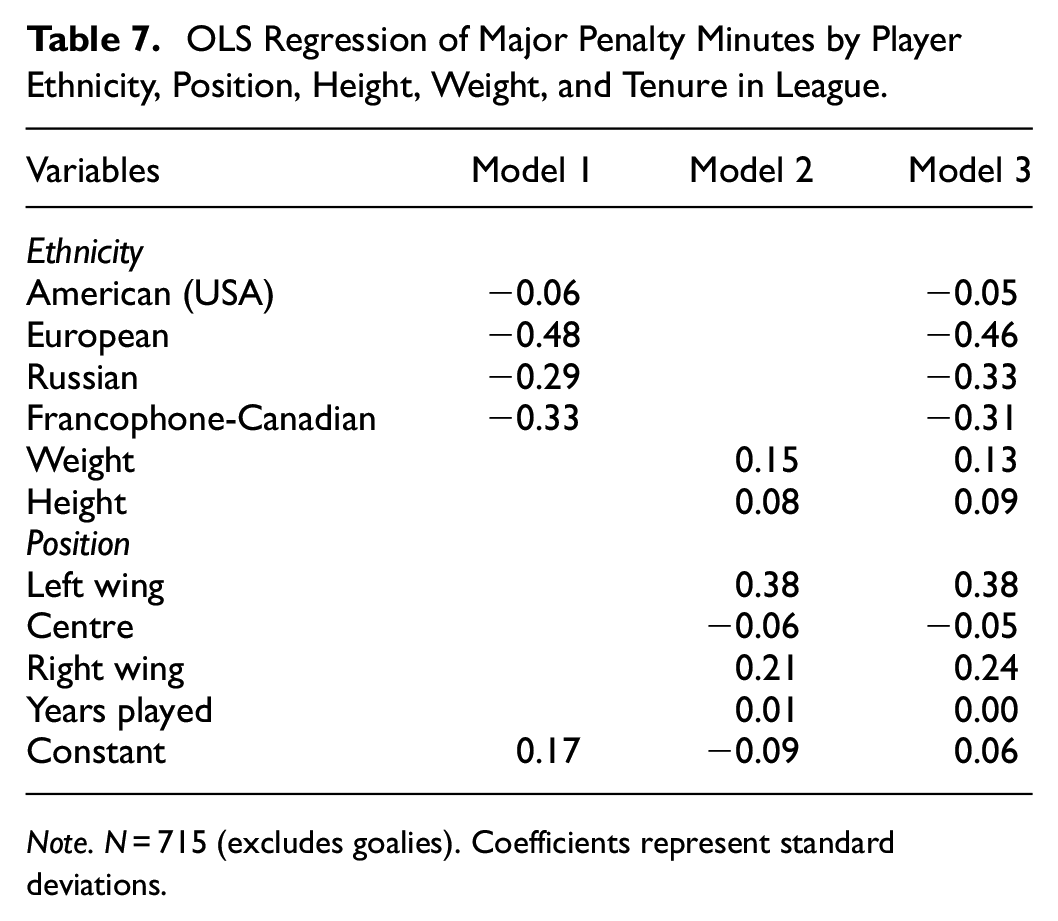
Note. N = 715 (excludes goalies). Coefficients represent standard deviations.
Discussion
The goal of this paper has been to test whether stereotypes associated with devalued minority groups other than race drive similar patterns of inequality as those observed across racial groups in sport. Decades of scholarship demonstrates that stereotypes about racial minority groups drive unequal opportunities and even positional segregation (stacking) across multiple sports (Loy & Elvogue, 1970; Smith & Leonard, 1997). Recently, scholars allude to several more pernicious methods through which these discriminatory practices influence the ways athletes perform to conform to these stereotypes (c.f. Bopp & Sagas, 2014) and the discretionary power of match officials influencing penalty decision-making (Davis et al., 2022). The current paper extends this literature by examining whether similar mechanisms operate to discriminate against other devalued minority groups in predominantly monoracial spaces by exploring the National Hockey League.
First, contrary to what we expected, and unlike the effects of race in other sports, the results yielded no evidence of ethnic positional segregation in the NHL, despite potentially powerful mechanisms like language barriers that could preclude a foreign player from being assigned more central positions with more informational power. While race continues to be strongly associated with obstacles to entering the highest levels of hockey, the same is not true for intraracial ethnic differences. We speculate that in a predominantly white setting there is no positional segregation operating because a player’s ethnicity does not carry the same level of stigma or stereotype attached to physical markers such as skin color. Our findings also suggest that previous patterns of stacking observed for Francophone-Canadian players in the NHL (Lavoie, 1989, 2003) may have been resolved. It is also possible that the influx of “outsiders” to the NHL in the form of European and Russian players has discouraged stereotypes that break up Canadian groups.
Our similar null findings concerning captaincy suggest that persistent stereotypes concerning intelligence and hard work as sources of white athletes’ success may operate more powerfully when participants can more readily “other” athletes of non-white racial groups than when athletes from different parts of the world can lay claim to similar alleged internal sources of superiority. While beyond the scope of this study, our findings indicate that future research should look at interracial and intraracial patterns within feeder or minor leagues that are more regionally constrained. While we do not yet know how “othering” might be operating for ethnic minority players in such pipelines, media reports suggest both that more European players are using Canadian junior hockey leagues as pipelines into the NHL and that prominent Anglophone-Canadian media personalities view the use of traditionally Canadian pipelines by “outsiders” skeptically (Koshan, 2018). Because teams in NHL feeder leagues are often located in smaller, more rural areas with varying degrees of racial and ethnic diversity, examining players in these contexts may provide more insight into how ethnic minority status operating in heavily white spaces might limit access at the beginning of the hockey pipeline for these players, as well.
At the other end of the hockey labor pipeline, our results mirror those of previous studies that examine racial stereotypes in professional coaching networks (Day, 2015); indeed, we found profound differences in opportunities for athletes from intraracial minority groups to transition into executive positions, like general manager or head coach. These findings suggest that in white spaces, discrimination is still operative via ethnic differences, and, in tandem with the null findings from positional segregation, that distinctions within white groups tend to be more important further up the job ladder and for positions that wield more power, autonomy, and authority (Dufur, 2008; Wilson & McBrier, 2005). Stereotypes about sources of intelligence, decision-making processes, and leadership skills, which might be even more important for executive than for on-field positions, might accrue to majority groups within white spaces as they attempt to move into front office positions rather than in sorting players on the ice. Our findings suggest such a pattern; as a result, we might conclude that discrimination operates in similar ways in both multiracial and white spaces, but that it is important to examine different levels of sport participation in those different spaces to uncover where gatekeeping occurs. If this is the case, looking only at player outcomes to the exclusion of executive and front office positions might mask ways ethnic-based stereotypes continue to operate in largely white settings.
However, there is some evidence of what might be considered ethnic tasking in the NHL. We found that there are notable differences across ethnic groups in terms of their style of play. It is evident from these findings that Anglophone-Canadians’ playing style is on average different from other groups’ play. We suspected that stereotypes surrounding playing style might provide a venue for how Canadians see outsiders, and specifically how outsider ethnic identities were being constructed for European and Russian players. However, our findings provide less support for boundary maintenance designed to define an outgroup, and are more suggestive that hyper-aggressive play might be adopted by Anglophone-Canadian players as a way to define an ingroup. Hockey is a “window” into how Canadians see themselves (Kennedy et al., 2019). As Canada and the NHL diversify, significant differences in aggressive and violent styles of play might indicate attempts at defining boundaries around a Canadian ethnic identity that continues to be celebrated for its portrayal of traditional values such as strength and aggression (Allain, 2008; Kennedy et al., 2019; Robidoux, 2002). While we note that this construction of Canadian ethnic identity might in many ways be closed to racial minorities, women, and other historically oppressed groups, this reinforces the importance of looking beyond race to other statuses along which discrimination might occur. Our potential measures for ethnic tasking are limited in these data; observational data of how enacted behaviors might map onto ethnic tasking in ways similar to the interracial tasking observed in Bopp and Sagas’ (2014) work would be useful to determine the extent of this phenomenon.
One interesting aspect of our findings is the way they lead to questions about the general applicability of traditional stacking theory across different contexts. Most previous work on stacking has found evidence of racial discrimination in sports with larger playing fields and teams, but these approaches may not work for sports with other physical and structural characteristics. It is possible that sports with smaller playing surfaces on which centrality can play out, or with smaller numbers of players across which to discriminate, may demonstrate discriminatory practices in ways different than those that seem obvious in other sports. Our findings also suggest it is necessary to take into account specific sports cultures. Our results provide support for previous research on professional hockey showing that as the enforcer role fell out of favor, Aboriginal players tasked with such roles lost ground in the NHL (Valentine, 2012). It is difficult to assess whether athletes are stacked into central or peripheral positions based on race when there are only a handful of minority players in the athlete population to begin with. Cultural shifts specific to a sport, then, can drive racial or ethnic patterns in ways that do not align with previous inquiries. For example, these findings are similar to research that found mixed evidence for how traditional stacking approaches applied to women’s softball (Jamieson et al., 2002).
There are limitations to using administrative data as we have here. One is that such data are unable to dig into the specifics of individual athletes’ or executives’ daily lived experiences. Research on interracial discrimination has outlined how athletes from interracial minority groups experience and manage microagressions and prejudices as part of their everyday participation in sport (cf. Singer, 2019). The kinds of data we employ here are likely masking ways intraracial minorities experience similar discrimination, such as exclusion based on names or language (Tuboltseva, 2019). Qualitative research could help to examine whether intraracial minority athletes experience such microagressions in the same ways and to the same degree athletes from interracial minority groups do.
In this research, we found that even in monoracial occupational contexts, like the NHL, majority status groups are uniquely privileged in ways that exclude minority groups. Unlike more racially diverse contexts, where minority groups are blocked from impactful positions or from leadership responsibilities on the field of play, in this monoracial context occupational inequality occurs before and after player careers for both inter- and intraracial minority groups. Interracial minority players, or non-white players, are more likely to be excluded from entering the league at all, while intraracial minority players, or co-racial minority players, are excluded post-career from coaching and general manager positions. This means that the majority group advantage that once existed on the ice persists off the ice. This also means that while the NHL has made progress in equalizing intraracial opportunities once players from varying backgrounds make it into the league, equalizing interracial exclusion may prove to be difficult as long as league executive decision makers are not comprised of intra- or interracial minority group members. Together, these findings provide support for the idea that it is necessary to move away from theories about centrality in favor of more granular examinations that take into account histories of colonization, conflict, and culture both across and within racial groups (Malcolm, 1997). The approach to ethnicity in sport we take here could be applied to other settings that have experienced recent ethnic conflicts, such as Serbia and Croatia (Brentin, 2013; R. Mills, 2009), clarifying how political and ethnic conflicts might extend into sports that have instead tended to be framed as opportunities for unity. In addition, our approach could be applied to other minority status groups beyond either race or ethnicity to better understand the potentially nuanced ways stereotyping of minority groups might block opportunity.
Footnotes
Authors’ Note
We appreciate advice provided by John Hoffmann and panelists and audience members at the session of the American Sociological Association meetings where we presented an earlier version of this paper. This research was conducted while Kevin Shafer was at Brigham Young University; he is now an independent scholar and can be reached at
Declaration of Conflicting Interests
The author(s) declared no potential conflicts of interest with respect to the research, authorship, and/or publication of this article.
Funding
The author(s) received no financial support for the research, authorship, and/or publication of this article.
