




Abstract
The aim of this article is to understand the relationship between ethnic identity, victimization/witnessing community violence, ethnic discrimination, and aggression in a sample of university students living in the South East Region of Turkey. The participants were 263 university students of predominantly Kurdish ethnic origin. The results showed that males had higher levels of ethnic identity in the dimensions of exploration and commitment. Males also presented higher scores for witnessing community violence and lifetime exposure to ethnic discrimination. The most important predictor of participants’ ethnic identity was witnessing community violence. Participants who witnessed violent acts in their social environment had higher ethnic identity levels. Although the predictor variables could not explain an important part of the participants’ aggression levels, only perceived ethnic discrimination was positively related to aggressive behavior. The role of native language efficiency in ethnic identity is also discussed.
Keywords
Introduction
Recent studies have concentrated on the self-identification of children, youth, and emerging adults in various social contexts in a multiracial world. Ethnic identity development and the social dynamics related to the ethnic identity formation of young people have become crucial topics for social scientists and researchers working on positive youth development. It is not always easy to develop an independent ethnic identity in social contexts in which the dominant ethnic group is authoritarian and ethnic discrimination is apparent. In Turkey, many ethnic groups (e.g., Arabs, Zazas, Kurds, Armenians, and Circassians) live together. Kurds are the second-largest group, following the Turkish ethnic group. Despite Turkey’s multiracial social context, few studies have focused on the ethnic identity development of youth in Turkey. Although there are no official statistics on the population of ethnic groups in Turkey, more than 20 million people belong to non-Turkish ethnicities, and 12 million of these people are Kurds and Zazas (“Etnik Nüfus Dağılımı,” 2012). The Kurd populations live predominantly in the South East and East regions of Turkey. The people living in these regions have suffered from community violence for more than 30 years because of the conflict between the PKK (Kurdish Workers Party) and the Turkish Armed Forces. Turkey’s South East region has experienced significant conflict, with thousands of deaths in the 1990s (Pedersen, 2002). These traumatic experiences and the environment of continuing war have affected the people living in Turkey socially, economically, and psychologically (Gün & Bayraktar, 2008; Tekin-Yılmaz, 2005). In this study, we analyze the ethnic identities of emerging adults living in this conflicted region and examine the social and psychological effect of this environment on their ethnic identity development.
Ethnic identity has been formulated differently by sociologists, social psychologists, and anthropologists. In this study, we understand ethnic identity from a developmental psychology perspective. Phinney’s (1990) review, which summarized previous studies on ethnic identity, defined the components of ethnic identity, including self-identification with one’s ethnic group, a sense of belonging to this group, and positive or negative attitudes toward one’s ethnic group. Soon after framing ethnic identity and its related factors, Phinney (1992) constructed a brief, two-component psychological measure to understand and investigate ethnic identity through empirical research that conceptualized ethnic identity based on dimensions of exploration and commitment based on developmental psychology, especially Erikson’s (1968) ego identity formation theory and Marcia’s (1980, 2001, 2002) formulization of four ego identity statuses. Phinney’s (1990, 1992) ethnic identity formulation was derived from the identity theories of developmental psychology and filled an important gap in the empirical research.
Ethnic Identity and Gender
Ethnic identity seems to be a protective factor for minority group members who are suffering from bad effects of ethnic discrimination. Burnett-Zeigler, Bohnert, and Ilgen (2013) found that higher sense of pride, belonging, and attachment to one’s ethnic group reduced the risk of having psychopathological symptoms like anxiety and depression in Black, Hispanic, and Asian emerging adults living in United States. Self-esteem was positively related to ethnic identity in college students coming from various ethnic groups living in United States. Developing an advanced ego identity was found to be a combination of strong ethnic identity, and appositive attitude toward other ethnic groups (Yuh, 2005).
Social role expectations for men and women are predominantly shaped by cultural values and practices through socialization. During the lifelong socialization process, different role expectations for males and females are transferred and generally internalized by the members of a social group or community. In Turkey, masculinity, traditional values, and collectivistic tendencies are highly valued, especially in rural populations. Hence, traditional gender roles may increase men’s contribution in organizations or social groups related to their own ethnic group and may encourage men to be active in political and cultural activities of their ethnic group. The literature on gender differences has generally examined data collected from adolescent samples, and little research has been conducted among young adults. These studies have produced contradictory findings. For instance, some research has suggested that girls have a higher sense of ethnic identity compared with their male peers (e.g., Charmaraman & Grossman, 2010; Costigan, Koryzma, Hua, & Chance, 2010; Galliher, Jones, & Dahl, 2010; Martinez & Dukes, 1997; Umaña-Taylor & Guimond, 2010). In contrast, some researchers have reported that there are no significant gender differences between male and female adolescents (e.g., Gaylord-Harden, Ragsdale, Mandara, Richards, & Petersen, 2007; Shrake & Rhee, 2004). In Shrake and Rhee’s (2004) cross-sectional research, participants’ age was important in the development of a sense of ethnic identity. Older adolescents (aged 16-18) had a greater level of ethnic identity in comparison with early adolescents (aged 13-15). Studies that concentrated on young adult samples have also produced fragmentary results related to gender differences in the development of ethnic identity. For example, some studies identified no gender differences in emerging adults and young adults (e.g., Negy, Shreve, Jensen, & Uddin, 2003; Smith & Silva, 2011; Yoo & Lee, 2009). In a study of immigrant college students, males were found to be more connected with their ethnic identities than females were (Lee, Falbo, Doh, & Park, 2001).
Community Violence, Ethnic Identity, and Gender
The World Health Organization (WHO) defined community violence as a type of interpersonal violence caused by acquaintances or strangers that harms an individual physically, sexually, or psychologically or that results in deprivation (Krug, Mercy, Dahlberg, & Zwi, 2002). Being a victim of or witness to community violence affects young people in a very negative manner and can cause externalized behavioral problems, such as aggression (e.g., Bradshaw, Rodgers, Ghandour, & Garbarino, 2009; Spano, Rivera, & Bolland, 2006), or internalized behavioral problems, such as depression (e.g., McAloney, McCrystal, Percy, & McCartan, 2009) and post-traumatic stress disorder (e.g., Ozer & McDonald, 2006). When we examine gender differences related to being victimized by or witnessing acts of community violence, we find that males are more disadvantaged in their exposure to community violence. For example, Allwood and Bell (2008) found that early adolescents in the midwestern United States were exposed to community violence more often than domestic violence. Furthermore, males experienced more frequent traumatic events in their community than did females, and males were more likely to experience physical and verbal abuse in their social environment. In a large sample of adolescents (Bossarte, Swahn, & Breiding, 2009), males were found to have more exposure to physical fights and were more likely to be injured in these fights than females were. Bradshaw et al. (2009) found that male adolescents had a greater likelihood of being victims of and witnesses to violent acts in comparison with female adolescents.
Community violence is common among ethnic minority settlements, post-conflict societies, and poor rural populations. A study that concentrated on rural adolescents’ experiences of violence in three social settings found that males experienced relatively higher levels of direct school and neighborhood violence compared with females. Females were more likely to witness domestic violence at home and were not exposed to community violence as frequently as their male peers (Carlson & Slovak, 2007). Although male youths have been found to have more exposure to community violence in many studies (e.g., Copeland-Linder, Lambert, Chen, & Ialongo, 2011; McAloney et al., 2009; Wilson, Rosenthal, & Battle, 2007), some studies have found that females also experience community violence frequently, but in different ways. For instance, Mendelson, Turner, and Tandon (2010) explored the experiences and consequences of exposure to violence among African American adolescents and young adults and found that males reported more neighborhood violence, but among the multiple domains of community violence, experiences of forced sexual activity were more common among females. A meta-analytical study that combined studies on sex differences in the experience of traumatic events (Tolin & Foa, 2006) found that females were more likely than males to experience sexual assault and childhood sexual abuse but were less likely to experience neighborhood violence and to witness acts of community violence, such as death or injury.
Ethnic Discrimination
Exposure to ethnic discrimination has various negative effects on adolescents’ and young adults’ psychological health and social adjustment. Research has found that higher levels of perceived ethnic discrimination are positively related to depression (e.g., Benner & Kim, 2009; Kim, Wang, Deng, Alvarez, & Li, 2011; Santana, Almeida-Filho, Roberts, & Cooper, 2007), anxiety (e.g., Juang & Alvarez, 2010; Soto, Dawson-Andoh, & BeLue, 2011), and aggression (e.g., Borders & Liang, 2011; Copeland-Linder et al., 2011; Flores, Tschann, Dimas, Pasch, & de Groat, 2010; Liang & Borders, 2012; Simons et al., 2006).
Chou (2012) found that perceived discrimination was positively associated with depressive symptoms in immigrant Chinese adult sample in Hong Kong. Results of that mentioned study also exposed that social support and neighborhood collective efficacy reduced the harmful effects of perceived discrimination on immigrants’ depressive symptoms a year later living in that new society. Culturally related stress and perceived discrimination was found to be related with vulnerability to depression and suicidal ideation in emerging adults, but a strong ethnic identity protected participants against the damaging effects of ethnic discrimination (Polanco-Romans & Miranda, 2013). Umaña-Taylor, Wong, Gonzales, and Dumka (2012) investigated Mexican-origin adolescents’ ethnic identity, perceived ethnic discrimination, and externalizing behaviors in school contexts. They found that ethnic identity affirmation emerged as a protective factor especially for male adolescents by buffering negative impacts of discrimination on their externalizing behaviors in school environment.
Previous research has also suggested that there are gender differences in exposure to ethnic discrimination in many societies. An important part of the research that concentrated on gender differences found that male adolescents (Cassidy, O’Connor, Howe, & Warden, 2004; Dotterer, McHale, & Crouter, 2009; Galliher et al., 2010; Greene, Way, & Pahl, 2006; Shrake & Rhee, 2004; Wiehe, Aalsma, Liu, & Fortenberry, 2010) and male young adults (Jasinskaja-Lahti, Liebkind, & Perhoniemi, 2006; Landrine, Klonoff, Corral, Fernandez, & Roesch, 2006; Liang, Alvarez, Juang, & Liang, 2009; Neto, 2006) were more likely than females to perceive ethnic discrimination from their teachers/professors, peers, strangers, and civil servants. However, some research found contradictory results: In these studies, there was no difference between female and male participants in perceived ethnic discrimination (Broudy et al., 2007; Copeland-Linder et al., 2011; Ying & Han, 2006).
Although exposure to ethnic discrimination has a negative psychological impact on children and adolescents, research investigating the links between perceived ethnic discrimination and ethnic identity formation in adolescent samples is lacking. Sabatier (2008) investigated the cultural and ethnic identities of second-generation immigrant adolescents living in France. Their study found that parental enculturation had an important effect, especially on ethnic identity affirmation and exploration. Adolescents who perceived more discrimination also had greater tendencies toward ethnic identity affirmation and exploration.
Language and Ethnic Identity
Language plays a key role in the cultural transmission processes of children and adolescents. Ethnic or heritage language proficiency provides social capital for youths to become involved in cultural practices and to communicate with members of their ethnic group. There is growing interest in psychology about the relationship between cultural transmission, ethnic language proficiency, and ethnic identity development because of the multicultural social contexts in many countries. Recent empirical studies have examined the importance of heritage languages for ethnic identity. For instance, Azmuddin and Ibrahim (2011) found that emerging adult Turkish Australian participants who preferred to use their heritage language were more likely to identify themselves as Turkish. In a qualitative study, Jaspal and Coyle (2010) explored British-born South Asian youths’ use of their heritage language and ethnic identity. They determined that heritage language use led participants to make “us” and “them” evaluations and positively impacted their ethnic group identities. Oh and Fuligni (2010) investigated ethnic identity development among adolescents from Latin American and Asian backgrounds and found that heritage language proficiency was the most important predictor of adolescents’ ethnic identities. The results of that study suggested that adolescents who were more proficient in their heritage language had greater identification with their own ethnic group. In another study with an adolescent sample (Phinney, Romero, Nava, & Huang, 2001), ethnic language proficiency and in-group peer interactions were the major predictors of participants’ ethnic identities.
Although previous studies have shown a strong link between ethnic or native language proficiency and ethnic identity, Vedder and Virta (2005) presented some contradictory findings. In their study, the authors investigated Turkish immigrant youths’ first- and second-language proficiency, adaptation, and ethnic identity. The research results for Turkish immigrants living in Sweden supported a positive link between ethnic language proficiency and ethnic identity, as found in previous studies, but there was no significant relationship between native language proficiency and ethnic identity for Turkish immigrants living in the Netherlands.
The Relationship Between Ethnic Identity, Community Violence, Ethnic Discrimination, and Aggression
Ethnic identity has gained significance as part of healthy identity development. Young people who do not assimilate and who remain connected with their own culture, traditions, and customs and maintain a sense of belonging to their ethnic group may have some important psychosocial advantages. Some researchers have defined ethnic identity as a resiliency factor for youth and have identified positive links between ethnic identity development and psychosocial adjustment (Galliher et al., 2010; Martinez & Dukes, 1997). Most of the research on ethnic identity has found that a higher level of ethnic identity promotes positive well-being in young adult samples from various ethnic minority groups (e.g., Cislo, 2008; Lee, 2003, 2005; Smith & Silva, 2011; Yip & Fuligni, 2002). Chae and Foley (2010) investigated the relationship of ethnic identity, acculturation, and psychological functioning among Chinese, Japanese, and Korean American young adult participants. Results exposed the strong positive predictor role of ethnic identity in participants’ psychological well-being in Chinese, Japanese, and Korean American participant groups.
Although the positive consequences of ethnic identity development have been investigated in many studies, a gap remains in the understanding of the determinants of ethnic identity and the variables that are connected to ethnic identity development. Some societies lack a collaborative social and political environment for minority youth to search for their ethnic identity. The majority culture may not endorse social activities for minority groups’ ethnic culture or may force minority groups to conform to the dominant culture’s customs and traditions. In these authoritarian societies, conflict is inevitable, and young people can be badly damaged by community violence. Previous research on ethnic identity development has revealed that exposure to and witnessing acts of community violence are positively correlated with adolescents’ aggressive behavior and social maladjustment (e.g., McMahon & Watts, 2002; Spano et al., 2006). However, there were no significant correlations between ethnic identity and aggression (Le & Stockdale, 2008; Schwartz, Zamboanga, & Jarvis, 2007). Some research findings have suggested that ethnic identity is negatively correlated with aggression (McMahon & Watts, 2002) and antisocial behavior (Brook, Zhang, Finch, & Brook, 2010). Ethnic discrimination is another important risk factor for positive development among youth. A sense of alienation from the dominant group may consolidate bonds among ethnic group members and enhance their ethnic identities. These positive associations between ethnic identity and perceived ethnic discrimination have been identified in some empirical research (e.g., Awad, 2010; Cislo, 2008).
Aims and Hypotheses of the Study
This study was exploratory and preliminary because it is among the first of its kind, especially in Turkey. We aimed to examine the relationship between ethnic identity, victimization/witnessing community violence, ethnic discrimination, and aggression in a sample of university students living in the South East region of Turkey. Our first aim was to investigate whether there were gender differences in ethnic identity, victimization by and witnessing of community violence, perceived ethnic discrimination, and aggression. We expected to find gender differences for many of these variables. Specifically, we expected males to have stronger ethnic identity dimensions, to be more likely to be victims and witnesses of violent acts, and to have higher levels of perceived ethnic discrimination and aggression (Hypothesis 1).
Our second aim was to determine which of the important psychosocial variables predict levels of ethnic identity among university students. We predicted that higher levels of victimization and witnessing of community violence and perceived ethnic discrimination would be associated with higher levels of ethnic identity in our sample (Hypothesis 2).
The third aim of the study was to explore the relationships between perceived ethnic discrimination and aggression. We expected that higher levels of ethnic discrimination would be strongly associated with aggressive behaviors among young adults as an outcome behavior (Hypothesis 3).
The last aim of this investigation was to determine whether there were differences between participants who had higher degrees of native language proficiency (high language efficacy in Kurdish, Zazaish, or Arabic) and participants who had lower proficiency in their native language or who spoke only Turkish. We hypothesized that participants who had higher native language proficiency would have higher ethnic identity, greater exposure to community violence, and higher perceived ethnic discrimination in their social environment (Hypothesis 4).
Method
Participants
Participants in this study included 263 undergraduate students (119 males, 144 females) from physics, sociology, chemistry, mathematics, and engineering departments. Fifteen percent of the participants were first-year students, 44% were second-year students, 29% were third-year students, and 11% were fourth-year students. The study was conducted in South East Turkey at one of the major universities in this region (Dicle University-Diyarbakır). The greater part of our participants defined themselves as Kurdish (73%) and Zaza (6%). Some participants self-defined as Turkish (13%), Arabic (3%), or of other multicultural origins (5%). Many of our participants’ mothers were illiterate (50%). Others were literate without a degree (17%), had 5 to 8 years of total education (25%), or had a high school degree (5%). Only 1% had a university degree. Among the participants’ fathers, 10% were illiterate, the majority (41%) had 5 to 8 years of total education, 24% had a high school degree, and the minority (10%) had a university education. Participants generally came from low-income families, and the majority of the participants (87%) spent less than 500 TL (approximately 250 Euros) monthly for their individual expenses. The students’ ages ranged from 19 to 28 years (M = 22.3, SD = 1.76), and their families had 1 to 16 children (M = 6.4, SD = 2.69). The majority of the participants described themselves as bilingual or with proficiency in a language in addition to their mother tongue (97%).
Measures
Demographic questionnaire
Participants were asked to report their gender, department, age, the educational levels of their mother and father, their parents’ occupations, the number of children in their family, individual monthly expenses, and their perceived accuracy levels in their mother tongue and in other spoken languages.
Multigroup ethnic identity measure (MEIM)
The 14-item MEIM was developed by Phinney (1992) to assess the ethnic identity of various ethnic groups. Two items were subsequently removed from the MEIM, and the resulting 12-item scale was applied to a large sample of adolescents (n = 5,423; Roberts et al., 1999). The 12-item MEIM’s internal consistency ranged from .81 to .89 across 11 ethnic groups in the United States. According to the results of confirmatory factor analyses, the scale had two factors and an adequate model fit (Roberts et al., 1999). This 12-item MEIM was applied in our study. The items described behaviors that reflect exploration (e.g., “In order to learn more about my ethnic background, I have often talked to other people about my ethnic group”) and commitment (e.g., “I have a clear sense of my ethnic background and what it means for me”) in relation to ethnic identity. The MEIM uses a 5-point Likert-type scale ranging from 1 (strongly disagree) to 5 (strongly agree), with higher scores indicating higher levels of perceived ethnic identity. As a widely used scale for studying the ethnic identities of adolescent and young adult samples, the MEIM includes two factors, exploration (5 items) and commitment (7 items). High reliability and validity scores were found for these two factors in many previous studies with various ethnic backgrounds (e.g., Avery, Tonidandel, Thomas, Johnson, & Mack, 2007; Dandy, Durkin, McEvoy, Barber, & Houghton, 2008; Ponterotto, Gretchen, Utsey, Stracuzzi, & Saya, 2003). The MEIM was translated to Turkish by the author, and two academics from psychology and linguistics verified its language adequacy.
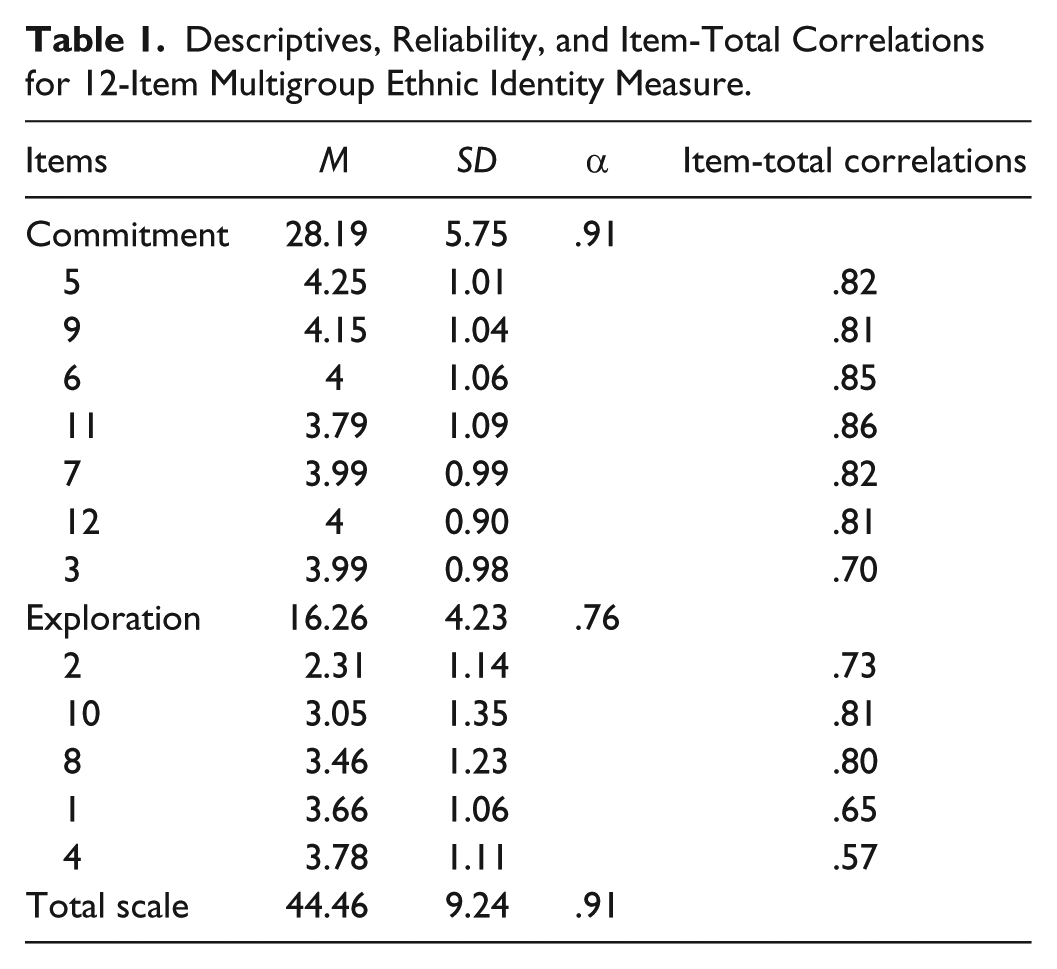
In the present study, reliability and validity analyses of the MEIM were conducted. The mean scores, standard deviations, Cronbach’s alphas, and inter-item correlations are presented in Table 1. As shown, the participants’ total scores were as follows for each subscale: Commitment: M = 28.19, SD = 5.75; Exploration: M = 16.26, SD = 4.23; and Total Score: M = 44.46, SD = 9.24. Item-total correlations were high, ranging from .57 to .86. To explore the internal reliability of the MEIM, Cronbach’s alpha and split-half reliability methods were applied. Cronbach’s alphas were relatively high for both subscales (α = .91 for Commitment, α = .76 for Exploration). Cronbach’s alpha was .91 for the 12-item total scale. The split-half reliability scores were as follows: .84 for Commitment, .64 for Exploration, and .91 for the Total Score.
Descriptives, Reliability, and Item-Total Correlations for 12-Item Multigroup Ethnic Identity Measure.
In most previous research, two-factor models of MEIM, Exploration and Commitment, were supported in samples of emerging adults from various cultures. Thus, in the present research, we tested the appropriateness of the two-factor model using LISREL 8.30. The fit indexes for the two-factor model χ2 = 164.81 (df = 53, p <.001), (χ2 / df = 3.1), Root mean square error of approximation (RMSEA) = .08, standardized Root mean square residual (RMR) = .05, Goodness-of-fit index (GFI) = .91, Comparative fit index (CFI) = .93, Incremental fit index (IFI) = .93, Normed fit index (NFI) = .90, and Relative Fit Index (RFI) = .88. Although the RFI was lower than .90, other fit indexes, such as the GFI, CFI, IFI, and NFI, were higher than .90, indicating an adequate model fit. For the standardized RMR and RMSEA, values below .05 are described as a good fit, and values between .08 and .10 indicate a mediocre fit. Therefore, the standardized RMR score had a good fit, and the RMSEA value was relatively good. As a whole, the fit indexes of the present study indicated that the two-factor model provided quite a good fit to the data. These two factors were also highly correlated, with a correlation of .82 between the exploration and commitment factors. We provide detailed reliability and validity information about the MEIM in the present study because of its pioneering role in the field of ethnic identity studies in Turkey.
The Victim of Violence and Witness of Violence Scale
This scale (Wilson & Rosenthal, 2003) has 7 items that measure participants’ experiences with community violence during the past 3 years (victimization) and 11 items that measure community violence to another person that participants may have witnessed in their social environment during the last 3 years (witnessing community violence). The 7-item subscale includes items that examine participants’ experiences of being chased by gangs, threatened with serious physical harm, assaulted, or mugged. The 11-item subscale included items that investigated participants’ witnessing of community violence (e.g., being picked up, arrested, stabbed with a knife, etc.). The measure was a 4-point Likert-type scale ranging from 1 (never) to 4 (very often), with higher scores indicating higher levels of victimization or witnessing of community violence. The scale was developed by Wilson and Rosenthal (2003), and the internal consistency scores for the original scale were .70 for the 7-item victimization dimension and .91 for the witnessing dimension. The scale was translated to Turkish by the authors, and two academics from psychology and linguistics verified its language adequacy. The results of reliability analyses showed that the internal consistencies of the 7-item Victim of Violence Scale was α = .52, and the Witness of Violence Scale was α = .87 for this present study.
General Ethnic Discrimination Scale
This Scale (Landrine et al., 2006) is an 18-item scale that measures adults’ perceived ethnic discrimination in the past year and throughout their lives (e.g., “How often have you been treated unfairly by teachers and professors because of your race/ethnic group”). It also measures how stressful the ethnic discrimination events were (e.g., “How stressful was this for you?”). The 6-point Likert-type scale ranges from 1 (never) to 6 (almost all the time), with higher scores indicating higher levels of perceived ethnic discrimination. This scale had high internal reliability scores (for lifetime and recent discrimination: α = .94; for appraised discrimination: α = .95). The split-half reliability for each scale was .91 of the original scale. The scale was translated to Turkish by the author, and two academics from psychology and linguistics verified its language adequacy. High reliability scores were found for the three subscales (lifetime and recent discrimination: α = .92; appraised discrimination: α = .92) in the present sample (n = 263), and the item-total correlation for each item was higher than .30 for each subscale.
Aggression Scale
This 45-item scale was used by Tuzgöl (1998) based on Kocatürk’s (1982) Aggression Inventory. Its 5-point Likert-type scale ranged from 1 (never) to 5 (almost all the time), with higher scores indicating higher aggression levels of participants. The items examined physical and psychological acts of aggression and attitudes. Tuzgöl (1998) found adequate reliability scores for this scale, with a test-retest reliability of .75 and Cronbach’s alpha of .71. Tok (2001) used the scale in her study and found an internal consistency of .84 in a Turkish university student sample, which is relatively high (n = 531). In the present study, we found reliable internal consistency results for the scale (α = .82) and item-total correlations higher than .30 for each item of the scale. Higher total scores on the scale indicate higher aggression levels of participants.
Procedure
A demographic form and the scales were administered to students who volunteered to participate in this study. After obtaining information about the aims of the study and their privacy rights, the participants completed the questions in 20 to 25 min during classroom sessions.
Results
Descriptive Statistics and Bivariate Correlations
For female and male participants, Pearson’s correlations were used to define bivariate correlations among all variables, as shown in Table 2. The correlation matrix shows that none of the demographical variables were significantly correlated with ethnic identity scores. Among the demographic variables, only the number of languages that the participants spoke were correlated with witnessing violence (for males: r = .34; for females: r = .25) or perceived ethnic discrimination in the past year (for males: r = .23; for females: ns). As shown in the table, two dimensions of ethnic identity (exploration and commitment) and total scores for ethnic identity were highly correlated with witnessing violence and perceived ethnic discrimination (for males: r = .24 through r = .41; for females: r = .19 through r = .29), but there were no significant correlations with participants’ aggression scores. Aggression was only found to be correlated with perceived ethnic discrimination (for males and females: r = .19).
Correlations Among the Variables in This Study.

Note. 1. Age (by years); 2. Mothers’ education (by years); 3. Fathers’ education (by years); 4. Numbers of children in the family; 5. Individual expense; 6. Number of languages; 7. Exploration; 8. Commitment; 9. Ethnic identity total score; 10. Being victim of violence; 11. Being witness of violence; 12. Perceived ethnic discrimination (for lifetime); 13. Perceived ethnic discrimination (in the past year); 14. Perceived ethnic discrimination (appraised); 15. Aggression. Correlations for females below the diagonal (n = 144), correlations for males above the diagonal (n = 119).
p < .05. **p < .01.
In Table 3, we can see the range, mean, and standard deviation scores for female and male participants separately.
Range, Mean, and Standard Deviations for the Variables of This Study.

Hypothesis 1: Gender Differences for Dimensions of Ethnic Identity, Being Victimized by and Witnessing Community Violence, Perceived Ethnic Discrimination, and Aggression
To investigate gender differences with regard to levels of ethnic identity, being victimized by and witnessing community violence, perceived ethnic discrimination, and aggression, a one-way ANOVA was conducted. As shown in Table 3, the following group differences between female and male participants were found in terms of the exploration, F(1, 261) = 6.6, p < .05 (for females M = 15.7, SD = 4.09; for males M = 17, SD = 4.3) and commitment, F(1, 261) = 6.5, p < .05 (for females M = 27.4, SD = 5.6; for males M = 29.2, SD = 5.8) dimensions of ethnic identity and the total ethnic identity score, F(1, 261) = 7.6, p < .01 (for females M = 43, SD = 8.8; for males M = 46.2, SD = 9.5). In addition, we found significant gender differences for witnessing community violence, F(1, 261) = 31.7, p < .01 (for females M = 19.1, SD = 5.4; for males M = 23.3, SD = 6.6) and perceived ethnic discrimination, F(1, 261) = 4.2, p < .05 (for females M = 31.5, SD = 13.2; for males M = 35.3, SD = 17.04). These results show that male university students had higher levels of general ethnic identity and higher exploration and commitment dimensions. Males also presented higher scores for witnessing community violence and lifetime exposure to ethnic discrimination. Gender differences for aggression levels were close to a significant level (p < .07) but were not high enough to report in our results.
Hypothesis 2: Psychosocial Variables That Predict the Ethnic Identity Levels of University Students
Hierarchical regression analysis was applied to determine the predictor variables for the participants’ ethnic identity levels. As shown in Table 4, the demographic variables were entered into the model in Step 1 and explained only 3% (adjusted R2 = .03) of the variance in ethnic identity. In Step 2, the total scores for victimization and witnessing violence were added to the model. The explained variance increased to 11% in that step (adjusted R2 = .11). In Step 3, three ethnic discrimination variables (perceived ethnic discrimination for the last year, for the lifetime, and appraised discrimination) were analyzed. In that step, the explained variance reached 14%. In the last step, only witnessing violence contributed significantly to ethnic identity. Participants who witnessed community violence in their social environment had higher levels of ethnic identity.
Hierarchical Regression Model Predicting Ethnic Identity From Being Victim and Witness of Community Violence, and Perceived Ethnic Discrimination.

p < .05. **p < .01.
Hypothesis 3: The Relationships Between Perceived Ethnic Discrimination and Aggression
Although the correlations between the total score for aggression and other psychosocial variables were not very high, stepwise regression analyses were applied for female and male participants separately. Three ethnic discrimination measures (perceived ethnic discrimination for the last year, for the lifetime, and appraised discrimination) were analyzed to investigate the predictor variables for aggression. For females, those variables explained 3% (adjusted R2 = .03) of the variance, and only perceived lifetime ethnic discrimination (β = .19) predicted aggression levels, F(1, 142) = 5.6, p < .05. For males, perceived discrimination variables accounted for 4% (adjusted R2 = .04) of the variance in aggressive behaviors, and perceived ethnic discrimination (appraised) contributed significantly (β = .21) to aggression levels, F(1, 117) = 5.3, p < .05. The female participants who had more experiences of lifetime ethnic discrimination and the male participants who experienced ethnic discrimination and found those experiences stressful had higher aggression scores.
Hypothesis 4: Language Efficiency and Its Relationship to Ethnic Identity, Exposure to Community Violence, Witnessing Violence, and Perceived Ethnic Discrimination
A one-way ANOVA was conducted to investigate the differences between participants who had higher degrees of language proficiency in their mother tongue (Kurdish, Zazaish, or Arabic; Group 1) and participants who had lower proficiency in their native language or who only spoke Turkish (Group 2). This analysis identified significant group differences in terms of total scores for ethnic identity, F(1, 261) = 28.1, p < .01, for Group 1: M = 41, SD = 9.04, for Group 2: M = 46.9, SD = 8.6; witnessing community violence, F(1, 261) = 16.1, p < .01, for Group 1: M = 19.2, SD = 5.3, for Group 2: M = 22.3, SD = 6.6; and perceived lifetime ethnic discrimination, F(1, 261) = 4.2, p < .05, for Group 1: M = 30.9, SD = 13.4, for Group 2: M = 34.8, SD = 16.1. Participants who had better language proficiency in Kurdish, Zazaish, or Arabic displayed higher ethnic identity, had more experiences of witnessing community violence, and perceived more ethnic discrimination during their lifetimes.
Discussion
Ethnic identity formation is one of the most important aspects of youths’ healthy identity development and is affected by various parental, social, political, and cultural factors. In the present study, we explored environmental factors by focusing on emerging adults’ perceptions of their social context in Turkey. Based on this goal, we adapted scales (i.e., the ethnic identity scale, the victim of violence and witness of violence scale, and the perceived ethnic discrimination scale) to Turkish and found that these scales had high validity and reliability for Turkish culture.
Turkey is a country that has suffered from deadly acts of community violence in recent decades (Pedersen, 2002). However, the negative effects of this conflicted social environment on children, adolescents, and emerging adults has not been investigated. There is a lack of knowledge about the relationship between ethnic identity and community violence in the social science literature. The present study found that ethnic identity was predicted by witnessing community violence (e.g., being picked up, arrested, stabbed with a knife, etc.). Although the participants did not have high levels of victimization by community violence, they had experienced situations of witnessing community violence that affected their level of ethnic identity. Emerging adults who had more experiences of witnessing community violence also had higher levels of ethnic identity in our predominantly Kurdish sample living in the South East region of Turkey. This important finding suggests that in some conflicted social contexts, adolescents construct their identities as a reaction to community violence. It is possible that participants may perceive that they experienced these acts of community violence because of their ethnic origins, causing them to claim their ethnic values and identities more strongly. To interpret these results more clearly, empirical studies are required that investigate the relationship between political conflict, ethnic identity, and community violence. Further studies that focus on adolescents who are attempting to form their identities in conflicted regions may provide the opportunity to understand these multifaceted relations.
There were also recognizable sex differences for some variables in the present study. Male participants had higher levels of ethnic identity in the dimensions of both exploration and commitment. Males also presented higher scores in witnessing community violence and lifetime exposure to ethnic discrimination. These findings were consistent with previous research that found higher scores for ethnic identity in male young adults (e.g., Lee et al., 2001). This result may indicate the more active role of males in social, ethnic, and political activities compared with females in the South East region of Turkey. During their active participation in such social contexts, males may have more opportunities to identify themselves ethnically and to develop a commitment to their own ethnicity. In accordance with many previous research findings (e.g., Copeland-Linder et al., 2011; McAloney et al., 2009; Wilson et al., 2007), males were more likely than females to be affected by community violence, especially in terms of witnessing acts of community violence in their social environment. Males also had higher perceived lifetime ethnic discrimination scores, in accordance with previous research results (e.g., Jasinskaja-Lahti et al., 2006; Landrine et al., 2006; Liang et al., 2009; Neto, 2006). The dominant role of men in social and political activities may enhance men’s ethnic identities. However, it may also cause men to witness acts of community violence, and their increased ethnic awareness may increase their exposure to discrimination in their social life.
Another important variable in the present research was emerging adults’ aggression. Aggression was not related to any demographic variables, ethnic identity dimensions, or exposure to community violence. Female participants’ aggression scores were only positively related to their experiences of lifetime ethnic discrimination, but male participants who experienced ethnic discrimination had higher aggression scores. This finding was consistent with previous research (e.g., Borders & Liang, 2011; Copeland-Linder et al., 2011; Flores et al., 2010; Simons et al., 2006) that highlighted the link between aggression and perceived ethnic discrimination in samples of adolescents and emerging adults. From these results, we infer that exposure to ethnic discrimination may damage the healthy psychosocial development of youth and may increase their aggressive behaviors. These results also reveal key factors that are relevant to youth’s positive development. If we aim to raise younger generations without anger or aggression, we must provide a peaceful social environment that does not include ethnic prejudice or discriminatory behavior toward any ethnic group.
This study also explored the relationship between ethnic or heritage language proficiency and the ethnic identity formation of emerging adults. Most of the participants in our sample defined themselves as Kurds, and Turkish was their second language, used mainly in school. Some of the participants had high proficiency in their mother tongue, whereas others had lower proficiency. To explore the role of heritage language proficiency, we grouped participants according to their language proficiency. Consistent with previous research (e.g., Azmuddin & Ibrahim, 2011; Jaspal & Coyle, 2010; Oh & Fuligni, 2010; Phinney et al., 2001), participants who had better language proficiency in their ethnic tongue (Kurdish, Zazaish, or Arabic) displayed higher ethnic identity levels. This result indicates the expected link between ethnic language proficiency and ethnic identity. Ethnic language seems to be the transmitter of cultural and ethnic values and shapes adolescents’ ethnic identities. Ethnic language proficiency may also reflect the bonds between adolescents, their families, their cultural traditions, and membership in a specific ethnic group. In addition, we found that participants who were proficient in their ethnic language also were more likely to witness community violence and to perceive more ethnic discrimination during their lifetime. We may interpret this finding based on the social and political environment in Turkey. Adolescents who are outside of the dominant ethnicity in Turkey may encounter ethnic discrimination and may witness acts of community violence during their lifetimes.
Limitations and Future Research
As a preliminary study of ethnic identity development among emerging adults in Turkey, the present study has several limitations. First, a university student sample may be a relatively sheltered group in terms of exposure to acts of community violence and ethnic discrimination. This population is also expected to be less aggressive, and the variance for these variables may not represent the general population. To generalize these results to other minority groups, further research should focus on adolescent and emerging adult samples from various ethnic origins and socio-economic statuses.
Second, ethnic identity formation is a many-sided, continuous, and complex phenomenon. Although we measure ethnic identity by one of the most widely used scales (MEIM), we may have had difficulties in understanding the ethnic formation of emerging adults. Ethnic identity formation is a process that is influenced by cognitive, psychological, parental, social, and cultural factors. To obtain more comprehensive and valid results, we must investigate the ethnic identity development of adolescents from early ages and follow these adolescents through adulthood. The present study focused on social and environmental factors (e.g., community violence and perceived ethnic discrimination) that were expected to be related to ethnic identity. This emphasis was important for evaluating youths’ interactions with their social context and community. However, it considers only one side of the complicated relations between adolescents and their social environments. Further research may examine parents, peers, teachers, and the role of other important socialization agents on the ethnic identity formation of young people.
Third, we studied the aggressive behaviors of emerging adults as a dependent variable and explored their relationship to perceived ethnic discrimination. Future researchers that replicates these measures should design studies about exposure to ethnic discrimination among various disadvantaged ethnic groups in Turkey. The present study’s sample comprised Kurdish people living in the region, who might have had lower exposure to ethnic discrimination because of their population dominancy in the region. An exploration of perceived ethnic discrimination among immigrated ethnic groups living in multicultural contexts like highly populated big cities in Turkey or similar contexts in other countries may provide clearer information about the relationship between these variables.
Footnotes
Acknowledgements
We are thankful to Dr. Abdurrahim Özmen and Dr. Fatih Bayraktar for their valuable contribution in translation procedure of this present study’s scales in Turkish, and giving feedback about the scale items’ relevancy to our language. We are grateful to Phd candidate Ayşegül Demir for her unforgettable help in data collection from undergraduate students. We also like to thank Dr. Serdar Demir for his support in data analyses.
Declaration of Conflicting Interests
The author(s) declared no potential conflicts of interest with respect to the research, authorship, and/or publication of this article.
Funding
The author(s) received no financial support for the research and/or authorship of this article.