




Abstract
Given the complex and disruptive open-ended dynamics in the current dynamic global environment, senior management recognizes the need for a formalized, consistent, and comprehensive framework to analyze the firm’s strategic posture. Modern assessment tools, such as H. Igor Ansoff’s seminal contributions to strategic diagnosis, primarily focused on identifying and enhancing the firm’s strategic performance potential through the analysis of the industry’s environmental turbulence level relative to the firm’s aggressiveness and responsiveness of capability. Other epistemic modeling techniques envisage Porter’s generic strategic positions, Strengths, Weaknesses, Opportunities, Threats (SWOT), and Resource-Based View as useful methodologies to aid in the planning process. All are complex and involve multiple managerial perspectives. Over the last two decades, attempts have been made to comprehensively classify the firm’s future competitive position. Most of these proposals utilized matrices to depict the position, such as the Boston Consulting Group, point positioning, and dispersed positioning. The GE/McKinsey later enhanced this typology by expanding to 3 × 3, contributing to management’s deeper understanding of the firm’s position. Both types of assessments, Ansoff’s strategic diagnosis and positional matrices, are invaluable strategic tools for firms. However, it could be argued that these positional analyses singularly reflect a blind spot in modeling the firm’s future strategic performance potential, as neither considers the interactions of the other. This article is conceptual and takes a different approach from earlier methodologies. Although conceptual, the article aims to present a robust model combining Ansoff’s strategic diagnosis with elements of the performance matrices to provide the management with an enriched capability to evaluate the firm’s current and future performance position.
Introduction
There are few studies in the area of analyzing the strategic decision-making process. Strategic planning is not any single panacea but is instead an adaptable set of concepts, procedures, tools, and practices intended to assist organizations determine where they are, what they should be doing, how to do it, and why (Bryson, 2004). Mintzberg and Lampel (1999) state that the deciding characteristic of a “formal” strategic planning process is “that the process is not just cerebral but formal, decomposable into distinct steps, delineated by checklists, and supported by techniques”. Traditionally, the historic paradigmic approach used commonly by management was the three-step method of setting goals and objectives, determining alternative solutions and strategic formulation, and implementing the feasible alternative (Ackerman, 1970; Allison, 1970; Bower, 1970; Carter, 1971; Cyert & March, 1963; Mintzberg, Raisinghani, & Theoret, 1976; Witte, 1972). Several normative approaches to the design of strategic planning systems have been offered by Ackoff (1970); Grant and King (1982); Andrews (1971); Ansoff (1971, 1984); Porter (1980); Bryson (2004); Cohen, Eimicke, and Heikkila (2008); Mulgan (2009); and Niven (2008); however, these models have had limited applicability and utility in the decision-making process when involving multiple critical variations in decision situations.
Nevertheless, the three-step method in the strategic decision-making process is central among strategic process issues. It is critical because it shapes those fundamental decisions for determining the future course and optimal strategy of a firm as well as having an impact on many aspects and functions of the firm—its direction, administration, and structure. However, these processes fail to examine the interrelationship between all of the strategic decision-making variables, namely, the firm’s strategic posture and strategic budget, with the future industry prospects and the firm’s future competitive position.
Extant research supports the necessity of integrating the elements of normative strategic planning, external environment, and the strategic choice perspectives in models of the strategic decision process (Bourgeois, 1984; Eisenhardt & Zbaracki, 1992; Glaister, 2008; Hrebiniak, Joyce, & Snow, 1988).
This article describes a computer-based research model of strategic decision making, which has been used in 45 business organizations. Four distinct strategic variables were measured and the correlation between each variable was plotted on a matrix. The relationship between each variable is then examined and their implications for optimizing the firm’s performance are discussed. The Optimal Strategic Performance Positioning (OSPP) matrix is designed to provide managers with specific measurable data on areas of the firm that require additional resources to improve its strategic positioning. Thus, the OSPP is both a descriptive as well as a prescriptive strategic analysis tool.
Historical Background
In 1987, H. Igor Ansoff developed an interactive computer program for strategic management that was designed to integrate the analytical power of a computer with the experiential heuristics of senior management. The program, ANSPLAN-A, was focused to serve a developing need in strategy consulting—the shifting trend of firms from the dependence on an external consultant to an internally developed strategic analysis capability which now included the input from those line managers who were responsible for the implementation of the strategy (Ansoff, 1986).
ANSPLAN-A was explicitly designed to be robust, be intricate, perform multialternative calculations, and be sensitive to senior management’s time constraints by relieving them of the responsibility of becoming strategic experts as the requisite analytical expertise was built into the program. The program model was intended to be straightforward and simple to use, requiring managers to respond to a detailed list of possibilities for strategy and capabilities as well as providing an estimate of the future competitive importance and probability of the respective potentials.
The program variables were based on the empirically proven Strategic Success Paradigm (Ansoff et al., 1993) and were valid for use in both turbulent environments as well as stable, extrapolative environments. In defining a turbulent environment, Ansoff (1965) states that the following characteristics prevailed:
Difficult if not impossible to extrapolate growth;
Historical strategies are no longer successful;
Profitability and growth are not coupled;
The future is highly uncertain;
The environment is highly surpriseful.
The logic of the ANSPLAN-A was achieved using four modules of data collections; Module 1 focused on the firm’s current practice and the prospects available in the strategic business area (SBA). During this analysis, the historic and present performance as well as its products and strategies are held in abeyance with the overarching focus on the identification of those threats, opportunities, growth, and profitability prospects that are available to the SBA.
Module 2 estimates how well the SBA will perform if it follows its current strategy using a range of uncertainties from pessimistic to optimistic.
Module 3 combines the previous modules and arrives at a decision point between an immediate commitment to a future strategy or a gradual commitment based on keeping options open for as long as possible. At this point, the software will guide the manager through a series of consequences for each choice. If immediate commitment is chosen, current strategies, capabilities to support the strategy, and the requisite strategic investment are calculated to support the choice.
Module 4 is the final step in which the program identifies those programs and subprojects that must be launched to ensure implementation of the project.
Although the architect’s intent was to design a management tool with ease of use, it was all but that as navigation was difficult, data screens were unintuitive, and the program was prone to “freezing” during the data input process.
The OSPP Model
The OSPP model is based on the principles of Ansoff’s ANSPLAN-A model which has its foundation embedded in the Strategic Success Paradigm, specifically; industry environmental turbulence level (ETL) assessment, firm’s strategic aggressiveness (SA), and general management capability responsiveness (CR) must be in alignment in order for the firm to achieve optimal strategic potential. Des Thwaites and Keith Glaister (1993) state, “to succeed in an industry an organization must select a mode of strategic behavior which matches the levels of environmental turbulence, and develop a resource capability which complements the chosen mode” (p. 33).
The OSPP adds robustness to the analysis by integrating industry data on two future variables:
Future competitive position and
Future industry prospects
Comprised of 11 data collection screens and a data summary output screen, the OSPP matrix is based on four measured variables.
Strategic Posture
Strategic Investment
Future Competitive Position and
Future Industry Prospects
The results of the four variables are plotted on the matrix illustrating the firms’ position relative to the “optimal strategic position.”
Strategic Posture
Strategic Posture is defined as the combination of the ETL, SA, and general management CR. In this first phase, managers perform a detailed analysis of the industry’s future ETL from a list of 22 turbulence-level “‘descriptors” encompassing both industry turbulence and marketing turbulence and classify their input on a range from 1 (placid and stable) to 5 (surpriseful and discontinuous). The ETL results are then calculated (Figure 1) and transferred to the summary output screen (Figure 12).

Environmental turbulence level assessment
Managers will thereafter assess the firms’ SA’ level measuring both their Marketing Aggressiveness and Innovation Aggressiveness. Managers complete a series of 11 innovation-aggressiveness “descriptors” (Figure 2) and 11 marketing-aggressiveness “descriptor” (Figure 3) questions and the results are calculated and transferred to the summary output screen (Figure 12).

Strategic aggressiveness–innovation aggressiveness

Strategic aggressiveness–marketing aggressiveness
At this point, the program has calculated the first “gap” analysis between the ETL and SA. The Strategic Aggressiveness Gap is entered into the summary output.
The final component used to determine the firm’s Strategic Posture variable is an assessment of General Management (CR). General management is the organizational function responsible for the overall performance of the firm. This responsibility includes strategic positioning of the firm in its environment in a way that assures a coordinated performance toward its near-term objective. General Management Capability is the firm’s propensity and its ability to engage in behavior that will optimize attainment of the firm’s near and long-term objectives. General Management is assessed in two complementary ways: (a) by observing the characteristics of the firm’s responsiveness behavior—for example, whether the firm anticipates or reacts to discontinuities in the environment and (b) by observing the capability profiles of the firm that produce different types of responsiveness.
These data are generated by completing five surveys measuring General Managers Capabilities (Figure 4), Firm Culture (Figure 5), Firm Structure (Figure 6), Firm Systems (Figure 7), and Firm Technology and Capacity of Management (Figure 8).
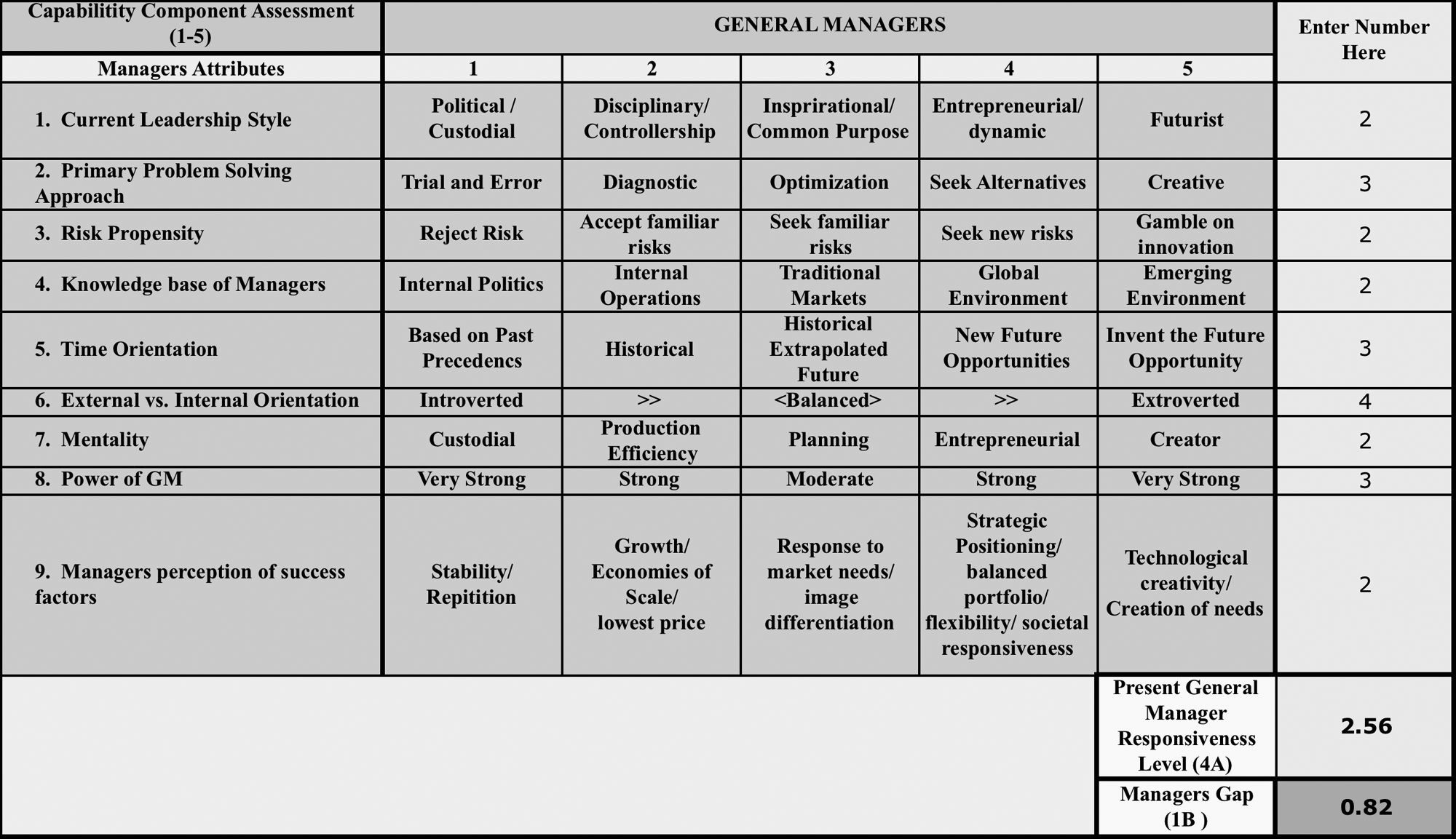
General managers capability assessment

Culture capability assessment

Structure assessment
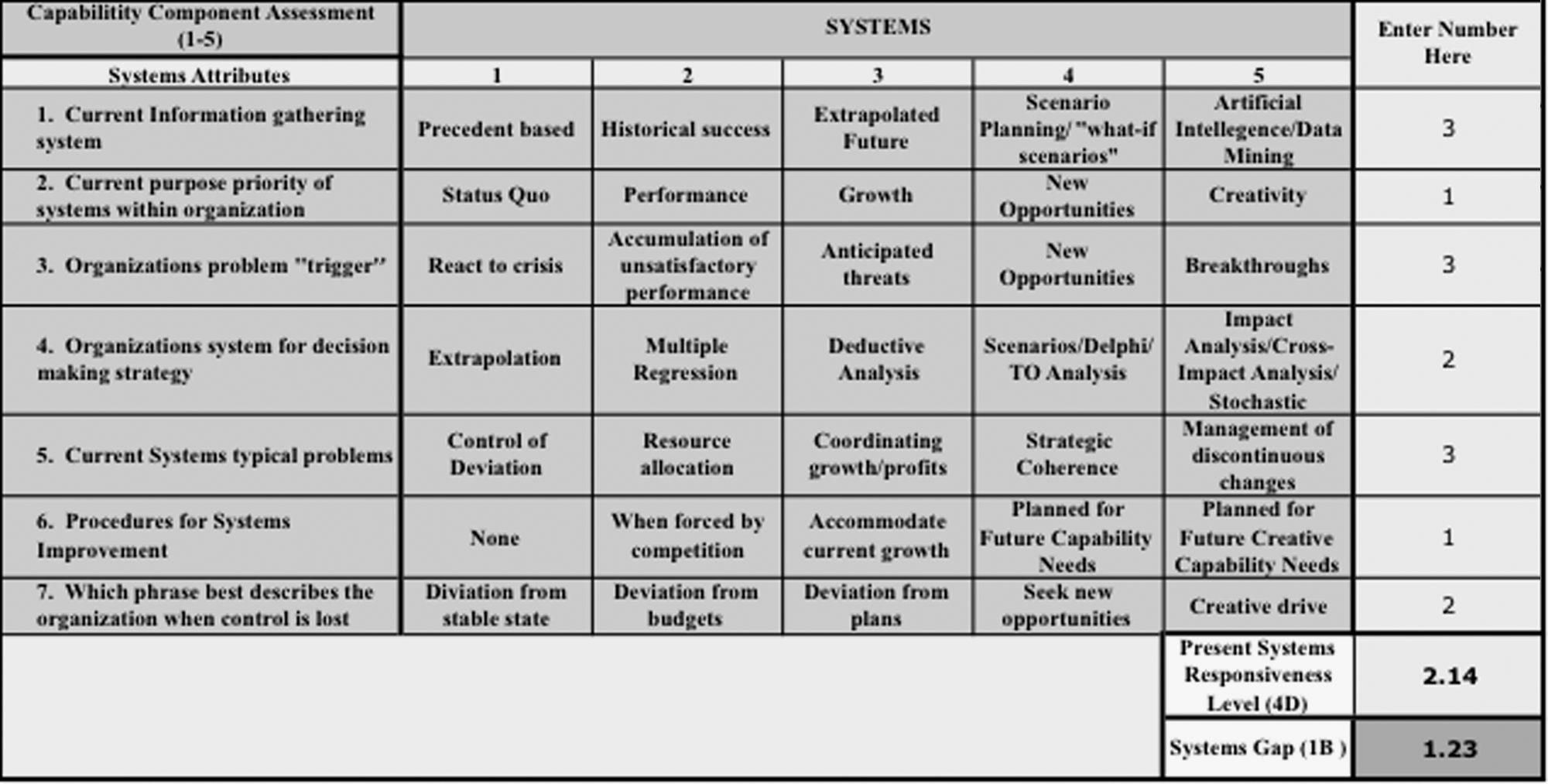
Systems assessment
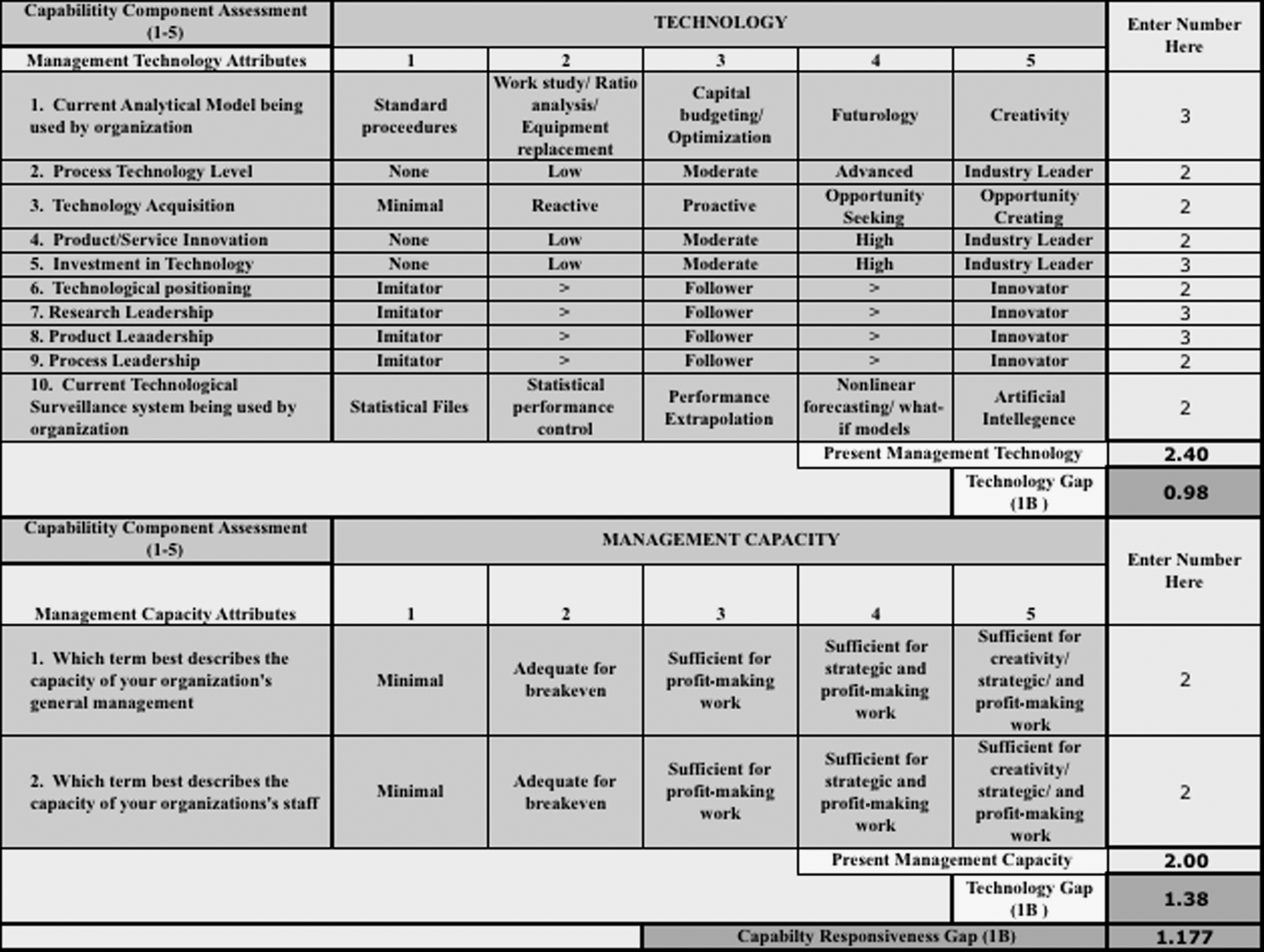
Technology/capacity assessment
Firm culture or (climate) is the management’s propensity (or willingness) to respond to strategic change. For example, to welcome, control, or reject change. Figure 5 illustrates the survey instrument used to assess the culture of the organization and the factors that determine the motivation of an organization to respond to a particular level of turbulence. Culture is defined as
The organizational attitude toward change—whether hostile, passive, or predisposed to change.
The propensity toward risk—whether as a group, management avoids, tolerates, or seeks risk (familiar or novel).
The time perspective in which management perceives its problems—past experiences, present, or emphasis on future.
The action perspective—focusing its energy and attention on internal operations or on the external environment.
The goals behavior—seeking stability, efficiency, effectiveness, growth, or innovation.
The trigger of change—is it driven by a crisis or accumulation of unsatisfactory performance or does the firm seek continual change.
Culture is also influenced by Power:
The distribution of power among groups with different cultures.
Stability of the power structure.
Militancy of the power centers.
The Culture assessment survey is illustrated in Figure 5.
Miller (1987) assesses organizational structure along formalized, centralized, and structurally integrated dimensions and noted that formalization had a significant and positive impact on the efficacy of the strategic making approaches. He further states that the firm’s organizational structure is critical to its information-processing capability and has a significant influence on the context and nature of human interactions. Firms relying on organic adaptive structure are characterized by a high level of mutual adjustment and tend to encourage flexibility and decentralized decision making (Burns & Stalker, 1961; Gibbons & O’Connor, 2005). Internal Power Structure is assessed within and among the functional units of the firm and the manner in which power is exercised. An autocratic structure, confirmed by Miller contributes to stability and efficiency; shared power contributes to changeability but at the expense of efficiency (Burns & Stalker, 1961; Gibbons & O’Connor, 2005). The Internal Power Structure survey is illustrated in Figure 6.
As shown in Figure 7, the organization system for decision-making strategy ranges from extrapolation to deductive analysis to impact analysis/stochastic. Each represents a family of systems within which, each type the specific systems share a distinctive perception of the future environment of the firm. The table shows that although different in intent, the systems are built of building blocks that perform identical functions in each system. The management system, even if responsive to the firm’s needs, will be ineffective if other components of the capability do not support it.
At the left-hand side of Figure 8, are listed 10 key technology factors that affect business strategy ranging from Current Analytical Model being used by the firm to Current Technological Surveillance System being used by the firm. Figure 8 is used to determine the technological aggressiveness of the firm’s strategy and identification of the gaps. Each factor lists several descriptors that together determine what is called the Present Systems Responsiveness Level. The importance of the respective factors to the firm’s future business strategy can be assessed as follows:
Determine the gaps between the future environment and the firm’s historical strategic position.
Provide an estimate of the firm’s future technological competitive position if the firm continues using its historical strategy.
Identify the changes in the technological strategy factors that should be made.
If the technology assessment shows that the firm’s technologies are turbulent and that they play an important role in the future success of the firm and that R&D investment will be significant, it becomes desirable to synthesize the strategic variables into a statement inclusive of the firm’s technology strategy.
The results of each of the seven surveys are calculated and entered into the summary output (Figure 12); in addition, the “component gaps” for each assessment are entered into the summary page. At this point, a second Capabilities Responsiveness Gap is determined and entered into the summary output.
Ansoff (1986) provide guidance and clarification as to the importance of aligning SA/CR with the ETL in achieving optimal strategic success. Empirical evidence confirms that a “gap” in SA and/or CR will adversely affect the firms’ optimal performance. As such, the OSPP account for the “size of gap” found in both the SA and Capabilities Responsiveness and assigns a coefficient for each. The coefficients “discount” the Strategic Posture from an optimal position. The formula for this function is

Management has now completed the data collection necessary for determining the variable position of the Strategic Posture on the final matrix.
Strategic Investment (ISTRATEGIC)
This is defined as the budget committed to the strategic development of the firm. Economic theory and practice both suggest that the firm’s profitability in an SBA will be proportional to the size of its investment. The Strategic Investment screen is the firm’s total commitment of resources to an SBA, including not only for facilities and equipment (operations) but also for developing the firm’s product (R&D) and market position (marketing) as well as the supporting capabilities in management, production, sales, and so on (operations). In each SBA, there is a minimal critical mass defined as the strategic breakeven point. Each budget component must be at or above its own critical mass level; misallocation of budgets in an SBA can have serious consequences. In addition, there is an optimal mass representing the level of investment beyond which profitability begins to decline due to decreased speed of organizational response and bureaucratization of the firm.
Figure 9 illustrates the survey used for both the capacity investment (CI; 8 descriptors) and strategic investment (SI; 10 descriptors) of the firm relative to the industry leader, which is the ISTRATEGIC Opt. The Strategic Investment Ratio is determined and expressed in the formula;
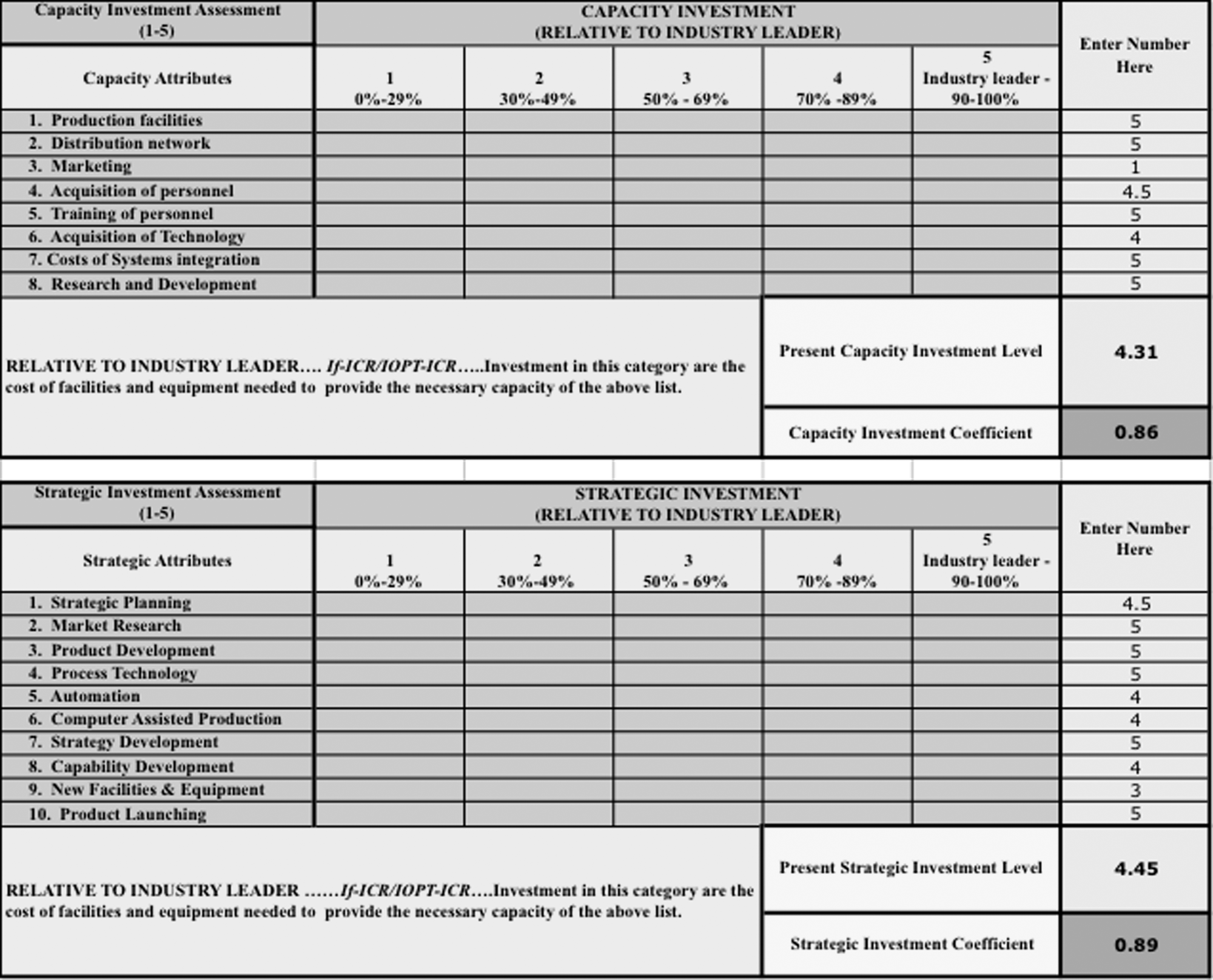
Technology/capacity assessment

in which the firm’s competitive position will be in proportion to the ratio of the firm’s investment into an SBA to the level of investment that will produce optimal profitability.
Management now has completed the data collection necessary to determine the second variable position, Strategic Investment, on the final matrix (Figure 12).
The OSPP now digresses from Ansoff’s ANSPLAN-A by including the firm’s future performance potential as well as an assessment of the industry’s future.
Future Competitive Position
Managers assess the firm’s future competitive position relative to the industry using both hard data (obtained from measurements and statistical data such as financials, market share, Return on Investment, Return on Equity, etc.) and soft data (views and opinions from qualified individuals, such as participating managers or experts in the industry, who contribute their expertise, judgments, and hunches about the inputs, estimation process, and outcomes). Managers complete a 27-point survey (Figure 10) of “competitive descriptors” to determine the firm’s future competitive position in its industry. For each attribute of Future Competitive Position, managers identify and enter the characteristic that best describes the future conditions of the industry using a numerical scale and assign numbers to each element. Managers now average the numbers and enter the average into the summary table; management has completed the data collection necessary for determining the Firm’s Future Competitive Position variable on the final matrix.

Future competitive position
Future Prospects of the Industry
The final variable required to complete the OSPP assesses the future prospects of the industry (i.e., is the industry still relevant to serve the consumers “need”?). For example, your firm may be the Number 1 competitor in the industry; however, your industry is chemical film manufacturing and your industry is dying.
Managers complete a 24-point survey (Figure 11) analyzing the future prospects of the industry. For each attribute of Future Industry Prospects managers identify the characteristic that best describes the future prospects of the industry and using a numerical scale, assign numbers to each element and average the numbers and enter the average at the bottom of the table. The data used to determine industry future prospects are gathered from industry publications, statistics, governmental reports, as well as informed subjective estimates from managers, customers, industry news, and so on. The results are calculated, as in the previous steps, and are entered into the summary table thus completing all of the 4-variables required to position the firm’s SBA on the OSPP matrix.

Future prospects of industry
OSPP Output
The logic of the OSPP is illustrated in Figure 12. As mentioned, the first step of the analysis was to determine the future ETL of the industry. The initial assessment of the environment is a critical element for the entire diagnosis as its value specifies the type of strategic behavior necessary for success.

OSPP summary page
As a result of completing the ETL assessment, managers now have formalized guidance on how to cope with turbulent environments to improve corporate performance.
Davis, Morris, and Allen (1991) and Calantone, Garcia, and Dröge (2003) confirm the proper assessment of the industry’s ETL as a foundational cornerstone to formulating a successful strategic plan.
The ETL assessment is illustrated in Figure 12 as 3.38. The SA of the firm in display reveals two components—Innovation Aggressiveness and Marketing Aggressiveness. Both are combined and the average SA of the firm is determined. In addition, each component gap is displayed for manager’s assessment allowing an increased granularity for strategic planning. The SA is displayed in Figure 12 as 3.85 with a gap of 0.48.
As well, Figure 12 displays the General Management Capabilities Responsiveness in six areas of the firm— managers, culture, structure, systems, technology, and capacity. Each component is assessed and individual component gaps are determined, again as an aid for management; the combined components are then summed and averaged, the CR is then displayed in Figure 12 as 2.32 with a gap of 1.06.
At this point, coefficients can now be determined based on the gaps of the SA / ETL and CR / ETL, and are entered into the following formula to calculate the firm’s Strategic Posture.

For example, as our OSPP Summary page illustrates, the SA gap is 0.48, the coefficient for this gap is generated from a proprietary table with a value of 0.80. The Capabilities Response gap is 1.06, with a corresponding coefficient value of 0.50.
Using our formula, it would be illustrated as

The four matrix variables are now displayed indicating the results of the Strategic Posture and Strategic Investment formulas. As well, the Firm’s Future Competitive Position, and Future Industry Prospects are displayed. Figure 13 illustrates the results as 2.0, 3.84, 3.19, and 2.83.

OSPP matrix
Plotting the OSPP Matrix
The results from the matrix variables are now plotted on the display matrix as illustrated in Figure 13. The nexus of the vertical and horizontal variables are displayed indicating the firm’s “Center of Gravity” (COG). The COG is the firm’s performance position relative to optimal performance positioning. Optimal performance positioning on the matrix is achieved by positioning the firm in the highest proximity to the top right corner of the matrix. (Note: Managers must consider that industries and industry conditions vary, and as such, what may be the optimal position for one industry, may be different for another industry; hence a lower position on the matrix.)
Interpreting the Matrix
As can be seen from Figure 13, the Firm’s Strategic Posture, Strategic Investment, Firm’s Future Competitive Position, and Future Industry Prospects are positioned as a result of the OSPP Summary Page, with the firm’s COG indicating a relatively moderate position on the matrix in the midcenter quadrant.
As mentioned, the OSPP is both descriptive and prescriptive; managers can now assess which area of the firm to concentrate its resources to improve its performance position. In this case, the matrix reveals that management can increase its Firm Strategic Posture and Firm’s Future Competitive Position. In this case, the firm’s strategic budget is aggressive. In addition, the OSPP provides management with a granular view of those “descriptors” within each variable that may have scored low. Management now has the option to increase, modify, and replace the low performing descriptor factors to increase the score. As management moves through the screen and makes modifications, the OSPP matrix will reflect those management choices, adding to management’s understanding of the relationship of the variables and descriptors affecting them.
An ideal strategic posture would suggest no gaps between the level of environmental turbulence, aggressiveness of strategy, and general management capability. As such, the innovation aggressiveness and marketing aggressiveness must be supported to achieve congruence with the level of environmental turbulence. For example, new hires can be brought in with the appropriate profile and marketing effort can be stepped up.
The same maintains for the General Management Capability and making the appropriate investment to support Climate, Competence, and Capacity. The appropriate changes must be made to achieve a climate/environment which supports or can accurately address the level of turbulence. The same effort can be effected to support and align posture in terms of competence and capacity of staff.
Summary
This article presented a robust systematic management process model combining Ansoff’s strategic readiness diagnosis with the elements found in the accepted industry positioning matrices. Through a detailed analysis of four variables—Firm’s Strategic Posture, Strategic Investment, Firm’s Future Competitive Position, and Future Industry prospects—management’s decision-making options are presented, thus revealing the position under which a firm’s strategic potential can be optimized.
Further Studies
The present study emphasizes the development of key determinants for assessing the performance or strategic classification of various firms. To provide consistent rigorous investigation on the classification mechanism, the detailed analysis on the underlying classification function or separating platform (or hyperplane) among these developed key determinants is needed. Recent developments in the approximation theory for unknown functions or regularities such as Support Vector Machine (SVM) will be introduced. The advantage of SVM is the approximation mechanism that avoids the complexity on tuning the parameters such as in Neural Networks, maps the original attributes into a function space, namely, the feature space. In other words, instead of approximating the functional based on the original inputs, the approximation is pursued in the features space. In using appropriate kernels, the approximation on the unknown classification function can be performed in a linear decision function where local minima can be reduced. Through algorithms in optimization theory, the underlying classification function can be estimated on a much-reduced set of parameters. As such, we will be able to perform uniform precise strategic classification based on the key determinants provided. We shall pursue the extension in the later works.
Footnotes
The author(s) declared no potential conflicts of interest with respect to the research, authorship, and/or publication of this article.
The author(s) received no financial support for the research and/or authorship of this article.