




Abstract
Social interest was Alfred Adler’s most important personality trait, and it reflects one’s genuine concern for the welfare of all individuals. Several measures of social interest are available, and the Social Interest Index (SII) is one of the most popular in current use. This study is the first to report the results of a confirmatory factor analysis of the SII. Using college students, three models were tested in an effort to find support for the factorial validity of this scale. All analyses showed a poor fit between the theoretical model and scale items. The results paint a fairly negative picture of the factor structure of this important scale.
The Concept of Social Interest
Alfred Adler’s (1938/1964) concept of social interest is one of the cornerstones of his personality theory and was his most important personality trait. Adler stated, “Social interest is the main characteristic of each person and is involved in all his [sic] actions” (p. 774). Social interest involves a sense of social feeling toward all humankind, and the essence of social interest is the valuing of something outside the self without ulterior motives. In other words, people with social interest have an absence of self-centeredness, egocentricity, and self-absorption. Social interest is based on one’s identification with others and a transcendence of one’s own interests, resulting in a genuine concern with and striving for community and human welfare. Adler believed that social interest is manifested in the life tasks of friendship, love, and work, and he also believed that mental health requires that one successfully cope with these major and pervasive challenges of life through social interest. Adler’s theory stated that social interest has important implications for personal adjustment as well as for the well-being of society. Social interest was seen as the foundation of mental health, and, as a corollary, many intrapersonal and interpersonal difficulties could be traced to an absence of social interest and community feeling.
Empirical Support for Social Interest Theory
Decades of research has established that individuals with relatively high levels of social interest, as assessed by a variety of instruments, possess common personality traits, such as friendliness, empathy, cooperation, tolerance, nurturance, and constructive independence (e.g., Crandall, 1981; Leak, Millard, Perry, & Williams, 1985; see Watkins, 1994, for an especially helpful review). Such individuals have also been found to have higher levels of marital satisfaction (e.g., Markowski & Greenwood, 1984), faith development, and spiritual maturity (Leak, 1992), and fewer symptoms of neuroticism, such as anxiety, hostility, and depression (cited in Watkins, 1994).
Measurement of Social Interest With the Social Interest Index (SII)
Within the past three decades, at least six self-report measures of social interest have been developed. Perhaps the most frequently used measure is the SII (Greever, Tseng, & Friedland, 1973). This instrument is divided into four subscales of eight items each, and it was designed to measure one’s level of social interest in the four Adlerian “life tasks” of friendship, love, work, and self-significance. Prior research (Watkins, 1994) and a recent meta-analysis (Bass, Curlette, Kern, & McWilliams, 2002) have presented evidence supporting the criterion validity of the SII.
Despite research indicating that the total score on the SII may be a sound measure of social interest, it has received some criticisms. The areas of greatest weakness seem to be its muddled factor structure (e.g., inappropriate factor loadings; Leak, 1982), and the factor structures found across studies have proven difficult to replicate (Leak, 1982; Watkins, 1994). Some studies have found a four-factor solution (Zarski, Bubenzer, & West, 1983) whereas others have found a five-factor solution (Zarski, West, & Bubenzer, 1981). Furthermore, some studies have found the existence of a general social interest factor (Greever et al., 1973), whereas others have not (Leak, 1982). Finally, the four subscales have been plagued by low internal consistencies (α range = .35-.64; Greever et al., 1973).
Purpose of the Present Study
This research focused on the SII because it is one of the most frequently used measures of social interest, and many studies have found support for its criterion validity (Bass et al., 2002). Despite its popularity and promise, however, Leak (1982, 2006) and Watkins (1994) have identified several problems with the SII (reviewed above), such as conceptually and statistically flawed items (e.g., “I enjoy music and literature” as an indicator of social feeling, and low or negative item-total correlations, respectively) and poor factorial validity.
However, there is a serious limitation to factor analytic studies mentioned above: They were based on exploratory factor analysis (EFA) only. The superiority of confirmatory factor analysis (CFA) over EFA is widely noted (e.g., Blunch, 2008; Brown, 2006; Kline, 2005). Examples of these advantages of CFA are its ability to examine correlations among factors (rather than scales), and the ability to estimate parameters (e.g., factor loadings), without the influence of measurement error. In addition, CFA allows for a more rigorous and precise test of the structure of a scale (e.g., EFA allows all items to load on all factors whereas CFA forces items to load on only certain factors.) To date no assessment of the factorial validity of the SII using CFA has been attempted. This study was designed to provide more information about the factorial validity of the SII through the use of CFA.
Method
Participants, Procedure, and Instrument
Undergraduate students (n = 500; 60% women; M age = 19.4) at a Jesuit university were recruited from Introductory, Developmental, and Personal Growth psychology classes.
Data were collected in groups of approximately 10 as part of a larger project on social interest, religion, and psychological well-being. They were awarded extra credit toward their course grade for their participation.
The SII (Greever et al., 1973) is a 32-item instrument with items clustered into four scales of 8 items each, each designed to assess the specific Adlerian “life tasks” of Friendship, Self-Significance, Love, and Work. Respondents answered on a 5-point Likert-type scale from strongly disagree to strongly agree.
Results
Evaluation of the SII Using the Original Theoretical Model
Initial analyses searched for violation of CFA assumptions (e.g., multivariate normality). Next, a measurement model was proposed based on the conceptualization of social interest that guided the development of the SII. This was Model 1, and it specified four factors or latent traits with 8 items per factor. In other words, the model specified that social interest is manifested in four psychological domains or latent traits, and those traits are assessed with 32 items or indicators from the original scale. Table 1 presents the factor loadings of each item on its putative latent trait.
Factor Loadings of the SII Items on Their Theoretical Latent Traits
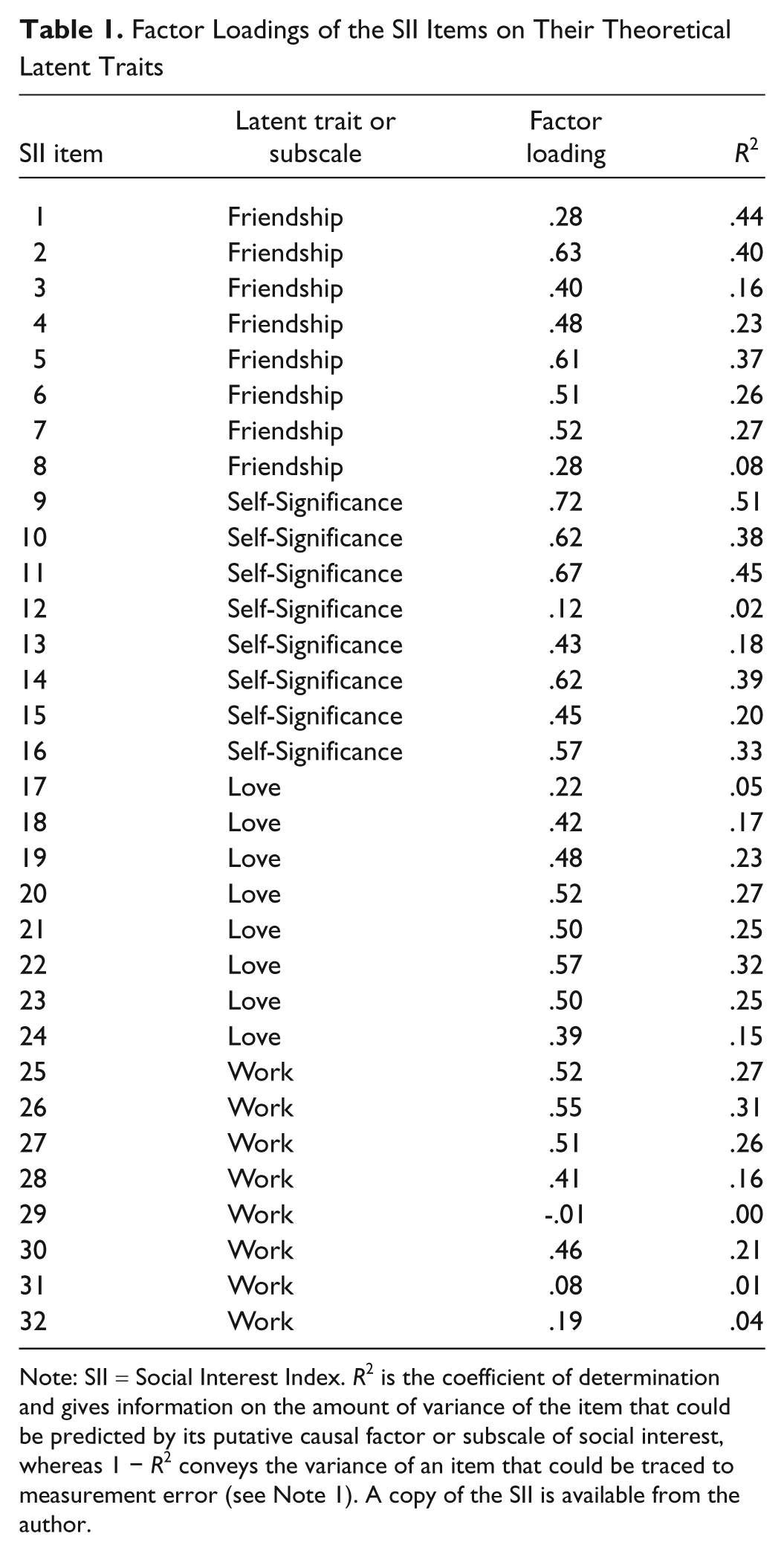
Note: SII = Social Interest Index. R2 is the coefficient of determination and gives information on the amount of variance of the item that could be predicted by its putative causal factor or subscale of social interest, whereas 1 − R2 conveys the variance of an item that could be traced to measurement error (see Note 1). A copy of the SII is available from the author.
An examination of the parameter estimates’ critical ratios indicated several weak items (SII Items 12, 29, and 31; p > .01). Four items had low standardized regression weights (βs < .20; Items 12, 29, 31, and 32; mean coefficient = .46, range = −.01 to .72). Two of the covariances between factors were unacceptably low (p > .01), and both involved the Work factor (mean correlation between factors = .57). Furthermore, the only factor variance to not reach acceptable significance was, again, the Work factor (p > .01). Finally, the squared multiple correlations (R2) between the 32 scale items or indicators and their underlying factor revealed that 11 were extremely low 1 indicating weak linkages between the factor and its indicators (mean R2 = .24; range = .00 to .51).
Table 2 presents fit indices for model evaluation. The indices selected are among the most respected in the field (Byrne, 2010), and they differ in terms of the information they provide about model fit as well as the factors they take into account in their calculation (e.g., being sensitive to the parsimony of the model). Several fit measures indicated a poor fit between the theoretical model and the observed covariance structure in the data: χ2 = 1,602, p < .001; comparative fit index (CFI) = .68; Akaike information criterion (AIC) = 1,743. Root mean square error of approximation (RMSEA), however, had a value of .07, and that value represents “reasonable errors of approximation” (Byrne, p. 80). A large number of modification indices had values above 10 suggesting many areas of model weakness or “strain” contributing to poor model-data fit.
Various CFA Fit Indices for the Three Models Developed to Test the Factorial Validity of the Social Interest Index

Note: CFA = confirmatory factor analysis; CFI = comparative fit index; RMSEA = root mean square error of approximation; AIC = Akaike information criterion. Model 1 is based on the original theoretical model that generated the Social Interest Index (SII) and it contained four factors and 32 indicators. Model 2 is the SII with the problematic Work factor and its 8 items removed (i.e., retaining three factors and 24 items). Model 3 contains three factors and 15 items (i.e., after 9 statistically weak items were removed from Model 2). For CFI, a well-fitting model should have a value ≥.95 (Byrne, 2009); for AIC and RMSEA, the smaller the values the better the fit.
p < .001.
Evaluation of a Revised Three-Factor, 24-Item Model
A second model was tested after removing the largest source of ill-fit, the psychometrically weak Work factor and its items from the model. This resulted in a 24-item, three-factor model and labeled Model 2 in Table 1. Fit measures suggested an improved but still poor (χ2, CFI, AIC) or adequate (RMSEA) fit between the model and the data. A test for the difference in fit between the two models, using a test of the difference between chi-square values (Kline, 2005), failed to establish that Model 2 was superior to Model 1, Δχ2(209) = 3.5, p > .05. However, the Model 1 versus Model 2 CFI and AIC values argued for the superiority of Model 2. Again, weak items were found that either (a) failed to have significant critical ratios for their parameter estimates, (b) had low standardized regression weights (βs < .40), and/or (c) had low R2 values.
Evaluation of a Three-Factor, 15-Item Model
Nine weak items identified in Model 2 were eliminated. The new model, Model 3, generated an improved fit relative to Model 2 in terms of changes in CFI and AIC values but not in terms of change in chi-square values, Δχ2(162) = 3.26, p > .05, or RMSEA. Even though Model 3 is a better model in some ways, the improvement over Model 2 is a relative one; Model 3 still represents a poor fit in an absolute sense. Even after eliminating the poorest items from Model 2, the three-factor, 15-item model still did not adequately reproduce the empirical covariance matrix and thus has unacceptable factorial validity. 2
Test of a Unidimensional Model
In light of the negative evidence to this point, it is possible that the theoretical structure of the SII, based on various life tasks or factors, is fundamentally incorrect. In other words, it may indeed be best not to view it as a multidimensional scale. Thus, a one-factor, 32-indicator model was tested. There was no evidence of acceptable fit: χ2 = 2,119, p < .001; CFI = .53; RMSEA = .084; AIC = 2,245.
Discussion
Summary of Results
Several models were tested that explored the factorial validity of the SII. The examination of Model 1 (the full 32-item scale with four hypothesized latent traits) generated a severe challenge to the factorial validity of the SII based on every statistic of model fit used except one. Given previous challenges to the integrity of the factor structure of the SII using EFA, coupled with the results presented here, I believe it would be negligent to maintain faith in, and continue to use in research, the original four subscales of SII as measures of Adlerian life tasks. Especially problematic was the Work factor, and it was deleted in Model 2. Again there was a poor fit of the model to the data. Various statistics were used as guidance in generating another hypothesized model to obtain better fit. This resulted in the best fitting model: a three-factor, 15-item scale, but although better than previous versions, the solution remained inadequate by traditional CFA standards (Byrne, 2009).
Implications
What can be concluded from the results of these analyses? I believe three conclusions are reasonable. One, researchers should not include the Work subscale and its psychometrically weak items in social interest research. Second, the revised Love factor (Model 3) was evaluated as a four-item scale, and it had unacceptably low internal consistency reliability to justify its use in research. 2 This leaves only two latent traits as the basis for two subscales, and one of those, Self-Significance, is of dubious theoretical heritage. (Watkins, 1994, has argued that self-significance does not appear in Adler’s writings and seem antithetical to the nature of other-oriented social interest.) Third, do not be tempted to use Model 3 as the foundation for a revised, shortened measure of social interest. The third model was certainly the best one tested, but it still did not perform well in the CFA (see Tables 1 and 2). Researchers cannot continue to justify their faith in the SII or any of its progeny that emerged here as measures of specific Adlerian life tasks. Researchers should instead turn to other measures of social interest that have shown greater promise (cf. Bass et al., 2002).
Footnotes
The author(s) declared no potential conflicts of interest with respect to the research, authorship, and/or publication of this article.
The author(s) received no financial support for the research and/or authorship of this article.