




Abstract
Comparative studies have demonstrated that the themes for corporate social responsibility (CSR) initiatives are different among nations and geographic regions based on their cultural, political, legal, social, and economic contexts. In this research, which was conducted on 56 corporations from IMI100 (100 Iranian companies with highest annual sales, ranked by Industrial Management Institute or IMI), CSR themes in priority have been identified. Data collected from a semistructured questionnaire and some complementary interviews were analyzed against the results of a reference study over 100 companies from developed countries. The resulted themes, some of which may have several subthemes, were developed in three economic, environmental, and social categories. Beside these qualitative findings, two indices are constructed for indicating the “importance” of and “contribution” to each theme. The results and discussions are supposed to help business leaders, international companies inside Iran, governmental authorities, and researchers to improve CSR discussions and practices in the country where CSR undergoes a less structured platform.
Introduction
Corporate Social Responsibility (CSR) Theme as a Core Concept
The role of corporations in social activities seems tremendously increasing; indeed, in some cases, such participations exceed the extent to which governments are able to undertake. As an illustration, the measures that ICT giants in collaboration with humanitarian organizations—such as NetHope—have taken in Haiti earthquake (Greenhill, 2010) or more recently have done in Pakistan flood (Brindley, 2010) are tokens of the actions which exceed the common capabilities of governments. However, social expectations from corporations have risen considerably, as several studies have demonstrated this fact—such as the evidences provided by Matten and Moon (2004) or McKinsey (Bielak, Bonini, & Oppenheim, 2007).
In terms of social problems, corporations can act reactively, like what happens in the times of natural disasters; however, for an active or proactive approach, it is crucial to determine the adequate societal issues on which a company should define CSR programs or apply CSR initiatives. This concept, corporate social initiative (CSI), is defined by Kotler and Lee (2005) as, “Corporate social initiatives are major activities undertaken by a corporation to support social causes and to fulfill commitments to corporate social responsibility” (p. 3). The concept CSR Theme or CSR Issue has emerged as the core subject based on which a CSR program is defined. These expressions have been frequently used but apparently always as a general concept. For a better clarification, here we define “CSR theme/issue” as a subject that could be practiced by corporations to resolve a part of problems a society is susceptible to or could be addressed through discourse, argument, or thought about how corporations can participate in resolving such problems.
In our terms, every social problem would be deemed as a CSR theme only when it has been addressed by a corporation. That is, if a certain societal issue is out of the influence of corporations, it cannot be a CSR theme. Different organizations have different levels of influence over their operating environment due to the dispersal of the factors; a CSR theme is therefore a relative and contingent concept. Figure 1 depicts a model for this idea.

Relationship between social problems, CSR themes, and CSR programs
The sphere of influence varies among different corporations. An issue that looks irremediable to a small company might somehow fall inside the influence realms of a large corporation. Of course it could be on a debate whether a social problem falls inside the influence sphere of a corporation or not. For a certain context, a variety of societal issues could be assumed as the contextual CSR themes’ base, although the borders of such a base might be sometimes vague, with loose interpretation.
“Contextuality” of CSR
It has been long argued that every corporation in a specific country is under the influence of a prevailing institutional framework that has been formed during history—Whitley (1997), for instance, named it National Business System. CSR, therefore, is a contextual arena as some researchers have demonstrated. To mention a few studies, Matten and Moon (2004) have discussed on the relationship between CSR and national contexts; Crane and Matten (2004) have described a sheer interest in comparative CSR studies; contingency of CSR in national contexts has been argued by Habisch, Janker, and Wegner (2005); and Gjølberg (2009) attempted to develop an index comparing national CSR practices. Beside the increasing trend of these contextual and comparative CSR studies, constraints such as the limited number of countries or regions included in the scope of research always inhibit academia and businesses from developing a general depiction of CSR practices.
Furthermore, studies such as that of McKinsey & Company (2007) demonstrated that business strategists in different parts of the world tend to concentrate on a wide range of societal issues. The themes that have been recognized or experienced in a specific region cannot be directly prescribed to the other regions. Such questions may immediately come to the mind of an individual: What societal issues shall be in focus in my country and which of them have been previously considered as CSR themes? Moreover, what analogies and anomalies can be found between these CSR themes and those of other nations or regions? Such questions have been addressed in an exploratory–descriptive research in Iran and a main part of its results is being discussed here.
Some Studies on CSR Themes: A Quick Glance
A number of studies have been conducted on social themes with a variety in scope, goals, respondents, methodology, and validity.
Maignan and Ralston (2002) performed a comparative study between the United States and three European countries—the United Kingdom, France, and Netherlands. With 50 large companies sampled from each country according to sales revenue, this study is a website content analysis research. Maignan and Ralston’s study is based on previous comparative studies such as that of Langlois and Schlegelmich (1990) and Bennett (1998). Developing the categorization of CSR by Danna Wood (1991), Maignan and Ralston organized their findings in three separate groups: motivating principles, CSR processes, and stakeholder driven. In terms of CSR themes, the third group includes a few different issues related to the stakeholders who receive the main advantage of each of the issues. Because of the purpose of this study, just a limited number of CSR themes have been identified in it.
Silberhorn and Warren (2007) developed Maignan and Ralston’s (2002) framework in a comparative study between 20 German and 20 British companies sampled through their turnover rankings. This study expanded the themes and showed results such as increasing “quality of life” topics in both countries and put more attention to “arts and culture” group in German corporations.
Beside such attempts, a more developed categorization was defined in 2004 by Athens University of Economics and Business in a project named CSR Quest. CSR Quest provides a well-rounded classification of themes in three “influence areas”: workplace, marketplace, and environment and society (CSR Quest, 2010). Each theme is then classified into subthemes and they in turn could be developed further to sub-sub-themes. This elaborate classification, we believe, is among the best taxonomies; yet its significant coverage is apparently used in no empirical research. Consequently, for the purpose of our research which includes identification of themes and measurement of how much each of them has been practiced, this classification was not applicable because there are no numeric data available for comparison.
A number of researches have also been conducted by professional institutions such as BSR, a nonprofit organization which works with its global network to develop sustainable business strategies and solutions. In its research, BSR identifies seven prioritized themes (BSR, 2009). Other instances of studies by similar bodies include two categorizations of themes by CSR Asia (Huen, 2008, and CSR Asia, 2009), and a research on themes in Indian companies with highest sales that was done in The Associated Chambers of Commerce and Industry of India (ASSOCHAM; Ahmad, 2009). Such researches conducted by professional institutions, in fact, have unknown validity because their methodologies have not been described or evaluated. However, other professional researches, such as a global survey undertaken by McKinsey & Company (2007) to assess the impact of societal issues on business, provide some valuable information in this field.
Finally, Ferguson and Popescu (2006) have conducted a research on 100 best corporate citizens from 16 countries categorized in five distinct geographical groups. These countries include the United States, the United Kingdom, Australia, Canada, Japan, Denmark, Finland, Netherlands, Norway, Sweden, Belgium, France, Germany, Italy, Spain, and Switzerland. In a part of their study, these two professors of public relations found that the companies had practiced more than 100 different types of CSR and sustainability programs, represented in three broad categories of (a) economic, (b) environmental, and (c) social initiatives. Although their study employed content analysis to survey the websites of the companies, which is different from our methodology, we consider it as a basis for our study because of its relatively good coverage of the themes, its statistics for our comparative purpose, and its adequate scientific validity. We call this taxonomy reference categorization and take it as a basis for our study.
Method and Research Process
Based on its purposes, 1 this research deploys a hybridized approach: A combination of qualitative and quantitative methods to identify the CSR themes and measure the priority of each theme, and also the extent to which the Industrial Management Institute 100 (IMI100) companies 2 have contributed toward each of them. Both parts have been fulfilled collectively through a semistructured questionnaire and some complementary interviews.
The research population primarily includes 100 top—in terms of annual sales—Iranian companies, each of which works in a specific industry. However, it was predictable that it would never be possible to collect data from all these top companies. Conducting this type of research in large corporations faces many obstacles (Wolff, 2004)—perhaps that is why website contents have been vastly used as the source of data in similar studies. In case of Iran, the obstacles seem more preventive because of the factors such as extreme bureaucratic atmosphere of large corporations, reluctance to share information with others, and scant attention to research activities. Nonetheless, 56 companies took part in the research and this was more than the expectation. In all, 52% of these companies belonged to private sector—government has been always dominant in Iranian business environment.
Case sampling was the next step. To determine the importance and priority of CSR themes, every single respondent from each corporation had to have a strategic position. A senior or C-level manager who is best related to CSR activities might be considered as the best. Still, in many of the surveyed companies, no specific department solely held the responsibilities around CSR. Whereas some corporations had established specific units to implement CSR-related measures such as those related to ISO 14000 standards and EFQM Excellence Model, in other companies CSR activities were distributed among different departments. Discovering the right respondent in each corporation was a major challenge. In all, 39% of the respondents were CEOs or other C-level managers, while 54% were middle managers relevant to CSR, and the 7% remained belonging to the lower levels. And regarding the level of the respondents’ education, 57% of them held a PhD or a master’s degree.
Data Gathering and Analysis
Based on the previous experiences in Iran, the best way to convince corporations to contribute to a research is personal networks through which the accomplishment of the task would tremendously be facilitated.
The main research tool was a semistructured questionnaire (appendix) that included both open-ended and closed questions—to identify the most important societal issues and to quantify the contribution of the firm to each issue, respectively. A flexible combination of different methods was applied to collect valid data. An initial telephone or face-to-face conversation provided the required information and background for contribution of the respondents. Still, the completed open-ended questions in many cases were not precise enough to be coded and categorized to form a specific taxonomy of socioenvironmental issues; hence, further telephone conversations were crucial.
Obviously, the degree to which companies had taken part in such CSR programs was not subjected to a close scrutiny and therefore the researchers tried not to let the desirability of the subject influence the validity of the results.
Raw data were transferred to a database designed for this purpose. Each of the socioenvironmental issues had to be mapped onto one category—or sometimes more—in the “reference categorization.” Predictably, part of these data could not be mapped onto the reference categorization. These contextual issues had to be placed in new appropriate themes and subthemes in one of the major triple groups. The final categorization of the Iranian themes which was named developed categorization is presented in Table 1 and will be described later.
Developed Categorization of Themes

Note: CSR = corporate social responsibility.
The researchers repeated this “coding” process 3 times separately while they checked and discussed about each other’s results. This led to a better categorization; however, because of the conceptual nature of such taxonomies, this could be as always debated. For instance, plenty of respondents had mentioned different issues around transportation, traffic, and movement. Transportation on its own can be classified based on different dimensions such as mode (air, rail, etc.) and function (passenger or freight). Such classifications, however, cannot be directly applied in this research as it would not be an appropriate approach to bring all the raw data under the same umbrella.
Developing the Indices
Using descriptive statistics, we then developed and used two indices to score the CSR themes captured through the questionnaires and interviews. The first index, “importance,” focuses on the significance assumed for each theme; whereas the second index, “contribution,” demonstrates the degree to which corporations entered on each theme in their CSR programs. The importance index for each issue is calculated based on the number of references the respondents held as important as to be addressed within the society. That is, for each specific theme, number of times it was mentioned to the total number of mentioning of all themes in its group was considered as its indicator of importance:

This index can be similarly calculated for the subthemes in a specific theme as well as the whole three groups. Contribution index, however, is calculated based on the number of the companies which implemented at least one CSR program in a distinct group, theme, or subtheme:

The contribution index is structured based on the number of companies to make it relatively comparable with the results of the reference research.
These two indices, together, provide adequate data to reach to an appropriate understanding of how different themes have been considered and practiced in companies. Although some themes look important, they might not have been practiced adequately by companies and this will reveal a “CSR gap” between the needs and the practices.
Results and Discussion
Contextual Issues
Data gathered from the Iranian companies are organized in three main groups as to be comparable with the results of the reference categorization. Each group contains several themes and probably subthemes, many of which are new to the reference categorization. Table 1 represents the developed categorization.
In each group, it was necessary to add new themes to include the contextual findings such as “unemployment” in economic group, “promotional programs for environment” in environmental group, and “social values and behavioral issues” in social group. Most of these added contextual themes that were not present in the reference categorization belong to the social group. These new themes may have new subthemes as well. Similarly, based on our findings, some existent themes also required adding one or more new subthemes to broaden the realm of its concept according to the data gathered. For instance, in environmental group, respondents mentioned issues related to other kinds of pollution like noise or wave pollution. Albeit, some of these important added themes might have primarily been identified in the reference study too and Ferguson and Popescu (2006) should have classified them into one of several “other” categories for their scant magnitude. To sum up, whereas in reference categorization, Ferguson and Popescu have classified their findings in 21 themes and 20 subthemes, in our developed categorization 31 themes and 47 subthemes have been listed, as shown in Table 1.
With regard to the previous discussion about the social problems and CSR issues, in this research 10 social issues are identified as non-CSR theme since no Iranian company had a CSR initiative for them. This includes five issues from the reference categorization and five identified social problems from the Iranian context. That is, five issues of the reference categorization were not mentioned by any Iranian executive at all. These include “programs prohibiting business in countries with human rights violations”; “environmental management programs beyond compliance”; “environmental research, generally”; “antiracism/bigotry”; and “genetics/testing.” These were excluded from the developed categorization as they found no application by the Iranian companies.
In addition, the other five issues were reportedly important social problems that were out of the sphere of influence of the researched companies. These five were considered as “social problems” and were removed from the list of CSR themes as no company had an initiative to address them: “prostitution,” “totalitarianism,” “interference of local people in corporate affairs,” “corruption,” and “social inequalities.”
Importance and Contribution in Groups
According to the analyzed data, most of the themes that executives have mentioned as “important” for the society fall in the environmental group with a 47% rate of inclusion, while social group stands next with 42%. Only 11% of the themes executives deemed important belong to economic group.
For contribution index, similarly, 87.5% of the Iranian companies have adopted at least one program for environmental issues, while their contributions to social and economic groups are less. Environmental regulations in the country underlie this meaningful attention of the companies: In the absence of real social monitoring institutions, such as consumer-related nongovernmental organizations (NGOs), the companies are more inclined toward environmental programs for which legislations and awards are somewhat present. More or less, governmental institutions inspect some dimensions of environmental protection, and certificates such as ISO 14000 are known in the society and can increase a company’s reputation.
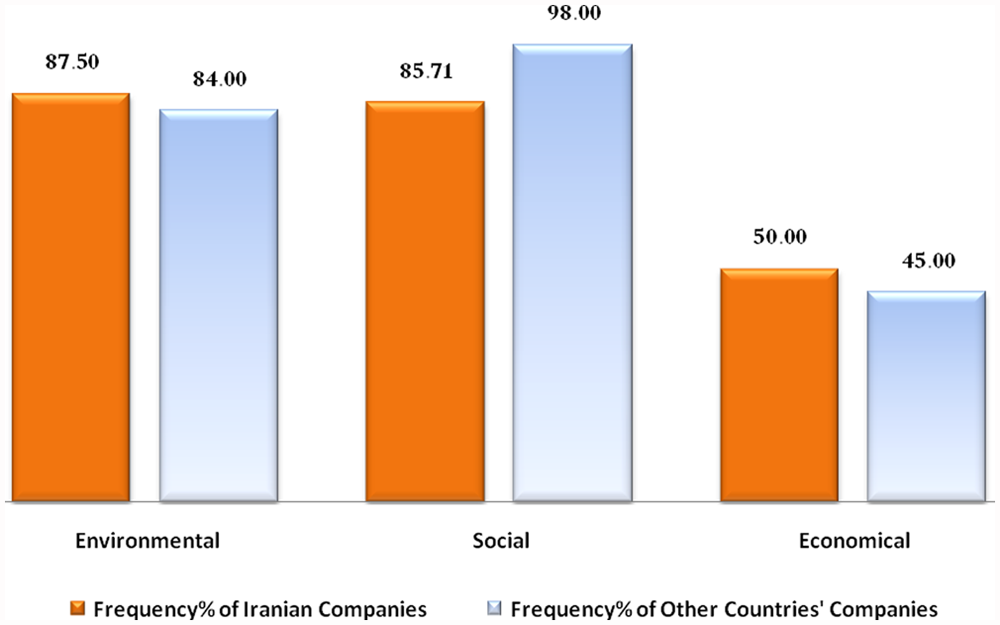
Contribution to each of the triple main groups in comparison
If we cautiously compare the results with the reference study, we find these results not so far from the international companies. Caveat is that for some differences in methodology exact comparison between the percentages is not recommended.
Economic Themes
Socioeconomic themes in studied companies were found tremendously different from that of reference study. Unemployment solely possessed 61% of importance for all economic themes, which is a token for this pressing problem in Iran, especially if we note that this theme was not addressed by companies from developed countries in the reference study. That might come by the explanation that despite the privatization program that Iran’s government has followed during the last two decades, Iran’s economy is still governmentally centralized. In addition, international economic sanctions against Iran have worsened the condition by far; hence, job creation and real employment has been tragically affected during recent years.
In terms of contribution, 34% of companies claimed to have participation in this field. “Inflation/low income compared with life costs” acquired the second position in both indices. This theme has not been addressed in the reference categorization, too. Table 1 shows that Iranian executives have further worrisome thoughts on society’s economic problems than their counterparts in developed countries. That might be considered as a natural outcome of being on the path of development.

Contribution to environmental themes in comparison
Environmental Themes
“Air/water/hazardous waste pollution” and its subthemes stand prominently on the top of important environmental issues of Iran with 74% of referrals over all the mentioned themes. Similarly, 84% of the studied companies announced that they have made contribution toward this major problem. A cautious comparison with reference findings is interesting. Increase of diseases, especially cancer, in the recent years might have been the root of such a worry for access to clean air and water among the Iranian managers.
Other themes such as “preservation” and “environmental education” have been practiced less than international companies. This could be interpreted as a rather reactive behavior than preventive approach. That is, in themes such as “environmental education” which are preventive measures for a better future, Iranian companies have worked less than their international counterparts.
Social Themes
The most substantial difference was observed in social group where 6 themes and 22 subthemes were substituted with the relatively minor-scaled categories of “others” in the reference study.
As shown in Figure 4, a considerable value is present for “traffic and transportation” over the importance index, overwhelmingly far off the figures expected. It is one of the significant anomalies of CSR themes in Iranian context and international context, as in the reference categorization, this theme is absolutely absent.
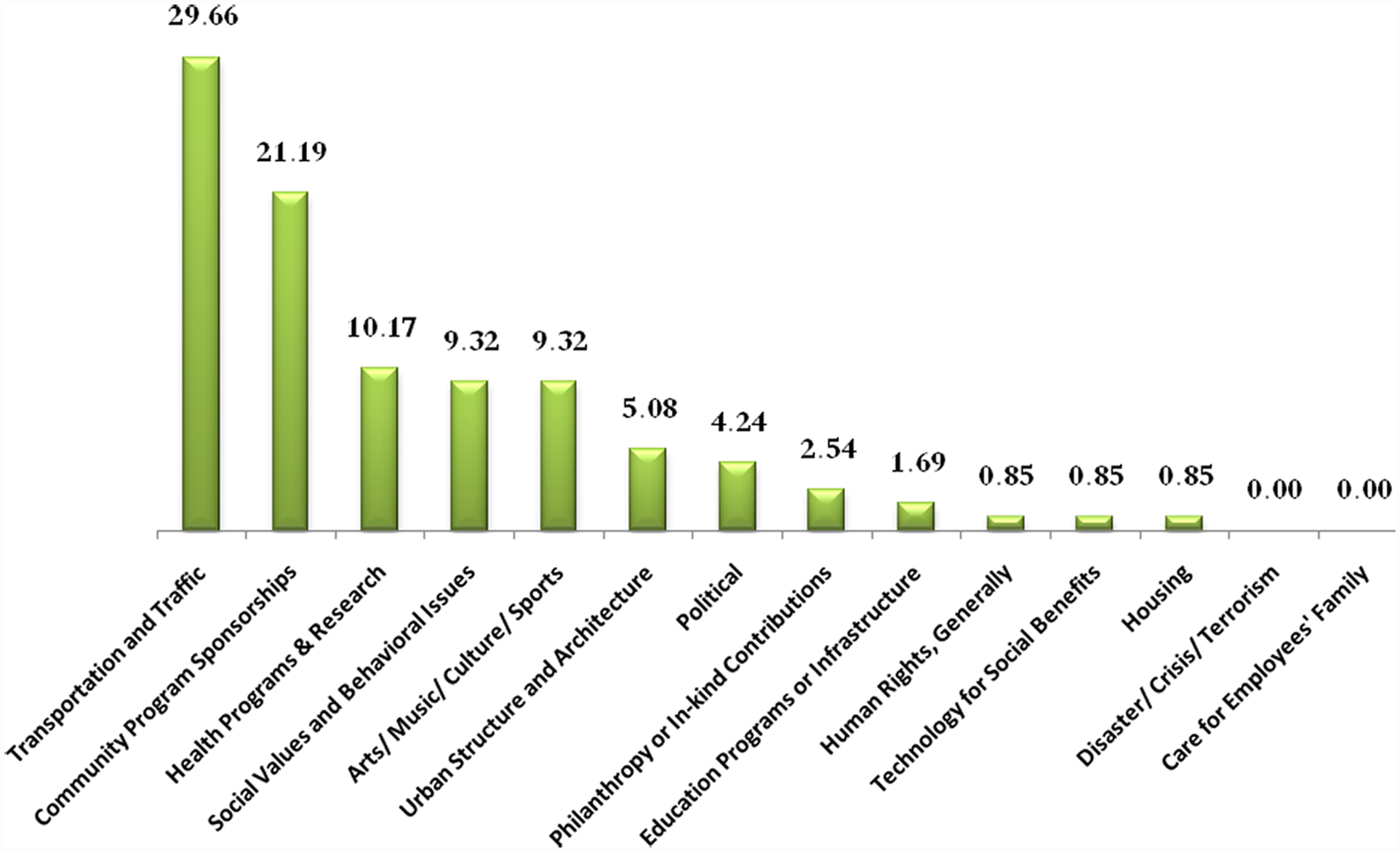
Importance of social themes in Iranian context
This finding seems natural; in fact, Tehran and other big cities are burdened with dense population, adding up the difficulty of moving people inside the cities. Finding a place to park your car in downtown of Tehran may take more than 1 hr, in crude terms. In addition, poor public transportation leaves people with no option but to drive their own cars. Annual death toll by car accidents stands higher than 24,000 (JahanNews, 2009). Commercial transportation infrastructure is also poor. All these cramming factors bring on “traffic and transportation” to be a major issue. This theme grasped a high 30% share of all important social themes mentioned, specific to Iran’s big cities, with a growing population in urban regions. However, as depicted in Figure 5, only 36% of Iranian companies planned programs for it; this can hence be considered as a CSR gap—this crucial issue stands in the fourth place of contribution. Shockingly, “car accidents” were neither ranked at the top rows in the importance index nor in the contribution. “Parking lots,” though appear to be a pragmatic theme for CSR projects, has been given a share of not more than 6% of the companies surveyed.

Contribution to social themes in comparison
The findings for “community program sponsorships” placed Iran not at a high level of the reference study’s results when roughly and cautiously comparing the figures (Figure 6). It should be considered that countries from reference study are all indexed with top figures at Organisation for Economic Co-Operation and Development (OECD) Social Indicators (OECD, 2009), whereas Iran could not reserve a better place than in the Medium Human Development table (United Nations Development Programme, 2010). As shown in Figure 6, Iranian companies did not get a better share of 51.79%, which is at the minimum threshold of the developed countries’ contribution, and this shows a big gap for corporate practices over this important issue. Themes like “crime/safety” and “antipoverty” seem not only important to the well-being of a society but also grasp the opportunity for risk-avoiding expansion of the businesses over that community, and the contribution of the corporations surveyed were reportedly at low level.

Contribution to “community programs sponsorships” in comparison

Contribution to “community programs sponsorship” subthemes in comparison
Combining the data from the reference study with this research in Figure 6, the contribution of different geographical contexts toward “community programs sponsorship” can be compared. Sponsoring the community programs among American and western European companies is higher than their counterparts in Japan and Nordic countries as well as Iranian companies. In search for the roots, based on the discussions made by researchers such as Matten and Moon (2004) and Gjølberg (2009), basic disparities in national systems and institutions underlies such contextual differences. In comparison with social systems governing Nordic countries, American companies find more necessity to sponsor public programs. However, it is shocking that in spite of enormous social needs in Iran, only about half of Iranian executives have considered this CSR theme important. Subthemes such as “employee volunteerism” seem new to Iranian companies and the company executives have less sponsored or supported community programs and voluntary works.
Another interesting result in this part is over the subthemes that are not mentioned as “important” by any of the respondents but have a noticeable share of participation. “Religious causes/programs support,” for instance, is a topic for which many corporations, especially large ones, define year-round programs. In summary, “community programs” is suggested as an essential subject for further researches in the context of Iran’s regime and nation’s institutional structure. It is interesting why a common and long-established way of practicing CSR is not finding its path to the business environment of Iran with its old tradition of philanthropic activities.
Many in Iran believe that contributing toward construction of the schools has been a long tradition; especially in deprived regions. Plenty of NGOs with such a mission have been always working in the country and it is said that about 100,000 philanthropist are active in this field (EcoNews, 2009). Surprisingly, this fact does not find a path to the corporate contributions in comparison with other countries (Figure 8). As Matten and Moon (2004) have discussed, the scant contribution of corporations in Nordic countries is not strange as governmental institutions are efficiently playing their roles in this field. In Iranian context, it seems that a combination of philanthropic measures by individuals and the development of semigovernmental and private higher education institutes have relieved the problem. This happens regardless to the fact that collaboration between academia and industries is not well defined: Design of the courses is not in compliance with the corporations’ needs.

Contribution to “education programs or infrastructure” in comparison
Another social topic that draws attention is “philanthropic contributions” where a divide between Iranian and international contributions is observed. This old type of CSR practicing remains at a very low percentage while even other Persian Gulf countries have apparently undergone this practice in expanding their programs to a broader range of stakeholders (Ronnegard, 2009). That holds the hypothesis that industries’ relationships with NGOs operating in Iran are not firmly established and businessmen are not conferring ideas with these institutions for a tighter cooperation.
“Disaster/crisis/terrorism,” surprisingly, has been remained out of the managers’ sight. Iran, being reported by Maplecroft (2010) has reported Iran at the third place vulnerable to natural disasters. Hence, beside the absolute necessity for public policies regarding preventative and corrective actions for disasters, serious corporate involvement is required over this issue. CSR, here, would receive a stricter investigation if it gains attention as an effective tool for progressing programs.
Near 10% of all social issues were categorized in “social values and behavioral issues”—an important complicated theme for a society in a long transition path from traditionalism to modernism.
Conclusion
The results of this study are not definitely intended to extend to any population other than the 56 studied companies; the researchers, however, try to deploy their general understanding of the Iranian context to show how different, or similar, CSR is perceived by the players of business environment in Iran—a country which is mainly out of international researches about CSR.
In addition, interpretation of such data might seem disputable, for CSR has never been adequately addressed in Iranian business and academic environment as a structured field or system. In spite of elaborate philanthropic traditions of entrepreneurs, CSR as a “structured knowledge” is still relatively new to Iran’s business atmosphere. This study, yet, shows that in the absence of a strong CSR platform, Iranian surveyed companies are not strangers to the CSR practices although they are unlinked to the international knowledge-generating events and bodies that occur and act around this still-to-rationalize concept.
General Implications for Business community
As shown in Table 1 and other information provided, anomalies and analogies can be observed between Iranian themes and internationally addressed ones. The results of this study can help business communities in several ways. First, business leaders may find a number of CSR themes for their participations which they might have not thought about yet. Second, these leaders can also focus their CSR practices on more important issues, especially those for which there is a “CSR gap” between “importance” and “contribution.” Besides, those Trans-National Corporations or Multi-National Enterprises (TNC/MNEs) which are active in Iran and obey their worldwide CSR plans may also find these analogies and anomalies useful for undergoing their global measures in compliance with contextual circumstances.
The significant differences between the CSR themes in Iranian companies and those of International ones confirm the agreed argument that CSR is a contextual subject. Themes such as “programs prohibiting business in countries with human rights violations” which have been addressed in international companies seem extremely faraway from Iranian business atmosphere in which international collaborations are limited and concepts such as TNC/MNEs, foreign markets, and globalization are not so common. Similarly, internationally practiced themes such as “antiracism/bigotry” and “genetics/testing” were not mentioned or practiced by Iranian business executives because in Iranian society, racism cannot be assumed as a serious social problem; similarly, subjects such as genetics are mostly addressed by governmental institutions in a limited scale; hence, neither is there a public awareness about the issue nor do these fall in the influence sphere of the companies. If one considers the isolation of Iranian business in global business atmosphere in terms of sanctions and other political reasons, the issues that have not been practiced would become more meaningful.
On the contrary, through the surveyed Iranian corporations, dozens of themes and subthemes were found that were new to the reference study. Albeit, some of these added themes have been found through other studies in countries with similar contexts, such as in India where “women entrepreneurship” is an important CSR theme (Ahmad, 2009).
In economic group, though researchers have tried to control the respondents not to be slanted toward less-social-and-more-economic issues, several themes were added to the reference categorization. The noticeable economic concerns of the executives seem natural if we consider serious economic problems in Iranian business climate in terms of employment, privatization, economic growth, and ease of doing business, especially during the recent years.
Pollution as a main concern surfaced in the environmental group—an old problem for which never a real treatment had been undergone in the country. Themes such as “noise pollution” and “wave pollution” have been distinctly added to the reference themes and this reflects Iranian executives’ concerns for escalation of different types of pollution. While noise pollution has been oppressing residents of large cities for decades, cell phone station antennas and satellite TV signal jam for political purposes are new subjects of informal or even formal speculations. 3 Mismanagement of natural resources is also a constant subject for a profound disputation by environmental activists and NGOs—two actors who are conceived of as intruders by authorities and sometimes acknowledged to deserve punitive actions. 4
The prominent number of social themes added to the reference categorization can also be interpreted as a clue to various societal issues that Iran is involved in. Identified CSR themes are generally accepted as main societal issues, such as drug abuse. Having an overall view on the issues to which Iranian companies have more contribution, one can find it interesting that majority of the actions are corrective/reactive measures; preventive measures like cultural initiatives are less addressed by corporations. Furthermore, in some cases, reactive programs such as disaster relief programs should be bettered. With such a high risk for earthquake, a noticeable gap was observed between the importance of and contribution to natural disasters among the companies.
To sum up, anomalies should be interpreted just with consideration of contextual circumstances. As an illustration, no respondent mentioned programs for music—maybe because of some religious restrictions which have been imposed on this art after the Islamic revolution in 1979. In contrast, “religious causes/programs support” have been addressed as an ongoing practice while respondents made no mention of it in terms of importance. It is wonderful that business executives strive for such a subject although they do not perceive it as an important subject.
Implications for Government and Researchers
Governmental institutions can also find the results of this research applicable if they intend to revise the rules and regulations to stimulate societal activities of business units in a more result-oriented platform. This, of course, needs further researches on specific subjects to reach to more generalizable results.
Beside the CSR themes, five “social problems” were identified for which no company had a program to address. These, therefore, are not considered as “CSR themes.” This reveals a meaningful conclusion on the influence sphere of the companies. Wide borders of problems such as “prostitution,” “totalitarianism,” “interference of local people in corporate affairs,” “corruption,” and “social inequalities” seem out of reach of the companies and are mostly assumed as government responsibility. Moreover, based on the religious roots of the Iranian government, problems such as prostitution have always been dismissed and ignored by the authorities who announce that there is no prostitution in Islamic Iran. Such taboos are barely found not troublesome as a CSR theme for companies. Furthermore, problems such as “totalitarianism” directly refer to a sociopolitical attitude which points the governance of the country. Regardless of how a company’s executive have dared to mention such a problem in this research, and considering the overall political climate of the country, one may find it natural why such issues fall out of the scope of CSR initiatives adopted by companies. This can be an interesting subject for further studies—how does the governance system of a country affects the CSR themes addressed by companies?
Such differences in themes can be a clue to the necessity of establishment of a more general taxonomy for CSR themes. Attempts such as the one performed in Athens University of Economics and Business (CSR Quest, 2010) should be hailed; yet, this taxonomy lacks availability of experimental data. Many researchers still deploy their own system of categorization; hence, it is tough to use their results in other researches. Maybe it is a responsibility of international CSR institutions to develop a general taxonomy.
And last but not least, studies on CSR themes and programs in many cases have been concentrated on what corporations have addressed. Parallel studies to explore which CSR themes are deemed significant by other stakeholders, such as consumers and social experts, can actually deepen the view to the subject.
Footnotes
Appendix
Hadi Chapardar and Raveed Khanlari are graduates in Master of Business Administration (MBA) from Tehran Industrial Management Institute (IMI). However, this research is not affiliated to IMI and the researchers have conducted this study independently
Acknowledgements
The authors hereby deeply wish to acknowledge Dr. Shahindokht Kharazmi, professor in IMI, whose advice and help were priceless in this research. Meanwhile, Dr. Gholamreza Nasirzadeh and Dr. Jafar Marashi, professors of IMI, and Mr. Majid Darvish, leader of IMI100 project, furnished the authors with their kind guidance. Dr. Morteza Imanirad and many others also shared their personal networks to find a suitable contact point in different organizations. A deep admiration shall be shown to the senior managers in some of the IMI100 companies who sincerely contributed toward this study.
The author(s) declared no potential conflicts of interest with respect to the research, authorship, and/or publication of this article.
The author(s) received no financial support for the research and/or authorship of this article.