




Abstract
The purpose of this study is to analyze the importance of management dimensions as well as the performance dimensions of rural producers’ cooperatives on the overall performance of rural producers’ cooperatives in Isfahan province. The statistical population of this research is the components of rural producers’ cooperatives in Isfahan province. Required data were collected by completing the questionnaire by 375 persons from rural cooperatives. In this study, principal component analysis (PCA), linear regression analysis, and arithmetic mean method were used. The results of the research indicated that a unit of improvement in cooperative management led to a 67% improvement in cooperatives performance. Among the seven component dimensions of cooperatives performance, the improvement of livelihood (0.852), had the highest factor loading in the performance structure of rural cooperatives. Also, among the four component dimensions of co-operative management, the leading (0.895) has been the most important factor in the management structure of rural producers’ cooperatives.
Introduction
Numerous scholars have argued that a rational solution to poverty eradication or at least poverty reduction is that poor people be considered as producers, not just as customers; thus, be organized in various formations (Dávila-Aguirre et al., 2014). In this regard, rural producers’ cooperatives constitute a very desirable option.
The realization of land integrity for the purposes of land development requires the creation of rural producers’ cooperatives. Also, the creation of rural producers’ cooperatives is the best option for the jointly-owned lands where farmers are cultivating in groups. In the event that a group of farmers who own little land and earn little money will form producers’ cooperatives, access to land and welfare services will be greatly facilitated (Lele, 1981, Gaillard and Dervillé, 2022, Neupane et al., 2022, Hasanova and Rzayeva, 2022).
As a result of Land Reforms in Iran, farmers' parcels of land were scattered and fragmented. The cultivation is not economically viable on scattered and fragmented lands. Therefore, in 1970, with the approval of the cooperative law, rural producers’ cooperatives were formed to improve the structure of the existing utilities system and to provide support to the villagers and farmers (Abbasi et al., 2022).
Over the past decades, economists have expressed some criticism for the cooperatives, and believe that cooperatives have failed in some cases to be effective as expected. Some cooperatives have incurred a lot of costs, some of which have been caused by their management weaknesses (Nilsson, 2001). Ali (2018) conducted a research study on cooperatives in Zanzibar, Tanzania, and Baoding City, China, revealing that the lack of knowledge and skills among cooperative managers significantly hampers the performance of cooperatives. The research study conducted by Junior and Wander (2021) on cooperatives in Brazil revealed that the professionalization of management plays a crucial role in driving the success of cooperatives. MacLean and MacKinnon (2000), in their research on the cooperatives in Atlantic Canada, identified a lack of commitment in cooperative managers to their duties as one of the obstacles to the performance of the cooperatives. Biswas (2015), in an investigation on producers’ cooperatives in developing countries, identified the management style in cooperatives as one of the important factors in the cooperatives’ performance. Mhembwe and Dube (2017), in their research on cooperatives in the Shurugui region of Zimbabwe, identified weak management and a lack of managerial skills as barriers to the success of these cooperatives. In a study on cooperatives in Gog woreda, southern Gambella, Ethiopia, Dorgi (2015) found that one of the most significant challenges for these cooperative was the inadequate managerial skills of their managers. In a study examining coffee farmers cooperatives in various regions of Ethiopia including East, West, and South, Gutema (2014) discovered a strong positive correlation between the role of leadership and the performance of these cooperatives. The study ultimately concluded that leadership plays a crucial role in the success of cooperatives. Dayanandan and Huka (2019), in their study on cooperatives in Ethiopia, discovered that the overall findings suggest that the leadership efficiency of the management committee is perceived as moderate by the members. They also recommend that the stakeholders involved organize regular leadership training sessions for the management committee of the cooperatives to enhance their performance and meet expectations. In a study conducted by Murumba (2017) on cooperatives in Kenya, it is clear that there is a significant need for managers who possess the ability and willingness to effectively carry out their roles and positively impact the performance of their institutions. These managers are required to provide strategic leadership that produces tangible results, thereby transforming both organizations and communities, while also meeting the expectations of their followers. The survival and success of farmer cooperatives heavily rely on the presence of honest strategic leadership, which involves setting, implementing, reviewing, and updating strategies. Achieving this requires discipline, passion, skill, and unwavering commitment. It is essential for the leadership to possess the appropriate skills, competencies, and behaviors that foster a culture focused on achieving desired outcomes. Therefore, it can be said that the management of cooperatives is a pivotal element in the proper functioning of cooperatives.
Yazdani (2012) in a research study on rural producers’ cooperatives in Fars province in Iran found that these cooperatives have been successful in achieving their goals. In a research conducted by Zhang et al. (2020) to evaluate the performance of producers’ cooperatives in China, it was concluded that these cooperatives had achieved successful performance. In their study on cooperatives in rural India, Kumar et al. (2015) discovered that these organizations have a significant impact on enhancing the quality of life for their members, particularly individuals with low incomes in rural areas. A study conducted by Zheng et al. (2011) on cooperatives in Jilin Province, China, it was found that there has been limited research conducted to understand the factors that influence farmers’ behaviors and performance within Chinese cooperatives. The researchers concluded that these cooperatives have a considerable impact on improving farmers’ income nationwide in China. In a study conducted by Calkins and Ngo (2010) in Côte d'Ivoire and Ghana, it was revealed that cooperatives had a positive impact on the income and overall livelihood of the producers. Additionally, the researchers observed that these advantages also spread to the neighboring community. Royce (2004) in a study conducted on Cuban producers’ cooperatives found out that the performance of these cooperatives has led to an increase in the production and income of their members. Verhofstadt and Maertens (2014) conducted research on cooperatives in rural households in Rwanda and found cooperative models have the ability to increase farmers' income. A study on cooperatives in Ethiopia, Getnet and Anullo (2012) highlighted the need for a comprehensive and organized examination to generate sufficient empirical data on the effects of cooperatives on livelihood development and poverty reduction in the country. Their findings indicated that cooperatives have a positive impact on farmers' livelihoods, as they improve income, increase savings, and reduce input expenses.
In their study, Jamaluddin et al. (2023) analyzed 30 papers and discovered that the majority of them (66.67%) focused on assessing cooperative performance in terms of financial performance. The remaining papers evaluated operational performance (16.67%), economic and social performance (10%), and other aspects such as overall, environmental, and other types of cooperative performance (3.33%). These findings highlight the significance of financial performance as a key area of interest for cooperatives. According to Suh (2015), research on organic rice producers' cooperatives in the South Korean region of Hong Dong, these cooperatives demonstrated good performance and can be viewed as a survival strategy for small farmers involved in rice production. In a study on cocoa producers’ cooperatives in Peru, Donovan et al. (2017) found that their cooperatives had a successful performance and had been able to provide a lot of services to their members.
Significantly, Ugandan researchers dedicated their attention exclusively to “policy compliance,” while their Chinese counterparts concentrated on “management, leadership, and strategy” as well as “social and human capital” concerns. This indicates that there are distinct areas to explore in each country, tailored to the local context and unique collaborative attributes. In general, there is a noticeable lack of research that utilizes organization or management theories in the context of cooperatives. Consequently, this presents valuable prospects for investigating how organization or management theories can be applied to analyze the distinctive characteristics, strategies, and results of cooperatives. Furthermore, it offers an opportunity to delve into the various typologies or styles of leadership and management that exist within these cooperatives (Jamaluddin et al., 2023).
During the review of numerous resources on cooperatives, it was observed that there is a limited amount of research available specifically analyzing the management dimensions and performance dimensions of rural producers' cooperatives. Analyzing the management and performance dimensions of cooperatives can offer valuable insights to cooperative managers and rural planners, enabling them to improve their strategic planning. The assessment of dimensions in cooperative management and cooperative performance aims to identify which dimensions have a more influential role in enhancing the management and performance of cooperatives. These insights will provide valuable guidance to cooperative managers in different countries. In this research, we tried to analyze the importance of management dimensions as well as the performance dimensions of rural producers’ cooperatives on the overall performance of rural cooperatives in Isfahan province.
The questions of this research are:
Which management dimensions of rural producers’ cooperatives have been the most important in the management of rural producers’ cooperatives in Isfahan province?
Which performance dimensions of rural producers’ cooperatives have had the most importance in the overall performance of rural producers’ cooperatives in Isfahan province?
What impact has the management had on the performance of rural producers’ cooperatives in Isfahan province?
In order to evaluate the performance of rural producers’ cooperatives in Isfahan province, the Articles of rural producers’ cooperatives approved by the Board of Directors of the Central Organization for Rural Cooperatives of Iran, 2017, was used. Based on the goals set out in those Articles, the cooperatives’ performance in six dimensions, namely, “reforming the structure of the exploitation system and promoting the productivity of production factors’’; “Optimal allocation and utilization of resources”; “Quantitative and qualitative increase of produce production” ; “Environmental protection”; “Improvement of livelihoods and economic power of members”; and, “service activities’’ were evaluated.
Education is an important and vital infrastructure in the cooperative system. A co-operative without a training aspect in its activities is not a true cooperative. In fact, a cooperative company without training will lose the characteristics and specifications that represent the co-operative. Cooperative and education are complementary to one another; so that no cooperative can achieve success without training. For this reason, education is considered to be the main foundation and an integral part of a cooperative. To emphasis the importance of training it can be added that in the third paragraph of note 2, Article 25 of the Law concerning the Cooperatives in the Islamic Republic of Iran, 4% of the profit of cooperative companies should be allocated to education (Amini and Safari Shali, 2002). Therefore, with regard to the importance of education and the fifth principle of the cooperatives, which is, education, awareness and apprenticeship (Carrasco, 2007, Seguí-Mas and Bollas-Araya, 2012), the dimension of educational and promotional activities is also added to the six dimensions mentioned earlier; and ultimately, the concept of cooperative performance was constructed with consideration of the seven dimensions. Therefore, the performance of rural producers’ cooperatives was evaluated based on the seven dimensions and 63 measures after examining and studying the Articles of rural producers’ cooperatives as detailed in Table 4.
In a general division, the tasks of managers can be considered into a general framework, including planning, organizing, leading, and controlling (Van Poeck et al., 2017, Juanda et al., 2022, Rostini et al., 2022, Ichsan and Muda, 2022). Planning involves creating a structured framework for future activities that are seamlessly coordinated and prearranged. Organizing involves the comprehensive process of categorizing individuals, resources, duties, obligations, and positions in a manner that facilitates the formation of a cohesive entity capable of working towards established objectives (Malikhah, 2021). Leading involves motivating individuals within the organization to excel, usually through personal connections with direct reports or team members. By understanding what motivates each team member, a manager can create strategies that inspire, reward, mobilize, and ignite a sense of purpose. Examples of leadership within the organization include engaging in personal conversations, implementing a bonus system, and delivering inspiring speeches. Controlling comprises of implementing processes that guide the team towards objectives, monitoring their progress, and adjusting the plan as needed. These control processes involve establishing systems that guarantee the organization remains aligned with the goals set during the planning phase (Lloyd and Aho, 2020). In this regard, co-operative managers will not be exempted from this, and they will have to work hard on these four tasks, in order to be able to perform their assigned duties well. Thus, the general concept of cooperative management was constructed by considering four dimensions of planning, organizing, leading and controlling, and 17 measures, as shown in Table 4.
Isfahan Province, with an area of about 107,019 square kilometers is located between 30 degrees, 43 min, and 34 degrees, 27 min northern latitude; and 49 degrees, 36 min to 55 degrees, 31 min east longitude from Greenwich meridian. The province is located in the center of Iran, from the north to the provinces of Markazi, Qom and Semnan; from the south to the provinces of Fars and Kohkiluyeh –va-Boyer Ahmad; from the west to the provinces of Lorestan, Khuzestan, Chahar Mahal-va- Bakhtiari, and from the east is limited to Yazd province (MPO, 2015).
Materials and Methods
This research is an applied research in terms of purpose and type, and a survey research in terms of its method.. In this research, for evaluating the reliability and validity of cooperative management structures and the performance of rural producers’ cooperatives, and calculating factor loadings, which indicate the importance of structure constituents, PCA or Principal Components Analysis was applied. In order to study the effectiveness of the independent research variable (management of rural producers’ cooperatives in Isfahan province) on the dependent variable of research (performance of rural producers’ cooperatives in Isfahan province), the linear regression analysis was used; and to assess the current status of cooperatives’ management and performance, the mean arithmetic method was applied. The software used for the investigation was SPSS v. 21.
According to the latest information from the rural cooperative organization of Isfahan province, the total number of rural producers’ cooperatives was 55, among whom, 43 were active (ongoing) enterprises and the remaining, inactive or semi-active. The 43 active companies, with a total of 17.157 members, cover 92.241 hectares of arable land (RCO, 2016). The statistical population of this study consists of the components of rural producers’ cooperatives in Isfahan province (general assembly, board of directors, inspector(s)) which include 17.157 people. The sample size was obtained using the Cochran formula with 5% accuracy and 95% reliability, including 375 people. A simple two-stage stratified cluster random sampling method was used. Thus, in the first stage, the townships of the province are considered as the strata; and in the next stage, samples were selected randomly among the clusters that are the producers’ cooperative companies. Two principles were considered for sampling: first, from all the townships (strata) that have rural producers’ cooperatives, samples should be taken and no township should be excluded from sampling; and secondly, in each township, for half the number of companies, the number of clusters is selected in a simple random fashion which, as shown in Table 1, they should be considered in 22 companies. Table 1 presents the count of rural producers’ cooperative companies and their corresponding members per township in Isfahan province. Additionally, it indicates the number of selected samples.
The Status of Isfahan Province Producers’ Cooperative Companies and Selected Samples by Township.

Source.RCO (2016).
Based on a sample size of 375 people and 22 companies, the number of samples needed for each company was 17. Since the statistical population of the research consists of the components of rural producers’ cooperatives, in each company, five members of the board of directors, one managing director, one inspector, a total of seven, plus ten cooperative members were included in the sample. This way, the full coverage of the statistical population variance with regard to all the townships and all organizational designations was ensured.
Results and Discussion
In this research, using the principal components analysis method (PCA), the dimensions of performance in rural producers’ cooperatives in Isfahan province as well as their management dimensions were constructed. “The goals of PCA are concerned with finding relationships between objects. One may be interested, for example, in finding classes of similar objects. The class membership may be known in advance.” And “another goal could be data reduction. This is useful when large amounts of data may be approximated by a moderately complex model structure.” (Wold et al., 1987). These characteristics of PCA suited the purpose of our research, therefore PCA method was selected.
Prior to factor extraction, various tests should be carried out to verify the suitability of the data for factor analysis. These tests include the Kaiser-Meyer-Olkin (KMO) statistic and Bartlett’s test. If the KMO statistic were higher than 0.50, it would be suitable for a factor analysis, On the other hand, regarding Bartlett’s test, if its significance were less than 0.05 (P < .05), it could be concluded that the data are suitable for factor analysis (Williams et al., 2010). The results of the study indicated that Bartlett’s test value was significant at a very high level; and that their KMO value was higher than 50%, so that one could conclude that the correlations between the data are suitable for factor analysis Table 2. Hidden variables were then constructed from the indicated measures and used for factor analysis. The dimensions considered for constructing the performance variable for cooperatives are presented in Table 2. This table provides information on the number of measures for each dimension, along with the Cronbach’s alpha coefficient, Bartlett’s test, and the KMO statistic.
The Reliability and Validity of the Research Dependent Variable in the Questionnaires at the Pretest Stage.

Source. Research Findings.
The performance of rural producer’s cooperatives included seven dimensions (Reforming the structure of the exploitation system and promoting the productivity of production factors, Optimal allocation and utilization of resources, Quantitative and qualitative increase of produce production, Environmental protection, Improvement of livelihoods and economic power of members, Educational and Promotional activities, Service activities) Cronbach’s alpha, KMO and Bartlett’s were calculated at the pretest stage with all the dimensions showed more than .761 Cronbach’s alpha, KMO above 0.512 and the Bartlett’s were all significant. Reforming the structure of the exploitation system and promoting the productivity of production factors (number of measures = 13.0.916)
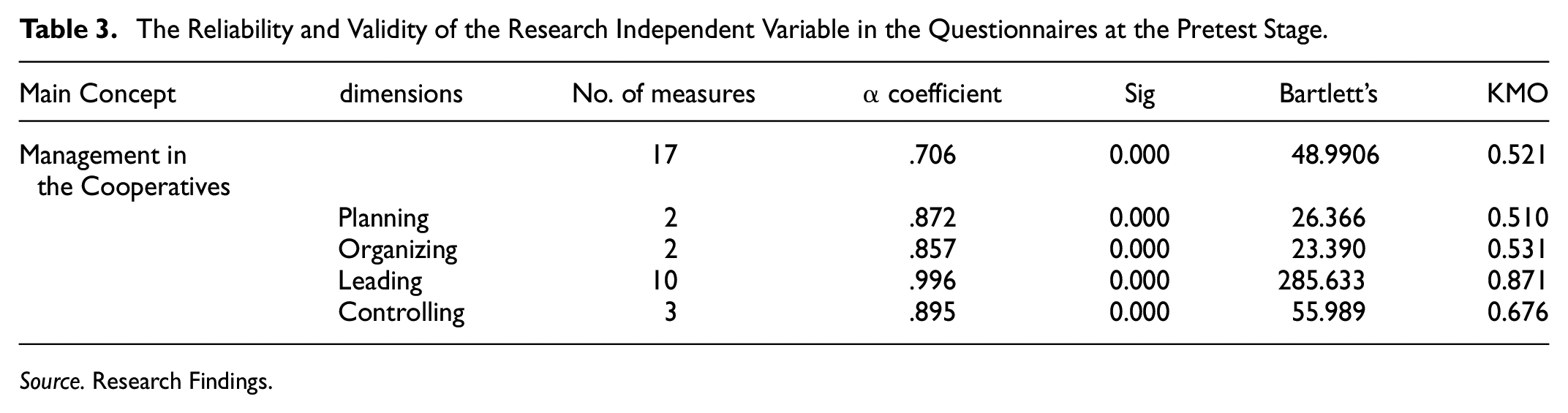
The cooperative management variable is the independent variable of this research. As shown in Table 3, its Cronbach’s alpha value was above 70%; and Bartlett’s test value was significant at a very high level; and its K.M.O value was above 50%. The dimensions considered during the creation of the cooperative management variable are presented in Table 3. This table provides information about the number of measures for each dimension, along with the associated Cronbach's alpha coefficient, Bartlett's test, and the KMO statistic.
The Reliability and Validity of the Research Independent Variable in the Questionnaires at the Pretest Stage.
Source. Research Findings.
After ensuring the reliability and validity of the constructs, questionnaires were distributed among, and completed by, 374 body members of the rural producers’ cooperatives (including members, board of directors, CEO, and inspector) in 11 townships of Isfahan province.
Factor analysis uses several mathematical methods to simplify interrelated measures in order to explain existing relationships in a set of variables (Yong and Pearce, 2013). Principal Component Analysis (PCA) was used to construct research variables. The factor loading of research measures is reasonable if it exceeds 0.4 (Lee et al., 2004). The factor loading of each and every measure was more than 0.4. Table 4 presents the factor loadings for the variable dimensions of cooperatives’ performance, as well as the dimensions of cooperative management variables. Additionally, it includes the factor loadings for the corresponding measures associated with each dimension.
Research Measures’ Factor Loadings.
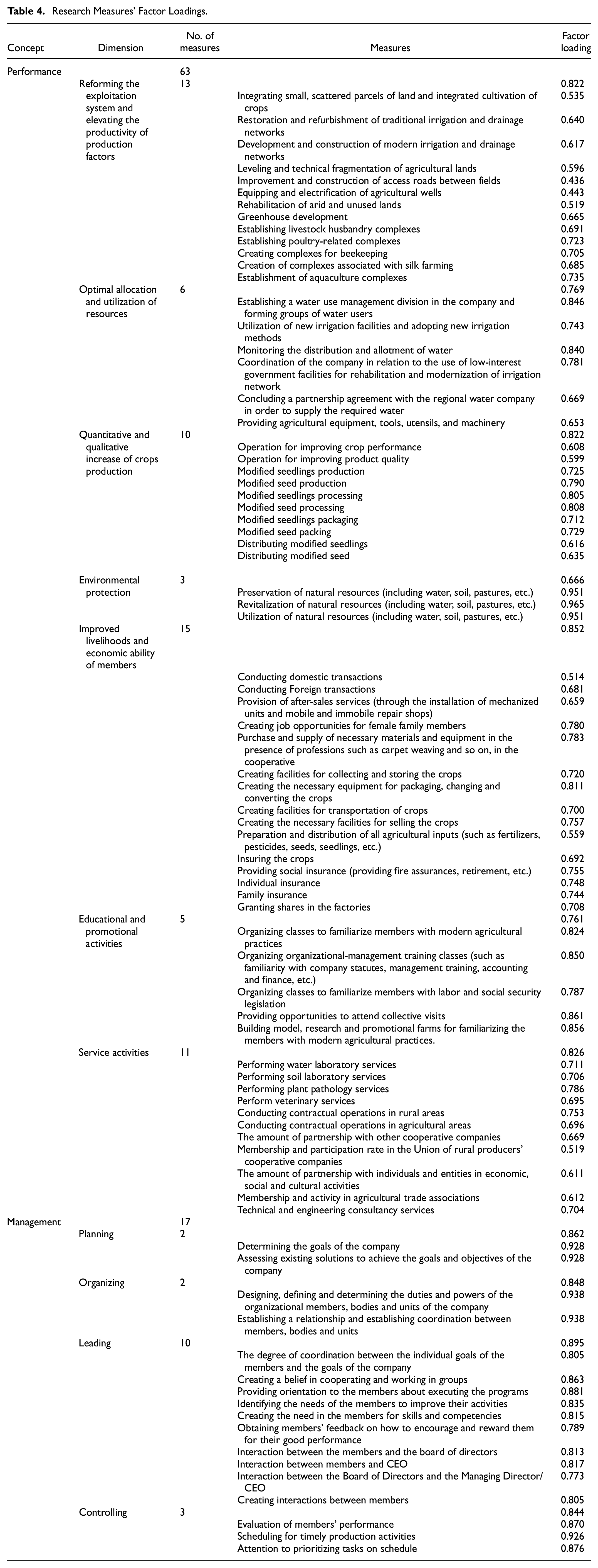
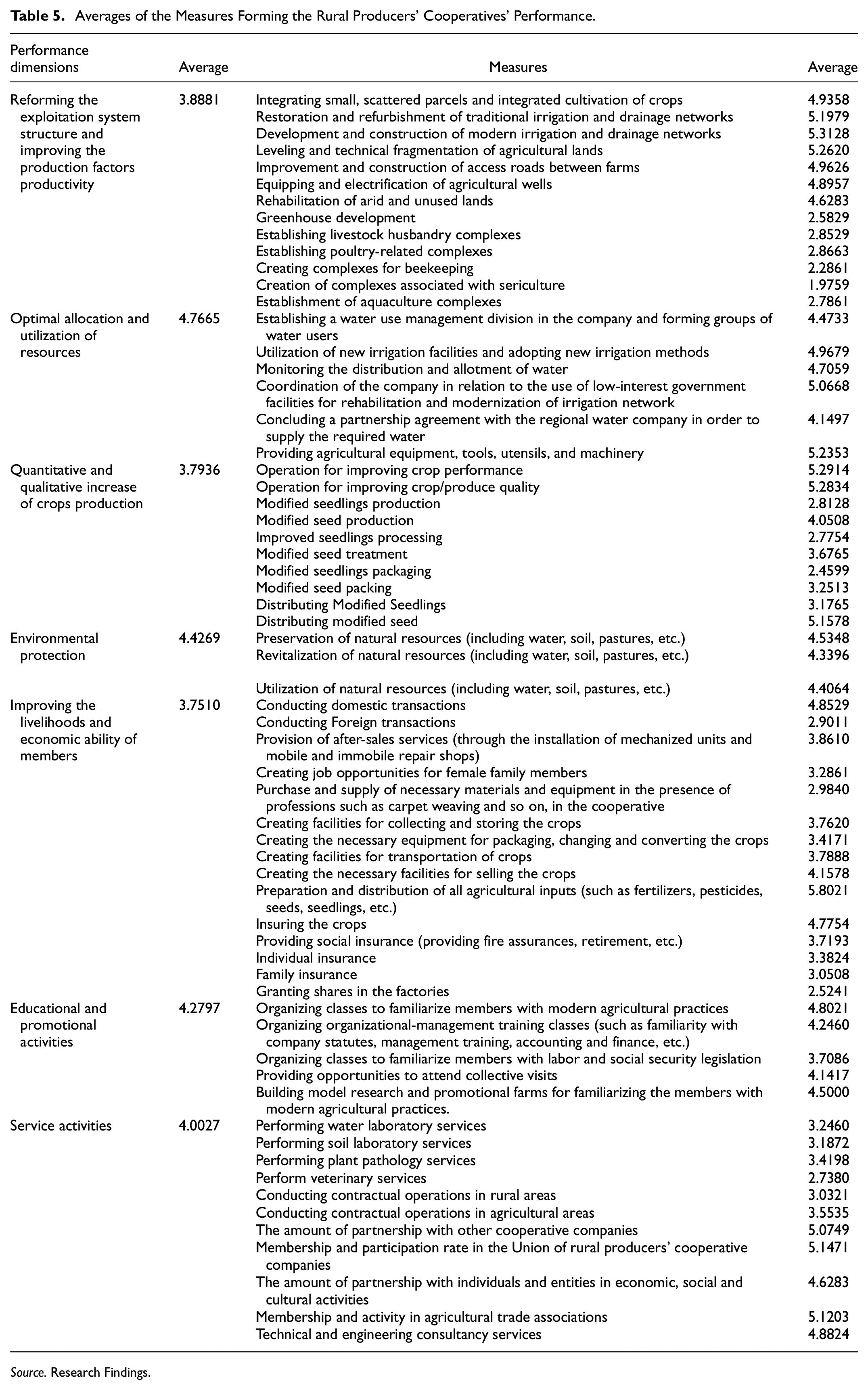
As mentioned, seven dimensions were considered when constructing the performance of rural producers’ cooperatives variable. Factor loadings of the seven dimensions were: reforming the structure of the exploitation system and promoting the productivity of production factors, 0.822; Optimal allocation and utilization of resources, 0.769; the quantitative and qualitative increase of production of crops, 0.822; Environmental protection, 0.666; improvement of livelihood and promotion of economic power of members, 0.852; educational and promotional activities, 0.761; and, service activities, 0.826. Among the seven dimensions mentioned above, the dimension of improving the livelihoods and promotion of economic power of members (0.852) had the highest factor loading in the performance structure of rural producers’ cooperatives. By improving this dimension, therefore, we can see a great improvement in the performance of rural producers’ cooperatives. The arithmetic average method was used to assess the current status of cooperatives performance. The performance dimensions of rural producers’ cooperatives and their averages, as well as the measures for each of the dimensions and their averages are presented in Table 5. The averages for the dimensions were: reforming the structure of the exploitation system and promoting the productivity of production factors, 3.8881; the optimal allocation and utilization of resources, 4.7665; the quantitative and qualitative increase of crops production, 3.7936; environmental protection 4.4269; improvement of livelihoods and the promotion of members’ economic power, 3.7510; the educational and promotional activities, 4.2797; and the service activities, 4.0027. Among the seven dimensions of performance, allocation and utilization of resources had the highest evaluation average in the view of cooperative bodies. On the other hand, the improvement in livelihoods and promotion of members’ economic power had the lowest average in the view of the cooperative’s components, while this very same dimension has had the highest loading factor in the performance structure of rural producers’ cooperatives.
Averages of the Measures Forming the Rural Producers’ Cooperatives’ Performance.
Source. Research Findings.
The Cooperatives have been working poorly on improving livelihoods and economic power of the members, which has had the most disadvantages in two areas: granting the shares of manufactures and foreign transactions. In regard to service activities, the cooperatives’ performance has been weak in both veterinary services and performing contractual operations in rural areas. Also, regarding the dimension of reforming the exploitation system structure and improving the productivity of production factors, the cooperatives have been weak in both creation of complexes associated with silk farming and the creation of complexes associated with beekeeping. Regarding the dimension of quantitative and qualitative increase in production of crops, the performance of cooperatives has been weak in both packaging of seedlings and the production of seedlings. Also, their performance in the areas of optimal allocation and utilization of resources has been poor in both conclusion of joint venture contract with the water company in order to supply the required water and establishing a water management unit in the company and the formation of water users groups. In regard to the dimension of educational and promotional activities of the cooperatives, they have performed poorly at both organizing classes to familiarize members with labor and social security legislation and providing the opportunity to attend collective visits. In the dimension of environmental protection, too, the cooperatives have not worked well on the restoration of natural resources.
Based on the findings of this research, it can be concluded that the dimension that has the highest impact on the performance of rural production cooperatives is improving the livelihoods and promotion of economic power of members, with a factor loading of 0.852. By prioritizing and enhancing this dimension, a significant improvement in the overall performance of rural producers' cooperatives can be expected. This study is in line with previous studies (Jamaluddin et al., 2023, Kumar et al., 2015, Zheng et al., 2011, Verhofstadt and Maertens, 2014, Getnet and Anullo, 2012, Calkins and Ngo, 2010), all of which highlight the critical importance of financial performance in the context of cooperatives. Moreover, the successful performance of these cooperatives can greatly enhance the quality of life for their members. Table 5 displays the average dimensions and measures of the cooperative performance variable, as determined using the arithmetic mean method.
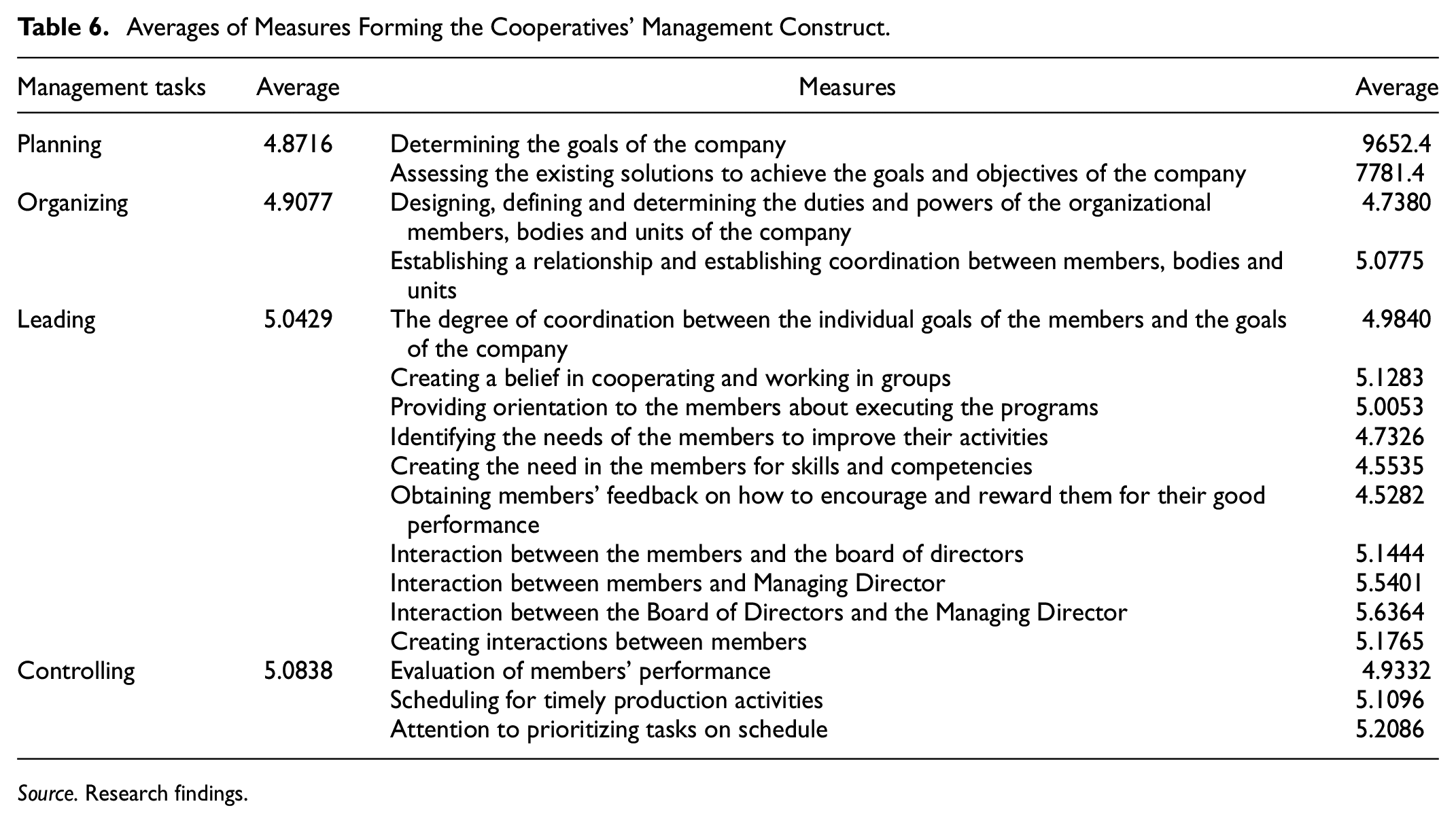
As mentioned earlier, when constructing the management variable, the four dimensions of planning, organizing, leading and controlling were considered, whose factor loadings were, 0.862, 0.848, 0.895, and 0.844, respectively. Leading had the highest factor loading followed by planning, organizing, and controlling. Thus, improving the leading dimension in a cooperative, one could observe a great improvement in its management. Arithmetic average method was used to assess the current status of cooperatives management, with 4.8716, 4.9077, 5.0429, and 5.0838 for the four dimensions of planning, organizing, leading and controlling, respectively. Table 6 provides the management dimensions, their averages, measures, and the measures’ averages. Even though planning has been the second most essential dimension in the construct of management structure, it has the lowest evaluation average in the views of cooperatives’ body members. This means that management has performed poorly in the planning area, which is the central and fundamental core of managerial tasks. This has been present especially in the evaluation of existing solutions for achieving the company’s goals and purposes. Moreover, poor management is observed in the organizing dimension in terms of designing, defining, and assigning the duties and powers of members, bodies, and organizational units of the company. Regarding the leading dimension, having the highest factor loading at the cooperatives’ management structure, the lowest evaluation averages in the views of cooperatives’ components belonged to such measures as surveying the members on how to reward their good performances; creating a need in the members for improving skills and competencies; identifying job requirements for their improved activities; and coordination levels of members’ personal goals with the company’s, respectively. Additionally, at the controlling dimension, the lowest average belonged to the “members’ performance evaluation.” If the cooperatives focus more on their points of poor performance and try to mitigate their managerial weaknesses, they shall be able to enhance their performance. According to the results of this study, it can be concluded that the dimension of management with the highest factor loading is the leading dimension. This suggests that enhancing the leading dimension within a cooperative can lead to significant improvements in management. The finding aligns with previous studies (Murumba, 2017, Gutema, 2014, Dayanandan and Huka, 2019) that have highlighted the significance of leadership in the role of cooperative managers. Table (6) presents the average dimensions and measures of the cooperative management variable, calculated using the arithmetic mean method.
Averages of Measures Forming the Cooperatives’ Management Construct.
Source. Research findings.
Using linear regression analysis, the effect of independent research variable, namely, the management of cooperatives, on the dependent research variable, namely, cooperatives’ performance (β = . 671, p < .0001) was obtained which indicates that an improvement unit for the management of cooperatives leads to a 67% improvement in the performance of cooperatives. Also, (R2 = . 450) was obtained, which shows that management of cooperatives accounted for 45% of total variance of cooperatives’ performance; and almost half the variance of dependent variable was accounted for by cooperatives management. It means that almost half the improvement in the cooperatives’ performance depends on improved management. It implies that nearly half of the enhancement in the cooperatives’ performance is reliant on better management. This outcome aligns with previous research findings (MacLean and MacKinnon, 2000, Biswas, 2015, Mhembwe and Dube, 2017, Junior and Wander, 2021, Ali, 2018, Dorgi, 2015), emphasizing the significant impact of cooperatives’ management on their performance.
Conclusion
The results of the research showed that a unit of improvement in cooperative management leads to 67% improvement in cooperatives’ performance, which indicates that among the factors affecting the performance of rural producers’ cooperatives, including physical, financial and environmental resources etc., the most important factor has been the management, as 45% of cooperative performance variance was accounted for by the cooperative management factor. Therefore, if the management of a rural producers’ cooperative were capable, it would be able to move its cooperative towards success, whereas if a rural producers’ cooperative is rich in physical, financial and environmental resources, but it is poorly managed, it shall not succeed. The results indicated that the leading dimension among the dimensions of cooperative management was the one with the highest loading factor. Therefore, it is suggested that the managers of rural producers’ cooperatives focus their attention on leading and make the most of their effort in this field. In order to achieve more success for rural producers’ cooperatives, it is also recommended that co-operative managers perform their management tasks in the following measures, thereby improving their own performances: evaluating the existing solutions in order to achieve the goals and objectives of the cooperative; designing, defining and assigning the duties and authority of members, bodies and units of the cooperative; obtaining the members’ feedback on how to encourage and award for their good performance; creating the need for skills and competency in the members; identifying the members’ job needs to improve their activities; the degree of coordination between the individual goals of the members with the cooperative goals; and finally, the evaluation of the members’ performances. In order to improve the performance of rural producers’ cooperatives, it is recommended that the managers of cooperatives focus more on the following measures, providing for necessary circumstances if possible: granting the shares of the factories; carrying out foreign buying and selling activities; performing veterinary services; performing contracting activities in rural areas; establishing complexes related to silk farming; establishing beekeeping-related complexes; packaging of modified seedlings; production of seedlings; conclusion of a contract with the water company in order to supply the required water; establishing a water management unit in the company and forming groups of water users; holding classes to familiarize members with labor and social security laws; providing more opportunities to attend collective visits; and, revitalizing natural resources. The results of the research showed that improving livelihoods and economic power of members has been the most important in increasing the performance of cooperatives. In this regard, it is suggested that managers make every effort to improve livelihoods and enhance the economic power of their members, since this dimension of performance will have the greatest role in improving the overall performance of cooperatives. In addition to the management of cooperatives, various other factors influence their performance. Hence, it is suggested that future research should focus on exploring the impact of socio-political factors on the performance of cooperatives.
Research Limitations
Throughout the course of this study, certain constraints were encountered. One major issue was the difficulty in obtaining the samples, as they were spread out in various locations. Furthermore, many members of the cooperatives possessed limited literacy skills or were entirely illiterate, making it challenging for them to fully participate in completing the questionnaires. Moreover, another obstacle arose when some respondents expressed skepticism toward the questionnaires' practicality and efficacy.
Footnotes
Author’s Note
Maryam Najafi has recently completed her postdoctoral fellowship at the University of Isfahan. She is interested in measuring the performance of cooperatives, organizations' managerial performance and geography.
Hedayat Nouri, Professor, is interested in geography, organizations' managerial performance, environmental planning and sustainability.
Amir Mozafar Amini, Assoc. Prof., is interested in organizations' managerial performance, agriculture and rural development.
Declaration of Conflicting Interests
The author(s) declared no potential conflicts of interest with respect to the research, authorship, and/or publication of this article.
Funding
The author(s) received no financial support for the research, authorship, and/or publication of this article.

Data Availability Statement
Data generated or analyzed during this study are available from the corresponding author.