




Abstract
The use of technology to provide contextual information for decision-making has been a long-standing practice. The study aims to identify the antecedents influencing tourists’ use of context-aware applications. It employs the Unified Model of Electronic Government Adoption (UMEGA) and the Expectation Confirmation Model (ECM) to investigate tourists’ behaviors in the use of Personal Locator Beacons (PLBs) during the pre-adoption and post-adoption stages at the Mole National Park in Ghana. Data was analyzed using Smart PLS 3.0 software. The findings suggest that pre-adoption performance expectancy, motivational needs, and personal situation significantly affect tourists’ pre-adoption intentions to continue using context-aware applications. In addition, information recommendation, service quality, confirmation expectation, and satisfaction influenced continued use and recommendation. However, social influence and enjoyment experience did not significantly impact tourists’ behavioral intentions. The findings contribute to theory by integrating components of the two models (UMEGA & ECM) and delving into the antecedents of users’ decision-making processes.
Introduction
The digitalization of the tourism industry and the upsurge in the use of mobile handheld technologies have offered unique possibilities for the Management of National Parks to enhance visitors’ experience and understanding of natural places (Müller-Roux, 2021; Muñoz et al., 2019; Psyché et al., 2020). The National Parks of Canada, the United States, and Australia in 2018 and 2019 received over 327 million, 24.5 million, and 34 million tourist visits, respectively (Geng et al., 2023; Hartman, 2021). The most visited national park in Africa, South Africa’s Kruger National Park, attracts over 1.4 million visitors annually (Ferreira & Harmse, 2014; Kruger et al., 2017; Plessis & Saayman, 2015). In Ghana, the Kakum National Park, known for its canopy walkway, receives around 300,000 visitors annually (Osei-Owusu et al., 2018). The Mole National Park and Bia National Park receive about 15,000 and 3,000 visitors annually. In terms of revenue, by the end of 2019, Ghana, as a destination, raked in US$ 3.3 billion with a total of 1.3 million tourist arrivals (Ghana News Agency (GNA), 2021). This number of visitors and the revenue generated may surge because the Ghana Tourism Authority launched “Beyond the Return” and “December in GH” initiatives to attract more foreign visitors to Ghana.
National Parks as tourist destinations attract tourists and these generate employment prospects, support conservation efforts, and support local businesses. It also promotes education, cultural exchange, and environmental advocacy. Via tourism activities, infrastructural improvements are made in tourism areas, enhancing and offering recreational activities (Hajiabadi et al., 2022). National Parks may act as templates of environmentally sound tourist practices, supporting eco-friendly efforts in the business. This also promotes biodiversity since wildlife and ecosystems are preserved. Tourism helps to diversify the local economy and provides a buffer during recessions (Jeong et al., 2021).
Due to inadequate technologies in managing the national parks, several human injuries and deaths are recorded as a result of wild animal attacks. The parks face various challenges, including wild animal attacks on human lives, illegal logging, poaching, mining, land encroachment, inadequate funding, and inadequate technological equipment required for easy monitoring and conservation (IUCN/PACO, 2010). In the United States, over 47,000 people sought medical attention annually after being attacked or bitten by wild animals (Conover & Resources, 2019). The Comptroller and Auditor General Department in India reported that between 2012 and 2015, 166 wild animal attacks were recorded with 133 deaths (Hindu, 2016). In Nepal, within 5 year 463 cases of injuries and deaths were recorded (Acharya et al., 2016). Incidence of animal attacks were also reported in Ghana (Duodu, 2019; GhanaWeb, 2017). As a result of these challenges, the use of context-aware applications has been introduced in the management of national parks. These applications utilize context-aware data such as location, time, and weather to enhance the user’s profile and recognize their surroundings. Context-aware applications have the potential of spontaneously obtaining functional contexts from users’ environments and providing essential information to the users, including global positioning systems, vision sensors (cameras), and locally based services (Dey, 2001; Feng, 2018). The applications use system software that offers services explicitly catered for tourists, such as satellite phones, GPS units, and Personal Locator Beacons (PLBs) (S. R. Martin & Blackwell, 2016). These include personalized recommendations, communication tools, essential utilities, and emergency assistance. Some applications utilize sensor networks (SN) and radio frequency identification (RFID) to monitor and track users, allowing emergency actions to be taken when necessary. They are designed to be universal, adaptable to different user interfaces, mobile, intelligent, heterogeneous, marketable, comprehensive, navigable, innovative, and appealing to tourists (Chang et al., 2017).
The National Parks of Ghana have embraced these mobile technologies to improve visitor experiences by offering access to basic park information, ecological facts, alerts in times of danger, and historical narratives (Agyeman et al., 2019). Through mobile apps, context-aware applications such as location-based services, personal locator beacons, intelligent museums, geotagging, and artificial intelligence, visitors can access information about any park, plan their visit, navigate trails, take photographs, and share their experiences with others while feeling safe (Ayala et al., 2014; D. Liu et al., 2016). The applications provide a means of outreach and promoting parks, ensuring that visitors are informed safe, and spend more time outdoors.
Many researchers have conducted studies in the area of tourism, national parks conservation, and context-aware applications, including information and navigation, personalized recommendations, and interactive interpretation services (Ferreira & Harmse, 2014; D. Liu et al., 2016; Lundmark et al., 2010). Through the large amounts of data collected from various sources, tourists can now interactively access helpful information and services. However, fewer studies have been conducted on the antecedents affecting tourists’ adoption of context-aware applications in third-world countries. Although the Mole National Park in Ghana receives about 15,000 visitors annually, it is still relatively minor compared to other national parks in other African countries. The Park has a sustainable growth potential that can benefit conservation and nearby communities when visitors’ experiences are improved by integrating relevant digital technologies.
The objective of this paper is to explore the antecedents affecting tourists’ adoption of context-aware applications in national parks, using Personal Locator Beacons (PLBs) at the Mole National Park as a case study, and discuss innovative measures to mitigate the technological challenges while embracing the opportunities for sustainable park tourism. The result contributes to assisting managers of national parks in understanding the expectations of tourists visiting national parks. This understanding in turn, informs strategic decision-making processes related to park management and resource allocation. It will also contribute to theoretical development in the area of technology adoption. The rest of the paper is organized as follows: Section 2 presents the literature review delving into context-aware applications, theories of user adoption behaviors, hypotheses development, and the study settings. Section 3 presents the materials and methods. Section 4 presents the results and analysis. Section 5 presents a discussion of the results. Finally, section 6 concludes.
Literature Review
The Use of Context-Aware Applications in National Parks
Context-aware applications are a valuable addition to the infrastructure of national parks. These applications can gather data and information through GPS, sensors, databases, and other simple technological devices to provide real-time information to park managers and visitors (Truong & Dustdar, 2009). The applications can send and receive feedback from within their functional setting, thus offering potential benefits to the user, including flexibility, responsiveness, versatility, and personalization (Mandato et al., 2000). Context awareness is defined as “the process of detecting context entities by various methods, such as collecting data via sensors and user input, and refining the collected information into higher-level knowledge that constitutes the context of the user, which can be useful in various applications” (Hasanov et al., 2019, p. 1). Villegas et al. (2018) explained that “context-aware system knows how to sense, negotiate, communicate, and interact with environmental systems and how to anticipate environmental system states, situations, and changes.” This information can enhance visitors’ experiences while improving safety and resource management in the park.
Several studies have been published on the application of context-aware sensors in tourism. Silva et al. (2018) presented a study on Android applications that utilizes device sensors and public APIs to gather user context-aware information. The application recommends places for tourists based on their context and provides additional options. It was found that with applications, users, through their mobile devices, can easily interact with their environment. Colomo-Palacios et al. (2017) proposed a POST-VIA 360 - a platform designed to aid in managing the entire life-cycle of tourism loyalty after the initial visit, and tested it in Salamanca, Spain. The system collects data during the initial visit through pervasive approaches. The data is analyzed, and on subsequent visits, recommendations are offered based on the positioning through a bio-inspired recommender system. The findings indicated that the system’s recommendations were highly accurate compared to previous attempts in the field. An intelligent mobile tourist guide, Mobile Guide–TAIS, has been used to test a multiple model context-aware tourism recommendation system that uses collaborative filtering, considering the user’s context, to generate attraction ratings (Kashevnik et al., 2017). Chanda et al. (2022) examined how ICT may be used to facilitate context-aware tourism in West Bengal, which could benefit the local community by providing equal access to high-quality education, professional skill development, and effective governance and administration. In Malaysia, the difficulties in implementing context-aware tourism were investigated by Ab. Rahman et al. (2020). Utilizing information acquired from two ecotourism destinations, Cameron Highland and Pulau Langkawi, discovered that the implementation process, security and privacy, and knowledge of context-aware tourism rank among the biggest obstacles encountered. The goal of Troisi et al. (2023) was to demonstrate how a data-driven strategy to digital transformation might redefine context-aware tourism and evaluate how this approach affects creativity and sustainability. The results showed that data-driven smart tourism ecosystems can foster creativity and sustainability through the activation of a data culture, various resource types and digital skills, and user participation. In their 2019 study, Hardy and Aryal (2020) described a research methodology that made use of an application (app) that was outfitted with GNSS technology and a synthesized demographic survey. Because of this, visitors to the Australian island state of Tasmania can now have their behavior automatically tracked during their whole visit.
Twumasi, Coleman, and Manu (2005) utilized ETM+ and Landsat TM data to establish a comprehensive database for Digya National Park in Ghana. The database aids in decision-making processes. The study found that the primary driver of deforestation in Digya National Park is the fluctuation of Volta Lake, which accounted for most of all deforestation variables. Twumasi (2005) published a book utilizing GIS and remote sensing technologies to provide valuable information for policymakers in Ghana to manage protected areas effectively. The book provided background information and operational research for protected area managers, researchers, foresters, students, and anyone interested in exploring remote sensing for managing natural resource conservation.
This study focused on location-based services (LBS) of context-aware applications because LBS can determine a user’s location and provide a spatially appropriate information to their current position in the field. Zhou (2011) identified some examples of LBS, including emergency evacuation, location-specific adverts, mobile navigation, and services for check-in of mobile social networking sites. A Research and Markets firm reported that the revenue of location-based services in Ghana is expected to grow at a CAGR of 27.1% from 2018 to 2023 (Markets, n.d.). Based on this, Personal Locator Beacons (PLBs) have been chosen. These devices feature an inbuilt GPS receiver and can determine the beacon’s location on the globe (longitude and latitude) and transmit this information to the Cospas-Sarsat emergency system. The purpose of these beacons is to facilitate a quick and accurate response from search and rescue teams in an emergency so that tourists can feel safe in touring the park (Manual, n.d.). The investigation have revealed that many national parks and tourist sites, including Mole National Park, Kakum National Park, Bia National Park, and many more, have started using context-aware applications.
Theories of User Adoption Behaviors
This research is based on behavioral intentions; thus, a two-stage theoretical model has been adopted to analyze the two categories of adoption behaviors and intentions in their decision-making processes. The first stage, the pre-adoption stage, explains the rationale behind users’ choice of some specific service. The user retention intentions are addressed in the post-adoption stage.
A Unified Model of Electronic Government Adoption (UMEGA), a comprehensive model grounded on an e-government-specific context, was applied in the pre-adoption phase. It was developed to elaborate on the UTAUT model (Venkatesh et al., 2003) to offer a precise theory for e-government adoption (Dwivedi et al., 2017). The primary determinants of behavioral intention to use electronic services are social influence, performance expectancy, facilitating conditions, and effort expectancy. These determinants are presumed to positively influence citizens’ behavioral intentions toward using e-government projects. Regarding these extensions, the UMEGA maintains performance and effort expectancies as the main antecedents to pre-adoption behavioral intention. The power to explain attitudes toward use improved by 3.2%, while behavioral intention also improved by 4.5% when UMEGA was extended to include constructs such as trust in government, computer self-efficacy, and trust in the internet (Verkijika & De Wet, 2018).
In the post-adoption phase, users gain a deep understanding of the electronic services and can decide to continue or discontinue using electronic services. The Expectation Confirmation Model (ECM), initially proposed by Oliver (1977), has gained wide dominance and is found to be relevant in the post-adoption research on user behavior and IT continuance usage (Joo et al., 2017). ECM proposes that customer satisfaction entirely depends on user expectation confirmation and perceived performance expectancy (Bhattacherjee, 2001). It shows evidence of an association between pre-adoption and post-adoption of technology. It includes variables such as experience with quality, post-adoption perceived usefulness, and confirmation of expectations, culminating in satisfaction and continued intentions to use (Bhattacherjee, 2001; Tzeng et al., 2021). Several academics have used ECM to study users’ intentions to use different electronic systems services continuously. To assess and predict users’ intention to continue to use e-learning platforms, TAM and ECM were incorporated into an empirical model (M. C. Lee, 2010). Susanto integrated perceived security, self-efficacy, trust, and privacy into an extended ECM framework to investigate Korean users’ intention to continue using online banking electronic services (Susanto et al., 2016). To inquire into the influential factors of consumers’ intention to keep using online mobile shopping applications, ECM was expanded by integrating perceived value into the empirical model (Shang & Wu, 2017). The study, therefore, integrates UMEGA and ECM to understand the factors influencing tourists’ pre-adoption and post-adoption of context-aware applications. The pre-adoption stage explains tourists’ pre-adoption choices in Figure 1, while the tourists’ post-adoption retention is addressed at the post-adoption stage in Figure 2.
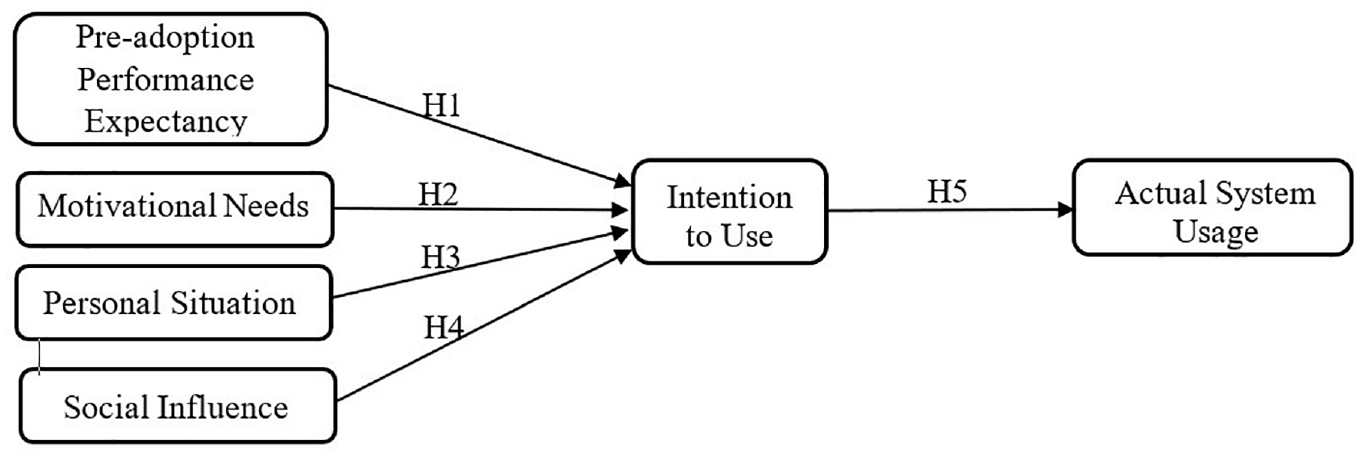
Pre-adoption stage.

Post-adoption stage.
Hypotheses Development
Pre-Adoption Stage
Pre-adoption Performance Expectancy and Intention to Use
Performance expectancy is “the degree to which an individual believes that using the system will assist him or her attain gains in job performance” (Venkatesh et al., 2003, p. 450). Several research findings have suggested that performance expectancy significantly correlates with the citizens’ intention to adopt and use electronic technologies (Khan et al., 2017). In addition, performance expectancy was the strongest predictor of individuals’ technology adoption (Mohammed et al., 2018). Cviko et al. (2013) stated, “Performance expectancy has been broadly used to comprehend the behavioral intention of teachers to adopt ICT.” Based on the above, it is determined if tourists’ initial performance expectancy for context-aware applications enhances their task achievement and intentions to use such applications. Therefore, the following proposal is made;
Motivational Needs and Intention to Use
Motivational Needs describe users’ motivation to use services that contain their instant desires and comfort and yield greater motivation that improves such feelings. Lin noted, “Motivation has been identified as a key determinant of general behavior….information technology acceptance behavior…and work-related behavior…motivation influences individual intentions regarding an activity as well as their actual behaviors” (Lin, 2007). A significant positive effect was found between motivation and the decision to take a performance action in a ubiquitous decision-making environment (K. C. Lee & Chung, 2013; Tabaeeian & Mohammad Shafiee, 2023). For personal locator beacons, if tourists are convinced that while accessing some specific animals within the forest, and there is danger, park managers would get signals from the system, they may use the PLBs. However, if there are no benefits from using the PLBs, they may not want to use them. Therefore, it is proposed:
Personal Situation and Intention to Use
The personal situation in this study denotes the specific environment where technology is being applied. In studying mobile information user acceptance, it was established that it is critical to fit the context of use and the information technology service provided (Van Der Heijden et al., 2005). The tendency is high for a user to use mobile technology when such services are conveniently located in the appropriate and suitable environment, leading to the users’ positive evaluation (Xu & Yuan, 2009). They further detailed empirical evidence that weather, service location, timing, mobility, and urgency influence users’ intention to use taxi services. From the above, the weather at a time, the location of the tourists from some service, and familiarity of the tourists around the park can influence the tourists’ intention to use the PLBs. We, therefore, propose;
Social Influence and Intention to Use
From the perspective of electronic service, social influence describes the degree to which others around them can influence individuals to use IT services. It comprises the direct and indirect influence of individuals’ feelings, thoughts, and attitudes by friends, parents, opinion leaders, social groups, reference groups, media, and peers to change their intentions to use electronic services (Rakibul Hafiz Khan Rakib, 2019).
Enormous studies have inveterate the dynamic function of social influence on users’ attitudes and intentions toward technology adoption (Alalwan et al., 2018; Patil et al., 2020). However, more research needs to be conducted on the ramifications of social influence on intention to use context-aware applications such as PLBs. Hoque and Sorwar (2017) pointed out the worthwhile effect of social influence on adopting technologies. In order to fulfill this gap in the literature, the following hypothesis is thus proposed:
Intention to Use and Actual Usage
The construct “behavioral intention to use” explains an independent perspective of users toward the acceptance and use of electronic technologies (Kalinic & Marinkovic, 2016). Behavioral intention to ply affects the utilization of new technologies (Tabaeeian & Mohammad Shafiee, 2023; Venkatesh et al., 2003). Prior studies have proven that the “behavioral intention to utilize” positively impacts usage and recommendation (Verkijika, 2020). Therefore, this study reinforced the existing knowledge that tourists’ behavioral intention to use context-aware applications affects their actual usage. Hence, it is hypothesized that:
Post-adoption Stage
User Enjoyment Experience and User Satisfaction
Enjoyment experience describes the experience associated with the pleasure and fun users gain using information technology. The study indicated that travelers using mobile electronic services achieve their expectation confirmation through their enjoyment experience with the journey undertaken, and enjoyment experience also leads to users’ satisfaction (Boulding et al., 1993; Sedera et al., 2017).
Through context-aware applications, tourists would not only gain complete information about the parks, but they could also gain the pleasure of using diverse supplementary services such as being found in times of danger. Hence, tourists who experience immediate pleasure and joy from using PLBs are more likely to confirm their satisfaction with the use of PLBs more extensively than others. The following is therefore proposed;
User Information Recommendation and Confirmation/Satisfaction
Information recommendation in this study context refers to previous users relaying relevant information on the use of information systems to new users. Mouakket and Sun (2019) noted that information is highly relevant to innovation technology system users. Previous users recommending information on the use of information systems to new users leads to the confirmation of their expectations and satisfaction, which, in turn, influences their decision to continue using such technologies (Tan, 2013). Informativeness is essential in technology use and fulfills tourists’ satisfaction and confirmation expectations by enabling tourists to look for relevant information for decision-making. Hence, the following is juxtaposed:
User Experience of Service Quality and Satisfaction
The service quality of a system describes a measure of the efficiency and effectiveness of an online support information system in responding to online queries (D. Liu et al., 2016); it is categorized into three: responsiveness, reliability, and personalization. Several studies have established the positive impact of service quality on users’ intention to use electronic services (Mensah & Piankova, 2018; Singh et al., 2020; Yavari et al., 2018). Satisfaction with service quality is much better than expected when quality expectation exceeds quality perception (Tabaeeian et al., 2023; Tzeng et al., 2021). In a study by Deng et al. (2010), the quality of electronic services and mobile value-added applications positively impacted users’ satisfaction.
Thus, in this study, the quality of the PLB can influence tourists’ satisfaction in using it. Hence, it is hypothesized that:
User Expectation Confirmation and User Satisfaction
Confirmation was described as a comparison between experience with an earlier expectation of users (Sedera et al., 2017). Several discussions and contemporary works have proven that electronic services performance is assessed based on users’ previous expectations and actual experiences (Shafiee & Bazargan, 2018; Susanto et al., 2016; Tam et al., 2020). In the post-adoption stage, satisfaction is an outcome between earlier expectation confirmation and actual consumption experience (Bhattacherjee, 2001). If tourists’ expectation of the PLBs is confirmed, it will undoubtedly lead to satisfaction with the services of PLBs. Ambalov (2018) confirmed a general connection between confirmation and satisfaction. Therefore, the following proposal is made:
User Satisfaction and Continued Usage
Whereas satisfaction refers to the level of pleasure derived by users from a particular information system, continuous intentions are the actions that generate deep interest in the users and motivate them to keep using such a service. It is confirmed that users who are fulfilled and satisfied with an information system have a higher chance to continue using it (Mishra et al., 2023; Mohammad Shafiee et al., 2018). Once tourists use the PLBs and have a pleasant experience, their motivation to use PLBs is enhanced, resulting in sustained usage. The effect of user satisfaction on tourists’ propensity to continue using the PLBs is a subject for investigation. The following hypothesis is proposed:
Users’ Continued Usage and Recommendation
Research has confirmed that users’ satisfaction and continued use of electronic services enhances their further recommendation of such a service to other users (B. Kim, 2012). In using information systems, users’ continued use is a critical requirement in evaluating the efficiency and effectiveness of electronic systems (Eom et al., 2006). There is a high probability for users to offer recommendations to others if they are satisfied and continue to use a particular service (De Pelsmacker et al., 2019). It presupposes that if tourists are satisfied and continue using context-aware services, they would likely recommend them to other tourists. Hence, the following hypothesis is proposed:
Study Setting
In Ghana, various national parks are conserved and managed to benefit wildlife and humans. National parks are protected land areas managed and conserved to benefit wildlife and humans. Some National Parks include Mole National Park, Kakum National Park, Kyabobo National Park, Digya National Park, Bui National Park, Bia National Park, and Nini-Suhien National Park. National Parks are valuable resources that aid in conserving and protecting biodiversity and ecological heritage. They have become increasingly important, especially as the government recognizes the need for biodiversity conservation to support agriculture and tourism. The Parks in Ghana have significant potential for supporting both the economy and biodiversity conservation. Parks and wildlife conservation could aid tourism development and create employment opportunities, particularly in rural areas (Lundmark et al., 2010).
Mole National Park, located near Damongo, the capital of the Savannah region, was chosen for the study due to the region’s numerous popular tourist attractions. Beyond the park being Ghana’s premier largest national park, other tourist attractions, including the Ancient Mosque and the Mystic Stone, both at Larabanga, are very close to the Mole Park. The Ghana Wildlife Division (GWD) manages national parks in Ghana.
The Mole National Park was established in 1930 as a game reserve to protect the antelopes. The park was gazetted and upgraded as a National Park under Wildlife Reserves Regulation (LI 710) in 1971, and it encompasses an area of 4,577 km2, making it the largest protected area in Ghana (Ghana News Agency (GNA), 2021; IUCN/PACO, 2010). The park is classified as a Category II Protected Area according to the IUCN system and is primarily managed to preserve the ecosystem and provide recreational activities (Acquah et al., 2016; IUCN/PACO, 2010). Its management goals are to safeguard its ecological integrity by preventing negative boundary alterations, restoring and preserving park features and ecological processes, preventing inappropriate development or exploitation, offering research opportunities to enhance knowledge of Mole and its ecosystem, and keeping Mole a top recreational and tourist destination with private sector involvement, among other objectives (Acquah et al., 2016). Although tourists visit the park for wildlife, they are open to more than just wildlife. However, they are also involved in nature-based activities inside and outside the park. These include community tours, canoe safaris, cultural entertainment, visits to an ancient mosque, and trips to a mystic stone in neighboring communities (Acquah et al., 2016).
Materials and Methods
The study employed a quantitative approach with cross-sectional data collected from tourists visiting the Mole National Park based on their experiences with PLBs. The PLBs have an inbuilt GPS receiver, which determines the beacon’s precise location and transmits this information to an emergency system. The beacons facilitate a quick and accurate response in an emergency so that the tourist can easily be located and saved (S. R. Martin & Blackwell, 2016).
The analysis was done with Smart-PLS Structural Equation Modeling (PLS-SEM) using Smart PLS 3.0 software. The present study employs primary data because it delivers the most precise first-hand evidence on the situation at the park.
The survey was conducted in two phases for both pre-adoption and post-adoption behaviors. The Park officials reported a daily average visit of 42 tourist in 2022, translating to 294 per week which represented our study population. The questionnaires were administered for 5 days including weekends in January 2023. A total of 210 tourists were randomly selected and oriented on the functions and uses of the PLBs. A total of 147 tourists completed the first survey questionnaires on pre-adoption of PLBs, with a response rate of 70%. After using the PLBs, they were made to complete the post-adoption survey questionnaire based on their usage experiences with the PLBs. Table 1 presents the demographic characteristics of the respondents in terms of gender, age, tour type and academic qualifications.
Sample Characteristics (n = 210).

The first part of the questionnaire covered the demographic characteristics of the respondents, and the second part consisted of 13 factors with 38 multiple questions adapted to the context and measured in a two-stage model. All the constructs for both pre-adoption and post-adoption were adapted from seasoned researchers and modified for this study. Under the pre-adoption stage, three items each from pre-adoption performance expectancy, motivational needs, user personal situation, user social influence, intentions to use, and actual system use were adapted from (Dwivedi et al., 2019; D. Liu et al., 2016; Singh et al., 2020; Taylor & Todd, 1995). Under the post-adoption stage, all three items from the constructs; user enjoyment experience, user information recommendation, user experience of service quality, user expectation confirmation, user satisfaction, user continued usage, and user recommendation were adapted from (Bougie et al., 2003; Gupta et al., 2020; Y. Liu & Li, 2011).
In this study, two items were below 0.7 out of 38 and were therefore deleted. The percentage of deletion was 5.3%. Each item was tested on a five-point Likert scale because it strengthened the scale’s validity compared to a less than four-point scale. It further provides satisfactory discriminable choices to the respondent (Asún et al., 2016). Statistical analysis was performed with Partial Least Squares Structural Equation Modeling (PLS-SEM) using Smart PLS 3.0 software (Ringle et al., 2015). Smart PLS 3.0 software provides a user-friendly and comprehensive platform for performing PLS-SEM analysis and reporting the results. It is widely used in research fields such as marketing, management, and social science.
Results
Measurement Model Evaluation
An evaluation of the theoretical measurement model comprises an examination of indicator reliability-loadings, internal consistency reliability-composite reliability, and convergent validity-average variance extracted, this done by following the standard decision-making procedures (J. F. Hair et al., 2019). Estimation of the measurement model assists in comparing the theories used for the investigation as well as the actual data obtained for the study (J. F. Hair et al., 2016). Indicator reliability is defined as “a variable or set of variables is consistent regarding what it intends to measure” (Urbach Frederik, 2010, p.18). Reflective loadings of 0.708 and above are recommended (L. Liu et al., 2020; Urbach Frederik, 2010). Table 2 shows the findings of the reflective measurement model. All loadings except USI02 and USI03 (deleted) under the pre-adoption were above the required threshold of 0.708. This implies that the indicators met the minimum threshold requirement and were a good measurement of the variables. An evaluation of the measurement and structural model was done when the results were then extracted and Figure 1 also shows the indicator loadings after USI02 and USI03 were deleted and the model re-run. Furthermore, Average Variance Extracted (AVE) a criterion for measuring convergent validity requires values of 0.50 and above (Fornell & Larcker, 1981; J. F. Hair et al., 2019). Accordingly, the empirically established latent variables are considered reliable and valid, as shown in Table 2.
Constructs Reliability and Validity.

Discriminant validity, defined as the “extent to which a construct is empirically distinct from other constructs in the structural model” was also assessed using Fornell and Larcker (1981) criteria. They argued that discriminant validity is achieved if a construct shares more variance with its assigned items than with any other construct. Table 3 shows that discriminant validity has been achieved as the various constructs share more variance with their required items than other constructs, denoted by the bold numbers.
Discriminant Validity.
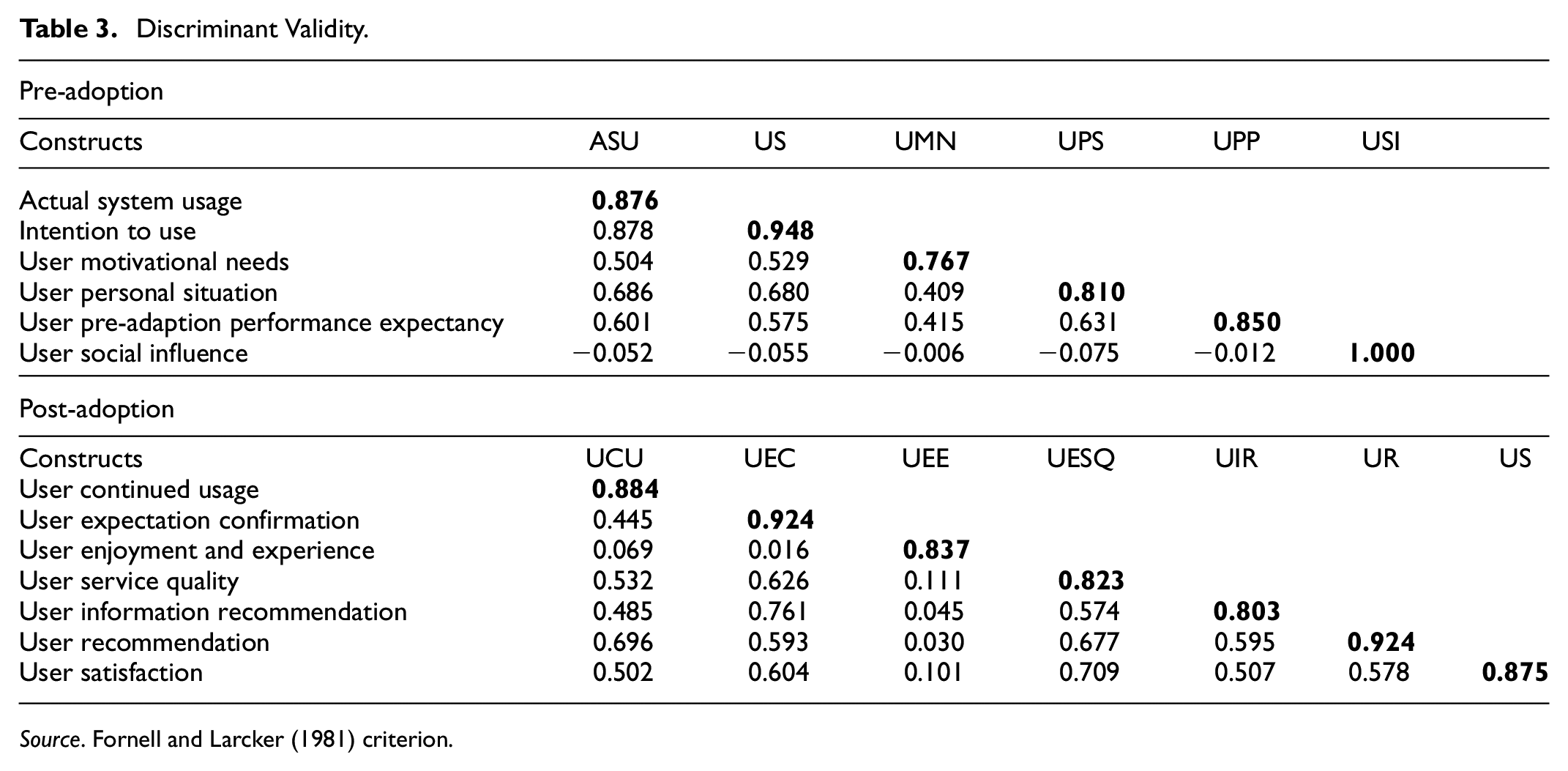
Source. Fornell and Larcker (1981) criterion.
Moreover, discriminant validity was again assessed using the cross-loadings criterion (Chin, 1998; Rönkkö & Cho, 2022). Discriminant validity is achieved where item loadings are higher for their assigned constructs than for any other construct. From Table 4, it can be inferred that discriminant validity has been achieved, as item loadings are higher for their assigned constructs than for any other construct, denoted by the bold values.
Discriminant Validity; Cross-Loading.

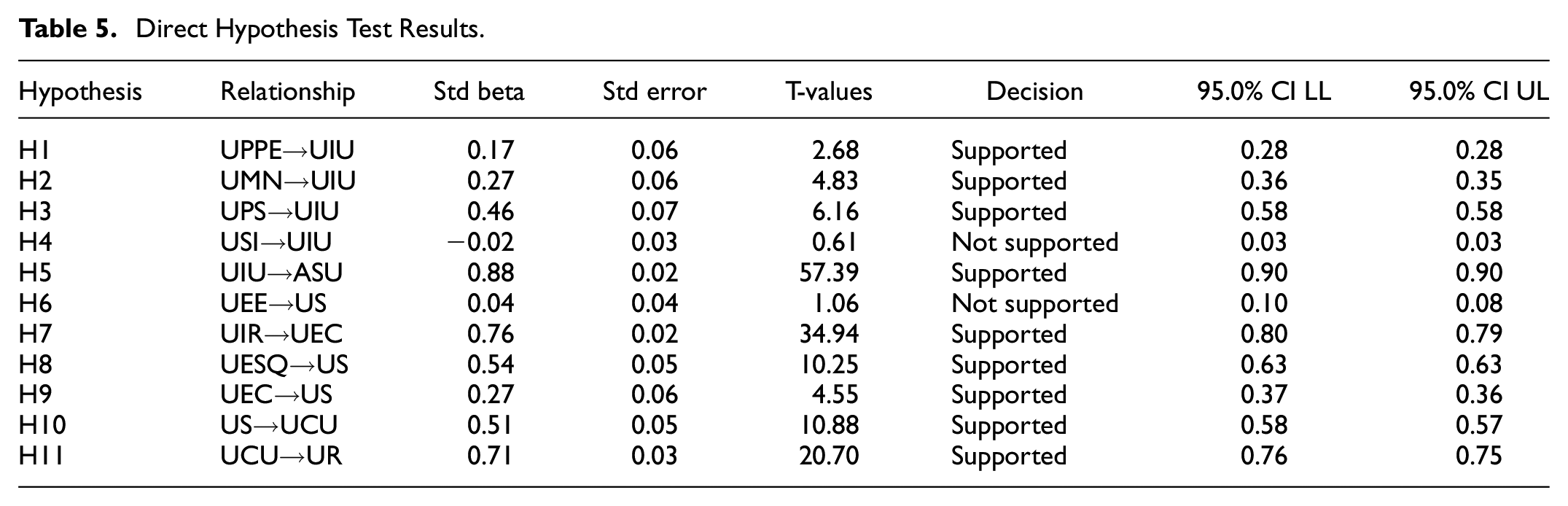
An assessment of path coefficient significance was carried out on the structural model using bootstrapping algorithm in SmartPLS. Bootstrapping is defined as a “non-parametric resampling procedure that assesses the variability of a statistic by examining the variability of the sample data rather than using parametric assumptions to assess the precision of the estimates” (Streukens & Leroi-Werelds, 2016, p. 2). Through bootstrapping method, values for t-statistics are produced for analyzing the direct and indirect effects (J.F. Hair et al., 2016). T-values of 1.65 (10% two-tailed) and above indicate significance for relationships (J. F. Hair et al., 2011). From Table 5, nine out of the 11 hypotheses, were significantly supported as they met the minimum T-value threshold of 1.65 and consistent with Rivai et al. (2019), and two hypotheses were not supported. The hypotheses supported in the path values are also shown with their corresponding significance in Figures 3 and 4. The R square determination coefficient (R2), a widely used criterion, measures the model’s explanatory power. R2 values presented in Figure 3 shows that user pre-adoption performance expectancy, user motivational needs, user personal situation, and user social influence together explain about 55.6% of the variations in user intention to use. User intention to use explains 77.2% of the variations in actual system usage. Figure 4 shows that user information recommendation explains about 57.9% of the variants in user expectation confirmation and user enjoyment experience, and the user experience of system quality explains about 63.5% of the variations in user expectation confirmation. It explains about 55.1% of the variation in user satisfaction. User satisfaction accounts for 25.3% of the variation in user continued usage, and user continuous usage accounts for 49.4% of user recommendations.
Direct Hypothesis Test Results.
Model Fit (SRMR).


Outer loadings pre-adoption.
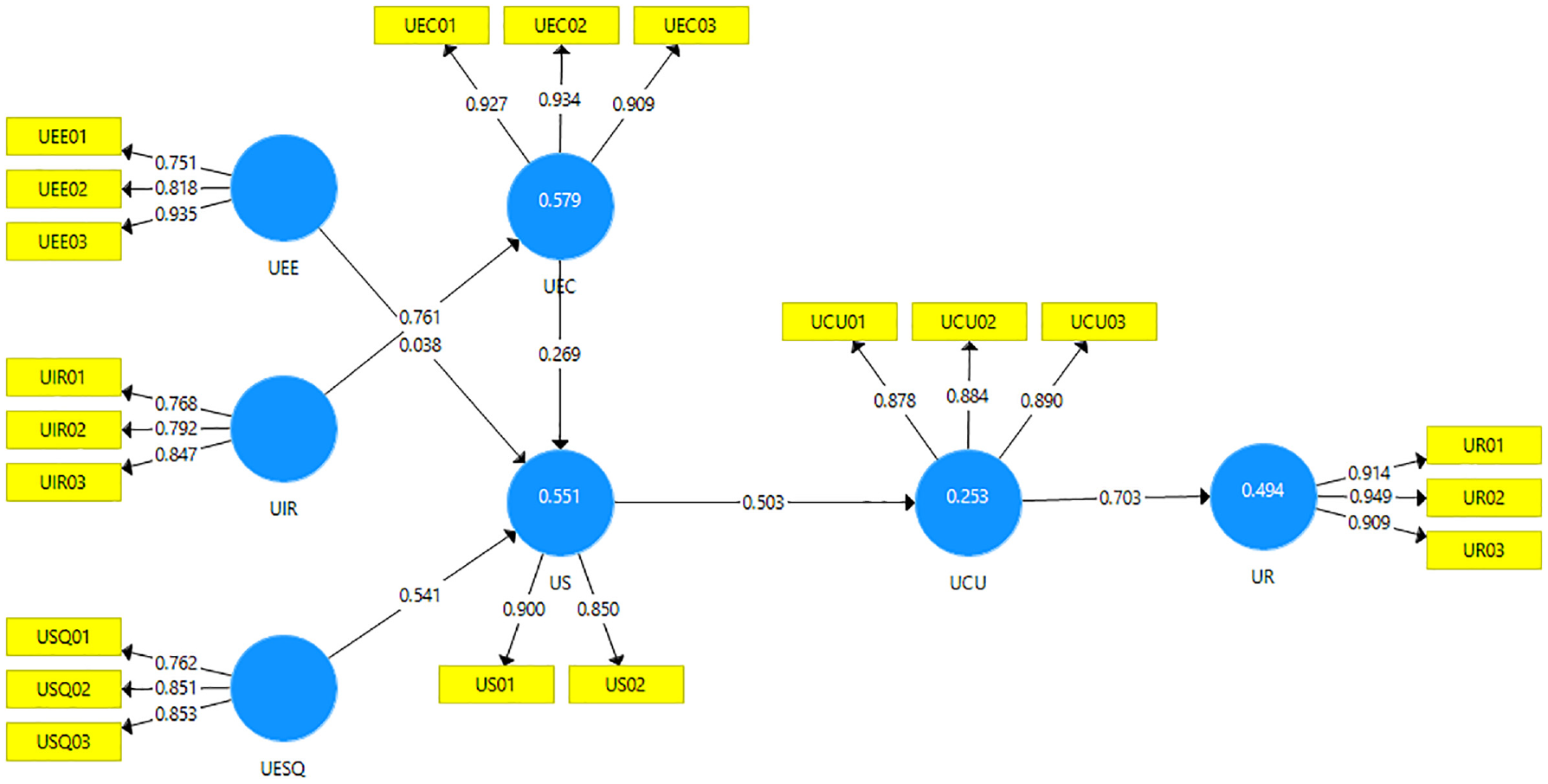
Outer loadings post-adoption.
Model Fit Analysis
The Standardized Root-Mean-Square Residual (SRMR) widely used for confirming the overall model fitness, was found to be 0.07 (the composite model) and 0.08 (the standard factor model), both were under the threshold of 0.08 (Bailey et al., 2017; J. F. Hair et al., 2016). This is shown in Figure 6.
Discussion
This study proposes an integrated model that explains the factors influencing tourists’ pre-adoption, post-adoption, and continued use of context-aware applications. Applying the UMEGA and ECM as the baseline theories, this study presents pertinent pre-adoption and post-adoption variables (Pre-adoption: motivational needs, pre-adoption performance expectancy, personal situation, and social influence. Post-adoption: user enjoyment experience, user information recommendation, user experience of service quality, expectation confirmation, user satisfaction, and recommendation). These factors are yet to be critically examined by other researchers in context-aware applications and national parks. In order to authenticate the relationships amongst the factors, a structural equations analysis was conducted using partial least squares (PLS-SEM) modeling and Smart PLS software 3. The result of the study indicated that out of the 11 (11) hypotheses proposed, except H4-social influence and H6-user enjoyment experience, all were supported, as indicated in the path values with their corresponding significance.
For the pre-adoption stage, the findings indicate that among the factors influencing tourists’ intention to use context-aware applications, personal situations, motivational needs, and pre-adoption performance expectancy significantly influenced tourists’ intention to use, which eventually determines their actual use of context-aware applications. Social influence was not supported. Personal situation has the most significant influence; this finding is supported by Jung et al. (2009), which means that the specific environment in the park would influence the tourists to use the PLB technology, which can positively influence their intention and then contribute to actual usage. Also, the motivational need was a crucial factor that may influence tourists’ use of context-aware applications, supported by K. C. Lee and Chung (2013). It reveals that feeling safe while visiting dangerous locations in the park for sightseeing and relaxation motivates tourists to use context-aware applications. In such circumstances, tourists would be highly inclined to use the applications in the park. It also presumes that tourists’ motivation to use the applications is associated with context. It is interesting to note that social influence was not theoretically supported in the study, which means that the views of some middle class in society do not necessarily influence the ordinary people’s use of new electronic technologies. This finding is supported by Lavuri et al. (2023).
At the post-adoption stage, the factors influencing the post-adoption experience of tourists’ use of context-aware applications, including user information recommendation, user experience with service quality, user expectation confirmation, and user satisfaction, were significantly supported. User enjoyment experience was not supported. User information recommendation has the highest impact on context-aware applications. This finding is supported by Mouakket and Sun (2019) and Tan (2013). It implies that once information on using context-aware applications is recommended to tourists and they confirm their expectations and become satisfied with it, they will continue using it. Also, users’ experience in service quality of context-aware applications was significantly influenced by satisfaction with using the applications, corroborated by prior findings by Singh et al. (2020). If PLBs can ensure responsive, personalized, and reliable service to the needs of tourists, then tourists are likely to feel satisfied with their experience (F. Martin & Bolliger, 2018; Saeed & Zyngier, 2012). The influence of user enjoyment experience on user satisfaction was not supported. This result was contrary to the findings of Boulding et al. (1993) and Sedera et al. (2017) that enjoyment experience also leads to satisfaction of users. The contrary outcome of the result was quite surprising because an enormous amount of literature supports it. However, this indicates that not all tourists who experienced enjoyment in the use of the PLBs would be satisfied.
Furthermore, the expectation confirmation of tourists using context-aware applications was shown to be significantly influenced by user satisfaction. Enormous studies have confirmed this with ECM (M. C. Lee, 2010). There is a general connection between confirmation and satisfaction (Ambalov, 2018). It implies that tourists’ tactual experience with context-aware applications would confirm their satisfaction. Satisfaction has tremendously impacted continuous usage and subsequent recommendation of electronic services. This finding adds to the works of S. S. Kim and Son (2009) and Mou et al. (2021), who discovered that word-of-mouth about online services is significantly influenced by satisfaction. Hence, tourists’ satisfaction with context-aware applications will increase their propensity to sustain their continued use. Alternatively, their dissatisfaction will cause them to discontinue using these applications. The influence of continued usage on user recommendation was highly significant. Though this was slightly similar to the findings of B. Kim (2012) and De Pelsmacker et al. (2019), there was less literature on continued usage and user recommendation. It confirmed that tourists who continued to use the applications would recommend the same to new tourists visiting national parks.
Based on the discussions above, national park managers must focus on improving the tourists’ initial adoption factors, such as personal situations, motivational needs, and pre-adoption expectations. This will ultimately lead to better decisions by post-adopters to continue using context-aware applications in the long term. Using the personal situation of tourists in the park is also an opportunity to market context-aware applications to them. The Ghana Tourism Authority has launched two initiatives—“Beyond the Return” and “December in GH ” Park operators can benefit from this initiative by promoting context-aware applications, mainly to foreigners, singles, and first-time visitors.
Policy and Theoretical Implications
The findings of this study have some implications for policy and theorical development in e-governance. First, policymakers in tourism should prioritize improving on tourists’ performance expectancy, motivational needs, personal situation, information recommendation, service quality, confirmation expectation, and satisfaction as these plays a crucial role in influencing tourists’ decisions to adopt, continue using, and recommending these applications, underscoring the importance of quality service provision.
Policies and strategies for deploying context-aware applications should consider the cultural sensitivities of tourist and contextual factors unique to African tourism destinations. Tailoring these technologies to align with local practices and preferences can enhance their acceptance and effectiveness among diverse tourist populations.
The Ghana Tourism Authority should encourage industry players to conduct research into initiatives that play a role in the use of context-aware applications at National Parks such as “Beyond the Return” and “December in GH” initiatives. Tourism policy implementers should ensure that donations from foreign agencies and funds from Government are aligned to effective development and promotion of context-aware application adoption.
The Authority should invest into additional innovative technologies, such as satellite network like Starlink for the network layer satellite phones, to continually improve and adapt these applications to evolving tourist needs and industry trends.
To improve on the overall experience of tourists, park managers should consider providing secondary recreational facilities such as table tennis, volleyball court, and a gym center for interested tourists.
This study offered theoretical contribution to the research on electronic government service adoption. It presented an integrated model of Unified Electronic Government Adoption and Expectation Confirmation Model for understanding factors influencing tourists’ pre-adoption and post-adoption of context-aware applications in tourism. It strengthened the theoretical relationships among the construct’s intentions to use, actual usage, confirmation, satisfaction, continuance intentions, and recommendation.
These policies, when implemented by tourism authorities and policymakers can contribute to the effective deployment of context-aware applications, ultimately fostering safer and more secure tourism experiences in African destinations.
Conclusion
The study aimed to investigate the factors that affect tourists’ use of context-aware applications at the pre-adoption and post-adoption stages using Mole National Park in Ghana. It was accomplished with data collected from tourists on their experiences and integrating UMEGA and UCM.
The study suggests that the success of context-aware applications lies in park managers improving tourists’ personal situations, motivational needs, and pre-adoption performance. It would influence their intentions to continue to use these applications. Tourists’ information recommendations, service quality, expectation confirmation, and satisfaction are critical for decision-making. Social influence does not necessarily impact the adoption of context-aware applications. It implies that park managers must ensure that these critical factors are fulfilled for tourists to continue recommending context-aware applications. This research highlights that post-adoption beliefs often differ from initial intentions and are greatly influenced by actual use experience.
Although the study has significantly contributed to tourism, theory, and information systems, one limitation of the study is the constrained generalizability of the findings as a result of the unique environmental conditions within the National Park such as weather patterns, access roads, and safari vehicles which may not accurately reflect the situation in other tourist destinations. Future studies may consider investigating how context-aware application use for tours varies in different environments.
In order to ensure accuracy in context-aware applications, integration of AI-powered cameras with edge computing technology is recommended, along with the utilization of a satellite network like Starlink for the network layer.
Footnotes
Declaration of Conflicting Interests
The author(s) declared no potential conflicts of interest with respect to the research, authorship, and/or publication of this article.
Funding
The author(s) received no financial support for the research, authorship, and/or publication of this article.
Ethics Statement
Not applicable in our study

Data Availability Statement
Data sharing not applicable to this article as no datasets were generated or analyzed during the current study.