



Abstract
This paper considers the notions of common sense and interobjectivity to articulate an understanding of how different cultural realities give rise to different construals of scientific phenomena across distinct cultures. Our main focus in this paper is on the social sciences. We propose a quadrant of different cultural–scientific stances from which the study of social phenomena is possible, based on the emic–etic dimension pertaining to the study of culture from contrasting perspectives. Although the emic–etic distinction is normally applied in fields within the science of culture, it is proposed here that the distinction is in some ways germane to scientific practice in general, making it amenable for use in a culture of science (CoS) programme. The four perspectives that emerge from the quadrant are illustrated using exemplars. Different aspects of CoS—that is, scientific practice, scientific conventions and representations of science—are then discussed in further detail, including in two tables illustrating points of convergence and divergence between the East and West when it comes to different aspects of CoS.
Keywords
Introduction
In the third volume of an influential book series on science and Chinese civilization, the eminent biochemist and sinologist Joseph Needham states: It is vital today that the world should recognise that 17th-century Europe did not give rise to essentially ‘European’ or ‘Western’ science, but to universally valid world science, that is to say, ‘modern’ science as opposed to the ancient or medieval sciences. (Needham and Ling, 1959: 448)
Putting aside questions concerning historiography and Eurocentrism in the history of science (Fan, 2007, 2012), Needham's view is widely shared and addresses fundamental questions concerning the nature of the scientific method and its universality, positioning him strongly on the matter. These issues are dealt with in different disciplines, including the philosophy of science, anthropology and discursive psychology. Notable problems concern whether there is such a thing as a monolithic scientific method, and changes in method throughout history (Kuhn, 1971). At a more local level, research has focused on the differing discourse and norms employed by scientists in different disciplines (Potter and Wetherell, 1987), and science as it is practised in actuality (Latour, 1987; Latour and Woolgar, 1979). What unifies these fields of inquiry is precisely the possibility of there being a phenomenon or process partly external to science, or at least not intrinsically constitutive of scientific practice, that influences the way science is conducted.
One such phenomenon is culture. Partly as a consequence of Needham's sinological work, various scholarly debates address a myriad of science-related topics in connection with China and the Western world. These topics include taxonomical issues concerning whether there is such a thing as a specifically ‘Chinese science’ (Elman, 2003); differences between ancient Greek and Chinese science (Lloyd, 1990; Raina, 1999); the reason scientific and industrial revolutions took place in Europe and not in China (Lin, 1995; Lloyd, 1990); and differences in the representations and use of science in China and the US based on differing historical contexts (Buck, 1975, 1980). While this historical corpus sheds light on the diachronic study of science–society relations and general differences in scientific endeavours, an omission in scholarship concerns the synchronic study of contemporary differences in scientific endeavours across cultures. Viewing culture as both ‘shared activity … and shared meaning’ (Greenfield et al., 2003: 462), it is thus the main thesis of this paper that a systematic understanding of cultures of science (CoS)—that is, of the cultural differences in scientific practice, scientific conventions and representations of science—is needed, and that a social-psychological understanding of interobjectivity (Sammut et al., 2010) and construal processes (Ross and Nisbett, 2011) can pave the way. By scientific practice, we refer to scientific methods and conceptual tools; by scientific conventions, we refer to the norms and customs surrounding and informing such practices; and representations of science constitute social representations and other forms of collective sense-making, as can be seen below.
In understanding whether the ‘world science’ expounded by Needham is impervious to cultural differences, the notion of CoS can be fruitfully distinguished from science–society relations, and from the science of culture (SoC). Science–society relations refer to the influence of science on society and vice versa, and incorporate issues such as the public understanding of science and value-based science governance (Gaskell et al., 2005). Contrastingly, SoC refers to the scientific study of different cultures, as seen in fields such as cross-cultural psychology and in various indigenous psychologies (Greenfield, 2000). There is an intimate relationship between these three notions. Furthermore, if the manifestation of psychological and anthropological phenomena is contingent on cultural context—as evidenced by SoC—then the methods of carrying out scientific inquiry are potentially culturally variable, making science amenable, rather than impermeable, to culture. A similar point is made by Elkana (1981: 9), who argues that ‘if science is a cultural system like all others, a field of study of comparative science could emerge.’ Nevertheless, there is a lack of systematicity in the study of CoS. That science is contextually dependent does not imply that it is an exclusively local phenomenon (Chiang, 2015), or that there is no scientific method that can be legitimated and justified (Nola and Sankey, 2007). Rather, it means that some aspects of science are culturally informed. That is, science is permeable to specific interobjective realities (Sammut et al., 2010) and commonsensical notions (Geertz, 1975) by virtue of its cultural situatedness. Indeed, viewing both science and common sense as interrelating cultural systems (Geertz, 1975) can further our understanding of CoS.
Accordingly, this paper will proceed by considering the notions of common sense and interobjectivity. In turn, these allow an appreciation of how different cultural realities, along with self-serving social-psychological processes—such as naive realism (Ross and Ward, 1996)—can potentially result in different construals (Asch, 1940) of scientific phenomena across cultures. Against this scholarly backdrop, a quadrant will be presented concerning the different cultural–scientific stances from which the study of social phenomena is possible. The quadrant is based on the emic–etic distinction (Pike, 1967), which relates to the study of a particular culture from contrasting perspectives; that is, from within (emic) or outside (etic) a particular culture (Berry, 1989). As such, the emic–etic distinction is not an exclusive way of approaching CoS. However, if one addresses CoS via the emic–etic distinction, then the distinction tends to be relevant vis-à-vis scientific practices, scientific conventions and the representations of science that arise around them. Although the emic–etic distinction is normally applied in fields within SoC, it is proposed here that the distinction is in some ways germane to scientific practice in general, making it amenable for use in a CoS programme. The four perspectives that emerge from the quadrant are illustrated using exemplars. Different aspects of CoS—that is, scientific practice, scientific conventions and representations of science—are then discussed in further detail. In concluding, two tables are presented illustrating points of convergence and divergence between the East and West when it comes to different aspects of CoS.
Interobjectivity across different cultural systems
The notion of common sense can be approached by considering a familiar dichotomy in the social sciences: that between lay and scientific thought. In this regard, two prominent conceptualizations feature in the literature: the difference between consensual and reified universes (Moscovici, 2000) and a corresponding difference between narrative and paradigmatic modes of thought (Bruner, 1986). The consensual universe is imbued with human meaning and is inclusive of popular opinion, without being exclusive vis-à-vis who can make claims to competence in particular fields. It is institutionalized in associations and places of leisure and constitutes a taken-for-granted and shared basis of intelligibility where there are ‘questions that must not be asked, topics that can or cannot be ignored’ (Moscovici, 2000: 34). In other words, the consensual universe is chiefly concerned with common sense (Purkhardt, 1993). Contrastingly, the reified universe is one in which claims to competence are acquired, precision and unambiguity are highly valued, and science is deemed as the method suitable for achieving such goals (Moscovici, 2000). Correspondingly, narrative thought is that which is concerned with stories, and their coherence and believability, while paradigmatic thought concerns logic, formalization and mathematization in the service of explanation (Bruner, 1986).
What these conceptualizations share is a distinction between common sense, exemplified by narrative thought operating within the consensual sphere, and scientific sense, exemplified by paradigmatic thought within the reified world. The sharpness of this distinction has been questioned due to its neglect of the mutual influence that both universes inflict on each other (Purkhardt, 1993). However, even if mutual influence is granted, the question of whether, and how, science is the antipode of common sense remains a pertinent one, because there are different degrees of systematicity and organization across the two systems of thought (Elkana, 1981). In answering this question, viewing both science and common sense as cultural systems can be helpful. Geertz (1975) argues that common sense constitutes an organized cultural system, as opposed to fleeting and disparate pieces of local knowledge. This formulation bestows a totalizing force upon common sense, by virtue of its taken-for-grantedness. Accordingly, ‘it is an inherent characteristic of common sense thought precisely to deny this [taken-for-grantedness and organization] and to affirm that its tenets are immediate deliverances of experience, not deliberated reflections upon it’ (Geertz, 1975).
That science is historically constructed and has the potential for being ‘questioned, disputed, affirmed, developed, formalized, contemplated, even taught’ (Geertz, 1975) equally makes science a cultural system (Elkana, 1981). Yet, granting the permeability and mutual influence exerted across cultural systems, what distinguishes scientific endeavour from common-sense thought is that the former does not employ attributions of self-evidence to phenomena. General qualities of common sense include its ‘naturalness’ (its being matter of fact), ‘practicalness’, ‘thinness’ (literality and simplicity), ‘immethodicalness’ and ‘accessibleness’ by most members of a community (Geertz, 1975). In other words, common sense aims at making the unfamiliar familiar. Contrastingly, science makes the familiar unfamiliar through the constant problematization of phenomena and attempts at explanation (Farr, 1993; Moscovici, 2000).
As systems, common sense and science thus both unfold against an interobjective reality of shared meanings that comes about as a consequence of the objectification of social objects in particular ways as opposed to others (Moghaddam, 2003). The notion of interobjectivity was initially formulated to refer to social interactions that are mediated through particular objects (Latour, 1996). Later work employed the concept to refer to ‘overarching and taken-for-granted objectifications’ (Moghaddam, 2003; Sammut et al., 2013a, 2013b) that constitute a bedding of intelligibility. Interobjectivity thus refers to a culturally constituted reality that endows members of a community with common starting points, thus enabling knowledge production/construction on the basis of ‘shared standards of intelligibility’ (Jenco, 2015: 9). In particular, it allows for interactions with reference to a reality that is non-consciously intelligible and need not be negotiated with every encounter between social agents (Sammut et al., 2010). Interobjective planes can be shared within groups and, to differing extents, between groups (Moghaddam, 2003). Consequently, the notion incorporates a consideration of ‘boundary objects’ or ‘intersectional objects’, which simultaneously reside in different cultural groups (Sammut et al., 2010). By extension, intersectional objects can partake in different cultural systems, such as common sense and science. Such intersectional objects partake in knowledge bases that are in some sense shared across, and in some sense separate from, the social realities of different cultural groups or systems.
Within the framework of interobjectivity, science can be conceptualized as a system that is more open than common sense, in the sense that the conditions that enable scientific practice must be constantly negotiated from within for the enterprise to reproduce itself meaningfully. Research groups have to ‘re-negotiate’ knowledge partly in the absence of a clearly shared reality (as when dealing with novel data or models), while still aspiring to a consensus with the scientific community in terms of the interobjective reality shared by that same community. This relates to what Horton (1967) refers to as second-order thought; that is, thought that reflexively takes note of the same rules it deploys in the service of explanation. Indeed, second-order thought, formalization, the prioritization of precision and an aspiration to self-correction and value-neutrality (to different extents, depending on the science in question) all constitute core scientific principles (see Cheng, 1977; Ip, 1985, on problems with the notion of value-neutrality). Other characteristics of science include honesty (Buck, 1980) and the pursuit of abstraction and mathematization (Barnes, 2009) where applicable. All these characteristics distinguish science, as a system, from common sense. Contrarily, it is arguably metaphorical and analogical thought (Harré and Secord, 1972; Knorr-Cetina, 1981) that loosely link science to common sense.
Intersectional objects abound on the boundaries of common sense and science. One example is the personality construct, or the concept of self, both of which have been studied scientifically in both Asian and Western cultures (Marsella et al., 1985), but which also feature in everyday commonsensical explanations of behaviour. Here, two kinds of intersections are worth considering: firstly, each scientific culture intersects with its own corresponding common-sense system during the formulation of an object of study; secondly, different scientific cultures can intersect with each other when objectifying a particular concept. Outcomes of the second kind of intersection necessarily depend on the first kind, and it is precisely these intersections that constitute the main focus of a CoS programme. Do the validity criteria, principles of refutation and definitional emphases employed in different CoS differ to a sufficient degree such that they constitute what can be legitimately called different modi operandi? In an attempt at beginning to answer the question of differences between CoS, we start by turning our focus to processes that are necessarily common across different CoS: the social-psychological processes of fact construction.
Construal biases, objects of judgement and the emic–etic distinction
Individuals, including scientists, think and act in culture-specific ways that are historically contingent (Dimaggio and Markus, 2010). In particular, any stimuli that are deemed as being objective are construed differently by different individuals based on their subjective meanings (Ross and Nisbett, 2011). Given the above, the psychological processes involved in fact construction are understood to be informed by the interobjective realities that scientists draw upon for their work. A key question here concerns the degree to which differences in construal processes effectively result in either (a) different judgements of the same object (when construal differences are minimal, yet evaluations/judgements of the objects differ among individuals), or else in (b) different ‘objects of judgement’ altogether (when an object is construed in divergent ways) (Asch, 1940; Ross and Nisbett, 2011). Among the different sources of influence in construal processes are variables such as the credibility of particular interlocutors and group membership (Robinson et al., 1995; Ross and Nisbett, 2011). Furthermore, in intergroup contexts, members of a group can effectively ‘fail to recognize the extent to which their adversaries’ judgements and decisions are predicated on different factual beliefs, ontological assumptions, or interpretations of relevant information’ (Robinson et al., 1995).
Such processes are also accentuated by a host of psychological biases, naive realism being chief among them by virtue of its ubiquity (Ross and Ward, 1996). Naive realism constitutes the belief that (a) one sees phenomena in an objective manner, devoid of subjective biases; (b) others will share one's views if only they have access to, and process, the same information; and (c) others’ divergent viewpoints stem from them having access to different information or else failures on their part, such as the failure to process information rationally or in an unbiased manner (Ross and Ward, 1996). There are various streams of evidence for naive realism; for example, research on the false consensus effect, whereby individuals believe that their choices are more normative and more common among members of a given group (Ross et al., 1977), and research on the hostile media phenomenon, wherein partisan groups attribute unfair bias to reports of relevant media events even when these events are presented in a manner that is intended to be neutral (Vallone et al., 1985). Common among these processes is the belief that one's views are fundamentally objective, not simply interobjectively negotiated within a community. Naive realism should be seen in view of the confirmation bias, whereby we look for, construe and defend evidence in ways that support our already held beliefs (Nickerson, 1998). The effects of such perceptual and processing biases are also corroborated by the view that human reasoning and argumentation are inherently motivated, and that attempts at persuasion, confirmatory thought and self-serving rhetoric constitute core features of how we process information (Kunda, 1990; Kruglanski, 1988; Kruglanski and Thompson, 1999; Mercier and Sperber, 2011).
Accordingly, a host of different biases that play a role in stalling scientific production have been documented. They have negative effects primarily by derailing scientific self-correction, which is one of the distinctive features of the scientific method (to different extents based on the science in question; see Ioannidis, 2012). When the topic in question is common sense, naive realism is particularly important to consider. This is because ‘realism’ implies an outside reality to which one's views can correspond to varying degrees. Given that the hallmark of common sense, as a cultural system, is its categorical affirmation that things are self-evidentially the way they are (Geertz, 1975), then it is probable that the naive realism of individual cognitive agents—including scientists—draws heavily upon the collective common-sense systems within their broader cultural milieu. This results in different ways of studying subjective and sociocultural phenomena across cultures, and the constant risk of erroneously imposing one's scientific categories and tools on outside cultures and cultural constructs (Berry, 1989).
Naturally, the possibility, sense or lack thereof of studying cultures that are not one's own has a long history in the social sciences (Morris et al., 1999), and has been a principal focus in disciplines such as cross-cultural psychology (Berry, 1976), cultural psychology (Cole, 1990) and various indigenous psychologies, which focus on developing psychological constructs relevant to particular cultural groups (Greenfield, 2000; Kim and Berry, 1993). This debate is tied to two orientations relevant to the study of culture: the emic perspective and the etic perspective (Berry, 1989; Pike, 1967). The emic perspective involves studying a particular culture from the inside, in its own terms, typically using methods that result in rich descriptions of phenomena. Emic research is thus limited to one culture, and the researcher uses definitions and criteria that are congruent with that culture's characteristics (Berry, 1969). Contrastingly, the etic perspective involves studying a culture from the outside, using constructs of a general nature and typically using methods that allow for quantification and the comparative study of cultures (Berry, 1969; Morris et al., 1999). Berry (1989) further distinguishes between imposed etic and derived etic. Imposed etic involves applying theories and instruments from one's culture to another. On the other hand, derived etic can be achieved following, first, the use of imposed etic on another culture, then the eventual study of this culture from an emic perspective, and finally the derivation of common aspects between one's own culture and the culture under investigation. In this way, derived etic research retains its universalist aspirations while providing a more valid foundation for comparative work (Berry, 1989). Accordingly, work within emic and etic perspectives corresponds to contrasting general orientations in cross-cultural research. For instance, a relativist position negating the possibility of context-free research restricts itself to the emic perspective; an absolutist position emphasizing the constancy of phenomena cross-culturally legitimizes imposed etic research; and a universalist position recognizing the commonality of certain psychological processes across cultures, together with their different cross-cultural manifestation, relies on derived etic research (Berry et al., 2002; Hwang, 2005).
The principal problem of imposed etic research therefore lies in its forced categorization (Berry, 1969). Given that the social sciences are dominated by, and reflect, European and American standards and procedures, etic research does not necessarily reflect context-free universal criteria but specifically Western theories and criteria, some of which have themselves been defined as being indigenous to Europe or America (Allwood, 2011a; Azuma, 1984; De Souza, 2014; Greenfield, 2000; Smith, 2005). Within this research context, talk of differing scientific perspectives seems more reflective of the situation than talk of purely objective research (Greenfield, 2000). Equally, according to Pike (1967) and Berry (1989), emic and etic research are not in direct opposition but rather ‘present the same data from two points of view’ (Pike, 1967: 41; emphasis added). However, the integration of emic and etic research remains a difficult task, chiefly because they differ not only in the content, theories and behaviours studied, but also in the methods used to investigate them (Smith, 2010). Such methods may overlap or may be completely divorced from each other, and the extent of this partly depends on shared or borrowed resources across different CoS (Jenco, 2015). Moreover, in view of the work on construal cited above, it is not even clear whether it is actually the ‘same data’ that is investigated when using these different orientations, or else different ‘objects of judgement’ altogether (Asch, 1940; Ross and Nisbett, 2011). Naturally, derived etic research—and any of the other modalities—face similar problems, despite the gaps that the research seeks to address.
The CoS quadrant
As can be appreciated from the emic–etic distinction, SoC and CoS constitute double-sided notions and are inextricably intertwined. Fields within SoC incorporate different CoS as objects of study, and, in turn, different CoS lead to different ways of practising SoC, as these inevitably operate within specific CoS, and so on. Consequently, if the emic–etic distinction, as defined within SoC, incorporates a more explicit consideration of construal processes and differences—making it more sensitive to the effects of common sense and naive realism on such processes—it can equally be applied to a CoS programme.
The CoS quadrant (Figure 1) serves as a schematic illustration of four different possibilities that can emerge when different CoS (i.e., different scientific practices, conventions and representations) are involved in knowledge production. While acknowledging the complexities that can emerge from such a programme, the quadrant illustrates idealized scenarios. The first two scenarios involve different CoS studying the same phenomenon. Thus, one can have a particular CoS Y (e.g., US) studying Phenomenon A, which is emic to Y's broader cultural milieu; or CoS Z (e.g., Chinese) studying the same phenomenon (i.e., one that is construed in a sufficiently similar manner across both CoS) from an etic perspective. Equally, one can have a particular CoS Z studying Phenomenon B, which is emic to Z's broader cultural milieu, or CoS Y studying this phenomenon (B) from an etic perspective. So far, this reflects the possibilities granted by the emic–etic distinction (Berry, 1989).
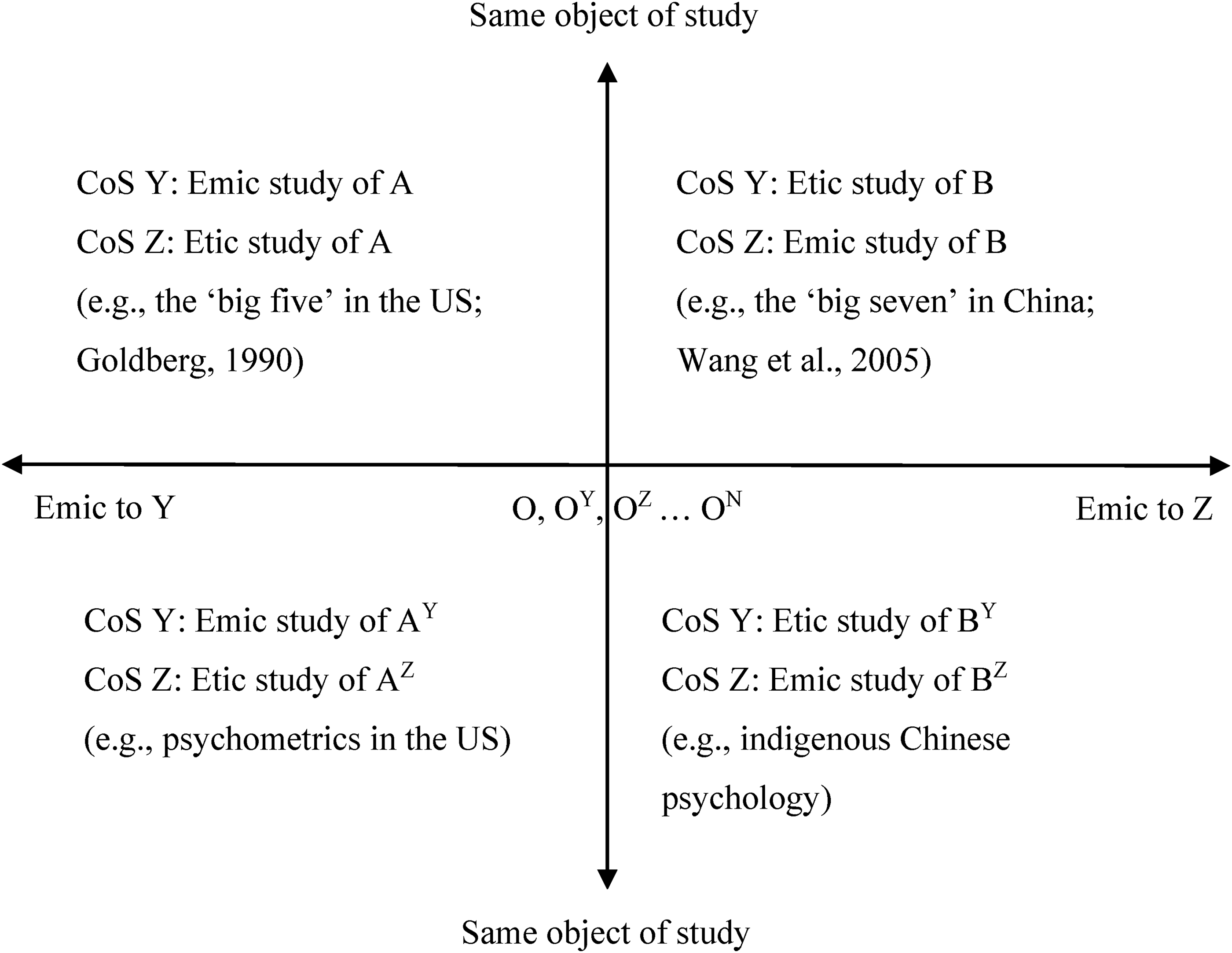
The CoS quadrant.
The quadrant is novel in its explicit incorporation of the possibility of CoS Y and CoS Z studying different objects of investigation—which are only ostensibly similar, as opposed to being the same object which is interpreted differently. Such construal differences come about due to wide-ranging contrasts in modi operandi (e.g., differential definitional emphases of object versus process), the common-sense systems different CoS appeal to, and naive realism among scientists. Thus, Phenomenon A finds its counterparts in AY (a construal of Phenomenon A particular to CoS Y) and AZ (a construal particular to CoS Z), and Phenomenon B in BY and BZ. This quadrant also considers situations in which Phenomenon O (or OY, OZ) is an intersectional object between CoS (most social-scientific phenomena may indeed be intersectional objects in a globalized world), as opposed to a strictly ‘inside’ or ‘outside’ object.
The study of personality and the self is particularly apt in serving as an exemplar for illustrative purposes, as can be seen in the quadrant. With regard to the scenario in which the same object of judgement is investigated, the same psychometric understanding of personality can nonetheless result in different personality models, for example in the US and China. Whereas the ‘big-five’ factor model of personality was found to adequately reflect the personality traits of students in the US (Goldberg, 1990), it did not adequately reflect the personality traits of students in China (Wang et al., 2005). Contrarily, this was better explained using a seven-factor model, which incorporates emic Chinese notions of personality (Wang et al., 2005). With regard to the scenario in which different objects of study are investigated, psychometric research as carried out in (mainstream) US psychology can be contrasted with (indigenous) Chinese psychology (Ho et al., 2001). While, ostensibly, both research programmes are concerned with the study of the same or similar psychological phenomena (e.g., the study of the self), the methods and meta-theoretical orientations they draw upon diverge to such an extent that any such similarities in the object being investigated (e.g., the self) become superfluous.
On a similar note, consider as another example Hsu's (1985) distinction between the Ptolemian and Galilean views of human nature, reflected in the West and East, respectively. The Ptolemian paradigm ‘sees the individual human animal as the center of his world’ (Hsu, 1985: 33); individual personality is the central focus here, and interpersonal relations are seen as being merely ‘indicators’ or ‘expressions’ of personality complexes (Hsu, 1985: 33). This aligns with the psychometric view of personality. In contrast, the Galilean paradigm foregrounds the social networks in which individuals are embedded. Individual characteristics are analysed here in terms of how they contribute, or not, to the interpersonal relationships that constitute the individual (Hsu, 1985; Sun, 2008). The Galilean paradigm is reflective of Eastern indigenous psychologies. There are also corresponding methodological counterparts to these paradigms. Methodological individualism (cf. psychometrics) asserts that it is knowledge about discrete individuals that is necessary for an understanding of social phenomena, and is predicated on Cartesian subject–object/self–other divisions (Ho et al., 2001). In contrast, methodological relationalism emphasizes the reciprocity inherent in all relationships. Its main tenet is that relationships precede not only individuals, but even situations; and it is in line with indigenous Chinese psychology (Ho and Chiu, 1998; Ho et al., 2001). These examples further elucidate how different CoS may be studying different objects of judgement altogether, despite surface similarities.
Having presented the CoS quadrant, a few qualifiers are in order before proceeding to compare Eastern and Western CoS. Firstly, it should be noted that the emic–etic distinction is usually applied to cultural groups, indigenous milieus (Allwood, 2011b) and possibly national distinctions (Liu, 2011), and thus certain modifications were in order for its fruitful application to CoS. For example, the objects of scientific study are not necessarily inside (emic) or outside (etic) a particular CoS. Rather, they can also constitute (a) intersectional objects, forming part of an interobjective reality equally accessible by different CoS, or else (b) objects that are yet to be discovered or objectified (Wagner and Hayes, 2005).
Secondly, SoC, or the social sciences, are necessarily in a constant intersection with CoS. In the social sciences, the constructs employed are in some sense co-created by researchers (Jahoda, 1977), and are also constitutive of the same phenomena that they seek to investigate, such that constructs and phenomena engage in a bilateral relationship of mutual influence (Gillespie et al., 2012). Arguably, this is less so the case with the natural sciences. Given the myriad divergences in scientific practice across the natural and social sciences, the quadrant thus limits itself mainly to application within the social sciences; future research within CoS in the natural sciences can adapt the model to suit different purposes.
Thirdly, cultures are heterogeneous, subject to different degrees of hybridity and not necessarily as coherent and integrated as can ostensibly be inferred from their observation (Allwood, 2011b; Archer, 1985; Gillespie et al., 2012). The globalized nature of contemporary science also means that ‘science, in a very important sense, is a species-specific rather than a cultural-specific [sic] activity’ (Ip, 1985). It is thus the purpose of a CoS programme to study the extent to which, in other important senses, scientific practice, conventions and representations are also specific to different cultural milieus, however fuzzily these might be defined.
Lastly, and crucially, it is our contention that CoS can be studied regardless of the extent to which their respective methods and practices, and the knowledge they produce, are deemed to correspond to actuality and factuality. Analogously, the study of science as a cultural system does not entail reducing scientific activity solely to its cultural dimensions. This reduction risks committing a genetic fallacy whereby scientific activity is discredited or downplayed simply due to its being contingent on specific sociocultural practices (Amsterdamska, 1990; Elkana, 1981).
The CoS quadrant builds on the emic–etic distinction by applying it to science as a cultural system, and through the added consideration of construal processes. Fittingly, in this initial attempt at showing how different CoS might differ, we now conclude by tabulating literature on the points of convergence and divergence in scientific practice, scientific conventions and representations of science across the East and West, with a particular focus on Chinese and Euro-American CoS. Practices, conventions and representations are inextricably linked. For the present purpose, different scientific practice is here taken to refer to the use of different methods and differential emphases in the definitions of concepts, scientific goals and working models (e.g., prediction versus thick description, or holism versus operationalism). Scientific conventions are taken to relate to customs and norms that surround scientific practice—such as citation norms and remuneration practices for output—and are institutionally embedded. Finally, representations of science here refer to the construal of science as a system among scientists themselves, the public understanding of science and social representations (Sammut and Howarth, 2014) of science together with the collective projects (Bauer and Gaskell, 1999) associated with science in the wider cultural milieu.
Accordingly, we now present a list of points of convergence and divergence across contemporary CoS in the East and West (see Tables 1 and 2). We acknowledge that a sharp distinction between East and West essentializes differences (Fan, 2007) and tends to use nation-states as proxies for cultural differences; accordingly, the tables specify the nation-state or region in question for each point of convergence/divergence. Moreover, the selected studies and references portrayed in the tables are by no means exhaustive: they either focus mainly on a particular point of convergence/divergence or else note it as part of a broader argument. When consulting the tables, it is important to keep in mind that the differences among CoS may mainly lie in differences in cultural traditions (within and across states), and that traditions, fashions, social trends and value orientations in different historical periods directly influence people's attitudes towards science and support for science. Accordingly, the tables are presented for illustrative purposes only, documenting a share of the present literature on convergences and divergences across CoS. While the analytical distinction between scientific conventions, scientific practice and representations of science is not reflected in the two tables, we maintain that it is a fruitful one; we therefore recommend the analytical separation of these three concepts as an avenue for future research.
Points of convergence across Western and Eastern CoS.
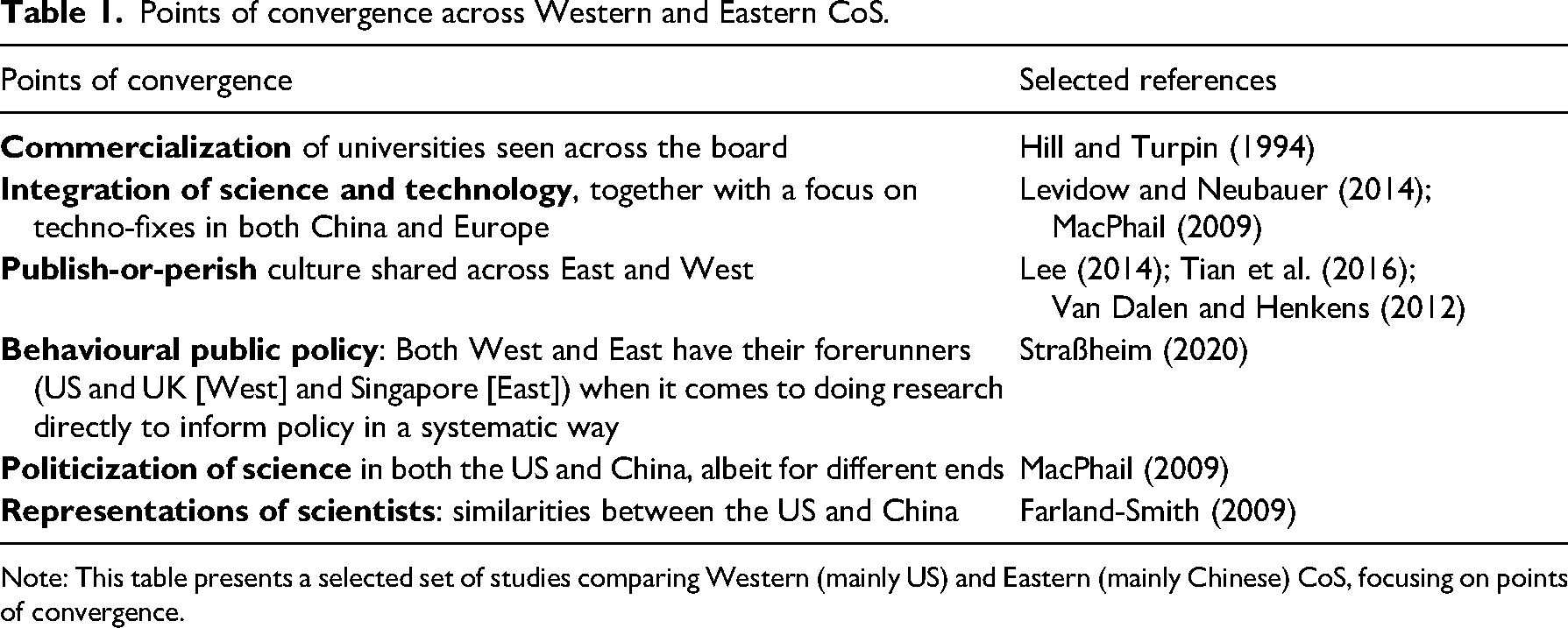
Points of convergence across Western and Eastern CoS.
Note: This table presents a selected set of studies comparing Western (mainly US) and Eastern (mainly Chinese) CoS, focusing on points of convergence.
Points of divergence across Western and Eastern CoS.
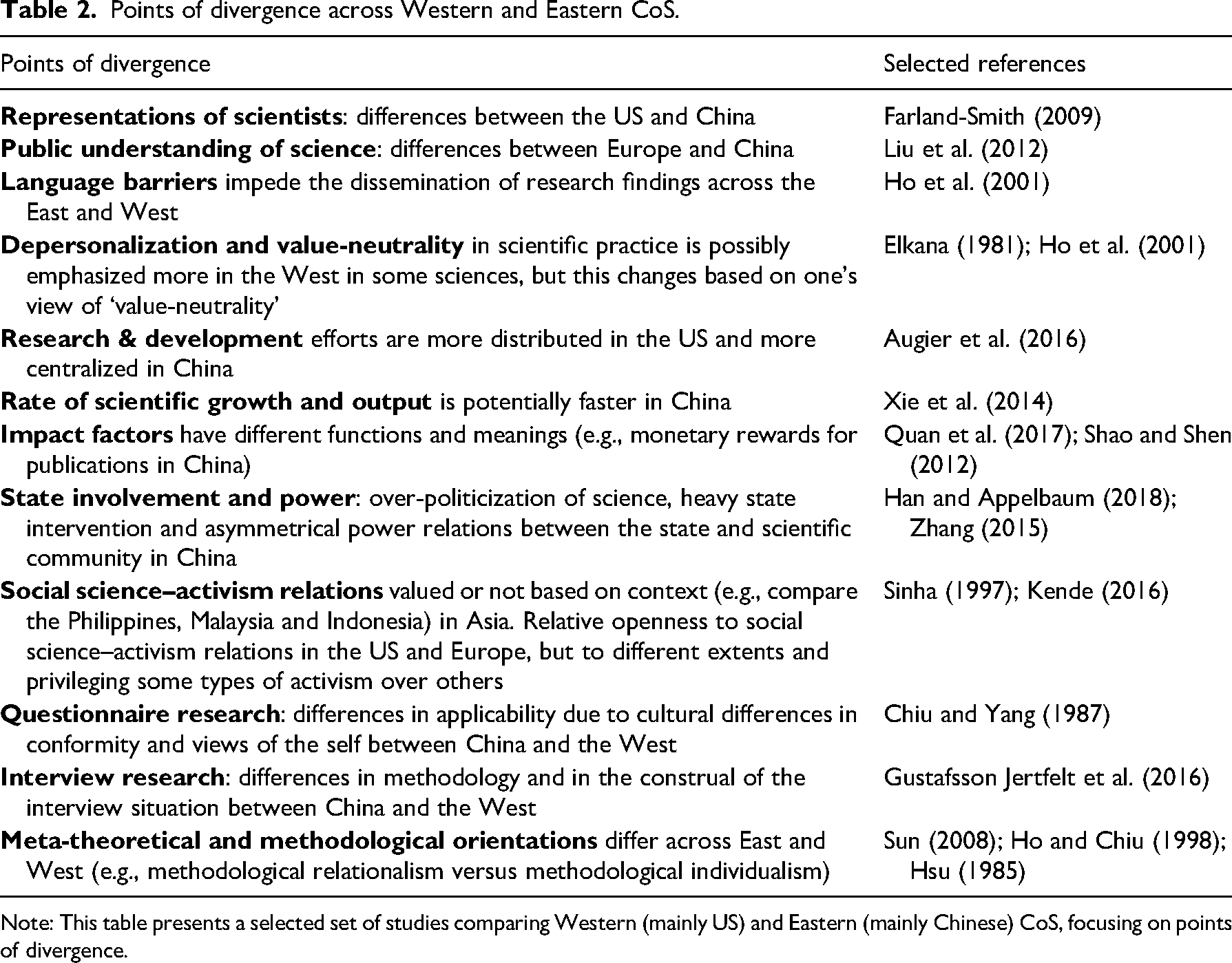
Note: This table presents a selected set of studies comparing Western (mainly US) and Eastern (mainly Chinese) CoS, focusing on points of divergence.
The convergences between the Western and Eastern CoS encountered in the literature were relatively few, but worthy of mention. The commercialization of universities (Hill and Turpin, 1994) is being witnessed across the board, together with an explicit focus on technological fixes for societal problems and a view of science that emphasizes its practical aspects and the efficient use of capital for such ends (Levidow and Neubauer, 2014; MacPhail, 2009). While the publish-or-perish mentality may carry different implications in the East and in the West, the pressure to publish in internationally indexed, high-impact journals is ubiquitous (Tian et al., 2016; Van Dalen and Henkens, 2012). Similarly, a common feature across CoS in the US and China concerns the politicization of science by different nation-states in the service of international recognition, national propaganda and technological advancement (MacPhail, 2009). Another similarity between these two nation-states concerns the fact that scientists are predominantly represented as male (Farland-Smith, 2009).
Contrarily, the points of divergence are more numerous. In the same study by Farland-Smith (2009), Chinese children tended to include more robots in their drawings of scientists, as opposed to American children, who had a tendency of including more lab chemicals. Such data indicates differences in representations across both states. The East and West also diverge in terms of the public understanding of science: levels of science literacy, engagement and interest are lower in China than in Europe, but attitudes towards science and what it can achieve are generally more positive in China (Liu et al., 2012). The way science is practised may also differ across the East and West, in that depersonalization may be a feature specific to Western science (Ho et al., 2001). The rate of scientific production is higher in China (Xie et al., 2014) and, contrary to the West, monetary rewards are given for high-impact publications (Quan et al., 2017). In terms of methodology, interview and questionnaire research might not be applicable in similar ways across China and the West; for instance, humility, as a cultural imperative, might influence scores that Chinese participants give on rating scales (Chiu and Yang, 1987). Similarly, Chinese participants can be more reluctant to talk about themselves than are Western participants, and approach interview research in a manner that contrasts with that of Western participants (e.g., asking the interviewer whether a question about one's point of view was answered correctly, expressing more aversion towards being recorded, and so on; Gustafsson Jertfelt et al., 2016). Table 2 illustrates these points of divergence and others.
In conclusion, this paper has discussed the notion of CoS in the light of the literature on common sense, interobjectivity and construal processes. Its main contributions are (a) the CoS quadrant, which depicts the various ways in which CoS may differ in terms of scientific practice; and (b) the literature tabulations concerning points of convergence and divergence in scientific practice, scientific conventions and representations of science. Concerning the former, while there have been similar programmatic attempts in the past (see Elkana, 1981, on the anthropology of knowledge), to the best of our knowledge, this is the first attempt focusing specifically on different CoS. Fundamentally, the quadrant can aid future research by helping investigators to position their research, both in terms of the emic–etic divide and also in terms of being aware of the influence of construal processes on scientific inquiry. Concerning the tabulations, the prevalence of divergences might be either truly reflective of the current situation, or else an indirect consequence of the direction taken by research efforts. The extent of divergence across CoS in the East and West is thus an open empirical question.
In summary, the CoS quadrant foregrounds the distinction between studying a social scientific phenomenon from inside the culture in which it manifests itself versus studying it from the outside. This distinction carries important implications due to the effects that different points of view can have on the way that phenomena are construed, approached, operationalized and studied. The quadrant demonstrates how differences in construal effectively lead to situations in which scientists investigate different objects of study while being under the impression that they are concerning themselves with the same object of study. The construct of personality, as studied in psychology, lent itself as an excellent example of this: psychometric and indigenous psychological approaches can produce drastically different views of personality (and notions approximating it), even when similar terms are employed for the notions under study. It is our main contention that this apparent impasse can benefit from a programme of study looking specifically at CoS promoting these different methods and views of the world.
Limitations and directions for future research are worth noting before concluding. Firstly, care must be taken to avoid undermining the objectivity of science itself where this criterion applies—for example, compare the natural sciences (in which the ideal of objectivity remains present in important ways) with discursive psychology (in which the emphasis generally steers away from this ideal or subscribes to alternative notions of it). While notions of objectivity in science require extended debate, our point has been mainly to argue for a CoS approach and to present a meaningful quadrant that acts as a heuristic. Therefore, one could utilize the quadrant regardless of one's view on the relationship between objectivity and the specific science in question.
Secondly, another limitation is that using nation-states or broad East–West distinctions as units of analysis for cultural differences may be overly simplistic, overlooking cultural diversity within individual countries; while we did include non-US and non-China examples in Tables 1 and 2, future research may wish to address this further.
Thirdly, the emic–etic distinction, on which we relied in formulating the quadrant, has well-known limitations, some of which have been noted above. Future research would do well to advance this thinking by approaching CoS via other literatures that go beyond emic–etic. A useful example here is the work of Jenco (2015), who analysed how Chinese reformers transferred knowledge from the West to China through an analytical lens that prioritizes the importance of social groups/circles as sites for knowledge, over national boundaries or the emic–etic divide. Indeed, the notion of culture itself goes beyond national boundaries, and care is needed not to equate culture with national borders, which can lead to constructing ‘cultural Others’. Instead, above, we used the West–East notion flexibly, appreciating the unique as well as shared histories and exchanges that exist beyond geographical limits. This interconnectedness ultimately invites a reflexive approach that acknowledges the complexities and historical baggage that these terms carry—which future research on CoS may want to explore further.
Finally, our research focused mainly on the social sciences, in which notions related to science (objectivity, replication, reflexivity, etc.) will be conceptualized differently than in the natural sciences, as the objects of study differ across these broad camps. This focus was deliberate, as it is reasonable to expect that different sciences merit different treatments when it comes to CoS. For instance, the interplay between SoC (practised in the social sciences, broadly construed) and CoS may not be as vivid in the natural sciences, in which SoC would not be an object of study per se. Nonetheless, future research may wish to analyse CoS more directly in a way that takes the natural sciences more into account.
Footnotes
Declaration of conflicting interests
The authors declared no potential conflicts of interest with respect to the research, authorship, and/or publication of this article.
Funding
The authors received no financial support for the research, authorship, and/or publication of this article.

Author biographies
Luke J Buhagiar is Lecturer at the Department of Policy, Politics and Governance, within the Faculty of Economics, Management and Accountancy at the University of Malta. He holds a PhD in social psychology (University of Malta). Buhagiar's research interests include social representation, intergroup relations, lived religion and philosophical psychology.
Stavroula Tsirogianni is an Associate Professor (Teaching) at the Division of Applied Psychology, School of Humanities and Social Science at The Chinese University of Hong Kong, Shenzhen. As an educator and a scholar, her praxis is rooted in the exploration of psycho-social and policy questions related to social values, subjectivities and the socio-cognitive mechanisms involved in community-driven visions of the future and social change. This exploration takes place within the context of four key areas: (1) Chinese youth, social imagination and public life; (2) community engagement and participation; (3) science–society relations and (4) migration and identity.
Gordon Sammut is Professor of Social Psychology at the University of Malta, where he directs the Centre for the Study & Practice of Conflict Resolution. He is interested in intergroup and intercultural reconciliation strategies, social influence modalities and the management of diversity. He is former editor of Papers on Social Representations and associate editor of Peace and Conflict: Journal of Peace Psychology. He has published numerous international peer-reviewed papers. His previous works include The Psychology of Social Influence: Modes and Modalities of Shifting Common Sense (Cambridge University Press, 2021), The Cambridge Handbook of Social Representations (Cambridge University Press, 2015) and Understanding the Self and Others: Explorations in Intersubjectivity and Interobjectivity (Routledge, 2013). His latest volume Politics and the New Challenge of Migration: Bridging Cultural, Social and Political Divides (2025) is published by Cambridge University Press.