




Abstract
Science culture is an important part of the social culture system and has become a major force in shaping modern society. High-quality and sustainable innovation is not possible without a vibrant and engaging science culture. Science popularization (SP) venues serve as a bridge between scientists and the public and constitute an important platform for disseminating science culture. This study explores the organic connection between SP venues and science culture dissemination and the internal mechanisms of those venues by discussing practices of SP venues in China and elsewhere. It concludes that the SP venue system is becoming an important part of science culture dissemination. It offers specific suggestions on how to promote the development of the SP venue system to improve the quality, efficiency, effectiveness and scope of science culture dissemination.
The concept of science being a kind of culture has been universally recognized. With advances in modern science, science culture has gradually become an important part of the social culture system and a major force in shaping modern society (Wang, 2015). In today's world, an excellent science culture is indispensable for a country or region to achieve high-quality and sustainable innovation (Wang et al., 2017). Many researchers think that science popularization (SP) in China today should be focused on exploring new approaches and new goals to popularize and disseminate science from the perspective of culture, and on systematically developing a science culture (Zheng and Wang, 2017). Sustainable scientific and technological innovation also calls for a robust science culture.
SP venues serve as a bridge that enables closer and smoother communication between scientists and the public. They provide places for SP work and platforms for science dissemination. The development of SP venues will greatly promote science culture dissemination and science education.
Science culture, scientific spirit and SP venues
In the development of an excellent science culture, we need to have a full understanding of the relations between science culture, scientific spirit and SP venues.
Science culture and scientific spirit
What is science culture? Science culture is a new type of culture that has developed based on scientific practice (Li, 2019). It has been examined and expounded on by academics in different eras, from different points of view, and from both broad and narrow perspectives. Zheng Wei (2009) defines science culture narrowly as ‘a set of ideas shared by the scientific community regarding how to engage in research activities', such as behavioural norms, values and ways of thinking. Han Qide (2012) considers science culture to be ‘a set of values, modes of thinking, institutional regulations, codes of conduct and social norms developed in the scientific activities of the scientific community. It is the spiritual soil of science and technology and the source of innovative development.’ The core of developing a science culture is to foster the scientific spirit.
With the development of science, science culture has permeated all sectors of society and developed a broad concept, which includes ‘the public's understanding of and attitude towards science (and scientists); their judgment and pursuit of scientific values; their respect and support for and engagement with scientific activities; and young people's aspiration for scientific careers’ (Zhou, 2019).
What is scientific spirit? The scientific spirit originated in ancient Greece and, following the historical periods of the Renaissance, the Enlightenment and the Industrial Revolution in Europe, gradually evolved into an ideological and cultural ethos. Aristotle gave the earliest description of the scientific spirit as ‘philosophizing in order to escape from ignorance' and ‘pursuing science in order to know, and not for any utilitarian end’ (trans. 1993). Evidently, the earliest scientific spirit went beyond the utilitarian dimension of knowledge and was motivated by an interest in gaining knowledge and the desire to ascertain the absolute truth (Wu, 2011).
Merton thought that the values of modern science boil down to a set of four norms: universalism, communism, disinterestedness and organized scepticism (trans. 2003, pp. 363–364). With the development of modern science in China, Chinese academics have proposed different interpretations of the scientific spirit. Ren Hongjun (2002), the founder of the Science Society of China, defined the scientific spirit as ‘the pursuit of truth'. Zhu Kezhen (1999) claimed that the scientific spirit is about the ‘exploration of truth’ and that the scientific attitude should be ‘not blindly following, not going with the tide… concerning about what is right or wrong but not the gains or losses… being modest… [and] seeking truth from facts’.
Han Qide (2012) advocates scepticism and critical thinking in carrying forward the scientific spirit, stating that ‘scepticism is the starting point of research, and critical thinking is the life of science.' The core value of the scientific spirit is the pursuit of truth, and its essence is rationality. Jiang Daoping made a comprehensive survey of Chinese and foreign academics’ definitions and descriptions of the scientific spirit from various aspects, including epistemology, methodology, social norms, values and the humanities. He proposes that the scientific spirit comprises two dimensions:
On the one hand, the scientific spirit is the sum total of faiths, values and behavioral norms formed in the process of humans' scientific inquiry; on the other hand, it is the ethos of the scientific community and what drives their pursuit of truth and innovation. (Jiang, 2017)
Scientists embody the scientific spirit and are direct practitioners of scientific methods and thoughts (Wang, 2015). As such, they play an irreplaceable role in carrying forward science culture. The spirit of the scientist epitomizes the scientific spirit and informs how the scientific spirit shapes the modern mind (Jiang, 2017). It is important to strengthen the role of scientists in developing science in the effort to promote science culture.
In contemporary China, the spirit of scientists encompasses not only free exploration, rational scepticism, truth-seeking and bold innovation but also patriotism, social responsibility and a sense of historical mission. The spirit is also shown in scientists' dedication to scientific research, as demonstrated by the Fudan University team, led by Professor Zhong Yang, that has spent more than 10 years on the Qinghai–Tibet Plateau researching biodiversity conservation. Also, data collected since 2018 shows that all research projects awarded the State Scientific and Technological Progress Award have had a research cycle of more than 10 years—demonstrating a true picture of the research world, in which long-term commitment and perseverance are required to achieve substantial research results.
Science culture and SP venues
SP venues play an important role in the dissemination of science culture. First, science culture is disseminated in the process of developing SP venues. Second, activities conducted by SP venues help to promote the integration of science culture with social culture and the globalization of science culture development.
Science culture dissemination in the development of SP venues
In the mid-18th century, when navigation technology made long sea voyages and explorations possible, explorers made expeditions to the far corners of the world and brought back all kinds of treasures to their home countries. Those private collections were often turned over to authorized third-party collections to be exhibited to the public. This was how the earliest museums emerged. The function of museums is to increase people's knowledge of nature. Museums serve to satisfy people's curiosity about nature by showcasing the results of previous scientific explorers and provide a platform for face-to-face communication among people.
At the beginning of the 19th century, as the number of scientific disciplines grew, there gradually came into being various types of specialized venues, including museums of science and industry. Those museums aimed to improve people's knowledge about industrial developments and scientific disciplines in different historical periods and about the connection between technological inventions and scientific discoveries, and to inspire the emergence of new knowledge. Specialized museums came into being in the mid-19th century with the development of scientific disciplines and various industrial sectors (Yin, 2015).
The earliest science centres appeared at the beginning of the 20th century. They promoted the development of science culture and science education through interaction with the public. This is a natural and rational process and is closely related to the advancement of scientific research and technological innovations. Science education is a strategic goal of governments and should be strengthened. Specifically, revealing scientific principles and promoting museum education through exhibits are crucial for shifting the focus of museums from exhibiting to educating (Schiele, trans. 2018).
China's current science and technology venue system includes science and technology museums; mobile science and technology stations; SP caravans; online science and technology museums; middle-school-based science and technology rooms in rural areas; youth science workshops; community-based SP activity rooms; social organizations committed to SP work; and enterprises producing SP products. The venue system provides diversified platforms for effective communication among all stakeholders, including government agencies, scientists and the public. As one of those platforms, SP venues aim to maximize the value of scientific resources through interaction and sharing and to emphasize openness, innovation and the dissemination of the scientific spirit and science culture.
From a specific culture to a social culture: Science culture development as a global endeavour
At present, science culture remains somewhat confined to the scientific community. It needs to be better integrated with and grow in social culture. A survey of 10,403 scientists from the French National Centre for Scientific Research showed that, during the year when the survey was conducted, three-quarters of the scientists did not engage in any public activity, such as producing a popular science book, delivering a relevant lecture or making a relevant poster. About 70% of all public activities were participated in only by the most active 10% of scientists (Jensen, 2005).
Growing science culture from a community culture within the scientific community to a social culture that is constructed and shared by all people is a new approach and new requirement in efforts to involve the public in scientific and technological advancement and enable them to benefit from it (Zheng, 2019). The Science and Society Action Plan introduced by the European Commission in 2011 emphasizes that science culture development is part of the European Union's effort to improve its overall competitiveness and invest in the future. The United States has proposed an ‘Innovation Strategy’ to advance its national science culture system. Stanford University and the Johns Hopkins University offer elective courses in science communication for undergraduate and postgraduate students (Brownell et al., 2013). China sees scientific and technological innovation and SP as the two wings of its innovation-driven development strategy, thus placing both in equally important positions.
By organizing popular science events such as ‘popular science lectures', ‘face-to-face with scientists’ and ‘nights of science’, SP venues provide opportunities for the public to communicate with scientists in person and experience the scientific spirit personally. Those venues encourage the participation of scientists in developing popular science courses, making exhibition plans and conducting venue–university and venue–enterprise cooperation, thus making their latest research results known to the public, helping to increase the scientific soundness and authority of science education programmes, accelerating science outreach and the integration of science culture with social culture, and improving the quality of science culture dissemination.
The SP venue system as an important part of science culture dissemination
The SP venue system functions as both a source and a vehicle of science culture dissemination.
SP venues are wellsprings of science culture dissemination
In achieving their missions and objectives, SP venues use permanent and special exhibitions. They are also becoming a vital complement to school education.
The missions and objectives of SP venues: Integration of science and culture
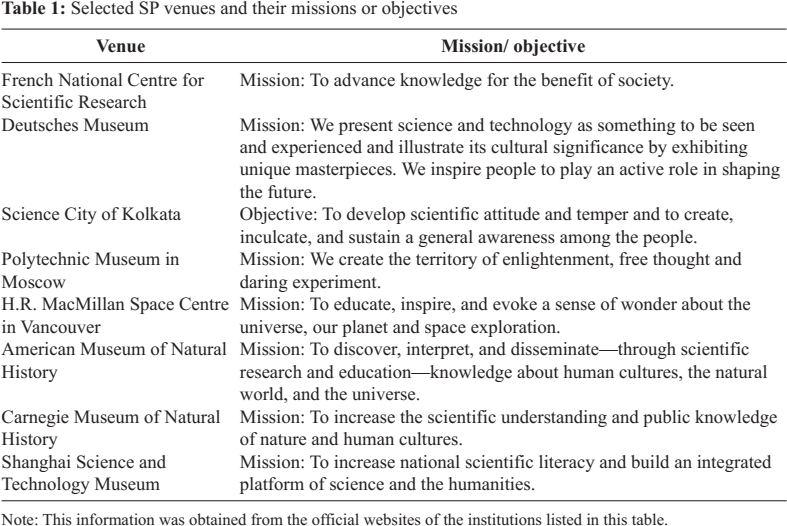
As the wellsprings of science culture dissemination, what can SP venues provide for the public? Many SP venues in China and in other countries have mission or objective statements that highlight efforts to ‘discover, interpret, and disseminate—through scientific research and education—knowledge about human cultures', ‘develop scientific attitude and temper, and create, inculcate and sustain a general awareness among the people’, and ‘advance knowledge for the benefit of society’ (Table 1). These statements demonstrate the principle of integrating venue development and science culture dissemination.
Selected SP venues and their missions or objectives
Selected SP venues and their missions or objectives
Note: This information was obtained from the official websites of the institutions listed in this table.
The Shanghai Science and Technology Museum is a pioneer in thematic exhibitions that highlight exhibition themes and expansive thinking. Based on the science, technology and society (STS) model, with its focus on ‘fostering a critical, sceptical and explorative scientific spirit’, the museum is committed to‘increasing national scientific literacy and building an integrated platform of science and the humanities’. It does so by integrating three venues—the Shanghai Science and Technology Museum, the Shanghai Planetarium and the Shanghai Natural History Museum— that cluster together to span the past, present and future, and fuse science and technology with nature and astronomy (Wang and Song, 2015).
Permanent exhibitions are the core of museums. They include a wide range of themes and diversified content that integrate science, culture and history. Permanent exhibitions are designated to express the fusion of science and art, and a transition from static description to dynamic display. They aim to strengthen people's understanding and appreciation of objects and phenomena in interactive experiential settings, which facilitates the development of scientific thinking and the scientific spirit and people's reflection on them.
The China Science and Technology Museum comprises five permanent exhibition halls: ‘Science Paradise', ‘Glory of China’, ‘Explorations and Discoveries’, ‘Science & Technology and Life’ and ‘Challenges and the Future’. The Shanghai Science and Technology Museum has permanent exhibitions including ‘Cradle of Designers’, ‘Light of Wisdom’, ‘Home Planet’, ‘Information Age’ and ‘Academicians Wall’. The Guangdong Science Center's permanent exhibitions include ‘Digital Park’, ‘Transportation World’, ‘Space Dreams’ and ‘Perception and Thinking’. The National Museum of Emerging Science and Innovation of Japan has permanent exhibitions including ‘Environment and Cutting-Edge Science’, ‘Technological Innovation and Future’, ‘Information Technology and Society’ and ‘Life Sciences and Humans’. The California Science Center has permanent exhibitions including ‘Science Plaza’, ‘World of Life’, ‘Creative World’ and ‘Ecosystems’. These permanent exhibitions demonstrate the historical process of scientific development, convey scientific methods and the scientific spirit developed in the process, and speak of the integration of the traditional and the modern and the fusion of science and the humanities.
Special exhibitions dedicated to frontier topics
In addition to permanent exhibitions, science museums also hold special exhibitions in the form of original exhibitions and introduced exhibitions. This juxtaposition of exhibits not only increases their appeal to and influence on the public but also improves their ability to disseminate science culture. Special exhibitions concern front-line scientific issues and the latest scientific achievements, as well as ‘hot’ topics related to people's lives, with a view to provoking public response and thought.
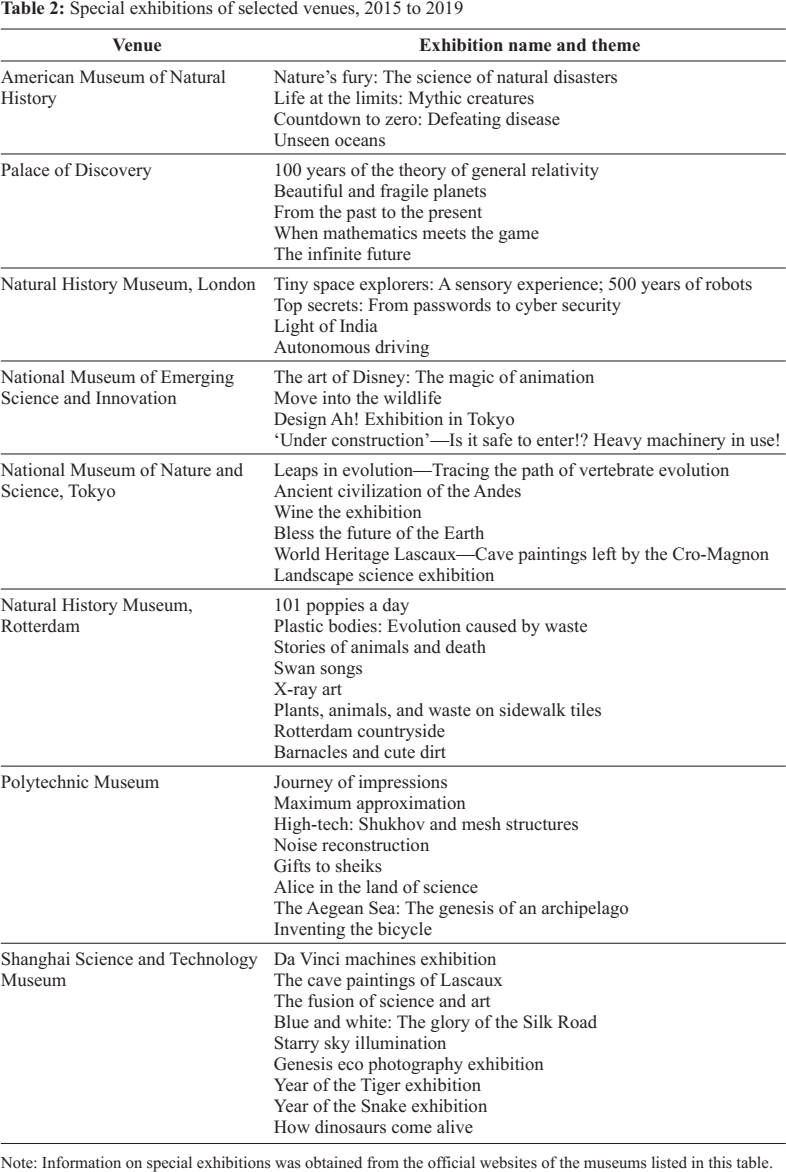
Table 2 lists the titles and themes of some special exhibitions hosted by selected Chinese and overseas science museums during the past five years. Some of the exhibition themes focus on scientific theories; some others display the development and application of science and technology, and the integration of different fields such as science, art and culture, allowing visitors to experience and understand science from different perspectives. For example, the Shanghai Science and Technology Museum's special exhibition ‘How dinosaurs come alive’ was staged at 15 places, including eight science museums and seven commercial plazas, in a nationwide tour across China within one and a half years. The exhibition extends its scope from the museum to society and covers many cities in east and west China, producing a widespread influence on the public and promoting the dissemination of science culture.
Special exhibitions of selected venues, 2015 to 2019
Special exhibitions of selected venues, 2015 to 2019
Note: Information on special exhibitions was obtained from the official websites of the museums listed in this table.
Museum education has become more diversified through the application of new media and new technologies. It plays an increasing role in informing the public of the latest scientific and technological advancements and in disseminating science culture. According to the 2017 national SP statistics of the Ministry of Science and Technology, SP activities were engaged in 771 million times by members of the public (that is, 771 million person-times); 880,100 popular science lectures were accessed 146 million person-times by members of the public; 48,900 science competitions were organized; and 2,713 international exchanges were accessed 702,100 person-times by members of the public (Wang, 2018a). Museum education is a form of open, informal education that is different from regular school education, and the two can be organically combined to create a public science education system.
By organizing activities such as popular science lectures and thematic exhibitions that debunk pseudoscience and falsehoods, SP venues can help the public increase its scientific literacy.
‘Popular Science Forum’ is a signature popular science programme of the Shanghai Science and Technology Museum. The forum focuses its content on frontier technologies, scientific events and hot topics related to people's lives and emphasizes the integration of science and the humanities and the arrangement of interactive online and offline activities. Since its launch in 2009, the forum has held more than 130 events to which more than 230 experts, including Nobel laureates and academicians, have been invited. These events have benefited an online and offline audience of more than 10 million person-times.
‘Meet@the scientist’ is another signature programme of the museum launched in 2019. Each month, the museum will select a renowned scientist born in that month as the star scientist and organize activities to showcase the scientist's scientific spirit and achievements. The programme aims to foster a social atmosphere that embraces science and honours scientists. It provides the public with opportunities to get familiar with scientists and is an effective way to disseminate science.
SP venues are an important vehicle of science culture dissemination
SP venues are places where science culture is disseminated, and they are applying new technologies and new formats to achieve their objectives and are making extensive use of the internet.
SP venues provide spaces for science culture dissemination
SP venues provide spaces for activities of varying sizes and disciplines and for the public to communicate and learn. Of the 20 most popular museums in the world in 2018, as published by the Themed Entertainment Association and AECOM, five were natural science museums, which received visits of 25.63 million person-times (Rubin, 2018). Large comprehensive SP venues in China—the China Science and Technology Museum, the Shanghai Science and Technology Museum and the Guangdong Science Center—have average visits of more than 3 million person-times annually. Visitors are from all age groups and backgrounds, indicating that SP venues are appreciated by the general public and have become the main places of science culture dissemination.
According to the 2018 Chinese national scientific literacy survey, the most visited SP venues in China were zoos, aquariums and botanical gardens (58.1%); science and technology museums and science centres (31.9%); and natural history museums (29.5%) (He et al., 2018). All percentages were higher than the 2015 percentages for those venues, which indicates growth in the use of SP venues, public engagement in SP activities, possibilities of acquiring scientific knowledge and information and science culture dissemination.
Besides venue-based exhibitions and education activities, SP venues have also developed some special forms to reach wider audiences in remote areas, such as SP caravans on exhibition tours, mobile museums, and science and technology rooms in rural middle schools. These flexible forms effectively expand the scope of science culture dissemination and benefit wider audiences.
From 2000 to 2018, the China Association for Science and Technology dispatched 1,538 SP caravans that travelled a total of 37,103,000 kilometres nationwide and offered 217,000 activities that reached 230 million person-times (CSTM, 2019). In the same period, the China Mobile Science and Technology Museum Programme dispatched approximately 420 sets of exhibits for 3,260 exhibitions that reached approximately 117 million person-times (Qiu, 2019). In the period from 2012 to 2018, 708 science and technology rooms were established in rural middle schools and directly reached and benefited more than 3.02 million person-times (Mao, 2019). These figures speak volumes about the fact that SP venues have become a main vehicle of science culture dissemination.
The application of new technologies in SP venues helps to expand the scope of science culture dissemination
In the process of constructing intelligent SP venues, many museums use new technologies, including remote video, virtual tour guidance, holography, virtual reality and augmented reality to develop more engaging visual products that appeal to the public and bring science to wider audiences, thus narrowing the gap between different regions and achieving balanced deployment of scientific resources and widespread dissemination of science culture.
For instance, the Shanghai Science and Technology Museum has introduced a remote video system that delivers real-time images of wild elephants in Yunnan to museum visitors in Shanghai. The new Shanghai Natural History Museum (a branch of the Shanghai Science and Technology Museum) uses augmented reality technology to animate a dinosaur skeleton in its collection, return it to the museum's original premises, and then place the animated skeleton on a time travel platform to its habitat 66 million years ago. This use of technology best expresses the inheritance of science culture and the vision of a return to nature.
New technologies such as information and communications technology and artificial intelligence facilitate the creation and dissemination of scientific knowledge and make it possible for people to experience and understand science and acquire knowledge at any time and from anywhere. By enabling everyone to create and share information, these technologies have been able to effectively promote science culture dissemination.
New formats of the popular science industry keep emerging to meet diversified needs
SP venues have been trying to explore ways to integrate science culture and creative industries and gradually introduce new formats of the popular science industry. Videos are a popular medium with the public, and many institutions around the world are making efforts to produce popular science videos.
The Shanghai Science and Technology Museum began developing popular science videos in 2009 and has carved out a new path for science communication. So far, the museum has produced 11 films and 17 documentaries on a diverse collection of popular science topics, including palaeontology; living animals; land and sea creatures; rare and endangered species; and biodiversity conservation. The series of documentaries on rare species highlights the role of science in documentary production by presenting high-quality scenes, conveying the concept of ecological civilization, displaying the achievements and ideas of Chinese scientists, and promoting nature conservation. The series of 4D films on the major achievements of China's basic research in palaeontology present the survival and evolution of animals and plants in the Palaeozoic, Mesozoic and Cenozoic eras. The focus of these films is on scientific themes, including the life cycles, environmental adaptations and coexistence of different species. The appearance of popular science films on cinema screens has promoted the development of such films and expanded the boundaries of the popular science industry.
The internet promotes the integration of the SP cause with the popular science industry and the dissemination of science culture
The internet has become a new platform for science culture dissemination: on the internet, everyone is a communicator and messenger of science. In 2018, the number of internet users in China reached 829 million, and fixed and mobile internet connections were the primary channels to access scientific and technological information for 76.3% of citizens (He et al., 2018). SP venues are not yet able to meet the strong public demand for scientific resources; this shortfall calls for mobilizing all social forces to develop the popular science industry and create opportunities and exchange platforms for science culture, on the basis of which an integration of the SP cause and the popular science industry would be achieved (Ren et al., 2018).
The development of internet technologies has advanced the cultural industry and helped to integrate the scientific spirit and scientific methods with cultural industry content (Zeng and Gu, 2010). China's national policy has explicitly advocated the development of the cultural and creative industry in SP venues with a view to developing science culture as both an industry and a public good. With regard to the development of venues, the cultural and creative industry can help to increase their social influence and competitiveness, enrich the cultural meanings of their collections, improve people's understanding of science culture, make art and science part of everyday life and make cultural innovation an intangible property. With regard to the external environment, driven by the ‘internet plus’, in-depth integration is a trend in future development; and, with increased domestic cultural consumption, enthusiasm for cultural development has reached a peak, boosting the cultural and creative industry and promoting social development (Wang, 2018b).
Conclusions and suggestions
Here we offer some suggestions for promoting science culture dissemination through the development of SP venues.
Build an SP venue system committed to open access to scientific resources to improve science culture services
As a first step, the development of an SP venue system should be included in the national cultural system to promote science culture dissemination. This step was taken at the First International Symposium on the Development of Natural Science Museums under the Belt and Road Initiative hosted by the Chinese Association of Natural Science Museums. At the symposium, the Beijing Declaration was adopted to promote long-term cooperation between SP venues in different countries and to develop exchange platforms for popular science exhibitions, education programmes and human resources among venues in ‘Belt and Road’ countries.
Second, diversified sharing platforms should be created to improve resource development and access and to maximize the efficiency of science culture dissemination. Cooperation between the Shanghai Science and Technology Museum and the Dunhuang Research Academy is a good example in this regard. The museum introduced popular science lectures and performances that integrate science, the humanities and the arts into the academy. In addition, the two organizations have also made extensive arrangements for personnel exchanges, academic exchanges and popular science education in order to attract more young people to the academy and to promote further development of the splendid cultural heritage of Dunhuang. Moreover, the museum took its original popular science films and exhibits to remote regions, including Xinjiang, Tibet and Inner Mongolia, and provided training for local SP workers in conducting science education activities. These representative and inclusive endeavours are geared to promoting science culture in a sustainable way and to maximizing the efficiency of science communication.
Third, all social forces should be directed to further increase the openness of the SP venue system. Enterprises, foundations, nongovernment organizations and other social forces have been increasingly involved in developing SP venues. For example, the Shanghai Science Education Development Foundation has provided comprehensive support to the Shanghai Science and Technology Museum since its inception, contributing to exhibits collection, education programme development, large-scale event planning and mobile museum development. In recent years, an increasing number of Chinese and foreign companies have provided support, including funds and exhibits, for special exhibitions and education programmes in SP venues. As part of this trend, a growing number of commercial plazas have established cooperation with SP venues and become new spaces for science communication. They provide places or funds for popular science exhibitions and education activities that are open to the public, allowing people to experience an atmosphere of science culture in their leisure time.
Strengthen museum education and special exhibitions to increase the efficiency and timeliness of science dissemination
Research on exhibits and specimen collections provides a strong foundation for museum exhibitions. Efforts can be made in the following two directions.
First, tap into the stories behind classic and precious exhibits and transform them into educational resources. In July 2018, the Shanghai Science and Technology Museum, Shanghai Museum and Shanghai History Museum launched the ‘Centurial collections— the history of museums in Shanghai’ special exhibition. The exhibition presented a choice collection of 83 animal specimens, seven categories of anthropological specimens and 17 books, displaying the integration of science, culture, art and history and representing an exploration of the history of Chinese museums and a compelling expression of Shanghai's deep cultural heritage.
Second, try to present the latest scientific achievements in exhibitions and other activities. For example, only hours after the paper ‘A feathered dinosaur tail with primitive plumage trapped in mid-Cretaceous amber’ was published online in Current Biology on 9 December 2016, its two authors appeared on the New Questions Salon programme at the Shanghai Natural History Museum to introduce the study to the audience and discuss such topics as the methodology and the scientific spirit included in their research. The speed at which this communication took place is a testament to the timeliness of science culture dissemination. Five months later, the Shanghai Science and Technology Museum launched the special exhibition ‘How dinosaurs come alive’ based on the study's findings, demonstrating how efficiently scientific findings can be transformed into scientific resources.
Put in place a sound administrative system of SP venues to expand science culture dissemination
In the process of globalization, SP venues face the challenge of steadily improving their administrative mechanisms and promoting science culture dissemination.
The Association of Science Popularization Venues of the Yangtze River Delta Region was initiated by eight organizations, including the Shanghai Science and Technology Museum. The association includes 78 SP venues and 80 organizations, including universities, enterprises and public institutions. It is united by the values of mutual consultation, sharing and win–win, and is committed to conducting in-depth exchanges in popular science education, exhibition, collection and research; forming an industry–education– research–application and exhibition chain; promoting coordinated development among museums, between museums and enterprises, between museums and research institutes, and between museums and universities; and achieving the integrated development of the Yangtze River Delta Region as a world-class megalopolis.
On National Popular Science Day in 2018, the association launched a special exhibition titled ‘Into the blue oceans: Marine popular science exhibition’ that staged simultaneously in eight museums. The exhibition presented a visual feast of knowledge on the marine world that reached wide audiences and successfully demonstrated how well science culture can be disseminated in the region.
Footnotes
Author biographies
Xidan Hu, PhD in Education, Associate Researcher. Her research interests are exhibition education and public communication.
Binsheng Zhang, PhD in Economics, Associate Researcher. His research interests are the popular science industry, fund management, and international trade and investment.
Xiaoming Wang, PhD in Ecology, Professor, Doctoral Supervisor. His research interests are museum management, science communication and the conservation biology of endangered animals.