



Abstract
The Chinese phrase kexue wenhua is a combined translation of science (equivalent to kexue) in a narrow sense and culture (equivalent to wenhua) in a narrow sense. In fact, kexue wenhua has multiple meanings (captured in four English phrases: ‘scientific culture’, ‘science culture’, ‘culture of science’ and ‘science as culture’), which confuse Chinese scholars greatly. This paper explores the diverse meanings of kexue wenhua. After tracing the sources of the four English phrases and studying some academic works of Western scholars, we have found that ‘scientific culture’ focuses on science's relationship with the scientific community, science education or science literacy; ‘science culture’ focuses on the establishment and application of the science culture index; the ‘culture of science’ focuses on its relationship with science communication; and ‘science as culture’ focuses on its research approaches and social significance. Based on this analysis, we propose a new four-layer structure for kexue wenhua, which comprises the cultural layers of material state, of system, of behaviour, and of mind. In this structure, material state is the basis, mind is the core, behaviour is the circulatory system, and the system is the framework.
Introduction
The Chinese phrase kexue wenhua, which has been used more and more frequently by Chinese scholars in recent years, contains multiple meanings: scientific culture, science culture, the culture of science and science as culture. However, diversified and fragmentary studies on kexue wenhua and scholars' different understandings of it have caused unproductive academic exchanges. This paper represents an attempt to clarify the etymologies and meanings of kexue wenhua in Chinese and ‘scientific culture’, ‘science culture’, ‘culture of science’ and ‘science as culture’ in English, and also to make new contributions to the public understanding of science, the development of the science culture index and the communication of kexue wenhua.
Science, culture and kexue wenhua in the Chinese context
The Chinese phrase kexue wenhua is a combination of the word kexue (science) and the word wenhua (culture), but it cannot be simply equivalent to the English phrase ‘science culture’ because of the semantic complexity of the Chinese term, which endows kexue wenhua with multiple meanings of scientific culture, science culture, the culture of science and science as culture. The term science, referring to systematic, deterministic and reliable knowledge (Wu, 2016), is derived from the Latin word scientia and was introduced from French into English. Commencing from the 17th century, science has assumed an increasingly prominent position within Western culture (Meng, 2017). The use of science in contemporary French is equated with the term natural science, which dates back to the middle of the 17th century (Wu, 2016). In the second half of the 19th century, a new use of science appeared, referring not only to knowledge (in general) and natural science (in particular), but also to the knowledge systems of nature and society based on objective and accurate descriptions and systematic and logical analysis (Zhou, 2010).
Before 1881, a Japanese term with the same graphemes as the Chinese phrase kexue and equivalent to the English word science emerged in Japan and became increasingly popular (Zhou, 2010). The Japanese term highlights the division of science at that time (Wu, 2016). Kang Youwei added the entries ‘Introduction to science’ and ‘Principles of science’ to his Japanese Bibliography when he wrote the book (published in 1897). The contents of the bibliography revealed that the conception of science (kexue) among Japanese scholars was mainly restricted to the natural sciences.
At the time, the Chinese term for science, viewed in this narrow sense, was Gezhi (Zhou, 2010). Liang Qichao (1922) proposed that ‘Kexue refers to all knowledge, such as politics, economics, sociology, etc.’ Wang Guowei further pointed that ‘Kexue should be systematic knowledge; that is, systematized knowledge. Even if a subject, such as history, is not about nature, it can also be called kexue as long as it is systematized knowledge (as cited in Zhou, 2010, p. 483).’ Since empirical social sciences, such as sociology, economics and politics, were not easily accommodated in the Chinese concept of Gezhi, scholars advocated the replacement of Gezhi by the term kexue, but this change did not become definitive until 1915 (Zhou, 2010). Evidently, kexue, in this sense, was similar in meaning to the new usage of science in the second half of the 19th century, which was conceptually broader in scope than the Japanese term. Ren Hongjuan proposed two further concepts of kexue that differed in their scope: kexue in a narrow sense that is equivalent to the English word science, and kexue in a broad sense that is equivalent to the German word Wissenschaft (as cited in Li, 2014). In fact, Wissenschaft is even broader in scope than the broader usage of science (Wu, 2016).
The Chinese word wenhua is a translation of the English word culture, which is derived from the Latin word cultura, and ‘took on the main meaning of cultivation or tending … though with subsidiary medieval meanings of honour and worship’ (Williams, 2015, p. 49). At the end of the 18th century, culture gradually began to assume its modern meaning, referring to the refinement of individuals and the social atmosphere. This contemporary meaning included the key aspects of social life, such as customs, techniques, religions, sciences and arts, as well as the practices of training, education and cultivation (Lv and Xia, 2009). In the 19th century, the meanings and usages of the terms culture and civilization in the West were very similar and easily confused (Huang, 2006). Gustav F Klemm, 1 who proposed that culture consisted of customs, information, skills, family and public life in peace and war, religions, sciences and arts, was the first scholar to endow culture with an anthropological and ethnographical meaning (as cited in Xiao, 2012). In 1882, Yan Yongjing translated the first chapter of Herbert Spencer's Education: Intellectual, Moral, and Physical into Yiye Yaolan (Introduction of Study at School). 2 In that publication, the word wenhua appeared seven times in three places (as cited in Huang, 2006). In Xixue Kaolue (Study of Western Knowledge), which was published in 1883, William AP Martin repeatedly used the word wenhua with its modern meaning (as cited in Huang, 2006). 3 These two works testified that ‘the word wenhua with its modern meaning (in a broad sense) had already appeared in China’ (Huang, 2006). On 1 April 1920, Chen Duxiu published What is the New Culture (wenhua) Movement, in which wenhua was defined narrowly: ‘The contents of wenhua include science, religion, morality, literature, art, and music’ (as cited in Huang, 2006, p. 29). In 1926 and 1927, Liang Qichao expressed his view of wenhua in Chinese History Research Method (Supplement). He pointed out that wenhua had two meanings: in the broad sense it included politics and the economy, while in the narrow sense it referred only to the important factors in human activities, such as language, words, religion, literature, fine arts, science, history, and philosophy (as cited in Huang, 2006). According to Huang Xingtao (2006), this definition is a mark of the formation of the modern concept of wenhua. Moreover, it closely approximates to the modern meaning of culture that gradually emerged at the end of the 18th century. Ren Hongjuan (1922) further proposed that wenhua in modern times is based on or produced by kexue, for ‘based totally on facts, kexue has great influence on people's thought, and its methods can be applied everywhere.’
The phrase kexue wenhua first appeared in China in 1931 or earlier. In one of its issues, Science (kexue) Monthly (1931) noted the origin of the ‘Kexue Wenhua’ Society of China and declared that the purpose of the journal was to create a new kexue wenhua in China. According to the journal, kexue in the broad sense should encompass the scientific spirit, analytical methods and critical attitudes, rather than just scientific results. It explained that ‘the reason why published papers are all about natural sciences is that we are not powerful enough, but not that we have forgotten social sciences’ and, in the future, ‘we will gather all papers studying natural phenomena with scientific methods and scientific attitudes’ (Science Monthly, 1931). Subsequently, the phrase kexue wenhua appeared in ‘How did science produce modern culture’ (Beichen Magazine, 1932) and ‘Pilter's theory on science, machines and culture’ (as cited in Liu, 1936). It was mentioned seven times in ‘Letter to the Chinese for establishing “kexue wenhua”’ by Lu Yudao (1936), who argued that the characteristics of modern wenhua are grounded in kexue, and ‘wenhua without kexue is like a lifeless thing’. Lu also pointed out that the three essentials of kexue wenhua are cultivating the scientific spirit, broadcasting science knowledge and conducting scientific research. The discussion of kexue wenhua during this period (1931–1949) showed three characteristics. First, it took 34 years to move from the occurrence of the term kexue to the discussion of the relationship between science and culture, and ultimately to the use of the Chinese phrase kexue wenhua in publications. Second, it was unclear whether this Chinese phrase was translated directly from English or whether it was a compound from both languages (for example, science and wenhua combine to form a compound). Third, people studied the relationship between kexue and wenhua, whether a certain wenhua is based on kexue, some cultural characteristics of science (kexue), and the relationship between kexue wenhua and scientific values, scientific methods, the scientific spirit, and so on. However, there was no thorough and systematic research on kexue wenhua. The two words kexue and wenhua in China carry both broad and narrow meanings. Therefore, when the two words combined into a phrase, it will have four different meanings: narrow kexue and narrow wenhua; narrow kexue and broad wenhua; broad kexue and narrow wenhua; and broad kexue and boad wenhua. kexue wenhua in China in the early 20th century referred to narrow kexue and narrow wenhua. The narrow concept of culture (wenhua) included science (kexue), whereas the narrow concept of science (kexue) mainly referred to the natural sciences. Therefore, it was not necessary to demonstrate their differences when considering science (kexue) as a kind of culture (wenhua), and here science referred only to natural sciences.
From 1949 to 1980, there were two peak periods associated with the usage of kexue wenhua in China. The first occurred during the period from 1956 to 1960, and could be attributed to the policy aimed at fostering a socialist science and culture. The phrases ‘modernized science and culture’, ‘modern science and culture’ and ‘scientific and cultural work’ were used successively during the 8th National Congress of the Communist Party of China held in 1956, and in the 26th State Council Gazette of the People's Republic of China in 1957 (Wen, 2004; Wang, 2013). It seemed that artistic issues and academic issues at that time were later called collectively ‘scientific and cultural issues’ (Zhan, 2011). The second peak was associated with the National Science Conference held in 1978, which emphasized the importance of science and technology. At that time, few works used the phrase kexue wenhua. The definition of kexue wenhua was not clear, and the term appeared merely to be a combination of kexue and wenhua.
Some scholars suggest that three surges in research on kexue wenhua occurred during the period from 1980 to 2010 in China. These periods of intensified research were 1986–1988, 1996–1998 and 2003. From the 1980s to the beginning of the 1990s, scholars' understanding of kexue wenhua was constrained within the layer of scientific knowledge, and research on the topic was fragmented. However, during the 1992–2002 period, understanding of the meaning and characteristics of kexue wenhua advanced to the level of scientific thinking and scholars began to attend to the relationship between scientific culture and humanistic culture. From 2003 to 2010, research focused on the relationship between the sciences and humanities, as well as on the meaning, structure, characteristics, value and function of kexue wenhua. A further focus was on the historical and cultural limits in the development of science in China (Ma, 2014). Ma Bailian (2014) and Wang Rongjiang (2011) reviewed the study of kexue wenhua in China during the 1980–2010 period. Our examination of the database of the China National Knowledge Internet revealed several influential views. 4
Li Xingmin (2014, p. 259) came to the following conclusion:
‘Kexue wenhua’ is a form and an important component of human culture, and it is one of the many subcultures of mankind … ‘Kexue wenhua’ is the living style and attitude of scientists when they are engaged in scientific activities, or the living style and attitude they unconsciously follow … ‘Kexue wenhua’, like other human cultures, consists of the layer of physical things, the layer of system, and the layer of concept.
Meng Jianwei (2017, p. 236) described kexue wenhua as follows:
‘Kexue wenhua’ includes four layers: scientific values, systems, behaviours, and achievements (theoretical, technological and physical things), of which the scientific spirit, concepts, ideals and values are the ‘soul’, belonging to the metaphysical layer of ‘kexue wenhua’, while the technical, empirical, mathematical or logical things are the ‘body’, belonging to the physical layer of ‘kexue wenhua’ … ‘Kexue wenhua’ is an organic unity of metaphysical and physical layers.
Yuan Jiangyang (2015, p. 3) offered the following conception of kexue wenhua:
‘Kexue wenhua’ always survives and operates based on a variety of specific local cultures … The core of ‘kexue wenhua’ is the scientific tradition … ‘Kexue wenhua’ not only involves the culture within scientific organizations or the scientific community, but also involves the communication and application of scientific knowledge, methods, values and ethical concepts in other social and cultural fields, as well as the cultural conflicts and cultural integration phenomena.
From the above analysis, we see that Chinese scholars have imparted diverse meanings to the phrase kexue wenhua from different perspectives, which inevitably leads to unsatisfactory academic communication. This issue of ineffective communication can be attributed partly to the fact that scholars from different backgrounds, and from different perspectives and positions, have developed a variety of different research paths to understand kexue (science) and its status, role and operational mode in society (Yuan, 2007). In addition, we think that there is another important reason for this lack of efficiency: the Chinese phrase kexue wenhua appears in a large number of English books and articles as one of the four English phrases ‘scientific culture’, ‘science culture’, ‘culture of science’ and ‘science as culture’, but in fact contains all of those four meanings.
Sever al connections between science and culture in the English context
According to the Chinese scholars mentioned above, Western scholars' definitions and researches on kexue wenhua showed that they treated kexue wenhua as a kind of culture, or even science as a kind of culture. It seems that there are not so many differences in understanding of kexue wenhua among Western scholars. However, the Chinese phrase kexue wenhua is a translation of more than any one of the four English phrases. Here, we identify how Western scholars describe kexue wenhua in English and the differences in their descriptions.
Chinese scholars are totally confused by the English phrases that can be equated to kexue wenhua. For example, Li Xingmin (2007) observed that the phrases ‘culture of science’ and ‘scientific culture’ were difficult to distinguish. Wang Rongjiang (2011) found that Chinese scholars' different understanding of kexue wenhua can be seen from the four English phrases they use to describe it (‘scientific culture’, ‘science culture’, ‘culture of science’ and ‘science as culture’). Han Caiying (2016) held that the Chinese phrase kexue wenhua was semantically ambiguous, and that it was difficult to determine whether it should be translated as ‘scientific culture’ or ‘science culture’. More over, Chinese scholars who introduced the four early English definitions and translated them into the single phrase kexue wenhua were similarly confused about the differences between them, or about the significant gap in their understanding of kexue wenhua. Therefore, we believe that tracing the English etymology of kexue wenhua and clarifying its meanings should be an urgent task.
In examining the English etymology of kexue wenhua, we focus on ‘scientific culture’, the ‘culture of science’, ‘science culture’ and ‘science as culture’. Obviously, there are similarities and differences among those four English phrases. Martin W Bauer made the following distinction between ‘scientific culture’ and ‘science culture’:
‘Scientific culture’ means ‘making science’, because fic in Latin means ‘making’. It is easier understood by Europeans, and can be understood as a place to make science in the laboratory. ‘Science culture’ includes the research of public understanding of science or STS [science, technology and society] out of the laboratory. Such a distinction is useful, because most people are not scientists. 5
There appears to be a correlation between the fic characteristic that is embodied within ‘scientific culture’ and Andrew Pickering's (1995) view that culture in a broad sense ‘denote[s] the “made things” of science’, which include ‘skills and social relations, machines and instruments, as well as scientific facts and theories’. CP Snow, who used the English phrase ‘scientific culture’, had a far-reaching impact on Chinese scholars.
An examination of the sources of the four English phrases revealed that the phrase ‘scientific culture’ appeared in 1824 in a book review (The North American Review, 1824, p. 334):
It has excited much inquiry and a spirit of observation among the farmers at the south, and turned the thoughts of many to a more careful and scientific culture. Excellent communications on subjects of husbandry are more numerous as the work advances, and minute details of the modes of successful cultivation, or of new and interesting experiments are more frequent.
The phrase ‘culture of science’ appeared in 1872 in an article describing the importance of the culture of science and art in Germany (Journal of Speculative Philosophy, 1872). The phrase ‘science culture’ appeared in 1907 in an article titled ‘Science for culture’, which discussed the differences and similarities between science culture and classical culture in JP Cooke's view (which can be seen from his book Scientific Culture) (Woodhull, 1907). Finally, the phrase ‘science as culture’ appeared in 1927 in an article titled ‘Science as culture’, along with such phrases as ‘scientific method’, ‘scientific habits’, ‘scientific career’ and ‘scientific knowledge’. The article expressed doubts about whether students who took chemistry courses possessed the required professional knowledge, and claimed that ‘a foundation of chemical history and the philosophy of chemistry is best’, ‘not only for training such scientists, but also for attracting men of the requisite bold devotion to the science’ (Haynes, 1927, p. 464). Our interest is in whether Snow's (1959) proposal of ‘two cultures’ affected the use or ratios of use of the four English phrases ‘scientific culture’, ‘culture of science’, ‘science culture’ and ‘science as culture’, and how Western scholars understood and used them after 1959. Accordingly, we found 431 articles and identified 29 of them in which the four English phrases were mentioned more frequently. 6 The articles covered 20 English-language academic journals, including Science as Culture (4 articles), 7 Public Understanding of Science (4 articles), Science Education (3 articles), Social Studies of Science (2 articles) and Science (2 articles). Numbers of articles for each of the four English phrases were: scientific culture (13 articles), culture of science (5 articles), science culture (4 articles), science as culture (7 articles).
‘Scientific culture’ is quite popular among Chinese scholars. Following Snow (as cited in Bibby, 1964), the phrase focuses on its relationship with the scientific community, examining how differences between the scientific community and the audience and communicators of a scientific journal shape the formation of scientific culture (Sheets-Pyenson, 1985). Another area of inquiry is the cultural factors relating to research objects and their influence on the cultural environment and the scientific community (Billings, 2012). Bauer (2012, p. 299) claimed that ‘the culture of research groups, the thinking community, the lab talk and practice shall be denoted by the term “scientific culture”’. Carlos Vogt (2012), who proposed a spiral model and indicators of scientific culture for Brazil and Ibero-America, held that ‘it was the reverse path that led to the formulation of the spiral conceit as a way of understanding the acquisition of scientific culture, which originated in the production and dissemination of science among scientists’. In light of the fact that the meaning of the word ‘culture’ encompasses developing and cultivating people (Williams, 2015, pp. 52–54), the phrase also highlights its relationship with public science education or public literacy (Jegede, 1997; Solomon, 2000; Hurtado and Cerezo, 2012; Meyer and Crawford, 2015).
‘Science culture’ is wider in scope than ‘scientific culture’. This English phrase mainly features in discussions on the establishment and application of the science culture index, comprising two parts: the scientific culture index and the public understanding of science culture index (PUS culture index). Martin W Bauer, who established the science culture index, held that ‘science culture’ primarily applies to science viewed from a wider society and cannot be equated with ‘scientific culture’, which relates to ongoing scientific activities. According to Bauer (2012), ‘science culture’ contains the science and technology activity of an elite group (scientific performance), the public understanding in a wider society (scientific mentality) and their mutual support. Subsequently, numerous scholars have adopted this meaning of science culture, mainly for measuring the science culture index (Song et al., 2013; Shein et al., 2015).
‘Culture of science’ is similar in meaning to ‘science culture’, but wider in scope. Relevant studies are relatively abundant, and almost all focus on PUS and science education. Kurath (2014, p. 83), in his review of the book titled The Culture of Science, noted: ‘The book is an attempt to take a fresh look at the research effort in the field of public understanding of science.’ According to Cossons (1993, p. 341), ‘The public understanding of science is about decoding the culture of science. As such it therefore helps us to decode our culture.’ Further, the Oxford Handbook of Science Fiction indicates that the phrase ‘culture of science’ relates to the social effects of PUS (Vint, 2014). A Science editorial, published in 2011 and titled ‘Celebrating the culture of science’, proposed the advancement of science and scientific values through informal education; for example, by letting the public participate in scientific activities (Durant and Ibrahim, 2011). One of the writers of the editorial, John Durant, proposed the deficit model of PUS.
In the above three English phrases, particular emphasis is placed on science and relevant content. However, the phrase ‘science as culture’, similarly to ‘science culture’, focuses on culture and social effects. Based on the view that ‘science is culturally produced’ (Wajcman, 2008, p. 345), the journal Science as Culture describes the versatility of scientific culture by claiming that it includes not only the scientific culture in which science is dominant, but also the science stemming from culture. This is a critical view of science and has social significance (Vint, 2014). The phrase ‘science as culture’ also appears frequently in anthropological works. For example, Franklin (1995, pp. 165, 173) gave the following description of the relationship between anthropology and science:
Anthropology is a science and has the tools to understand science as a form of culture … Haraway and Strathern have not only redefined the possibility of studying science as culture, through innovative empirical studies that exemplify its cultural effects, other scholars have undertaken ethnographies of the laboratory that illuminate the culture of science.
At least 10 categories of studies (including journals and books) have studied the relevance of ‘cultures of science’ and ‘science as culture’ (Franklin, 1995). It is noteworthy that the modern meaning of culture has been proposed and promoted by anthropologists (Xiao, 2012).
Snow's proposal of ‘two cultures’ has not led to the ascension of the English phrase ‘scientific culture’ as the sole, authoritative translation of the Chinese phrase kexue wenhua. On the contrary, the four English phrases used by Western scholars emphasize different aspects in their meanings. In light of the different areas of focus relating to the four English phrases, we divided the 29 articles mentioned above by subject. Nine of them explored the research approaches of ‘science as culture’ (such as anthropology and linguistics); seven discussed the relationship between the ‘culture of science’ and science communication (for example, PUS); another seven studied the relationship between ‘scientific culture’ and science education; and six were about specific practices in ‘science culture’ (such as index measurement). Differing from Chinese scholars, who preferred to make philosophical, cultural or historical analyses of scientific culture, science culture, the culture of science and science as culture, almost all the authors of the 29 articles emphasized practical effects, such as research methods, communicative and educational functions, and index measurements. Western scholars frequently used the four English phrases in a comprehensive manner. For example, Sarah Franklin (1995) used ‘science as culture’, ‘scientific culture’ and ‘cultures of science’ when talking about the importance of anthropology in research on scientific culture. The inclusion of ‘culture of science’, ‘scientific culture’ and ‘science culture’ was evident in a book review of The Culture of Science (Kurath, 2014). Labinger (1995) also referred to ‘scientific culture’ and the ‘culture of science’ when discussing the reasonableness and effectiveness of seeing science as culture.
It can be deduced from the Western scholars' use of the four English phrases that the boundaries between the phrases are relatively clear. To use them appropriately in the literature, their multiple meanings should be considered. For example, as pointed out by Carlos Vogt (2012), the phrase ‘scientific culture’ has at least three possibilities of meaning with semantic alternatives: the culture of science (the culture generated by science or proper to science), culture through science (culture by means of science or in favour of science), and culture for science (culture geared to the production or to the socialization of science). The study of the four English phrases may deepen Chinese scholars' understanding of them, thereby contributing to much more effective international academic exchanges.
Structural analysis of kexue wenhua
Kexue wenhua contains the multiple meanings of scientific culture, the culture of science, science culture and science as culture, and the four English phrases can be seen as three perspectives. The first discusses the relations between kexue wenhua and the scientific community, science communication, science education and social effects, which involves ‘scientific culture’, ‘science culture’, the ‘culture of science’ and ‘science as culture’. The second is research approaches, such as cultural tools or anthropological methods, which mainly refer to ‘science as culture’. The third is practical application; that is, the establishment and application of the science culture index, which mainly refers to ‘science culture’. The structure of kexue wenhua may clearly reflect the formation of and relationship between the multiple meanings. Li (2007) has proposed a three-layer structure of scientific culture (not including the other three English phrases) 8 —the layer of physical things, the layer of system and the layer of concept. The layer of physical things refers to the material foundation of science, especially the laboratory equipment and measuring instruments; the layer of system includes various systems of scientific activities, such as research institutes, academic societies and regulations; the layer of concept, as the core of the structure, comprises scientific knowledge, scientific thoughts, scientific methods and the scientific spirit, including cognition, language and psychology. Here, we propose a new structure of kexue wenhua that covers the multiple meanings of ‘scientific culture’, ‘science culture’, the ‘culture of science’ and ‘science as culture’ as far as possible, while reflecting the relevance of the multiple meanings and the structural layers.
At the base of a four-layer structure of culture (Feng, 1988), 9 the structure of kexue wenhua comprises four cultural layers (see Figure 1). The cultural layer of material state encompasses various scientific and cultural tools and constitutes an important foundation for the entire structure. The cultural layer of system is composed of the multiple meanings of ‘scientific culture’, ‘science culture’, the ‘culture of science’ and ‘science as culture’, which can be seen as the three perspectives mentioned above (the discussion of relations, the research approaches and practical application). The cultural layer of behaviour is composed of cultural behaviours forged through the mutual effects of multiple meanings. Last, the cultural layer of mind—the core of the structure—is composed of subjective factors, such as values, aesthetic inclinations, and the mind-set of science and of culture (Zhang and Fang, 2013).
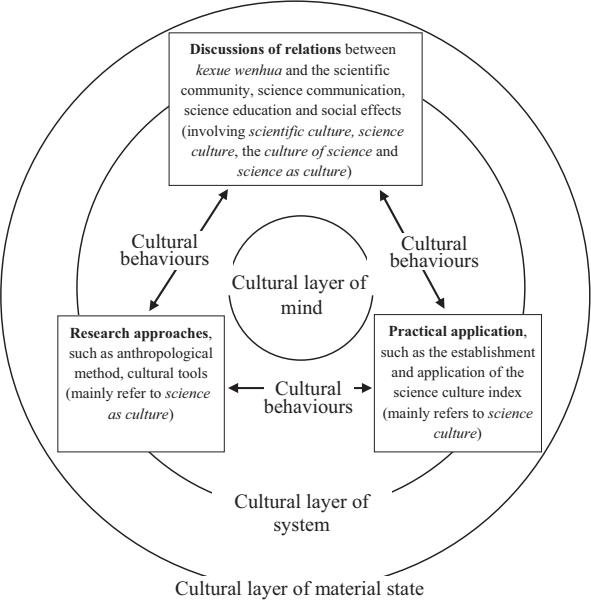
The structure of kexue wenhua.
In the structure of kexue wenhua, multiple meanings of ‘scientific culture’, ‘science culture’, the ‘culture of science’ and ‘science as culture’ are based on the cultural layer of material state with the cultural layer of mind being the core, the cultural layer of behaviour being the circulatory system, and the cultural layer of system being the framework. The three perspectives mentioned in the previous paragraph are correlated with each other, constituting a network of cultural behaviours, such as learning about kexue wenhua from the scientific community or public science literacy; promoting public understanding of kexue wenhua and even the local culture through science communication; exploring science and culture from a social perspective through establishing an index; and using anthropological or cultural tools to study kexue wenhua. If we take various cultural behaviours as individuals, and take the multiple meanings of kexue wenhua as groups comprising the individuals, then according to the relevance of cultural behaviours we can formulate ‘a series of criteria for assessing relationships between different individuals, between individuals and the groups, and between different groups’ (Zhang and Fang, 2013). These criteria are important factors in the network of kexue wenhua and can be considered as a part of the ‘social norms developed in humans’ social practice' (Zhang and Fang, 2013), which will develop into the cultural layer of system. To be more specific, the following process can serve as an example of establishing a series of criteria by conducting various cultural behaviours and assessing their relations, the final result of which is an index system of kexue wenhua in China.
First, explore the status quo of communication of kexue wenhua in China (discuss relations involving scientific culture, science culture, the culture of science and science as culture; see Figure 1).
Second, discuss the particularity and localized characteristics of kexue wenhua using anthropological approaches, and analyse the different contexts in which communicators understand kexue wenhua (research approaches, mainly referring to ‘science as culture’).
Third, make an analysis of the advantages and disadvantages of kexue wenhua (discussion of relations) according to the science culture index (practical application, mainly referring to ‘science culture’).
Fourth, establish a native index system and evaluate the construction and communication of kexue wenhua in China (practical application).
In practice, the index system can be refined according to the multiple meanings of ‘scientific culture’, ‘science culture’, the ‘culture of science’ and ‘science as culture’. If we take astronomy as an example, the four English phrases can be described as ‘astronomical culture’, ‘astronomy culture’, the ‘culture of astronomy’ and ‘astronomy as culture’. ‘Astronomical culture’ focuses on the characteristics of this subject, such as the basic role of physics and the astronomical observation methods, and mainly relates to Western astronomy and science education; ‘astronomy culture’ focuses on the exploration conducted by science centres or planetariums; the ‘culture of astronomy’ focuses on the role of astronomy in PUS and informal education; and ‘astronomy as culture’ emphasizes the relevance of astronomy to the humanities and social sciences.
Similarly, we are able to expand this refined index system into other subjects of natural sciences (physics, chemistry, biology, and so on), which involves both the discussion of relations (between kexue wenhua and the scientific community, science communication, science education and social effects) and research approaches. Therefore, we may find that the perspective of practical application as a part of kexue wenhua reflects the whole structure of kexue wenhua. It is obvious that the three perspectives cannot be separate from one another. Therefore, we further suppose that the perspective of discussions of relations and the perspective of research approaches can also reflect the whole structure of kexue wenhua, which tells us that this structure may be self-comparable.
Footnotes
1
Gustav F Klemm was an influential German ethnographer and the founder of anthropology. His publications included a 10-volume edition of The History of Human Culture (1843–1852) and a two-volume edition of General Science of Culture (1854, 1855) (Xiao, 2012).
2
Yan Yongjing (1838–1898), a native of Shanghai, graduated from Kenyon College, Gambier, Ohio, USA, in 1861. He subsequently returned to China and devoted his efforts to the spread of Western knowledge. He was the first scholar during the late Qing Dynasty to translate Western humanistic and social scientific works into Chinese (Xiao, 2012).
3
William AP Martin (1827–1916) was an American missionary and a senior professor at the School of Combined Learning and subsequently at the Imperial University of Peking.
4
On 31 March 2018, we searched for papers based on the search phrase kexue wenhua through the China National Knowledge Internet ( /), attempting to find major researchers in this field based on five criteria: the number of articles published, the frequency of being cited, the frequency of being downloaded, content relevance (whether the article focused on the meaning of kexue wenhua) and the sustainability and depth of the research.
5
This is from a conference held in the China Hall of Science and Technology on 30 June 2016. Martin W Bauer delivered the academic report Mapping the Culture of Science and Innovation.
6
We used Taylor & Francis Online, Web of Science, JSTOR and SpringerLink as the search engines to identify studies containing no fewer than two of the English phrases and to examine the frequency of occurrence of those phrases in the texts and whether they were a major research focus.
7
Science as Culture, which was launched in 1987, is currently the only Social Sciences Citation Index journal with a title containing one of the four English phrases. Published by Taylor & Francis (Routledge), with 25 volumes available at the time of this writing, the journal is intended to be read at leisure and to be a pleasure. The fields covered by the journal include bioethics; business, management and accounting; contemporary social theory; cultural studies; economics, finance, business and industry; genetic sociology; humanities; technical management; technology and innovation management; social policy; social science; social theory; sociology and social policy; and the sociology of science and technology. It is the only source of critique of science development and places science within the wider debate on the values that constitute culture. The journal claims to publish articles that are readable and jargon free. See .
8
Although Li Xingmin observed that the terms ‘culture of science’ and ‘scientific culture’ were difficult to distinguish, it is obvious that kexue wenhua is totally equivalent to ‘scientific culture’ for Li (Li, 2007).
9
The structure of culture (Feng, 1988): From the perspective of cultural morphology, culture should be regarded in its entirety, comprising an inner core and several outer layers. It is composed of four layers moving from the outside to the inside: the cultural layer of material state, which comprises various tools created by humans from nature that reflects ‘materialized knowledge’; the cultural layer of system, which includes various social norms established through social practices; the cultural layer of the behaviour, which consists of prescriptive practices in interpersonal interactions; and the cultural layer of mind, which is the core of culture and composed of subjective factors, such as values, aesthetic inclinations and thought that gradually developed through long-term social practice and the conscious activities of human beings.
Author biographies
Yiming Zhang is a PhD candidate in the philosophy of science and technology at the University of Chinese Academy of Sciences.
Zengyi Zhang is a professor at the School of Humanities, University of Chinese Academy of Sciences. He received his PhD in the philosophy of science and technology from Peking University. His research expertise covers science communication, analysis of scientific information and scientific methodology.