




Abstract
This article presents a cultural competence-based (CCB) framework to analyse contemporary science culture. Starting from the observation that two separate views of culture-as-context and culture-as-practice cannot address the ongoing transitions in the contemporary sciences towards esoteric–exoteric trans-sphere governance and multicultural science, we introduce key ideas from ‘older’ varieties of competence-based culture theories. We argue that a spectrum of cultural and sociocultural systems shapes contemporary science culture by being (un)supportive of individual scientists acquiring cultural competence and guiding scientists’ research practices. In contrast, individual scientists’ cultural competence shapes the fabrication of cultural and sociocultural systems through their scientific practices, thereby shaping contemporary science cultures. We also synthesize different concepts of science culture, reflect the transitions in contemporary sciences and construct three dimensions of the cultural system, sociocultural system and cultural competence from various elements. By providing a conceptual framework that contributes to a better understanding and management of contemporary science culture, we hope to enhance effective work ethics and fit-for-purpose science knowledge to address emerging ‘wicked’ societal challenges.
Introduction
Contemporary sciences have transitioned by merging the operations and management of different academic and research organizations with a complex web of cultural competences (Schiele, 2018). The transitions have led to significant institutional changes. These changes include shifting from value- to economy-based and entrepreneurial thinking (Beesley, 2003) and from esoteric to esoteric–exoteric trans-sphere governance (Irwin, 2021). For example, the current One Consortium of International Agricultural Research Centres (CGIAR) transition is a dynamic reformulation of the CGIAR partnerships, knowledge, assets and global presence for greater integration and impact. The transitions are also aided by formal science training, informal and unconscious learning, and the increasing application of interdisciplinary and transformative approaches to address societal challenges effectively (Horst, 2022). Such institutional transformations have implications for the cultural divide in multicultural science (Prasad, 2005), cultural and epistemological assumptions, and scientists’ cultural competence (Irwin, 2021).
Contemporary sciences are social and cultural endeavours, involving a long history, an extensive philosophy, dynamic revolutions and the concurrent doing of science. Thus, science culture 1 has become a central term in the literature on science's governance and ethics, education, communication and commercialization, and public perception (Bauer et al., 2007). Over time, different concepts of science culture have been developed, defined and adopted, including ‘the two cultures’ (Snow, 1956), ‘border crossing culture’ (Aikenhead, 1996), ‘public understanding of science’ (Miller, 1992) and ‘multicultural science’ (Harding, 1994). The debate over ‘science culture’ often involves the two viewpoints of culture-as-context and culture-as-practice (Bauer, 2015).
The definition of science culture as well as its development, measurements and outcomes must be better grounded to develop a common foundation for science-culture-related research (Burns et al., 2003; Song et al., 2013). Additionally, there is an overdetermination of general and Eurocentric constructions of ‘Western modern science’, and an epistemological and interpretive focus is exclusively applied when analysing contemporary science culture (Jegede, 1997). Therefore, a better framing and assessment of science culture is desirable for establishing the degree to which society participates in contemporary science (Du Plessis, 2022).
Contemporary science culture is a process in which individuals and communities of scientists practise cultural competence in doing science to produce and reproduce systems and patterns of shared symbols and meanings that guide knowledge development and use. It is developed by scientists and is driven by incentive schemes and the scientific and social norms of the current social and scientific systems (Casadevall and Fang, 2012). Such competence-based science culture views scientific practices and knowledge formation as contingent and intimately connected to social interests (Latour and Woolgar, 1986; Prasad, 2005). The acquisition of (science) culture is dependent upon and dialectical with multiple sources of cultural materials (Keesing, 1974), reflecting an active vision of the cultural acquisition process.
To develop an analytical framework for understanding contemporary science culture, this article examines persistent adherents of ‘older’ narratives of competence-based cultural thoughts (Allaire and Firsirotu, 1984) to draw new insights. It is evident that integrating complex cybernetic systems of humans-in-environments in culture as sociocultural systems and focusing on individuals and collectives in culture as ideational systems are needed to understand different actors’ cultural changes, multiplications and acquisitions in specific contexts. Thus, in this study, we reflect on (1) what the spectrum of cultural and sociocultural systems means to scientists’ research practices and (2) how cultural competence configures scientists’ creation (legitimacy) of cultural and sociocultural systems in scientific practices.
Given ongoing public debates over science culture as context and practice, a competence-based cultural perspective will provide a theoretical background for analysing the dynamic culture of contemporary science. The subsequent sections present different science culture concepts, followed by a synthesis of cultural theories and other cultural-competence models and a discussion of the cultural competence-based (CCB) framework. The debate reflects the framework's contributions to science culture and outlines four pathways to operationalize it in practice. The conclusion summarizes the limitations and suggests the empirical settings in which the framework can be applied.
Science culture
Science culture is theorized based on its uses (Godin and Gingras, 2000). Bauer (2012) suggested two main perspectives: culture-as-context and culture-as-practice. The former views science as exoteric (i.e., public), as it can be examined through the broader context of science in society and explores how citizens understand and use it. It is reflected through theories such as scientific literacy, public understanding of science, and science and society (Diaz Costanzo and Golombek, 2020). It is ‘an integrated societal value system of scientific content, processes, and social factors that appreciates and promotes science and widespread scientific literacy’ (Burns et al., 2003: 189). Miller (1992) identified three dimensions through which science is shared with the public understanding of its norms and methods, key scientific terms and concepts, and its impacts on society. Laugksch (2000) identified three aspects of scientific literacy, including being learned (having required science content and intellectual abilities), being competent (relying on shared stores of science content and knowledge) and being able to function in society. This formal vision of scientific literacy is often supported by informal and incidental learning (Nonaka et al., 2014), which usually occurs as a by-product of some other activities; therefore, it is difficult for scientists to recognize.
Scholars view culture as symbols embedded in the cognitive structure of science (e.g., scientific norms, methods and concepts) and the symbols’ functional abilities in the culture-bearers’ actions. Although additional emphasis has been placed on the cultural environment in which science and society interact, the assumption of science culture in these themes derives from a narrow perspective. The perspective, therefore, limits itself to the super-importance of technical aspects, scientific literacy levels and participation in decision-making on public affairs. This view ignores broad public participation and a wider view of the contextual and behavioural dimensions of science culture (López Cerezo and Cámara, 2007). Furthermore, this perspective presents individual and social dimensions of science culture. It reinforces the analysis of sociocultural perspectives and multifaceted aims for communicating science among the public, professional practitioners and schools (Song et al., 2013). Bauer (2012: 296) emphasized that ‘as both external and internal structures constrain human actions, the “objective world” is no proxy for the “subjective world”, nor vice versa. Culture is a product of the material (objective) and the symbolic (subjective), and for cultural development, individual or collective, both factors matter.’
Bauer (2012) proposed two indicators that can unravel science culture. Social indicators assist in the design of messages, drive the choice of channels and assess public understanding as an outcome of scientific communication. Cultural indicators are symbol systems; that is, co-evolving processes of written and spoken references to science in many life contexts. Science culture is presented daily, so people can make decisions and behave based on diverse elements of their judgement (López Cerezo and Cámara, 2007). Nevertheless, empirical studies in this field show a striking contrast between science culture as a value system exclusive to scientists and academics and as a means for society to access science and technology (Mede and Schäfer, 2020).
‘Culture-as-practice’ views science as esoteric (i.e., abstract) from society and reflects how scientists think, act and behave within the confines of science culture. In this perspective, science culture is socially constructed and developed when scientists interact with each other and reproduce values and behaviours (Krugly-Smolska, 1996). The perspective is embedded in studies of ‘the two cultures’, ‘border crossing culture’ and ‘multicultural science’.
‘The two cultures’ (Snow, 1956) describes two separate and even hostile cultures of (natural) science and the humanities, which not only speak different languages but live in ‘two worlds’. One specializes in ethics, aesthetics, history and culture, while the other focuses on understanding and controlling nature's laws. However, this perspective no longer applies to contemporary science due to radical social, intellectual and institutional transformations (Jegede, 1997).
‘Border crossing culture’ has emerged as an alternative, which looks at science culture as a set of norms, values, beliefs, expectations, practices, methods and conventional actions shared by communities of scientists (Aikenhead, 1996). In this case, science culture—the process and result of scientific activities—is seen as a way of explaining and representing the world (Jegede, 1997). Thus, science culture is the symbolic system of the accepted scientific norms, values, beliefs, knowledge sets and methodologies that are professionally related, and individuals and communities of scientists legitimize the symbolic system through their professional activities.
‘Multicultural science’ is a concept that is intensively used for analysing the governance and ethics of contemporary science and science education (see, e.g., Harding, 1994, 1998; Krugly-Smolska, 1996). It emphasizes analysing the epistemological aspect of science culture and mapping cultural differences onto an underlying hegemony (Harding, 1998; Prasad, 2005). Particularly important to this perspective is understanding the multicultural aspect of science as the reification of science culture within the constructed image of Western modern science, ignoring the networks of power and administration embedded in the environment in which scientific research occurs (Chun and Shamsul, 2001).
The different notions of science culture are distinctive in the ways they assess science and its culture: science-in-using and culture-in-context, science-in-doing and culture-in-practice, and science-crossing-borders and borders-crossing-cultures. The variations in science-culture concepts have emerged from different scientist groups, differentiated mainly by the researchers’ sociocultural and educational backgrounds, world views, disciplines and degrees of scientific embeddedness (Aikenhead, 1996). For example, science culture is a subculture of the society in which scientific activities occur (Godin and Gingras, 2000; Hess, 1997). Science culture also belongs to and is embedded in scientific communities (López-Vergès et al., 2021).
In practice, these perspectives often influence the professional activities of individuals and communities of scientists. The cultural aspect of science always reflects border crossings between (1) individuals’ life–world cultures and science culture, (2) humanistic and science cultures, (3) business and science cultures, (4) different scientific disciplines, and (5) Western and non-Western science perspectives and practices in contemporary science (Aikenhead, 1996).
In the contemporary world, science is a trans-sphere, involving interactions with ethnically different populations, and science culture is dynamic with a continuous acquisition process carried out by individual actors under the influences of other contextual and cultural systems. Hence, the critical questions are how to conceptualize science culture empirically to investigate it in the science community's current transitional frame and for sharing, communicating and crossing its borders. A more integrative perspective reflected in the concept of cultural competence is needed to understand culture and how it is developed in contemporary science.
Theory of culture
Cultural theorists propose diverse and complex theories of culture that may be characterized by their assumptions, slants and emphases (Allaire and Firsirotu, 1984). Keesing (1974) distinguished between two perspectives on culture. First, the evolutionary perspective views culture as sociocultural systems in which cultural and social realms are integrated. Second, the locality perspective of culture is an ideational system in which cultural realms are inferred ideational codes that exist behind the realm of recognizable events. Inspired by Keesing (1974), Allaire and Firsirotu (1984) further distinguished four schools of thought each in both the ‘culture as sociocultural systems’ and the ‘culture as ideational systems’ perspectives.
Culture as a sociocultural system can be studied through functionalist, structural-functionalist, ecological-adaptationist and historical-diffusionist perspectives (Allaire and Firsirotu, 1984). For functionalists such as Malinowski, culture is an instrumental apparatus by which a person is better positioned to satisfactorily cope with a specific problem in a particular time and space. Cultural manifestations such as social institutions, myths, traditions and customs function continuously because they serve basic human needs and interests. To structural-functionalists such as Radcliffe-Brown, culture is a component of a consolidated social system, including the social structure, that maintains an orderly social life in each environment. It is also an adaptive mechanism by which humans maintain societal equilibrium with their physical environments.
Ecological adaptationists such as White, Harris and Meggers see culture as a system of socially transmitted behavioural patterns. For example, technological patterns, economic organizations and religious beliefs relate human communities to their ecological settings. Historical diffusionists such as Boas, Benedict and Kroeber frame culture as temporal, reciprocal, super-organic and autonomous configurations resulting from historical events. Thus, cultural changes occur through an adaptation process, leading to the natural selection and mitigation of cultural traits by system and place.
Keesing (1974) argued that culture as a sociocultural system relates to behavioural patterns associated with groups of people. Sociocultural systems include economic domains (e.g., subsistence, technology, and productive units’ economic and social organization) and ideational realms (e.g., religion, ideology, political organization and art). Allaire and Firsirotu (1984) conceived of sociocultural systems holistically as organizations in which the ideational component interlocks with the social structure components. Hence, a sociocultural system can be analysed as a complex cybernetic system of humans-in-environments that links cultures to social systems, ecosystems, and an individual's psychology and biology.
Culture as an ideational system entails cognitive, mutual-equivalence, structuralist and symbolic perspectives (Allaire and Firsirotu, 1984; Keesing, 1974). Regarding the cognitive approach, those such as Goodenough suggest that cultures are functional cognitions organized into a knowledge system in the minds of those who use the culture to perceive, believe, evaluate and act in acceptable ways. Regarding the mutual-equivalence perspective, philosophers such as Wallace believe that culture is a set of standardized cognitive processes located in the minds of those who bear it. This perspective creates a general framework for the concerted prediction of the behaviours of individuals who interact in a social setting. It also allows individuals with very different motivations and cognitive orientations to organize collectively to strive and participate in the social life of a community.
For structuralists such as Levi-Strauss, culture comprises shared symbolic systems that are the mind's progressive creations. Here, cultural elaborations are generated in a cultural domain that includes myth, art, kinship, language and individual principles (Keesing, 1974). From the symbolic perspective, those like Schneider hold that culture is a system of meanings and symbols shared by social actors. Culture can be seen as a set of shared codes of meanings and/or categories or ‘units’ and ‘rules’ about relationships and modes of behaviour. For cultural theorists, the cultural and the social realms are distinct but interrelated; each reflects the other, but each must be considered on its own terms (Keesing, 1974).
Conceptual disagreements, however, arise between the social predominance of shared common meanings and understandings when individuals engage in social relations and internalize their private experiences. The disagreements also lie in the collective ideational system in which culture is separated from an idealized individual's mind and psychodynamics to reduce cultural systems to cognitive ones (Keesing, 1974).
Although definitions of culture vary, many emphasize that it has been shared and adapted at some point and is transmitted across time and generations (Triandis, 1994). Culture as a system of competence is a theory of what individual actors know, believe and mean. It is also a theory of laws followed and rules obeyed in the society into which an individual was born (Allaire and Firsirotu, 1984; Keesing, 1974). Thus, culture as competence should not be viewed solely as a collection of symbols fitted together but also as human actions guided by cultural principles and rules about the game of life and how it is to be played under the pressures resulting from a wide range of social environments (Keesing, 1974). This view allows the cultural competence concept to be widely adopted in different fields. In the health discipline, cultural competence is an ongoing process of developing and achieving abilities to work effectively in culturally diverse environments and professional respect for cultural attributes, both differences and similarities (Bartlett, 1998). School education defines cultural competence as a dynamic growth process that occurs through ongoing questioning, self-assessment, knowledge and skill-building (Sue, 2001).
Organization study theorizes cultural competence as a system of symbols and meanings shared by an ambient society and an organization's history, leadership and contingencies, differentially shared, used and modified by the way actors behave and make sense of organizational events (Allaire and Firsirotu, 1984). Culture is developed, maintained and changed in an organization with three interrelated components: a sociocultural system, a cultural system and individual actors. The sociocultural system comprises the interworking of formal and informal structures, strategies, policies, management processes and other ancillary components of an organization's reality and functioning. The cultural system embodies the organization's expressive and affective dimensions in the system of shared and meaningful symbols manifested in myths, ideologies, values and multiple cultural artefacts. The individual actor has endowments, experiences, a personality, a status and leadership roles, and contributes to meanings based on cultural competence.
Powell (2020) postulates that competence and cultural competence are not separate constructs, and a competent clinician must be able to work with clients from diverse cultures. Greene-Moton and Minkler (2020) refer to it as a binary construct. Cultural competence constructs are generally related to continually gaining awareness, knowledge and skills rather than focusing on a finite learning process (Tehee et al., 2020). Thus, cultural competence is ‘an ongoing process to achieve the ability to work effectively with culturally diverse groups and communities with a detailed awareness, specific knowledge, refined skills, and personal and professional respect for cultural attributes, both differences and similarities’ (Suh, 2004: 96).
Cultural competence is required in interactions with different populations, such as teachers and students, staff and clients, and doctors and patients (Suh, 2004). The health, psychology and school-education conceptualizations of cultural competence have not mapped the complex cybernetic system in which individuals practise, construct and acquire culture. The conceptualization in the organizational study literature integrates notions of the individualization and collectivization of culture as an ideational system and the humans-in-environments aspect of culture as a sociocultural system. However, a conceptual framework capturing the cultural competence dimensions is needed to help direct the analysis and interpretation of culture change and acquisition in specific professional settings.
Contemporary science culture and a CCB framework
Contemporary sciences view the ‘traditional sciences’ as ‘scientific enterprises’. Major transformations in the latter have changed the nature of scientific practices from ‘primary-academia science’ to ‘contextualized science’. Driven by economic factors rather than values (Beesley, 2003), the transformation process leaves the contemporary sciences internally and externally vulnerable. Contemporary sciences involve trans-sphere scientific practices embedded in both the esoteric and exoteric spheres of science, and these practices are influenced by a multicultural environment and the scientific symbolic system that exists in scientists’ minds. Public communication, consultation and participation mechanisms have been introduced in practice in the exoteric sphere, creating spaces for science and the public to meet and engage in the collective construction of knowledge claims. Scientific practices and knowledge formation are contingent and intimately connected to social interests (Prasad, 2005). Therefore, ‘to be successful, today's scientists must often be self-promoting entrepreneurs whose work is driven not only by curiosity but by personal ambition, political concerns, and quests for funding’ (Casadevall and Fang, 2012: 891). To this end, scientists must close the gap between science and the scientific product's utility by researching for publishable contributions to the literature and scanning the results for their commercial and intellectual potential (Ambos et al., 2008).
Contemporary sciences are distinguished principally by their institutions, procedures and technologies, arising principally in one geographical locale (Chambers and Gillespie, 2000). Contemporary science culture is thus contingent and dialectically related to its historical, political and sociotechnical contexts (Prasad, 2005). Two essential issues must be addressed in any analysis of contemporary science culture: (1) Which perspective should be used to view contemporary sciences? (2) Should contemporary sciences be viewed through a non-material prism only or through a combination of the material and the non-material? Figure 1 indicates the proposed CCB framework for analysing contemporary science culture.
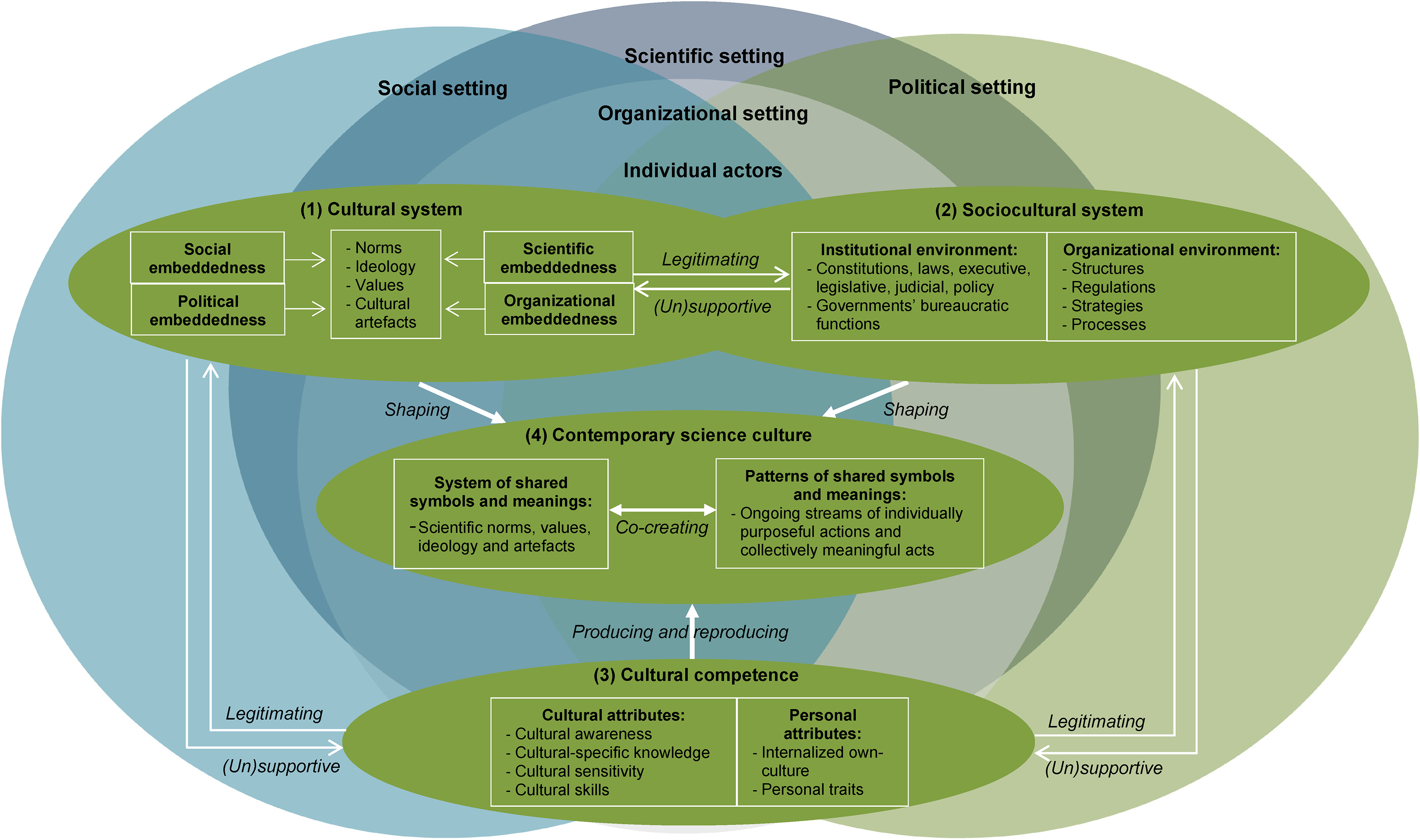
Cultural competence-based framework for analysing contemporary science culture (inspired by Allaire and Firsirotu, 1984: 214).
Inspired by the organizational culture framework developed by Allaire and Firsirotu (1984), the CCB framework places contemporary sciences in a multifaceted context constituted by social, political, scientific and organizational settings. Social settings are spaces where individuals solve problems through interactions with their social contexts as they do science and learning. Sociocultural theory indicates that social settings’ interactive norms and knowledge resources shape collective and individual agency (Billett, 1996). The political setting comprises political institutions, structures and rules of governance that regulate scientists’ societal functions and resolve conflicts in their internal and external relationships. The scientific setting offers opportunities for doing science, communicating among peers and learning, peer review and quality control, disseminating science outputs, representing professional interests, giving policy advice, and addressing societal needs. The organizational setting establishes an organizational climate—a form of acquired competence—guiding and enabling individuals to interpret the demands of and make sense of their ongoing interactions with an organization and its members (Allaire and Firsirotu, 1984).
These settings embrace both institutional and embeddedness environments. Institutional environments have fundamental legal rules or consist of formal socioeconomic institutions that establish the basis for individuals’ professional practices and behaviours (Williamson, 2002), forming the sociocultural system. Meanwhile, embeddedness environments encompass traditions, norms, religions, cultures, conventions, beliefs and sociopolitical imperatives set in social, political, scientific or organizational settings, founding the cultural system. Such a multifaceted context forms three interrelated dimensions for individual actors’ actions in doing and observing contemporary sciences to develop contemporary science culture: the cultural system, the sociocultural system and cultural competence.
The cultural system consists of shared meanings and symbols shaped by social, political, scientific and organizational embeddedness, manifested in norms, ideology, values and cultural artefacts (Granovetter, 1985).
In this framework, social norms refer to shared beliefs and statements about expected behaviour. They constitute informal rules that facilitate, motivate and govern joint actions of organizations and individuals (Nee, 2005). These structural systems shape political, scientific and organizational norms and become informal rules that influence scientific systems, individual behaviour and scientists’ research and practices.
Ideology is a unified and symbolic system of beliefs that provide encompassing, compelling and often mythical explanations of social reality (Allaire and Firsirotu, 1984). In contemporary science, the social, political, scientific and organizational ideology is a set of ideas proposed by a society, a dominant group of the society, a political system, a scientific community or a key actor in a scientific organization that establishes scientists’ and academia's goals, expectations and actions.
Values are symbolic interpretations of reality that provide meanings for social actions and standards for social behaviour (Allaire and Firsirotu, 1984). In this framework, values are critical and lasting beliefs or ideas about what is good or bad and desirable or undesirable that emerge from social, political, scientific and organizational systems, and they are shared by scientists and the academic community. These values influence scientists’ attitudes and behaviours. They serve as broad guidelines in their action-in-doing science and may affect academic publishing, competitive funding processes, and journal and grant peer-review guidelines (Hallonsten, 2022).
Cultural artefacts, specifically scientific and organizational ones, include scientific literacy, metaphors, traditions, customs and physical attributes (such as equipment, scientific knowledge, software and knowledge-production modes) created by scientists to provide information about their organizations’ cultures.
Sociocultural system
While the cultural system accommodates the informal aspects of embeddedness, the sociocultural system embraces formal elements in the institutional and organizational environments. The institutional environment embeds formal regulatory rules, including constitutions, laws, executive, legislative, judicial, bureaucratic functions of government, and distribution of powers (Williamson, 2002). These are monitored and enforced by the state that governs scientific and academic systems and shapes the incentive structures in these systems. As contemporary sciences have embraced a new social contract of dialogue, transparency and consultation with the public and engaged in broader stakeholder engagement, the institutional environment is essential in the shifts in scientific governance and cultural philosophy (Irwin, 2021).
The organizational environment captures the functioning or the interworking of formal structures, strategies, policies and management processes, such as formal goals and objectives, authority and power structures, control mechanisms, reward and motivation, the process of recruitment, selection and education, and sundry management processes (Allaire and Firsirotu, 1984). In this regard, individual actors, through their collective actions, selectively adopt a set of formal regulatory rules to make them agree more closely with their organizations’ interests.
Cultural competence
The CCB framework highlights two subcomponents of cultural and personal attributes that can increase individuals’ cultural competence. Cultural attributes consist of four common factors.
First, cultural awareness relates to becoming appreciative of and sensitive to other cultures’ values, beliefs, lifeways, practices and problem-solving strategies (Campinha-Bacote, 1999). It also entails examining one's cultural prejudices and biases towards other cultures and engaging in an in-depth exploration of one's cultural background (Suh, 2004). Furthermore, cultural awareness consists of cultural-general knowledge of the complex environment in which an individual's profession is located. Such knowledge can apply to any cultural environment and includes the know-how to work effectively in a cross-cultural environment (Johnson et al., 2006).
Second, cultural-specific knowledge is an educational foundation used to understand other cultures, including learning about other cultures’ world views, languages and cultural elements, such as historical, political, social and economic factors (Suh, 2004). Such knowledge can be factual knowledge of a country's history, political and economic systems, institutions and social structure(s). It can also be conceptual knowledge or the understanding of a cultural group's value system and how values are reflected in people's behaviour (Johnson et al., 2006; Tang, 2019). These types of knowledge are explicit, are easily transmitted through different forms of communication, and can be readily assessed.
Cultural-specific knowledge can be attributional knowledge or appropriate behavioural awareness that builds upon factual and conceptual knowledge to correctly attribute the individual's behaviour to the target culture. Such knowledge is tacit, informal and personal. Informal knowledge is highly contextual, social and challenging to convey in the formal, structured setting of contemporary science. The situated nature of this knowledge requires a detailed analysis of the organizational context and processes to unravel what is being learned, how and by whom (Fuller et al., 2003).
Third, cultural sensitivity is the individual's intentional and affective perception and recognition of cultural diversity and differences, and an accepting attitude (Suh, 2004).
Fourth, cultural skills are relevant to cultural assessments, communication skills (Suh, 2004), foreign language competence, adaptability to the behavioural norms of different cultural environments, effective stress management or conflict resolution, and an individual's capacity to acquire additional abilities in a specific skill set (Johnson et al., 2006).
Personal attributes include an individual's cultural and personality traits (Johnson et al., 2006). An individual's culture consists of the values, beliefs and norms (Johnson et al., 2006) that the individual internalizes from the cultural system. Internalization shapes individual scientists’ ways of behaviours when doing science. Personality traits are supporting or hindering antecedents to the effective acquisition of (scientific) culture, skill and/or practices that exist as material forms for cultural development (Johnson et al., 2006). These antecedents include emotions, interests, motives, ambition, courage, curiosity, decisiveness, enthusiasm, fortitude, integrity, judgement, loyalty, perseverance, self-efficacy and tolerance of ambiguity. In the attributional complexity of monocultural and bicultural contexts, antecedents are also related to cross-cultural competence and effectiveness outcomes. They may exhibit incremental value over established personality traits in predicting them (Lakshman et al., 2021).
Contemporary science culture
Contemporary science culture results from the actions of individuals and their social groups in a codependent relationship with the cultural and sociocultural systems and cultural competence. The behavioural assumptions underlying the CCB framework are that rationality is multicultural and contextually bound, and that individual actors, with their cultural and personality attributes, strive to construct a coherent culture-related picture and practices to orient them to the goings-on in an organization. Interactions among individual actors in the same social setting lead to the exchange of culture-related pictures and practices, forming that social group's culture. Individuals and communities of scientists with various cultural competence levels perceive different social functions of science and legitimate different sets of cultural and institutional materials as their ways of being responsible for the integrity of their work and outcomes. These ways are ongoing streams of individually purposeful activities and collectively meaningful actions towards doing sciences. These activities and actions shape a system of scientific norms, values, ideology and artefacts shared among the scientific community and with public stakeholders. This system of shared symbols and meanings guides the ongoing streams of doing science (Groves et al., 2016). Cultural competence enables scientists to build the capacity to work effectively across multicultural contexts and to have a multidimensional world view of issues. Increasingly, most scientists are acquiring unique skills in community engagement, multistakeholder forums, action research and participatory research approaches.
Interconnecting individual actors and their actions, the cultural system of contemporary sciences provides cultural raw materials that facilitate, motivate and govern scientists’ professional actions. The sociocultural system provides formal institutional constraints and mechanisms that direct scientists officially as they do science. Cultural competence provides tools and know-how to assist scientists in using these cultural raw materials, operating under institutional constraints and applying mechanisms for constructing science culture (Yuan, 2018).
In normal circumstances, the relationship between cultural and sociocultural systems is mutually supportive: the former bestows legitimacy upon the latter, and each receives support and reinforcement from the other (Allaire and Firsirotu, 1984). However, the relationship may be disrupted due to abrupt and discontinuous changes in these systems or their malfunctioning. Scientists might favour using one system over another to enhance their chances of survival and secure advantages in scientific, economic and political spheres. Likewise, the relationship between cultural competence and the cultural/sociocultural system should be mutually supportive. It may be disrupted due to scientists’ incompetence in institutionalizing guidance from the two systems and because of unsupportive functioning and changes or conflicts in the two systems that motivate scientists to maintain the general level of legitimacy over their other interests.
Discussion
This article, as a theoretical reflection and synthesis of the literature, proposes a conceptual framework for analysing contemporary science culture from a nuanced perspective and for understanding science culture. The article argues that contemporary science culture is multidimensional (Gazni et al., 2012; Prasad, 2005) in the esoteric–exoteric trans-sphere of contemporary sciences (Gauchat, 2015).
Insights into the CCB framework
The CCB framework contributes to the science-culture literature in various ways. First, it sheds light on the interrelationship paradox among the multiple-contextual and embeddedness environments that affect research in contemporary sciences, especially those operating in the institutional void. Doing contemporary science is a multilocal activity involving collaboration among academic organizations and between academics and businesses from the national to international levels (Gazni et al., 2012). Therefore, contemporary science culture crosses different cultural borders of science, humanism and business, and involves different science cultures (Prasad, 2005), scientific disciplines (Gazni et al., 2012), knowledge-production modes (Beesley, 2003) and institutional settings in which scientists and scientific activities are situated.
The cultural system materializes from embeddedness factors such as norms, values and cultural artefacts in various social, political, scientific and organizational environments within which individual scientists are situated. These factors form a set of informal institutions (Chambers and Gillespie, 2000) that guides individual scientists in doing science-related behaviours and the constructs of a system of shared symbols and meanings—one component of the contemporary science culture. The sociocultural system is built partly by a formal institutional environment or public laws, legislation and constitutions that direct science in a broad context (Gauchat, 2015; Irwin, 2021). The organizational environment contributes to the system with a scientific structure, operational regulations, procedures, functions and processes. The system (un)supportively influences the development of individual scientists’ cultural competence and sets an institutional framework within which patterns of shared symbols and meanings are constructed.
Second, the CCB framework reveals the uniqueness of cultural competence in shaping contemporary science culture by highlighting the elements that characterize cultural competence, their functions, and the factors that influence individual scientists’ acquisition of the competence. Cultural competence is credited to an individual scientist's personal and cultural attributes (Bartlett, 1998; Suh, 2004). It determines the individual's abilities to resolve cultural differences (Johnson et al., 2006) and shapes the ongoing streams of their purposeful actions and collectively meaningful acts. It also determines the transfer of existing norms, ideologies, values and cultural artefacts into shared symbols and meaning systems for the contemporary science culture. These dimensions are reproduced in contemporary science culture through systems, ongoing shared symbols and meaning patterns. The dimensions also shape contemporary science culture by shaping the cultural competence of individual scientists and their communities.
Cultural competence has process and content features (Johnson et al., 2006); that is, individual scientists with a high level of cultural competence have cultural awareness, specific knowledge, sensitivity and motivational incentives to legitimate and adapt different features of cultural and sociocultural systems into their culture-as-practice. They also have the cultural skills and abilities to function effectively in the contemporary scientific setting and to engage in adaptive behaviours to culture-as-context (López Cerezo and Cámara, 2007).
Cultural competence can (re)construct the identity by which scientists cultivate new scientific practices and cultures. Given contemporary sciences’ dysfunctionalities and threats from diverse anti-science and political forces (Casadevall and Fang, 2012), culturally competent scientists rationally respond to system incentives such as scientific discovery, publication prestige and quantity, grant funding and social impacts in (re)constructing ‘meanings’ from the materials provided by the multiple-contextual and embeddedness environments in which research practices are embedded (Casadevall and Fang, 2012). These reconstructions then factor in individual scientists’ decisions to tailor their research and scientific practices to different settings and missions of contemporary sciences, making new sense of the multiperspective science. This explains the dynamic processes by which cultural competence is acquired and reveals a trans-sphere perspective of reflecting on the contemporary science culture's science-in-doing and science-in-society aspects.
Finally, cultural competence moves beyond individual actors’ abilities to make sense of a collection of symbols, meanings, codes and rules of the games under the pressure of multiple social environments, as Keesing (1974) and Allaire and Firsirotu (1984) argued for. Furthermore, cultural competence is an ongoing process in which individual scientists decode existing cultural and sociocultural systems to reproduce sense-making cultures and scientific structures, produce scientific practices, and cultivate and translate these practices into contemporary science culture. This process does not exist in a vacuum but occurs as a scientist interacts with his or her scientific communities and various actors in a multifaceted context (see Figure 1).
Operationalizing pathways
The CCB framework is centred on the transitions experienced in contemporary science communities. Operationalizing the framework in contemporary science settings can take various pathways, as illustrated in Figure 2. Positioned along these pathways are individual scientists and their communities who can use the framework based on their capabilities and desires. Operationalizing each pathway requires joint efforts from scientists and their communities to engage with diverse contextual environments, disciplinary cultures and methodological approaches. As core groups of agents, they engage and attract the participation of other actors and stakeholders in the multifaceted context.
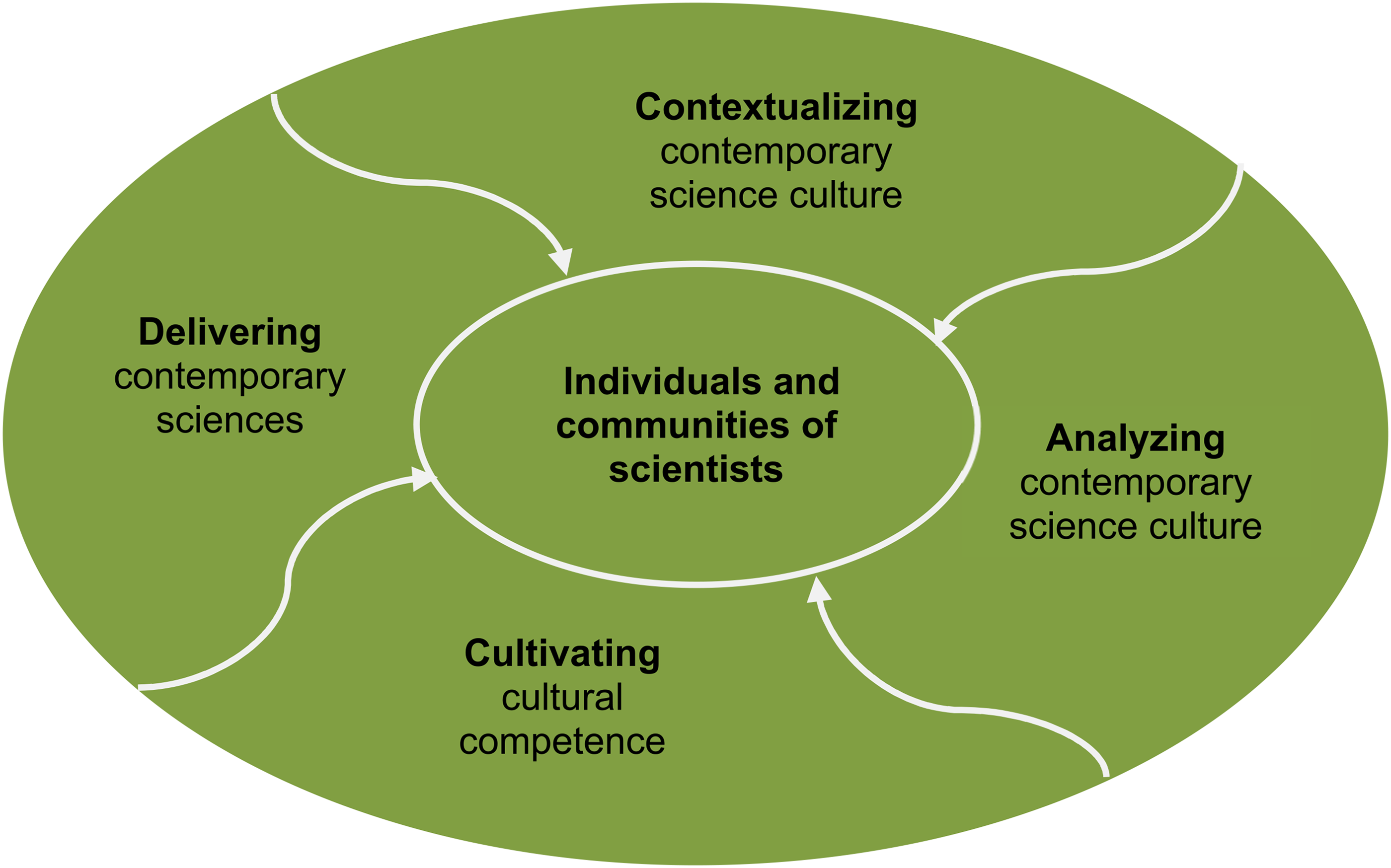
Pathways to operationalize the CCB framework.
The contextualizing pathway situates contemporary science culture within diverse cultures such as the professional, disciplinary, governance and ethnic, as well as within global, local, social and political contexts. The pathway considers the fundamental political and economic changes in science's role in the contemporary world and the risks, uncertainties and ethical queries concerning such changes. The political changes require social legitimacy, and the economic changes are vital for moral legitimacy. Both must be closely related to contemporary science culture. Power and administration networks embedded in the organizational environment in which research occurs matter for understanding the multicultural aspect of science culture (Chun and Shamsul, 2001).
The analysing pathway considers using the CCB framework to examine the contemporary science culture from a multilevel perspective in a nuanced way. It centres on the micro-level view, scientists’ actions, the psychological and cognitive world, and how individuals perceive and fabricate the complex social, political and ecological systems. The pathway analyses scientists’ concrete behavioural patterns in doing science and the controlling and governing mechanisms of these behaviours. It anchors acquiring these patterns with elements from various embeddednesses in which scientists exercise sciences. Analysing the acquisition of contemporary science culture should entail a system of symbols and meanings located in scientists’ minds, the products of their shared minds, and the sociopolitical settings in which they act. These factors require researchers to take contemporary science culture's symbolic, interpretive and agency elements seriously and to engage with rich, in-depth and longitudinal data and interpretive methods attained through a combination of qualitative, quantitative, (game) experiment and multi-grounded theory approaches.
The cultivating pathway incorporates cultural competence into strengthening institutional capacity pipelines and capabilities for early- and mid-career researchers to conduct impactful science-deliver research. Cultural competence refers to scientists’ ways of thinking, acting and interacting among the multifaceted contexts, societies and material objects that shape their ways of doing science together. Acquiring cultural competence is essential for scientists to use the surrounding multicultural system to fabricate their science culture. Hence, it is critical to cultivate scientists’ and their communities’ capabilities to manoeuvre between cultural and sociocultural systems so that scientists and their communities can decode the institutional and organizational environments and embeddedness and enact their cultural competence to produce systems and patterns of shared symbols and meanings of contemporary sciences.
The delivering pathway emphasizes the adaptive management of contemporary sciences, practical work ethics and knowledge productivity to address societal problems within a transforming science community. It also serves as an entry point for supporting early-career researchers as they understand the contemporary science culture within their expertise and strengthen their cultural competence. These effects can be confirmed only when scientists and their communities enact and translate their cultural competence into innovative science governance, new research modalities and collaborative processes to deliver large-scale impacts.
The transformation of contemporary sciences requires more insightful empirical analyses, a science-culture understanding and cultural competence. This article proposes a CCB framework that bridges contemporary science knowledge gaps. In outlining critical conceptual dimensions of cultural competence and scientific, organizational, political and social embeddedness, the framework combines existing but largely separate bodies of knowledge on the culture-as-practice and culture-as-context aspects of science culture. The framework is critical to ensure that the ongoing transformations are well understood in terms of their benefits and drawbacks so that these can be effectively managed within the context of the cultural differences existing among individual scientists and their communities, scientific disciplines and organizations, and societal arrangements and actors.
This study acknowledges several limitations for further consideration. The proposed framework has not been operationalized in empirical contexts, nor have causal relationships been established between individual scientists’ interactions with their research communities and their acquisition of cultural competence. Applying the framework is highly relevant and has potential for scientific settings at the high curve of refining the nuanced nature of contemporary science culture. The One CGIAR transition is one such setting in which more than 9000 scientists, researchers, technicians and staff have exercised their cultural competence to construct the science culture of delivery and impact. The empirical application of the framework will also generate important insights into blending science culture from the emerging transitions of traditional teaching universities to an entrepreneurial educational agenda.
Footnotes
Declaration of conflicting interests
The authors declared no potential conflicts of interest with respect to the research, authorship, and/or publication of this article.
Funding
The authors received no financial support for the research, authorship, and/or publication of this article.

Notes
Author biographies
Thai Thi Minh is a senior researcher leading innovation scaling research at the International Water Management Institute (IWMI). She holds a PhD in agricultural science from the University of Hohenheim, Germany, and has more than 25 years of experience working in development research in Asia, Africa and Europe. Her research interests focus on innovation systems and scaling, food systems, and action research approaches to engaging multiple actors and stakeholders across sectors.
Charity Osei-Amponsah is a senior regional researcher and deputy country representative at IWMI. She has a PhD in rural development sociology from Wageningen University. Her research spans over 15 years and focuses on social transformation analysis and climate resilience building, innovation systems, agricultural partnerships, governance, institutional and political economy analysis in food, land and water systems.