




Abstract
Biotechnology, as an emerging technology, has drawn much attention from the public and elicited hot debates in countries around the world and among various stakeholders. Due to the public's limited access to front-line scientific information and scientists, as well as the difficulty of processing complex scientific knowledge, the media have become one of the most important channels for the public to get news about scientific issues such as genetically modified organisms (GMOs). According to framing theory, how the media portray GMO issues may influence audiences’ perceptions of those issues. Moreover, different countries and societies have various GMO regulations, policies and public opinion, which also affect the way media cover GMO issues. Thus, it is necessary to investigate how GMO issues are covered in different media outlets across different countries. We conducted a comparative content analysis of media coverage of GMO issues in China, the US and the UK. One mainstream news portal in each of the three countries was chosen (People's Daily for China, The New York Times for the US, and The Guardian for the UK). We collected coverage over eight years, from 2008 to 2015, which yielded 749 pieces of news in total. We examined the sentiments expressed and the generic frames used in coverage of GMO issues. We found that the factual, human interest, conflict and regulation frames were the most common frames used on the three portals, while the sentiments expressed under those frames varied across the media outlets, indicating differences in the state of GMO development, promotion and regulation among the three countries.
Introduction
In the late 20th century, the world became fascinated by the promise that biotechnology held for dealing with medical, environmental and agricultural challenges (Cao, 2018). Those technological advances have been applied to various scenarios, such as disease diagnosis and immunization in medical treatment and healthcare and the cultivation of crops with specific traits such as resistance to pests or tolerance of herbicides in agriculture. However, unlike applications in the biomedical field, which are seen as less controversial, the application of agricultural biotechnology (agritech), especially genetically modified organisms (GMOs), has always been met with public doubt and strong opposition because of its ‘unnaturalness’ and possible consequences for people's health and the environment (Cao, 2018).
Concern over GMOs has not been limited to certain countries but has swept across the globe, thus deepening the public's fear about modern science and technology. Understanding modern sciences and technologies, such as biotechnology, nanotechnology and climatology, has become an increasingly complex task, as these disciplines have both high levels of uncertainty and risk and the potential to benefit society greatly. These characteristics of modern science and technology make it harder for laypeople to comprehend (Yeo and Brossard, 2017). Moreover, these technologies have become integrated into daily life in a highly sophisticated and unprecedented manner (Yeo and Brossard, 2017); it is therefore important that discussions of these issues take account of their social, ethical and cultural aspects, rather than only the scientific ones. In the case of GMOs, for example, although for the mainstream academic community there is no difference between consuming genetically modified (GM) crops and those cultivated more traditionally, there is a great deal of public concern about the safety of GM crops and their possible adverse impact on health (Lull and Scheufele, 2017).
However, the public rarely has direct access to GMO-related studies or scientists in this discipline (Scheufele, 2007); besides, without relevant professional training, it is almost impossible to process such sophisticated scientific information. Thus, the media, especially the legacy media, play an essential role in the transmission and interpretation of GMO-related knowledge and information (Listerman, 2010; McCluskey et al., 2016), affecting the public's opinions and attitudes towards GMOs (Clark and Illman, 2006) as well as the policymaking process concerning biotechnology (Lundy and Irani, 2004; Maeseele and Schuurman, 2008; Pollock et al., 2017). Media may influence people's understanding and perception of scientific issues through agenda setting and framing (Lundy and Irani, 2004; Meraz, 2009). When delivering scientific messages, news media tend to select issues to cover and make certain aspects of an issue salient and then emphasize the importance and value of the selected aspects over others, thus providing the public with a lens through which to look at and consider the issue (Entman, 1991; McCombs and Shaw, 1993; Nisbet and Scheufele, 2009; Scheufele, 2000). Even in the face of the impact of social media, mainstream media have retained their agenda-setting influence, which operates through both print and online channels (Ceron et al., 2016; Harder et al., 2017).
Several factors affect the way that GMO issues are covered, such as the news system, GMO policy, economic and agricultural development, the overall scientific atmosphere, and values in various regions and countries (Nisbet and Lewenstein, 2002; Pollock et al., 2017). For example, during the period examined in this study, China was actively carrying out research and development (R&D) work, while the commercialization process was slow, as experts in China were watching for any change in attitudes towards GMOs in other countries (Williams, 2003). Meanwhile, in the US, GM crops and foods were not regarded as different from their non-GM equivalents; there is thus no law or institution established in the country specifically for the regulation of GM products (Cao, 2018). The UK follows the regulatory framework of the European Union, which requires applications for permission to use GM products to be decided on a case-by-case basis (European Commission, 2000). These factors may further influence the choice of frames through which information about GMOs is presented and the sentiments conveyed under those frames in different social contexts.
Hence, our study sought to understand the differences in news framing—and the differences in the sentiments expressed behind the various news frames—of GMO issues among mainstream news portals in China, the US and the UK. This study should serve as a useful tool to understand how GMO issues were constructed in different societies and to observe public attitudes towards them, allowing us a glimpse of the interwoven conditions among scientific innovations, political and economic considerations, and public opinion. The three countries were chosen mainly due to differences in their GMO policies and GMO-related R&D. Moreover, public opinion towards GMO issues also varies among the three countries.
Literature review
This section considers GMO issues, risk communication and framing theory.
GMO issues and risk communication
Agricultural biotechnology is an emerging technology: its R&D is still in progress, and the further commercialization of its products is still under heated discussion among the various stakeholders in society (Pidgeon et al., 2017). Despite overwhelming academic consensus on the safety of GM crops and foods, the public expresses its concerns about consuming such products out of consideration of issues such as their potentially harmful impact on health and the environment and the violation of the laws of nature and ethics. This reflects Akin and Scheufele's (2017) view that the public does not perceive scientific issues from a purely scientific perspective; instead, social, cultural and ethical dimensions are all included in people's assessments of these emerging technologies. This may also reveal the complexity of communicating modern science to the public, as these topics have become deeply embedded in society and can strongly affect people's lives.
One of the critical factors that make communicating GMO issues challenging is that modern science has developed so rapidly that laypeople cannot process or understand it (Jamieson et al., 2017). Under these circumstances, scandals relating to food safety and biotechnology that have taken place in different countries may make people's impressions of biotechnology and genetic modification even worse. For example, in 2002, the international non-governmental organization Greenpeace revealed that several food products, including baby formula, that contained GM ingredients were being sold in Chinese supermarkets without the public being aware of those ingredients (Cao, 2018). Since then, Chinese consumers’ demand for GMO labelling and insistence on people's ‘right to know’ has begun. Several subsequent food safety scandals, such as those involving melamine-contaminated baby formula and clenbuterol-contaminated meat, have further heightened public concern over and opposition to GM foods and weakened public trust in the government (Cao, 2018).
In the US and the UK, the findings of several published studies have sparked heated public debates about the possible adverse impacts of GM crops and foods on animals or the environment. For example, a study conducted by researchers at Cornell University, stating that Bt corn pollen might harm monarch caterpillars, was published in Nature in 1999 (as cited in Cao, 2018). This elicited the public's worry about GM crops’ detrimental effects on the environment. In 1998, Árpád Pusztai of the Rowett Institute in the UK declared that eating GM potatoes was related to the thickening of stomach mucosa and suppression of the immune system in rats, and that finding was published in the medical journal The Lancet in 1999 (as cited in Cao, 2018). These concerns are manifestations of what Beck (1992) called the ‘risk society’, in which the risks that arise from modern technologies go far beyond the comprehension or perception of human beings.
In this situation, in which most members of the public cannot learn about scientific progress directly from scientists, the media play a vital role in building a channel between scientific advancements and the public (Jamieson et al., 2017; Schäfer, 2012), as well as in the construction of risks and uncertainty. Consequently, the public's perception of GMOs—both their benefits and their risks— is primarily based on messages provided by the media.
Biotechnology coverage and framing theory
How the news media influence the public's attitudes, opinions and choices has always been one of the concerns of political science and communications. McCombs and Shaw (1972) found that, although coverage in newspapers cannot determine how people think about different issues, it can affect what people think. In the case of scientific issues such as biotechnology, nuclear technology, nanotechnology and climate change, which the public has little direct access to or cognitive experience of, people rely heavily on news media (McCluskey et al., 2016; Scheufele, 2007). The public's reliance on media for information about biotechnology, in particular, has been shown by several studies (Marks et al., 2003; Marks et al., 2007; Priest, 1994). Therefore, the influence of the media's agenda setting and framing on the public's attitudes to scientific issues, particularly biotechnology issues, is evident (Meraz, 2009). In other words, the public's ideas about and attitudes towards emerging technologies such as biotechnology can be seen as a reflection of how those issues are covered in the media (Marks et al., 2007).
Notably, media agencies also influence one another's agenda setting in a phenomenon called ‘intermedia agenda setting’ (Heim, 2013; McCombs, 2004). It has been argued that legacy media or traditional mainstream media influence less elite traditional media outlets (Lim, 2006; Meraz, 2009). However, given the rise of newer forms of media and of more channels for the public to use to access information, the number of agenda-setters will also increase, which may contribute to weakening the influence of the traditional media's agenda setting (Ceron et al., 2016; Sayre et al., 2010). Nevertheless, several studies have shown that, even in the context of the internet, the public still turns to traditional media sites such as The New York Times for information (McCombs, 2005) and that legacy media still influence the agendas and coverage of other media outlets, including social media (Ceron et al., 2016; Sayre et al., 2010). Thus, taking this situation and the accessibility of research materials into account, we chose as our subjects one elite traditional media website in each of China, the US and the UK. Each website can be regarded as an agenda-setter on the national level.
Agenda-setting theory has different levels of application, such as issue agenda-setting and attribute agenda-setting (McCombs and Ghanem, 2001; Meraz, 2009). The former is concerned with the media's role in choosing specific topics or issues to transmit to the public, while the latter focuses on highlighting certain features and aspects of a topic for the public (Boydstun et al., 2013)—an idea that overlaps with framing theory. Some communications scholars equate framing with attribute agenda-setting, as both work to make the selected attributes of an issue salient (Boydstun et al., 2013; Park et al., 2012; Scheufele, 2000). Although some voices disagree that framing is identical to attribute agenda-setting (Song, 2007), this is not the focus of the current study, which follows the former vein.
Entman (1991) describes framing as a process of selecting and presenting specific aspects of an issue or event and further illustrating and interpreting those aspects, such as highlighting specific considerations regarding an issue over others. Frames are the angles for media to interpret an issue, as well as the lens through which the public can understand it (Nisbet and Scheufele, 2009). Using frames can simplify complex issues to a certain extent and can also provide a common ground for dialogue between scientists and the public on scientific issues (Nisbet and Scheufele, 2009). Concerning science communication, in which the news media are an essential source from which the public obtains information, the frames used may play an important role, as they are very likely to affect public opinion on the issue.
Moreover, framing theory argues that news frames reflect the cognitive and discursive norms agreed on and followed by individuals and organizations in a given society and historical period, which are influenced by factors such as the nature of news organizations, the process of newsmaking, the ideologies of journalists and the characteristics of information providers (Pan and Kosicki, 1993). Thus, the use of frames may change across time and space and be sensitive to related events and policies. For example, in a study of biotechnology coverage in three regions/countries between 1992 and 1996 and between 1997 and 1999, researchers found that the medical frame was the most salient in US coverage, while food and related frames were prominent in the European elite press (Bauer et al., 1996). In addition, Botelho and Kurtz (2008) revealed that major GMO-related events also influenced the use of frames in biotechnology coverage.
Given that news coverage emphasizes certain aspects of GMO issues over others by using frames, different sentiments may follow. For example, when focusing on the potential hazards of GMOs, the sentiment of the coverage is likely to be negative, whereas the sentiment is likely to be positive when GMOs’ economic benefits are salient in the coverage (Marks et al., 2007). Moreover, the sentiment expressed in news coverage affects public attitudes to the issues. For example, Nisbet and Lewenstein (2001) found that when biotechnology coverage became negative, the public's attitudes towards biotechnology would, in turn, become negative.
As the R&D status of GMOs in China, the US and the UK is different, one would expect differences in their GMO regulations and in public opinion towards GMO-related issues. The consequential differences in the coverage of GMO issues in the three countries are worth investigating.
In an earlier study of GMO coverage in China, Li (2007) showed that the primary frames used were progress and economic prospects and that, as the international debate on the safety of GMO technologies became increasingly heated, the People's Daily started to emphasize legal regulation. Regarding the US news media, Nisbet and Lewenstein (2002) analysed reports on biotechnology in The New York Times and Newsweek between 1970 and 1999 and found that scientific progress and economic prospects were the main frames employed. In the UK, Clayton et al. (1993) found no significant difference in topic selection in the coverage of sci-tech issues between The Times and The Guardian; however, the latter focused more on the negative impacts of science and technology. Overall, very few studies have compared GMO coverage in these three countries; the current study is intended to fill that research gap.
In the studies mentioned above, and using De Vreese's (2005) typology, it was apparent that the media tended to use both generic frames and issue-specific frames when reporting on biotechnology issues. Issue-specific frames, such as scientific progress, economic prospects, ethics, Pandora's Box, runaway, nature/nurture, public accountability and globalization (Bonfadelli, 2017; Eyck and Williment, 2003; Nisbet and Lewenstein, 2002; Schäfer, 2009), are used in covering specific issues, such as healthcare and biotechnology (De Vreese and Lecheler, 2012). Although it is indeed a strength to use issue-specific frames in the coverage of particular issues, as they can deepen the discussion and provide readers with more detail about the issue, it can sometimes become a disadvantage in situations in which, for example, people want to make comparisons of different themes across time in various cultures (Lecheler and De Vreese, 2019; Semetko and Valkenburg, 2000), and that is when generic frames have the advantage.
As our study sought to compare the coverage of GMO issues in three countries, we used generic frames for our analysis. There are seven commonly identified generic frames: factual, conflict, human interest, responsibility attribution, morality, economic consequences and leadership (De Vreese et al., 2001; Zillmann et al., 2004). However, unlike sudden events that require clarity about the responsible parties, the coverage of GMO issues places more emphasis on the responsibility for regulation. Thus, in this study, the responsibility attribution frame was changed to the regulation frame.
Based on the factors discussed above, we aimed to identify the differences in GMO coverage, particularly in the use of frames, among three legacy news media portals in China, the US and the UK. We also intended to explore various sentiments expressed by those media outlets under different frames when reporting on GMO-related issues. To examine the differences in the use of news frames and in the sentiments behind the various frames, the following research questions were put forward:
RQ1: What are the most prominent frames for GMO coverage in mainstream media portals in China, the US and the UK?
RQ2: What are the differences in the framing of GMO issues among mainstream media portals in the three countries?
RQ3: What are the most prominent sentiments expressed in GMO coverage under different frames by mainstream media portals in the three countries?
RQ4: What are the differences in the association of particular sentiments with particular frames for GMO coverage among mainstream media portals in the three countries?
Methods
This section describes our approach to sampling and measurement, including our coding scheme.
Sampling
We chose as subjects for this study articles that covered GMO issues on the websites of the People's Daily (People.cn, http://people.cn), The New York Times (https://www.nytimes.com) and The Guardian (https://www.theguardian. com) between 2008 and 2015. Because China launched a major project to cultivate new varieties of GMOs in 2008, which received considerable attention and thus contributed to the increasing coverage of GMO issues (Cao, 2018), that year was selected as the start of the study period.
We sought Chinese news articles covering GMO issues using the combination of keywords ‘ ’ (genetically modified) and ‘
 ’ (People's Daily website: People.cn), yielding 317 articles from 1 January 2008 to 31 December 2015. We searched The New York Times using the keywords ‘genetically modified’, ‘genetically engineered’ and ‘GMO’ to collect articles. As an additional consideration, only those articles that mentioned GMO-related keywords three or more times were chosen, ultimately yielding 144 articles from The New York Times website. For The Guardian, we gathered articles directly from the integrated GMO-themed webpage on the publication's website, yielding 288 articles. In total, 749 eligible articles (in Chinese and English) were collected. Table 1 shows the number of articles covering GMOs across the three countries.
Number of GMO-related articles on three mainstream media websites
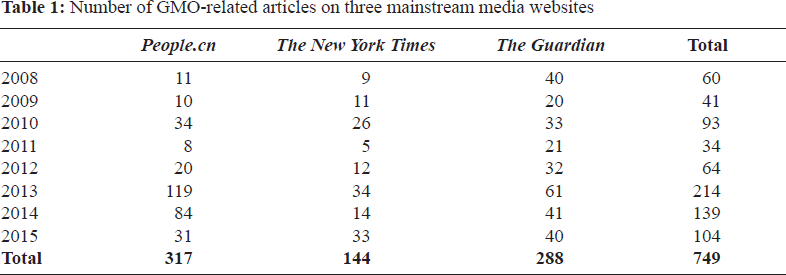
Number of GMO-related articles on three mainstream media websites
Content analysis was used to analyse all news articles selected (n = 749), and the individual article was the unit of analysis.
Coding scheme
For basic information about the news, we coded the sentiment of the coverage. As for the frames, we took a deductive approach (Graham and Wright, 2015). Since one of the study's aims was to use generic frames instead of issue-specific frames to analyse the coverage of GMO issues, the generic frames used in previous studies were adopted (De Vreese et al., 2001; Zillmann et al., 2004), with a slight change to convert the responsibility attribution frame into the regulation frame, so the final frame list comprised factual, conflict, human interest, regulation, morality, economic consequences and leadership (see Table 2). It should be noted that the codes for sentiment and generic frames were mutually exclusive; that is, only one frame and one indicator of sentiment were coded for each article.
Coding scheme

Coding scheme
To ensure confidence in the coding scheme, we conducted an inter-coder reliability test.
Inter-coder reliability (n = 749)
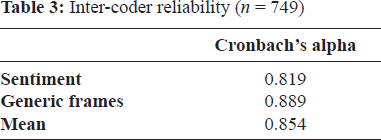
Inter-coder reliability (n = 749)
The coder in the current study invited another coder to code 60 randomly selected articles together but independently (20 from the People's Daily, 20 from The New York Times and 20 from The Guardian). The reliability of the coding scheme was relatively high, with an average Cronbach's alpha of 0.854 on inter-coder agreement. One researcher, who had participated in the inter-coder reliability test, then coded the 749 articles independently.
In this section, we present the results of our analysis of framing and the relative weights of frames and sentiments.
Preliminary analysis: Volume of GMO coverage
Before analysing the frames used in coverage, this section first examines descriptive statistics about the articles analysed and briefly describes some findings and trends. Figure 1 depicts the changes in the number of articles covering GMO controversies on the three websites over time.
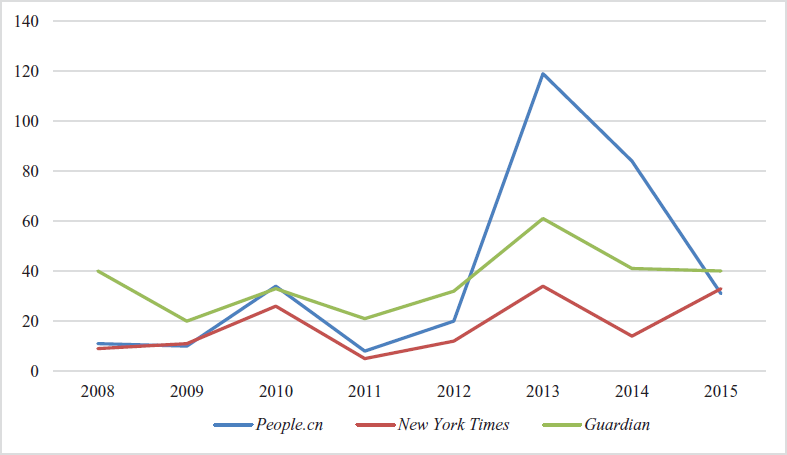
Number of articles covering GMO controversies on the websites, 2008 to 2015
Figure 1 reveals very similar trends in the number of articles covering GMO controversies on the three websites. For example, from 2009 to 2010 and from 2011 to 2013 all three websites showed an upward trend, while from 2010 to 2011 and from 2013 to 2014 they all showed a declining trend. Put alternatively, over the eight years examined, there were five years during which the trend in the number of articles covering GMO issues was similar across the three websites. There is obviously an association between the occurrence of newsworthy GMO-related events and trends in coverage: for example, in 2010, the controversy about GM salmon and changes to policies on GMOs in the UK and the European Union were issues that drew attention from all three websites, indicating that events in other countries may have a strong agenda-setting function for domestic reports. It can thus be argued that the GMO issue is international.
When the situation in each country is examined closely, it becomes evident that changes in the number of articles covering GMOs may be related to GMO incidents that occurred at that time. In China, the ‘golden rice’ controversy in 2012 was a significant turning point in the GMO discourse, after which the GMO agenda entered the People's Daily, marked by the first wave in its trend line. In 2013, China approved the importation of three types of GM soybean from Monsanto and BASF (Cao, 2018) along with other GM crops, which raised concerns about the examination and approval system and the safety of GMOs in China. Subsequently, in 2014, a year of several GMO-related scandals and topical events, the People's Daily carried 84 reports on GMO issues. For example, in 2014, a GM rice that was still at the experimental stage was found to have been released into the environment illegally in Hainan (Cao, 2018) and illegal planting of GM rice was discovered in Hunan.
The amount of coverage in The New York Times was limited and fluctuating. It peaked in 2010, 2013 and 2015. In 2010, reports focused on events such as the approval of GM beets and alfalfa (lucerne) in the US, the assessment of the safety of GM salmon as food, and Europe's loosening policy on GMOs (Kanter, 2010; Pollack, 2010a, 2010b). From 2012 to 2013, two major GMO events drew the media's attention. First, several US states voted on whether to label GMOs (Harmon and Pollack, 2012). Second, GM wheat was found among farmers’ crops in Oregon (Wines, 2013). When GM salmon was approved for commercial production in 2015, the media's attention to GM animals peaked (Pollack, 2015).
Overall, of the three mainstream media websites, The Guardian had the most stable coverage of GMOs, with peaks in 2008, 2010 and 2013. In 2008, Prince Charles made negative comments on genetic modification (Collier, 2008). In 2010, two critical incidents may have contributed to an increase in the amount of coverage: the UK was pressing the European Union to let in more GM products (Lucas, 2010), while the GM salmon experiment was ongoing in the US (Doward, 2010; Kennedy, 2010). In 2012, the destruction of GM fields in the UK gave rise to critical public discussion of anti-GMO activists (Atkinson, 2012). In 2013, the UK's new environment minister, Owen Paterson, who supported GMOs, eased the restrictions on GMOs in the UK (Vidal, 2013a, 2013b).
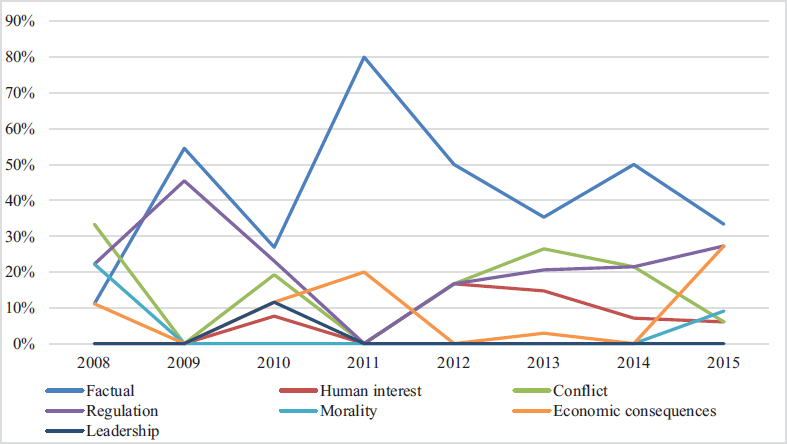
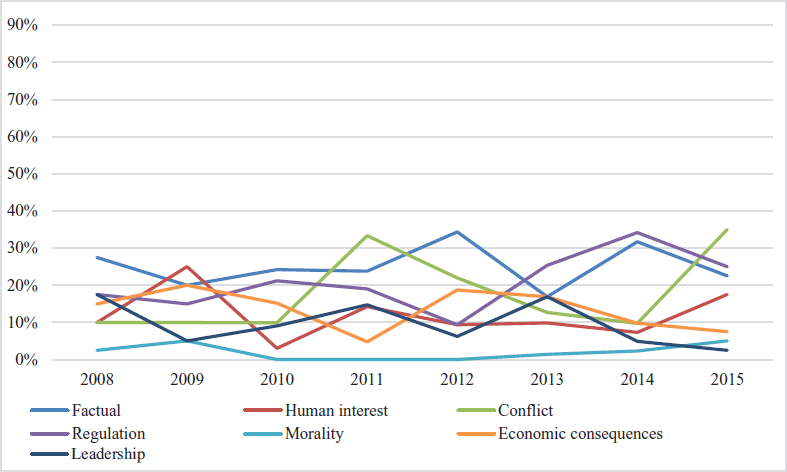
By examining the frames adopted in news coverage, it is possible to learn how the media choose certain aspects of GMO issues to articulate and present to the public. Therefore, the ideas that the media have tried to convey can be deduced via the salient attributes of GMO issues highlighted by media frames. Using generic frames modified explicitly for this study, we sought to determine how the focal mainstream media websites presented GMO issues and changes in the frames used from 2008 to 2015. Figures 2, 3 and 4 show the frames that appeared on the three websites.
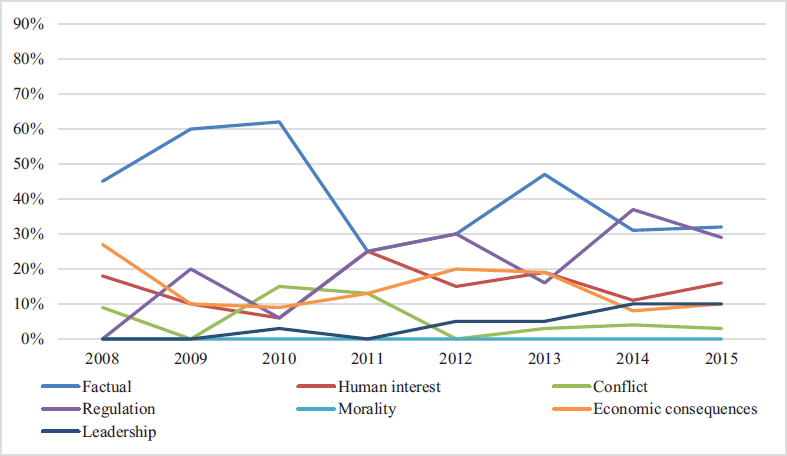
Occurrence of frames on the People's Daily website, 2008 to 2015 (%)
Occurrence of frames on The New York Times website, 2008 to 2015 (%)
Occurrence of frames on The Guardian website, 2008 to 2015 (%)
As shown in Figure 2, the People's Daily website generally gave priority to the factual frame. A total of 132 articles used that frame to cover GMO issues (accounting for 41.64% of all coverage collected from the website), followed by the regulation (22.40%) and human interest (14.83%) frames. The website's emphasis on the factual frame may reflect the newspaper's belief that GMO was not a clear concept for the public; rather, it was an unfamiliar concept and it was very challenging, if not impossible, for ordinary people to understand. Therefore, the People's Daily paid more attention to the facts related to GMOs, perhaps indicating that it sees itself as a provider of essential information.
In 2010, the Chinese Government proposed to accelerate the commercialization of GMOs (Cao, 2018: 67), indicating that its emphasis had changed from research into GMOs to practical applications. In effect, GMOs are no longer just scientific issues, but have entered the public domain. The policy change has affected the use of frames in the People's Daily's coverage of GMO issues. Since then, the overall proportion of the factual frame used has declined slightly, and the use of the regulation and human interest frames has increased.
The regulation frame focuses on the management and regulation of GMO technologies in China; hence, emphasizing the regulation frame indicates that the People's Daily had moved the framing of risk from science and technology per se to related regulatory aspects. This shift echoed a change in the Chinese public's imagination of risk following various food safety scandals in China, which gave rise to a negative impression of food safety regulation that, in turn, spilled over into GMO issues. The human interest frame used anecdotes from ordinary people to convey attitudes to GMOs. The stories were based mainly on GMO scholars and government officials (Lin, 2013).
Human interest is a frame that contains sentiment. Resorting to feelings and emotions, in most cases, is more likely to impress readers. The People's Daily might use that frame as a way to persuade the public or change people's attitudes to GMOs.
Frames used on the New York Times website
As shown in Figure 3, coverage of GMO issues on The New York Times website was also dominated by the factual frame, although its proportion of 37.50% was slightly lower than on the People's Daily website. The regulation and conflict frames were in second and third places, accounting for 23.61% and 16.6%, respectively. The proportion of the regulation frame used in GMO coverage on The New York Times website increased after 2012, when a referendum on GM food labelling was held in California. Since then, debates about GMO labelling have appeared frequently on the website. While presenting opinions from different sides, The New York Times emphasized the public's ‘right to know’ and assumed the role of the public's spokesperson. By 2015, the proportion of the regulation frame used on the website had increased to 27.27%. This trend partially reflected the fact that The New York Times had been following GMO regulatory issues, such as the policy debate over GMO labelling. 1
However, in contrast to previous studies (such as Nisbet and Lewenstein, 2002), the data in our study did not reflect the tendentious use of the economic consequences frame in The New York Times’ coverage of GMO issues, which accounted for less than 10% of overall coverage. One possible explanation may be that there is usually more than one frame present in an article, and the economic consequences frame might not necessarily be the most prominent; thus, it could have been replaced by other frames during the coding process. The same situation may exist in the construction of the conflict frame. Even though multiple, even conflicting, sentiments were presented in an article, those conflicts were based on regulation topics, such as GMO labelling. Thus, the regulation frame took the place of the conflict frame. During the period examined in this study, coverage in The New York Times highlighted the regulation frame, which may be associated with the events that were taking place at that time. In other words, the construction of frames in news coverage is influenced by related events.
Frames used on the Guardian website
As shown in Figure 4, coverage on The Guardian website was dominated by the factual (25.35%) and regulation (20.83%) frames. The conflict frame came next, at 19.44%. In 2013, the regulation frame began to appear at about the time of discussions about the ‘right to know’ about GMOs in the UK and the US. However, because the UK adopted a clear policy that GM foods had to be labelled, the situation in the UK was quite different from that in the US. In this scenario, The Guardian's coverage might have been influenced by the agenda of the media in other countries. The conflict frame was used mainly in discussing whether the UK needed to accept GMOs and whether GMOs could bring benefits.
It is noticeable that the leadership frame was particularly prominent in 2008 (Percival, 2008), when the British Government believed that the UK ought to adopt a different perspective on GMOs. Such remarks recurred over the following years (Carrington, 2014; Quinn, 2012; Stirling, 2013). It could be said that the British Government's attitude to GMOs was generally positive. However, the use of the leadership frame on The Guardian's website decreased after 2008.
Comparison of the frames used by the three media websites on GMO issues
The use of frames by the websites of The New York Times and The Guardian was somewhat similar, suggesting that the two media outlets have similarities in content when covering GMO issues, whereas frames were used differently on the People's Daily website. Our analysis revealed that some GMO issues were highlighted over time while some were gradually ignored, accounting for the use of corresponding frames. There is thus competition between the frames used in GMO coverage.
All three websites highlighted the regulation frame, indicating that the regulatory issue of GMOs was a common concern for people in many regions and reflecting the consensus that GMOs need to be regulated. However, in the coverage using this frame, attribution of responsibility varied. For example, in coverage on the People's Daily website, the Chinese Government was mainly represented as being responsible for GMO regulation. Therefore, many articles that used the regulation frame were related to government supervision and regulation policies in China. By contrast, coverage on The New York Times website suggested that the industry had primary responsibility and that GMO enterprises should promote the establishment of a GMO labelling system. Meanwhile, coverage on The Guardian website attributed responsibility to the European Union and the British Government.
The conflict frame was prominent in coverage by The New York Times and The Guardian. This frame reflected the fact that GMO issues are controversial, magnifying the uncertainty of genetic modification. Under the conflict frame, the media presented the different views of various stakeholders, thus implying the conflicts among them. This practice of balancing the views of various stakeholders is in line with the principle of news neutrality. It also reflected the differentiation of attitudes towards GMOs among different actors in the US and the UK. However, the People's Daily website rarely used the conflict frame, which accounted for only 4.73% of articles. This ratio has continually declined in recent years, which indicates that the People's Daily website might have reduced its coverage of uncertainties and controversies related to GMOs. The human interest frame differentiated the People's Daily website from the other two newspaper websites, transmitting the voices and stories of GMO scholars and government officials who support GMOs, thus making GMOs more familiar to the public in a positive way.
The use of the leadership frame was proportionally similar in GMO coverage on the People's Daily and The Guardian websites. Figure 2 shows that the use of the leadership frame in the People's Daily's GMO coverage has increased steadily since 2012. Government officials, especially Ministry of Agriculture officials, have begun to use the media to spread information about China's strict administration of genetic modification. By contrast, although the proportion of the leadership frame was still high in The Guardian's GMO coverage, it was characterized by a general declining trend during the study period, indicating that the leadership frame became less popular in The Guardian's portrayal of GMO's image.
Through the use of news frames, the People's Daily website has constructed GMOs as an important but less controversial sci-tech issue that needs government regulation. The New York Times portal has presented GMOs as a rapidly growing, well-known, highly controversial issue that calls for stronger regulation. Somewhat similarly, The Guardian has presented GMOs as a well-known but controversial issue with high levels of associated uncertainty that also needs regulatory action.
Cross Comparison: Frames versus Sentiments
The sentiments of all the collected articles were coded to find the overall sentiment expressed in GMO coverage in different countries (see Table 4) and to discuss the possible factors associated with this. Additionally, we sought to investigate whether different sentiments were expressed under different news frames. This section briefly describes the pattern and changes of sentiment in GMO coverage on the three websites. It then cross-analyses between sentiment and news frames in GMO coverage.
Sentiment of GM coverage on the three websites
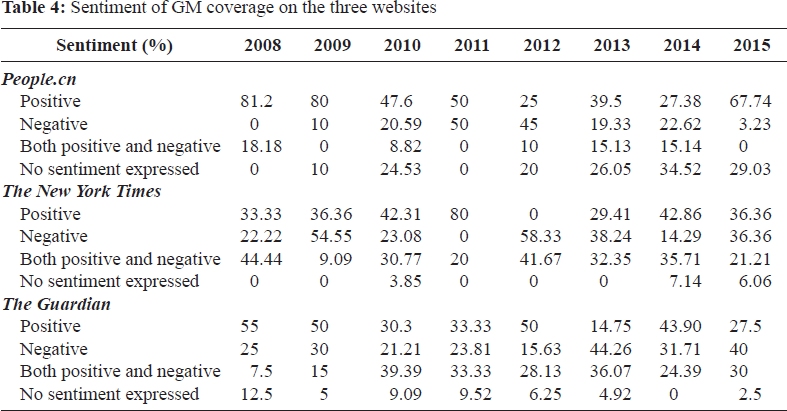
Sentiment of GM coverage on the three websites
The results of a chi-square test (P < 0.001) indicated a statistically significant difference among sentiments expressed on the three websites. The sentiment in coverage by the People's Daily was the most positive. Although GMO coverage sentiment in The New York Times and The Guardian was slightly positive, more coverage expressed negative sentiments, as well as both positive and negative sentiments. Therefore, the image of GMOs may seem somewhat contradictory on the two English-language websites. There is far more coverage lacking expression of any sentiment on the People's Daily website than on those of The New York Times and The Guardian. Articles that did not express any sentiment basically covered the simple facts about GMO issues. At one stage, The New York Times had a large proportion of GMO coverage expressing no sentiment (Priest and Ten Eyck, 2004), but that proportion has been decreasing, indicating that with the gradual maturity of GMO development the media will shift from chasing facts to critiquing GMO issues.
We then explored the differences in sentiment under different frames on the three websites. We performed a cross-comparison of the sentiments expressed in the three portals under the three most prominent frames they used. This left four media frames with which to make cross-comparisons of sentiment among the three portals: factual, human interest, conflict and regulation (see Table 5).
Cross-comparison between prominent frames and sentiment in GMO coverage on the three websites
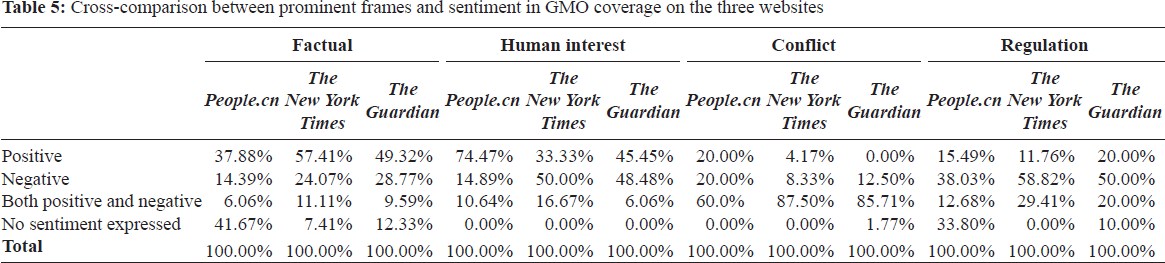
Coverage using the factual frame on the People's Daily website tended to express no sentiment but gave a simple description of the facts, whereas in GMO coverage on the websites of The New York Times and The Guardian this frame was used more often in expressing positive sentiment. As for the human interest frame, GMO coverage on the People's Daily website expressed the opposite sentiment to that of The New York Times and The Guardian: when using the human interest frame, they tended to cover GMO issues negatively. This maybe partly because The New York Times and The Guardian were more inclined to report stories about individuals who oppose GMOs. In contrast, the People's Daily website tended to report stories about government officials and scientists who support GMOs.
As the word ‘conflict’ indicates, the coverage usually contained ideas on opposite sides when using the conflict frame. Correspondingly, the sentiment expressed under this news frame contained both positive and negative sentiments. Although all three websites used the conflict frame in covering GMO issues, they used it in different ways. Unlike The New York Times or The Guardian, which presented confronting ideas to draw out the controversial nature of GMO issues, the People's Daily website focused more on describing conflicts. However, by presenting both positive and negative sentiments in a balanced way, The New York Times and The Guardian made the content more readable and dramatic, regardless of the scientific nature of the GMO issues. This choice may be associated with the pursuit of economic interests by attracting readers’ attention, as these publications differ in that The New York Times and The Guardian are more market-oriented than the People's Daily. In this situation, it may seem inevitable that those newspapers will amplify the uncertainty and risk of GMO issues to draw the public's attention.
In terms of the regulation frame, although the sentiment of coverage on the three media portals was mostly negative, 33.8% of the People's Daily's coverage exhibited no sentiment. In these non-sentiment articles, only the importance of GMO regulation and the government's responsibility for it were mentioned; specifically, many national policies were introduced via the regulation frame. However, coverage in The New York Times and The Guardian attributed responsibility more clearly and directly expressed discontent over inadequate GMO regulation from the government and enterprises.
This section summarizes some key points from the discussion in the previous sections and discusses the differences in covering GMO issues among Chinese, American and British mainstream media portals.
Generally, GMO coverage in Chinese media, of which the People's Daily website was used as an example, was more likely to be susceptible to national policies and key opinion leaders. The preference for using the regulation and factual frames shows that Chinese media tend to set agendas aligned with official voices, and GMO messages were more likely to be transmitted in plain language that was not intended to provoke a public reaction. The US media, represented by The New York Times, tended to report GMO stories from the industry's perspective, emphasizing domestic GMO incidents and policy development. The British media, represented by The Guardian, were inclined to strike a balance between coverage of the benefits and uncertainties of GMOs.
Characteristics of GMO reports on the three media websites
Based on our findings, we summarize the characteristics of GMO reports on the three mainstream media websites in this section.
People's Daily: A tendency to endorse policies
GMO coverage on the People's Daily website showed a sudden increase in 2012, suggesting that national policies and opinion leaders strongly influenced how the People's Daily covered GMO issues. The factual, human interest and regulation frames were the news frames used most frequently on the People's Daily website, and the proportion of human interest and regulation frames exhibited an increasing trend. Moreover, positive coverage was particularly prominent under the human interest and leadership frames. Even under the human interest frame, the individuals covered were mostly scientists and government officials. The articles all reflected, to some extent, the People's Daily website's emphasis on the nation's capabilities in GMO regulation. This characteristic of GMO coverage reflects the People's Daily's tendency to engage in policy endorsement.
The New York Times: A tendency to reflect domestic GMO development
On The New York Times website, scientific progress and national regulatory events were more likely to cause fluctuations in the amount of GMO coverage. This website's GMO coverage heavily used the factual, regulation and conflict frames, and the proportion of the regulation frame increased after 2013, reflecting changes in domestic public opinion and policies on GMO issues. Over the period examined, GMO coverage on The New York Times website that was either positive or expressed no sentiment decreased, while negative sentiment reports increased. GMO coverage in The New York Times focused more on domestic GMO development. This is also consistent with the leading status of GMO companies in the US. Moreover, heavy use of the regulation and conflict frames in GMO coverage was in line with the highly controversial issue of GMO labelling at that time.
The Guardian: A tendency to provide balanced coverage
The Guardian has always paid a high level of attention to GMO issues. Over the study period, its use of the conflict frame increased, containing both positive and negative sentiment. This could partially reflect the UK pausing to ponder the benefits and risks of GMOs, as well as the media's contradictions in covering this issue. By using a relatively neutral sentiment, The Guardian's GMO coverage was balanced, highlighting both the advantages and risks of GMOs. This kind of approach to reporting was affected by the reality of political and scientific development regarding GMOs in the UK. Due to the UK's lagging scientific progress in GMO areas and unsound GMO policies, the content of GMO coverage sometimes needed to be introduced from other countries, presenting different attitudes from the outside world; therefore, UK media may have had little choice on what to cover in GMO news. Over the years, they have been trying to maintain a kind of delicate balance in their coverage of GMO issues.
Reasons for differences among GMO reports on the three media websites
Cultural differences, the current status of GMO R&D and the public's science literacy may all contribute to differences in the construction of GMO issues by the three media outlets. In his work Culture's Consequences, Hofstede (2001) proposed five dimensions for understanding cultural differences, two of which may provide explanations for the differences in the media's construction of GMOs in this study: uncertainty avoidance and individualism versus collectivism.
Uncertainty avoidance
Uncertainty avoidance is the extent to which members of a certain culture feel comfortable (or uncomfortable) about novel and unknown subjects such as GMOs. Those cultures with substantial uncertainty avoidance tend to focus on reducing uncertainty through various means and measures, whereas cultures with low uncertainty avoidance tend to embrace risks and challenges (Hofstede, 2001). In Hofstede's research, among China, the UK and the US, China has the most avoidant attitude towards uncertainty, followed by the UK and then the US. This is consistent with the findings of the current study, in which the People's Daily website was found to be least likely to report on the scientific progress of GMOs, while The New York Times showed interest in the development of GMOs in various fields, exhibiting its confidence in scientific advances.
Individualism versus collectivism
The opposition between ‘individualism’ and ‘collectivism’ concerns the degree to which individuals maintain their individual independence or integrate into groups (Hofstede, 2001). The Chinese and Western cultures differ sharply in this respect. Under the influence of China's collectivist culture, the nation tends to be the priority of the Chinese news media, while the US media's deference to the government's voice is less frequent. Therefore, in GMO coverage, the People's Daily website focused on propagating related policies and educating the public. Furthermore, in the construction of GMO issues, the People's Daily website stuck closely to aspects such as national strategy and national food security, trying to persuade the public through emphasizing community good over the individual.
Additionally, the state of GMO R&D in different countries may also affect how GMO issues are constructed. Although China is accelerating scientific research on GMOs and may commercialize them in the future, the US is currently more advanced in such research. Therefore, the People's Daily GMO reports contained more basic information, such as popular science content, whereas The New York Times published more coverage of new GMO scientific research results.
Limitations and future directions
This study compared the use of news frames in GMO coverage in the mainstream media of China, the UK and the US over an eight-year period. Using framing analysis, we identified the prominent frames used by different media outlets and the changes in their use over time. This may reveal the deeper-level contest over GMO issues among various stakeholders of different societies.
Moreover, this study made innovative use of generic frames, instead of issue-specific frames, to compare media portals across different cultures. This strategy could be used in the future to compare coverage regarding other issues and media forms. However, in this study of the mainstream media in three countries, only one representative media outlet was selected in each country due to limited time and human resources. This is far from enough to understand how GMO issues are constructed by the media in a given country.
Future research could choose more than one media outlet in a country to derive a more comprehensive view. In addition, with the rise of newer forms of media, increasing numbers of people tend to source scientific information from social media. Future studies could also investigate the association between GMO coverage on social media and mainstream media websites and the mutual agenda-setting effects among them.
Funding
The study was supported by the Science Popularization and Risk Communication of Transgenic Biotechnologies project (grant ID: 2016ZX08015002).
Footnotes
1
On 14 July 2016, the US House of Representatives passed the bill on GMO labelling (Cao, 2018: 21).
Author biographies
Yiqin Ruan is a product manager at ByteDance.
Jing Yang is a PhD candidate at the School of Journalism and Communication of Tsinghua University. Her research interests are public understanding of science and new media effects.
Jianbin Jin is a professor at the School of Journalism and Communication of Tsinghua University. His research interests include new media uses and effects and science communication.