




Abstract
This paper uses word frequency statistics and semantic network analysis to analyse text related to genetically modified organisms (GMOs) in microblog in China. We discuss the structure of the main discourses and changes in them over the past decade, explore the reasons for those changes and provide possible references that may be useful when related problems or situations occur in future. We have found that conspiracy theories permeated online discussions and that netizens’ emotions had a nationalist tendency. The GMO issue was highly socialized. Participants in online discussions were from different backgrounds, and the topics went far beyond GMO technology. The public tended to trust the government, rather than experts, while opinion leaders also played a role in guiding public opinion. The keywords in this discussion have gradually changed in recent years from clustering around ‘harmful’ to clustering around ‘scientific’, and new participation models brought about by new media have provided new reference paths for problem solving.
Introduction
As a controversial socio-scientific issue, genetically modified organisms (GMOs) have attracted extensive attention in recent years. In this mediated era, the ‘socialization of science and scientization of society have become prominent features of contemporary society, as communication between science and society has become ever deeper’ (Jin and Xu, 2017). In the debate about GMOs, the public has gradually become indifferent to the scientific nature of agricultural biotechnology. The scientific issue has gradually evolved into a social issue, while the scientific aspects of the debate have been gradually eliminated. GMO technology and its products are closely related to the public's life. When GMO-related events occur, digital media platforms are the sites of much discussion and extremely heated debates. While digital technologies have given more citizens a voice in the debates, different views can hinder the development and promotion of agricultural biotechnology and related knowledge, as well as the formulation of appropriate policies.
At present, although the government offers more support for the GMO industry and helps promote GMO production, and the online debate has come to a relative silent state, there has been no evident improvement in public acceptance of GMOs (Jia and Fan, 2016). Why have debates about GMOs not yet been resolved till now? Some studies have found that the main reason is that the public cannot trust the government and scientists. In other words, there is an insurmountable lack of trust (Jia and Fan, 2015; Jin and Chu, 2015). Some studies have indicated that this is because people in China are susceptible to the traditional Chinese thinking mode of intuitive extrapolation (Fan et al., 2013), making it hard for them to accept GMOs. In addition, some studies have collected data on the media's performance on GMO topics and demonstrated that the audiences’ attitudes have been influenced to some degree by the media chosen by the audiences and the orientation of those media (Cheng, 2016; Xu and Liu, 2018a). Other studies have suggested that experts play a vital role in guiding the public's attitudes (Dai et al., 2015), but that there has been little timely and effective communication between experts and the public (Xu and Liu, 2018b). Such attitude-influencing factors all have rational foundations, but some core elements remain unclear, such as how to enhance communications between science and public opinion and establish a trust mechanism.
In this paper, we contend that only by finding out what the public is concerned about, based on online public discourse, can we identify the key elements that influence people's attitudes, better understand the nature of the debates on GMOs and ultimately solve the communication problem. We describe trends in the public discourse using word frequency statistics and semantic network analysis, and discuss the policies and specific cases that have changed discourse over time.
Changes in the public discourse on GMOs
With the ‘public participation’ shift in science communication, laypeople are able to express their opinions on accessible media platforms and negotiate with other discourses. Gradually, public views about and attitudes to scientific and technological issues have come to be taken seriously and to some extent have affected policymaking. However, the relatively free and relaxed environment for public comment has caused a confrontation between heterogeneous discourses, and the debate about GMOs was born in those circumstances. Generally, the Chinese public's opinions about and attitudes towards GMOs have been greatly affected by online debate and have moved through three discernible stages.
In 2002, the proportion of respondents who thought genetically modified (GM) foods were unsafe was about 13%; due to media reports, online debates and related events, that proportion rose to 45% in 2012 (Huang and Peng, 2015). The ‘golden rice’ incident at the end of 2012 further strengthened people's negative attitude to GM foods and marked a turning point in public opinion about GMOs (Cui and Shoemaker, 2018). At the same time, online debates had an impact on the opinions of offline society and managers, interrupting policymaking and policy implementation.
From 2013 to 2015, the GMO debate became very heated, and the ‘for’ and ‘against’ (‘pro-GMO’ and ‘con-GMO’) factions turned from online to offline, leading to the consolidation of each of the two factions. In most cases, the focus of controversy was not on the technical attributes of GMOs but on issues such as conspiracy theories and the academic ability and integrity of the scientists involved. The debate had a negative influence on decision-making agencies, the public, researchers and scientific research institutions. In 2015, the publication of a clear statement on GMOs in the ‘No. 1 Central Document’, which aimed to popularize GMO-related knowledge, and the Ministry of Agriculture's response to relevant proposals created a temporary pause in the GMO debate (Chen and Zhang, 2016).
After 2015, although the appeal of the con-GMO faction was somewhat weaker, public opinion online did not show a trend towards support for the pro-GMO faction, following the rule of “the spiral of silence”. In fact, both of the two factions are trapped in a state of relative silence (Li and Jin, 2019). This kind of silence does not necessarily mean acceptance, concession or compromise by the two parties. Instead, it occurs because the parties do not pay attention to or actively participate in the debate. Once relevant issues or sensitive events re-emerge, the two sides will be very likely to return to and even intensify the debate. For example, in May 2018, GM golden rice was approved by FDA in the United States, once again triggering a heated discussion among netizens in China.
To explore these phenomena, we proposed two research questions:
RQ1: What have been the topics of online discourse in the three stages of the GMO discussion?
RQ2: What are the characteristics of online discourse in the three stages?
Methodologies
Based on the above discussion, we divided the evolution of online debate concerning GMOs in China into three periods:
The first period, which was the preliminary stage in the discourse, was before 2012. Incidents related to genetic modification had attracted public attention and public attitudes to GMO technology started to become negative.
The second period, from 2013 to 2015, involved much heated discussion. The pro-GMO and con-GMO factions were diametrically opposed to each other, and the discussion had negative impacts on both sides.
In the third period, from 2016, debates between the two factions became calmer after researchers, the government and relevant agencies expressed their opinions.
In this research, we used semantic network analysis to analyse public opinion towards GMOs, as expressed in cyberspace, over time. By using the method, researchers can discern variations in the themes under discussion and infer possible causes for those changes.
Semantic network analysis derives from cognitive science and treats human memory as a structured meaning system. Linguists using this approach claim that it is effective in unearthing hidden structures and latent frameworks of meaning by considering word frequency, word co-occurrence and distances between words (Collins and Quillian, 1972; Danowski, 1993; Doerfel, 1998). By abstracting and simplifying complex texts, semantic network analysis can discern texts’ deep meaning and sum up a number of key dimensions.
Sina Weibo is China's most widely known social media platform. Its technical features and diverse users make it an opinion-exchange space in which competition between heterogeneous discourses is common (Lu and Qiu, 2013). Previous studies have explored network debate and the evolution of discourse on particular issues by analysing the Weibo corpus to track the social ethos (Zheng et al., 2019). Researchers have found that GMO issues are less visible in traditional Chinese media but are being actively discussed on social media platforms (Li and Jin, 2019; Wen and Wei, 2018). Therefore, we adopted the Weibo corpus as raw data for our study.
We retrieved posts by using ‘GM’ as search term, and the advanced search platform of Sina Weibo returned 886,837 pieces of text. A crawler program written by one of us was used to collect the text data. We divided the texts into three chunks according to the development trend of online GMO discussions (Chunk 1, 173,699 texts from 2009 to 2012; Chunk 2, 389,254 texts from 2013 to 2015; Chunk 3, 323,884 texts from 2016 to 2018). We used random sampling to extract 20,000 texts from each chunk as the final sample.
To process the data, we proceeded as follows:
First, we performed a first round of tokenization and compared segmentation results with original texts. We created a customized dictionary to ensure that meaningful terminologies and noun phrases would not be segmented.
Second, we incorporated a list of predefined Chinese stop-words from Harbin Institute of Technology and replenished our specific stop-words list.
Third, we wrote a parallel tokenization program to perform a second round of word segmentation on all texts in the final sample. Considering the words’ scale and informational value, we selected nouns, verbs and adjectives for our analysis by referring to predecessors’ work (Yuan et al., 2013; Zhang et al., 2018). We thus produced a file with precise and accurate tokens.
The frequency and co-occurrence of words were two focuses in our research, as the co-occurrence of words is the bedrock of semantic network analysis. We calculated those two indicators in each period in order to describe and summarize discussions of GMO-related issues over time:
First, we removed duplicate words in each tokenized text and computed combinations of different words. The cumulative value was regarded as the co-occurrence weight.
Second, we excluded co-occurrence relationships including the word ‘GM’, as ‘GM’ was the essential element in every text. This treatment reduced the disturbance of extreme values in subsequent handling (Yuan et al., 2013).
Third, not all words could be displayed in the final semantic networks to reveal clear semantic relevance. We removed duplicate co-occurrence values and sorted the remaining values. The value corresponding to the first percentile point was taken as the truncated value.
We detected communities in semantic networks in each period and calculated several network indicators. Combining visual presentations, high-frequency words and semantic communities, we returned to the original text for qualitative interpretation and decoded the meaning in each semantic community.
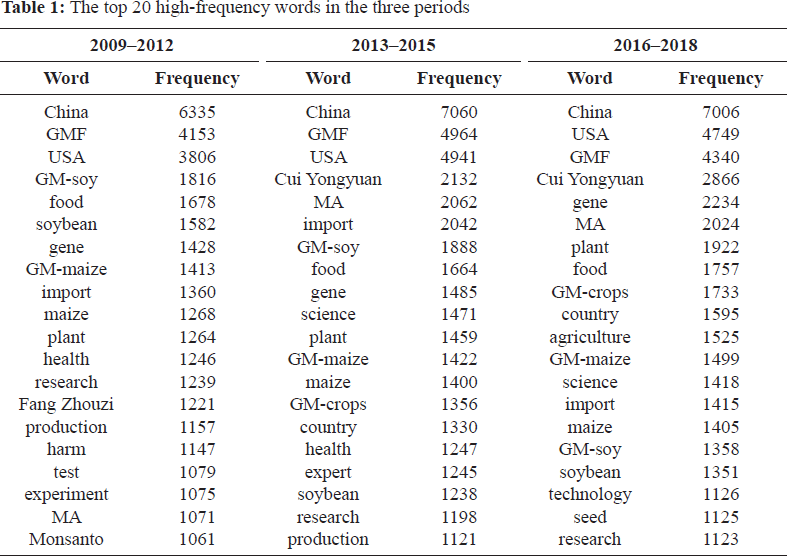
From the word frequency statistics, we found that ‘China’, ‘USA’ and ‘GMF’ (for ‘GM food’) occupied the first three positions in the three periods, which revealed that discussions about GMOs did not stick to their original technical implications but focused more on the game played between powerful countries, the comparison of different policies and the close relation between GMO technology and people's daily life, such as the safety and reliability of GM foods. Since GMO technology is mainly adopted in agriculture, words such as ‘GM-soy’ and ‘GM-maize’ appear frequently. The ‘Ministry of Agriculture’ (MA), as the official department in charge of agricultural production and relevant activities, was also mentioned frequently in our corpus. MA is not only closely involved in the adoption and application of GMO technology in agriculture, but also manages the import, experiments and research of agricultural products.
In addition to the commonalities, there were differences in the three periods. For example, the high-frequency word switched from “Fang Zhouzi” to “Cui Yongyuan”. This clearly reflected a change in the main opinion leader in the GMO discussion before and after 2013 (Fang Zhouzi is pro-GMO, while Cui Yongyuan is con-GMO). The use of ‘harm’, which was a high-frequency word in the first period, declined in the latter two periods, while the use of ‘science’ increased. The rank of ‘health’ decreased year by year.
Such changes reflect the shift of Weibo users’ focus from initial doubts about the risks and health concerns of GMOs to scientific evidence. The results also demonstrate that, with the deepening of GMO technology in all aspects of daily life, public concerns and issues discussed have become more diverse.
The top 20 high-frequency words in the three periods are shown in Table 1.
The top 20 high-frequency words in the three periods
The top 20 high-frequency words in the three periods
Figures 1 to 3 show the semantic networks in the three periods. The nodes in the network represent words, while the edges indicate the co-occurrence relationship between words. We adopted the eigenvector centrality as the indicator to measure the importance of nodes. The higher the eigenvector centrality of a word, the greater its influence in the network (Calabrese et al., 2019) and, accordingly, the larger the node size. In addition, the thickness of nodes’ edges indicates the frequency of co-occurrence between words. The colour of nodes and edges corresponds to the community detection result: nodes and edges in the same community share one colour. Our semantic network rendering follows the Fruchterman-Reingold layout, which is part of the force-oriented layout algorithm. This layout pattern is based on the strength of nodes’ connections, and the resulting visual effect looks smoother compared with other layout algorithms (Fruchterman and Reingold, 1991).
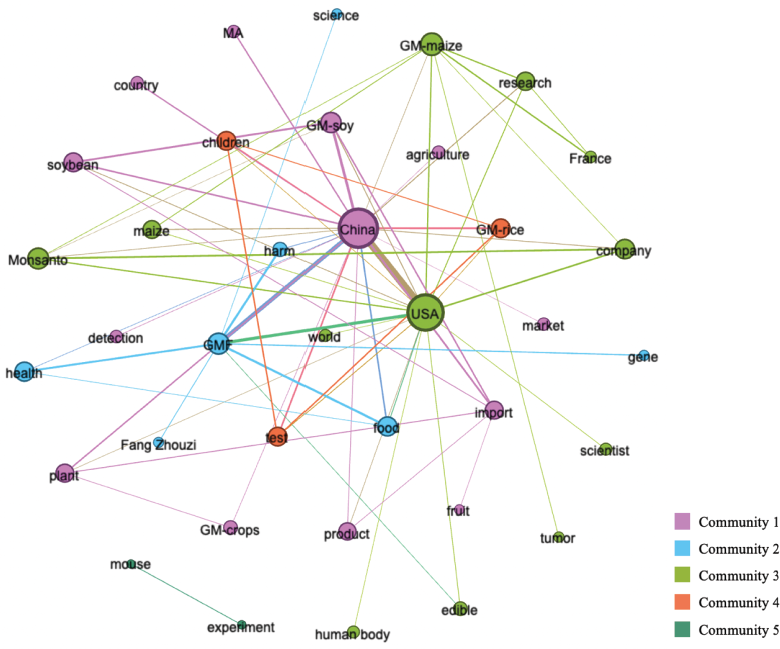
Semantic network of GMO discussion from 2009 to 2012 (no. of nodes: 37, no. of edges: 71, value of truncation: 192)
Figure 1 shows that the largest community in the semantic network from 2009 to 2012 (Community 1, percentage (p) = 35.14%) contained words such as ‘China’, ‘GM-soy’, ‘import’, ‘detection’, ‘country’, ‘market’ and ‘MA’. The co-occurrence of those words revealed public vigilance about imported GM products and public appeals for the urgent detection, labelling and regulation of GM products under the guidance of relevant government departments. For example, Nanfang Daily published an article titled ‘Supplier of Golden Dragon Fish oil is accused of illegal use of GM-soy’ in 2011. As a response to that article, a media account with many followers forwarded the following message:
After questioning and verification, Golden Dragon Fish, an edible oil brand that almost monopolizes the edible oil market of China, used GM-soy without the approval by the Ministry of Health, and the approval for its use of GM-soy by the MA did not follow regular procedures and no safety certificate was granted. This way of entering the market can be viewed as illegal. 1
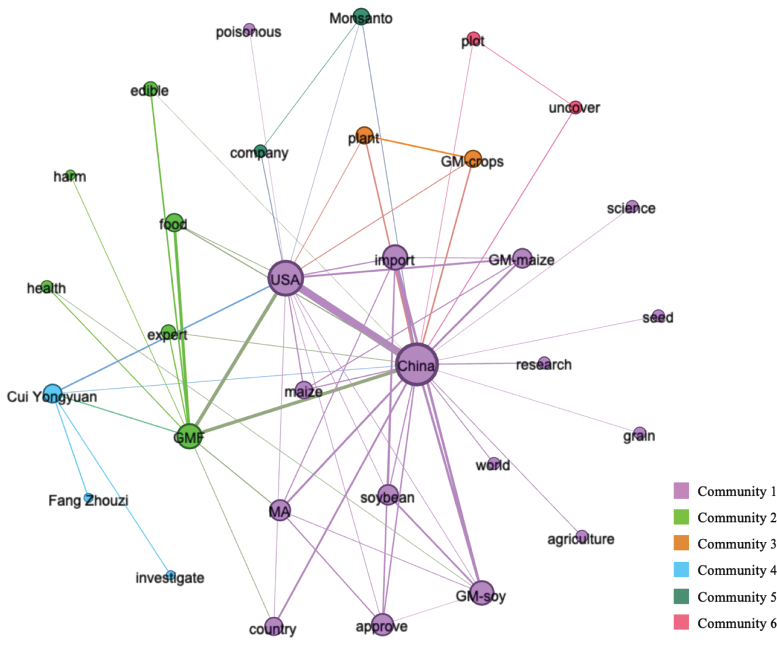
Semantic network of GMO discussion from 2013 to 2015 (no. of nodes: 32, no. of edges: 64, value of truncation: 179)
In Community 2, ‘GMF’ was tightly bound up with ‘harm’ and ‘health’ (p = 18.92%). ‘Fang Zhouzi’, as a most prominent GMO supporter at that time, often appeared along with ‘GMF’, but most Weibo users were inclined to describe him as ‘a GMO promoter with ulterior motives’.
In the discussion online, Weibo users often compared China with other countries. Community 3 included such words as ‘USA’ and ‘France’ (p = 32.43%). The corpus often focused on Americans’ GM food consumption, GMO regulations, and French GMO detection. In addition, ‘research’ carried out in those countries also attracted a lot of attention. For example, one French research institute in University of Caen Normandy published a scientific report claiming that the US GM-maize NK603 would induce tumour and organ damage on experimental mice (Huang, 2012). Negative and critical attitudes pervaded the discussion and even led to a series of rumours and speculations without scientific evidence.
The typical characteristics of GMO discussion during this period were that negative opinions prevailed over positive opinions, the technical attributes of GMOs were far from the centre of discussion, and the prevalence of unproven inferences and lack of evidence jointly contributed to public suspicion and vigilance. Furthermore, the discussions conveyed some tone of nationalism.
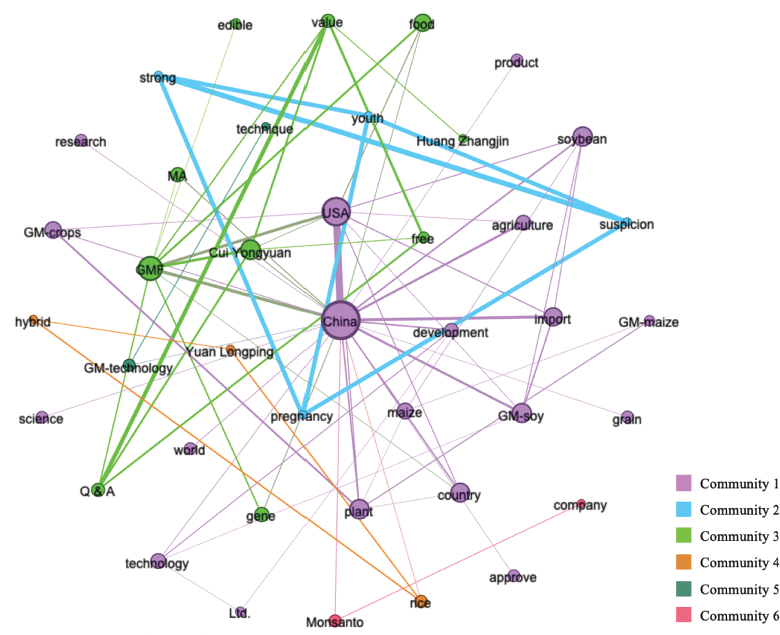
Semantic network of GMO discussion from 2016 to 2018 (no. of nodes: 41, no. of edges: 74, value of truncation: 189)
The semantic network established on the basis of discussions from 2013 to 2015 can be split into six communities. ‘China’ and ‘USA’ were in a quite stable relationship, and those two words had the highest frequency. In the largest community (Community 1, p = 53.12%), words that co-occurred with ‘China’ and ‘USA’ did not differ much from the previous period, but the word ‘science’ occurred and was juxtaposed with ‘China’. In the discussion in this period, Weibo users started to pay attention to scientific experimental evidence rather than believe rumours blindly. Hence, discourses followed objective logic, and logical deductions appeared more often. For example, one article stated:
Although everyone can comment on the GMO issue, the real decision should come from genuine scientists, rather than celebrities who have hundreds of millions of fans, especially singers or movie stars who are fond of giving opinions on professional issues; some of them are incapable of science and mathematics since childhood. As for those political speculators who are likely to be reactionists and anxious to see the world in disorder, there is no need to pay attention to them. 2
In the research corpus, discourse focusing on ‘science’ did not fully represent objective and hard-headed thinking. Some users preferred to see ‘science’ as a target; they held the view that pure science does not exist and that interests and secret intentions were hidden behind ‘science’. Therefore, true science may be covered by deliberate ulterior motives. For example, one article noted:
The core of GMO problems is the combining role of ‘athlete’ and ‘referee’ in the field. They always cheat for huge profits, conceal the scientific truth and harm the nation and its people. This core problem needs to be resolved; otherwise, the so-called ‘safety’ and ‘management’ of GMOs are all nonsense. 3
Doubts about GM food in this period were not completely eliminated. In Community 2 (p = 18.75%), ‘GMF’ is tied with ‘harm’, ‘health’ and ‘edible’. Related arguments that had not been confirmed appeared quite often, and discussions about GM foods were quite active, as food is part of everyone's daily life.
Words co-occurring in other communities included ‘plant’ and ‘GM-crops’ (Community 3, p = 6.25%); corresponding discussions focused mainly on the commercial development and industrialization of GM crops. However, comparative perspectives were hidden behind those discussions, such as the global ranking of China's area of planted GM crops and the differences between China's regulation of GM crops and regulation in Western countries.
Other word links included ‘plot’ and ‘uncover’ (Community 6, p = 6.25%). This pair of words was closely related with rumours and tied tightly with nationalism. For example, stirring titles such as ‘Revealing the truth of GMOs, very shocking, Chinese must watch this video!’ appeared frequently on the internet.
It can be inferred that some people still regarded GMOs as being confidential, being manipulated by the authorities and being difficult for ordinary people to understand. Words such as ‘Cui Yongyuan’, ‘Fang Zhouzi’ and ‘investigate’ (Community 4, p = 9.38%) referred to the two main intellectuals involved in GMO discussions during this period. Fang and Cui launched a series of network debates in which they took different stances on GMOs and were seen as the leaders of the pro-GMO and con-GMO factions. Weibo users’ discussions were not closely related to GMO technology or GM products, but to personal reputations, supportive forces and so on. Elements closely pertinent to GMOs did not attract enough attention.
In summary, we can discern some remarkable features of GMO discussions in the 2013–2015 period. First, scientific perspectives, rational discourse and empirical thoughts received more attention, while ‘science’ itself evolved into a resource in controversial discourse. Second, the comparative perspective was prevalent, and the GMO issue was not only regarded as a security or technical issue but was also connected with various social factors, including politics and economics. Third, the emergence and actions of opinion leaders led the public discussion to some extent, but the discussion went beyond GMOs; some irrelevant issues were repeatedly mentioned, which diluted the discussion about the central problem.
Analysis of the semantic network from 2016 to 2018
From 2016 to 2018, the dominant Community 1 (p = 48.78%) continued to make the most use of two keywords: ‘China’ and ‘USA’. According to the eigenvector centrality value, important words included ‘plant’, ‘soybean’, ‘GM-soy’, ‘import’, ‘technology’, ‘development’, ‘research’ and ‘approve’. They occupied central positions, just as in the earlier two periods, but the inclusion of ‘development’ and ‘research’ reflected Weibo users’ supportive attitude towards the development of GMO technology. This transformation from negative attitudes to positive attitudes cannot be separated from the enthusiastic voices of scientific workers and statements promulgated at the national level. For example, in an interview, Zhu Zuoyan, an academician of the Chinese Academy of Sciences, noted that after 20 years the present GMO debate would be simply a joke:
‘I don't like the name “genetically modified”, because people will get panicked when hearing this terminology.’ Zhu Zuoyan, an academician of the Chinese Academy of Sciences, said that genetic modification is a kind of molecular hybridization or molecular hybrid breeding more exactly. The Chinese Academy of Sciences issued statements supporting GMO, but they produced limited effect. Zhu believes that after 20 years, when we look back at the GMO debate, it is just a joke. The development of science experiences a similar process, like the scientific discoveries by Bruno, Copernicus and Galileo. The whole world condemned it vehemently when the first test-tube baby came out 40 years ago, but how about now? Progress in science is unstoppable. 4
A document released by the government also showed a positive attitude towards the development of GMO technology:
The recently issued Thirteenth Five-Year Plan for National Science and Technology Innovation clarifies that a series of major national science and technology projects including genetic modification will be accelerated, and the key technological hindrance will be overcome during the Thirteenth Five-Year Plan period to gain a competitive edge in strategically important areas. 5
The above-mentioned texts revealed the alliance of expert and administrative discourses, which undermined conspiracy theories, rumours and disinformation to a certain extent.
In the second largest community (Community 3, p = 24.39%), new opinion leaders joined the discussion (such as ‘Huang Zhangjin’) and a new opinion-exchange system emerged: ‘Q&A’ (questions and answers). As a new feature of the Sina Weibo platform launched at the end of 2016, Q&A allows users to publish questions and invite other users to answer them for a monetary reward. Other users who are interested in those questions can share their answers freely or for a fee. The juxtaposition of the terms ‘value’, ‘Q&A’ and ‘free’ indicated that the new information-exchange mechanism had arisen from the GMO discussion. While the two earlier periods featured much self-talking and disorderly debate, the introduction of Q&A during this period provided a platform for scientific and technical experts and gave them more influence, which was valuable in alleviating the dilemma of self-referential speech and salvaging the professional discourse. For example, a Weibo user said:
I saw Cai Lan's answer. It is worth 39 yuan, but you can just spend 1 yuan to look at the answer. Question: How do you think about GMO technology? Do you buy non-GM foods? 6
This kind of content accelerated information dissemination on Weibo, helped to create an orderly diffusion of professional opinions and set up reasonable information-receiving mechanisms. The Q&A mode even guided the direction of future discussion and avoided deadlocks after continuous blind debates.
Words that co-occurred in Community 2 (p = 9.76%) indicated that this semantic community indulged in a kind of teasing; the use of ‘youth’, ‘strong’, ‘suspicion’ and ‘pregnancy’ corresponded to the following widely told joke:
A pregnant cat and the tiger had never before met each other. The cat looked at the tiger with curiosity: ‘How could a cat be so strong? Genetically modified cat?’ The tiger also had a strong feeling after seeing the cat and thought: ‘The young are not taking care of themselves; they are pregnant at such a young age.' 7
The joke looks funny at first glance but it reflects the suspicion and ridicule of Weibo users towards GMO technology. Similarly, other co-occurring words, such as ‘Monsanto’ and ‘company’, ‘Yuan Longping’ and ‘rice’ also demonstrate people's doubts and concerns about the uncertain development of GMO technology (Yuan Longping developed the world's first hybrid rice varieties in the 1970s). What's more, subjective inferences that had not been substantiated were put forward as facts. For example, an article claimed that ‘Monsanto Nongda 1988 pesticide registration deceives the Chinese Government and Chinese people in eight aspects’:
1. Based on experimental results, the US Environmental Protection Agency classified glyphosate as a carcinogen (Group C) on March 4, 1985. However, Monsanto claims that Nongda/glyphosate ‘is not carcinogenic'! … 6. Monsanto's 1983 metabolic test report reveals that ‘glyphosate will be accumulated in humans’ bodies’, but now, Monsanto claims that using glyphosate will not cause accumulation…! 8
Our analyses showed that the third period inherited representative characteristics from the first two periods: scepticism based on technological uncertainty and discourse related to conspiracy theories continued, but that was perhaps inevitable. However, due to the combined influence of scientists, administrative officials and new modes of information dissemination, the GMO discussion entered into a more dialectical phase. Discursive debates and discussions that deviated from the subject decreased eventually. Furthermore, due to the evolution of communication mechanisms, some creative discourses about GMO technology (such as the joke cited above) also emerged. Those factors showed the creativity and initiative of discussion participants in the virtual Weibo space, which was relatively rare in the previous two periods.
Discussion and conclusions
By processing more than 800,000 Sina Weibo microblog posts from 2009 to 2018 using ‘GM’ as a search term, and with the help of word frequency statistics and semantic network analysis, we analysed the characteristics of and trends in discourses related to GMOs. In this paper, we have discussed the different themes and their causes in three consecutive periods. In the first period, when most of the public did not pay much attention to GMOs, online public opinion was dominated by negative emotions. Netizens focused on discussing what benefits China and the United States could get from the technology. In the second period, when the discussions were most intense, public opinion divided into pro-GMO and con-GMO factions, and elite discourses began to dominate the discussion. In the third period, after the publication of relevant policies and the efforts of all parties in society, positive views appeared online. After opinion leaders left the debate, discussions about GMO-related topics gradually became less intense and public opinion became more muted.
After examining and analysing the data, we believe that public discourses about GMOs have the characteristics of a new technology. They are also influenced by various factors and developmental stages in Chinese society and thus show some new traits. We have explored the dominant GMO discourse and its characteristics, and now discuss possible causes in order to offer suggestions for the resolution of related issues and a reference path for further research.
First, discussion about the gains and losses of China and the United States brought by GMOs runs through the core semantic subgroups from the beginning to the end of the study period. The most representative view is that GMOs are a ‘new way of aggression’ by the United States against China. All of its research, development, production and promotion of GMOs in China is regarded as a ‘conspiracy’. Public opinion on this topic expresses a certain nationalism. Reviewing the history of science and technology, we have found that the popularization of some technologies and innovations has been susceptible to factors such as religion, cultural trends and ideology (Brossard et al., 2009, Gaskell et al., 2000; Lu and Chu, 2016). Due to the particularity of GMO technology and the influence of Sino-US relations, such a standpoint in public opinion is reasonable. With the improvement of China's GMO technology and industrial autonomy, the popularization of relevant knowledge and technology, and the transparency of supervision and policies, the public's level of trust in the research, development and management of GM products in China has increased, while negative public opinions are gradually decreasing.
Second, GMO technology has been applied widely and relates to almost every citizen's daily life. The social implications of GMOs are relatively great, and the resolution of scientific problems in the field is likely to be affected by those implications. As our semantic network analysis shows, most of the discourses regard GMOs as an ‘industry’ rather than a ‘technology’. This makes the public more concerned about the necessity for and short-term benefits of GMO technology, rather than its nature as a scientific technology. As this technology penetrates deeper into public life, its beneficial aspects are constantly emerging, and the public is beginning to care about its ‘certainty’ and discuss it more rationally on the internet. We believe that relevant parties’ communication strategies should still be closely based on the ‘deficit model’ in science communication, so that the public can better understand GMO technology and its advantages as well as its disadvantages and then talk about other aspects of the technology democratically and cautiously.
Third, public attitudes towards scientific issues are generally influenced by professionals in related fields (Dai et al., 2015). However, by analysing public opinions on Weibo, we found that the Chinese people are more likely to rely on the official discourse on GMO issues. On the one hand, this is because early reports and academic papers on GMOs included errors; elite public discourse diverged, and rumours occurred frequently before 2015, which briefly led the public to nowhere. People were at a loss and looking for a trustworthy and authoritative source of information. On the other hand, although some responses were delayed, the government has since defined its attitude to GMOs. Because the government takes a neutral stand, weighing various stakeholders’ views and interests when making decisions, as well as acting for the benefit of the country and the people, the public trusts the government more and has become more tolerant of GMOs endorsed by officials (Brossard and Shanahan, 2007). This should remind us that, when discussing controversial topics, the official discourse may be an indispensable component, but officials must always ensure the seriousness and timeliness of their contributions and pay attention to maintaining and enhancing the government's credibility in the daily lives of the people.
Fourth, another distinctive feature of public opinion about GMOs is the emergence of the discourse of the elite. The pro-GMO and con-GMO factions each have their own opinion leaders, including professional experts, intellectuals with particular reputations and nonprofit organizations. In the second stage of our study period, which included the most heated discussion, the opinions and attitudes of several opinion leaders led trends in the entire field of public debate. After years of stalemate between the factions, some major opinion leaders have become less vocal, and online public discussion about GMOs has cooled down. In online discussion, due to a lack of traditional gatekeepers, opinion leaders could form a strong framework for discussion, and that played an important role in guiding public opinion (Yang, 2016). Therefore, to influence public opinion on controversial issues, we should cultivate public opinion leaders. We can encourage leaders in professional fields to become public opinion leaders, cooperate with the media and officials and turn to the democratic participation mode when necessary, which means incorporating ordinary citizens into deliberations.
Finally, many changes in online GMO discussions took place during our 2009–2018 study period. For example, the clustering of keywords in our semantic network analysis gradually turned from ‘harmful’ to ‘scientific’, which indicates that the continuous and joint efforts of various parties began to have beneficial effects. The topics discussed in the semantic network became more pluralistic, more nuanced and culturally richer. With the constant participation of the audience, the discourse was filled with new power; new forms of participation brought about by the new media also provided new paths for all parties into the discussion about GMOs.
This paper sheds light on the evolution of discussions concerning GMO-related issues in China. We believe that our research also contributes to the understanding of controversial technological issues in developing countries. As a branch of biotechnology, GMO technology is a relatively new thing for ordinary citizens. In its early stages, doubts and suspicions caused by uncertainty were inevitable. Also, in the era of globalization, GMO technology's implications for developed countries (such as the United States) and developing countries (such as China) are quite different, so it is understandable that the discussion on Sina Weibo was filled with comparisons and speculations. As the technology attracted more and more attention from society, its social meaning transcended its technological meaning, leaving some space for public deliberation. In that phase, opinion leaders were actively engaged in the discussion, exerting agenda-setting influence over the public.
However, central government and other public agencies still serve as authorities. Their decisions and regulations affect ordinary citizens to a great extent. Thus, although citizens were facing a contentious technology, they were still inclined to trust the government. With the emergence of new communication mechanisms, clear support from the state and more active experts, negative attitudes to GMO technology—attitudes based on unsubstantiated evidence—were weakened. Also, scientific evidence received extended endorsements. Correspondingly, the keyword clusters gradually changed from ‘harmful’ to ‘scientific’.
For all those reasons, we propose that the deficit model of science communication should be still adopted to improve the public's understanding of GMO technology. We also encourage a new participation pattern to widen communication channels and enhance mutual understanding between professionals and laypeople. In short, online discussions about GMOs in China reflect the interaction and competition behind newborn things, and stakeholders from diverse backgrounds contend for their own places in the discussions. Accompanied by state intervention and timely adjustments, the development of public opinion will eventually follow the right direction.
Funding
The study was supported by the Science Popularization and Risk Communication of Transgenic Biotechnologies project (grant ID: 2016ZX08015002).
Footnotes
Original microblog posts are available at the following addresses.

Author biographies
Yang Li, PhD (Tsinghua University), is an assistant professor at the College of Communication and Art Design, University of Shanghai for Science and Technology. She was a visiting scholar at the Brian Lamb School of Communication, Purdue University. Her research interests include science communication, new media studies, and editing and publishing science.
Chen Luo is a PhD candidate at the School of Journalism and Communication, Tsinghua University. He is also a visiting scholar at University of California, Davis. His research interests include science communication, quantitative research methods, new information communication technologies and social change.
Anfan Chen, PhD (Tsinghua University), is a postdoctoral researcher at the Department of Science Communication and Science Education, University of Science and Technology of China. His research interests include computational communication, science communication and emerging media.