




Abstract
Moral psychology holds that negative judgements on genetically modified organisms (GMOs) are likely to be intuitive reactions driven by trait disgust without deliberation, which brings difficulty to genetic science communication. Based on two interrelated experiments examining the processes and conditions of individual and scenario features influencing disgust and moral judgement about GMOs, this study aims to identify the different routes through which disgust influences moral judgement about GMOs in the physical and social dimensions. We found that the process of elicited state disgust influencing moral judgement on GMOs is regulated by pathogen disgust sensitivity and moral disgust sensitivity. The difference in opposition to GMOs brought by preferences for precepts implied in moral theories is evidently subject to the joint effect of the disgust elicitation type and emotion reappraisal (ER). This study clarifies the relationship between disgust for GMOs and moral judgement. It also confirms the effectiveness of ER in promoting the transition of moral judgement on GMOs from intuitive reaction to deliberation, thus offering benefits for science communicators targeting audiences who differ in their preferences for precepts implied in moral theories and trait disgust.
Keywords
Disgust for GMOs in science communication: From the cognitive domain to moral interpretation
Science communication generally attempts to cognitively influence GMO opponents, to inform the public of the risks and benefits of GMOs and to foster a positive attitude towards transgenic technology by increasing the public's scientific literacy and knowledge. However, whether transgenic technology is perceived as safe is a question of cognition and morality. Despite scientific consensus that genetically improved crops are no more threatening to the environment or dangerous to humans than traditional crops (Nicolia et al., 2014), there remain many GMO opponents who ignore factual evidence and remain unaffected by the risk–benefit analysis. This group of absolutists forms the majority of GMO opponents. In contrast to consequentialists, they believe that a technology with potential risks ‘should be prohibited absolutely no matter how great the benefits and minor the risks from allowing it’ (Scott et al., 2016). Research finds that, for products with the same chemical components, people still tend to prefer the ‘natural’ one (Rozin, 2005; Rozin et al., 2004); the low perceived naturalness of genetically modified (GM) crops indicates that negative public attitudes towards them will persist in the long term (Tenbült et al., 2005). Researchers have advocated investigating the underlying intuitions and emotions of disgust for GMOs and examining food disgust as a moralization process (Rozin, 1999; Rozin et al., 1997).
The social intuitionist model explains the above situation by emphatically justifying emotions and intuitions in moral judgement (Haidt, 2001). In the discourse of GMO opponents, representations that appeal to the audience intuitively are mainly based on folk biology steeped in psychological essentialism, with the belief that organisms are immutable rather than the result of resource competition or reproduction (Gelman, 2004); and nature worship, with the teleological/intentional intuition that views nature as purposefully created and genetic engineering as a god-playing act against nature (Järnefelt et al., 2015).
In addition, emotional disgust also plays an important role in the assessment of the risks of GMOs (Savadori et al., 2004). Emotional disgust for GMOs possibly arises from psychological essentialism, whereby people intuitively interpret genetic modification as an unwarranted and contaminating intervention into the essence of an organism, rendering it impure and, therefore, no longer consumable. The effect is probably greater when the introduced DNA derives from a different species, especially one considered ‘dirty’. Compared with scientific discourse that requires enhanced cognitive effort, such representations can better capture attention and are more easily understood, remembered, mentally processed and disseminated; consequently, they are termed ‘cultural attractors’ (Blancke et al., 2015).
For this study, we conducted two interrelated experiments from the perspective of moral psychology, examining how the intuitive moral judgement underlying disgust for GMOs is influenced by scenario features, individual differences and emotions in response to the current theoretical debate, hence offering practical advice for science communication on GMOs.
The nature of moral judgement and emotional disgust
Moral judgement is the evaluation of moral values, such as right versus wrong or good versus bad (Chapman and Anderson, 2013), and is often made quickly by relying on feelings after the heuristic process, without involving cognitive efforts or deliberation (Sinnott-Armstrong et al., 2010). In the process of moral intuition, affective valence appears suddenly and without any conscious awareness by the subject of having searched for and weighed evidence before inferring a conclusion (Haidt, 2001). Therefore, automatic moral intuition is core to moral judgement, while moral reasoning is just a tool for justifying an already made intuitive judgement or for sharing or solving intuitive contradictions with others. In the process of moral judgement, emotional disgust is a better indicator than rational cognition. According to moral foundations theory, disgust originated from purity/sanctity—one of the five moral domains (Horberg et al., 2009)—and evolved to motivate the avoidance of contact with disease-causing organisms and toxins (Tybur et al., 2013). This evolutionary view on emotional disgust is called the ‘pathogen avoidance perspective’. The public's disgust for GM food shows the pursuit of purity.
Narrowly speaking, disgust is a food-related emotion of revulsion at the prospect of oral incorporation of offensive objects (Rozin and Fallon, 1987). Broadly speaking, it is part of the behavioural immune system that guards the body, soul and social order against defilement, protecting people against harmful food, sex and interpersonal contact (Haidt et al., 1994), as well as illness (Schaller and Park, 2011), and keeping potential toxins outside the body (Toronchuk and Ellis, 2007). Emotional disgust is often elicited by particular foods, even when they are completely non-toxic. People's intuitive avoidance of GMO crops and overestimation of their risks represents the operation of the disease avoidance mechanism, which is prone to false alarms and magnifies disgust despite worry being unnecessary (Oaten et al., 2009). It is very difficult to transcend and overthrow the clues of contamination, and the influence of affective clues of diseases and contagion cannot be thoroughly replaced cognitively. Consequently, it is difficult for people to thoroughly overcome disgust (Rozin et al., 1986).
Emotional disgust incites people to condemn not only GM foods but also the producers and developers of GM products as immoral (Blancke et al., 2015). However, this emotion is not directly elicited by the elicitor but, rather, occurs when individuals evaluate it according to their goals and resources. Although disgust, fear, anger and contempt are highly interrelated and will all trigger strict condemnation (Royzman et al., 2014), disgust is not the only emotion related to morality, and negative emotions differ from each other: for example, physical disgust relates to avoidance (Rozin et al., 1999a), anger relates to approach (Fischer and Roseman, 2007) and fear results from neophobia (Sjöberg, 2000). Negative emotions may occur simultaneously, so they should be investigated together with emotional disgust to better understand which emotions truly influence opposition to GMOs and to establish more accurate relationships between different emotions and moral judgements on GMOs.
The dual physical–social characteristic of moral disgust for GMOs
People's absolute opposition to GM foods reflects their trait disgust sensitivity (Scott et al., 2016). This shows that state disgust for GM foods results from interactions between the disgust elicitor and trait disgust. State disgust is a transitory emotional state, while trait disgust is a dispositional trait reflecting how readily and intensely a particular individual experiences disgust in response to a potential disgust elicitor (Clifford and Wendell, 2016). Trait disgust does not equate to state disgust. It regulates how an individual selects and experiences specific environments and requires interactions with disgust elicitors to influence the formation of emotional states and attitudes.
The elicitors of trait disgust and state disgust all possess multiple orientations of physicality and social morality. Disgust not only relates to food but also includes the social rejection of acts of injustice, such as moral transgressions (for example, hypocrisy, flattery, betrayal, theft, cheating and fraud) (Tybur et al., 2009). People in different cultures use similar words (such as ‘disgust’, ‘abhorrence’ and ‘repulsion’) and facial expressions in rejecting physically disgusting or socially inappropriate people and behaviours.
Moral disgust is elicited by violations of social and moral norms, which do not have to involve any bodily aggression and may take the form of moral transgression or purity transgression (Chapman and Anderson, 2013). These mainly manifest as individuals’ failure to fulfil their community or hierarchical responsibility, or as contempt or autonomy violations infringing others’ rights or eliciting anger (Rozin et al., 1999b). On the one hand, transgenic technology elicits people's suspicion of species purity and their physical disgust. On the other hand, the prevalence of conspiracy theories increasingly convinces people that transgenic technology will undermine domains of autonomy, including the public's right to know. Therefore, moral disgust for GMOs is close to an intersecting-appraisal model fusing distaste appraisal and physical disgust appraisal (Chapman and Anderson, 2013). Further investigation is therefore needed to differentiate the physical and social dimensions of state disgust and trait disgust for GMOs.
Disgust elicitors may be divided into non-social and social elicitors. The former mainly refers to elicitors of physical (or core) disgust (Nabi, 2002), which involves the oral rejection system; the latter mainly refers to elicitors of sociomoral disgust at the violation and contamination of social norms (Rubenking and Lang, 2014). Existing research has focused on the effect of physical disgust elicitation on the strictness of moral judgement (Wheatley and Haidt, 2005), with little consideration of the possible different routes through which physical disgust and sociomoral disgust elicitors influence moral judgement.
Disgust sensitivity is also a multidimensional construct. It includes pathogen disgust, which serves as a first line of defence that functions as a behavioural immune system, preventing contact with and the intake of pathogens; and moral disgust, which motivates the individual to avoid violations of social norms (Tybur et al., 2009). Existing research, when using individual differences in trait disgust to explain attitudes towards GMOs, does not generally distinguish between the two. Since excessive stimuli will divert cognition from information encoding and reduce memory (Bradley et al., 2001), and because sociomoral disgust elicits a slower response pattern than core disgust (Rubenking and Lang, 2014), sociomoral disgust may possess certain cognition-enhancing functions that motivate people to form a fairer moral judgement on GMOs.
Based on the foregoing, this study investigated the following research question:
RQ1: How do individual differences in pathogen disgust sensitivity and moral disgust sensitivity influence passive emotional states (disgust, fear and anger) elicited in people by different types of disgust (non-disgust, core disgust or sociomoral disgust) and affect their judgements on GMOs?
The conditionality of intuitive judgement: Examining preferences for precepts implied in moral theories and emotion reappraisal underlying disgust for GMOs
People make some moral judgements intuitively, without awareness or deliberate processing (Lazarus, 1991), and make other judgements by resorting to moral theories with high normative and cognitive requirements, in a counter-intuitive way (Kahane et al., 2012). Research finds that people in whom positive emotions are elicited are less prone to making intuitive moral judgements (Valdesolo and DeSteno, 2006), leading to debate on the role of intuitions and the deliberative process. Some scholars propose dual-process models of moral judgement (Feinberg et al., 2012), contending that emotion-driven intuitive moral judgements can be replaced by deliberate moral judgements in certain conditions. The emotion-regulation perspective posits that individuals regulate themselves by the types and degrees of emotions they feel (Gross and John, 2003). Besides strategies such as expressive suppression and attentional deployment (Gross, 2007), emotion reappraisal (ER) allows individuals to lower the intensity of emotional experiences by constructing emotion-eliciting conditions or events (Gross, 2002). When people face potential immoral behaviours, ER will bring reduced emotional intensity, thereby restricting the impact of intuitions and allowing the more deliberative formation of moral judgements.
The degree to which moral intuitions are suppressed by ER can vary among individuals. In view of the flexibility of moral judgement, some scholars propose the agent–deed–consequence (ADC) model to supplement the moral foundations theory, which states that, although most untrained individuals lack explicit knowledge of philosophical ethics, their intuitive moral judgements correspond to certain moral precepts implied in key ethical theories (Dewey, 2009), such as:
virtue ethics, which focuses on the intentions and character of a person involved in a morally salient situation
deontology, which focuses on the analysis of actions that a person is duty-bound to undertake
consequentialism, which focuses on the balance of harms and gains resulting from the morally salient situation (Dubljević and Racine, 2014).
According to the integrative approach of the ADC model, when the three moral intuitions diverge, people will show preferences for precepts implied in moral theories (PPIMT). Those preferences are acquired through social learning and remain relatively stable as personality traits over time (Railton, 2017). As an ethical framework, moral preferences produce a framing effect by moderating the accessibility, focus or awareness of key information and influencing people's perception of scenarios and the focus of moral precepts. They also regulate attention allocation in the process of moral judgement, causing people to not consider and even neglect other information, ultimately influencing their moral judgements (Tanner et al., 2008). Absolutist opposition to GMOs reflects absolute moral values without regard to consequentialist precepts, in which generalizations elicit emotions and lead to wrong judgements (Baron and Spranca, 1997), whereas the consequentialist reasoning of the deliberative process may transcend intuitions (Greene et al., 2004). Based on the foregoing, this study investigated the following research question:
RQ2: How are different types of disgust influencing individuals’ moral judgement and ultimate stance on GMOs regulated by the ER process and moral preferences?
We have answered the two research questions through two experiments, as described below, and offer a detailed supplementary dialogue on existing theories based on a summary of the findings.
Experiment 1 examined, through a single-factor between-subject experiment, whether different types of disgust elicitation (non-disgust elicitation, core disgust elicitation or sociomoral disgust elicitation) can elicit different degrees of disgust, fear and anger in people and, consequently, influence their moral judgements on GMOs. The research controlled for subjects’ existing absolute opposition to GMOs and included pathogen disgust sensitivity and moral disgust sensitivity in the scope of analysis as moderating variables.
Research method
Sample composition
A total of 209 students from two universities, one in Southeast China (n = 161, 77%) and the other in Northwest China (n = 48, 23%), participated in the experiment. Their average age was 20.73 years (SD = 1.482); most were Chinese (n = 202, 96.7%) and the remainder were foreign (n = 7, 3.3%); 58 were male (27.8%) and 151 were female (72.2%); 177 studied humanities (84.7%) and 32 studied sciences (15.3%); 190 were undergraduates (90.9%) and 19 were graduates (9.1%); 26 were freshmen (12.4%), 22 were sophomores (10.5%), 120 were juniors (57.4%) and 41 were seniors (19.6%).
Experimental process and the measurement of variables
The experiment took the form of an online Chinese-language questionnaire survey in which additional course credits were offered to all participants. Wherever the concept of ‘disgust’ appeared in the questionnaire, disgust was expressed by the two Chinese words yanwu and e'xin side by side to avoid cross-cultural misunderstanding (Barger et al., 2010). To measure trait disgust, participants first completed the section of the Disgust Domain Scale on pathogen disgust sensitivity and moral disgust sensitivity: the former included seven items, such as ‘stepping in dog poop’ (mean = 4.612, SD = 1.112), with fairly good internal consistency (Cronbach's α = 0.804); the latter also included seven items, such as ‘cheating friends’ (mean = 5.807, SD = 0.843), with acceptable reliability (Cronbach's α = 0.769) (for more detail on the scales, see Tybur et al., 2009). Participants’ absolute opposition to GMOs was measured by four items, including ‘GMOs should be banned no matter how great the benefits and minor the risks’ (Baron and Spranca, 1997). The average score on a 7-point scale was 2.88 (SD = 1.18), and the scale showed good reliability (Cronbach's α = 0.767).
The next step was an autobiographical writing task for disgust elicitation (Schnall et al., 2008). Participants were randomly allocated to the control group (n = 70), core disgust elicitation group (n = 69) or socio-moral disgust elicitation group (n = 70) and were required to describe, in at least four sentences, an event they had recently experienced. Participants in the control group were required to describe ‘a typical or everyday behavioural event'; those in the core disgust group had to describe ‘a physically disgusting event causing physical discomfort, disgust, unpleasant oral sensation or stomach upset’ (Clifford and Wendell, 2016); those in the moral disgust group had to describe ‘a morally disgusting event violating social norms’ (Rubenking and Lang, 2014). The three groups did not significantly differ in gender (P = 0.188), age (P = 0.424), major discipline (P = 0.374), training category (P = 0.459), nationality (P = 0.345), region (P = 0.563) or grade (P = 0.773).
To measure emotional state, participants were asked to describe disgust (mean = 4.22, SD = 2.08), fear (mean = 2.60, SD = 1.76) and anger (mean = 3.68, SD = 2.05) on a 7-point Likert scale (Scott et al., 2016). To better reflect the research context, the moral acceptability scale (Tannenbaum et al., 2011) was revised to measure moral judgement, including two items such as ‘With all factors considered, GMOs are morally acceptable to me/society’ (Cronbach's α = 0.648, mean = 4.36, SD = 1.24), which showed average moral acceptability of 4.86 (SD = 1.48) and average social acceptability of 3.86 (SD = 1.41).
Results for Experiment 1
Using the SPSS PROCESS package (Hayes, 2013), bootstrap sampling was set at 5,000 with a confidence interval of 95%, and a conditional process model was established, as shown in Table 1. After controlling for the degree of existing absolute opposition to GMOs, participants’ state disgust (b = 8.97, P < 0.001) and state anger (b = 6.60, P < 0.01) were significantly influenced by different types of disgust elicitation conditions, and their moral judgements on GMOs were also significantly influenced by the different types of disgust elicitation (b = –3.42, P < 0.01). Consistent with prior findings, there was a positive correlation between an individual's pathogen disgust sensitivity and their state disgust (b = 3.65, P < 0.001), state anger (b = 3.10, P < 0.05) and tendency to morally reject GMOs (b = –2.30, P < 0.01). Moral disgust sensitivity works in roughly the same direction as pathogen disgust in increasing state disgust (b = 3.49, P < 0.001) and state anger (b = 3.48, P < 0.001) and in reducing moral judgement (b = –1.19, P < 0.05) on GMOs.
Effects of disgust elicitation types and trait disgust on emotional state and moral judgement on GMOs (n = 209)
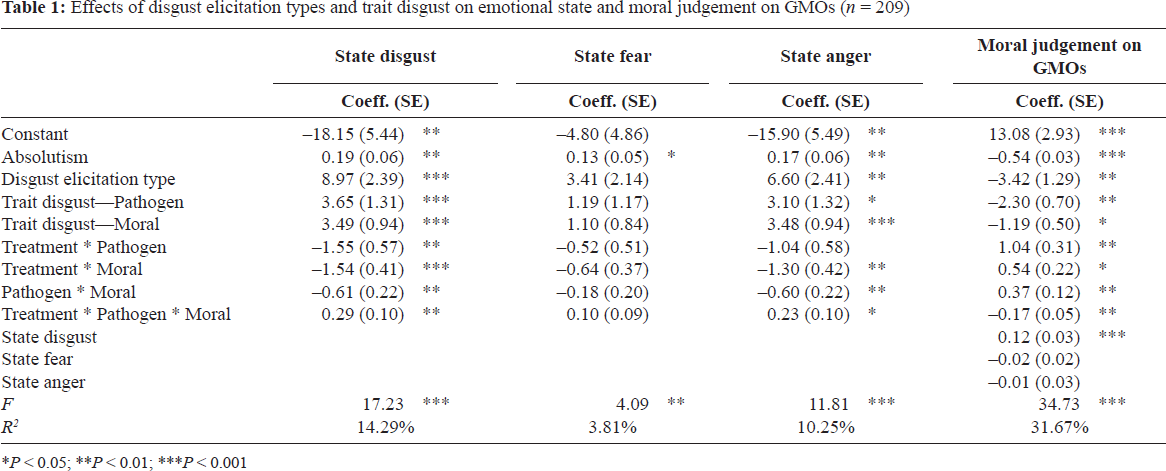
Effects of disgust elicitation types and trait disgust on emotional state and moral judgement on GMOs (n = 209)
P < 0.05;
P < 0.01;
P < 0.001
When disgust elicitation conditions and the two types of trait disgust influenced state disgust, state anger and moral judgement on GMOs, they exhibited significant second-order and third-order interaction effects.
As shown in Figure 1-a, one type of trait disgust may increase the state disgust of the other (weaker) type of trait disgust. When core disgust is elicited, the two types of trait disgust independently increase state disgust in individuals. Under the condition of socio-moral disgust, the lower the individual's moral disgust sensitivity, the lower the increase in their perceived moral acceptability of GMOs as trait pathogen disgust increased; when individuals with higher trait pathogen disgust had a medium or higher level of trait moral disgust, their perceived moral acceptance of GMOs increased with their moral disgust sensitivity.
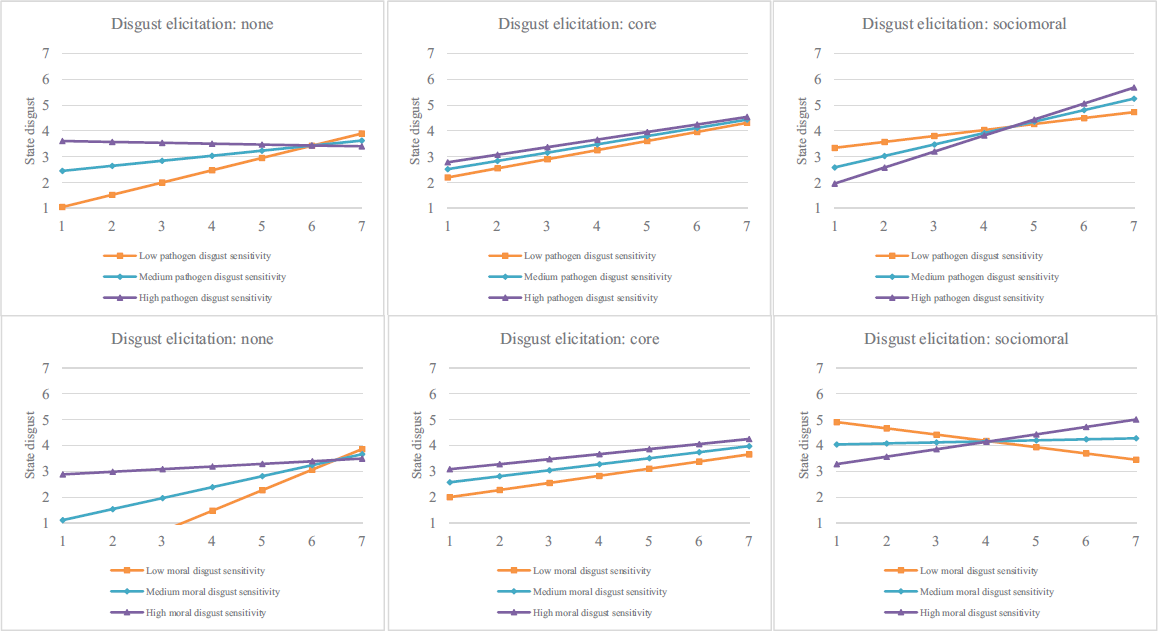
Moderating effects of pathogen disgust sensitivity (top) and moral disgust sensitivity (bottom) on state disgust under the conditions of no disgust elicitation (left), core disgust elicitation (middle) and sociomoral disgust elicitation (right)
Figure 1-b shows how the direct effects of moral judgement on GMOs changed with disgust elicitation types and trait disgust. Unlike in Figure 1-a, in the absence of disgust elicitation, trait pathogen disgust motivated individuals to make stricter moral judgements on GMOs, while trait moral disgust increased their moral tolerance of GMOs. Core disgust elicitation made people's moral judgements on GMOs less regulated by trait disgust. When sociomoral disgust was elicited, trait pathogen disgust and trait moral disgust were jointly operational: if individuals had high sensitivity to both types of disgust, then their moral evaluation of GMOs decreased more as trait disgust increased.
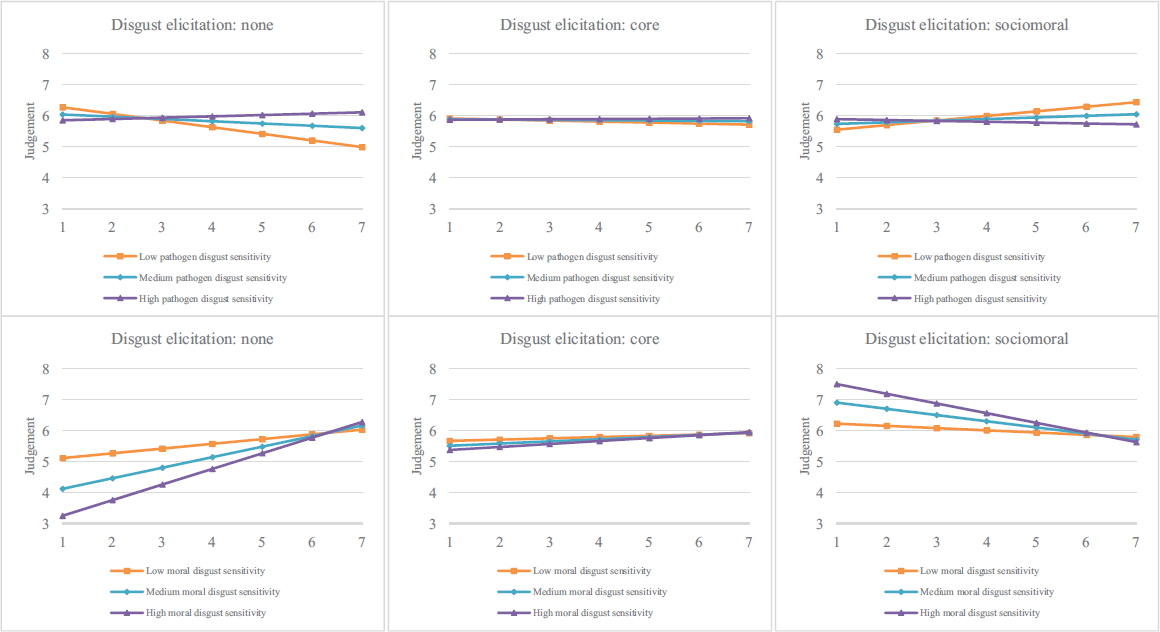
Moderating effects on the direct effect of pathogen disgust sensitivity (top) and moral disgust sensitivity (bottom) on moral judgement on GMOs under the conditions of no disgust elicitation (left), core disgust elicitation (middle) and sociomoral disgust elicitation (right)
When the three types of emotional state (intermediary variables), the control variables and regulation variables were included in the regression model predicting moral judgement on GMOs, only state disgust exhibited a significant intermediary effect on moral judgement (b = 0.12, P < 0.001). State anger was not influenced by trait disgust, tasks that elicited disgust or the type of such tasks. It was also not related with moral judgement on GMOs. While state fear was related to disgust sensitivity and could be elicited by different types of disgust, that emotional state was not necessarily related to moral judgement on GMOs. Therefore, even though disgust elicitation tasks could produce other emotions simultaneously, moral judgement was subject only to the influence of disgust type, trait disgust and state disgust. This result bears out the indirect effect of state disgust on moral judgement about GMOs and supports the single-emotion theory of intuitive judgement of moral disgust.
Experiment 2 adopted a 3 (disgust types: non-disgust, core disgust, sociomoral disgust)* 2 (ER: no vs. yes) two-factor between-subject design, in which individuals’ moral preference served as a moderating variable, to examine whether the influence of disgust types and ER on people's moral judgement and ultimate stance on GMOs varies among individuals.
Research method
Experiment 2 used the same sample as Experiment 1. For the control of variables before disgust elicitation, this experiment not only measured pathogen disgust sensitivity, moral disgust sensitivity and existing absolutist opposition to GMOs, but also drew on a tool used previously to measure individuals’ normative moral preferences, by asking them to rate a series of factors influencing their moral judgements (Dubljević et al., 2018). As shown by factor analysis, the average score on a 7-point Likert scale was 5.71 (SD = 1.03) for the four virtue ethics items, including ‘Is this well-intended or ill-intended?’ (Cronbach's α = 0.884); 5.48 (SD = 0.98) for the five moralist items, including ‘Does this comply with a specific duty?’ (Cronbach's α = 0.896); 5.62 (SD = 0.87) for the six consequentialism items, including ‘Will this bring well-being or harm?’ (Cronbach's α = 0.820). The moral concept on which a participant scored highest was then set as their moral preference, and those with the same score for two or more moral concepts were classified as ‘other’. According to their moral preferences, the participants comprised 70 virtue ethicists (33.5%), 37 deontologists (17.7%), 56 consequentialists (26.8%) and 46 in the ‘other’ category (22.0%).
To manipulate disgust type, each participant was randomly assigned to one of the four conditions to read the purchase and use scenarios of four products: papaya, tuna, a cotton shirt and laboratory mice. The disgust type of the reading content was consistent with the result of the random allocation in Experiment 1. The non-disgust group read about ordinary products (for example, ‘Xiao Zhang bought and ate a papaya’); the core disgust group read about the informed purchase of GM products (for example, ‘Xiao Li, with informed consent, bought and ate a tuna sandwich containing GM tuna with growth-boosting DNA’); and the sociomoral disgust group read about the uninformed purchase of GM products (for example, ‘Medical student Xiao Zhao, without informed consent, bought a batch of GM mice to facilitate genetic research in the laboratory’) (Scott et al., 2016).
To manipulate ER, participants were randomly allocated to experimental groups with or without ER: those in the groups with ER were asked to use at least four sentences to describe their main thinking process when completing the questionnaire (Feinberg et al., 2012). The six experimental groups with different combinations of the three disgust types and two ER conditions did not vary significantly in gender (P = 0.346), age (P = 0.603), major discipline (P = 0.701), training category (P = 0.329), nationality (P = 0.547), region (P = 0.330), or grade (P = 0.331). Finally, all participants were asked to rate four items on absolutist opposition to GMOs on a 7-point Likert scale (Cronbach's α = 0.815, mean = 2.93, SD = 1.22). Moral judgement on GMOs as an intermediary variable was measured as in Experiment 1.
Results for Experiment 2
The stronger a participant's existing absolute opposition to GMOs, the more likely they were to consider GMOs immoral (b = –0.54, P < 0.001); and participants maintained a significant anti-GMO stance even after ER (b = 0.72, P < 0.001). Opposition to GMOs was increased by pathogen disgust sensitivity (b = 0.09, P < 0.001) and suppressed by moral disgust sensitivity (b = –0.08, P < 0.01), while moral judgement on GMOs was not affected by trait disgust. Individuals with different moral preferences differed significantly in their moral judgements on GMOs (b = –0.65, P < 0.05) and absolute opposition to GMOs after ER (b = 0.71, P < 0.001). Moral preferences also regulated the effects of disgust types, ER and their interactions on moral judgement on GMOs and opposition to GMOs after ER. Moral judgement could significantly reduce opposition to GMOs (b = –0.16, P < 0.001) and partially mediate the effect of independent variables and moderating variables on dependent variables (see Table 2).
Moderating effects of disgust types and ER on the influence of moral preferences on judgement and stance on GMOs (n = 209)
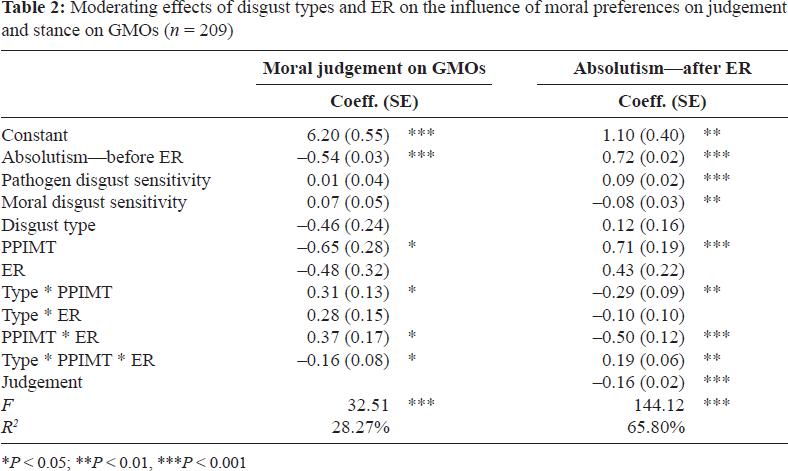
Moderating effects of disgust types and ER on the influence of moral preferences on judgement and stance on GMOs (n = 209)
P < 0.05;
P < 0.01
P < 0.001
As Figure 2 shows, in the non-disgust scenario for non-GM products, consequentialists were the most likely to be influenced by the moderating effect of ER, to positively assess the morality of GMOs and to have lowered absolute opposition. They were followed by deontologists, while virtue ethicists remained relatively stable in their stance and moral judgement on GMOs. In the core disgust scenario of the informed purchase of GM products, ER helped to increase deontologists’ and consequentialists’ assessment of the morality of GMOs and lower their GMO opposition; only virtue ethicists showed increased opposition to GMOs after the ER intervention. In the sociomoral disgust scenario of the uninformed purchase of GM products, ER positively changed moral judgement on GMOs in consequentialists (the strongest effect), deontologists and virtue ethicists (the weakest effect), but, due to the elicitation of sociomoral disgust, opposition to GMOs also increased, indicating that such opposition is generally more stable than moral judgement and that its formation requires the mobilization of moral deliberation and cognitive reasoning.
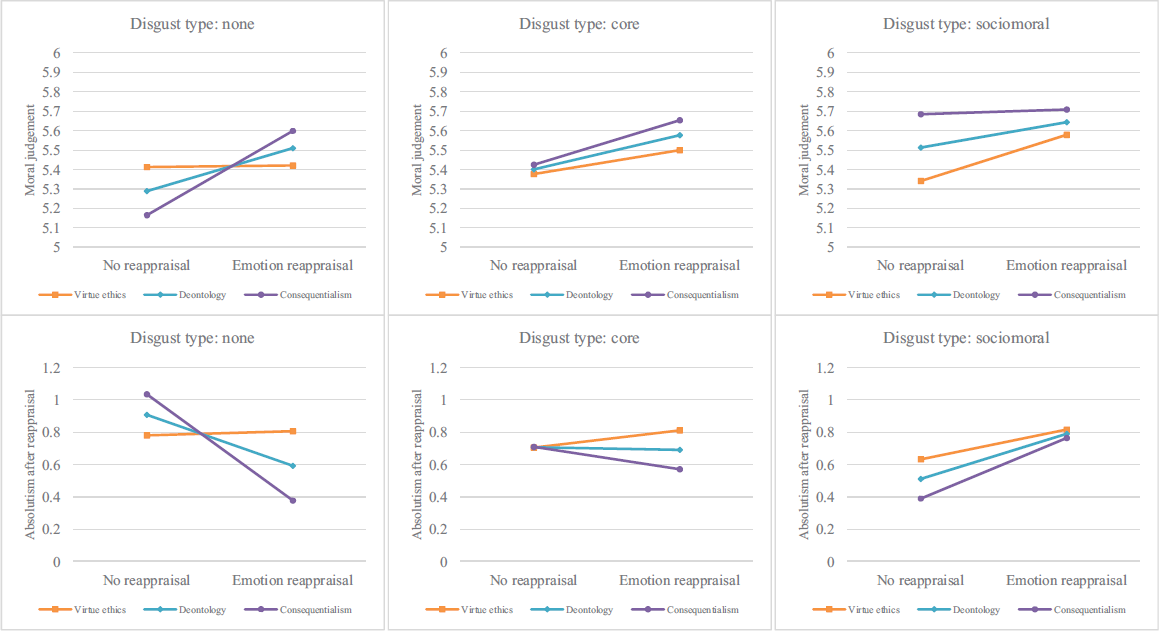
Moderating effects of emotion reappraisal and moral preferences on the direct effect of moral evaluation of GMOs (top) and absolute opposition to GMOs (bottom) under the conditions of no disgust elicitation (left), core disgust elicitation (middle) and sociomoral disgust elicitation (right)
When shaping individuals’ expectations of the world and their evaluation of the risks of new technologies, emotions and intuitions may lead to rational judgement or the dissolution of rationality (Finucane et al., 2000). People make some decisions quickly, without awareness of their decision-making process. Intuitions may oppose rationality, especially when people face complicated and abstract situations. Due to lack of interest, thinking or attention concerning complicated questions such as genetic modification technology, laypeople evaluating the risk of GMOs tend to rely on their intuitive mind and choose expressions conforming to their expectations to facilitate understanding and memorization.
Intuitions do not directly undermine rationality. Absolute opposition to GMOs arises from the absence of factors suppressing intuitive thinking, especially when scientific discourse lacks cultural appeal. Therefore, although disgust for GMOs has a strong attraction for the public, scientific discourse should not withdraw (Blancke et al., 2015).
Through two interrelated experiments, this study revealed the mechanism of disgust influencing moral judgement on GMOs, and demonstrated the effects of scenario factors such as disgust elicitation types and ER, as well as individual differences such as trait disgust and moral preferences. The main findings of the experiments are shown in Figure 3.
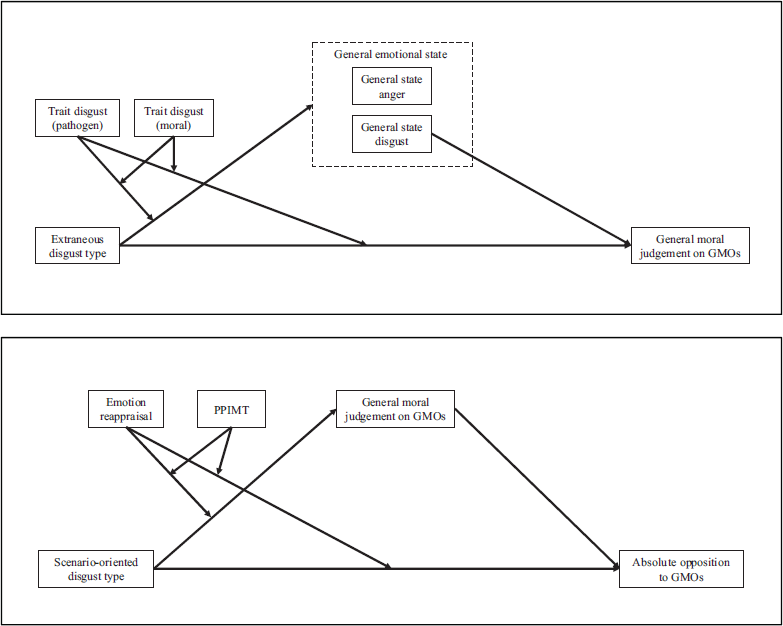
Main conclusions of Experiment 1 (top) and Experiment 2 (bottom) PPIMT = preferences for precepts implied in moral theories
State disgust and trait disgust are mutually conditional or interacting. Disgust, anger and fear differ in their elicitation mechanisms and mediating effect on moral judgement, while external disgust elicitation types act only on disgust and anger, which is related to sociomoral factors.
Our study examined the different routes through which sociomoral disgust and moral disgust influence moral judgements on GMOs. When sociomoral disgust elicitation was matched with higher moral disgust sensitivity, trait disgust differed from the other five conditions in moderating state disgust (see the bottom right of Figure 1-a). There was a positive correlation between the perceived morality of GMOs and state disgust: the more clearly people experienced disgust, the more directly their moral judgement was influenced by it; negative situational emotions were also suppressed by moral disgust sensitivity. Our findings provide evidence that:
emotional states cannot be equated to moral judgements in certain scenarios
compared with core disgust, sociomoral disgust elicitation has a lower emotion elicitation potential and higher cognitive level
emotional awareness can, to some extent, play the role of ER (Gross and John, 2003)
moral disgust can also promote moral cognition and lower the harshness of moral evaluation.
Real-world science communication on GMOs should feature contents informed by these insights to promote individuals’ emotional awareness and the transition from intuitive thinking to rational moral attribution.
Moral awareness may, together with ethical predispositions, act on moral judgement and activate preferences for precepts (Dubljević et al., 2018). Communicators of genetic science could appeal to the audience's moralization process by priming their moral precepts to motivate moral deliberation (Horberg et al., 2009). Science communication should overcome the inherent bias in everyday Chinese discourse that vulgarizes utilitarianism/consequentialism and even ethical egoism as being ‘immoral’: consequentialists can overcome moral intuitions by weighing harms and gains, while deontologists also value the possible outcomes of GMOs through gain–risk evaluations of genetic modification technology (Tanner et al., 2008). Only by educating and training the audience in reflective ability can the damage of intuitive thinking be avoided.
Science communication on GMOs should comprehensively consider differences in individual and scenario features by adopting formats capable of motivating the audience's emotional awareness and reflection; it should avoid content that elicits sociomoral disgust and adjust content according to individual differences in moral preferences and disgust sensitivity.
This study had four main limitations.
First, since the sample mainly consisted of Chinese college students, our conclusions might not apply to other groups of the population. Moral disgust is a phenomenon of developmental psychology. The psychological traits of teenagers and their underlying mechanisms are not necessarily stable over time, and there might be generational differences in the acceptance of GMOs in China due to a combination of factors, such as education, cultural tradition and knowledge gaps. Accordingly, caution should be exercised in applying the experimental conclusions of this study to other groups.
Second, moral acceptability does not equate to cognitive or behavioural acceptance, and GMO opponents may nonetheless buy GM food (Scott, et al., 2016). Emotional disgust may affect how much money people are willing to spend on specific products (Lerner et al., 2004). Future research should focus on the relationship between emotions and the purchase intent of prospective consumers of GM products.
Third, people's evaluation of public policy relies more on their existing political attitudes than on manipulated disgust. Whether risk assessment of GMOs relies on emotions (Schnall et al., 2008) and whether the rejection of GMOs is immoral or non-moral also deserve further investigation.
Finally, it is difficult to differentiate disgust for GMOs and other negative emotions through oral self-reports (Chapman and Anderson, 2013). Further validation by functional neuroimaging and psychophysiological research is needed.
Funding
The study was supported by the Science Popularization and Risk Communication of Transgenic Biotechnologies project (grant ID: 2016ZX08015002).
Footnotes
Author biographies
Yusi Liu is an associate professor in the College of Media and International Culture at Zhejiang University. Her research areas include science communication and media psychology.
Fangfang Gao is an associate professor in the College of Media and International Culture at Zhejiang University. Her research areas include new media and risk communication.
Yijia Zhu is a graduate student in the College of Media and International Culture at Zhejiang University. Her research areas include computer-mediated communication and media effects.